
Introduction
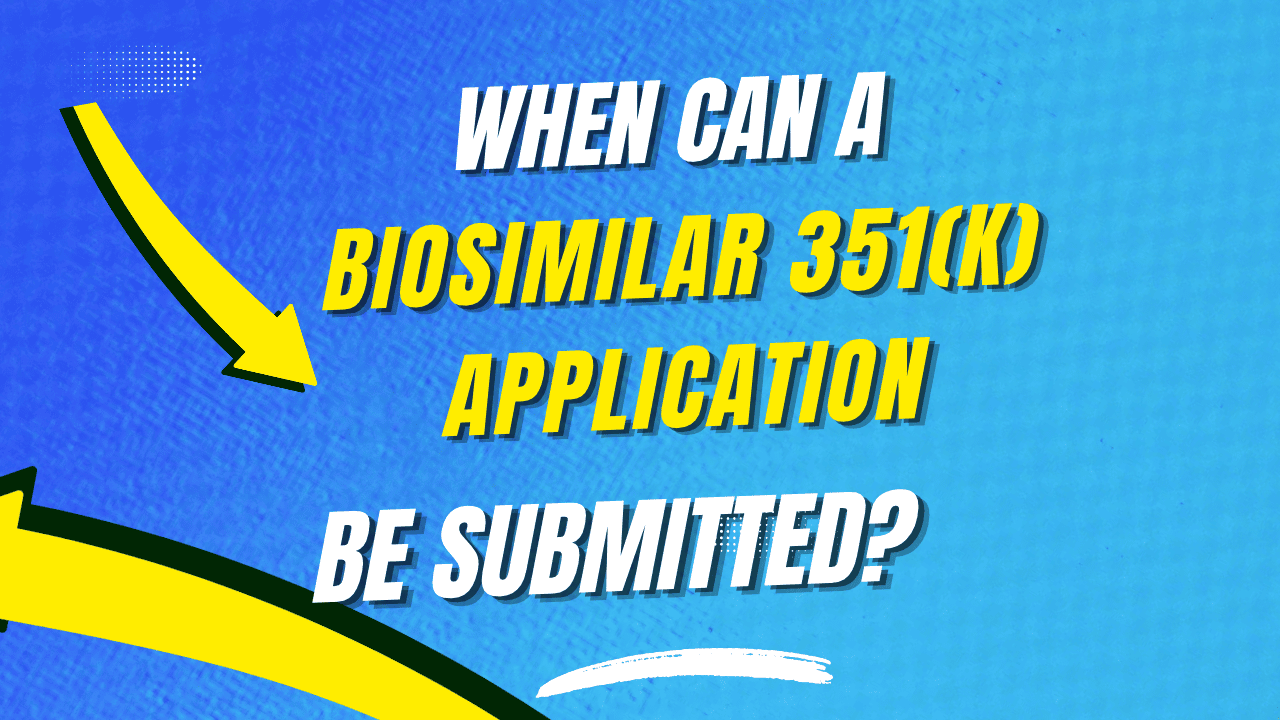
Under Section 351(k) of the Public Health Service Act (PHS Act), an abbreviated Biologics License Application (aBLA) for a biosimilar or interchangeable biological product may be submitted to the U.S. Food and Drug Administration (FDA) four years after the reference product’s initial licensure date. However, the FDA is statutorily prohibited from granting final approval that becomes effective until twelve years after the reference product’s first licensure. These provisions establish the dual regulatory framework known as 12-Year Exclusivity and the 4-Year Filing Bar. Together, they create a defined timeline separating pre-submission research, regulatory review, and eventual commercial market entry.
Understanding the regulatory expectations for biosimilar development begins with a strong analytical foundation. Explore our biosimilar characterization services to learn how advanced analytical techniques support comprehensive molecular evaluation.
Introduced under Title VII of the Patient Protection and Affordable Care Act of 2010, the Biologics Price Competition and Innovation Act (BPCIA) established this regulatory framework to maintain incentives for innovation in novel biological therapeutics while promoting competitive access through the development of follow-on biological products. Unlike small-molecule pharmaceuticals regulated under the Hatch-Waxman Act, biological drugs are complex, high-molecular-weight proteins produced using living cell lines. These manufacturing complexities require a separate regulatory pathway in which data protection and market exclusivity operate independently of existing patent portfolios.
Manufacturing biological products involves complex processes that can influence their structural and functional characteristics. Read about the differences between biosimilar and biologic manufacturing to understand the factors that distinguish these development approaches.
The 4-year filing bar and 12-year market protection function as non-patent regulatory barriers. Patent exclusivity relies on patent prosecution history and judicial enforcement, whereas reference product exclusivity (RPE) provides statutory protection that the FDA directly enforces. Therefore, understanding the precise operational boundaries, applicable exceptions, and procedural requirements associated with 12-Year Exclusivity and the 4-Year Filing Bar is critical for biosimilar developers when planning research programs, bioanalytical characterization activities, and commercialization strategies.
Share via:
Quick Summary:
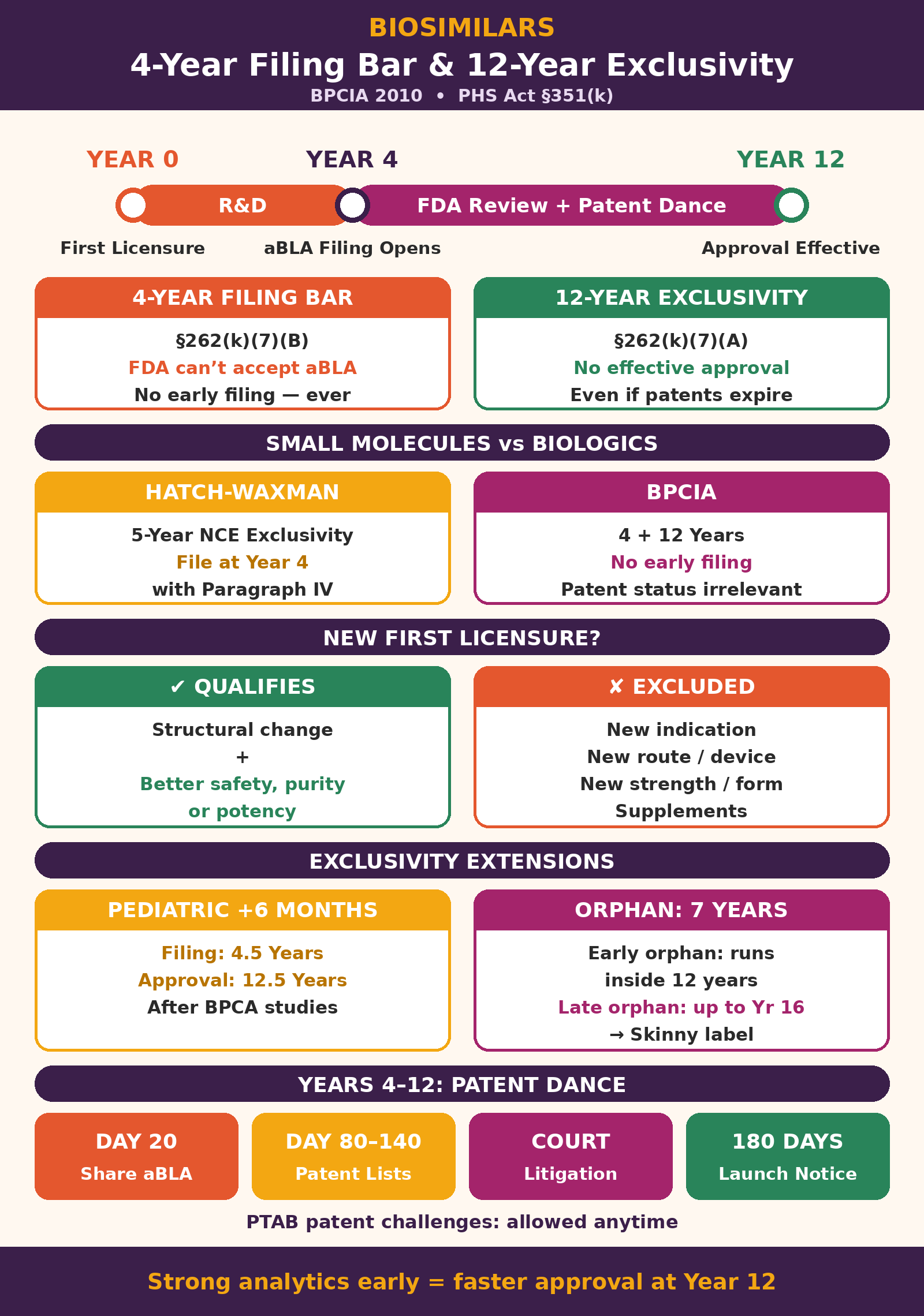
- 4-year filing bar. Under 42 U.S.C. § 262(k)(7)(B), the FDA cannot accept a biosimilar (351(k)) application until 4 years after the reference product’s first licensure.
- 12-year exclusivity. Under § 262(k)(7)(A), the FDA cannot make a biosimilar approval effective until 12 years after first licensure. Both protections apply regardless of patent status, even if the patents expire or are invalidated.
- Different from Hatch-Waxman. Small-molecule generics can file at Year 4 with a Paragraph IV patent challenge. The BPCIA has no early-filing exception for biosimilars.
- New first licensure is limited. A modified biologic gets a fresh exclusivity period only if a structural change improves safety, purity or potency. New indications, routes, dosage forms, delivery devices, strengths and supplements do not qualify. This rule exists to prevent evergreening.
- Extensions. Completing pediatric studies adds 6 months, making the periods 4.5 and 12.5 years. Orphan drug exclusivity gives 7 years of indication-specific protection. A late orphan approval can extend protection to around Year 16, which means biosimilars must leave that indication off their label (a “skinny label”).
- Years 0–12 strategy. In Years 0–4, developers can do R&D, analytical similarity studies and early clinical work under the Safe Harbor, and PTAB challenges are allowed at any time. In Years 4–12, the FDA reviews the application while the patent dance runs: aBLA sharing on Day 20, patent list exchange on Days 80–140, litigation, and a 180-day notice of commercial marketing.
- Key takeaway. Strong, early analytical comparability data can reduce clinical trial needs and speed up approval. This positions biosimilars for launch as soon as exclusivity ends.
Statutory Mechanics of 42 U.S.C. § 262(k)(7) and the 4-Year Filing Bar
Under 42 U.S.C. § 262(k)(7)(B), the FDA is prohibited by statute from receiving or accepting a biosimilar application submitted under Section 351(k) for review until four years have passed from the reference product’s date of first licensure. This four-year filing restriction functions as an absolute administrative barrier, preventing the agency from accepting the application regardless of whether the applicant intends to challenge the underlying innovator patents.
The statutory provisions outlined in 42 U.S.C. § 262(k)(7) establish a clearly defined, two-tier protection period. Subsection (A) establishes reference product exclusivity by preventing the FDA from making a biosimilar approval effective until twelve years have elapsed from the reference product’s first licensure. Subsection (B) establishes the corresponding filing restriction by prohibiting the submission or receipt of a 351(k) aBLA during the first four years following the same initial licensure date.
This statutory structure differs considerably from the regulatory pathway governing small-molecule drug approvals under the Hatch-Waxman Act. Under Hatch-Waxman, applicants seeking approval for generic drugs through Section 505(j) or 505(b)(2) of the FD&C Act are subject to a five-year New Chemical Entity (NCE) exclusivity period. However, the framework permits a generic applicant to submit an Abbreviated New Drug Application (ANDA) after four years, commonly referred to as the “NCE-1” date, provided the application includes a Paragraph IV certification challenging a listed Orange Book patent. In comparison, the BPCIA does not establish any statutory provision that permits a 351(k) application to be submitted before the four-year period expires. The 4-year filing bar under 42 U.S.C. § 262(k)(7)(B) remains strictly applicable, irrespective of patent validity, patent expiration dates, or non-infringement arguments.
The eight-year interim period between the expiration of the Year 4 filing restriction and the Year 12 approval restriction serves two major legal and regulatory purposes:
1. It allows the FDA sufficient operational time to conduct a comprehensive scientific assessment of the biosimilar’s comparative analytical, nonclinical, and clinical pharmacology data.
2. It establishes a structured statutory period during which the reference product sponsor (RPS) and biosimilar applicant (BA) can complete the patent exchange procedure, commonly known as the “patent dance” under 42 U.S.C. § 262(l). This process helps address and resolve patent disputes before the biosimilar enters the commercial market.
Comparing Regulatory Parameters: 12-Year Exclusivity and the 4-Year Filing Bar
The 4-year filing bar controls the administrative eligibility to submit a 351(k) application, whereas 12-year exclusivity determines the earliest date on which the FDA can make final market approval effective. Although the four-year restriction establishes when formal regulatory review and certain patent-related procedures can begin, the twelve-year exclusivity period determines the earliest potential commercial launch date, subject to applicable patent invalidation or licensing arrangements.
Throughout the first four years following the reference product’s initial licensure, biosimilar developers cannot submit an aBLA to the FDA. Nevertheless, laboratory R&D, cell line engineering, analytical comparability studies, and early clinical trials remain permissible under the Safe Harbor statutory exemption provided by 35 U.S.C. § 271(e)(1). Once the four-year filing restriction expires, the FDA can accept the 351(k) application for review, initiating the applicable information exchange procedures under the BPCIA.
Cell line development and manufacturing consistency are important considerations when establishing a reliable biosimilar production process. Discover more about cell line development for biosimilars and its contribution to product development.
| Regulatory Dimension | 4-Year Filing Bar | 12-Year Reference Product Exclusivity |
|---|---|---|
| Statutory Authority | 42 U.S.C. § 262(k)(7)(B) | 42 U.S.C. § 262(k)(7)(A) |
| Core Regulatory Action | Prevents FDA receipt and formal review of a 351(k) aBLA. | Prevents the FDA from making final approval effective. |
| Triggering Event | Date of “first licensure” of the reference biological product. | Date of “first licensure” of the reference biological product. |
| Permitted Biosimilar Activities | Cell line development, analytical similarity studies, and clinical trials under Safe Harbor. | FDA multidisciplinary review, BPCIA Patent Dance, and PTAB litigation. |
| Effect of Pediatric Extension | Extends the submission restriction to 4.5 years (54 months). | Extends the market exclusivity restriction to 12.5 years (150 months). |
| Relationship to Patent Status | Operates independently and cannot be altered by patent invalidation. | Operates independently and prevents market entry even after patent expiration. |
The relationship between these two regulatory provisions demonstrates that regulatory exclusivity represents an independent form of protection alongside patent rights. Even if the primary composition-of-matter patent associated with a reference product expires or is invalidated six years after its initial approval, the FDA cannot make the approval of a biosimilar candidate effective until the complete 12-year reference product exclusivity period has ended.
Defining critical quality attributes (CQAs) is essential for assessing the quality and consistency of biological products. Learn more about critical quality attributes in biosimilars and their importance in analytical comparability programs.
Determining First Licensure: Exceptions, Structural Modifications, and Exclusivity Limits
The date of “first licensure” for a reference product is established when a novel biological product initially receives approval under Section 351(a) of the PHS Act. However, subsequent applications, supplements, or modifications submitted by the same sponsor do not automatically initiate a new exclusivity period. Under 42 U.S.C. § 262(k)(7)(C), a subsequent BLA may qualify for its own 12-year exclusivity period and corresponding 4-year filing bar only when the sponsor establishes that a structural modification has resulted in a clinically meaningful change in safety, purity, or potency.
To prevent reference product sponsors from obtaining additional market protection through minor or incremental product modifications, a practice commonly known as evergreening, Congress established specific statutory exclusions under 42 U.S.C. § 262(k)(7)(C). The statute expressly provides that a new reference product exclusivity period does not apply to the following:
- A supplement submitted for the original reference biological product.
- A subsequent application submitted by the same sponsor, manufacturer, licensor, predecessor in interest, or related corporate entity for a change in indication, route of administration, dosing schedule, dosage form, delivery system, delivery device, or strength.
- A subsequent application submitted by the same sponsor or a related entity for a modification to the molecular structure that does not produce a change in safety, purity, or potency.
In its guidance concerning reference product exclusivity determinations, the FDA established a rigorous two-part assessment that sponsors must satisfy to obtain a new date of “first licensure” for a modified biological product:
1. Demonstration of Structural Modification: The sponsor must establish that the product contains a distinct alteration in its principal molecular structural characteristics. Relevant modifications may involve changes to the primary amino acid sequence, post-translational modification patterns (including glycosylation or pegylation), tertiary or quaternary higher-order structure, or molecular target-binding characteristics.
2. Impact on Safety, Purity, or Potency: The structural modification must directly produce a measurable change in the biological drug’s clinical safety, purity, or functional potency.
| Post-Approval Modification Scenario | Qualifies for New First Licensure Date? | Statutory Determination Rationale |
|---|---|---|
| Initial 351(a) BLA Approval of Novel Biologic | Qualifies | Establishes the original 12-year and 4-year exclusivity periods. |
| Label Expansion Supplement (New Indication) | Excluded | Represents a line extension by the same sponsor without structural modification. |
| Subcutaneous Formulation Conversion | Excluded | Involves a change in route of administration or delivery form without structural modification. |
| Citrate-Free or High-Concentration Reformulation | Excluded | Involves an excipient or strength modification while maintaining the active moiety. |
| Modified Amino Acid Sequence with Lower Immunogenicity | Qualifies | Involves a proven structural alteration that produces a demonstrated improvement in safety. |
| Engineered Glycoform with Enhanced ADCC Potency | Qualifies | Represents a structural modification that produces a proven improvement in biological potency. |
Assessing structural modifications requires extensive comparative bioanalytical characterization. Advanced analytical platforms, including intact mass spectrometry, peptide mapping, capillary electrophoresis, dynamic light scattering, and cell-based potency assays, are essential for determining whether structural alterations influence the product’s clinical activity. Independent analytical testing laboratories, such as ResolveMass Laboratories Inc., offer high-resolution structural characterization and comparative profiling services to help evaluate whether a modified biological product satisfies the FDA’s requirements for a new first licensure date or remains subject to its existing exclusivity period.
Detailed molecular characterization helps identify structural variations and evaluate their potential impact on biological product quality. Explore proteomics approaches for biosimilars to understand how protein-level analysis supports comprehensive characterization.
Overlapping Regulatory Exclusivities: Pediatric and Orphan Extensions to 12-Year Exclusivity and the 4-Year Filing Bar
Pediatric extensions under Section 505A add six months to applicable unexpired statutory exclusivity periods. Consequently, the filing restriction can extend to 4.5 years, while market protection can continue for 12.5 years. Orphan Drug Exclusivity (ODE), on the other hand, provides seven years of indication-specific market protection that operates alongside reference product exclusivity.
When an innovator reference product sponsor completes pediatric studies in response to an official Written Request under the Best Pharmaceuticals for Children Act (BPCA), a six-month pediatric extension may be granted to applicable unexpired regulatory exclusivities associated with the product. This extension modifies the statutory submission and approval restrictions in the following ways:
Extended Filing Bar: The four-year application submission restriction increases to 4.5 years (54 months) following the reference product’s initial licensure. The FDA cannot receive a 351(k) application until this extended 54-month period has expired.
Extended Approval Bar: The 12-year market exclusivity period increases to 12.5 years (150 months) following initial licensure. The FDA cannot make the approval of a referencing 351(k) application effective until the 150-month period has concluded.
In comparison, Orphan Drug Exclusivity (ODE), established under 21 C.F.R. Part 316, provides seven years of market protection for biological drugs designated for rare diseases affecting fewer than 200,000 individuals in the United States. This exclusivity prevents the approval of biosimilars for the specific designated orphan indication, subject to applicable regulatory exceptions.
The relationship between the seven-year ODE period and the 12-year RPE period depends on the timing of the orphan drug approval:
Concurrent Run: When a reference product receives its initial 351(a) approval for an orphan indication, the seven-year ODE period runs concurrently with the 12-year RPE period. Under these circumstances, the 12-year RPE period generally remains the controlling regulatory barrier to biosimilar market entry.
Late-Stage Orphan Approval: If an innovator obtains approval for an additional orphan indication later in the reference product’s life cycle, such as during Year 9 after initial licensure, the seven-year ODE period for that particular indication may extend protection until Year 16. Although the general 12-year RPE period ends in Year 12, biosimilar applicants intending to enter the market before Year 16 must exclude the protected orphan indication from their proposed product labeling through “skinny labeling” strategies under the applicable 351(k) regulations.
Strategic R&D and Litigation Timelines Between 12-Year Exclusivity and the 4-Year Filing Bar
The eight-year period between the Year 4 submission milestone and the Year 12 effective approval restriction provides the operational timeframe for FDA multidisciplinary review and statutory patent litigation under the BPCIA. During this period, biosimilar applicants participate in the Section 351(l) patent dance and may pursue Patent Trial and Appeal Board (PTAB) inter partes review (IPR) proceedings to challenge and potentially invalidate originator patent thickets before commercial market entry.
Successfully transitioning from research and development to commercial launch requires a coordinated, multi-phase strategy involving regulatory planning, bioanalytical characterization, and intellectual property management.
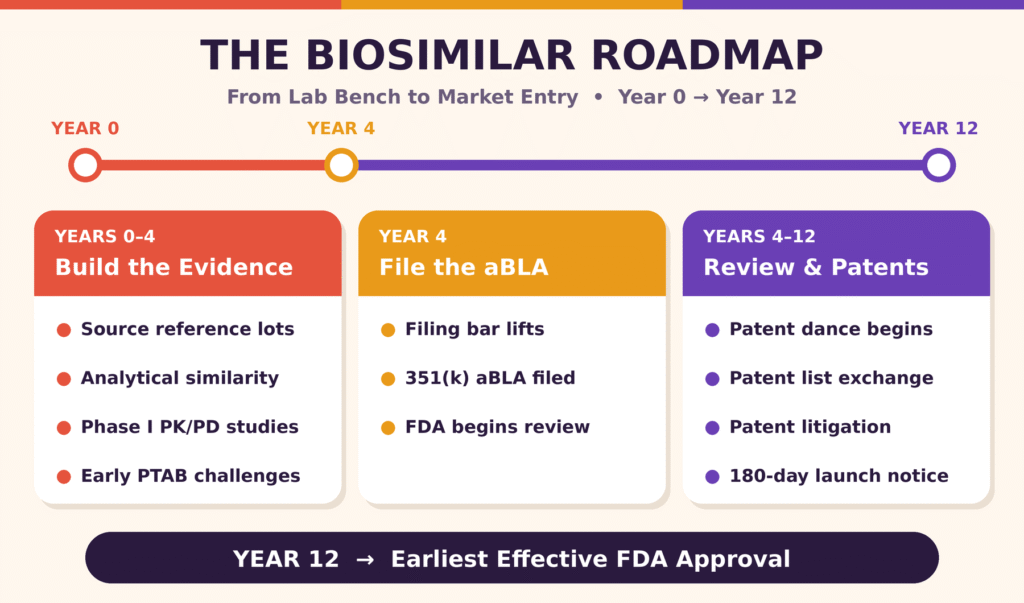
Pre-Submission R&D Phase (Years 0 to 4)
Reference Product Lot Sourcing: Biosimilar developers obtain multiple commercial lots of the reference product over several years. Evaluating these samples helps identify lot-to-lot variability and establish appropriate target ranges for critical quality attributes (CQAs).
Comprehensive Analytical Comparability: Developers perform orthogonal biophysical and physicochemical characterization, higher-order structure assessments, and functional bioassays to establish analytical similarity between the proposed biosimilar and its reference product.
Clinical Pharmacology: Phase I comparative pharmacokinetic (PK) and pharmacodynamic (PD) studies are completed in healthy volunteers to evaluate relevant pharmacological similarities between the biosimilar candidate and the reference product.
Preemptive PTAB Challenges: Biosimilar applicants may submit inter partes review (IPR) or Post-Grant Review (PGR) petitions to the United States Patent and Trademark Office (USPTO). Since PTAB standing does not require an active FDA application, developers can challenge important blocking patents before submitting their aBLA.
Comparing multiple reference product and biosimilar batches helps establish whether observed differences are within acceptable analytical ranges. Learn more about biosimilar comparability studies and their role in development to understand the importance of systematic comparative evaluation.
Formal Application Milestone (Year 4)
351(k) Submission: Once the four-year filing restriction expires, biosimilar developers become eligible to formally submit their aBLA to the FDA.
Agency Acceptance: The FDA evaluates the application’s completeness and formally receives the 351(k) submission for multidisciplinary regulatory review.
Regulatory Review and BPCIA Patent Dance Phase (Years 4 to 12)
aBLA Information Disclosure (Day 20): Within 20 days after the FDA’s acceptance of the application, the biosimilar applicant provides a copy of the aBLA and relevant manufacturing process documentation to the reference product sponsor under applicable confidential protective orders.
Patent List Exchange (Days 80 to 140): The RPS provides a list of patents that it believes cover the biological product or its manufacturing process. The biosimilar applicant subsequently submits detailed legal arguments addressing patent invalidity, unenforceability, or non-infringement.
Phase I Litigation: Formal patent infringement proceedings begin in federal district court concerning the patents included in the agreed-upon litigation list.
Notice of Commercial Marketing: The biosimilar applicant provides the RPS with a 180-day notice of commercial marketing. Following the U.S. Supreme Court’s decision in Sandoz Inc. v. Amgen Inc., this notice may be provided before FDA approval, allowing Phase II preliminary injunction litigation to be addressed before the Year 12 exclusivity period concludes.
Recent regulatory developments involving the FDA, EMA, and WHO demonstrate an increasing emphasis on analytical comparability rather than relying extensively on repetitive clinical trials. Modern draft guidance indicates that when comparative analytical evidence establishes a high degree of similarity between a biosimilar and its reference product, extensive clinical efficacy trials may be reduced or eliminated. Developing a comprehensive bioanalytical characterization strategy during the early pre-submission stage can therefore simplify the FDA review process and support timely biosimilar approval once the reference product exclusivity period expires.
Conclusion
Successfully navigating 12-Year Exclusivity and the 4-Year Filing Bar requires an integrated regulatory, bioanalytical, and intellectual property strategy to determine appropriate submission timelines and facilitate compliant commercial market entry. A clear understanding of how statutory exclusivity provisions operate independently of patent portfolios allows biosimilar developers to manage regulatory submission windows, anticipate potential barriers, and establish realistic commercialization plans.
The four-year statutory filing restriction establishes the earliest point at which the FDA can accept a biosimilar application, creating an eight-year operational window for regulatory review and statutory patent litigation before the twelve-year market exclusivity restriction expires. Careful assessment of first licensure determinations, structural modification exclusions, and potential pediatric or orphan drug extensions is essential for developing accurate market entry projections and minimizing the risk of unexpected regulatory delays.
A successful regulatory submission depends on a well-organized analytical strategy supported by reliable characterization data. Explore the end-to-end biosimilar analytical package for regulatory submissions to learn how comprehensive analytical support can strengthen biosimilar development.
For specialized analytical testing, structural characterization, and analytical similarity assessments that support biosimilar 351(k) applications, visit the ResolveMass Contact Us Page to connect with experienced bioanalytical specialists.
Frequently Asked Questions
No, the four-year restriction applies only to the formal submission of a 351(k) application and does not prohibit research and development activities. Biosimilar manufacturers can conduct laboratory testing, process development, analytical comparability assessments, and clinical trials before Year 4 under the applicable Safe Harbor provision of 35 U.S.C. § 271(e)(1).
No, obtaining approval for an additional indication, changing the dosage form, modifying the administration route, or introducing a different strength does not automatically establish a new exclusivity period. Under 42 U.S.C. § 262(k)(7)(C), these modifications are generally excluded from qualifying as a new date of first licensure when they do not meet the statutory requirements for structural modification.
A qualifying six-month pediatric extension under Section 505A can extend the applicable unexpired regulatory exclusivity periods associated with a reference biological product. As a result, the original four-year filing restriction may increase to 4.5 years (54 months), while the twelve-year approval restriction may extend to 12.5 years (150 months) after initial licensure.
Yes, biosimilar developers can pursue patent challenges before becoming eligible to submit their 351(k) applications. They may file Inter Partes Review (IPR) or Post-Grant Review (PGR) petitions with the United States Patent and Trademark Office (USPTO), as these PTAB proceedings do not require a pending FDA application. This allows companies to address potentially restrictive originator patents during the early development stage.
A modified biological product may qualify for a new date of first licensure under 42 U.S.C. § 262(k)(7)(C) when the sponsor demonstrates a qualifying structural alteration that produces a clinically meaningful change in safety, purity, or potency. Examples may include modifications to the amino acid sequence or higher-order molecular structure. Minor formulation adjustments or excipient changes alone generally do not satisfy these statutory requirements.
Orphan Drug Exclusivity provides seven years of protection against approval of competing products for the specific designated orphan indication. When this period ends before the 12-year reference product exclusivity expires, the RPE remains the primary regulatory barrier. However, if ODE continues beyond Year 12, a biosimilar applicant may pursue approval for non-protected indications by excluding the orphan indication from its proposed labeling, where permitted under applicable regulations.
Under the Hatch-Waxman Act, a new chemical entity receives five years of NCE exclusivity, but a generic applicant may submit an ANDA after four years if it includes a qualifying Paragraph IV patent certification. The BPCIA follows a different approach by imposing a strict four-year restriction on 351(k) application submissions. Unlike Hatch-Waxman, it does not provide an equivalent statutory exception for early filing based on patent challenges.
Biosimilar developers can consult the FDA’s Purple Book database to access information about licensed biological products, reference product designations, and available exclusivity information. The database serves as an important regulatory resource for checking reference product details and relevant licensure information. Applicants should review the FDA’s official records when establishing submission and commercialization timelines.
Under 42 U.S.C. § 262(l)(8)(A) and the U.S. Supreme Court’s decision in Sandoz Inc. v. Amgen Inc., a biosimilar applicant may provide its 180-day notice of commercial marketing to the reference product sponsor before obtaining final FDA approval. This notification allows the parties to address applicable patent disputes and pursue Phase II litigation, helping clarify potential legal barriers before the reference product’s 12-year exclusivity period expires.
Reference:
- Food and Drug Administration. (2014, August). Reference product exclusivity for biological products filed under Section 351(a) of the PHS Act: Guidance for industry (Draft guidance). U.S. Department of Health and Human Services. https://www.fda.gov/media/89049/download
- U.S. Food and Drug Administration. (2018, December). Interpretation of the “Deemed to be a License” Provision of the Biologics Price Competition and Innovation Act of 2009: Guidance for industry. U.S. Department of Health and Human Services. https://www.fda.gov/media/119590/download
- U.S. Food and Drug Administration. (n.d.). Background information: List of licensed biological products with reference product exclusivity and biosimilarity or interchangeability evaluations (Purple Book). U.S. Department of Health and Human Services. https://www.fda.gov/drugs/biosimilars/background-information-list-licensed-biological-products-reference-product-exclusivity-and
- U.S. Food and Drug Administration. (2026, October). Questions and answers on biosimilar development and the BPCI Act: Guidance for industry (Revision 4). U.S. Department of Health and Human Services. https://www.fda.gov/media/119258/download
Get In Touch With Us
About The Author