

Introduction: Why Solvent Selection in Extractables Studies Is a Regulatory Science Decision
One of the most overlooked variables in extractables study design is solvent selection. Laboratories that treat solvents in extractables studies as a secondary consideration, often relying on a generic water/ethanol/hexane combination without a scientifically justified rationale, frequently generate extractables profiles that are either excessively broad, leading to false-positive safety concerns, or dangerously incomplete, resulting in the failure to identify chemically significant extractables that may migrate into the actual drug product.
Extractables studies are designed to characterize the full range of chemical compounds that could migrate from a container closure system (CCS), primary packaging material, or drug delivery device into a pharmaceutical product under worst-case conditions. The solvent system selected for the study directly determines which portion of that chemical universe becomes detectable. An inappropriate solvent choice is not merely an analytical weakness. It represents a scientific gap with direct consequences for regulatory compliance and patient safety.
The selection of extraction solvents influences every downstream aspect of the study, including analytical method compatibility, extraction efficiency, artifact generation, and the toxicological assessment strategy ultimately applied to identified compounds.
To understand how these studies form the foundation of product registration, read our detailed guide on extractables and leachables in pharmaceutical products.
Share via:
Article Summary:
- Choosing the appropriate solvent system for extractables testing is both a scientific and regulatory responsibility, not merely a routine laboratory step. An unsuitable solvent can produce an incomplete extractables profile and increase the likelihood of regulatory concerns during product review.
- Extraction solvents should be selected based on the physicochemical characteristics of the drug formulation being evaluated, including scenarios representing worst-case conditions such as highly aqueous, organic-rich, or extreme pH environments.
- The effectiveness of chemical extraction from polymers, elastomers, coatings, and adhesive materials is primarily controlled by three key factors: solvent polarity, solution pH, and ionic strength.
- Global guidance documents including ICH Q3E, USP <1663>, and ISO 10993-18 do not mandate a universal solvent combination. Instead, they require a scientifically supported explanation for why each solvent has been chosen.
- To achieve broad extractables coverage under worst-case conditions, laboratories commonly rely on multiple extraction media, often combining aqueous, hydroalcoholic, and non-polar solvents within the same study design.
- Solvent quality, background blank evaluation, and analytical interference control are essential components of a reliable extractables strategy and must be considered alongside solvent selection itself.
- Extraction performance and method robustness are strongly influenced by the relationship between solvent choice, extraction temperature, contact time, and the solvent-to-surface-area ratio applied during the study.
- At ResolveMass Laboratories Inc., solvent selection is approached as a core element of method development, supported by detailed scientific justification to help ensure regulatory-ready extractables and leachables submissions.
The Physicochemical Basis of Solvent Selection
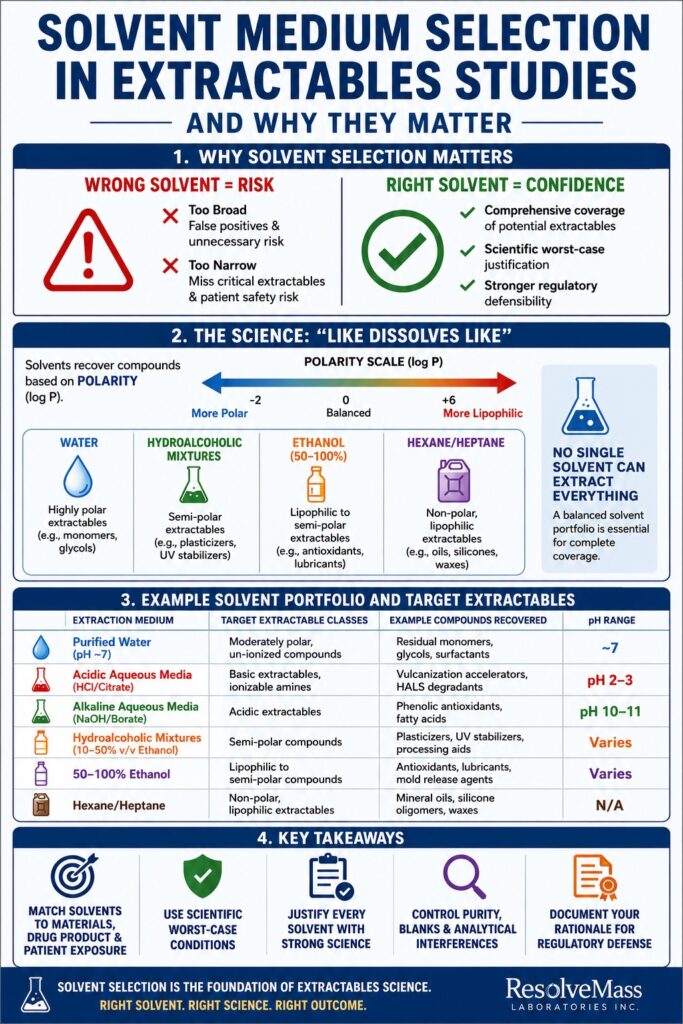
Solvents recover compounds according to polarity compatibility, commonly summarized by the principle “like dissolves like.” Therefore, the solvent portfolio used in extractables studies must adequately span the polarity range of both the drug product and the potential extractables associated with the packaging materials.
This principle is not a simplified rule of thumb. It is the scientific foundation underlying every defensible solvent selection strategy. A successful extractables study must simultaneously account for two critical polarity considerations:
- The polarity profile of the intended drug product, which determines the compounds to which patients may actually be exposed.
- The polarity range of potential extractable compounds originating from the packaging or device materials, which defines what substances may migrate regardless of the final drug formulation.
Polarity Matching and the Partition Coefficient Challenge
Every extractable compound possesses a characteristic log P value, representing its octanol-water partition coefficient. This property governs the compound’s affinity for aqueous versus organic phases. Highly lipophilic compounds such as plasticizers with log P values greater than 4, antioxidant degradation products, and process lubricants are not efficiently recovered using water alone, even under elevated temperature conditions. In contrast, highly polar extractables such as residual monomers, polymerization initiators, and hydrolysis products may exhibit poor solubility in non-polar solvents such as hexane.
The practical implication is clear: any extraction approach based on a single solvent will inevitably generate a biased extractables profile. The critical question is not whether bias exists, but whether that bias is scientifically characterized and acceptable from a regulatory perspective.
pH as a Critical Extraction Variable
pH does far more than simulate drug product conditions. It directly alters the ionization state of extractable compounds, significantly influencing their solubility and partitioning behavior.
Acidic extractables, including carboxylic acids and phenolic antioxidants, exhibit greater solubility in alkaline extraction media. Conversely, basic extractables such as amines derived from vulcanization chemistry and hindered amine light stabilizers (HALS) become more soluble under acidic conditions.
| Extraction Medium | Target Extractable Classes | Example Compounds Recovered |
|---|---|---|
| Purified water (pH ~7) | Moderately polar, un-ionized compounds | Residual monomers, glycols, surfactants |
| Acidic aqueous media (pH 2–3, HCl/citrate) | Basic extractables, ionizable amines | Vulcanization accelerators, HALS degradants |
| Alkaline aqueous media (pH 10–11, NaOH/borate) | Acidic extractables | Phenolic antioxidants, fatty acids |
| Hydroalcoholic mixtures (10–50% v/v ethanol) | Semi-polar compounds | Plasticizers, UV stabilizers, processing aids |
| 50–100% ethanol | Lipophilic to semi-polar compounds | Antioxidants, lubricants, mold release agents |
| Hexane/heptane | Non-polar, lipophilic extractables | Mineral oils, silicone oligomers, waxes |
This table should not be interpreted as a universal prescription. Instead, it serves as a foundational framework. Final solvent selection must always be scientifically justified against the specific material composition and intended product application.
Regulatory Expectations for Solvent Justification
Regulatory agencies do not provide a predefined list of acceptable extraction solvents. Instead, they expect sponsors to provide a scientifically justified rationale supporting every solvent selected in the study design.
ICH Q3E, which addresses extractables and leachables for orally inhaled and nasal drug products alongside broader harmonized E&L expectations, and USP <1663> both emphasize the same principle: extraction solvents must represent either the intended product-use conditions or scientifically justified worst-case conditions, whichever generates the most comprehensive chemical profile.
Discover how global frameworks align by reviewing our analysis of the ICH Q3E guideline for extractables and leachables.
What “Worst-Case” Means in Extractables Science
In extractables science, “worst-case” refers to extraction conditions that maximize the recovery of the widest possible range of compounds. This includes solvent composition, extraction temperature, and contact duration.
Importantly, worst-case extraction conditions are not identical to actual product-use conditions. Regulatory reviewers increasingly examine whether sponsors understand and appropriately justify this distinction.
For example, a worst-case extraction strategy for an aqueous parenteral drug product should not rely solely on neutral pH water. A scientifically robust approach typically incorporates:
- Acidic extraction conditions to recover basic extractables that may become soluble under pH shifts during manufacturing or degradation.
- Hydroalcoholic extraction media because many injectable formulations contain preservatives, co-solvents, or excipients that create partially organic microenvironments at material interfaces.
- Elevated-temperature extraction conditions to accelerate diffusion and generate a more comprehensive inventory of compounds that could migrate over the product shelf life.
Ensure your analytical protocols meet modern benchmarks with our breakdown of ICH Q3E extractables and leachables E&L study requirements.
ISO 10993-18 and Medical Device Extractables
Within medical device evaluations conducted under ISO 10993-18:2020, solvent selection criteria are described more explicitly. The standard requires extraction solvents that are chemically characterized, analytically compatible, and capable of covering the polarity range of compounds potentially extractable from the tested materials.
This requirement extends beyond merely simulating the clinical use environment.
For example, a urinary catheter may clinically contact only aqueous urine. However, elastomeric and adhesive components within the catheter may contain highly lipophilic plasticizers and vulcanization-related compounds that cannot be adequately extracted using water alone. ISO 10993-18 specifically rejects water-only extraction logic in such scenarios and requires the inclusion of non-polar solvents despite the aqueous nature of the clinical environment.
Solvent Portfolio Design: Moving Beyond the Standard Triplet
The traditional water/ethanol/hexane solvent triplet broadly spans the polarity spectrum and is often adequate for relatively simple polymer systems such as polyethylene, polypropylene, and certain PVC formulations with well-characterized additive profiles.
However, modern packaging systems and medical devices frequently require a more sophisticated solvent portfolio.
The conventional three-solvent strategy becomes inadequate, and potentially problematic from a regulatory perspective, in cases involving:
- Multi-layer flexible packaging films where each layer possesses distinct additive chemistries and polarity characteristics.
- Rubber elastomers such as bromobutyl, chlorobutyl, and EPDM materials that contain complex vulcanization chemistry requiring both acidic aqueous and organic extraction conditions.
- Coated or laminated materials where coating chemistries exhibit extractables profiles substantially different from the substrate.
- Drug delivery devices incorporating adhesives, such as transdermal patches or prefillable syringes with tip caps, where acrylate and rubber-based adhesives require solvent systems tailored to their respective chemistries.
Risk Mitigation: Learn how to evaluate complex material matrices by exploring the ICH Q3E extractables leachables E&L risk assessment framework.
Ethanol Concentration as a Tunable Variable
Within hydroalcoholic extraction systems, ethanol concentration should not be viewed as a simple binary choice between diluted ethanol and absolute ethanol.
The polarity of the extraction medium changes continuously across the ethanol concentration range. Semi-polar compounds located near the inflection point of their solubility curves may demonstrate extraction efficiencies that vary by an order of magnitude depending on the ethanol percentage used.
For CCS systems exposed to formulations containing co-solvents such as PEG 400, glycerin, or propylene glycol, the extraction solvent should reflect the actual co-solvent concentration present at the material interface. In some cases, surface enrichment phenomena may result in local solvent environments substantially different from the bulk drug formulation.
Emerging Solvent Systems: Simulated Biological Fluids
For medical devices involving complex tissue contact or implantable applications, simulated biological fluids are increasingly being incorporated alongside traditional extraction solvents.
Examples include:
- Simulated body fluid
- Simulated synovial fluid
- Simulated gastric fluid
These systems are not intended to replace conventional solvent-based extractables studies. Instead, they provide complementary mechanistic data by reproducing ionic strength, protein interactions, and enzymatic conditions that may alter leaching kinetics relative to purely aqueous or organic environments.
This represents a more advanced application of extraction science that supports toxicological risk assessment through clinically relevant mechanistic insight.
Advanced Applications: Review how modern modalities approach specialized testing in our article on extractables and leachables in biologics and ATMPs.
Solvent Purity, Blanks, and Analytical Interference Control
Solvent purity is just as important as solvent selection itself. Even a scientifically appropriate solvent becomes analytically meaningless if impurities within the solvent generate background interferences that either obscure genuine extractables or mimic target compounds.
In practice, this is one of the areas where significant discrepancies often arise between theoretical method design and actual laboratory execution.
The purity requirements for solvents used in extractables studies are substantially more stringent than standard laboratory-grade specifications.
Critical Purity Parameters for Extractables Solvents
| Parameter | Requirement | Analytical Risk if Ignored |
|---|---|---|
| GC-MS background | Below specified method thresholds | False-positive volatile and semi-volatile extractables |
| LC-MS UV baseline | Flat baseline below target analyte LOQ | Interference with low-level polar extractables |
| Residual solvents in water | USP <467> compliant | False-positive residual solvent findings |
| Metal content for ICP-MS | ppb-level specifications | Contamination of elemental impurity profiles |
| Peroxide content in ethers/alcohols | Less than 1 ppm | Oxidative artifact generation |
| Stabilizer content | Fully declared and characterized | Stabilizers themselves may appear as extractables |
Poor solvent blank control does not simply reduce precision. It can systematically inflate extractables profiles, force toxicologists to investigate analytical artifacts, prolong safety assessments, and weaken the scientific credibility of the entire study package.
Extraction Conditions and Their Interaction With Solvent Selection
Solvent choice cannot be evaluated independently of extraction temperature and duration. These variables form an interconnected system that collectively determines extraction efficiency and worst-case coverage.
Temperature and Solvent Interactions
Elevated extraction temperatures such as 40°C, 50°C, or 70°C increase diffusion coefficients within polymer matrices, accelerating processes that may otherwise require months under ambient storage conditions.
However, temperature also interacts with solvent chemistry in complex and sometimes unpredictable ways:
- Reflux conditions in ethanol may induce oxidative degradation of sensitive antioxidants such as Irganox 1010, producing degradation products like Irganox 1010 lactone that appear as extraction artifacts rather than true pre-existing extractables.
- High-pH aqueous extraction under elevated temperatures may hydrolyze ester-based plasticizers including phthalates, citrates, and adipates, producing carboxylic acid fragments not originally present in the material.
- Hexane extraction above 50°C may volatilize low-boiling non-polar extractables before recovery, paradoxically reducing extraction efficiency for target analytes.
For this reason, extraction temperatures should never be applied using a universal protocol. Instead, each solvent-material combination requires individual scientific evaluation.
Explore how evolving analytical parameters influence future study designs in our forward-looking brief on the future of extractables and leachables testing.
Documentation and Scientific Justification: Regulatory Expectations
Regulators expect more than a simple list of solvents used during extraction studies. They expect a comprehensive scientific rationale explaining why each solvent is appropriate for the specific material, drug product, and patient exposure scenario.
A scientifically defensible solvent selection rationale typically includes:
- Detailed material composition information, including additive packages, colorants, lubricants, and process aids together with their expected polarity characteristics.
- Drug product formulation analysis, including pH, surfactant content, co-solvent composition, and anticipated contact temperature.
- Extraction efficiency data demonstrating recovery of representative compounds from the material class using the selected solvent systems.
- References to applicable guidance documents such as ICH Q3E, USP <1663>, ISO 10993-18, and product-specific FDA guidance documents.
- Comprehensive blank subtraction procedures supported by documented solvent blank data throughout the analytical sequence.
At ResolveMass Laboratories Inc., every extractables study protocol includes a dedicated Solvent Selection Rationale document. This scientific narrative links each solvent choice directly to material chemistry, drug product characteristics, and applicable regulatory expectations. The document is incorporated into the final study report and structured to withstand regulatory scrutiny without requiring additional sponsor clarification.
For a comprehensive review of regulatory expectations, see our article on extractables and leachables (E&L) requirements for U.S. market authorization.
Conclusion: Solvent Selection Is the Foundation of Extractables Science
The overall quality of an extractables study is largely determined before any sample is actually extracted. It is established during method design, and no aspect of method design is more influential than solvent selection.
A scientifically robust solvent strategy must account for material chemistry, drug product formulation, intended patient exposure, and applicable regulatory requirements. This strategy forms the foundation of a credible, submission-ready extractables package.
Solvent selection is not a procedural checkbox. It is a scientific argument requiring expertise in polymer chemistry, analytical science, toxicology, and regulatory expectations. When approached rigorously, it eliminates many of the most common causes of regulatory deficiencies in extractables and leachables submissions, including incomplete extractables profiles, uncharacterized analytical artifacts, and insufficient justification for worst-case extraction claims.
Partner with Experts: Discover our complete suite of specialized testing capabilities by visiting ResolveMass extractables and leachables testing.
Organizations developing extractables study programs and seeking support for solvent selection strategy, extraction protocol development, or complete E&L package preparation can benefit from the regulatory and analytical expertise offered by ResolveMass Laboratories Inc..
👉 Contact ResolveMass Laboratories Inc. to discuss your extractables study requirements.
Frequently Asked Questions (FAQs)
No individual solvent can effectively dissolve every category of extractable compound because chemical substances vary widely in polarity and solubility behavior. Highly polar compounds dissolve better in aqueous media, while non-polar substances such as plasticizers and silicone-related compounds require organic or hydrocarbon-based solvents. Relying on only one solvent creates analytical blind spots and increases the possibility of missing chemically relevant extractables. A scientifically designed solvent portfolio is therefore essential for generating a complete and regulatory-defensible extractables profile.
Although 70% ethanol is commonly used in extractables studies, it should not automatically be considered appropriate for every parenteral drug product. The suitability of this solvent depends heavily on the actual formulation characteristics, including the presence of co-solvents such as PEG 400 or propylene glycol. In some formulations, these excipients create a more aggressive extraction environment than standard hydroalcoholic mixtures. For that reason, solvent selection should always be supported by formulation-specific scientific justification rather than industry convention alone.
Elastomeric materials typically contain a more chemically complex additive system compared to thermoplastics. Vulcanized rubbers may include sulfur compounds, accelerators, processing aids, and degradation products that require both acidic aqueous solvents and hydroalcoholic media for effective extraction. Thermoplastics generally contain fewer additives, but they may still release antioxidants, UV stabilizers, and lubricants that require organic solvents for adequate recovery. Because of these differences, solvent selection must always be tailored to the specific material chemistry being evaluated.
HPLC-grade solvents are designed primarily for chromatographic purity and may still contain trace contaminants that interfere with extractables analysis. These background impurities can appear in GC-MS or LC-MS datasets and may be incorrectly identified as genuine extractable compounds. Without proper solvent blank verification, false-positive results can compromise the integrity of the entire analytical study. Extractables-grade solvents are preferred because they undergo additional characterization to minimize background interference during highly sensitive extraction testing.
Multi-layer packaging systems require a more detailed extraction strategy because each layer may contain different polymers, adhesives, coatings, and additives. The layer directly contacting the drug product is usually the primary focus for clinical relevance, but outer layers may also contribute indirectly to the overall extractables profile. Some studies evaluate the complete laminate structure, while others separate individual layers when technically possible. Solvent selection should be based on the additive chemistry and polarity characteristics associated with each layer of the packaging system.
Supercritical CO₂ has attracted interest as an extraction medium because it efficiently recovers lipophilic compounds and leaves minimal solvent residue after extraction. Its extraction behavior can also be modified using co-solvents such as methanol to broaden polarity coverage. However, despite these advantages, supercritical CO₂ is not yet widely accepted as a standard regulatory extraction solvent for submission-based extractables studies. Extensive validation and comparison with conventional extraction techniques are generally required before it can be considered suitable for primary regulatory applications.
An extractables study report should clearly describe every solvent used, including solvent composition, concentration, and extraction conditions. The report should also explain the scientific rationale connecting each solvent to the material chemistry, drug product characteristics, and expected extractable profile. References to applicable regulatory guidance and solvent purity specifications should be included as part of the documentation package. In addition, solvent blank characterization and supporting extraction efficiency data should be provided to demonstrate analytical reliability.
The surface-area-to-volume ratio mainly affects the concentration of extractables recovered during testing rather than determining which solvents should be selected. A higher surface-area-to-volume ratio generally increases extraction intensity and may produce higher extractables concentrations. However, solvent selection itself should continue to be based on material chemistry and formulation characteristics. The surface-area-to-volume ratio becomes especially important when comparing extractables data with leachables studies, since mismatched conditions can lead to misleading quantitative interpretations.
Reference:
- United States Pharmacopeia. (n.d.). Extractables and leachables. USP. https://www.usp.org/impurities/extractables-and-leachables
- U.S. Food and Drug Administration. (2025). Q3E guideline for extractables and leachables (Draft guidance for industry). U.S. Department of Health and Human Services. https://www.fda.gov/media/189890/download
- Kushwah, V., Münzer, J., Feenstra, V., Mohr, S., & Paudel, A. (2022). Impact of extractables/leachables from filter materials on the stability of protein-based pharmaceutical products. AAPS PharmSciTech, 23, 233. https://doi.org/10.1208/s12249-022-02374-x
Get In Touch With Us
About The Author


