

Introduction:
In peptide drug development, the quality of your analytical data is only as good as the reference standard anchoring it. Peptide reference standard qualification is the structured, science-driven process of assigning confirmed identity, certified purity, quantitative potency, and verified stability to a peptide material before it is used to calibrate assays, establish acceptance criteria, or support a regulatory filing.
Peptides present qualification challenges that small-molecule reference standards do not. Their larger molecular size, susceptibility to oxidation, deamidation, and aggregation, sensitivity to trace moisture, and the complexity of their synthetic or recombinant origins mean that a simple HPLC purity check is nowhere near sufficient. This is particularly evident in modern GLP-1 peptide drugs such as semaglutide and liraglutide, where extensive analytical characterization is required to support regulatory submissions.
This article outlines the full analytical scope of peptide reference standard qualification, the regulatory expectations that govern it, and the practical laboratory considerations that determine whether a standard is fit for regulatory and assay use.
Summary:
- Peptide reference standard qualification is the formal process of verifying that a peptide standard meets defined criteria for identity, purity, potency, and stability before use in regulatory submissions or assay validation.
- Regulatory frameworks from ICH Q6B, USP ⟨1045⟩, and FDA/Health Canada guidance define the minimum analytical data package required to qualify a peptide reference standard.
- Primary, secondary, and working reference standards have different qualification requirements; mixing these tiers without proper traceability is a critical GMP compliance gap.
- Core analytical tests include amino acid analysis, mass spectrometry (HRMS/MS/MS), HPLC purity profiling, UV/fluorescence quantitation, water content (Karl Fischer), and counterion determination.
- Stability indicating methods and assigned expiry dating are mandatory for standards used in GMP-regulated assays.
- ResolveMass Laboratories Inc. supports end-to-end peptide reference standard qualification for pharmaceutical developers, CROs, and regulatory submissions targeting FDA, Health Canada, and EMA markets.
1: What Is a Peptide Reference Standard and Why Does Qualification Matter?
A peptide reference standard is a well-characterized material of established quality used as a benchmark against which test samples are measured. Qualification matters because an unqualified or poorly characterized standard propagates uncertainty through every downstream measurement that relies on it.
Under ICH Q6B and USP ⟨1045⟩, reference standards used in the testing of biologics and peptide drug substances must be:
- Traceable — linked to a primary standard or compendial reference where one exists
- Characterized — confirmed in identity, purity, and potency by multiple orthogonal methods
- Stable — monitored over time with defined storage conditions and assigned expiry
- Documented — supported by a complete qualification report acceptable to regulatory reviewers
An unqualified standard introduces systematic error into potency assays, release testing, and stability studies — errors that compound silently until a regulatory audit or patient safety event forces a reckoning.
2: Regulatory Framework Governing Peptide Reference Standard Qualification
Regulatory guidance is clear and consistent on the requirements for reference standard qualification. The primary frameworks are:
| Regulatory Document | Scope Relevant to Peptide Reference Standards |
|---|---|
| ICH Q6B | Specifications for biotechnological/biological products; defines characterization depth for peptide drug substances |
| USP ⟨1045⟩ | Biological assay validation and reference standard establishment |
| USP ⟨1058⟩ | Analytical instrument qualification — applies to all instruments used in the qualification process |
| FDA Guidance: Analytical Procedures and Methods Validation | Defines data requirements for assay methods anchored to reference standards |
| Health Canada: Quality of Biological/Biotechnological Products | Aligns with ICH Q6B; addresses Canadian NDS/ANDS submissions |
| ICH Q2(R2) | Method validation requirements for analytical procedures used during qualification |
| ICH Q1A(R2) / Q1B | Stability testing requirements, including reference standard stability |
For generic peptide ANDA submissions (e.g., those targeting RLD comparators for semaglutide, liraglutide, or exenatide), the FDA’s Product Quality Research Institute (PQRI) guidance and Office of Pharmaceutical Quality (OPQ) expectations reinforce the need for a defensible qualification package that matches the complexity of the peptide. These expectations align closely with current regulatory requirements for GLP-1 peptide characterization and broader GLP-1 peptide characterization regulatory requirements governing analytical comparability and quality assessment.
3: The Three Tiers of Peptide Reference Standards
There are three qualification tiers, each with distinct analytical expectations. Using the right standard at the right tier — with proper traceability — is a GMP requirement, not a recommendation.
Primary Reference Standard The highest-quality tier. Used as the ultimate anchor for potency and purity assignment. Must be subjected to the most extensive characterization, including full sequence confirmation, absolute quantitation, and multi-laboratory equivalence testing. In the absence of a compendial standard (USP, EP, WHO), the manufacturer must internally qualify a primary standard with primary method-level data.
Secondary (Working) Reference Standard Qualified against the primary standard by direct comparison using validated assay methods. Requires a formal bridging study with defined acceptance criteria. Used routinely in QC release testing to minimize consumption of the primary standard.
In-House Working Standard Batch-specific material qualified against the secondary standard for day-to-day assay use. Full qualification is not required, but assay bridging and traceability documentation are mandatory.
Failing to document the traceability chain from working standard back to primary standard is a recurring FDA 483 observation in peptide manufacturing facilities.
4: Core Analytical Requirements for Peptide Reference Standard Qualification
The following suite of analytical methods is expected for a complete qualification package. At ResolveMass, we apply orthogonal strategies across all of these domains to build a data package that withstands regulatory scrutiny.
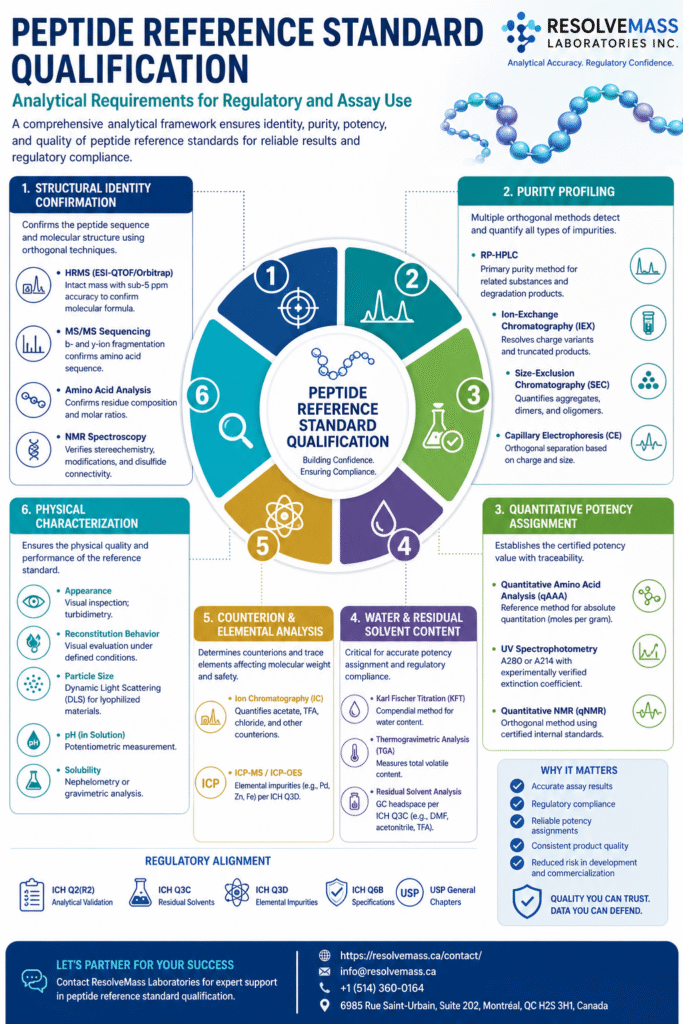
1. Structural Identity Confirmation
Structural confirmation is the cornerstone of peptide reference standard qualification. Regulatory reviewers expect unambiguous sequence verification—not just intact mass. Comprehensive peptide sequencing of GLP-1 peptide therapeutics and peptide sequencing of GLP-1 drugs is increasingly required to verify primary structure and detect sequence-related variants.
- High-Resolution Mass Spectrometry (HRMS): ESI-QTOF or Orbitrap-based platforms provide intact mass measurement with sub-5 ppm mass accuracy, confirming molecular formula. This is the primary identity tool. Advanced LC-MS characterization of GLP-1 peptides enables accurate molecular weight determination and supports comprehensive impurity and degradation assessments.
- MS/MS Sequencing (Tandem Mass Spectrometry): CID or HCD fragmentation generates b- and y-ion series that sequence-confirm each residue. Particularly important for peptides ≥5 residues where isobaric ambiguity is possible. Modern GLP-1 peptide sequencing analytical techniques combine HRMS and tandem MS workflows to achieve high-confidence residue-level confirmation.
- Amino Acid Analysis (AAA): Acid hydrolysis followed by HPLC separation of derivatized amino acids (e.g., with PITC or OPA/FMOC) confirms residue composition and provides a molar ratio map. Essential for peptides containing non-standard or modified residues. AAA is often used alongside GLP-1 analog peptide sequencing workflows to establish composition and verify synthetic fidelity.
- NMR Spectroscopy (¹H, ¹³C, 2D COSY/TOCSY/NOESY): Used for primary reference standard qualification to confirm stereochemistry, regiochemistry of side-chain modifications, and disulfide connectivity where present.
2. Purity Profiling
For complex peptides such as semaglutide, comprehensive GLP-1 peptide impurity characterization is essential because chromatographic purity alone may not adequately identify structurally related impurities.
- Reversed-Phase HPLC (RP-HPLC): The primary purity method. UV detection at 214 nm (peptide bond absorbance) with a gradient optimized for the peptide’s hydrophobicity profile. Must be validated per ICH Q2(R2) including specificity, linearity, precision, and detection limits.
- Ion-Exchange Chromatography (IEX): Resolves charge-variant impurities — deamidation products, truncated sequences, and aggregates with altered isoelectric points — not always separated by RP-HPLC.
- Size-Exclusion Chromatography (SEC): Quantifies high-molecular-weight species (HMWS), including dimers, oligomers, and aggregates. A critical purity dimension for peptides prone to aggregation.
- Capillary Electrophoresis (CE-SDS or CZE): Orthogonal charge- and size-based separation providing purity information independent of chromatographic selectivity.
3. Quantitative Potency Assignment (Absolute Quantitation)
Accurate potency assignment depends on prior confirmation of molecular integrity through analytical characterization of GLP-1 peptide drugs and sequence verification studies.
Assigning a certified potency value — expressed as mass fraction or molar concentration — is what separates a qualified reference standard from a mere sample. Methods used include:
- Quantitative Amino Acid Analysis (qAAA): Considered the reference method for absolute quantitation of peptides. Provides a moles-per-gram assignment based on residue composition.
- UV Spectrophotometry (A280 or A214): Suitable for peptides containing tryptophan, tyrosine, or phenylalanine. Extinction coefficient must be experimentally verified, not solely calculated.
- Quantitative NMR (qNMR): Increasingly accepted by regulatory agencies as an orthogonal quantitation method. Uses certified internal standards (e.g., DMSO-d6 with dimethyl sulfone as internal reference) to assign absolute purity on a weight/weight basis.
The assigned purity and potency value, along with its uncertainty interval, must appear on the certificate of analysis (CoA) and be traceable to the qualification data package.
4. Water and Residual Solvent Content
Water content directly affects the mass-based potency assignment. All peptide reference standards must be tested for:
- Karl Fischer Titration (KFT): Volumetric or coulometric KFT is the compendial method for water content determination. Dry-weight correction to the purity assignment must account for KFT data.
- Thermogravimetric Analysis (TGA): Provides total volatile content, complementary to KFT.
- Residual Solvents (ICH Q3C): GC headspace analysis for Class 1, 2, and 3 solvents used during synthesis and purification (e.g., DMF, acetonitrile, TFA, acetic acid).
5. Counterion and Elemental Analysis
Many synthetic peptides are supplied as acetate or TFA salts, which affect molecular weight calculations and potency assignment.
- Ion Chromatography (IC): Quantifies acetate, TFA, chloride, or other counterions.
- ICP-MS / ICP-OES: Elemental analysis for residual metals (palladium from coupling catalysts, zinc, iron) relevant under ICH Q3D elemental impurities guidance.
6. Physical Characterization
| Test | Method | Regulatory Basis |
|---|---|---|
| Appearance | Visual inspection; turbidimetry | ICH Q6B |
| Reconstitution behavior | Visual inspection under defined conditions | USP ⟨1⟩ |
| Particle size (if lyophilized) | Dynamic light scattering (DLS) | ICH Q6B |
| pH (in solution) | Potentiometric measurement | Compendial |
| Solubility | Nephelometry or gravimetric | ICH Q6B |
5: Stability Assessment: Assigning Expiry to Peptide Reference Standards
A reference standard without an assigned expiry — backed by real stability data — is not compliant for GMP use. Stability assessment for peptide reference standards includes:
- Accelerated and real-time stability studies per ICH Q1A(R2), with sampling points at 0, 3, 6, 9, 12, 18, and 24 months
- Photostability testing per ICH Q1B, especially for peptides containing aromatic residues
- Freeze-thaw stability — minimum three cycles — to mimic handling conditions
- In-use stability after reconstitution (open-vial stability), critical for working standards used across multiple assay runs
Stability programs should incorporate analytical approaches specifically designed for GLP-1 peptide stability analytical methods to monitor oxidation, deamidation, aggregation, and hydrolysis pathways.
Stability-indicating methods must demonstrate specificity: the method must resolve degradation products (oxidation, deamidation, hydrolysis, aggregation) from the parent peptide and from each other.
6: Documentation: The Qualification Report and Certificate of Analysis
The qualification data package must be compiled into a formal qualification report that includes:
- Purpose and scope of the reference standard and intended use(s)
- Traceability statement linking the standard to its primary reference
- Tabulated analytical results with method references, instrument identifiers, and operator traceability
- Assigned values — purity (anhydrous, dry basis), potency, water content, and counterion content — with uncertainty estimates
- Stability plan and current stability data
- Storage conditions, handling requirements, and container closure specification
- Expiry date or re-qualification interval
The CoA issued against the qualification report must be co-signed by a qualified person and traceable to a raw data archive maintained per 21 CFR Part 11 or equivalent Health Canada data integrity requirements.
7: Common Deficiencies in Peptide Reference Standard Qualification Submissions
Based on patterns in FDA 483 observations and EMA inspection findings, common deficiencies include:
- Relying on RP-HPLC purity alone without orthogonal methods
- Failing to correct the potency assignment for water content
- Absent or incomplete traceability documentation for secondary standards
- No stability-indicating method validation; generic HPLC methods used for stability monitoring
- Counterion content not measured or not factored into the CoA
- Expiry dating based on assumption rather than data
- NMR and AAA data absent for primary standard qualification packages
Many of these deficiencies stem from inadequate sequence confirmation, poor impurity characterization, or failure to address known GLP-1 peptide sequencing challenges during method development.
8: How ResolveMass Laboratories Supports Peptide Reference Standard Qualification
ResolveMass Laboratories Inc. is a specialized CRO for GLP-1 peptide characterization and advanced peptide analytics, supporting pharmaceutical developers throughout product development and regulatory submission programs.
ResolveMass Laboratories Inc. is a Canadian CRO with deep specialization in peptide and biopharmaceutical analytical characterization. Our peptide reference standard qualification service is built to support regulatory submissions to FDA, Health Canada, and EMA, covering:
- Full structural characterization by HRMS, GLP-1 peptide sequencing CRO services, MS/MS sequencing, and amino acid analysis (AAA)
- Including advanced GLP-1 impurity peptide mapping and orthogonal impurity characterization strategies.
- Absolute quantitation by qAAA and qNMR
- Karl Fischer water content, residual solvents by GC headspace, and counterion analysis by IC
- ICH-compliant stability studies with stability-indicating method validation per ICH Q2(R2)
- GMP-compliant documentation: full qualification reports and CoAs with 21 CFR Part 11-aligned data traceability
Our scientists have hands-on experience qualifying reference standards for synthetic peptides including GLP-1 receptor agonists, LHRH analogs, oxytocin analogs, and long-acting depot formulation API characterization — the kind of domain depth that translates directly into defensible regulatory packages.
Conclusion:
As peptide therapeutics become increasingly complex, analytical workflows must evolve beyond simple identity testing. Advanced methods such as de novo GLP-1 peptide sequencing, GLP-1 sequence variant analysis, and GLP-1 peptide mapping versus intact mass analysis provide the depth of characterization needed for modern regulatory expectations.
The analytical requirements for peptide reference standard qualification span structural identity by HRMS and MS/MS, orthogonal purity profiling, absolute quantitation by qAAA or qNMR, water and counterion correction, and ICH-compliant stability with expiry dating — all documented in a traceable qualification report and CoA. Meeting these requirements demands both analytical depth and regulatory fluency.
ResolveMass Laboratories Inc. brings both. Whether you are qualifying a primary standard from scratch, bridging to a secondary working standard, or remediating a qualification gap identified during an FDA pre-approval inspection, our team is ready to help you build a data package that meets the highest regulatory standard.
Frequently Asked Questions:
Peptide Reference Standard Qualification is important because analytical methods depend on reference standards for accurate calibration and comparison. An inadequately qualified standard can result in inaccurate potency measurements, unreliable impurity quantification, and regulatory compliance issues. Comprehensive qualification improves data integrity and supports confident decision-making during product development and commercialization.
Identity confirmation is commonly performed using advanced analytical techniques such as LC-MS, high-resolution mass spectrometry (HRMS), peptide mapping, and amino acid analysis. These methods verify the molecular weight, amino acid sequence, and structural integrity of the peptide, ensuring that the material matches its intended specification.
Purity testing measures the percentage of the desired peptide present in the reference material, while impurity profiling identifies and quantifies related substances, degradation products, and process-related impurities. Both evaluations are essential because a peptide can exhibit high purity while still containing critical impurities that may impact analytical performance or regulatory acceptance.
Common impurities include truncated peptides, deletion sequences, oxidized variants, deamidated forms, aggregated species, and isomerized peptides. These impurities may originate during peptide synthesis, purification, storage, or handling. Comprehensive impurity characterization helps ensure the accuracy and reliability of analytical testing.
Peptide content is typically assigned using quantitative amino acid analysis (qAAA), quantitative NMR (qNMR), or a mass balance approach. The assigned value reflects the actual amount of peptide present after accounting for moisture, residual solvents, and other non-peptide components, making it critical for assay calibration and potency determination.
Stability testing demonstrates that the reference standard maintains its identity, purity, potency, and overall quality throughout storage and use. These studies support shelf-life assignments, storage recommendations, and handling procedures while ensuring that the standard remains suitable for analytical and regulatory applications over time.
Regulatory agencies expect peptide reference standards to be thoroughly characterized and supported by robust documentation. Qualification data should include identity confirmation, purity assessment, impurity characterization, content assignment, and stability evaluation. Organizations should also maintain lifecycle management practices and periodic monitoring programs to ensure continued suitability.
A qualified peptide reference standard provides accurate calibration and reliable quantification, resulting in improved assay accuracy, precision, and reproducibility. It also reduces analytical variability and increases confidence in quality control testing, method validation, and regulatory submissions.
Reference
- Vergote V, Burvenich C, Van de Wiele C, De Spiegeleer B. Quality specifications for peptide drugs: a regulatory‐pharmaceutical approach. Journal of peptide science: an official publication of the European Peptide Society. 2009 Nov;15(11):697-710.https://onlinelibrary.wiley.com/doi/abs/10.1002/psc.1167
- Rastogi S, Shukla S, Kalaivani M, Singh GN. Peptide-based therapeutics: quality specifications, regulatory considerations, and prospects. Drug Discovery Today. 2019 Jan 1;24(1):148-62.https://www.sciencedirect.com/science/article/pii/S1359644618302514
- McCarthy D, Han Y, Carrick K, Schmidt D, Workman W, Matejtschuk P, Duru C, Atouf F. Reference Standards to Support Quality of Synthetic Peptide Therapeutics: McCarthy et al. Pharmaceutical Research. 2023 Jun;40(6):1317-28.https://link.springer.com/article/10.1007/s11095-023-03493-1
- Elsayed YY, Kühl T, Imhof D. Regulatory guidelines for the analysis of therapeutic peptides and proteins. Journal of Peptide Science. 2025 Mar;31(3):e70001.https://onlinelibrary.wiley.com/doi/abs/10.1002/psc.70001
- Wu L. Regulatory considerations for peptide therapeutics.https://books.rsc.org/books/edited-volume/801/chapter/540098
About the Author


