

Identifying and addressing the root causes of failed Extractables and Leachables (E&L) studies has become a critical regulatory requirement for obtaining global approvals for complex pharmaceutical products and medical devices. Data gathered from regulatory submissions worldwide suggest that E&L-related deficiencies are silently contributing to the rejection or delay of nearly twenty percent of active drug applications, often resulting in costly Complete Response Letters (CRLs) and prolonged approval timelines. These failures occur when chemical substances migrating from packaging materials, manufacturing components, or drug delivery systems adversely affect the safety, efficacy, or physical stability of a therapeutic product.
Historically, impurity control efforts focused primarily on process-related contaminants generated during active pharmaceutical ingredient (API) synthesis. However, current regulatory expectations have evolved significantly. Regulatory authorities such as the Food and Drug Administration (FDA) and the European Medicines Agency (EMA) now require robust, scientifically justified evidence demonstrating that packaging systems and manufacturing materials do not introduce toxic, mutagenic, or immunogenic chemical entities into the final product administered to patients.
To learn more about how E&L programs protect patient safety and support regulatory submissions, explore our comprehensive guide: Extractables and Leachables (E&L) Testing for Drug Safety for NDA/ANDA Submissions
Article Summary:
- Failed E&L studies are a major regulatory risk, contributing to delays or rejections of pharmaceutical and medical device applications when chemical migrants from packaging, manufacturing equipment, or delivery systems threaten product safety, efficacy, or stability.
- Poor extraction study design is a leading cause of failure. Using extraction solvents that do not accurately reflect the drug product’s chemical environment can produce misleading results and fail to predict real-world leaching behavior. A balanced multi-solvent strategy is essential for comprehensive risk assessment.
- Incorrect Analytical Evaluation Threshold (AET) calculations can create false conclusions. Failure to account for detector response variability and analytical uncertainty may cause harmful leachables to go undetected or generate excessive non-relevant data that complicates regulatory review.
- Analytical uncertainty and response factor differences must be scientifically addressed. Modern E&L programs rely on experimentally derived relative response factor (RRF) databases and evidence-based uncertainty factors to improve detection accuracy and support regulatory compliance.
- Limiting evaluations to container-closure systems can overlook critical contamination sources. Manufacturing components such as silicone tubing, filters, and single-use processing equipment may release process-related leachables that ultimately reach the final drug product.
- Secondary packaging materials can also introduce contaminants. Volatile compounds from adhesives, inks, labels, or cardboard packaging may migrate through semi-permeable containers and contaminate pharmaceutical formulations, even when primary packaging appears chemically inert.
- Successful E&L programs require a lifecycle-based, risk-driven approach. Combining material risk assessment, representative extraction studies, multiple analytical techniques, toxicological evaluation, and ongoing leachables monitoring helps ensure patient safety, regulatory acceptance, and product quality throughout development and commercialization.
Watch the Full Video: 7 Costly Extractables & Leachables (E&L) Study Mistakes (And How to Avoid Them)
Are hidden extractables and leachables putting your pharmaceutical product at risk?
Extractables & Leachables (E&L) studies are a critical part of pharmaceutical development, biologics manufacturing, medical device qualification, and regulatory submissions. Yet many organizations make avoidable mistakes that can lead to delayed approvals, unexpected regulatory questions, costly rework, and potential patient safety concerns.
In this video, we break down 7 common E&L study mistakes that can compromise data quality and regulatory compliance—and more importantly, how to avoid them.
You’ll learn:
🔬 Why selecting the wrong extraction conditions can generate misleading extractables profiles
📦 How overlooking packaging system materials can create unexpected leachable risks
📊 The importance of establishing a scientifically justified Analytical Evaluation Threshold (AET)
⚠️ Common identification and toxicological assessment gaps that trigger regulatory concerns
🧪 Why method sensitivity, LC-MS/GC-MS screening strategies, and orthogonal analytical techniques matter
📋 Key regulatory expectations from USP <1663>, USP <1664>, PQRI recommendations, and emerging ICH Q3E guidance
💡 Best practices for building a risk-based E&L program that supports product quality and patient safety
Whether you’re working with drug products, biologics, combination products, inhalation therapies, ophthalmics, or injectable formulations, understanding these E&L study pitfalls can help reduce development risks and strengthen your regulatory submissions.
At ResolveMass Laboratories, we support pharmaceutical and biotech companies with comprehensive Extractables & Leachables testing, LC-MS and GC-MS characterization, toxicological risk assessments, and regulatory-ready analytical reports.
Watch the full video to discover how a proactive E&L strategy can save time, reduce costs, and prevent major development setbacks.
Subscribe for more content on pharmaceutical analytical testing, regulatory science, nitrosamine analysis, biosimilars, peptide characterization, and drug development.
#ExtractablesAndLeachables #ELTesting #ExtractablesAndLeachablesTesting #AnalyticalTesting #PharmaceuticalScience #DrugDevelopment #PharmaQuality #LCMS #GCMS #USP1663 #USP1664 #ToxicologicalRiskAssessment #Biologics #MedicalDevices #RegulatoryAffairs
Primary Thermodynamic and Chemical Root Causes of Failed Extractables and Leachables (E&L) Studies
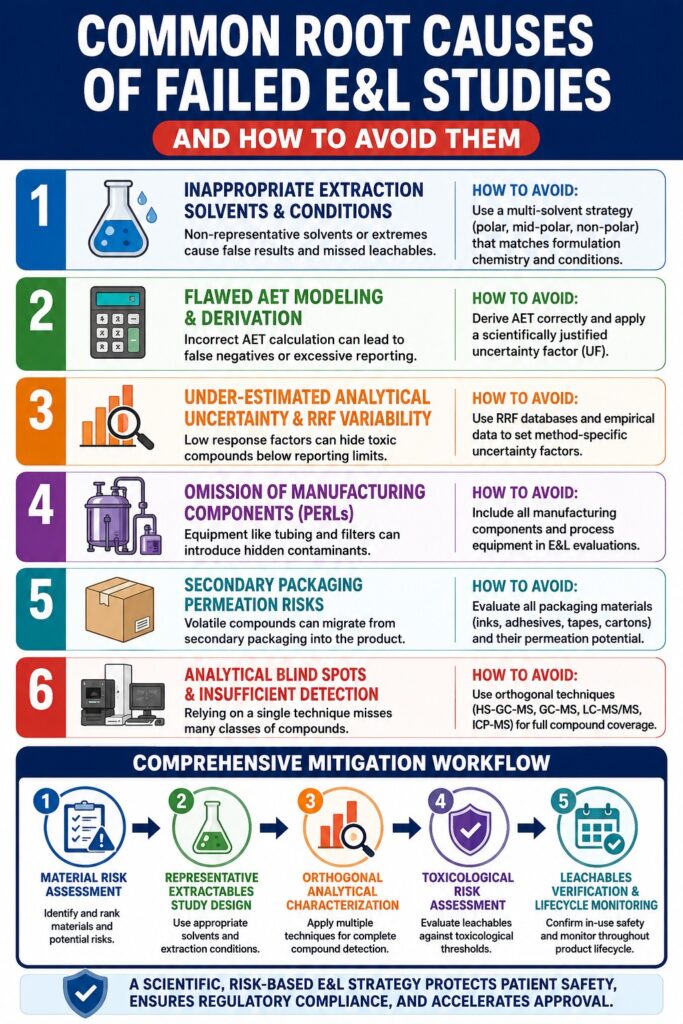
Thermodynamic failures in E&L studies commonly arise when extraction solvents fail to accurately represent the polarity, pH, and ionic strength of the actual drug product formulation. As a result, the migration behavior of chemical compounds cannot be predicted reliably. One of the most significant chemical causes of failed studies is the selection of non-representative extraction solvents. When extraction media do not adequately reflect the thermodynamic characteristics of the final formulation, the study cannot function as a predictive worst-case model for real-world leaching behavior.
The migration of compounds into a liquid drug product is governed by thermodynamic partitioning, whereby substances preferentially move into solvents that possess similar chemical properties. This behavior is driven by the well-established principle of “like dissolves like.” For example, sophisticated drug formulations such as biopharmaceuticals often contain highly concentrated proteins, isotonic agents, preservatives, and buffering systems, creating a chemical environment that differs substantially from conventional laboratory solvents. When extraction solvents differ significantly from these formulation characteristics, a disconnect is created that limits the ability to accurately identify and quantify potential leachables.
To minimize this risk, scientifically robust study designs should incorporate a multi-solvent extraction strategy. This approach generally includes polar, mid-polar, and non-polar solvents to achieve comprehensive extraction while avoiding degradation of polymeric materials. Extraction conditions that are too mild may fail to identify potentially harmful migratory compounds, resulting in underreported risk. Conversely, excessively aggressive extraction conditions can degrade packaging materials and generate artificial degradation products, complicating toxicological evaluations and potentially leading to misleading conclusions.
For a deeper analysis of chemical migration and testing frameworks specific to medicinal compounds, read our dedicated article: Extractables and Leachables in Pharmaceutical Products
| Solvent Classification | Representative Target Analytes | Common Failure Modes in Study Design | Corrective Mitigation Strategy |
|---|---|---|---|
| Polar (e.g., Water, Acidic/Basic Buffers) | Ionic species, heavy metals, highly hydrophilic monomers | Failure to account for pH-dependent extraction kinetics within the formulation matrix | Match extraction media to formulation pH and ionic strength; utilize pH-adjusted aqueous systems |
| Mid-Polar (e.g., Ethanol, Isopropanol) | Plasticizers, moderately lipophilic stabilizers, degradation products | Use of excessive alcohol concentrations that dissolve or damage the polymer substrate | Optimize solvent composition to maximize polymer swelling while preventing dissolution |
| Non-Polar (e.g., Hexane, Dichloromethane) | Highly lipophilic slip agents, antioxidants, rubber oligomers | Exclusion of non-polar extraction phases for aqueous drug products | Include non-polar extraction phases to evaluate worst-case lipophilic migrant scenarios |
Flawed Mathematical Modeling and AET Derivation as Root Causes of Failed Extractables and Leachables (E&L) Studies
Failures in mathematical modeling often occur when analysts establish a fixed Analytical Evaluation Threshold (AET) without adequately accounting for variability in relative response factors (RRFs) and analytical uncertainty. This incorrect derivation represents a major cause of failed studies because it can produce Type II false negatives. If the threshold is set too high, potentially hazardous leachables may remain undetected. If the threshold is set too low, excessive chemical noise can overwhelm data interpretation and complicate the analytical workflow.
The AET calculation is a mandatory regulatory requirement intended to convert a dose-based safety threshold, such as the Safety Concern Threshold (SCT) or Threshold of Toxicological Concern (TTC), into an analytical concentration threshold suitable for laboratory evaluation. The initial AET is calculated using the following equation:
AETinitial = (SCT / MDD) × (Vextract / (Vcontact × f))
Where:
- SCT is the Safety Concern Threshold (typically 1.5 μg/day for parenteral and ophthalmic drug products).
- MDD is the Maximum Daily Dose of the drug product.
- Vextract is the extraction solvent volume.
- Vcontact is the contact volume or surface area of the component.
- f is the accumulation factor accounting for multiple containers or doses.
During untargeted analytical screening, unknown analyte concentrations are typically estimated using a simple quantitation approach. This method assumes that unknown compounds and internal reference standards produce identical detector responses. In reality, detector response factors can vary substantially depending on chemical structure and analytical detection mode. Consequently, compounds with low response factors may appear below the calculated AET even when present at toxicologically significant concentrations, creating a Type II false-negative result.
To compensate for response factor variability and analytical uncertainty, the initial AET should be adjusted downward using an Uncertainty Factor (UF):
AETadjusted = AETinitial / UF
Selection of the UF must be supported by scientific evidence. Historically, a default UF value of 2, corresponding to 50% of the AET, was commonly accepted for pharmaceutical applications. However, current expectations under standards such as ISO 10993-18 and draft ICH Q3E require empirical determination of the UF using robust RRF databases tailored to specific analytical methods. Applying scientifically justified compound-specific response factor data can significantly reduce unnecessary reporting burdens while preserving patient safety and regulatory compliance.
Understand the specific market entry requirements and threshold expectations set by regulatory bodies here: Extractables and Leachables (E&L) Requirements for U.S. Market Authorization
Underestimating Analytical Uncertainty and Response Factor Variability
Analytical uncertainty is introduced because different chemical compounds produce widely varying detector responses relative to a chosen internal standard. Underestimating this variability can result in the failure to detect toxic impurities that fall below an improperly adjusted threshold. This systematic issue remains one of the most common root causes of failed Extractables and Leachables (E&L) studies.
In untargeted chromatographic analyses, it is impossible to optimize detector settings for every unknown compound that may be present. As a result, analytes with low relative response factors may exceed toxicological limits while still generating chromatographic peak areas below reporting thresholds. To address this challenge, advanced laboratories develop comprehensive RRF databases using authentic reference materials and surrogate standards. By evaluating detector performance across a broad range of chemical classes, analysts can establish scientifically defensible, method-specific uncertainty factors. This data-driven approach replaces arbitrary assumptions with empirical evidence and ensures that adjusted AET values remain sufficiently conservative to capture low-responding toxic compounds while avoiding excessive analytical noise.
Learn how advanced laboratories resolve analytical uncertainties across the United States: Extractables and Leachables (E&L) Testing in the United States
Manufacturing Component Omissions as Root Causes of Failed Extractables and Leachables (E&L) Studies
Failure to evaluate process equipment-related leachables (PERLs) originating from silicone tubing, sterile filtration systems, and single-use bioreactors can introduce unexpected contaminants into the final drug product. Restricting the study scope solely to the container closure system is a common contributor to failed E&L programs. Throughout pharmaceutical manufacturing, both intermediate and finished formulations come into contact with numerous polymeric materials that may release process-related contaminants capable of carrying through to the final product.
A well-documented example involves silicone tubing used in aseptic manufacturing operations. Repeated autoclaving cycles and prolonged exposure to pharmaceutical product streams can result in the release of volatile and semi-volatile silicone oligomers. These substances may migrate into process streams and accumulate as PERLs over time. Even when the final drug product is packaged in an inert glass container, contaminants introduced during manufacturing can compromise formulation stability or create patient safety concerns.
Discover how manufacturing equipment evaluation integrates into biopharmaceutical production pipelines: Extractables and Leachables in Biopharma
Secondary Packaging and Permeation Vulnerabilities
Volatile compounds originating from secondary packaging components, including printing inks, label adhesives, and cardboard binders, can permeate semi-permeable primary packaging materials. This migration pathway represents a significant chemical risk that is frequently overlooked during early-stage study planning. Materials such as low-density polyethylene (LDPE) do not provide an absolute barrier against volatile organic compounds.
Volatilization and Outgassing
↓
Thermodynamic Partitioning
↓
Migration Through Semi-Permeable Packaging
A notable industry investigation demonstrated the significance of this risk pathway in a preservative-free ophthalmic drug product. Routine E&L testing performed on the LDPE bottle and cap identified no extractable plasticizers. However, stability testing later revealed substantial contamination by diethyl phthalate (DEP). Subsequent investigation traced the contamination source to adhesive tape used to bundle packaged vials during storage within the stability chamber. The adhesive formulation contained DEP, which volatilized, permeated the secondary packaging, migrated through the LDPE container walls, and entered the drug product at concentrations exceeding established safety limits. This case illustrates the importance of including all materials that come into contact with the product or its packaging, even on a temporary basis, within the E&L risk assessment framework.
For insights into secondary packaging interactions and specific impurities like nitrosamines, see our specialized analysis: Packaging Leachables and Nitrosamines in E&L
Analytical Blind Spots and Insufficient Orthogonal Detection
Dependence on a single analytical detection technique creates substantial blind spots for volatile, semi-volatile, non-volatile, and elemental contaminants. This lack of analytical breadth remains one of the most common technical causes of failed E&L studies during regulatory review. Since E&L profiles contain compounds with a wide range of physicochemical characteristics, no individual analytical platform can detect all potential migrants.
For example, volatile organic compounds (VOCs) require headspace sampling combined with gas chromatography-mass spectrometry (HS-GC-MS). Semi-volatile organic compounds (SVOCs), including plasticizers and slip agents, are generally analyzed using direct injection GC-MS techniques. Non-volatile organic compounds (NVOCs), such as high-molecular-weight antioxidants and polymer stabilizers, often require liquid chromatography-tandem mass spectrometry (LC-MS/MS) for reliable detection and quantification. In addition, elemental impurities and toxic metals leaching from glass, metal components, or pigments must be quantified using inductively coupled plasma mass spectrometry (ICP-MS).
| Analytical Platform | Targeted Compound Class | Representative Analytes | Regulatory Context & Standards |
| HS-GC-MS | Volatile Organic Compounds (VOCs) | Residual solvents, low-molecular-weight monomers | USP, PQRI Guidelines |
| Direct GC-MS | Semi-Volatile Organic Compounds (SVOCs) | Plasticizers (phthalates), antioxidants (Irganox) | ISO 10993-18, USP |
| LC-MS/MS | Non-Volatile Organic Compounds (NVOCs) | High-molecular-weight stabilizers, rubber oligomers | USP, Draft ICH Q3E |
| ICP-MS | Elemental Impurities | Heavy metal catalysts, toxic transition metals | ICH Q3D, USP |
Beyond instrument selection, analytical failures frequently stem from insufficiently validated screening methodologies that do not adequately account for matrix interference effects. High-concentration APIs, lipid nanoparticles, surfactants, and other complex excipients may cause substantial ion suppression or ion enhancement during mass spectrometric analysis. Without formulation-specific method verification and recovery assessments, analytical data may underestimate toxic leachables and ultimately contribute to regulatory deficiencies during pharmacological and toxicological review.
Check-List Compliance versus Defensible Scientific Strategy
Approaching E&L testing as a generic compliance checklist rather than a risk-based, product-specific scientific assessment is a major contributor to FDA Complete Response Letters (CRLs). Regulatory agencies are increasingly rejecting submissions that merely satisfy minimum compendial requirements without providing scientifically justified rationale. Extractables and Leachables testing must be integrated into the overall product development strategy and aligned with the chemistry and lifecycle of the drug product.
Under modern regulatory frameworks such as ISO 10993-18 and the draft ICH Q3E guideline, manufacturers are expected to adopt a lifecycle-based approach. This strategy requires detailed scientific justification for analytical methods, extraction conditions, toxicological thresholds, and risk assessment methodologies. The importance of this approach was reinforced by the FDA’s August 2025 communication regarding nitrosamine contamination detected in drug products packaged within infusion bags. This communication highlighted that nitrosamines may originate not only from manufacturing processes but also from packaging materials, emphasizing the need for comprehensive E&L evaluations throughout the entire product lifecycle.
Real-world agency interactions highlight the importance of strategy over checkboxes. Read our review of regulatory outcomes: FDA Extractables and Leachables Case Studies
Comprehensive Strategy to Mitigate the Root Causes of Failed Extractables and Leachables (E&L) Studies
Successful E&L programs rely on the integration of material risk ranking, representative extraction methodologies, validated orthogonal analytical techniques, and rigorous toxicological assessment. This systematic and scientifically driven strategy minimizes regulatory risk while protecting patient safety. By implementing a structured, multi-phase testing program, pharmaceutical manufacturers can transform E&L evaluation from a compliance challenge into a powerful quality assurance tool.
The mitigation workflow typically consists of five interconnected phases:
Material Risk Assessment
↓
Representative Extractables Study Design
↓
Orthogonal Analytical Characterization
↓
Toxicological Risk Assessment
↓
Leachables Verification and Lifecycle Monitoring
This integrated workflow ensures continuity throughout the testing process. The extractables profile serves as a predictive reference library, enabling observed leachables identified during stability studies to be traced back to specific materials of construction and manufacturing components.
Explore modern strategies engineered for cell therapies and advanced biotherapeutics: Extractables and Leachables (E&L) in Emerging Biologics and Advanced Therapies
Conclusion
Addressing the root causes of failed Extractables and Leachables (E&L) studies is essential for ensuring drug safety, preserving formulation stability, and achieving regulatory approval. Common causes of study failure include inadequate solvent selection, flawed AET calculations, underestimation of analytical uncertainty, omission of manufacturing-related contaminants, and failure to assess secondary packaging permeation risks. Modern regulatory expectations under ISO 10993-18 and draft ICH Q3E require organizations to move beyond checkbox-style compliance and adopt comprehensive, scientifically justified risk assessment strategies.
Collaborating with an experienced contract research laboratory equipped with advanced analytical instrumentation and deep regulatory expertise provides the most effective pathway for navigating the increasingly complex E&L landscape. Such partnerships help ensure robust study design, reliable data generation, and successful regulatory outcomes.
Find out how partnering with an elite laboratory can secure your regulatory strategy: ResolveMass Extractables and Leachables Testing Services
For customized study designs, advanced mass spectrometry capabilities, or expert guidance on regulatory compliance, contact our team directly at: https://resolvemass.ca/contact/
Frequently Asked Questions
E&L studies often fail regulatory review because of weaknesses in study design, analytical methodology, or risk assessment. Common issues include improperly established Analytical Evaluation Thresholds (AETs), incomplete identification of materials that come into contact with the product, and insufficiently validated analytical methods. Regulatory agencies also frequently identify gaps when manufacturers fail to evaluate components used during processing, such as tubing, filters, and single-use systems. These shortcomings can result in incomplete safety assessments and additional regulatory scrutiny.
The choice of extraction solvent has a direct impact on the ability of an E&L study to predict real-world leachable behavior. If the extraction media do not closely reflect the chemical characteristics of the drug product, important migrating compounds may not be detected. Extraction conditions that are too mild can underestimate risk, while overly aggressive solvents may damage packaging materials and generate degradation products that would never occur under normal storage conditions. Selecting representative solvents is therefore essential for obtaining meaningful and defensible results.
The AET serves as a critical decision-making tool by translating toxicological safety limits into measurable analytical thresholds. It helps determine which detected compounds require further identification and toxicological assessment. A scientifically justified AET reduces the risk of overlooking potentially harmful leachables while preventing excessive investigation of compounds that pose minimal safety concern. Proper threshold setting ultimately supports both regulatory compliance and patient safety.
A Type I error, commonly referred to as a false positive, occurs when analytical data suggest that a compound exceeds the reporting threshold even though its actual concentration is below that limit. This can lead to unnecessary investigations and increased study costs. A Type II error, or false negative, is generally considered more serious because a potentially harmful compound may remain undetected due to low detector response or inappropriate threshold settings. Effective analytical strategies are designed to minimize both types of errors.
Process equipment-related leachables originate from manufacturing materials that come into contact with the product during production, such as silicone tubing, sterile filters, mixing vessels, and bioreactor systems. Packaging-related leachables, on the other hand, migrate from container closure systems and packaging materials during storage. Although these contaminants arise from different sources, both have the potential to affect product quality, stability, and patient safety. Comprehensive E&L programs should evaluate both categories to ensure a complete risk assessment.
Materials such as low-density polyethylene (LDPE) allow certain volatile organic compounds to pass through their structure over time. Chemicals released from secondary packaging components, including adhesives, printing inks, and cardboard materials, can migrate through the primary container and enter the drug product. This process may occur even when the primary packaging itself does not contain the contaminating substance. As a result, secondary packaging materials should always be included in the overall E&L risk evaluation strategy.
A simulated-use study is generally recommended when the drug product contains a highly complex formulation that may interfere with conventional analytical testing. Examples include protein-based therapeutics, lipid nanoparticle systems, and other advanced formulations. Instead of using aggressive extraction conditions, the study recreates actual product-use environments to better predict material interactions and leachable formation. This approach often provides more realistic and scientifically relevant data for risk assessment purposes.
Different chemical compounds can produce significantly different detector responses even when present at identical concentrations. This variation, known as relative response factor variability, can affect the accuracy of concentration estimates during untargeted screening. Compounds with low detector responses may appear to be present at lower concentrations than they actually are, increasing the risk of underreporting potentially hazardous substances. Applying scientifically justified uncertainty factors and response factor databases helps improve the reliability of quantitative assessments.
The draft ICH Q3E guideline introduces a more integrated and risk-based framework for evaluating extractables and leachables across the product lifecycle. It emphasizes the connection between analytical findings and toxicological risk assessments, requiring manufacturers to provide stronger scientific justification for study designs and testing strategies. The guideline also encourages a comprehensive evaluation of packaging systems, manufacturing materials, and product-specific risks. As a result, companies are expected to adopt a more proactive and evidence-based compliance approach.
Reference:
- Rozio, M. G., Angelini, D., & Carrara, S. (2025). Uncertainty factors and relative response factors: Correcting detection and quantitation bias in extractables and leachables studies. Analytical and Bioanalytical Chemistry, 417(19), 4331–4349. https://doi.org/10.1007/s00216-025-05946-5
- Singh, S., Rozio, M. G., Angelini, D., & Carrara, S. (2025). Extractables and leachables in pharmaceutical products: Potential adverse effects and toxicological risk assessment. Pharmaceuticals, 18(2), Article 246. https://doi.org/10.3390/ph18020246
- Ronk, M., Liu, J., Gallegos, A., Luo, Y., Fujimori, K., Li, K., Lee, H., & Nashed-Samuel, Y. (2020). Holistic extractables and leachables program: Evaluations of prefilled syringe systems for biotechnology products. PDA Journal of Pharmaceutical Science and Technology, 74(6), 627–643. https://doi.org/10.5731/PDAJST.2019.011379
- U.S. Food and Drug Administration. (2025, August 18). Emerging scientific and technical information on leachable NDBA and other small-molecule nitrosamines in infusion bags. U.S. Department of Health and Human Services. https://www.fda.gov/media/188238/download
- U.S. Food and Drug Administration. (2025, November). Q3E guideline for extractables and leachables (Draft guidance for industry). U.S. Department of Health and Human Services. FDA Q3E Guideline for Extractables and Leachables
- U.S. Pharmacopeia. (2025, December 17). From nitrosamines to packaging safety: The expanding story of impurities. Quality Matters. Quality Matters – USP Blog
Get In Touch With Us
About The Author


