


Introduction:
Bioanalytical method development for mRNA therapeutics is fundamentally different from conventional drug modalities — and getting it wrong at the preclinical stage can delay an IND filing by six months or more. Unlike small molecules or biologics, mRNA therapeutics are inherently unstable, delivered inside lipid nanoparticles (LNPs), and present in biological matrices alongside a sea of endogenous nucleic acid background that can overwhelm even well-designed assays.
At ResolveMass Laboratories Inc., our scientists have spent years building the technical infrastructure and regulatory fluency needed to support next-generation RNA-based medicines. This case study presents one of our most scientifically demanding engagements: a full bioanalytical method development and validation program for a first-in-class mRNA therapeutic candidate targeting a rare metabolic disorder. The program spanned pharmacokinetic (PK) assessment, biodistribution, and protein expression quantification across plasma, liver, spleen, and muscle — four matrices that each presented distinct analytical obstacles.
The study was designed to support IND-enabling GLP toxicology studies in rat and non-human primate (NHP) models, with regulatory submissions to both FDA and Health Canada in scope.
Summary:
- mRNA therapeutics introduce unique bioanalytical challenges that standard small-molecule or protein-based assay frameworks cannot address directly.
- ResolveMass Laboratories Inc. developed a fully validated, fit-for-purpose bioanalytical method suite for a first-in-class mRNA therapeutic across four complex biological matrices.
- Key challenges resolved included lipid nanoparticle (LNP) interference, endogenous RNA background, species cross-reactivity, and ultra-low analyte concentrations in tissue.
- The approach combined LC-MS/MS, RT-qPCR, and ELISA-based platforms with custom sample preparation workflows tailored to each matrix.
- Regulatory acceptance was achieved on first submission, reflecting the strength of the scientific rationale and documentation quality.
- This case study demonstrates how specialized expertise in bioanalytical method development for mRNA therapeutics can compress timelines and reduce risk during IND-enabling studies.
1: The Therapeutic Candidate and Program Overview
What Was Being Developed?
The client’s asset was a therapeutic mRNA encapsulated in ionizable LNPs, designed to transiently express a secreted enzyme deficient in patients with the target metabolic disorder. Key program parameters included:
| Parameter | Details |
|---|---|
| Modality | LNP-encapsulated mRNA |
| Target protein | Secreted enzyme (hepatic expression) |
| Species | Rat and non-human primate (NHP) |
| Matrices | Plasma, liver, whole blood, skeletal muscle |
| Regulatory target | FDA IND and Health Canada CTA |
| Study type | GLP-compliant PK, biodistribution, and PD |
What Needed to Be Measured?
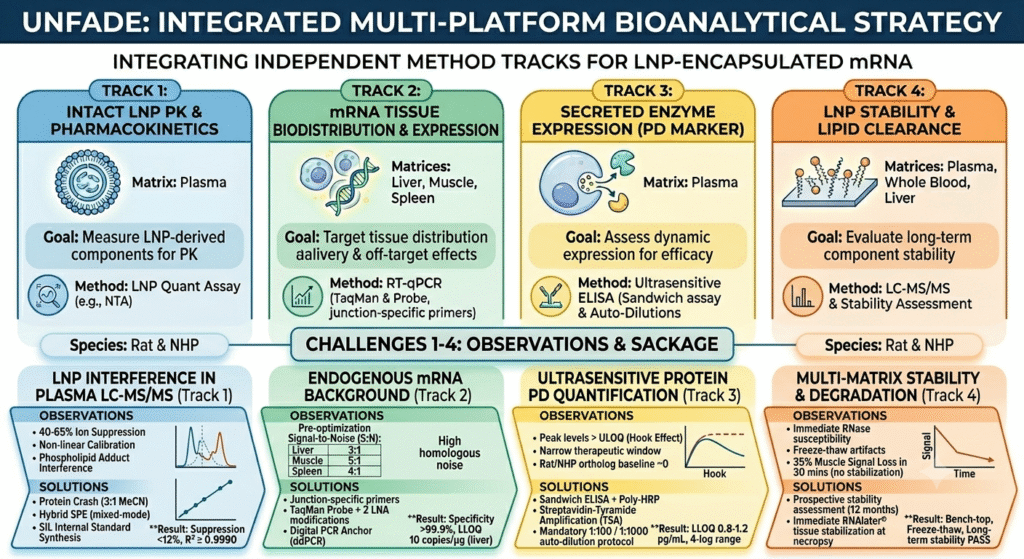
Four distinct analyte categories required separate bioanalytical strategies:
- Intact LNP concentration — quantifying nanoparticle delivery vehicles in plasma
- mRNA tissue distribution — quantifying mRNA levels in target and off-target tissues
- Translated protein expression — quantifying the secreted enzyme in plasma as a pharmacodynamic (PD) marker
- LNP-derived lipid components — tracking ionizable lipid clearance by LC-MS/MS
Each of these required an independent method development track, with cross-platform integration required for the final bioanalytical report package.
Challenge 1: Lipid Nanoparticle Interference in Plasma PK Assays
LNP interference is the single most common cause of assay failure in early mRNA bioanalytical programs. Ionizable lipids, when present at high concentrations post-dose, co-elute with endogenous phospholipids and cause severe ion suppression in LC-MS/MS assays.
What We Observed
In early method scouting runs on rat plasma collected at Tmax (1–4 hours post-dose), we observed:
- 40–65% ion suppression for the ionizable lipid analyte at relevant concentrations
- Non-linear calibration curves due to matrix-dependent suppression that varied by time point
- Phospholipid adducts appearing as interference peaks in the mass transition window
How ResolveMass Resolved It
Our analytical chemists implemented a multi-step precipitation and phospholipid depletion protocol:
- Protein crash with acetonitrile (3:1 v/v) followed by centrifugation at 14,000 × g
- Hybrid SPE cartridge (mixed-mode cation exchange + reverse phase) to selectively retain lipid components while washing phospholipid matrix
- Stable isotope-labeled (SIL) internal standard synthesized to match the ionizable lipid’s exact isotopologue pattern
Post-optimization, ion suppression was reduced to below 12% across all matrix lots, and calibration curve linearity (R² ≥ 0.9990) was achieved consistently across six independent runs.
Key lesson: Matrix-matched calibration standards prepared in LNP-depleted plasma — not naive plasma — were essential to accurately represent the in-study matrix composition.
Challenge 2: Endogenous RNA Background in Tissue mRNA Quantification
Endogenous mRNA background is the defining challenge of tissue distribution studies for RNA therapeutics. Every tissue contains abundant endogenous transcripts, and the analyte mRNA must be measured against this background with sufficient specificity and sensitivity.
Matrix-Specific Complexity
| Tissue | Primary Interference | Observed Signal-to-Noise |
|---|---|---|
| Liver | High endogenous mRNA expression | 3:1 (pre-optimization) |
| Skeletal muscle | Myosin/actin transcripts | 5:1 (pre-optimization) |
| Spleen | Immune-related RNA abundance | 4:1 (pre-optimization) |
| Plasma | Circulating free mRNA and exosomes | 8:1 (pre-optimization) |
The RT-qPCR Platform Architecture
ResolveMass developed a RT-qPCR method using the following design principles:
- Sequence-specific primers designed to span an mRNA junction unique to the construct (not present in any known rat or NHP transcript)
- TaqMan probe with a locked nucleic acid (LNA) modification at two positions for enhanced discrimination against single-nucleotide variants in endogenous homologs
- DNase pretreatment of all tissue lysates to eliminate genomic DNA signal
- Synthetic RNA standards produced by in vitro transcription (IVT) and quantified by digital PCR (ddPCR) to anchor the absolute quantification framework
The final assay achieved a lower limit of quantification (LLOQ) of 10 copies/µg total RNA in liver and 50 copies/µg in muscle — meeting the pre-defined acceptance criteria for detection of biodistribution signal at expected efficacious doses.
Species Cross-Reactivity
A critical regulatory concern in NHP studies is whether the RT-qPCR primers and probe show unexpected cross-reactivity with closely related NHP transcripts. We conducted an in silico BLAST analysis against the NHP transcriptome followed by empirical spike-recovery experiments in NHP-derived tissue lysates. Cross-reactivity was confirmed to be less than 0.1% for all NHP tissues tested.
Challenge 3: Ultrasensitive Protein Expression Quantification
Measuring translated protein in plasma requires assays with sub-picomolar sensitivity — particularly in rare disease contexts where the endogenous baseline is near zero and the therapeutic window for expression is narrow.
The Pharmacodynamic Assay Design
For the secreted enzyme PD marker, ResolveMass developed a sandwich ELISA incorporating:
- Capture antibody: Affinity-purified polyclonal antibody raised against the recombinant human enzyme (cross-reactive with rat and NHP orthologs confirmed)
- Detection antibody: Biotin-conjugated monoclonal antibody targeting a non-overlapping epitope
- Signal amplification: Streptavidin-poly-HRP conjugate with tyramide signal amplification (TSA) to achieve sub-pg/mL sensitivity
- Reference standard: Recombinant enzyme produced in a mammalian expression system matching the therapeutic protein’s predicted glycosylation pattern
The assay achieved an LLOQ of 0.8 pg/mL in rat plasma and 1.2 pg/mL in NHP plasma, with a dynamic range of four orders of magnitude.
Hook Effect Mitigation
At peak expression time points, plasma enzyme concentrations exceeded the upper limit of quantification (ULOQ). A mandatory 1:100 and 1:1000 dilution QC strategy was implemented for all samples collected within 48–96 hours of dosing, with auto-dilution verification built into the data reduction template.
Challenge 4: Multi-Matrix Stability — A Frequently Underestimated Risk
RNA analyte stability in biological matrices is the hidden risk that derails many mRNA bioanalytical programs — often discovered only after study samples have been collected and stored. mRNA is inherently susceptible to RNase degradation, freeze-thaw cycling artifacts, and pH-dependent hydrolysis.
Stability Failures We Anticipated and Prevented
ResolveMass built a prospective stability risk assessment into the method development phase, evaluating:
| Stability Parameter | Condition Tested | Acceptance Criteria | Result |
|---|---|---|---|
| Bench-top stability | 4°C, 2 hours (RNA in lysis buffer) | < 15% change from T0 | PASS |
| Freeze-thaw stability | 3 cycles, -80°C | < 15% change | PASS |
| Long-term frozen stability | -80°C, 12 months | < 20% change | PASS |
| Post-extraction stability | 4°C, 24 hours in TE buffer | < 15% change | PASS |
| LNP in plasma stability | -80°C, 6 months | < 15% change | PASS |
One critical finding: skeletal muscle tissue required immediate RNA stabilization in RNAlater® at the time of necropsy — a delay of even 30 minutes at room temperature prior to stabilization caused a 35% reduction in analyte signal. This finding was built into the study protocol as a required procedural control.
2: Regulatory Strategy: Building a Defensible Submission Package
Regulatory acceptance of bioanalytical methods for RNA therapeutics is an evolving area, and the guidance landscape continues to mature. ResolveMass approached the regulatory package with the following framework:
- Alignment with FDA 2018 Bioanalytical Method Validation Guidance as the primary framework, with supplemental alignment to EMA/CHMP 2011 guidance
- ICH M10 (2022) requirements incorporated for the ligand binding assay (ELISA) components
- Incurred sample reanalysis (ISR) performed for all four analyte categories, including first-ever ISR data for the ionizable lipid component in NHP plasma
- Cross-validation between rat and NHP matrices for all shared assay platforms
The submission package included over 340 pages of method validation data across seven bioanalytical methods. FDA issued no bioanalytical-related comments during the IND review cycle.
3: Lessons Learned: What Sets Successful mRNA Bioanalytical Programs Apart
After completing this program and multiple others like it, the ResolveMass scientific team has identified the factors that consistently distinguish successful from failed mRNA bioanalytical programs:
Start matrix characterization before assay development. Understanding what your biological matrix looks like — its endogenous RNA content, lipid composition, and enzyme activity — is not a luxury; it is a prerequisite.
Design for the worst-case sample, not the average sample. Tmax plasma samples and high-expression liver samples are the most analytically challenging. Build the assay to handle those first.
Treat the LNP as an analyte and an interferent simultaneously. The same lipid nanoparticle you are trying to measure in plasma is also disrupting your other assays if sample prep is not controlled.
Stability data must match the actual study sample handling chain. Lab-generated stability data is only valid if it reflects the exact freeze-thaw history, storage conditions, and processing delays that will occur during the GLP study.
Invest in absolute quantification standards. ddPCR-anchored IVT RNA standards are more expensive than plasmid curve approaches but deliver traceable quantification that regulators and scientific reviewers trust.
4: Why ResolveMass Laboratories Inc.?
ResolveMass Laboratories Inc. is a Canadian CRO specializing in advanced bioanalytical sciences for complex therapeutic modalities — including RNA therapeutics, cell and gene therapies, ADCs, and oligonucleotide drugs. Our team includes:
- PhD-level bioanalytical scientists with direct experience across RNA modalities, LNP formulation characterization, and GLP compliance
- An LC-MS/MS laboratory with dedicated instruments for lipid and oligonucleotide quantification
- Full GLP certification with regulatory inspection history across FDA, Health Canada, and EMA-aligned studies
- A track record of zero first-cycle bioanalytical deficiencies across IND and CTA submissions in the past three years
We do not outsource your science. Every method is developed, validated, and reported by our in-house team — with the scientific director personally reviewing all validation reports before submission.
Conclusion:
The case study described here illustrates why bioanalytical method development for mRNA therapeutics demands a fundamentally different approach from conventional drug development bioanalysis. From LNP interference management to ultra-low sensitivity protein quantification, each challenge required a purpose-built solution grounded in deep scientific understanding and regulatory foresight.
ResolveMass Laboratories Inc. exists precisely for programs like this one — where the therapeutic is novel, the biology is complex, and the regulatory stakes are high. Our scientists bring not just technical capability, but the strategic thinking and regulatory experience to anticipate problems before they become program-stopping failures.
If your mRNA, siRNA, LNP-based, or gene therapy program needs bioanalytical support from an organization that has already solved the hardest problems in this space, we are ready to support your next study.
Frequently Asked Questions:
mRNA therapeutics present unique analytical challenges because they are highly susceptible to enzymatic degradation and often exist at very low concentrations in biological matrices. Additionally, they are frequently delivered using lipid nanoparticles, which can complicate extraction and quantification. Endogenous RNA molecules present in tissues and plasma can also interfere with analytical measurements, making assay specificity critical.
Common matrix challenges include high levels of endogenous nucleic acids, RNase activity, protein binding, lipid interference, and tissue-specific variability. These factors can reduce extraction efficiency, suppress analytical signals, and increase assay variability. Proper matrix characterization and optimized sample preparation are essential to overcome these issues and ensure reliable data generation.
Sample preparation directly impacts assay accuracy, precision, and sensitivity. Poor extraction methods can lead to degradation of the mRNA therapeutic or low recovery from biological matrices. Optimized workflows that include RNase inhibition, efficient lysis conditions, and tailored purification strategies are often necessary to maximize analyte recovery and reduce matrix effects.
Lipid nanoparticles protect mRNA therapeutics during delivery but can complicate analytical workflows. The encapsulated mRNA must often be efficiently released before extraction and quantification. Incomplete release can result in inaccurate measurements and underestimation of drug concentrations, making formulation-specific extraction methods an important part of assay development.
Regulatory agencies generally expect bioanalytical methods to demonstrate acceptable accuracy, precision, sensitivity, selectivity, recovery, stability, and reproducibility. Additional assessments may be required depending on the therapeutic modality and intended use of the data. A properly validated method ensures that generated results are suitable for decision-making and regulatory submissions.
Matrix effects can be reduced through optimized extraction procedures, matrix-matched calibration standards, internal controls, selective assay design, and careful sample cleanup. Evaluating multiple biological matrices during early development helps identify potential interferences and enables scientists to build more robust analytical methods before validation begins.
Reference
- Kaur S, Alley SC, Szapacs M, Wilson A, Ciccimaro E, Su D, Henderson N, Chen L, Garofolo F, Hengel S, Jian W. 2021 White Paper on Recent Issues in Bioanalysis: Mass Spec of Proteins, Extracellular Vesicles, CRISPR, Chiral Assays, Oligos; Nanomedicines Bioanalysis; ICH M10 Section 7.1; Non-Liquid & Rare Matrices; Regulatory Inputs (Part 1A–Recommendations on Endogenous Compounds, Small Molecules, Complex Methods, Regulated Mass Spec of Large Molecules, Small Molecule, PoC & Part 1B-Regulatory Agencies’ Inputs on Bioanalysis, Biomarkers, Immunogenicity, Gene & Cell Therapy and Vaccine). Bioanalysis. 2022 May 1;14(9):505-80.https://www.tandfonline.com/doi/abs/10.4155/bio-2022-0078
- Mekhssian K. Bioanalytical developments for the analysis of antisense oligonucleotides (ASOs).https://f.hubspotusercontent10.net/hubfs/6893718/BZ_Q3_eBook_Altasciences_oligonucleotides_01.09.21-min.pdf
- Yu H, Dambra R, Chan G, Ishida E, Khalilimeybodi A, Krebs N, Ravindra Pilvankar M, Seeland S. ADME investigations of novel therapeutic modalities: challenges and opportunities 2025. Expert Opinion on Drug Metabolism & Toxicology. 2026 Mar 4;22(3):181-99.https://www.tandfonline.com/doi/abs/10.1080/17425255.2026.2650189
- Thayer MB, Humphreys SC, Lade JM, Rock BM. ADME considerations for siRNA-based therapeutics. InOvercoming Obstacles in Drug Discovery and Development 2023 Jan 1 (pp. 41-50). Academic Press.https://www.sciencedirect.com/science/article/pii/B9780128171349000246
- Humphreys SC, Davis JA, Iqbal S, Kamel A, Kulmatycki K, Lao Y, Liu X, Rodgers J, Snoeys J, Vigil A, Weng Y. Considerations and recommendations for assessment of plasma protein binding and drug–drug interactions for siRNA therapeutics. Nucleic acids research. 2022 Jun 24;50(11):6020-37.https://academic.oup.com/nar/article-abstract/50/11/6020/6605317
About the Author


