


Strategic Frameworks for Bioanalytical Method Development for POC Therapeutics
Establishing robust analytical assays for peptide-oligonucleotide conjugates requires highly specialized methodologies capable of accurately quantifying these hybrid therapeutics within complex biological matrices while minimizing interference from endogenous components. Effective Bioanalytical Method Development for POC Therapeutics is essential for addressing the unique analytical challenges associated with chimeric drug modalities that combine cell-penetrating or receptor-targeting peptides with gene-modulating nucleic acids, including antisense oligonucleotides, small interfering RNAs (siRNAs), and phosphorodiamidate morpholino oligomers (PMOs). Specialized contract research organizations (CROs), including ResolveMass Laboratories Inc., tackle these complexities through the use of automated synthesis platforms, high-resolution chromatographic systems, and validated mass spectrometric technologies that support both preclinical pharmacokinetic investigations and regulated clinical development programs.
Learn more about our comprehensive bioanalytical CRO services for Phase II and Phase III clinical programs.
[Peptide Domain] -- (Cleavable or Stable Linker) -- [Oligonucleotide Domain]
       │                                                     │
       ▼                                                     ▼
Amphipathic / Cationic                                Highly Polyanionic
Ionizes in Positive Mode                              Ionizes in Negative Mode
Prone to Glass/Metal Binding                          Prone to Metal/Endogenous Binding
Extensive Peptidase Cleavage                          Exonuclease/Endonuclease Trimming (N-1, N-2)
Through the development of customized sample-preparation workflows and the optimization of chromatographic column chemistries within a unified analytical environment, CROs significantly reduce sample loss while ensuring complete sequence confirmation. This integrated analytical strategy minimizes degradation risks and inconsistent recovery rates that frequently occur when peptide and oligonucleotide analyses are conducted separately on non-specialized instrumentation.
Discover how we address bioanalytical method validation failure to keep your project on track.
Share via:
Article Summary:
- Peptide-oligonucleotide conjugates (POCs) present unique analytical challenges because they combine peptide and nucleic acid components with different physicochemical properties, requiring specialized bioanalytical methods to ensure accurate quantification in biological samples.
- Non-specific adsorption and instability are major concerns during analysis, as POCs can interact with laboratory plastics, glass surfaces, and metal components. Optimized materials, passivated systems, and low-binding consumables are essential to minimize analyte loss and improve recovery.
- Advanced sample preparation techniques improve extraction efficiency, with enzymatic digestion followed by weak anion exchange solid-phase extraction (WAX SPE) providing effective recovery of conjugates from plasma and tissue matrices while reducing interference from endogenous biomolecules.
- Ion-pair reversed-phase liquid chromatography (IP-RPLC) coupled with mass spectrometry is widely used to enhance retention, separation, and detection of oligonucleotide-containing therapeutics. Careful optimization of ion-pairing reagents, mobile phases, and column chemistry improves analytical sensitivity and metabolite resolution.
- Hybrid immunoaffinity LC-MS/MS platforms offer superior molecular specificity compared with conventional ligand-binding assays by distinguishing intact therapeutic conjugates from truncated metabolites, leading to more reliable pharmacokinetic and bioanalytical data.
- High-resolution mass spectrometry plays a critical role in metabolite identification and sequence mapping, enabling detailed characterization of peptide degradation, oligonucleotide trimming, linker instability, and other biotransformation pathways that influence therapeutic performance.
- Regulatory-compliant method validation is essential for clinical development, requiring demonstrated accuracy, precision, selectivity, carryover control, and stability in accordance with FDA and ICH M10 guidelines to support IND, NDA, and BLA submissions.
Physicochemical Complexity and Non-Specific Adsorption of Hybrid Conjugates
The distinct physicochemical properties of peptide-oligonucleotide conjugates (POCs) contribute to substantial levels of non-specific adsorption to conventional laboratory plastics, metallic surfaces, and glassware. Addressing these interactions requires the implementation of low-binding materials and carefully optimized recovery matrices to preserve analyte integrity and maximize recovery.
Peptides are amphipathic molecules that become protonated under analytical conditions and typically ionize most efficiently in positive-ion mode. In contrast, oligonucleotides are highly polar, negatively charged polyanions that exhibit optimal ionization in negative-ion mode. Once covalently linked, the resulting hybrid conjugate demonstrates intricate solubility characteristics and a pronounced tendency toward non-specific adsorption. Hydrophobic domains of cell-penetrating peptides (CPPs) readily interact with glass and polymer surfaces, whereas the polyanionic sugar-phosphate backbone of the oligonucleotide exhibits strong affinity for metallic components present within LC pumps, autosamplers, tubing assemblies, and column frits.
Explore our advanced peptide-oligonucleotide conjugates preclinical services for early-stage development.
To minimize analyte loss arising from these interactions, analytical workflows must incorporate passivated fluidic systems, PEEK-lined chromatographic columns, and specialized multi-charge blocking reagents. The thermodynamic behavior associated with peptide-domain conformational folding can be evaluated using the Gibbs free energy relationship:
ΔG = ΔH − TΔS
In this context, the transition from an intrinsically disordered conformation in solution to a folded state upon adsorption to a surface must be counterbalanced through the use of surface-blocking additives or suitable organic modifiers within extraction buffers.
Furthermore, the selection of the conjugation site, whether at the 5′ terminus, 3′ terminus, or a strategically positioned internal amine handle, significantly influences the accessibility of the molecule to enzymatic degradation pathways. Consequently, conjugation position directly affects plasma stability and overall pharmacokinetic behavior.
Key Bioanalytical Method Development for POC Therapeutics Methodologies
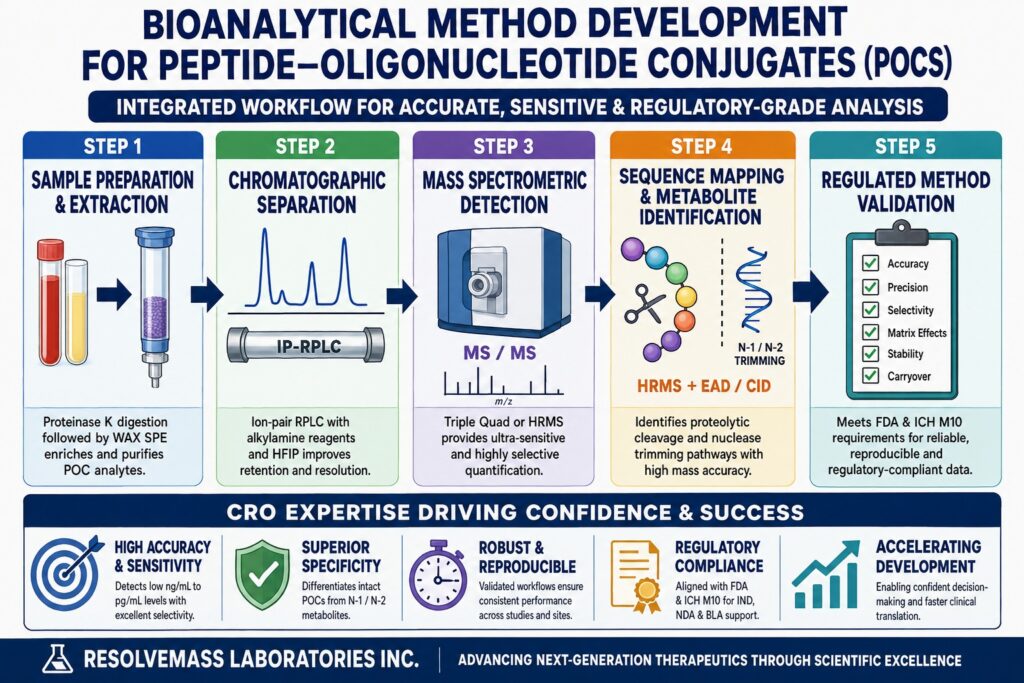
Efficient isolation of hybrid therapeutics from complex biological matrices is commonly achieved through the combination of enzymatic matrix digestion and weak anion exchange solid-phase extraction (WAX SPE). This dual-stage sample-preparation approach disrupts strong plasma protein interactions while selectively enriching negatively charged target analytes and removing endogenous interferences.
Because therapeutic conjugates often bind extensively to plasma proteins such as albumin, conventional protein precipitation techniques frequently produce inadequate recoveries and elevated baseline noise during downstream analysis. To overcome these limitations, CROs employ enzymatically driven pretreatment strategies that enhance analyte liberation and recovery.
Read about our specialized tissue and CSF bioanalytical services for complex sample matrices.
By incubating plasma or tissue homogenates with RapiZyme Proteinase K at 55°C, endogenous proteins are degraded into smaller peptide fragments, thereby releasing the bound peptide-oligonucleotide conjugate.
Following enzymatic digestion, samples are diluted using low-ionic-strength buffers to prevent analyte breakthrough during solid-phase extraction. The prepared sample is then loaded onto a mixed-mode weak anion exchange polymeric sorbent.
The negatively charged phosphate backbone of the oligonucleotide component forms selective ionic interactions with tertiary amine functionalities present on the sorbent surface. During subsequent washing steps, endogenous lipids, neutral proteins, and cationic peptides are effectively removed using optimized aqueous-organic solvent systems. The purified target conjugate is then eluted using a high-pH or high-salt mobile phase that remains compatible with electrospray ionization mass spectrometry.
| Extraction Strategy | Base Mechanism | Target Analyte Compatibility | Operational Risks | Recovery Efficiency |
|---|---|---|---|---|
| Proteinase K Digestion + WAX SPE | Enzymatic protein cleavage followed by tertiary amine ionic capture | Antisense oligonucleotides, siRNAs, and peptide conjugates | Requires precise temperature and incubation control to avoid unintended linker cleavage | High (56%–115%) |
| Anion-Exchange Microextraction | Direct-immersion electrostatic adsorption without protein precipitation | Short single-stranded oligonucleotides and DNA fragments | Limited loading capacity and sensitivity to elevated salt concentrations | Moderate (70%–85%) |
| Phenol-Chloroform Liquid-Liquid Extraction (LLE) | Differential solvent partitioning and protein denaturation | Pure, unmodified nucleic acid sequences | Involves hazardous solvents, extensive manual handling, and reduced recovery for hydrophilic conjugates | Variable (40%–75%) |
Chromatographic Optimization of Ion-Pairing Systems
Chromatographic and Mass Spectrometric Parameterization for Bioanalytical Method Development for POC Therapeutics
Optimization of liquid chromatographic separation for therapeutic conjugates frequently relies on ion-pair reversed-phase liquid chromatography (IP-RPLC), utilizing carefully selected amine counterions and fluoroalcohol modifiers within the mobile phase. These reagents transiently neutralize the negative charges of the phosphate backbone, improving chromatographic retention while simultaneously enhancing mass spectrometric sensitivity.
                     [Oligonucleotide Phosphate Backbone] (Highly Anionic)
                                       │
                         (Electrostatic Association)
                                       │
                                       ▼
                       [Alkylamine Ion-Pairing Reagent]
                (e.g., DMCHA, TEA, DBA, or DIPEA counterions)
                                       │
                     (Hydrophobic Interaction & Retention)
                                       │
                                       ▼
                     [C18/C4 Stationary Phase Column]
                                       │
                        (Desolvation & MS Ionization)
                                       │
                                       ▼
                      [Fluoroalcohol Volatile Modifier]
                                (e.g., HFIP)
Understand the peptide-oligonucleotide conjugate linker chemistry and its impact on analytical stability.
Unmodified oligonucleotides typically exhibit poor retention on conventional reversed-phase stationary phases. To address this challenge, ion-pairing reagents are incorporated into the mobile phase. Frequently used reagents include:
- Dimethylcyclohexylamine (DMCHA)
- Triethylamine (TEA)
- Dibutylamine (DBA)
- N,N-diisopropylethylamine (DIPEA)
These alkylamine reagents associate electrostatically with negatively charged phosphate groups, generating a more hydrophobic complex capable of interacting effectively with the stationary phase. At the same time, a volatile fluoroalcohol modifier, most commonly hexafluoroisopropanol (HFIP), is introduced to regulate mobile-phase pH, improve chromatographic retention, and enhance desolvation efficiency during mass spectrometric ionization.
To achieve effective separation between active parent conjugates and structurally related metabolites, including N-1 and N-2 sequence-shortened species as well as oxidative deamination products, CROs optimize both stationary-phase chemistry and gradient composition. Altering organic solvents, such as replacing acetonitrile with methanol or isopropanol, can substantially modify elution strength and improve the resolution of closely related degradation products.
Additionally, switching chromatographic stationary phases from conventional C18 materials to C4 columns often improves separation between active therapeutic molecules and deaminated impurities (Δm ≈ 0.984 Da).
Because alkylamine-based ion-pairing systems can contribute to significant signal drift within mass spectrometers, CROs establish rigorous standard operating procedures (SOPs). These practices include dedicating specific chromatographic columns to ion-pairing applications, preparing fresh mobile phases daily in tightly sealed containers to prevent amine evaporation, and implementing extended column-cleaning procedures lasting two to three hours using initial mobile-phase compositions to eliminate carryover and maintain analytical consistency.
Immunoaffinity Hybrid LC-MS/MS vs. Conventional Ligand-Binding Assays
Hybrid LC-MS/MS methodologies integrate sequence-specific immunoaffinity enrichment with high-resolution mass spectrometric detection, delivering exceptional sensitivity and molecular selectivity. Unlike traditional ligand-binding assays (LBAs), this approach generally requires only a single capture reagent, reducing the risk of cross-reactivity and analytical interference.
Step 1: Biological Sample (Plasma/Serum) + [Single Capture Probe / Antibody]
                                  │
                                  ▼
                   (Immunoaffinity Enrichment / Wash)
                                  │
                                  ▼
Step 2: Eluted Fraction + [IP-RPLC Chromatographic Separation]
                                  │
                                  ▼
Step 3: Triple-Quadrupole or HRMS [Mass Spectrometric Detection]
               (Differentiates Parent POC from N-1 / N-2 Metabolites)
Compare our capabilities in peptide vs. antibody oligonucleotide conjugates and associated analytical workflows.
Traditional hybridization-based ligand-binding assays, including ELISA and Meso Scale Discovery Electrochemiluminescence (MSD-ECL), provide excellent sensitivity but often lack the ability to distinguish intact parent conjugates from truncated metabolites that retain identical binding epitopes. As a result, active drug concentrations may be overestimated during pharmacokinetic evaluations.
To address this limitation, hybrid LC-MS/MS approaches employ anti-human IgG antibodies, sequence-specific peptide antibodies, or complementary peptide nucleic acid (PNA) probes to selectively capture and enrich POC analytes from biological samples.
Following enrichment and elution, analytes are analyzed using high-performance LC-MS/MS systems. For double-stranded therapeutics such as siRNA conjugates, the antisense strand is frequently monitored as a surrogate marker of active drug exposure. Mass spectrometers can then track highly specific precursor-to-product ion transitions.
For example, monitoring the phosphorothioate fragment ion at m/z 95 rather than the more commonly observed phosphate fragment ion at m/z 79 reduces background interference originating from endogenous oligonucleotides and significantly improves signal-to-noise ratios within complex biological matrices.
The use of advanced analytical platforms, including the Sciex Triple Quad 7500+ and high-resolution Orbitrap mass spectrometers, enables CROs to achieve sensitivity levels comparable to those of traditional ELISA assays while preserving superior molecular specificity.
| Platform | Specificity / Selectivity | Sensitivity Levels | Reagent Requirements | Dynamic Range |
| Hybrid LC-MS/MS | High; differentiates parent POCs from truncated metabolites | High (<1 ng/mL with microflow LC) | Requires a single capture probe or antibody | Broad (10³–10⁴ fold) |
| Hybridization LBA | Moderate; susceptible to metabolite cross-reactivity | Ultra-high (1–10 pM) | Requires two specific antibodies or probes | Narrow (10¹–10² fold) |
| Quantitative PCR (qPCR) | High sequence selectivity but unable to detect minor modifications | Extremely high amplification-based sensitivity | Requires optimized primer and probe sets | Broad, but susceptible to amplification inhibitors |
Mass Spectrometric Sequence Mapping and Degradation Pathway Elucidation
Comprehensive metabolic characterization of peptide-oligonucleotide conjugates relies heavily on high-resolution mass spectrometry coupled with advanced dissociation technologies capable of mapping both proteolytic degradation pathways and nucleotide-trimming events. Such structural characterization is critical for identifying metabolic vulnerabilities and evaluating the stability of cleavable and non-cleavable linker systems.
Get detailed insights on peptide-oligonucleotide conjugates pharmacokinetics and how we model these pathways.
Within biological environments, the peptide component of a POC is frequently subjected to rapid enzymatic degradation, generating multiple peptide fragments. Simultaneously, the oligonucleotide component undergoes progressive trimming by intracellular and extracellular nucleases.
Moreover, conjugates containing chemically labile linker systems, such as maleimide-thiol linkages, may undergo retro-Michael ring-opening reactions, resulting in hydrated species (+H₂O) that can alter pharmacological activity as well as systemic clearance profiles.
               [Proteolytic Cleavage Sites]
                         │
                         ▼
   Peptide: Arg - Phe - Phe - Arg - (Linker) - Oligo: Gp - Ap - Tp - Cp ...
                                                   ▲
                                                   │
                                      [Nuclease Trimming Sites]
To characterize these complex degradation pathways, CROs employ high-resolution mass spectrometry (HRMS) in combination with electron-activated dissociation (EAD) and collision-induced dissociation (CID). EAD is particularly valuable for analyzing hybrid macromolecules because it preserves labile linker structures while selectively fragmenting peptide backbones. This capability enables analysts to pinpoint modification sites accurately and verify sequence integrity with exceptional mass accuracy, typically below 5 ppm.
Additionally, automated software platforms such as PeptideID and PeptideMS2 facilitate the prediction of parent-to-metabolite conversion pathways, accelerating the identification and interpretation of complex degradation profiles across non-clinical species.
For early-stage target screening applications, researchers are also investigating label-free biophysical technologies, including graphene field-effect transistor (GFET) platforms, to evaluate peptide-binding interactions and characterize short peptide sequencing profiles.
Regulated Bioanalytical Method Validation Frameworks
Regulated validation of analytical methods for therapeutic conjugates must comply with FDA and ICH M10 guidance requirements to ensure data integrity, reproducibility, and regulatory acceptability. Demonstrating consistent performance across critical validation parameters is essential for supporting Investigational New Drug (IND), New Drug Application (NDA), and Biologics License Application (BLA) submissions.
Learn about the key EMA vs FDA bioanalytical method validation differences to ensure global regulatory compliance.
As development progresses from discovery research into clinical studies, analytical methods must undergo a structured validation program spanning multiple days. According to the ICH M10 Guideline, key validation criteria include:
Accuracy
The mean concentration of quality control samples must remain within 85%–115% of the nominal value, with an expanded acceptance range of 80%–120% at the lower limit of quantification (LLOQ).
Precision
The coefficient of variation (%CV) must not exceed 15% for standard quality control samples and 20% at the LLOQ.
Selectivity and Matrix Effects
Selectivity must be demonstrated across at least six independent matrix lots, including hemolyzed and lipemic plasma samples, confirming that endogenous matrix constituents do not interfere with analyte detection.
Carryover
Carryover must be carefully monitored and controlled. Signals detected in blank samples following high-concentration calibration standards must not exceed 20% of the LLOQ response.
Comprehensive stability assessments must also be performed to reflect the anticipated storage, transportation, and handling conditions of clinical-study specimens.
[Sample Collection] ──► [Bench-top Stability] ──► [Processing / Extraction] ──► [Autosampler Stability]
                                                            │
                                                     (Freeze-Thaw)
                                                            │
                                                            ▼
                                                 [Long-Term Storage (-80°C)]
Autosampler (Post-Preparative) Stability
Processed samples must remain stable within the instrument autosampler at operational temperatures for periods extending up to 95 hours.
Freeze-Thaw Stability
The analyte must demonstrate stability through at least five complete freeze-thaw cycles, evaluated at both -20°C and -80°C.
Bench-top Stability
Both processed and unprocessed matrices must maintain stability at room temperature or on wet ice for a minimum duration of six hours.
Long-Term Matrix Stability
Particularly important for clinical programs, analyte stability must be verified in plasma stored at -20°C and -80°C for periods of up to 157 days or longer.
The bioanalytical expertise demonstrated by specialized CROs such as ResolveMass Laboratories Inc. aligns directly with these stringent validation requirements. Their integrated analytical workflows support method development, partial validation, cross-validation for multi-site studies, and comprehensive impurity profiling, including deletion sequences and oxidative degradation products, ensuring full regulatory preparedness.
Check our specialized bioanalytical services for rare disease therapeutic programs.
Strategic Execution and Future Milestones in Bioanalytical Method Development for POC Therapeutics
The successful implementation of advanced strategies in bioanalytical method development for POC therapeutics represents a critical enabler for expanding the reach of genetic medicines beyond traditional hepatic targets. By integrating advanced peptide purification technologies, site-specific conjugation chemistries such as SPAAC, CuAAC, and SpyTag002 linkers, together with automated sample-preparation platforms, CROs provide the comprehensive bioanalytical support necessary to meet increasingly demanding global regulatory standards.
See our specialized phase I bioanalytical support for fast-track FDA pathways.
Addressing the physical and chemical complexities associated with hybrid macromolecules ensures that both preclinical pharmacokinetic evaluations and clinical drug-exposure studies are supported by accurate, reproducible, and scientifically defensible data.
Ultimately, collaboration with an experienced bioanalytical CRO such as ResolveMass Laboratories Inc. allows drug developers to navigate an evolving regulatory landscape with greater confidence, minimize the risk of costly submission delays, and accelerate the successful clinical translation of next-generation therapeutic conjugates.
For professional assistance with the design, synthesis, bioanalytical method development, and validation of peptide-oligonucleotide conjugate drug development programs, contact ResolveMass Laboratories Inc. at https://resolvemass.ca/contact/.
Frequently Asked Questions
The type of linkage used between the peptide and oligonucleotide components plays a major role in determining the overall bioanalytical strategy. Chemically sensitive linkers, such as maleimide-thiol bonds, may undergo hydrolysis, retro-Michael reactions, or other degradation processes during biological exposure and sample handling. As a result, gentler extraction procedures and carefully controlled analytical conditions are often required. In contrast, highly stable linkers produced through SPAAC or triazole-based chemistries generally tolerate more rigorous extraction and chromatographic workflows without compromising structural integrity.
Conventional ligand-binding assays frequently struggle to differentiate intact peptide-oligonucleotide conjugates from closely related metabolites generated during biological degradation. Truncated oligonucleotide species, including N-1 and N-2 metabolites, may retain the same recognition regions targeted by assay antibodies or probes. This can result in cross-reactivity and inaccurate quantification of the active therapeutic molecule. Consequently, measured drug concentrations may be artificially elevated, leading to an inaccurate assessment of pharmacokinetic behavior and drug exposure.
Successful separation of N-1 and N-2 metabolite variants depends on the careful optimization of several chromatographic variables. Key factors include mobile-phase composition, gradient design, stationary-phase selection, and the choice of ion-pairing reagents such as DMCHA or DIPEA. Adjustments to fluoroalcohol modifiers can further improve selectivity and retention behavior. Additionally, C4 columns or specialized stationary phases are often employed to resolve analytes that differ only slightly in mass, polarity, or sequence length.
Many peptide-oligonucleotide conjugates exhibit strong binding interactions with plasma proteins, making simple organic precipitation methods less effective. These conventional approaches often produce poor analyte recovery and elevated background interference. Proteinase K digestion addresses this limitation by enzymatically breaking down plasma proteins into smaller peptide fragments, thereby releasing the bound therapeutic conjugate. The liberated analyte can then be efficiently purified using weak anion exchange SPE methods, resulting in improved recovery and cleaner extracts.
A fully validated POC bioanalytical assay must satisfy the performance requirements outlined in the ICH M10 guideline. Critical validation parameters include accuracy within 85%–115% of nominal values, precision of 15% CV or less, demonstrated selectivity across multiple matrix lots, effective carryover control, and comprehensive stability assessments. These evaluations ensure that the assay produces reliable and reproducible results under regulated conditions. Full validation is typically conducted across three independent validation runs to confirm consistent performance.
Non-specific adsorption is a common challenge when analyzing peptide-oligonucleotide conjugates because of their complex physicochemical properties. CROs minimize these losses by using passivated LC-MS systems, PEEK-lined flow paths, and advanced low-adsorption surface technologies. Sample preparation is often performed using low-bind consumables specifically designed to reduce analyte interactions with plastics and glass. Additional blocking agents or matrix additives may also be incorporated to occupy potential binding sites and improve analyte recovery.
An analog internal standard serves as a critical quality-control component throughout the analytical workflow. It is typically designed to closely resemble the target oligonucleotide in length, chemical modifications, and physicochemical behavior while possessing a distinguishable sequence or mass signature. By tracking the internal standard alongside the analyte, analysts can compensate for variability in extraction efficiency, injection volume, chromatographic performance, and ionization response. This approach significantly enhances quantitative accuracy and method reproducibility.
Electron-activated dissociation provides unique fragmentation characteristics that are particularly valuable for the analysis of hybrid peptide-oligonucleotide conjugates. Unlike traditional collision-induced dissociation, EAD can selectively fragment peptide backbones while preserving fragile linker structures and nucleic acid modifications. This capability enables detailed structural characterization without destroying critical molecular features. As a result, analysts can identify metabolite sequences more accurately and determine the exact location of chemical modifications within the conjugate.
Volatile ion-pairing reagents such as DMCHA and HFIP can significantly improve chromatographic performance, but they also introduce operational challenges. Because these compounds readily evaporate, changes in mobile-phase composition may occur over time, leading to shifts in retention behavior and mass spectrometric response. Such variability can affect assay reproducibility if not carefully managed. To minimize these risks, CROs prepare fresh mobile phases regularly, use tightly sealed solvent reservoirs, and implement strict column-cleaning and maintenance procedures.
Reference:
- Jin, H., Choi, Y., Suh, J., Kim, J., Lee, S., & Park, K. (2025). A novel hybrid LC-MS/MS methodology for the quantitative bioanalysis of antibody-siRNA conjugates. AAPS Journal, 27, Article 12. https://doi.org/10.1208/s12248-024-01095-8
- Heinlein, C., Mandal, S., Jacob, T., Paulus, S., Sauermann, L., Schuster, M., Schierling, T., Chavre, S., & Roehl, I. (2026). PNA-HPLC and hybrid LC-MS/MS as complementary platforms for bioanalysis of next-generation nucleic acid therapeutics. Current Protocols, 6(2), e70322. https://doi.org/10.1002/cpz1.70322
- Ivanova, G. D., Arzumanov, A., Abes, R., Yin, H., Wood, M. J. A., Lebleu, B., & Gait, M. J. (2015). Development and application of an ultrasensitive hybridization-based ELISA method for the determination of peptide-conjugated phosphorodiamidate morpholino oligonucleotides. Nucleic Acid Therapeutics, 25(5), 222–231. https://doi.org/10.1089/nat.2015.0542
- Venkatesan, R., Prasad, A., Kumar, S., Sharma, P., & Gupta, R. (2025). A graphene field-effect transistor-based biosensor platform for the electrochemical profiling of amino acids. Biosensors, 15(4), 214. https://doi.org/10.3390/bios15040214
- U.S. Food and Drug Administration. (2022, November). M10 bioanalytical method validation and study sample analysis: Guidance for industry. U.S. Department of Health and Human Services. https://www.fda.gov/regulatory-information/search-fda-guidance-documents/m10-bioanalytical-method-validation-and-study-sample-analysis
Get In Touch With Us
About The Author


