Introduction
Nitrosamine Control Strategy Development Services offer a comprehensive, science-driven framework for identifying, quantifying, and controlling mutagenic N-nitroso impurities throughout the entire lifecycle of a pharmaceutical product, ensuring patient safety while meeting global regulatory expectations. Within the highly regulated pharmaceutical manufacturing industry, implementing effective Nitrosamine Control Strategy Development Services has become an essential requirement for safeguarding product quality and maintaining commercial availability. The need for these specialized services gained global attention in mid-2018 when N-nitrosodimethylamine (NDMA) was detected in valsartan active pharmaceutical ingredients (APIs), resulting in extensive product recalls worldwide. Following this incident, major regulatory authorities, including the United States Food and Drug Administration (FDA), the European Medicines Agency (EMA), and Health Canada, introduced mandatory multi-stage evaluation programs requiring pharmaceutical manufacturers to identify, assess, and eliminate mutagenic impurities from both drug substances and finished pharmaceutical products.
Explore our expertise in genotoxic impurity testing to ensure your compliance with ICH M7 standards.
The concern surrounding N-nitrosamines is primarily due to their classification as highly potent mutagenic carcinogens. According to the International Council for Harmonisation (ICH) M7(R2) guideline, these compounds are categorized within the “cohort of concern,” a group of DNA-reactive alkylating agents that require compound-specific acceptable intake (AI) limits derived from long-term rodent carcinogenicity studies. Unlike conventional mutagenic impurities, which are generally managed using a Threshold of Toxicological Concern (TTC) of 1.5 µg/day, nitrosamines present a significant carcinogenic risk even at substantially lower exposure levels. As a result, regulatory control limits are often established in the parts-per-billion (ppb) or even parts-per-trillion (ppt) range. To satisfy these stringent regulatory requirements, pharmaceutical manufacturers depend on specialized analytical laboratories to perform comprehensive risk assessments, develop and validate highly sensitive trace-level analytical methods, and prepare scientifically robust documentation for regulatory submissions.
Learn the basics of what nitrosamines are and why they pose such a critical threat to pharmaceutical safety.
Share via:
Article Summary:
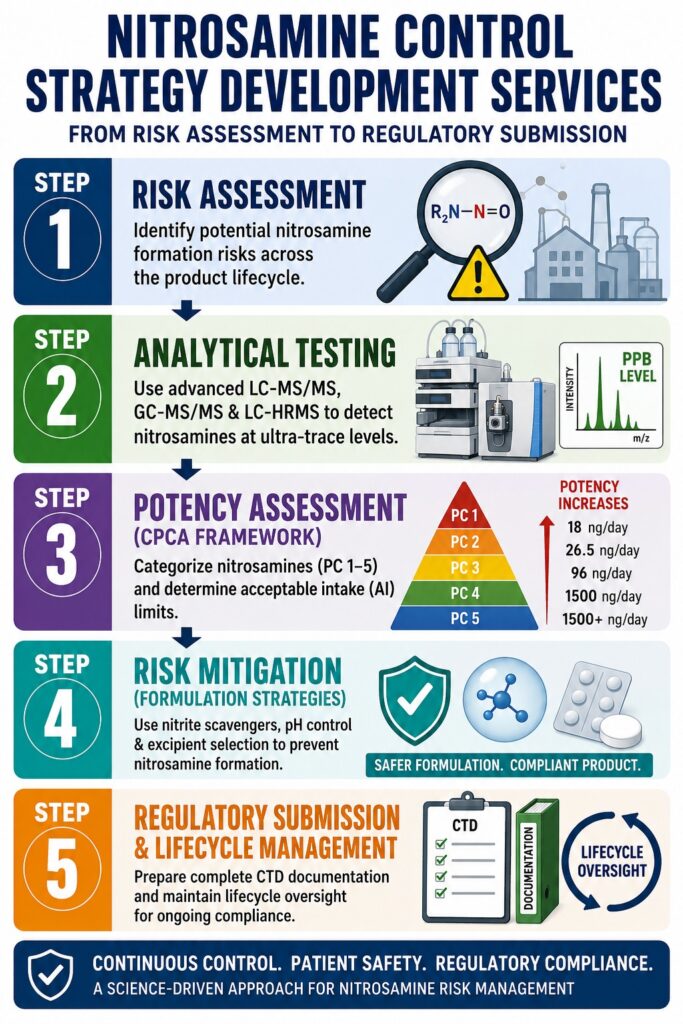
- Nitrosamine control begins with a comprehensive risk assessment that evaluates APIs, excipients, solvents, manufacturing processes, packaging, and storage conditions to identify potential sources of N-nitrosamine formation before products reach the market.
- Understanding the root causes of nitrosamine formation is essential because these impurities can develop when susceptible amines react with nitrosating agents such as nitrites under favorable processing or storage conditions, making proactive prevention a critical quality strategy.
- Highly sensitive analytical technologies including LC-MS/MS, GC-MS/MS, and LC-HRMS are used to detect nitrosamines at ultra-trace levels, ensuring compliance with global regulatory expectations and minimizing the risk of false-positive or false-negative results.
- The Carcinogenic Potency Categorization Approach (CPCA) supports regulatory decision-making by estimating the cancer risk of nitrosamine impurities based on their chemical structure and assigning appropriate acceptable intake (AI) limits when experimental toxicology data are unavailable.
- Formulation optimization can significantly reduce nitrosamine risk through careful excipient selection, the use of nitrite scavengers such as ascorbic acid, and strategies that limit nitrosation reactions during manufacturing and long-term product storage.
- Successful regulatory submissions require an integrated control strategy that combines scientific risk assessments, validated analytical methods, robust documentation, lifecycle management, and ongoing change control to satisfy FDA, EMA, and other international regulatory requirements.
- Continuous monitoring throughout the product lifecycle is essential to maintain compliance, protect patient safety, prevent costly product recalls, and ensure that any changes in materials, suppliers, equipment, or manufacturing processes are promptly evaluated for potential nitrosamine risk.
Comprehensive Risk Assessment in Nitrosamine Control Strategy Development Services
Risk assessment within Nitrosamine Control Strategy Development Services involves a systematic evaluation of chemical vulnerabilities and potential pathways that may lead to the formation of N-nitrosamines. This assessment includes a detailed review of active pharmaceutical ingredient structures, excipient nitrite content, solvent usage history, manufacturing operations, and equipment design. Under current global regulatory expectations, this process represents “Step 1” of the mandatory nitrosamine assessment program and determines whether confirmatory analytical testing is required or whether the product can be considered free from significant mutagenic risk. A comprehensive risk assessment evaluates the complete manufacturing process by tracking raw materials, processing conditions, environmental influences, packaging components, and storage conditions throughout the product’s entire shelf life.
Streamline your nitrosamine risk assessment for ANDA submissions with our expert support team.
The formation of nitrosamines depends on the simultaneous presence of a secondary or tertiary amine precursor together with a nitrosating agent under favorable reaction conditions, including acidic environments or elevated processing temperatures. During the risk assessment process, several major contributing factors are thoroughly investigated:
Precursor Amine Sources: Numerous active pharmaceutical ingredients, synthetic intermediates, and degradation products naturally contain secondary or tertiary amine functional groups that are highly susceptible to nitrosation reactions. Furthermore, commonly used amide solvents such as N,N-dimethylformamide (DMF) and N-methylpyrrolidone (NMP) may degrade under acidic manufacturing conditions to produce volatile secondary amines such as dimethylamine, which serves as a direct precursor for NDMA formation.
Nitrosating Species: Sodium nitrite (NaNO₂), nitrous acid (HNO₂), and different nitrogen oxides (NOₓ) are the principal nitrosating agents capable of reacting with susceptible amines to generate N-nitrosamines. Trace concentrations of nitrites present as impurities within commonly used pharmaceutical excipients, including microcrystalline cellulose, lactose, and crospovidone, are recognized as significant contributors to nitrosamine formation during wet granulation processes as well as throughout long-term storage under high-humidity conditions.
Environmental and Utility Vectors: Process water used during API manufacturing may introduce trace levels of nitrites, with potable water commonly containing concentrations of up to 3 ppb. In addition, nitrocellulose-containing primary packaging materials may release nitrosating substances through leachable components. Recycled or recovered solvents, particularly those processed by third-party recycling facilities using shared distillation systems, also represent a well-established source of cross-contamination capable of introducing nitrosamine precursors into pharmaceutical manufacturing processes.
Investigate nitrosamine formation pathways in API synthesis to proactively mitigate manufacturing risks.
Amine Vulnerability Evaluations within Nitrosamine Control Strategy Development Services
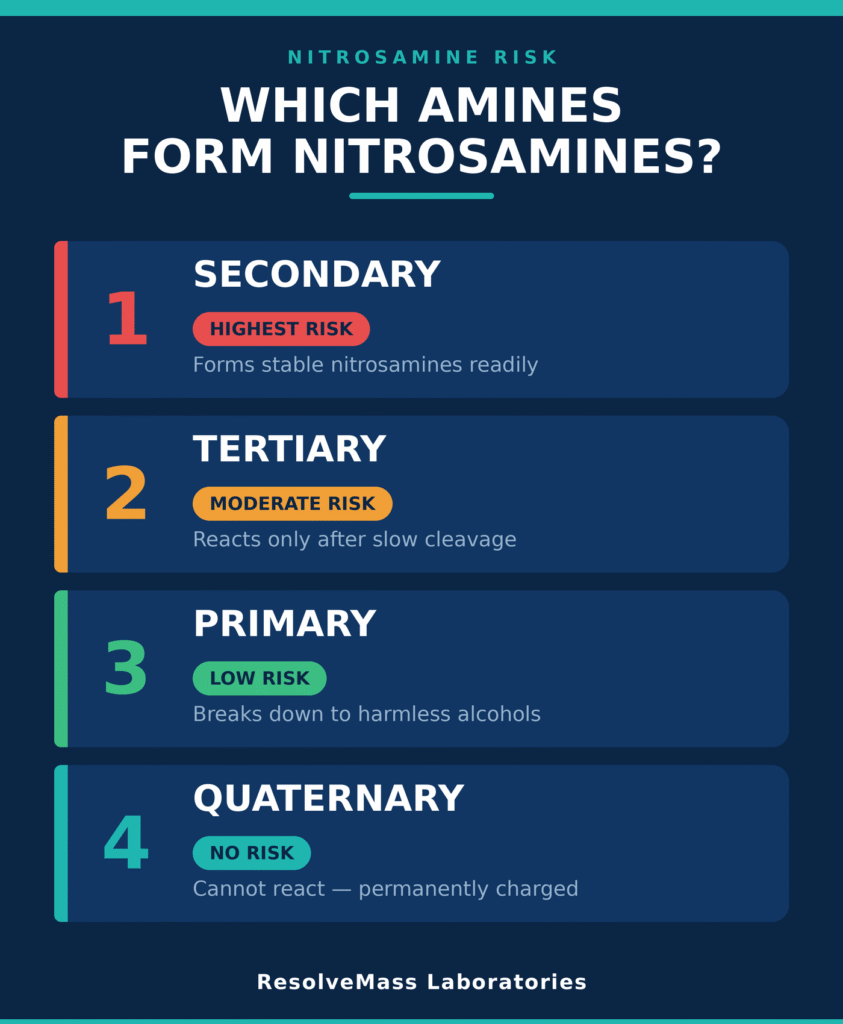
Amine vulnerability evaluations are conducted to determine whether active pharmaceutical ingredients, intermediates, raw materials, or related compounds contain secondary, tertiary, or quaternary amine structures that may undergo nitrosation reactions. Detailed chemical structure assessments examine the nucleophilicity of the amine nitrogen because this characteristic directly influences the rate and likelihood of nitrosation. Secondary amines exhibit the highest susceptibility to forming stable N-nitrosamines due to their chemical structure. In contrast, tertiary amines generally require slower and more complex cleavage reactions before nitrosated products can be generated. Primary amines interact with nitrosating agents to form highly unstable diazonium ions, which rapidly decompose into non-toxic alcohols rather than stable nitrosamines. Quaternary ammonium salts are coordinatively saturated and carry a permanent positive charge, preventing them from directly participating in nitrosation reactions.
Determine if your products require assessment via our nitrosamine risk assessment guide.
Excipient Trace Nitrites and Formulation Risk Factors
Excipient evaluation focuses on determining the concentration of trace inorganic nitrites present within inactive pharmaceutical ingredients to estimate the potential for solid-state nitrosamine formation during product storage. Although active pharmaceutical ingredients often remain chemically stable throughout synthesis, incorporation into a tablet formulation containing excipients with elevated trace nitrite concentrations, such as sodium starch glycolate or crospovidone, creates a continuous possibility for gradual nitrosamine formation during the product’s shelf life. To reduce these formulation-related risks, excipient manufacturers actively monitor and minimize nitrite concentrations in direct compression materials while also developing low-nitrite alternatives, including nitrogen-free mannitol, to reduce degradation pathways associated with nitrosamine generation.
Read about nitrosamine impurities in biologics and the unique challenges they present.
Analytical Method Validation under Nitrosamine Control Strategy Development Services
Analytical method validation performed under Nitrosamine Control Strategy Development Services demonstrates that chromatographic and mass spectrometric techniques possess the required sensitivity, selectivity, accuracy, and precision necessary to detect mutagenic impurities at ultra-trace concentrations within complex pharmaceutical matrices. Global regulatory agencies require all confirmatory analytical procedures to be validated in accordance with ICH Q2(R1) guidelines, with particular emphasis placed on achieving exceptionally low Limits of Detection (LOD) and Limits of Quantification (LOQ).
Outsource your needs to a specialized CRO for nitrosamine testing to ensure precise, regulatory-grade results.
To satisfy the extremely low quantitation limits established by international regulatory authorities, advanced analytical laboratories utilize highly sophisticated analytical platforms, including:
Liquid Chromatography-Tandem Mass Spectrometry (LC-MS/MS): This analytical platform remains the preferred gold standard for quantifying polar, thermally unstable, and high-molecular-weight Nitrosamine Drug Substance-Related Impurities (NDSRIs). Triple Quadrupole (QqQ) mass analyzers operating in Multiple Reaction Monitoring (MRM) mode together with Atmospheric Pressure Chemical Ionization (APCI) routinely deliver Limits of Quantification as low as 0.5 ppb, making the technique highly suitable for regulatory compliance testing.
Gas Chromatography-Tandem Mass Spectrometry (GC-MS/MS): GC-MS/MS is particularly effective for analyzing volatile, low-molecular-weight nitrosamines such as NDMA, NDEA, and N-nitrosodibutylamine (NDBA). The use of headspace GC-MS/MS significantly minimizes direct matrix injection, thereby reducing instrument contamination while simultaneously providing excellent separation and highly sensitive detection of volatile nitrosamine compounds.
High-Resolution Mass Spectrometry (LC-HRMS): LC-HRMS systems equipped with Orbitrap or Time-of-Flight (TOF) mass analyzers play a critical role in screening for multiple unknown impurities while resolving isobaric interferences that cannot be adequately separated using conventional analytical techniques. For example, LC-HRMS effectively distinguishes NDMA from DMF, preventing false-positive analytical results that may otherwise occur because of mass co-elution.
Access our nitrosamine method development and validation services for robust analytical performance.
FDA and Health Canada Recommended Testing Protocols
Regulatory agencies such as the FDA and Health Canada have established validated analytical testing protocols specifically designed to address different pharmaceutical products, drug classes, and nitrosamine volatility characteristics. Although manufacturers are not obligated to adopt the published regulatory methodologies, any alternative analytical procedure must undergo full validation under Good Manufacturing Practice (GMP) requirements and demonstrate equivalent or superior performance when compared directly with the established reference methods.
Learn more about nitrosamine testing for beta-blockers and other specific drug classes.
The table below summarizes the principal analytical methodologies recommended by the FDA for detecting specific nitrosamine impurities across various pharmaceutical substances and drug products.
| Drug Substance or Class | Target Nitrosamine Impurities | Recommended Analytical Method | Key Method Parameters & Technical Notes |
|---|---|---|---|
| Sartans (Valsartan, Losartan) | NDIPA, NEIPA, NDBA, NMBA | RapidFire-MS/MS | High-throughput screening methodology optimized for rapid analysis; comparatively lower sensitivity for NDMA and NDEA detection. |
| Sartans (Valsartan, Losartan) | NDMA, NDEA | Combined Headspace GC-MS | Simultaneous analysis of volatile nitrosamines while minimizing thermal degradation of the pharmaceutical matrix. |
| Sartans (Valsartan, Losartan) | NDMA, NDEA, NEIPA, NDIPA, NDBA, NMBA | LC-HRMS | High-resolution analytical technique capable of simultaneously separating and quantifying six critical nitrosamine impurities. |
| Bumetanide | N-Nitroso-Bumetanide | LC-ESI-HRMS | Specialized extraction methodology developed specifically for loop diuretic formulations with complex analytical matrices. |
| Propranolol | N-Nitroso-Propranolol | LC-ESI-HRMS | Reverse-phase chromatographic separation combined with electrospray ionization and high-resolution mass spectrometric detection. |
| Metformin | NDMA, NDEA, NEIPA, NDIPA, NDPA, NMPA, NDBA, NMBA | LC-ESI-HRMS | Multi-component analytical method capable of simultaneously screening eight nitrosamine impurities while eliminating interference from DMF in biguanide formulations. |
| Varenicline Tartrate | Varenicline NDSRI | LC-ESI-HRMS (Q Exactive) | Targeted Parallel Reaction Monitoring (PRM) method with an LOD of 0.2 ppm and an LOQ of 1.0 ppm, utilizing extracted ions m/z 211.1105 and 169.0762. |
Resolving Co-Elution and Matrix Challenges Using LC-HRMS
High-Resolution Mass Spectrometry (LC-HRMS) effectively addresses analytical challenges associated with matrix-induced spectral interferences and chromatographic co-elution by providing highly accurate mass measurements with a narrow tolerance range of approximately 1 to 5 ppm. During ultra-trace nitrosamine analysis, conventional mass spectrometers frequently encounter isobaric interference, a situation in which excipients, solvents, or other formulation components possess nearly identical nominal mass-to-charge ratios (m/z) as the target nitrosamine impurity. One well-recognized example involves the protonated NDMA ion and the ¹⁵N isotope of DMF, which differ in mass by only 21 ppm (0.002 amu). Successfully distinguishing these closely related signals requires a minimum instrument mass resolution of approximately 45,000, allowing accurate identification of NDMA while preventing false-positive analytical findings that could otherwise result in unnecessary product recalls and regulatory actions.
The Carcinogenic Potency Categorization Approach (CPCA) Framework
The Carcinogenic Potency Categorization Approach (CPCA) is a structured Structure-Activity Relationship (SAR) framework developed to estimate the carcinogenic potential of nitrosamine impurities when direct in vivo toxicological data are unavailable. This predictive methodology was established through collaboration with the Nitrosamine International Technical Working Group (NITWG) and has since been harmonized across major regulatory authorities, including the FDA, EMA, and Health Canada. The scientific foundation of the CPCA is based on the understanding that metabolic activation through α-hydroxylation represents the rate-limiting step responsible for nitrosamine-mediated DNA alkylation and the initiation of tumor formation.
The CPCA algorithm evaluates both the distribution of hydrogen atoms and the electronic characteristics of carbon atoms located immediately adjacent to the N-nitroso functional group. Using these structural characteristics, the framework generates a Potency Score that assigns each compound to one of five Potency Categories (PC 1 through PC 5). Each category corresponds to a predefined default human Acceptable Intake (AI) limit intended to guide regulatory risk assessment.
Potency Score = α-Hydrogen Score + Deactivating Feature Scores + Activating Feature Scores
The CPCA framework evaluates several important structural characteristics, including the following:
α-Hydrogen Features: The number and arrangement of hydrogen atoms attached to the carbon directly adjacent to the nitroso functional group are among the most important determinants of carcinogenic potency. Molecules that completely lack α-hydrogen atoms, such as structures exhibiting a 0,0 configuration with a tertiary α-carbon, cannot undergo the conventional metabolic activation pathway. As a result, these compounds are generally assigned to Potency Category 5 and receive a comparatively high default Acceptable Intake limit of 1500 ng/day.
Deactivating Features (Risk-Reducing): Structural elements such as significant steric hindrance, the presence of carboxylic acid or sulfonic acid functional groups, and neighboring electron-withdrawing substituents reduce the rate of metabolic activation. These characteristics increase the overall Potency Score and typically result in assignment to categories associated with higher Acceptable Intake limits.
Activating Features (Risk-Increasing): Structural characteristics including unhindered alkyl substituents, benzyl groups, and the absence of steric hindrance facilitate metabolic activation of nitrosamines. These features lower the Potency Score and generally place compounds into categories requiring much stricter Acceptable Intake limits, in some cases as low as 18 ng/day.
The following table summarizes the relationship between CPCA categories, predicted carcinogenic potency, corresponding default Acceptable Intake limits, characteristic structural features, and the recommended analytical strategy.
| CPCA Category | Predicted Potency | Default AI Limit (ng/day) | Typical Structural Features | Analytical Action Required |
|---|---|---|---|---|
| Category 1 | High | 18 | Unhindered 2,2 or 2,3 α-hydrogen configurations with activating benzyl substituents. | Ultra-trace LC-HRMS analysis supported by highly sensitive extraction procedures. |
| Category 2 | Moderate | 26.5 | Standard 1,3 or 2,3 α-hydrogen arrangements with minimal steric interference. | Standard LC-MS/MS methods with routine batch monitoring. |
| Category 3 | Intermediate | 96 | Balanced combination of activating and deactivating structural features commonly observed in alkyl and aryl nitrosamines. | Routine LC-MS/MS or appropriately validated GC-MS/MS analysis. |
| Category 4 | Low | 1500 | Bulky tertiary nitrosamine structures containing weak deactivating functional groups. | Routine HPLC testing together with periodic verification. |
| Category 5 | Negligible | 1500+ | Highly sterically hindered structures possessing 0,0 or 0,1 α-hydrogen configurations, including sulfonic acid-containing compounds. | Standard quality control procedures with routine specification verification. |
Whenever reliable rodent carcinogenicity data are available, including experimentally determined TD₅₀ values obtained from rat bioassays, the compound-specific Acceptable Intake (AI) value supersedes the default prediction generated by the CPCA framework. This approach allows regulatory decisions to be based on experimentally established carcinogenic potency rather than solely on structural prediction models. Examples of compound-specific Acceptable Intake limits established through toxicological assessment include the following:
- N-nitrosodimethylamine (NDMA): 96 ng/day
- N-nitrosodiethylamine (NDEA): 26.5 ng/day
- N-nitroso-atomoxetine: 100 ng/day (derived using NNK as a surrogate)
- N-nitroso-duloxetine: 100 ng/day (derived using NNK as a surrogate, with an interim limit established at 600 ng/day)
- N-nitroso-piperazine (NPZ): 1300 ng/day (derived using N-nitrosopiperidine as a surrogate)
- N-nitroso-vonoprazan: 96 ng/day (derived using NDMA as a surrogate)
Formulation Reformulation and Risk Mitigation Strategies
Formulation-based risk mitigation strategies utilize carefully selected functional excipients, including nitrite scavengers and pH-modifying agents, to interrupt nitrosation reactions and minimize the formation of nitrosamines during long-term storage of pharmaceutical products. These stabilization approaches provide manufacturers with a practical solution for achieving regulatory compliance, particularly when modifying the active pharmaceutical ingredient (API) synthesis process is either technically impractical or economically prohibitive. Preventing solid-state nitrosation has therefore become a fundamental element of comprehensive Nitrosamine Control Strategy Development Services.
Discover effective nitrosamine reformulation strategies to stabilize your products.
The Integration of Nitrite Scavengers and Excipient Selection
The incorporation of selected antioxidants, including ascorbic acid, alpha-tocopherol, and cysteine hydrochloride, has proven to be an effective strategy for scavenging nitrites and suppressing nitrosamine generation. Among these compounds, ascorbic acid functions as a sacrificial reactant by rapidly reacting with nitrous acid and converting it into nitric oxide, thereby preventing nitrosation reactions involving susceptible secondary and tertiary amines.
Efficacy at Low Concentrations: Laboratory investigations and clinical studies have demonstrated that ascorbic acid can significantly reduce nitrosamine formation in tablet formulations even when incorporated at relatively low concentrations ranging from 0.25% to 1.0%.
Homogeneity of Distribution: Maximizing the effectiveness of nitrite scavengers depends on achieving a highly uniform distribution of ascorbic acid throughout the excipient blend. Comparative research has shown that wet blending techniques provide considerably better distribution than conventional dry mixing methods, improving the interaction between the scavenger and trace nitrite impurities.
Chemical Compatibility and Stability Constraints: Despite its demonstrated effectiveness, the use of ascorbic acid is associated with certain formulation limitations. The compound is inherently unstable over extended storage periods and may undergo degradation under accelerated stability conditions involving elevated temperature and humidity, leading to tablet discoloration or browning. In addition, ascorbic acid may chemically interact with specific active pharmaceutical ingredients to generate new API-related degradation products, requiring additional structural characterization and toxicological qualification before regulatory acceptance.
Alternative Bioequivalence Approaches for Reformulated Products
Reformulated pharmaceutical products containing relatively small quantities of antioxidants may qualify for alternative in vitro bioequivalence pathways, eliminating the need for costly fasting or fed clinical bioequivalence studies. To encourage rapid implementation of formulation-based nitrosamine mitigation strategies, regulatory authorities, including the FDA through its September 2024 guidance, have introduced alternative regulatory pathways supporting qualifying reformulated products.
The regulatory requirements and eligibility criteria for bioequivalence waivers differ considerably among the various categories of the Biopharmaceutics Classification System (BCS).
BCS Class I (High Solubility, High Permeability): Products within this category are highly favorable candidates for bioequivalence waivers. Immediate-release solid oral dosage forms reformulated with commonly accepted nitrite scavengers, including ascorbic acid, alpha-tocopherol, propyl gallate, or cysteine hydrochloride at doses of 10 mg or less per unit, may demonstrate bioequivalence using comparative in vitro dissolution testing across multiple physiological pH conditions.
BCS Class II (Low Solubility, High Permeability): Drug products in this category may also qualify for bioequivalence waivers provided that rapid dissolution characteristics are maintained throughout the relevant physiological pH range. Regulatory evaluation generally involves comparison of the reformulated product’s in vitro dissolution profile with that of the originally approved reference formulation.
BCS Class III (High Solubility, Low Permeability): These products are likewise eligible for bioequivalence waivers because available research indicates that the incorporation of small concentrations of antioxidants does not significantly alter the in vitro permeability or transport characteristics of Class III drug substances.
BCS Class IV (Low Solubility, Low Permeability): This category presents the greatest challenge for obtaining dissolution-based bioequivalence waivers. Since drug absorption characteristics are inherently unpredictable, even relatively minor modifications to excipients or manufacturing processes may substantially influence clinical bioavailability. Consequently, Class IV drug products generally require comprehensive in vivo clinical bioequivalence studies. However, advanced Physiologically Based Pharmacokinetic (PBPK) modeling together with scientifically justified risk-based dissolution profiling may, in selected situations, provide an alternative regulatory pathway.
Regulatory Submission Workflows and Lifecycle Management
Regulatory submissions require a comprehensive and well-documented integration of risk assessments, confirmatory analytical testing results, and scientifically justified control strategies within the Common Technical Document (CTD). For approved pharmaceutical products, manufacturers were required to complete and submit Step 1 nitrosamine risk assessments by March 31, 2021, followed by execution of Step 2 confirmatory analytical testing. The regulatory deadline for implementing and submitting manufacturing or formulation modifications identified during Step 3, including submissions through mechanisms such as Post-Approval Supplements (PAS) or Changes Being Effected (CBE-30), is August 1, 2025, for products containing chemical APIs and August 1, 2025, for biological and radiopharmaceutical products.
Contemporary regulatory submissions increasingly incorporate artificial intelligence (AI) technologies together with predictive computational toxicology tools to improve the efficiency of risk characterization while satisfying regulatory expectations. AI-driven methodologies, including Quantitative Structure-Activity Relationship (QSAR) models, Graph Neural Networks (GNNs), and automated potency prediction software, evaluate complex chemical pathways to determine the likelihood of nitrosamine formation within pharmaceutical products. During real-world root-cause investigations, such as those examining NDMA contamination in metformin products, predictive AI models establish relationships between solvent impurities, manufacturing variables, and formulation characteristics. These capabilities enable manufacturers to optimize synthetic processes, perform virtual supplier qualification assessments, and enhance audit readiness while reducing development timelines.
Stay ahead of deadlines with our nitrosamine testing timeline overview.
Regulatory Inspection Alignments and Appendix 1 Focus
Modern Good Manufacturing Practice (GMP) inspections place significant emphasis on the scientific justification supporting a manufacturer’s nitrosamine control strategy, the identification of realistic formation mechanisms, and the maintenance of continuous lifecycle management as suppliers, materials, or manufacturing processes change over time. Under the European Medicines Agency’s updated Appendix 1 guidance, regulatory inspectors generally assess nitrosamine compliance by examining four essential operational components.
Step 1: Risk Scenario Identification
Inspectors evaluate manufacturing process design, raw material sourcing practices, historical process modifications, and supporting scientific documentation to verify that identified nitrosamine risks accurately reflect actual manufacturing operations and product lifecycle conditions.
Step 2: Control Strategy Evaluation
During this stage, inspectors critically assess the scientific basis supporting the manufacturer’s analytical testing strategy, including the appropriateness of the selected analytical methods, demonstrated Limits of Detection (LOD), Limits of Quantification (LOQ), and the frequency established for routine batch monitoring.
Step 3: Lifecycle Oversight Review
Regulatory authorities verify that any changes involving raw material suppliers, manufacturing facilities, production equipment, utilities, or processing conditions automatically trigger a formal retrospective nitrosamine risk reassessment as part of an effective pharmaceutical quality system.
Step 4: Documentation Consistency Check
Inspectors conduct detailed cross-comparisons of batch manufacturing records, stability study data, validation reports, change control documentation, and regulatory submissions to ensure complete technical consistency across all functional departments involved in pharmaceutical development and manufacturing.
Nitrosamine compliance should therefore be regarded as an ongoing and continuously managed process rather than a one-time documentation exercise. Pharmaceutical manufacturers are expected to maintain comprehensive change control systems capable of immediately identifying modifications involving raw material suppliers, water purification systems, cleaning procedures, manufacturing equipment, or production processes. Continuous monitoring ensures that the nitrosamine risk profile remains effectively controlled throughout the entire commercial lifecycle of the product.
Conclusion
In summary, implementing scientifically driven Nitrosamine Control Strategy Development Services provides pharmaceutical companies with the most dependable approach for addressing the increasingly complex scientific and regulatory challenges associated with N-nitroso impurities. As international regulatory expectations continue to evolve and compliance deadlines become increasingly stringent, the establishment of structured risk assessment, analytical testing, and formulation mitigation programs is essential for preventing product recalls, avoiding market interruptions, and protecting patient safety.
ResolveMass Laboratories Inc. supports pharmaceutical and biotechnology organizations worldwide by delivering advanced mass spectrometry services, computational toxicological assessments, and ISO-certified analytical method validation. As an FDA-registered testing facility (Establishment Identifier No. 3042696771), ResolveMass utilizes advanced high-resolution analytical instrumentation, including the Thermo Orbitrap Q Exactive Plus and the Sciex 5600 TOF, together with fully validated analytical workflows to generate the high-quality scientific data required for regulatory submissions. Pharmaceutical sponsors seeking assistance with custom analytical method validation, nitrosamine risk characterization, or formulation stabilization can initiate project consultations directly through the ResolveMass Laboratories Inc. Contact Page.
Frequently Asked Questions (FAQs)
A comprehensive nitrosamine risk assessment is required for medicinal products containing chemically synthesized or semi-synthetic APIs, as well as certain biological products that include chemically synthesized components. The assessment should evaluate every possible source of nitrosamine formation throughout the product lifecycle. This includes raw materials, solvents, excipients, manufacturing equipment, packaging materials, production processes, and storage conditions. The objective is to identify and control potential risks before they affect product quality or patient safety.
The Carcinogenic Potency Categorization Approach (CPCA) estimates the carcinogenic potential of a nitrosamine by analyzing specific structural characteristics of the molecule. The evaluation considers the α-hydrogen score together with structural features that either increase or decrease carcinogenic activity. Based on the resulting potency score, the impurity is assigned to a potency category with a corresponding Acceptable Intake (AI) limit. Higher potency scores generally indicate a lower predicted carcinogenic risk and allow higher regulatory exposure limits.
Regulatory authorities require analytical methods used for confirmatory testing to demonstrate exceptionally high sensitivity. The validated Limit of Quantification (LOQ) should be at or below the established Acceptable Intake (AI) level for the specific nitrosamine being measured. When analytical testing is intended to justify removing a routine product specification, the required LOQ is even more stringent and should not exceed 10% of the calculated AI based on the product’s maximum daily dose. These requirements ensure accurate detection of ultra-trace impurities.
Theoretical purge calculations, including approaches such as the Teasdale model, provide scientific evidence that manufacturing processes may effectively remove nitrosamine impurities. However, regulatory authorities generally consider these calculations insufficient when used alone because they are based on predictive assumptions rather than experimental confirmation. They do not account for contamination introduced during later manufacturing stages, cross-contamination from shared production equipment, or nitrosamine formation during product storage. For this reason, regulators usually require supporting analytical data to verify actual product safety.
Trace levels of nitrites are naturally present as impurities in several commonly used pharmaceutical excipients, including microcrystalline cellulose, starch, and lactose. When these excipients are combined with APIs containing reactive secondary or tertiary amines, moisture and acidic conditions may convert nitrites into reactive nitrosating species such as nitrous acid (HNO₂) or dinitrogen trioxide (N₂O₃). These reactive compounds can gradually form Nitrosamine Drug Substance-Related Impurities (NDSRIs) throughout the product’s shelf life. As a result, careful excipient selection and nitrite monitoring play a significant role in formulation development.
Ascorbic acid is widely recognized as an effective nitrite scavenger and can significantly reduce nitrosamine formation even at relatively low concentrations, typically between 0.25% and 1.0%. Despite its effectiveness, the compound is susceptible to oxidation and chemical degradation during long-term storage, particularly under elevated temperature and humidity conditions. This instability may lead to tablet discoloration, commonly observed as browning, and may also result in interactions with certain APIs that produce additional degradation products. These newly formed impurities often require further structural characterization and toxicological evaluation.
The Biopharmaceutics Classification System (BCS) helps determine whether reformulated drug products may qualify for alternative bioequivalence approaches. According to the FDA’s revised September 2024 guidance, immediate-release formulations classified as BCS Class I, II, or III may qualify for in vitro bioequivalence studies when formulation changes involve approved scavengers or pH modifiers. Comparative multi-pH dissolution testing demonstrating rapid drug release can replace clinical studies in many cases. Products categorized as BCS Class IV generally require more extensive clinical evaluation because of their low solubility and permeability characteristics.
When stability testing confirms that nitrosamine concentrations exceed the established Acceptable Intake (AI) limit, the manufacturer must promptly notify the appropriate regulatory authority and initiate a comprehensive investigation. This process typically includes an Out-of-Specification (OOS) investigation to identify the root cause of contamination. Corrective and Preventive Actions (CAPAs) are then implemented to eliminate the identified source of risk. Depending on the severity of the findings, additional formulation modifications, packaging changes, or voluntary product recalls may also be required to protect patient safety.
Artificial intelligence has become an increasingly valuable tool for identifying and managing nitrosamine risks during pharmaceutical development. Technologies such as Quantitative Structure-Activity Relationship (QSAR) models, predictive reaction databases, and machine learning algorithms can evaluate chemical structures and forecast potential nitrosamine formation pathways before laboratory testing begins. These tools also help identify contamination sources by modeling solvent degradation, excipient-API interactions, and manufacturing variables. As a result, generic drug manufacturers can prioritize analytical testing, optimize formulations more efficiently, and reduce both development costs and the likelihood of future product recalls.
Reference:
- European Medicines Agency. (n.d.). Nitrosamine impurities. https://www.ema.europa.eu/en/human-regulatory-overview/post-authorisation/referral-procedures-human-medicines/nitrosamine-impurities
- Health Canada. (2026, May 29). Nitrosamine impurities in medications: Guidance. Government of Canada. https://www.canada.ca/en/health-canada/services/drugs-health-products/compliance-enforcement/information-health-product/drugs/nitrosamine-impurities/medications-guidance.html
- Zhang, Y., Widart, J., Ziemons, E. M., Hubert, P., & Hubert, C. (2025). N-nitrosamine risk assessment in pharmaceuticals: Where are we from a regulatory point of view in 2025? Journal of Pharmaceutical and Biomedical Analysis Open, 6, 100084. https://doi.org/10.1016/j.jpbao.2025.100084
- Kroll, S., Schmidtsdorf, J., Strohbach, A., Holzgrabe, U., & Keizers, P. H. J. (2025). Quantitative investigation of nitrosamine drug substance-related impurities (NDSRIs) under artificial gastric conditions by liquid chromatography–tandem mass spectrometry and structure–activity relationship analysis. Journal of Pharmaceutical Sciences. Advance online publication. https://pmc.ncbi.nlm.nih.gov/articles/PMC12401632/
- U.S. Food and Drug Administration. (2025). Nitrosamine impurities: Resources [Presentation]. U.S. Department of Health and Human Services. https://www.fda.gov/media/189240/download
- U.S. Food and Drug Administration. (n.d.). CDER nitrosamine impurity acceptable intake limits. U.S. Department of Health and Human Services. https://www.fda.gov/regulatory-information/search-fda-guidance-documents/cder-nitrosamine-impurity-acceptable-intake-limits
- United States Pharmacopeia. (2024, February 26). FDA updated information on recommended AI for NDSRIs (23/Feb/2024) – Tables 2 & 3. Nitrosamines Exchange. https://nitrosamines.usp.org/t/fda-updated-information-on-recommended-ai-for-ndsris-23-feb-2024-tables-2-3/9323
Get In Touch With Us
About The Author