
Peptide CDMO vs. CMO: Which Does Your Program Actually Need?
 By Anusha Sinha
•
July 22, 2026
By Anusha Sinha
•
July 22, 2026
# Introduction
Evaluating a Peptide CDMO vs. CMO requires determining whether a drug candidate still requires synthetic route development, analytical validation, and regulatory filing support, which are typically provided by a CDMO, or whether it is ready for fixed, high-throughput commercial batch execution at scale, which aligns more closely with a CMO model. Programs progressing from preclinical discovery through Phase III clinical trials generally benefit from the integrated capabilities of a CDMO, while fully commercialized molecules with established critical process parameters (CPPs) are often better suited to the operational efficiency of a CMO.
Within the modern biopharmaceutical development environment, selecting between a contract development partner and a contract manufacturing partner is one of the most important risk-mitigation decisions faced by biopharmaceutical sponsors. As increasingly complex peptide therapeutics, including multi-target GLP-1 receptor agonists, cyclic peptides, stapled sequences, and peptide-drug conjugates (PDCs), continue to reshape global development pipelines, manufacturing capacity is experiencing increasing operational pressure. The decision to collaborate with a Contract Development and Manufacturing Organization (CDMO) or a traditional Contract Manufacturing Organization (CMO) has a direct effect on development timelines, regulatory filing outcomes, unit economics, and supply chain security throughout the product lifecycle.
Need expert development support for your pipeline? Explore how partnering with a pharmaceutical CDMO in the US and Canada can streamline your program from early discovery to scale-up.
Scaling a peptide from milligram-level discovery batches to multi-kilogram or metric-ton commercial campaigns requires the management of complex synthetic and analytical challenges. Peptides occupy a specialized chemical space between conventional small molecules and large biologics and may require Solid Phase Peptide Synthesis (SPPS), Liquid Phase Peptide Synthesis (LPPS), or hybrid synthetic approaches. Regulatory authorities, including the U.S. FDA, the European Medicines Agency (EMA), and Health Canada, have also increased their scrutiny of sequence-related impurities, D-amino acid racemization, and aggregation-induced immunogenicity. Meeting these regulatory expectations requires sponsors to understand clearly when integrated process engineering capabilities are necessary and when dedicated contract manufacturing capacity is more appropriate.
Still Unsure Whether Your Peptide Program Needs a CDMO or CMO?
Whether you need process development, analytical support, scale-up, or manufacturing expertise, our team can help you determine the most appropriate partner model for your needs.
Contact UsArticle Summary Key Takeaways
- Peptide CDMOs and CMOs serve different roles: CDMOs focus on synthetic route development, process optimization, analytical validation, regulatory support, and manufacturing, while CMOs primarily execute established and validated manufacturing processes at scale.
- Early-stage peptide programs generally benefit from CDMO support: Preclinical and Phase I/II programs often involve evolving synthetic routes, unknown impurity profiles, and developing analytical methods, making process development and technical optimization essential.
- Late-stage and commercial programs may be better suited to CMOs: Once the manufacturing process is validated, critical process parameters (CPPs) are established, and master batch records are locked, high-capacity CMOs can provide efficient large-scale production.
- The appropriate synthesis strategy depends on peptide complexity: SPPS, LPPS, hybrid synthesis, and recombinant or fermentation-based approaches may be selected according to sequence length, structural complexity, scale requirements, and impurity-control needs.
- Complex modifications require specialized development expertise: Lipidation, PEGylation, macrocyclization, and peptide-drug conjugation can introduce additional challenges involving protecting-group strategies, linker stoichiometry, disulfide folding, aggregation, and analytical characterization.
- Comprehensive analytical characterization is essential for regulatory compliance: Techniques including RP-HPLC, LC-MS/MS, NMR, qNMR, HIC, CE, GC-MS, Karl Fischer analysis, and forced degradation studies help evaluate peptide identity, purity, impurities, structure, stability, and physicochemical properties.
- Choosing the right partner at the right development stage reduces risk: Aligning the partner’s capabilities with the peptide’s synthetic maturity, analytical readiness, clinical phase, regulatory requirements, and commercial scale needs can help prevent batch failures, minimize technology-transfer challenges, support regulatory submissions, and maintain reliable manufacturing timelines.
# Core Operational Scope: Peptide CDMO vs. CMO Differences
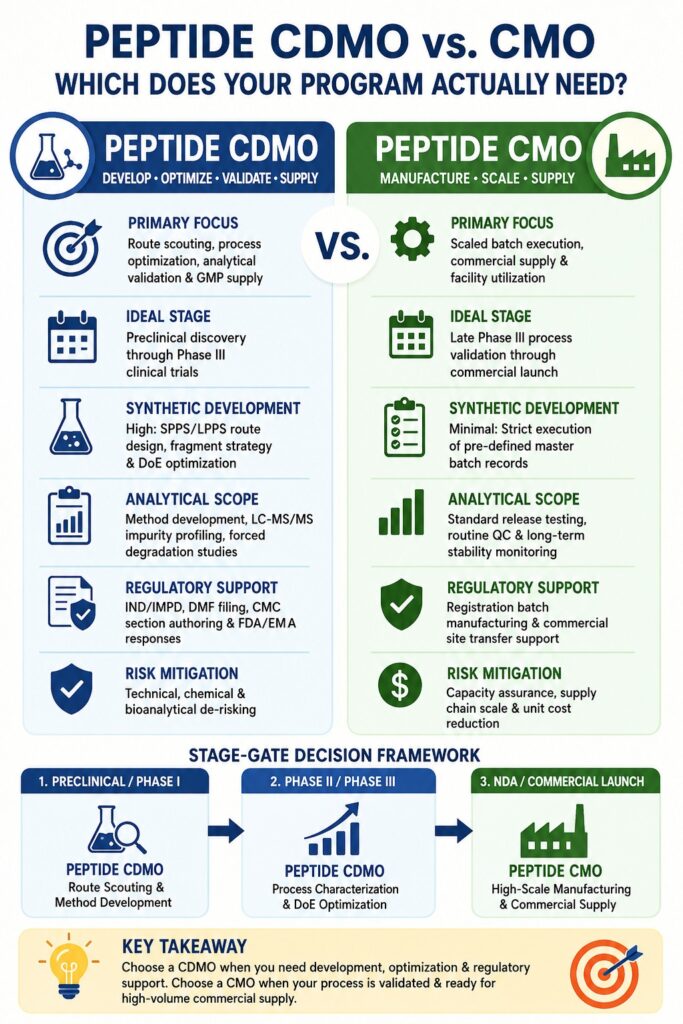
The fundamental operational distinction between a Peptide CDMO vs. CMO is that a CDMO develops, optimizes, and validates the manufacturing process, whereas a CMO primarily executes an established and validated manufacturing process. A CDMO helps reduce risks associated with early-stage chemistry and analytical development, while a CMO is generally focused on maximizing plant throughput and improving unit-cost efficiency for commercial supply.
A Peptide CDMO supports programs across multiple stages of the drug development lifecycle. Its activities may include initial synthetic route scouting, Process Optimization through Design of Experiments (DoE), Critical Process Parameter (CPP) definition, and analytical method validation according to ICH Q2(R1) guidelines. In comparison, a pure Peptide CMO typically works under a tech-transfer model in which the synthetic route, critical quality attributes (CQAs), and master batch records (MBRs) have already been comprehensively defined and validated by the sponsor.
Evaluating your outsourcing model? Compare organizational frameworks with this deep-dive guide on peptide CDMO vs CRO to determine the right operational fit for your team.
| Operational Dimension | Peptide CDMO | Peptide CMO |
|---|---|---|
| Primary Focus | Route scouting, process optimization, analytical validation, and GMP supply | Scaled batch execution, commercial supply, and facility utilization |
| Entry Stage | Preclinical discovery through Phase III clinical trials | Late Phase III process validation through commercial launch |
| Synthetic Development | High: SPPS/LPPS route design, fragment strategy, and DoE optimization | Minimal: Strict execution of pre-defined master batch records |
| Analytical Scope | Method development, LC-MS/MS impurity profiling, forced degradation studies | Standard release testing, routine QC, and long-term stability monitoring |
| Regulatory Support | IND/IMPD, DMF filing, CMC section authoring, and FDA/EMA responses | Registration batch manufacturing and commercial site transfer support |
| Program Risk Mitigation | Technical, chemical, and bioanalytical de-risking | Capacity assurance, supply chain scale, and unit cost reduction |
Swipe horizontally to view the full table on smaller screens.
Transferring an unoptimized synthetic process to a pure CMO too early can result in poor coupling yields, difficult-to-control deletion sequence impurities, and unexpected batch failures. CDMOs help reduce these risks by establishing robust process controls and improving the manufacturing process before commercial-scale production begins.
# Stage-Gate Decision Framework for Peptide CDMO vs. CMO Selection
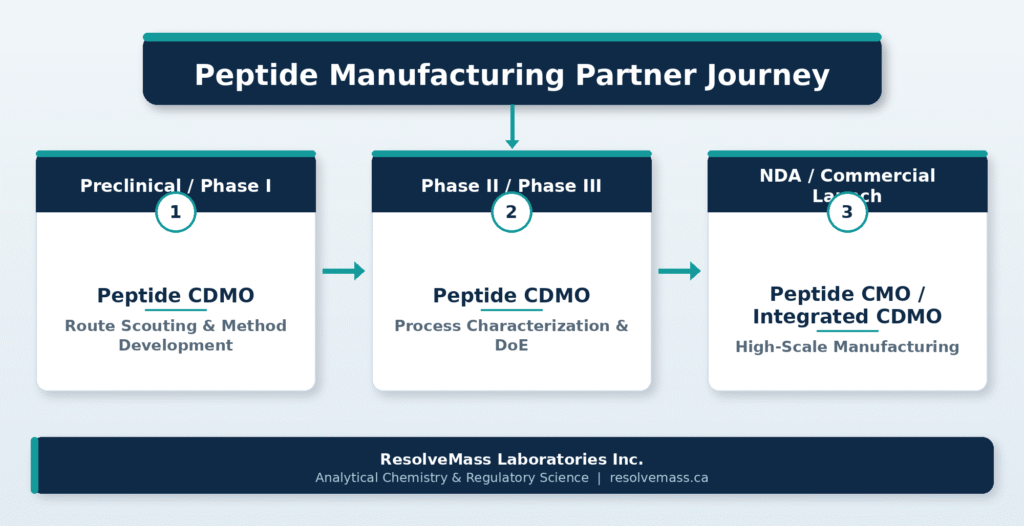
Determining whether a program requires a Peptide CDMO vs. CMO depends largely on the maturity of the clinical program, the stability and reproducibility of the synthetic route, and the extent to which analytical testing methods have been developed and validated. Selecting a CMO before process parameters have been adequately established can create significant delays in the development timeline. Conversely, continuing to use a highly development-focused CDMO model throughout the commercial manufacturing phase may increase unit production costs unnecessarily.
Early-Stage Development: Why Preclinical and Phase I/II Programs Require a CDMO
Early-stage peptide development programs generally require the capabilities of a CDMO because their synthetic routes may still be undergoing optimization, impurity profiles may not yet be fully characterized, and analytical methods often need to be developed and validated.
During the initial stages of candidate selection, synthetic routes commonly depend on standard research-grade stepwise SPPS procedures that use high excess ratios of reagents. A Peptide CDMO can systematically improve these processes by evaluating resin linkers, protecting group strategies (Fmoc vs. Boc), and coupling reagents to minimize side reactions such as racemization and aspartimide formation. In addition, the production of early clinical supplies requires comprehensive bioanalytical development. CDMOs use high-resolution Liquid Chromatography–Mass Spectrometry (LC-MS/MS) to identify deletion sequences, truncated fragments, and oxidation variants. These studies support the establishment of batch release specifications needed for Investigational New Drug (IND) applications.
Launching an early-phase candidate? Learn how specialized peptide drug development CDMO solutions guide assets smoothly through early clinical gates.
Late-Stage Characterization and Commercial Transfer to a CMO
Late-stage commercial scale-up requires the transition to a high-capacity CMO or an integrated CDMO with the ability to operate large-scale reactors and continuous purification equipment.
As a therapeutic candidate advances toward Phase III and pivotal registration trials, the primary focus shifts toward comprehensive process characterization. This stage includes establishing proven acceptable ranges (PARs) for reaction times, temperatures, and raw material purity through Design of Experiments (DoE). After process validation has been completed and regulatory filings (NDA/ANDA) have received approval, contract manufacturing activities increasingly focus on equipment utilization, resin lifetime, solvent recovery, and the consistent production of reliable multi-kilogram batches.
Accelerate your go-to-market timelines: Discover how to leverage CDMO to accelerate generic drug development in the US and Canada for efficient late-stage scale-up.
# Chemical Modalities and Synthesis Engineering Strategy
Selecting the most appropriate peptide manufacturing route requires the sequence length, hydrophobic properties, and structural modifications of the peptide to be matched with the capabilities of SPPS, LPPS, or hybrid condensation platforms.
The selected synthetic modality has a direct influence on capital expenditure, raw material consumption, and downstream purification requirements. Stepwise SPPS offers rapid production and automation capabilities for sequences of up to 50 amino acids. LPPS is particularly advantageous for the multi-kilogram manufacturing of short peptides ranging from 2–15 amino acids because it can reduce solvent consumption and enable the use of intermediate crystallization steps. For complex long-chain peptides exceeding 40 residues, hybrid synthesis, which involves coupling SPPS-generated fragments in solution, can provide improved overall yields and cleaner impurity profiles.
| Synthesis Modality | Optimal Sequence Length | Automation & Scale Potential | Purification Strategy | Primary Cost Drivers | Common Impurity Challenges |
|---|---|---|---|---|---|
| Stepwise SPPS | 10–50 amino acids | Fully automated; mg to 100+ kg scale | Preparative reverse-phase HPLC | Solvents (DMF, NMP), resins, and protected amino acids | Deletion sequences, truncated fragments, and racemization |
| LPPS | 2–15 amino acids | Manual/semi-automated; multi-kg to multi-ton | Intermediate crystallization and extraction | Labor, batch isolation steps, and process engineering | Process-related organic impurities and residual reagents |
| Hybrid (SPPS + Solution) | 40+ amino acids | Partial automation; kg to multi-ton scale | Intermediate isolation and final prep-HPLC | Fragment strategy development and coupling chemistry | C-terminal modifications and incomplete fragment coupling |
| Recombinant / Fermentation | >50 amino acids / proteins | Fermentation-based scale; high volume | Downstream filtration and chromatography | Media components, strain optimization, and bio-purification | Host cell proteins and post-translational variants |
Swipe horizontally to view the full table on smaller screens.
Navigating Complex Modifications and Lipidation Challenges
Advanced peptide modifications, including lipidation, PEGylation, macrocyclization, and conjugation, require specialized CDMO development capabilities to preserve structural stability and minimize the risk of non-native aggregation.
Modern therapeutic peptides, including long-acting GLP-1 receptor agonists, frequently use side-chain fatty-acid acylation to promote albumin binding and extend plasma half-life. Implementing these regioselective modifications while maintaining acceptable yields requires carefully designed protecting-group strategies and specialized orthogonal analytical monitoring. Similarly, cyclic peptides and peptide-drug conjugates (PDCs) require rigorous evaluation of disulfide folding patterns and linker stoichiometry to minimize the formation of immunogenic aggregates during scale-up and manufacturing.
# Bioanalytical Characterization and Regulatory Compliance Architecture
Regulatory approval of therapeutic peptides requires orthogonal analytical workflows that can identify, quantify, and control product- and process-related impurities in accordance with ICH Q6B and EMA guidelines.
Regulatory agencies have progressively strengthened expectations for peptide purity and comprehensive impurity profiling. A standard single-method HPLC analysis is generally insufficient to establish complete product quality. A comprehensive bioanalytical package must therefore combine high-resolution MS, Nuclear Magnetic Resonance (NMR), and complementary chromatographic separation strategies.
- Primary & Secondary Structure Verification: High-performance Liquid Chromatography–Mass Spectrometry (LC-MS/MS) is used for exact mass determination and sequence confirmation, while disulfide bond mapping supports the evaluation of disulfide connectivity. Quantitative NMR (qNMR) can additionally support structural elucidation and the determination of absolute purity.
- Impurity & Variant Profiling: Reverse-phase HPLC (RP-HPLC), together with Hydrophobic Interaction Chromatography (HIC) and Capillary Electrophoresis (CE), can be used to separate and characterize deletion sequences, diastereomers, insertion fragments, and beta-amyloid-like aggregations.
- Solid-State & Physico-Chemical Controls: Comprehensive control strategies may include counter-ion quantification, such as acetate vs. trifluoroacetate exchange, Karl Fischer moisture analysis, residual solvent profiling using GC-MS, and structural evaluation of the lyophilization cake.
- Stability & Stress Degradation Protocols: Forced degradation studies involving thermal, photolytic, oxidative, and acidic/basic hydrolysis conditions are conducted under accelerated storage conditions in accordance with ICH Q1A(R2) standards.
Operating within verified quality management frameworks, including Health Canada Drug Establishment Licences (DEL), FDA registrations, and ISO certifications, helps ensure that characterization data can withstand scientific and regulatory evaluation during IND, NDA, and ANDA filings.
Need deeper analytical clarity? Review advanced methodologies for sequence identification with peptide analytical characterization services.
# Strategic Selection Matrix: Aligning Program Goals with Partner Capabilities
Selecting the most suitable manufacturing and development partner requires an assessment of the program phase, internal technical maturity, regulatory complexity, and long-term manufacturing objectives.
One of the most common challenges in biopharmaceutical development is transferring an inadequately optimized synthetic process to a commercial CMO before the process is ready for scale-up. When process controls have not been fully established, scale-up activities may result in batch failures, difficult-to-resolve deletion impurities, and unexpected regulatory holds. In contrast, remaining within an early-stage development model during late-stage commercialization can limit access to high-volume manufacturing infrastructure and increase production costs.
Navigating cross-border submissions? Learn more about securing comprehensive regulatory support for generic drugs with a US and Canada CDMO.
| Program Status & Molecular Attributes | Recommended Model | Primary Operational Action |
|---|---|---|
| Unvalidated route or low coupling yields | Peptide CDMO | Conduct synthetic route scouting, DoE process optimization, and solvent screening |
| Complex modifications (lipidation, cyclic, PDC) | Specialized Peptide CDMO | Develop specialized coupling chemistry, orthogonal characterization, and folding protocols |
| Phase I/II clinical trial supply | Integrated CDMO | Execute GMP clinical batch manufacturing, method validation, and IND/IMPD documentation |
| Validated process with locked MBRs | Peptide CMO | Transfer the process, optimize reactor occupancy, and execute scaled batch production |
| High-volume commercial demand (multi-kg) | Commercial CMO / Large CDMO | Utilize large-capacity SPPS/LPPS infrastructure, prep-HPLC, and automated lyophilization |
| Generic peptide filing (ANDA submission) | Specialized Bioanalytical CDMO | Conduct head-to-head structural characterization, qNMR, and LC-MS comparability studies against RLDs |
Swipe horizontally to view the full table on smaller screens.
# Conclusion: Making the Right Choice for Your Peptide CDMO vs. CMO Partner
Selecting between a Peptide CDMO vs. CMO requires aligning the synthetic maturity and analytical readiness of the drug candidate with the strategic capabilities of the selected partner.
Early-stage, highly modified, and structurally complex peptide programs require the flexible process development capabilities, analytical method validation, and regulatory support offered by a CDMO. As a program advances toward commercial manufacturing, transitioning to a high-capacity CMO or integrated CDMO can support cost-effective, multi-kilogram production while maintaining continuous quality control. Establishing rigorous bioanalytical characterization strategies early in development helps sponsors reduce manufacturing scale-up risks, meet global regulatory expectations, and protect clinical development timelines.
Ready to find the ideal development partner? Connect with the best peptide CDMO to discuss your technical specifications, scale requirements, and regulatory strategy.
For expert guidance on bioanalytical method development, mass spectrometry characterization, and peptide impurity profiling, contact the technical team through the ResolveMass Laboratories Contact Page.
# Frequently Asked Questions
When should a biopharmaceutical program transition from a CDMO to a CMO?
A transition to a CMO is generally appropriate after the synthetic process has been optimized and the critical process parameters (CPPs) have been established and controlled. Analytical methods should also be validated and the manufacturing process should be sufficiently mature for technology transfer. Moving too early can increase the risk of batch failures, process inconsistencies, and additional validation work after transfer.
What synthetic synthesis method is best for long peptide sequences?
For peptide sequences longer than approximately 40 to 50 amino acids, hybrid synthesis is often a suitable strategy. In this approach, individual fragments are prepared using SPPS and subsequently coupled in solution. This convergent manufacturing approach can improve overall synthetic efficiency and help produce a cleaner impurity profile compared with prolonged stepwise synthesis.
How does a CDMO ensure peptide purity meets ICH guidelines?
A CDMO typically uses multiple complementary and orthogonally validated analytical techniques to evaluate peptide quality. Methods such as reverse-phase HPLC, LC-MS/MS, and qNMR help identify and quantify sequence-related impurities, diastereomers, degradation products, and other variants. These analytical strategies support compliance with relevant requirements under ICH Q6B and Q2(R1).
What is the difference between peptide purity and net peptide content?
Peptide purity indicates the proportion of the desired peptide sequence relative to other peptide-related components, typically determined using HPLC-based analysis. Net peptide content reflects the actual amount of peptide present in the bulk material after accounting for substances such as counter-ions, residual water, and organic solvents. Techniques such as amino acid analysis or UV spectrophotometry may be used to determine net peptide content.
Why are GLP-1 receptor agonists challenging to scale in contract manufacturing?
GLP-1 receptor agonists can be difficult to scale because of their long amino acid sequences, hydrophobic characteristics, and susceptibility to aggregation. Many also require complex side-chain modifications, including lipidation, which introduces additional synthetic and analytical challenges. Successful scale-up may require large SPPS reactors, robust purification systems, and reliable sourcing of specialized protected amino acids.
What regulatory documentation is required for peptide API submissions?
Regulatory submissions for peptide APIs generally require comprehensive Chemistry, Manufacturing, and Controls (CMC) information. Depending on the regulatory pathway, documentation may include a Drug Master File (DMF) or Certificate of Suitability (CEP), validated analytical methods according to ICH Q2(R1), and stability data generated in accordance with ICH Q1A(R2). The submission must demonstrate consistent manufacturing quality and adequate product characterization.
Can a peptide synthesis route be changed during late-stage clinical trials?
A peptide synthesis route can be modified during late-stage clinical development, but such a change requires extensive regulatory and technical evaluation. The sponsor may need to perform additional process validation, comparability studies, and updates to the CMC documentation. The effect on the product’s quality, safety, and performance must be carefully assessed before regulatory acceptance.
Why is mass spectrometry critical in custom peptide characterization?
Mass spectrometry provides highly accurate molecular mass measurements and supports confirmation of peptide sequence identity. It can also help identify truncated sequences, modified species, and trace impurities that may not be adequately characterized using conventional UV-based detection alone. LC-MS/MS is therefore an important tool for comprehensive peptide characterization and impurity identification.
How do specialized analytical CROs support generic peptide (ANDA) approvals?
Specialized analytical laboratories support generic peptide development by conducting detailed comparative characterization studies between the proposed generic peptide API and the Reference Listed Drug (RLD). These studies may evaluate primary sequence identity, structural characteristics, impurity profiles, and aggregation behavior. Validated LC-MS/MS and qNMR methods can provide the analytical evidence needed to support comparability assessments for ANDA submissions.
Reference:
- Elsayed, Y. Y., Kühl, T., & Imhof, D. (2025). Regulatory guidelines for the analysis of therapeutic peptides and proteins. Journal of Peptide Science, 31(3), e70001. https://doi.org/10.1002/psc.70001
- European Medicines Agency. (2023). Guideline on the development and manufacture of synthetic peptides (EMA/CHMP/CVMP/QWP/387541/2023) [Draft guideline]. https://www.ema.europa.eu/en/documents/scientific-guideline/draft-guideline-development-manufacture-synthetic-peptides_en.pdf
- Lernhardt, W., Karlen, C., Tinder, R., Jenkins, I., Ko, S., Casazza, K., Robinson, B., Mathur, E. J., Andrade, D., Gutierrez-Castrellon, P., Uffens, J., & Lakey, J. R. T. (2025). Peptide therapeutics 2.0: AI-driven design, sustainable synthesis, and next-generation medicine. American Journal of Biomedical Science & Research, 28(1), Article 003631. https://doi.org/10.34297/AJBSR.2025.28.003631
- Kekessie, I., Wegner, K., Martinez, I., Kopach, M. E., White, T. D., Tom, J. K., Kenworthy, M. N., Gallou, F., Lopez, J., Koenig, S. G., Payne, P. R., Eissler, S., Arumugam, B., Li, C., Mukherjee, S., Isidro-Llobet, A., Ludemann-Hombourger, O., Richardson, P., Kittelmann, J., Pedersen, D. S., & van den Bos, L. J. (2024). Process mass intensity (PMI): A holistic analysis of current peptide manufacturing processes informs sustainability in peptide synthesis. The Journal of Organic Chemistry, 89(7), 4261–4282. https://doi.org/10.1021/acs.joc.3c01494
Still Unsure Whether Your Peptide Program Needs a CDMO or CMO?
Whether you need process development, analytical support, scale-up, or manufacturing expertise, our team can help you determine the most appropriate partner model for your needs.
Contact Us
About The Author
Anusha Sinha
Anusha Sinha, B.Pharm, is an experienced pharma professional with a strong background in Analytical Chemistry and Polymer Chemistry. With a passion for translating complex scientific data into clear, accessible content, she plays a vital role in communicating ResolveMass Laboratories Inc.’s advanced testing capabilities. In addition to her scientific expertise, Anusha leads Business Development initiatives, helping clients across pharmaceutical, biotechnology, and materials science sectors find tailored analytical solutions. Her combined experience in science and strategy positions her at the forefront of client engagement and technical communication.

