

Introduction
Nitrosamine Testing for Antidepressants and SSRIs is a specialized analytical and regulatory process designed to detect, quantify, and control trace levels of Nitrosamine Drug Substance-Related Impurities (NDSRIs) in central nervous system (CNS) medications. Through the integration of Carcinogenic Potency Categorization Approach (CPCA) risk assessments and highly sensitive liquid chromatography-tandem mass spectrometry (LC-MS/MS) methodologies, pharmaceutical manufacturers and contract research organizations (CROs) can meet stringent regulatory requirements established by the US Food and Drug Administration (FDA), European Medicines Agency (EMA), Health Canada, and Swissmedic.
The potential for nitrosamine formation in active pharmaceutical ingredients (APIs) used in Selective Serotonin Reuptake Inhibitors (SSRIs), Serotonin-Norepinephrine Reuptake Inhibitors (SNRIs), and Tricyclic Antidepressants (TCAs) is closely linked to their molecular structures. Compounds including fluoxetine, sertraline, duloxetine, amitriptyline, nortriptyline, and atomoxetine contain secondary or tertiary amine functional groups that are susceptible to nitrosation reactions. These amines may interact with trace inorganic nitrites present in widely used tablet excipients, leading to the formation of NDSRIs during manufacturing operations or throughout long-term storage. Since antidepressant therapies are frequently administered over extended periods, patient exposure to potentially mutagenic impurities must be rigorously controlled at sub-parts-per-million (ppm) or parts-per-billion (ppb) concentrations.
To address these risks, global regulatory agencies have implemented structured three-phase compliance programs that require marketing authorization holders (MAHs) to complete comprehensive risk assessments, perform confirmatory cGMP testing, and submit any required regulatory updates. Specialized CROs offering advanced analytical testing services provide the expertise necessary for custom reference standard synthesis, high-sensitivity method development, and validated analytical testing, thereby supporting regulatory compliance and ensuring continued product quality and patient safety.
Learn how to select the right laboratory partner by reading our guide on Nitrosamine Testing CRO Selection.
Share via:
Article Summary:
- Nitrosamine testing identifies and controls Nitrosamine Drug Substance-Related Impurities (NDSRIs) in antidepressants and SSRIs to ensure patient safety and compliance with FDA, EMA, Health Canada, and Swissmedic regulations.
- Secondary and tertiary amine-containing antidepressants (such as fluoxetine, sertraline, duloxetine, amitriptyline, nortriptyline, and atomoxetine) can react with trace nitrites to form potentially carcinogenic nitrosamines during manufacturing or storage.
- The Carcinogenic Potency Categorization Approach (CPCA) classifies NDSRIs into potency categories and establishes acceptable intake (AI) limits, guiding regulatory specifications and analytical sensitivity requirements.
- Advanced LC-MS/MS and LC-HRMS methods, supported by optimized chromatography and robust sample preparation, enable reliable detection of trace nitrosamines at sub-ppm and ppb levels.
- Method validation follows ICH Q2(R1/R2) guidelines, demonstrating accuracy, precision, sensitivity, selectivity, and linearity for routine regulatory testing.
- Contract Research Organizations (CROs) support pharmaceutical companies through risk assessment, cGMP analytical testing, custom reference standard synthesis, method validation, and regulatory submissions.
- Comprehensive risk assessment, sensitive analytical technologies, and formulation mitigation strategies help manufacturers minimize NDSRI formation, maintain regulatory compliance, and ensure the long-term safety and quality of antidepressant products.
Structural Chemistry and Nitrosamine Testing for Antidepressants and SSRIs
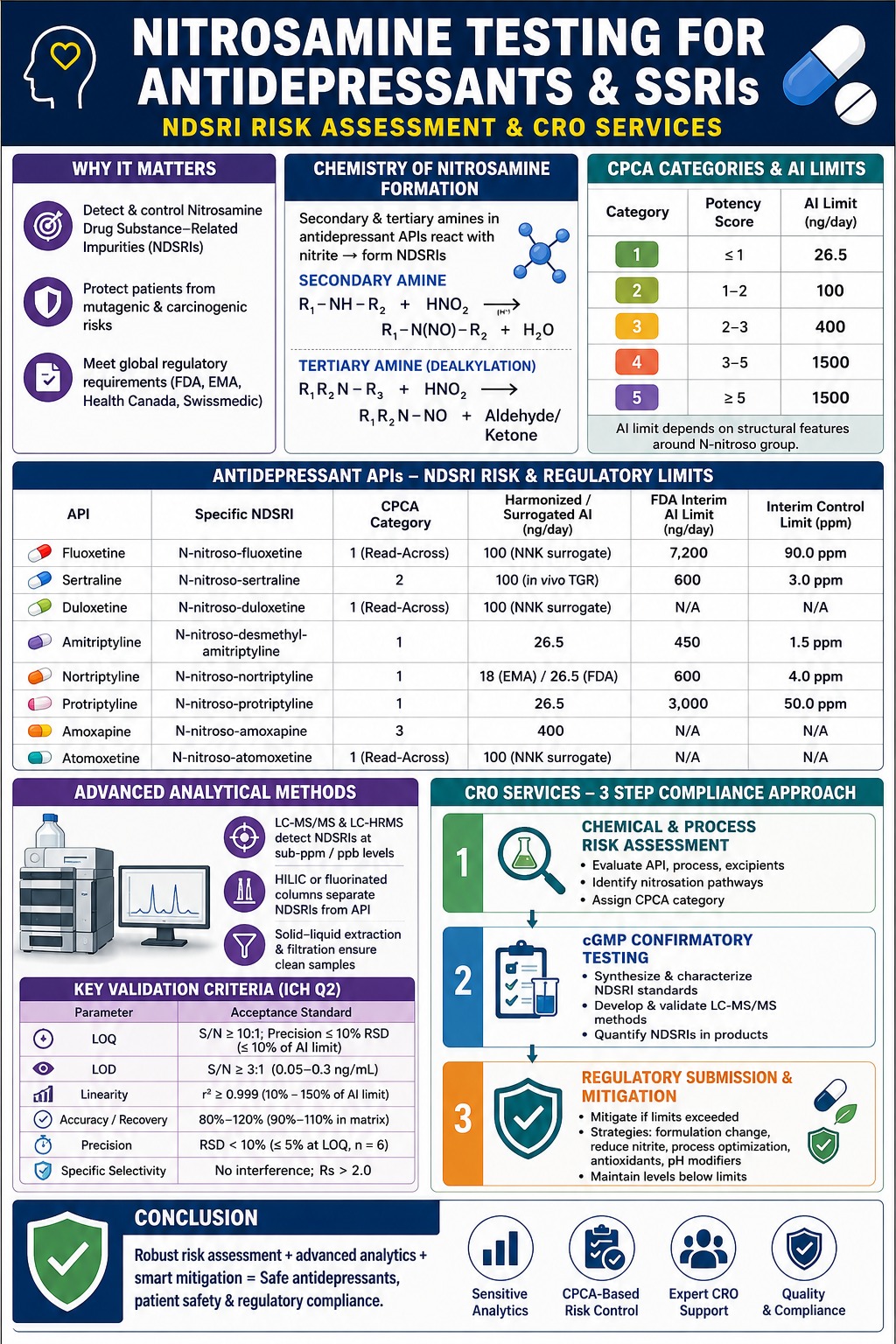
Nitrosamine Testing for Antidepressants and SSRIs focuses on the inherent susceptibility of secondary and tertiary amine groups to react with trace nitrite contaminants present in pharmaceutical excipients, resulting in the generation of genotoxic NDSRIs. A detailed understanding of these chemical pathways enables analytical laboratories to anticipate nitrosation mechanisms, evaluate impurity formation rates, and develop effective mitigation strategies.
Secondary amine functionalities found in SSRIs such as fluoxetine and sertraline can undergo direct electrophilic nitrosation when exposed to nitrous acid (HNO₂) or dinitrogen trioxide (N₂O₃), both of which may originate from excipient-derived nitrites (NO₂⁻) under localized acidic conditions. In contrast, tertiary amine-containing APIs, including amitriptyline, typically experience dealkylative nitrosation. In this mechanism, electrophilic attack promotes oxidative cleavage of an alkyl substituent, producing a secondary amine intermediate that can rapidly transform into an NDSRI.
Secondary Amine Nitrosation: R1-NH-R2 + HNO2 → R1-N(NO)-R2 + H2O (H+)
Tertiary Amine Dealkylation: R1R2N-R3 + HNO2 → R1R2N-NO + Aldehyde/Ketone Byproduct (Dealkylation)
The rate and extent of these reactions are influenced by multiple factors, including amine basicity (pKa), micro-environmental pH, manufacturing temperatures, and residual moisture levels present during processes such as wet granulation and fluid-bed drying. Highly basic secondary amines (pKa > 9.5) can exhibit rapid nitrosation behavior even when nitrite concentrations in excipients such as microcrystalline cellulose, crospovidone, or lactose remain below 1 ppm. As a result, robust risk assessments must consider not only the chemical reactivity of the API but also the nitrite profile and quality attributes of all formulation excipients.
Interested in the differences between complex and simple impurities? Explore our detailed breakdown of NDSRIs vs. Simple Nitrosamines.
CPCA Guidelines for Nitrosamine Testing for Antidepressants and SSRIs
The Carcinogenic Potency Categorization Approach (CPCA) provides a standardized framework for establishing Acceptable Intake (AI) limits for NDSRIs identified in antidepressant products. These limits are determined by evaluating critical molecular features surrounding the N-nitroso functional group and may range from 26.5 ng/day to 1500 ng/day. The assigned AI value directly influences analytical sensitivity targets and regulatory specification limits for commercial drug products.
Within the CPCA framework, a numerical potency score is calculated by assessing α-hydrogen availability together with the presence of structural features that either enhance or reduce carcinogenic potential. The combined score is subsequently assigned to one of five potency categories.
Potency Score = Scoreα-Hydrogen + Σ ScoreDeactivating Features + Σ ScoreActivating Features
Navigating internal specification thresholds? Read our analysis on establishing a Nitrosamine Alert Limit vs. Action Limit.
| CPCA Potency Category | Predicted Potency Score | Recommended AI Limit (ng/day) | Structural Characteristics & Functional Features |
|---|---|---|---|
| Category 1 | ≤ 1 | 26.5 | High α-hydrogen availability (score 1 or 2) with minimal deactivating influence; highly reactive acyclic structures. |
| Category 2 | 2 | 100 | Moderate steric hindrance accompanied by weak deactivating groups or a single electron-withdrawing substituent. |
| Category 3 | 3 | 400 | Intermediate steric effects; cyclic architectures or neighboring hydroxyl/carboxylic functionalities. |
| Category 4 | 4 | 1500 | Strong steric protection arising from tertiary α-carbons or complex polycyclic frameworks. |
| Category 5 | ≥ 5 | 1500 | Extensive steric hindrance associated with morpholine/pyrrolidine ring constraints or multiple deactivating features. |
As additional compound-specific carcinogenicity data become available through in vivo Transgenic Gene Mutation (TGR) studies, surrogate-based assessments, or read-across evaluations, regulatory authorities may revise the default CPCA-derived limits. In addition, to minimize the risk of drug shortages and ensure uninterrupted patient access to critical therapies, health agencies have implemented interim AI limits and temporary control limits expressed in ppm for selected antidepressants, with certain compliance deadlines extended through August 1, 2027.
| Antidepressant API | Specific NDSRI Name | CPCA Category | Harmonized / Surrogated AI (ng/day) | FDA Interim AI Limit (ng/day) | Interim Control Limit (ppm) |
|---|---|---|---|---|---|
| Fluoxetine | N-nitroso-fluoxetine | 1 (Read-Across) | 100 (NNK surrogate) | 7,200 | 90.0 ppm |
| Sertraline | N-nitroso-sertraline | 2 | 100 (in vivo TGR) | 600 | 3.0 ppm |
| Duloxetine | N-nitroso-duloxetine | 1 (Read-Across) | 100 (NNK surrogate) | N/A | N/A |
| Amitriptyline | N-nitroso-desmethyl-amitriptyline | 1 | 26.5 | 450 | 1.5 ppm |
| Nortriptyline | N-nitroso-nortriptyline | 1 | 18 (EMA) / 26.5 (FDA) | 600 | 4.0 ppm |
| Protriptyline | N-nitroso-protriptyline | 1 | 26.5 | 3,000 | 50.0 ppm |
| Amoxapine | N-nitroso-amoxapine | 3 | 400 | N/A | N/A |
| Atomoxetine | N-nitroso-atomoxetine | 1 (Read-Across) | 100 (NNK surrogate) | N/A | N/A |
Managing regulatory batch release protocols? Review the complete Nitrosamine Batch Release Testing Requirements to maintain continuous market supply.
Advanced Analytical Methodologies for Nitrosamine Testing for Antidepressants and SSRIs
Advanced Nitrosamine Testing for Antidepressants and SSRIs utilizes highly sensitive liquid chromatography-tandem mass spectrometry (LC-MS/MS) and high-resolution accurate-mass spectrometry (LC-HRMS) platforms to detect trace NDSRIs at sub-ppm concentrations, even in the presence of substantial matrix interference from active pharmaceutical ingredients. The incorporation of specialized chromatographic approaches, including Hydrophilic Interaction Liquid Chromatography (HILIC), enables effective separation of low-level nitrosamine impurities from high-concentration parent drug substances.
One of the primary analytical challenges associated with NDSRI detection is that these impurities often possess structural characteristics very similar to those of the parent API while existing at significantly lower concentrations. As a result, direct electrospray ionization (ESI) analysis may be affected by severe ion suppression, reduced sensitivity, or source contamination caused by the overwhelming presence of the active ingredient. Contemporary analytical strategies overcome these limitations through the use of HILIC columns or specially designed fluorinated reversed-phase columns that modify chromatographic selectivity. These stationary phases facilitate the elution of NDSRIs separately from, and often before, the parent API peak, thereby minimizing matrix effects and improving quantitative performance.
Deciding between analytical testing workflows? Compare rapid triage against quantitative analysis in our guide on Nitrosamine Screening vs. Confirmatory Method.
Sample preparation procedures are equally critical for successful nitrosamine analysis. Typical workflows involve solid-liquid extraction using appropriate organic solvents, followed by centrifugation and membrane filtration through PVDF filters to eliminate insoluble excipient components and particulate matter before chromatographic injection. These preparation steps help reduce matrix complexity while enhancing analytical reliability and reproducibility.
Method validation for NDSRI determination must be conducted in accordance with ICH Q2(R1/R2) requirements to demonstrate that the analytical procedure is suitable for its intended purpose across a variety of commercial pharmaceutical formulations and dosage forms.
Testing complex or multi-component formulations? Read about analytical considerations in Nitrosamine Testing in Combination Products.
| Validation Parameter | ICH Q2 Compliance Acceptance Standard | Technical Performance Criteria for NDSRI Assays |
|---|---|---|
| Limit of Quantitation (LOQ) | S/N ≥ 10:1; precision ≤ 10% RSD | Must achieve ≤ 10% of target AI limit (typically 0.1–1.0 ng/mL or 1–10 ppb). |
| Limit of Detection (LOD) | S/N ≥ 3:1 | Typically 0.05–0.3 ng/mL (0.3–1.0 ppb). |
| Linearity Range | Correlation Coefficient (r²) ≥ 0.999 | Evaluated from 10% to 150% of the target regulatory AI specification limit. |
| Method Accuracy / Recovery | Mean recovery 80%–120% across the validated range | Spiked recovery in finished drug product matrices maintained within 90%–110%. |
| Repeatability & Precision | Relative Standard Deviation (RSD) < 10% | Six replicate injections at the LOQ level demonstrating RSD ≤ 5%. |
| Specific Selectivity | No interfering peaks within the analytical retention window | Resolution (Rs) > 2.0 between the NDSRI, parent API, and relevant degradation products. |
CRO Services for Risk Mitigation, Method Validation, and Compliance
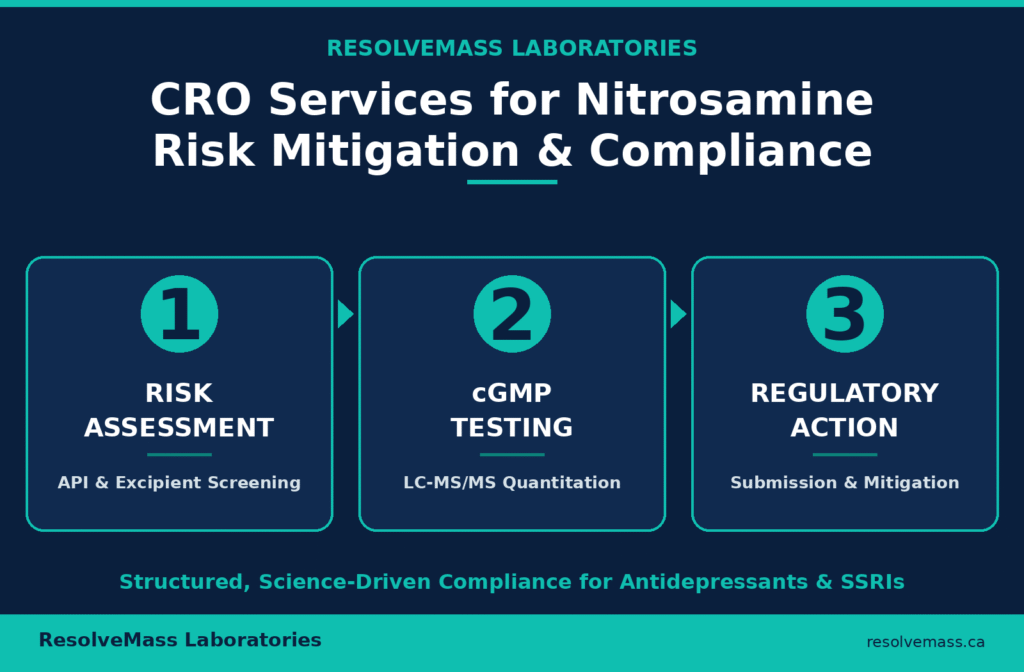
Contract Research Organizations (CROs) play a critical role in supporting pharmaceutical manufacturers with comprehensive nitrosamine compliance programs. These organizations provide integrated analytical testing services, custom reference standard synthesis, toxicological expertise, and regulatory guidance to assist sponsors in meeting evolving nitrosamine requirements. Through structured risk assessment and mitigation programs, CRO laboratories transform regulatory expectations into practical and scientifically validated control strategies.
Step 1: Chemical & Process Risk Assessment
The initial phase involves a detailed evaluation of API molecular structures, synthetic manufacturing routes, raw material quality attributes, and excipient nitrite content. Regulatory toxicologists and analytical scientists assess the potential for NDSRI generation throughout manufacturing and storage, identify critical nitrosation pathways, and establish preliminary CPCA classifications. This risk-based approach allows manufacturers to prioritize products requiring confirmatory testing and mitigation efforts.
Uncovering the source of impurity contamination? Examine a real-world investigation in our NDMA Root Cause Investigation Case Study.
Step 2: cGMP Confirmatory Analytical Testing
Following risk assessment, specialized analytical laboratories conduct confirmatory testing under cGMP conditions. This stage often includes the custom synthesis of high-purity NDSRI reference standards, which are thoroughly characterized using ¹H/¹⁵N NMR and Mass Spectrometry to verify structural identity and purity. Validated LC-MS/MS methods are subsequently developed and applied to quantify trace nitrosamine impurities in commercial drug products, drug substances, and stability samples. These analytical studies generate the data required to demonstrate compliance with regulatory AI limits and product specifications.
Need a formal long-term compliance framework? Discover how to establish robust protocols with our Nitrosamine Control Strategy Development Services.
Step 3: Regulatory Dossier Submissions and Formulation Mitigation
When confirmatory testing identifies NDSRI concentrations that exceed established regulatory thresholds, formulation scientists and regulatory specialists collaborate to implement corrective actions. Potential mitigation strategies include modifying formulation compositions, reducing nitrite-containing excipients, optimizing manufacturing processes, or introducing nitrosation inhibitors. Antioxidant scavengers such as ascorbic acid, sodium ascorbate, and α-tocopherol are frequently evaluated for their ability to suppress nitrosation reactions. Additionally, the incorporation of alkaline pH modifiers into solid oral dosage formulations may further reduce nitrosamine formation. These interventions can effectively maintain impurity levels below regulatory limits while preserving product quality and therapeutic performance.
Overcoming out-of-specification results during reformulation? Learn practical formulation adjustments in our guide to Nitrosamine Reformulation Strategy.
Conclusion
Nitrosamine Testing for Antidepressants and SSRIs has become a fundamental element of contemporary pharmaceutical quality systems, helping ensure that patients receive safe and effective therapies without unnecessary exposure to potentially genotoxic impurities. As regulatory scrutiny continues to increase, comprehensive risk assessment programs, advanced analytical technologies, and scientifically sound mitigation strategies are essential for maintaining compliance and protecting public health.
The combination of highly sensitive LC-MS/MS platforms, robust CPCA-based risk evaluation methodologies, and proactive formulation control measures enables pharmaceutical sponsors to meet demanding regulatory expectations while ensuring the uninterrupted availability of critical antidepressant medications. By identifying and controlling NDSRIs throughout the product lifecycle, manufacturers can strengthen product quality, support patient safety, and reduce regulatory risk.
ResolveMass Laboratories Inc. provides specialized cGMP analytical testing, nitrosamine assessment services, method development, method validation, and regulatory support to assist pharmaceutical organizations in addressing complex NDSRI compliance challenges.
To consult with technical specialists regarding custom NDSRI assay development, sample testing, or regulatory risk assessments, visit the ResolveMass Laboratories Contact Us page.
Frequently Asked Questions
The Carcinogenic Potency Categorization Approach (CPCA) estimates the carcinogenic potential of an NDSRI by evaluating the structural characteristics surrounding the N-nitroso group. Factors such as α-hydrogen availability, steric hindrance, ring systems, and electron-withdrawing or electron-donating substituents are considered when assigning a potency category. Based on the resulting classification, regulatory authorities establish AI limits that generally range from 26.5 ng/day to 1500 ng/day.
The FDA has established temporary intake limits for several antidepressant-related nitrosamines to help maintain drug availability while manufacturers implement long-term control measures. For N-nitroso-fluoxetine, the interim AI limit is 7,200 ng/day with a corresponding control limit of 90 ppm. For N-nitroso-sertraline, the interim AI limit is 600 ng/day with a control limit of 3 ppm. These temporary allowances currently remain in effect through August 1, 2027.
LC-MS/MS is generally the preferred analytical technique because many NDSRIs are thermally sensitive and may degrade when exposed to the elevated temperatures required for gas chromatography. In some cases, GC-based methods can even promote unintended nitrosamine formation during sample injection, leading to inaccurate results. LC-MS/MS avoids these issues by operating under milder conditions while providing exceptional sensitivity and selectivity for trace-level quantification.
Matrix suppression is controlled by designing chromatographic methods that effectively separate trace nitrosamine impurities from the much larger concentration of the parent API. CRO laboratories frequently utilize HILIC or specialized fluoro-phenyl stationary phases to achieve optimal peak separation before ionization occurs. This strategy reduces interference within the electrospray ionization source, resulting in improved method sensitivity, accuracy, and reproducibility.
Analytical methods used for NDSRI testing must demonstrate adequate specificity, sensitivity, linearity, accuracy, precision, and robustness in accordance with ICH Q2(R1/R2) expectations. Validation studies typically establish low limits of quantitation, excellent correlation coefficients across the analytical range, acceptable recovery performance, and consistent repeatability. These requirements ensure that the method can reliably detect and quantify trace nitrosamine impurities in commercial pharmaceutical products.
When testing reveals nitrosamine levels above the applicable regulatory limit, manufacturers must initiate a formal investigation to determine the root cause and evaluate potential patient risk. Corrective and preventive actions may include modifications to manufacturing processes, tighter control of raw materials, selection of low-nitrite excipients, or formulation redesign. Depending on the circumstances, sponsors may also be required to notify regulatory agencies and submit supporting documentation outlining remediation efforts.
When more than one nitrosamine is detected within a pharmaceutical product, regulatory authorities generally require a cumulative risk assessment rather than evaluating each impurity independently. Manufacturers must calculate the contribution of each nitrosamine relative to its individual AI limit and ensure that the combined exposure remains within the overall acceptable risk threshold. This approach helps account for the potential additive impact of multiple nitrosamine impurities on patient safety.
Excipients are often the primary source of trace inorganic nitrites in solid oral dosage forms. Even very low nitrite concentrations can contribute to nitrosamine formation when they come into contact with susceptible amine-containing APIs during manufacturing or storage. Factors such as residual moisture, processing conditions, and long-term product stability can further accelerate these reactions, making excipient selection and qualification critical components of nitrosamine risk management.
Results from in vivo mutagenicity studies can significantly impact the regulatory classification of an NDSRI. When well-designed studies demonstrate a low mutagenic potential, health authorities may adjust the acceptable intake level or revise the impurity’s potency category. Conversely, evidence indicating mutagenic activity can lead to more stringent compound-specific limits that override default CPCA predictions. These data-driven decisions allow regulators to establish safety thresholds based on experimental evidence rather than structural predictions alone.
Reference:
- U.S. Food and Drug Administration. (2026, July 24). CDER nitrosamine impurity acceptable intake limits. https://www.fda.gov/regulatory-information/search-fda-guidance-documents/cder-nitrosamine-impurity-acceptable-intake-limits
- U.S. Food and Drug Administration. (2023, August). Recommended acceptable intake limits for nitrosamine drug substance-related impurities (NDSRIs): Guidance for industry. U.S. Department of Health and Human Services. https://www.fda.gov/media/170794/download
- Schlingemann, J., Burns, M. J., Ponting, D. J., Avila, C. M., Romero, N. E., Jaywant, M. A., Smith, G. F., Ashworth, I. W., Simon, S., Saal, C., & Wilk, A. (2023). The landscape of potential small and drug substance related nitrosamines in pharmaceuticals. Journal of Pharmaceutical Sciences, 112(5), 1287–1304. https://doi.org/10.1016/j.xphs.2022.11.013
- U.S. Food and Drug Administration. (2024). Determining recommended acceptable intake limits for N-nitrosamine impurities in pharmaceuticals: Development and application of the carcinogenic potency categorization approach. https://www.fda.gov/drugs/spotlight-cder-science/determining-recommended-acceptable-intake-limits-n-nitrosamine-impurities-pharmaceuticals
- Dande, A., Dhampalwar, V. R., Pallaprolu, N., & Peraman, R. (2025). Nitrosamine drug substance-related impurities (NDSRIs) in pharmaceuticals: Formation, mitigation strategies, and emphasis on mutagenicity risks. Pharmaceutical Research, 42(4), 547–578. https://doi.org/10.1007/s11095-025-03857-9
Get In Touch With Us
About The Author


