

Chiral Analysis of Therapeutic Peptide APIs: D-Amino Acid Detection by LC-MS and Enzymatic Digestion
 By Anusha Sinha
•
August 8, 2026
By Anusha Sinha
•
August 8, 2026
Introduction
Chiral Analysis of Therapeutic Peptide APIs is a critical analytical requirement in biopharmaceutical development for verifying the optical purity, biological performance, and immunological safety of synthetic peptide active pharmaceutical ingredients (APIs). Therapeutic peptides, especially synthetic molecules composed of up to 40 amino acid residues, including glucagon-like peptide-1 (GLP-1) receptor agonists such as semaglutide, liraglutide, and tirzepatide, have emerged as one of the fastest-expanding categories in contemporary pharmaceutical pipelines. Since peptide primary structures are constructed from inherently chiral amino acid building blocks, the unintended conversion of a single L-amino acid residue into its D-enantiomer results in the formation of a diastereomeric impurity. These diastereomeric species exhibit the same molecular mass, monoisotopic isotope distribution, and elemental composition as the intended peptide API, making them indistinguishable by conventional high-resolution mass spectrometry (HRMS) unless dedicated chiral separation techniques or specialized enzymatic digestion methodologies are employed.

Explore specialized analytical testing workflows: GLP-1 Peptide Characterization CRO Services
The biological and clinical implications associated with D-amino acid contamination in therapeutic peptide APIs extend well beyond a simple reduction in receptor-binding activity. Although intentional incorporation of D-amino acids at selected positions can improve resistance to enzymatic degradation by circulating proteases, unintended D-amino acid impurities generated during solid-phase peptide synthesis (SPPS) or subsequent storage can significantly alter peptide conformation and three-dimensional folding behavior. These structural changes may promote the formation of anti-drug antibodies (ADAs) or stimulate innate immune pathways. Consequently, the development of highly sensitive analytical strategies capable of detecting and quantifying D-amino acid impurities at concentrations as low as 0.10% or below is essential for meeting global regulatory requirements and supporting generic Abbreviated New Drug Application (ANDA) submissions.
Learn how advanced mass spectrometry resolves minor diastereomeric and degradant species: GLP-1 Peptide Impurity Characterization Services
Need Reliable D-Amino Acid Detection for Your Peptide API?
Contact our experts today to discuss your project and develop a customized chiral analysis strategy that supports development, quality control, and regulatory submissions. Contact us
Article Summary: Key Takeaways
- Chiral analysis is essential for confirming the optical purity, biological performance, and safety of therapeutic peptide APIs by detecting unwanted D-amino acid impurities.
- Racemization can occur during SPPS and storage, mainly through base-catalyzed α-carbon deprotonation and oxazolone formation. Cysteine, histidine, aspartic acid, serine, and threonine are particularly susceptible.
- Enzymatic digestion is preferred because it uses mild conditions that preserve native stereochemistry and sensitive residues while enabling site-specific localization of D-amino acid substitutions.
- Deuterated acid hydrolysis (DCl/D₂O) can distinguish native D-amino acids (M) from hydrolysis-induced artifacts (M+1 Da), but harsh hydrolysis can destroy Trp, alter Asn/Gln, and eliminate sequence information.
- Advanced LC-MS approaches include Marfey’s derivatization, direct chiral stationary phase (CSP) separation, and LC-MS/MS, providing sensitive and selective detection of trace D-amino acid impurities.
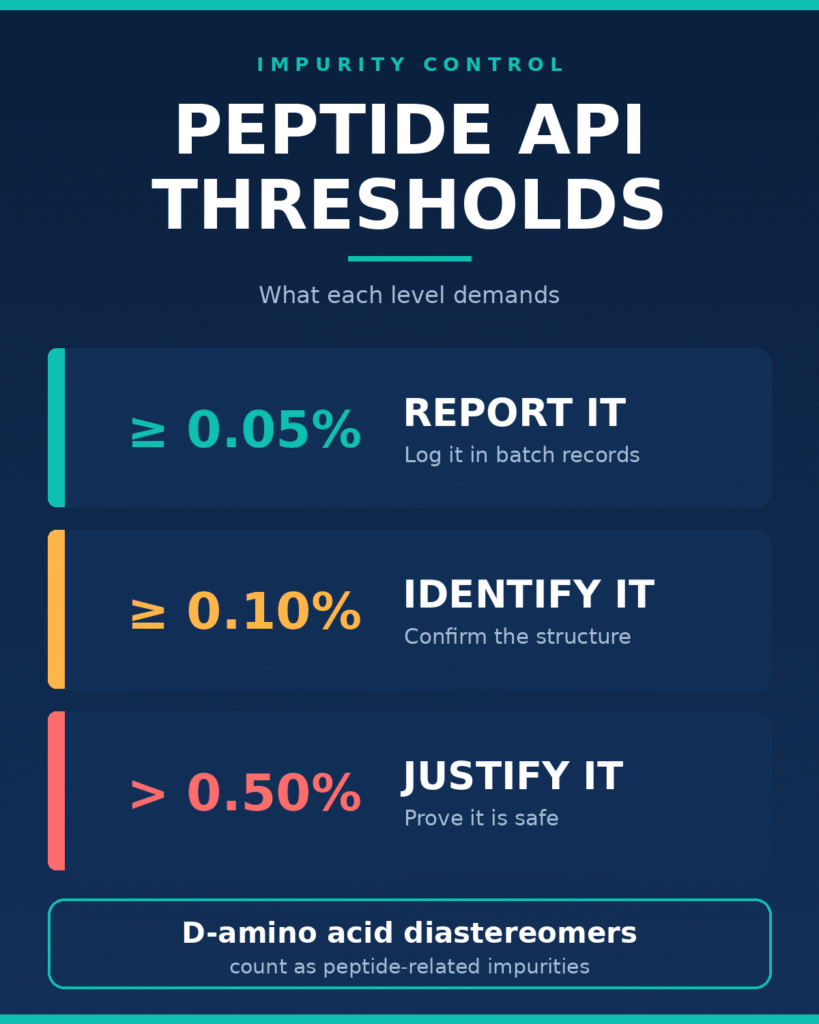
- Regulatory control is critical: peptide-related impurities at ≥0.05% must be reported, ≥0.10% identified, and >0.50% require qualification/safety justification, making sensitive chiral characterization essential for regulatory submissions.
- An integrated workflow combining enzymatic digestion, deuterated hydrolysis, Marfey’s derivatization, chiral CSPs, and LC-MS/MS provides comprehensive stereochemical characterization and reliable detection of D-amino acid impurities below regulatory thresholds.

Mechanisms of Racemization in Chiral Analysis of Therapeutic Peptide APIs
Racemization in therapeutic peptide APIs occurs predominantly during solid-phase peptide synthesis (SPPS) through base-catalyzed α-carbon deprotonation and oxazolone intermediate formation, although it may also arise during prolonged storage under conditions of elevated temperature or unfavorable pH. This stereochemical transformation converts naturally occurring homochiral L-amino acids into D-enantiomers, thereby generating diastereomeric impurities that possess the same molecular weight as the intended peptide product.
Throughout the coupling and deprotection stages of SPPS, exposure to tertiary amine bases such as N,N-diisopropylethylamine can remove the acidic proton attached to the α-carbon of an activated amino acid residue. This process forms a planar, resonance-stabilized carbanion (enolate) intermediate. Because the intermediate lacks stereochemical preference, reprotonation can occur from either face of the molecule, producing a mixture of both L- and D-enantiomeric forms. In another common pathway, activation of the C-terminal carboxylic acid during peptide segment coupling can trigger intramolecular cyclization, generating a 5(4H)-oxazolone intermediate. This intermediate undergoes rapid base-mediated racemization before nucleophilic attack by the incoming amino component, leading to stereochemical inversion.
The extent to which an amino acid undergoes racemization is influenced by several factors, including side-chain electronic properties, protecting-group selection, and the surrounding steric environment within the peptide sequence. Certain amino acids are particularly susceptible to stereochemical inversion during synthesis and downstream processing:
- Cysteine: Exhibits a high tendency toward base-catalyzed racemization through β-elimination and readdition mechanisms because the protected thiol group strongly withdraws electron density.
- Histidine: Undergoes rapid racemization through intramolecular base-catalyzed processes involving the tele-nitrogen of an unprotonated or inadequately protected imidazole ring.
- Aspartic Acid: Particularly vulnerable to base-induced enolization and aspartimide formation, especially during repeated piperidine-mediated deprotection cycles.
- Serine and Threonine: Can experience direct α-proton abstraction under basic conditions when side-chain hydroxyl functionalities become activated or are insufficiently protected.
In addition to synthesis-related mechanisms, prolonged thermal exposure, hydrolytic degradation in aqueous environments, and storage under highly acidic or alkaline conditions can promote non-enzymatic post-synthetic racemization. Since stereochemical inversion changes the three-dimensional orientation of functional groups within the peptide, even very low levels of D-amino acid substitution may adversely affect receptor-binding interactions and generate immunogenic neo-epitopes.
Discover analytical methods for evaluating peptide degradation and storage stability: GLP-1 Peptide Stability & Analytical Methods
Enzymatic Digestion vs. Acid Hydrolysis in Chiral Analysis of Therapeutic Peptide APIs
Enzymatic digestion maintains the native chirality of peptides under mild, physiologically relevant conditions and therefore avoids introducing artificial racemization. In contrast, conventional acid hydrolysis can generate sample-preparation-induced stereochemical inversion, making isotopic correction strategies necessary. The choice between enzymatic and chemical cleavage approaches has a significant impact on the ability to accurately differentiate naturally occurring D-amino acid impurities from those generated during analytical processing.
Deuterated Acid Hydrolysis for Quantifying Induced Racemization
Traditional liquid-phase acid hydrolysis employs 6 N hydrochloric acid (HCl) at elevated temperatures ranging from approximately 100°C to 165°C to cleave peptide bonds and release free amino acids. Although effective for complete peptide degradation, these harsh acidic and thermal conditions inherently promote partial racemization of L-amino acids into D-amino acids during the hydrolysis process itself. To measure and compensate for this analytical artifact, deuterated acid hydrolysis using 6 N DCl in D₂O is commonly applied, often in the presence of 1% phenol to minimize tyrosine halogenation.
When an L-amino acid undergoes racemization in a D₂O/DCl environment, hydrogen exchange at the α-carbon results in incorporation of a deuterium atom (²H), producing a measurable +1 Da mass increase. High-resolution mass spectrometry can subsequently distinguish between two separate populations:
- Endogenous D-Amino Acids: Native, unlabeled D-enantiomers that were originally present within the therapeutic peptide API and therefore retain their unmodified monoisotopic mass (M).
- Artifactual D-Amino Acids: Deuterium-labeled D-enantiomers exhibiting a mass of M+1 Da that arise specifically from acid-induced racemization during sample preparation.
Although isotopic labeling provides a means to quantify hydrolysis-induced racemization, acid hydrolysis remains associated with several limitations. The procedure destroys tryptophan (Trp) residues, converts asparagine (Asn) and glutamine (Gln) into aspartic acid (Asp) and glutamic acid (Glu), and completely removes positional sequence information once peptide bonds have been fully cleaved.
Site-Specific Enzymatic Digestion Strategies
Site-specific enzymatic digestion relies on the use of targeted endopeptidases such as trypsin, endoproteinase Lys-C, and chymotrypsin, together with exopeptidases including Aminopeptidase M. These enzymes operate under near-neutral pH conditions (6.8 to 7.8) and moderate temperatures around 37°C, conditions that preserve native stereochemistry and prevent chemically induced racemization during sample preparation.
Enzymatic methodologies support two distinct yet complementary analytical approaches:
- Sequence-Dependent Mapping: Endopeptidases selectively cleave specific peptide bonds to generate shorter peptide fragments suitable for analysis. The presence of a D-amino acid can alter local stereochemistry and steric orientation, frequently reducing or completely preventing enzymatic cleavage at neighboring peptide bonds. For example, Aminopeptidase M efficiently hydrolyzes L-L peptide bonds from the N-terminus in a sequential manner but typically stops digestion when a D-amino acid residue is encountered. By monitoring digestion profiles and cleavage kinetics using LC-MS, analysts can identify the precise sequence location of a D-amino acid substitution.
- Sequence-Independent Hydrolysis: Combinations of exopeptidases can be used to achieve complete liberation of constituent amino acids while avoiding the degradation of acid-sensitive tryptophan residues and preventing deamidation of asparagine and glutamine. This strategy enables comprehensive amino acid analysis while maintaining the integrity of chemically sensitive residues.
Check out high-resolution peptide sequencing services to pinpoint amino acid modifications: Peptide Sequencing CRO Services
Advanced LC-MS Methodologies for Chiral Analysis of Therapeutic Peptide APIs
Advanced LC-MS methodologies for chiral analysis integrate diastereomeric derivatization techniques or direct chiral stationary phase separations with tandem mass spectrometry to achieve the resolution and quantification of D-amino acid enantiomers at trace concentrations. These analytical approaches deliver the sensitivity, selectivity, and structural discrimination necessary to satisfy stringent regulatory requirements for therapeutic peptide API characterization and batch-release testing.
Pre-Column Chiral Derivatization Using Marfey’s Reagent
Pre-column derivatization with Marfey’s reagent (1-fluoro-2,4-dinitrophenyl-5-L-alanine amide, FDAA) transforms L- and D-amino acid enantiomers into corresponding diastereomeric derivatives. FDAA reacts efficiently and quantitatively with both primary and secondary amino groups under mild alkaline conditions, typically using 0.5 M NaHCO₃ at 60°C for 1–3 hours.
Because FDAA introduces a fixed L-alanine amide stereocenter into the analyte structure, derivatized L- and D-amino acids become diastereomers that exhibit distinct chromatographic retention characteristics. These diastereomeric pairs can be effectively separated using conventional reversed-phase C18 or Phenyl-Hexyl chromatographic columns. When coupled with electrospray ionization mass spectrometry (ESI-MS/MS), the highly electron-withdrawing dinitrophenyl moiety significantly improves ionization efficiency and signal intensity. Operation in Multiple Reaction Monitoring (MRM) mode enables highly selective and sensitive quantification of trace D-enantiomer impurities, often achieving detection limits below 0.01%.
Direct Enantioseparation Using Chiral Stationary Phases
Direct enantioseparation employs Chiral Stationary Phases (CSPs) to separate underivatized amino acids and small peptide fragments without the need for chemical derivatization. Eliminating derivatization steps minimizes sample manipulation and reduces the potential for processing-induced artifacts. Separation is achieved through a combination of non-covalent interactions between analyte enantiomers and the immobilized chiral selector, including hydrogen bonding, π-π interactions, steric recognition, ionic interactions, and dipole effects.
Key Chiral Stationary Phase classes compatible with LC-MS include:
Macrocyclic Glycopeptide Phases (CHIROBIOTIC™ T, T2, TAG)
These stationary phases contain immobilized macrocyclic glycopeptide antibiotics such as teicoplanin or vancomycin covalently bonded to silica supports. CHIROBIOTIC TAG, which lacks carbohydrate side chains, demonstrates particularly strong selectivity toward sulfur-containing amino acids, including cysteine, methionine, and histidine. Operation under Polar Organic Mode (POM) or Polar Ionic Mode (PIM) conditions using volatile organic solvents and ammonium formate-based mobile phases provides direct compatibility with mass spectrometric detection.
Zwitterionic Chiral Ion-Exchanger Phases
Zwitterionic chiral ion-exchanger phases incorporate cinchona alkaloid derivatives combined with chiral sulfonic acid or carboxylic acid functionalities. These materials recognize zwitterionic amino acids and small peptide analytes through complex ionic and hydrogen-bonding interactions, delivering robust stereoselective separations without requiring prior chemical modification of the sample.
Crown Ether Stationary Phases
Crown ether-based stationary phases utilize chiral crown ether selectors capable of forming inclusion complexes with primary ammonium ions (R-NH₃⁺). These host-guest interactions generate measurable retention differences between L- and D-amino acid enantiomers, enabling direct stereochemical discrimination and separation.
Streamline your analytical testing package with comprehensive physicochemical testing: Peptide Physicochemical Characterization Services
Regulatory Compliance and FDA Impurity Thresholds for Synthetic Peptide APIs
Regulatory expectations for synthetic peptide APIs require strict control of peptide-related impurities, including D-amino acid-containing diastereomers. Current guidance establishes an identification threshold of 0.10% and a qualification threshold of 0.50% for peptide-related impurities. Consequently, manufacturers must implement validated analytical methodologies capable of detecting, identifying, quantifying, and monitoring D-amino acid impurities during both release testing and long-term stability programs.
A primary regulatory reference for generic synthetic peptide products is the FDA guidance document, ANDAs for Certain Highly Purified Synthetic Peptide Drug Products That Refer to Listed Drugs of rDNA Origin. While ICH Q3A(R2) and ICH Q3B(R2) provide general impurity frameworks for small-molecule drug substances and drug products, synthetic peptides containing 40 amino acids or fewer are subject to additional regulatory scrutiny and more stringent impurity control expectations.
Regulatory Thresholds for Peptide-Related Impurities
- Reporting Threshold (≥ 0.05%)
Any impurity detected at or above 0.05% relative to the active pharmaceutical ingredient must be reported in analytical documentation and batch records. - Identification Threshold (≥ 0.10%)
Any peptide-related impurity, including diastereomeric species arising from D-amino acid incorporation, present at or above 0.10% of the active ingredient must be structurally characterized and identified. - Qualification Threshold (> 0.50%)
Any novel peptide-related impurity present between 0.10% and 0.50% that is absent from the Reference Listed Drug (RLD) requires appropriate toxicological and safety justification. Impurities exceeding 0.50% generally represent a significant regulatory concern and may prevent approval through an abbreviated ANDA pathway unless supported by extensive toxicological, immunogenicity, and comparability data.
Diastereomeric impurities produced through racemization can influence major histocompatibility complex (MHC) Class II binding affinity, potentially promoting T-cell activation and subsequent anti-drug antibody (ADA) formation. For this reason, comprehensive chiral characterization is necessary to demonstrate equivalence to the Reference Listed Drug throughout the entire product shelf-life period.
Ensure your analytical package meets stringent submission guidelines: Regulatory Requirements for GLP-1 Peptide Characterization
Comparative Analytical Techniques for Chiral Analysis of Therapeutic Peptide APIs
Selection of the most appropriate analytical strategy requires careful consideration of sample preparation requirements, preservation of acid-labile amino acids, analytical sensitivity, stereochemical specificity, and the ability to retain positional sequence information. The following comparison highlights the principal analytical approaches currently used for chiral characterization of therapeutic peptide APIs.
| Analytical Method | Hydrolysis / Sample Preparation | Chromatographic Mode | Ionization & MS Detection | Key Advantages | Analytical Limitations |
|---|---|---|---|---|---|
| Deuterated Acid Hydrolysis + Marfey’s Derivatization | Microwave-assisted hydrolysis in 6 N DCl/D₂O at 165°C followed by pre-column FDAA derivatization | Reversed-Phase C18 or Phenyl-Hexyl column | Positive ESI-MS/MS operating in MRM mode | Enables discrimination between native D-amino acids (M) and hydrolysis-induced artifacts (M+1 Da) with excellent sensitivity (LOD < 0.01%) | Destroys tryptophan residues, converts asparagine and glutamine to aspartic acid and glutamic acid, and eliminates positional sequence information |
| Site-Specific Enzymatic Digestion + LC-MS/MS Mapping | Targeted endopeptidase and exopeptidase digestion at pH 7.4 and 37°C | Reversed-Phase C18 or Zwitterionic CSP | ESI-HRMS and MS/MS fragment-ion analysis | Prevents analytical racemization, preserves Trp, Asn, and Gln, and enables localization of D-amino acid positions within the peptide sequence | Enzymatic cleavage efficiency may decrease or become completely inhibited near D-amino acid residues, requiring method optimization |
| Direct Chiral Stationary Phase LC-MS | Direct dissolution or extraction without derivatization | Macrocyclic Glycopeptide CSPs (CHIROBIOTIC TAG/T2) or Zwitterionic Ion-Exchanger CSPs | ESI-MS/MS operated in Polar Organic or Polar Ionic Modes | Eliminates derivatization-related side reactions, shortens analysis time, and provides excellent recovery of methionine, cysteine, and histidine | Reduced peak capacity for highly complex amino acid mixtures and higher cost of specialized chiral columns |
| Chiral Gas Chromatography-Mass Spectrometry (GC-MS) | Acid hydrolysis followed by trifluoroacetic anhydride (TFAA) derivatization and isopropyl esterification | Capillary Chiral GC columns containing cyclodextrin derivatives | Electron Ionization (EI) or Chemical Ionization (CI) | Provides exceptional chromatographic efficiency and enantiomeric separation for volatile amino acid derivatives | Requires extensive multistep derivatization and often exhibits poor recovery for cysteine, histidine, and arginine |
Swipe horizontally to view the full table on smaller screens.
Explore multi-attribute monitoring workflows for routine batch screening: Multi-Attribute Monitoring (MAM) for Peptide Characterization
Conclusion
Rigorous Chiral Analysis of Therapeutic Peptide APIs remains fundamental for ensuring product quality, preserving pharmacological performance, and meeting increasingly stringent regulatory expectations for synthetic peptide drug substances. As the therapeutic peptide market continues to expand, controlling diastereomeric impurities resulting from D-amino acid incorporation remains a critical component of risk mitigation strategies aimed at reducing immunogenicity and maintaining batch-to-batch consistency.
The implementation of comprehensive analytical workflows that combine site-specific enzymatic digestion, deuterated acid hydrolysis (D₂O/DCl), Marfey’s reagent derivatization, direct chiral stationary phase separations, and highly sensitive LC-MS/MS analysis enables reliable identification and quantification of D-enantiomer impurities at concentrations significantly below established regulatory thresholds. These integrated approaches provide both stereochemical specificity and structural confirmation, supporting robust impurity profiling throughout product development and commercial manufacturing.
Maintaining stereochemical purity below the 0.10% identification threshold in accordance with FDA and ICH expectations plays a crucial role in ensuring the safety, efficacy, quality, and regulatory acceptability of synthetic peptide therapeutics. Organizations seeking specialized support for chiral method development, advanced LC-MS/MS characterization, impurity profiling, or regulatory compliance strategies for peptide API programs can collaborate with the analytical experts at ResolveMass Laboratories to establish scientifically robust and regulatory-compliant analytical solutions – Contact us today.
Frequently Asked Questions
How does deuterated acid hydrolysis (D₂O/DCl) distinguish naturally occurring D-amino acids from analytical artifacts?
Deuterated acid hydrolysis uses deuterium chloride in heavy water during peptide degradation. If racemization occurs during sample preparation, a deuterium atom becomes incorporated at the α-carbon of the affected amino acid, creating a measurable mass increase. Native D-amino acids already present in the peptide remain unlabeled, enabling mass spectrometry to differentiate genuine impurities from those generated during laboratory processing.
What are the major drawbacks of acid hydrolysis for chiral peptide analysis?
Although acid hydrolysis effectively releases individual amino acids for analysis, it can damage or chemically modify certain residues. Tryptophan is typically degraded, while asparagine and glutamine may undergo conversion into their corresponding acidic forms. In addition, complete hydrolysis removes all sequence information, making it impossible to determine the original location of a D-amino acid within the peptide chain.
Why can’t mass spectrometry alone identify D-amino acid impurities in intact peptides?
Mass spectrometry primarily measures molecular mass and elemental composition. Since L- and D-amino acid forms possess identical molecular weights and isotopic patterns, they generate essentially indistinguishable mass spectra. As a result, additional techniques such as chiral chromatography, stereoselective derivatization, or enzymatic digestion are required to separate and identify stereochemical variants before MS detection.
How does Marfey’s reagent (FDAA) improve LC-MS analysis of D-amino acids?
Marfey’s reagent reacts with amino acids to create diastereomeric derivatives that exhibit different chromatographic behaviors. This conversion allows standard reversed-phase LC systems to separate L- and D-amino acid forms effectively. Furthermore, the reagent enhances ionization efficiency during electrospray ionization, improving sensitivity and enabling reliable detection of trace-level chiral impurities.
Which amino acids are most vulnerable to racemization during solid-phase peptide synthesis (SPPS)?
Certain amino acids are particularly prone to stereochemical inversion during SPPS because of their chemical structure and reaction environment. Cysteine, histidine, and aspartic acid are among the most sensitive residues and can undergo racemization through multiple reaction pathways. Their susceptibility often requires careful control of coupling conditions, protecting groups, and deprotection strategies during peptide manufacturing.
What advantages do macrocyclic glycopeptide stationary phases offer in direct chiral LC-MS?
Macrocyclic glycopeptide stationary phases, including CHIROBIOTIC™ TAG and CHIROBIOTIC™ T2, provide highly selective chiral recognition without requiring chemical derivatization. Their unique molecular architecture enables effective discrimination between L- and D-amino acid forms through multiple interaction mechanisms. Because they are compatible with volatile mobile phases, they can be directly coupled to LC-MS systems for sensitive stereochemical analysis.
What is the difference between sequence-dependent and sequence-independent chiral analysis approaches?
Sequence-independent methods completely break down peptides into individual amino acids and determine overall D/L ratios for each amino acid type. In contrast, sequence-dependent approaches preserve portions of the peptide sequence through controlled enzymatic digestion, allowing researchers to identify the exact site where stereochemical inversion has occurred. This positional information is often valuable during impurity investigations and process optimization.
What FDA impurity limits apply to peptide-related stereochemical impurities?
FDA guidance for synthetic peptide products requires close monitoring of peptide-related impurities, including D-amino acid-containing diastereomers. Impurities present at or above 0.10% generally require structural identification, while higher levels may require additional toxicological evaluation and safety justification. These expectations help ensure that stereochemical impurities do not compromise product safety, efficacy, or comparability to the reference product.
How does enzymatic digestion prevent sample-preparation-induced racemization?
Enzymatic digestion is performed under mild conditions that closely resemble physiological environments, typically near neutral pH and moderate temperatures. Unlike strong acid hydrolysis, these conditions do not promote stereochemical inversion during sample preparation. As a result, enzymatic digestion provides a more accurate representation of the peptide’s original chiral composition while preserving sensitive amino acid residues and valuable sequence information.
Reference:
- Abdulbagi, M., Wang, L., Siddig, O., Di, B., & Li, B. (2021). D-amino acids and D-amino acid-containing peptides: Potential disease biomarkers and therapeutic targets? Biomolecules, 11(11), 1716. https://doi.org/10.3390/biom11111716
- D’Hondt, M., Bracke, N., Taevernier, L., Gevaert, B., Verbeke, F., Wynendaele, E., & De Spiegeleer, B. (2014). Related impurities in peptide medicines. Journal of Pharmaceutical and Biomedical Analysis, 101, 2–30. https://doi.org/10.1016/j.jpba.2014.06.037
- Achilleos, K., Petrou, C., Nicolaidou, V., & Sarigiannis, Y. (2025). Beyond efficacy: Ensuring safety in peptide therapeutics through immunogenicity assessment. Journal of Peptide Science, 31(6), e70016. https://doi.org/10.1002/psc.70016
- Puig, M., & Shubow, S. (2025). Immunogenicity of therapeutic peptide products: Bridging the gaps regarding the role of product-related risk factors. Frontiers in Immunology, 16, 1608401. https://doi.org/10.3389/fimmu.2025.1608401
- Ayon, N. J., Sharma, A. D., & Gutheil, W. G. (2019). LC-MS/MS-based separation and quantification of Marfey’s reagent derivatized proteinogenic amino acid DL-stereoisomers. Journal of the American Society for Mass Spectrometry, 30(3), 448–458. https://doi.org/10.1007/s13361-018-2093-9
- Duncan, K. (2024, May). CMC regulatory experiences and expectations for peptides [Conference presentation]. USP Peptides and Oligonucleotides Workshop, United States Pharmacopeia (USP). https://ipq.org/wp-content/uploads/2024/05/USP-CMC-Reg-Experiences-Expectations-Peptides-2024-cleared-1.pdf
Need Reliable D-Amino Acid Detection for Your Peptide API?
Contact our experts today to discuss your project and develop a customized chiral analysis strategy that supports development, quality control, and regulatory submissions.
Contact usAbout The Author
Anusha Sinha
Anusha Sinha, B.Pharm, is an experienced pharma professional with a strong background in Analytical Chemistry and Polymer Chemistry. With a passion for translating complex scientific data into clear, accessible content, she plays a vital role in communicating ResolveMass Laboratories Inc.’s advanced testing capabilities. In addition to her scientific expertise, Anusha leads Business Development initiatives, helping clients across pharmaceutical, biotechnology, and materials science sectors find tailored analytical solutions. Her combined experience in science and strategy positions her at the forefront of client engagement and technical communication.

