


Introduction
Executing Generic Ophthalmic Suspension ANDA Development requires a coordinated technical strategy that integrates qualitative and quantitative sameness (Q1/Q2), structural and physicochemical comparability (Q3), robust aseptic process engineering, and validated container closure integration. Generic ophthalmic suspensions are complex, heterogeneous dispersed systems in which an active pharmaceutical ingredient (API) is maintained as micronized solid particles within an aqueous vehicle. Unlike simple ophthalmic solutions, which may qualify for bioequivalence (BE) waivers under 21 CFR 320.22(b)(1) when formulation identity requirements are satisfied, suspensions cannot be sterile-filtered in their final form and introduce additional thermodynamic, rheological, and dissolved-phase equilibrium considerations. The regulatory framework governing generic topical ophthalmic products has evolved substantially following the publication of the United States Food and Drug Administration (FDA) revised draft guidance, Quality Considerations for Topical Ophthalmic Drug Products, together with updated product-specific guidances (PSGs). These regulatory expectations place strong emphasis on product sterility, control of sub-visible and visible particulate matter, extractables and leachables (E&L) safety, and multi-dose container delivery performance. Demonstrating therapeutic equivalence for generic ophthalmic suspensions therefore depends significantly on a “totality-of-evidence” strategy supported by advanced characterization testing, allowing sponsors to substantiate an in vitro bioequivalence pathway that can avoid lengthy and potentially variable clinical endpoint studies.
Learn more about specialized manufacturing and regulatory pathways for generic ophthalmic formulations: Explore CDMO Services for Generic Ophthalmic Drug Products
Share via:
Quick Summary:
- Q1/Q2 sameness: Generic ophthalmic suspensions should closely match the Reference Listed Drug (RLD) in inactive ingredients and concentrations, generally within the 95–105% range, to support the bioequivalence strategy.
- Q3 characterization: Comprehensive physicochemical and structural testing should assess particle size, polymorphic form, rheology, surface properties, pH, osmolality, and buffer capacity to demonstrate microstructural comparability with the RLD.
- IVRT and dissolution: In Vitro Release Testing (IVRT) can provide functional evidence of comparable drug release and support an in vitro BE pathway when appropriate, potentially reducing reliance on clinical endpoint studies.
- Sterile manufacturing: Because micronized API particles cannot pass through sterilizing-grade filters, ophthalmic suspensions require dual-stream sterilization—sterile filtration of the aqueous vehicle and separate sterilization of the API, followed by aseptic compounding.
- Particulate and container closure control: Advanced inspection technologies should distinguish API crystals from foreign particles, while container closure systems (CCS) must demonstrate sterility, delivery consistency, physical integrity, and appropriate extractables and leachables (E&L) safety.
- Stability and performance: Testing should include drop-volume uniformity, preservative efficacy, tip integrity, upright/horizontal/inverted storage, and freeze–thaw studies to confirm consistent performance throughout shelf life.
- Regulatory strategy: An in vitro BE pathway may offer a shorter, lower-risk development route when Q1/Q2/Q3 equivalence is adequately demonstrated. Early FDA interaction through Controlled Correspondence, Pre-ANDA meetings, or PSG Teleconferences can help align the development strategy and reduce regulatory delays.
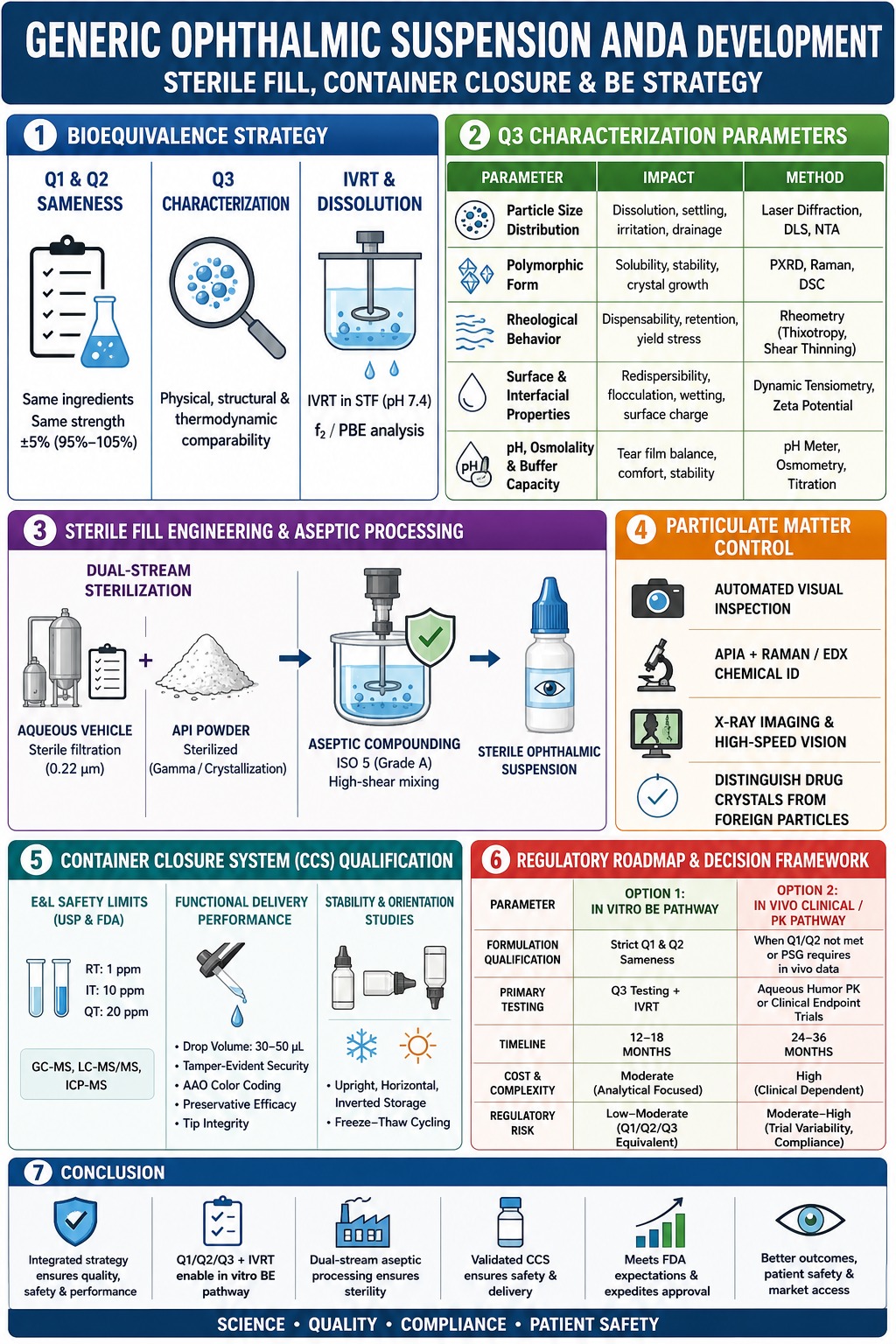
Bioequivalence Strategy for Generic Ophthalmic Suspension ANDA Development
Demonstrating bioequivalence in Generic Ophthalmic Suspension ANDA Development requires the establishment of qualitative (Q1) and quantitative (Q2) formulation sameness together with comprehensive physical and structural (Q3) characterization to support qualification for an in vitro regulatory approval pathway. Demonstrating formulation sameness and microstructural comparability can reduce the need for complex clinical endpoint trials involving post-surgical or ocular hypertensive patient populations, provided the applicable regulatory requirements and product-specific guidance support such an approach.
Review the essential components of bioequivalence study design for generic drug products: Read the Bioequivalence Study Design for Complex Generic Drug Products Guide
Establishing Q1 and Q2 Formulation Sameness
Achieving Q1 and Q2 sameness requires identifying the same inactive ingredients and matching their concentrations within a strict ±5% range (or 95%–105%) relative to the Reference Listed Drug (RLD). Excipients incorporated into ophthalmic suspensions—including polymeric suspending agents such as carbomers, hydroxypropyl methylcellulose, and microcrystalline cellulose; surfactants such as polysorbate 80 and tyloxapol; tonicity agents; and buffers—can directly influence viscosity, flocculation behavior, particle sedimentation rate, and pre-corneal residence time. Reverse engineering of multiple RLD lot numbers using validated deformulation assays, including high-performance liquid chromatography coupled with mass spectrometry (HPLC-MS), inductively coupled plasma mass spectrometry (ICP-MS), dynamic light scattering, and refractometry, is important for determining excipient grades and concentrations. Even relatively small differences in excipient composition or grade may influence zero-shear viscosity, structural recovery kinetics, or API saturation solubility, potentially affecting drug release characteristics and local bioavailability.
Discover how reverse engineering and RLD sourcing accelerate generic formulation development: Learn More About RLD Sourcing and Reverse Engineering
Physicochemical and Structural Characterization (Q3) in Generic Ophthalmic Suspension ANDA Development
Q3 characterization in Generic Ophthalmic Suspension ANDA Development assesses the physical state, structural organization, and thermodynamic characteristics of the formulation to determine whether the generic product demonstrates comparable microscopic and macroscopic behavior to the RLD. Since suspended API particles continuously interact with dissolved polymers and surfactants, generic suspensions must be evaluated against the reference product across a broad range of critical quality attributes (CQAs).
| Q3 Parameter | Critical Impact on Ophthalmic Performance | Preferred Analytical Methodologies |
|---|---|---|
| Particle Size Distribution (PSD) | Influences dissolution kinetics in tear film, ocular tissue irritation, dynamic settling behavior, and drainage from the ocular surface. | Laser Diffraction, Dynamic Light Scattering (DLS), Nanoparticle Tracking Analysis (NTA) |
| Polymorphic Form & Crystal Habit | Affects thermodynamic activity, equilibrium solubility, crystal growth, and physical stability of the suspension. | Powder X-Ray Diffraction (PXRD), Raman Spectroscopy, Differential Scanning Calorimetry (DSC) |
| Rheological Behavior | Influences bottle dispensability, drip formation, pre-corneal retention, and yield stress behavior following blinking. | Rotational & Oscillatory Rheometry (Shear Thinning, Thixotropy, Yield Stress) |
| Surface & Interfacial Properties | Affects particle redispersibility after shaking, flocculation state, surface charge, and wetting characteristics. | Dynamic Tensiometry, Zeta Potential Electrophoretic Light Scattering |
| pH, Osmolality, & Buffer Capacity | Helps prevent reflex lacrimation, maintains physiological tear film balance, and supports stability of the dissolved API fraction. | Micro-pH Electrodes, Vapor Pressure / Freezing Point Osmometry, Acid-Base Titration |
Access comprehensive analytical support designed for abbreviated new drug applications: View One-Stop CDMO Analytical Services for ANDA
In Vitro Release Testing (IVRT) and Dissolution Kinetics
In Vitro Release Testing (IVRT) provides a sensitive functional surrogate for microstructural sameness by continuously measuring API release from the suspension matrix into simulated tear fluid under sink conditions. Conventional dissolution configurations, such as USP Apparatus 1 or 2, may be inappropriate for ophthalmic suspensions because particle settling, formulation dilution, and fluid dynamics can produce conditions that do not adequately represent the intended product behavior. Specialized configurations using USP Apparatus 4 (flow-through cell) in an open-loop system, together with modified suspension adapters, can instead provide continuous percolation of simulated tear fluid (STF, pH 7.4) across a synthetic membrane filter, such as low-binding glass fiber or cellulose ester. Comparative drug release profiles obtained from multiple generic batches and RLD lots can then be assessed using non-parametric f2 similarity factor calculations or population bioequivalence (PBE) statistical modeling to evaluate whether the products demonstrate comparable release rates and drug transport characteristics.
Explore analytical characterization techniques applied to complex APIs and therapeutic peptides: Examine Peptide Characterization Case Study of Semaglutide
Sterile Fill Engineering and Aseptic Processing for Ophthalmic Suspensions
Sterile fill engineering for generic ophthalmic suspensions requires a dual-stream aseptic processing strategy in which the aqueous vehicle is subjected to sterile filtration while the insoluble micronized API is independently sterilized before aseptic compounding. Terminal sterilization of finished suspensions using heat or radiation is generally challenging because of potential heat-induced polymer degradation, API solubilization followed by uncontrolled re-crystallization, and physical phase separation. Consequently, the manufacturing process must be designed to maintain sterility while preserving the intended particle characteristics and physical properties of the suspension.
Understand the operational and strategic distinctions when selecting a development and manufacturing partner: Compare Peptide CDMO vs CMO Differences
Dual-Stream Sterilization and Aseptic Compounding
Because micronized active drug particles are larger than the 0.22 μm pore size of sterilizing membrane filters, aseptic manufacturing requires the vehicle and active raw material to follow two parallel processing pathways. The aqueous vehicle, containing water for injection (WFI), dissolved polymers, tonicity agents, buffers, and preservatives, is prepared, subjected to bioburden testing, and passed through redundant 0.22 μm polyethersulfone (PES) or polyvinylidene fluoride (PVDF) membrane filters into a sterile compounding vessel. At the same time, the micronized API powder is pre-sterilized through a validated process, such as gamma irradiation or sterile crystallization from solution. The sterilized API powder is subsequently aseptically introduced into the sterile vehicle within an ISO 5 (Grade A) aseptic processing zone. High-shear homogenizers, inline rotor-stator mixers, or sterile wet-milling systems are operated under controlled aseptic conditions to distribute the active particles uniformly while minimizing thermal stress and avoiding unintended changes to the target particle size distribution.
Learn about scale-up strategies required when moving from lab-scale formulation to commercial manufacturing: Discover Peptide CDMO Scale-Up Services
Particulate Matter Control and Advanced Automated Inspection
Particulate matter control in ophthalmic suspensions requires the use of advanced orthogonal visual inspection and chemical identification technologies capable of differentiating native suspended drug crystals from foreign particulate contaminants. Standard light obscuration methods (USP) may not reliably differentiate active drug crystals from extraneous materials, such as glass, synthetic fibers, or elastomeric particles, particularly in opaque dispersed systems. To meet regulatory expectations, manufacturers can therefore implement complementary inspection strategies. Automated Powder/Particle Image Analysis (APIA) combined with Raman or Energy-Dispersive X-Ray Spectroscopy (EDX) can provide chemical characterization of filtered particulates. For opaque semi-rigid container closure systems, non-destructive inspection approaches—including high-resolution contrast X-ray imaging and high-speed automated camera vision incorporating specialized kinetic spin-and-stop agitation—or destructive high-throughput sub-sampling can be incorporated into the production quality release process.
Evaluate how analytical methodologies differ between distinct active pharmaceutical ingredient types: Understand the Difference Between a Peptide and a Small Molecule Drug
Container Closure System Qualification and Leachables Safety
Container closure system (CCS) qualification for generic ophthalmic suspensions requires a comprehensive evaluation of extractables and leachables (E&L), delivery volume performance, and orientation-specific stability to support product safety and physical integrity throughout the intended shelf life. Ophthalmic drops are commonly packaged in semi-permeable primary containers that may include low-density polyethylene (LDPE) or linear low-density polyethylene (LLDPE) bottles, specialized dropper tips, and high-density polyethylene (HDPE) caps. These packaging configurations may be susceptible to volatile extractable migration, material interaction, and solvent loss, making appropriate container closure characterization an important component of product development.
See how specialized characterization techniques support regulatory submissions for complex formulations: Read About GLP-1 Peptide Analytical Characterization
Extractables and Leachables (E&L) Safety Limits
Extractables and leachables safety testing for ophthalmic packaging requires carefully controlled analytical evaluation to minimize the potential for local ocular irritation or tissue toxicity associated with migrating plasticizers, vulcanization agents, antioxidants, or other packaging-related substances. In accordance with USP, USP, and FDA draft quality guidances, generic applicants should conduct controlled extraction studies on primary and secondary packaging components using solvent systems with different polarity characteristics. Leachables testing is performed on formal stability samples using gas chromatography-mass spectrometry (GC-MS), liquid chromatography-mass spectrometry (LC-MS/MS), and inductively coupled plasma mass spectrometry (ICP-MS). Regulatory assessment applies defined safety evaluation thresholds, including:
- Reporting Threshold (RT): 1 ppm
- Identification Threshold (IT): 10 ppm
- Quantification Threshold (QT): 20 ppm
When a detected leachable exceeds the Identification Threshold, additional toxicological evaluation may be required to establish an Allowable Daily Exposure (ADE) based on an appropriate topical ocular risk assessment.
Review key considerations for preparing regulatory submission packages for generic drug approvals: Learn More About CMC Documentation at a CDMO for ANDA
Functional Delivery Performance and Physical Integrity
Functional delivery qualification verifies that the primary container can consistently provide the intended drop volume while preserving product sterility throughout the multi-dose period of use. Important performance evaluations include:
- Drop Volume Uniformity: Drops delivered from inverted bottles at the initial, middle, and final stages of container use should remain within the established target drop-volume range, typically between 30 μL and 50 μL, with minimal standard deviation. Consistent delivery helps maintain accurate API dosing while minimizing the likelihood of excessive dosing that could trigger reflex tearing.
- Tamper-Evident Security: Tamper-evident rings associated with the closure system should remain securely retained on the bottle neck following initial opening. This helps prevent the closure component or associated material from becoming detached and potentially entering the patient’s eye during use.
- AAO Color Coding Compliance: Container caps should follow the American Academy of Ophthalmology (AAO) color coding standard, such as pink for topical corticosteroids, teal for prostaglandin analogs, and yellow for beta-blockers, to support medication identification and reduce the potential for patient dosing errors.
- Preservative Efficacy & Tip Integrity: Multi-dose preserved formulations must meet Antimicrobial Effectiveness Testing (USP) requirements throughout storage. For unpreserved multi-dose products, validated mechanical tip-seal valves and anti-microbial membrane barriers should be incorporated where appropriate to reduce back-suction and minimize the risk of microbial ingress.
Explore specialized formulation strategies for complex sterile injectable and drug delivery platforms: Read How to Formulate a Lyophilized Peptide Injectable
Stability Protocol Design and Container Orientation Studies
Stability testing protocols for generic ophthalmic suspensions should include stress conditions specifically designed for heterogeneous semi-permeable systems. Regulatory expectations require evaluation of samples maintained in upright, horizontal, and inverted orientations. Inverted storage maintains continuous contact between the liquid suspension and the dropper-tip elastomer, which can accelerate the detection of tip leachables, nozzle evaporation, and dry-cap re-crystallization that could obstruct tip orifices. In addition, freeze-thaw thermal cycling studies can determine whether temporary temperature excursions result in permanent API particle agglomeration, changes in flocculation behavior, or alterations in polymorphic form. These studies provide additional information regarding the ability of the formulation and container closure system to maintain critical physical and chemical attributes under anticipated storage and handling conditions.
Regulatory Roadmap and Decision Framework for Generic Ophthalmic Suspension ANDA Development
Selecting the appropriate regulatory pathway for Generic Ophthalmic Suspension ANDA Development requires sponsors to determine whether an in vitro characterization approach or an in vivo clinical/pharmacokinetic pathway is appropriate based on applicable FDA Product-Specific Guidances. The selected pathway should reflect the formulation characteristics, demonstrated Q1/Q2/Q3 comparability, available analytical evidence, and specific requirements established for the individual reference product.
| Regulatory Parameter | Option 1: In Vitro Bioequivalence Pathway | Option 2: In Vivo Clinical / PK Pathway |
|---|---|---|
| Formulation Qualification | Strict Q1 (Qualitative) and Q2 (Quantitative) Sameness required. | Applicable when Q1/Q2 sameness cannot be met or when the PSG requires in vivo data. |
| Primary Testing Framework | Complete Q3 physicochemical testing, polymorphism, rheology, and IVRT. | Comparative Aqueous Humor PK sampling or Clinical Endpoint Efficacy Trials. |
| Development Timeline | 12 to 18 Months. | 24 to 36 Months. |
| Cost & Complexity | Moderate capital expenditure; focused on advanced analytical characterization. | High capital expenditure; dependent on multi-center patient recruitment. |
| Regulatory Risk | Low-to-moderate, provided Q1/Q2/Q3 equivalence is statistically demonstrated. | Moderate-to-high, due to clinical trial endpoint variability and patient non-compliance. |
To reduce development risk, applicants should engage with regulatory agencies early through formal communication channels. Generic sponsors may submit Controlled Correspondence to the FDA to seek formal assessment of Q1/Q2 formulation alignment for up to three proposed formulations before manufacturing bioequivalence batches. If the FDA revises a PSG while product development is ongoing, sponsors can consider requesting a PSG Teleconference or Pre-ANDA meeting to determine whether the proposed in vitro characterization methodologies are acceptable for submission. Early regulatory interaction can help establish alignment on the development strategy and reduce avoidable delays during the ANDA review process.
Compare geographic advantages and regulatory landscapes when selecting a drug development partner: Compare United States vs. Overseas Peptide CDMOs
Conclusion
Successful execution of Generic Ophthalmic Suspension ANDA Development requires an integrated framework that combines Q1/Q2 formulation sameness, statistically supported Q3 microstructural comparability, dual-stream aseptic processing, and validated container closure integrity. By utilizing validated in vitro release testing (IVRT), laser diffraction particle profiling, and thixotropic rheological characterization as part of a comprehensive bioequivalence strategy, generic developers can generate robust evidence of product comparability while potentially reducing reliance on high-variability clinical endpoint trials. Compliance with evolving FDA quality expectations related to particulate matter control, extractables and leachables thresholds, sterility assurance, and functional container design is essential for demonstrating that generic ophthalmic suspensions consistently meet their intended quality and performance requirements. A scientifically justified development program can therefore support efficient regulatory review and facilitate timely market access while maintaining the quality, safety, and performance expected of ophthalmic drug products.
For specialized analytical characterization, deformulation, Q1/Q2/Q3 equivalence testing, and regulatory support for complex generic formulations, contact our technical team at ResolveMass Laboratories.
Frequently Asked Questions (FAQs)
Terminal heat sterilization can negatively affect the physical and chemical stability of an ophthalmic suspension. Exposure to elevated temperatures may promote API crystal growth through Ostwald ripening, modify polymorphic characteristics, and degrade polymeric viscosity modifiers. Therefore, these products generally require aseptic processing that combines a sterile-filtered vehicle with independently sterilized micronized API under controlled aseptic conditions.
The FDA considers extractables and leachables (E&L) particularly important for ophthalmic products because migrating substances can come into direct contact with ocular tissues. Packaging components are evaluated through controlled extraction and leachables studies using techniques such as GC-MS, LC-MS/MS, and ICP-MS. Detected compounds are assessed against applicable analytical and toxicological thresholds to determine whether additional safety qualification is necessary.
USP Apparatus 4, also known as the flow-through cell, can be used for IVRT of ophthalmic suspensions when appropriately configured for the product. The system allows controlled movement of simulated tear fluid across a membrane and supports continuous monitoring of API release. Its flow-through design can provide more representative release conditions than conventional dissolution configurations for dispersed ophthalmic systems.
Important Q3 attributes include particle size distribution, including D10, D50, D90, and span, together with polymorphic form and crystal habit. Additional characteristics include zero-shear and high-shear viscosity, yield stress, thixotropy, pH, buffer capacity, osmolality, surface tension, and zeta potential. Collectively, these parameters help determine whether the generic suspension exhibits comparable physical behavior and performance to the RLD.
An ANDA for an ophthalmic suspension may be eligible for an in vitro bioequivalence approach when the applicable FDA Product-Specific Guidance supports this pathway. Sponsors generally need to demonstrate the required Q1/Q2 formulation sameness together with appropriate Q3 characterization and comparative IVRT results. The specific evidence required depends on the reference product and the current regulatory recommendations established by the FDA.
Particle size distribution is a critical attribute because it can influence dissolution, drug availability at the ocular surface, sedimentation, redispersibility, and potential ocular irritation. Significant changes in particle size can also affect suspension stability and the consistency of drug delivery from the container. Maintaining an appropriate and comparable particle size profile is therefore essential for achieving consistent product performance.
Multi-dose ophthalmic containers must provide adequate protection against microbial contamination throughout the intended period of use. Depending on the formulation, this may involve an effective antimicrobial preservative system or a validated preservative-free multi-dose delivery mechanism. The container closure system should also support consistent drop delivery, tamper evidence, and appropriate physical integrity throughout product use and storage.
Container orientation can change the contact pattern between the formulation and different components of the container closure system. Upright, horizontal, and inverted configurations can therefore help identify potential differences in solvent loss, dropper-tip interaction, particulate accumulation, clogging, and leachables migration. Including multiple orientations in stability studies provides a broader assessment of container closure performance under realistic storage conditions.
FDA Product-Specific Guidances (PSGs) provide product-specific recommendations for demonstrating bioequivalence to a particular Reference Listed Drug. They may define the expected formulation characteristics, analytical evaluations, statistical approaches, and other evidence needed to support an ANDA. Reviewing the applicable PSG early in development helps sponsors design their studies around the current regulatory expectations and select an appropriate bioequivalence strategy.
Reference:
- U.S. Food and Drug Administration. (2023, September 13). Characterization-based bioequivalence approaches for topical products: Part 1: Q3 guidance [PowerPoint slides]. https://www.fda.gov/media/173389/download
- U.S. Food and Drug Administration. (2022, September 20). Q1/Q2 assessment and regulatory pathway for biowaiver of injectable solutions [PowerPoint slides]. https://www.fda.gov/media/166580/download
- Choi, S. H., & Lionberger, R. A. (2016). Clinical, pharmacokinetic, and in vitro studies to support bioequivalence of ophthalmic drug products. The AAPS Journal, 18(4), 1032–1038. https://doi.org/10.1208/s12248-016-9932-z
- Tamim, M. K. (2026). Demonstrating ophthalmic bioequivalence: A comprehensive PK/PD study framework under FDA and EMA guidance with MIDD as an enabling tool. World Journal of Advanced Research and Reviews, 29(3), 1226–1240. https://doi.org/10.30574/wjarr.2026.29.3.0671
- U.S. Food and Drug Administration. (2015). FY2015 regulatory science research report: Ophthalmic products. FDA
- U.S. Food and Drug Administration. (n.d.). Product-specific guidances for generic drug development. U.S. Food and Drug Administration
Get In Touch With Us
About The Author


