

Introduction
Executing compliant Impurity Control Strategies Under ICH Q3A and Q3B requires establishing scientific and toxicological parity with the Reference Listed Drug (RLD) while maintaining strict dose-dependent reporting, identification, and qualification thresholds. For Abbreviated New Drug Applications (ANDAs) regulated by the U.S. Food and Drug Administration (FDA) under Title 21 of the Code of Federal Regulations (21 CFR 314.94), demonstrating therapeutic equivalence and safety in relation to the RLD represents a fundamental regulatory benchmark. Developing and implementing robust Impurity Control Strategies Under ICH Q3A and Q3B is therefore essential for demonstrating chemical purity, product quality, and long-term stability in generic drug substances and finished dosage forms. Generic drug developers must address the distinct requirements of International Council for Harmonisation (ICH) Q3A(R2) for active pharmaceutical ingredients (APIs) and ICH Q3B(R2) for finished drug products. Whereas pioneer drug developers establish safety through extensive original nonclinical and clinical studies, generic applicants generally depend on comparative analytical profiling, compendial alignment, and toxicological threshold assessments to justify impurity acceptance criteria. Failure to adequately characterize, report, or qualify organic impurities may result in immediate Refuse-to-Receive (RTR) actions by regulatory authorities. Analytical testing facilities such as ResolveMass Laboratories Inc. demonstrate that successful generic submissions require a proactive quality-by-design (QbD) framework that integrates synthetic process understanding, forced degradation studies, and validated ultra-sensitive analytical methods.
Compare regulatory environments and analytical standards by exploring our detailed guide on Canadian vs. US Peptide CDMOs.
Share via:
Quick Summary:
- ICH Q3A(R2) governs impurities in the drug substance/API, while ICH Q3B(R2) focuses on impurities and degradants in the finished drug product.
- Impurity limits are dose-dependent, using Maximum Daily Dose (MDD) and Total Daily Intake (TDI) to establish reporting, identification, and qualification thresholds.
- Key ANDA strategies include Reference Listed Drug (RLD) impurity profiling, USP monograph alignment, forced degradation/mass balance studies, and toxicological or metabolite bridging.
- Analytical method validation under ICH Q2(R2) should demonstrate adequate sensitivity, including suitable LOQ/LOD, accuracy, precision, specificity, and linearity for trace impurity detection.
- To reduce FDA Refuse-to-Receive (RTR) risks, applicants must properly justify specified impurities, investigate unidentified impurities, and ensure analytical methods can detect impurities below applicable reporting thresholds.
- Impurity control should also integrate ICH M7(R2) for mutagenic impurities, ICH Q3C(R8) for residual solvents, and ICH Q3D(R2) for elemental impurities.
- An integrated approach combining RLD benchmarking, robust analytical testing, toxicological assessment, and proactive risk management supports patient safety, regulatory compliance, efficient ANDA approval, and sustained market access.
Impurity Control Strategies Under ICH Q3A and Q3B: Regulatory Alignment and Threshold Mechanics
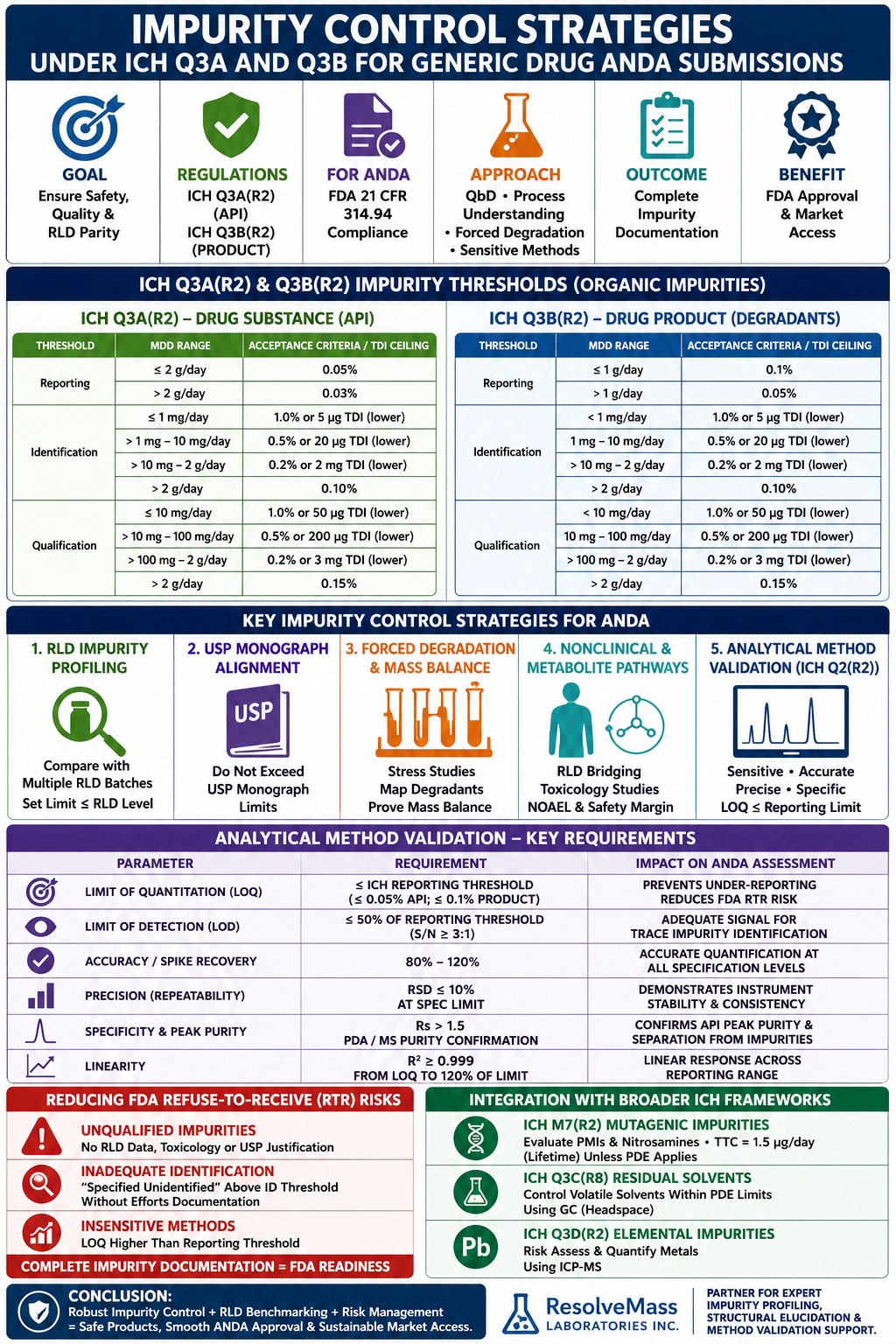
Establishing alignment between drug substance and drug product impurity profiles under ICH Q3A(R2) and ICH Q3B(R2) requires the calculation of Maximum Daily Dose (MDD) and Total Daily Intake (TDI) limits to classify organic impurities according to reporting, identification, and qualification tiers. These dose-dependent thresholds determine whether an impurity needs to be reported on batch certificates, structurally elucidated, or qualified through nonclinical toxicology or RLD bridging.
Learn more about navigating regional outsourcing strategies in our analysis on United States vs. Overseas Peptide CDMOs.
Threshold Calculation Mechanics and TDI Considerations
The regulatory threshold applicable to an organic impurity is directly associated with the drug’s Maximum Daily Dose (MDD). As the MDD decreases, the applicable percentage threshold increases; however, an absolute Total Daily Intake (TDI) ceiling is also applied to prevent excessive daily mass exposure. For example, at an MDD of 500 mg/day, the ICH Q3A identification threshold is 0.1% (0.5 mg/day), whereas for a low-dose drug with an MDD of 0.5 mg/day, the percentage threshold is 1.0% or 5 µg TDI, whichever is lower.
ICH Q3A(R2) — Drug Substance / API
| Guideline Target | Impurity Threshold Category | Maximum Daily Dose (MDD) Range | Threshold Acceptance Criteria / TDI Ceiling |
|---|---|---|---|
| ICH Q3A(R2) | Reporting Threshold | ≤ 2 g/day | 0.05% |
| ICH Q3A(R2) | Reporting Threshold | > 2 g/day | 0.03% |
| ICH Q3A(R2) | Identification Threshold | ≤ 1 mg/day | 1.0% or 5 µg TDI (whichever is lower) |
| ICH Q3A(R2) | Identification Threshold | > 1 mg to 10 mg/day | 0.5% or 20 µg TDI (whichever is lower) |
| ICH Q3A(R2) | Identification Threshold | > 10 mg to 2 g/day | 0.2% or 2 mg TDI (whichever is lower) |
| ICH Q3A(R2) | Identification Threshold | > 2 g/day | 0.10% |
| ICH Q3A(R2) | Qualification Threshold | ≤ 10 mg/day | 1.0% or 50 µg TDI (whichever is lower) |
| ICH Q3A(R2) | Qualification Threshold | > 10 mg to 100 mg/day | 0.5% or 200 µg TDI (whichever is lower) |
| ICH Q3A(R2) | Qualification Threshold | > 100 mg to 2 g/day | 0.2% or 3 mg TDI (whichever is lower) |
| ICH Q3A(R2) | Qualification Threshold | > 2 g/day | 0.15% |
ICH Q3B(R2) — Drug Product / Degradants
| Guideline Target | Impurity Threshold Category | Maximum Daily Dose (MDD) Range | Threshold Acceptance Criteria / TDI Ceiling |
|---|---|---|---|
| ICH Q3B(R2) | Reporting Threshold | ≤ 1 g/day | 0.1% |
| ICH Q3B(R2) | Reporting Threshold | > 1 g/day | 0.05% |
| ICH Q3B(R2) | Identification Threshold | < 1 mg/day | 1.0% or 5 µg TDI (whichever is lower) |
| ICH Q3B(R2) | Identification Threshold | 1 mg to 10 mg/day | 0.5% or 20 µg TDI (whichever is lower) |
| ICH Q3B(R2) | Identification Threshold | > 10 mg to 2 g/day | 0.2% or 2 mg TDI (whichever is lower) |
| ICH Q3B(R2) | Identification Threshold | > 2 g/day | 0.10% |
| ICH Q3B(R2) | Qualification Threshold | < 10 mg/day | 1.0% or 50 µg TDI (whichever is lower) |
| ICH Q3B(R2) | Qualification Threshold | 10 mg to 100 mg/day | 0.5% or 200 µg TDI (whichever is lower) |
| ICH Q3B(R2) | Qualification Threshold | > 100 mg to 2 g/day | 0.2% or 3 mg TDI (whichever is lower) |
| ICH Q3B(R2) | Qualification Threshold | > 2 g/day | 0.15% |
Discover key parameters for selecting development partners with How to Choose a Peptide CDMO in the US.
Key Impurity Control Strategies Under ICH Q3A and Q3B for ANDA Applications
Key Impurity Control Strategies Under ICH Q3A and Q3B for generic filings include comparative RLD impurity profiling, USP monograph benchmarking, forced degradation studies, and metabolite safety bridging. Generic applicants apply these strategies to support specified impurity acceptance criteria that may exceed standard ICH qualification thresholds while maintaining appropriate assurance of patient safety.
Explore end-to-end analytical solutions for ANDA filing via our One-Stop CDMO Analytical Services for ANDA.
Reference Listed Drug (RLD) Impurity Profiling and Equivalence
When an impurity identified in an ANDA generic submission exceeds the applicable ICH qualification threshold, it may be considered qualified when the applicant demonstrates that the proposed acceptance criterion does not exceed the concentration observed in multiple commercial batches of the Reference Listed Drug (RLD). Generic applicants should analyze multiple commercially available RLD batches, preferably those approaching their expiration date, using identical, validated stability-indicating analytical procedures. For example, if an impurity in the generic drug product is present at 0.35% while the applicable ICH qualification threshold is 0.2%, but RLD testing demonstrates impurity levels consistently ranging from 0.35% to 0.40%, a proposed limit of 0.35% may be supported through comparative exposure to the RLD.
Master reverse engineering and benchmark strategies via Reference Listed Drug (RLD) Sourcing and Reverse Engineering.
USP Compendial Monograph Alignment
When an official United States Pharmacopeia (USP) compendial monograph is available for a drug substance or drug product, the proposed acceptance criteria should not exceed the limits established in the applicable monograph. For example, if a USP monograph establishes a limit of 0.2% for Impurity A, an ANDA applicant should not propose a limit of 0.3% without appropriate safety qualification and consideration of the applicable compendial revision process. FDA assessors expect generic applicants to consider the more stringent criterion when evaluating the USP monograph limit alongside the impurity profile demonstrated through RLD batch analysis.
Optimize your regulatory filing process with our resource on CMC Documentation at a CDMO for ANDA.
Forced Degradation and Mass Balance Studies
Forced degradation studies conducted under stress conditions, including acidic, basic, oxidative, photolytic, thermal, and humidity stress, are essential components of ICH Q3B impurity assessment because they help map degradation pathways and demonstrate the selectivity of stability-indicating analytical methods. Applicants must establish mass balance by comparing the assay value and total degradation products with the assay value of the initial unstressed sample. Early identification and characterization of potential degradants help minimize the risk of unexpected impurity increases during long-term and accelerated stability testing.
Nonclinical and Metabolite Qualification Pathways
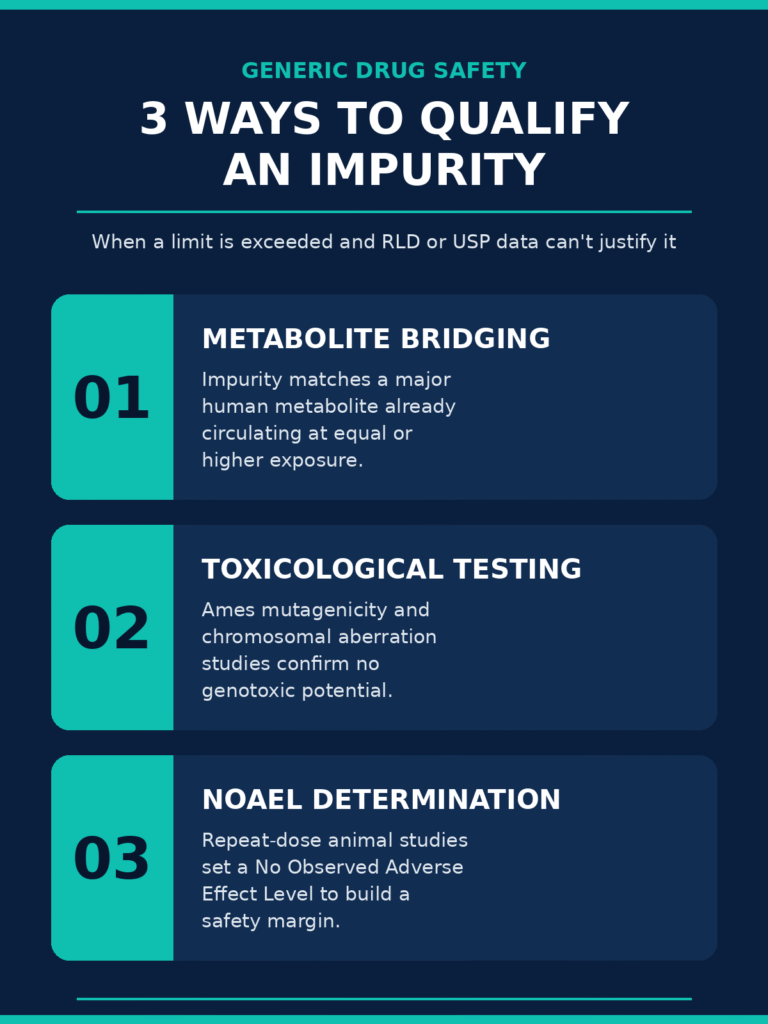
When an impurity exceeds the applicable ICH qualification threshold and cannot be adequately justified through RLD profiling or USP limits, generic sponsors may need to pursue alternative qualification pathways:
- Significant Human Metabolite Bridging: An impurity may be considered qualified when it is structurally identified as a major human metabolite that circulates at systemic exposure levels equal to or greater than those observed with the target drug.
- Toxicological Evaluation: Nonclinical safety studies, including in vitro bacterial mutagenicity (Ames) assays and in vitro chromosomal aberration tests, may be conducted to assess and confirm the absence of genotoxic potential.
- NOAEL Determination: Establishing a No Observed Adverse Effect Level (NOAEL) through repeat-dose animal toxicology studies can support the derivation of a safety margin relative to the patient’s daily intake.
Understand clinical trial framework alignment using our guide to Bioequivalence Study Design for Complex Generic Drug Products.
Analytical Method Validation and Sensitivity Under ICH Q2(R2)
Validation of analytical procedures used for generic drug impurity quantification requires demonstrating that the Limit of Quantitation (LOQ) is at or below the applicable ICH reporting threshold, together with precision RSD ≤ 10% and recoveries ranging from 80% to 120%. High-Performance Liquid Chromatography (HPLC) coupled with photodiode array (PDA) or mass spectrometry (LC-MS/MS) can provide the sensitivity and specificity required to resolve process impurities and degradants. Specialized Contract Development and Manufacturing Organizations (CDMOs) and testing laboratories, including ResolveMass Laboratories Inc., utilize ultra-high performance liquid chromatography (UHPLC) and high-resolution mass spectrometry (HRMS) to isolate and structurally characterize unidentified impurities that exceed applicable identification thresholds.
| Analytical Method Parameter | Mandatory Validation Requirement | Impact on Regulatory ANDA Assessment |
|---|---|---|
| Limit of Quantitation (LOQ) | Must be ≤ ICH Reporting Threshold (e.g., ≤ 0.05% for API; ≤ 0.1% for Product) | Prevents under-reporting of degradants and reduces the risk of FDA Refuse-to-Receive (RTR) designations. |
| Limit of Detection (LOD) | Typically established at ≤ 50% of the reporting threshold | Provides an adequate signal-to-noise ratio (S/N ≥ 3:1) for trace impurity identification. |
| Accuracy / Spike Recovery | 80% to 120% mean recovery across reporting, identification, and qualification levels | Supports accurate quantification across low-level specification boundaries. |
| Precision (Repeatability) | Relative Standard Deviation (RSD) ≤ 10% at the specification limit | Demonstrates instrument stability and analytical consistency across testing runs. |
| Specificity & Peak Purity | Complete baseline separation (Rₛ > 1.5) with photodiode array (PDA) or MS purity confirmation | Confirms API peak purity and separation from synthetic intermediates and degradants. |
| Linearity | Correlation coefficient R² ≥ 0.999 from LOQ to 120% of specification limit | Demonstrates a linear detector response across the applicable reporting ranges. |
Learn how specialized characterization techniques apply to complex molecules in our Peptide Characterization Case Study of Semaglutide.
Overcoming Refuse-to-Receive (RTR) Risks via Impurity Control Strategies Under ICH Q3A and Q3B
Reducing the risk of FDA Refuse-to-Receive (RTR) decisions requires the submission of fully justified acceptance criteria for all specified impurities and demonstrating that unqualified impurities do not exceed applicable RLD levels or ICH thresholds. Incorporating comprehensive risk assessments covering mutagenic impurities, residual solvents, and elemental impurities further supports the completeness and regulatory readiness of Module 3 CTD documentation.
Common Impurity-Related RTR Pitfalls
Submitting an ANDA without comprehensive impurity documentation can result in significant administrative deficiencies and potential Refuse-to-Receive concerns. Common deficiencies include:
- Unqualified Specified Impurities: Proposing acceptance criteria above ICH qualification thresholds without providing comparative RLD data, toxicological bridging, or USP monograph justification.
- Inadequate Identification Efforts: Listing “specified unidentified” impurities above the identification threshold without providing documentation describing unsuccessful isolation attempts or structural elucidation efforts.
- Insensitive Analytical Methods: Using HPLC methods with an LOQ higher than the applicable ICH reporting threshold, resulting in inadequate quantification of low-level impurities.
Delve deeper into operational differences in services with Peptide CDMO vs CMO.
Integration with Broader ICH Impurity Frameworks
Impurity management during generic drug development should integrate ICH Q3A and Q3B controls with specialized risk assessments:
- ICH M7(R2) Mutagenic Impurities: Potential mutagenic impurities (PMIs) and nitrosamines must be evaluated using structural activity relationship (SAR) computational toxicology software, such as Derek and Leadscope. Any DNA-reactive impurity should be controlled to the Threshold of Toxicological Concern (TTC) level of 1.5 µg/day for lifetime exposure unless compound-specific Permitted Daily Exposure (PDE) values apply.
- ICH Q3C(R8) Residual Solvents: Volatile organic chemicals used during API synthesis or formulation must be controlled within PDE limits using headspace Gas Chromatography (GC-FID/MS).
- ICH Q3D(R2) Elemental Impurities: Heavy metal residues, including Class 1, 2A, 2B, and 3 metals, originating from synthetic catalysts or manufacturing equipment require risk assessments and quantification using Inductively Coupled Plasma Mass Spectrometry (ICP-MS).
Delve deeper into operational differences in services with Peptide CDMO vs CMO.
Conclusion
Implementing robust Impurity Control Strategies Under ICH Q3A and Q3B provides generic drug manufacturers with the scientific foundation needed to support efficient ANDA approval while maintaining patient safety and product quality. Combining rigorous analytical method validation, comparative RLD benchmarking, and proactive risk management helps mitigate regulatory RTR risks and supports sustained market access. Adopting an integrated strategy encompassing ICH Q3A, Q3B, M7, Q3C, and Q3D provides generic manufacturers with the regulatory framework needed to support an efficient commercial launch. Generic sponsors seeking advanced impurity profiling, structural elucidation, and method validation support can engage directly with technical experts at ResolveMass Laboratories Inc. through the ResolveMass Laboratories Inc. Contact Us page.
Frequently Asked Questions
Qualification thresholds are determined according to the Maximum Daily Dose (MDD) of the active drug substance and the corresponding percentage or Total Daily Intake (TDI) limit. For example, at an MDD of 100 mg/day, the ICH Q3B qualification threshold is 0.2% or 3 mg TDI, whichever is lower. Because 0.2% of 100 mg equals 0.2 mg, or 200 µg, the percentage-based limit is the applicable criterion.
An impurity may be permitted above the standard ICH qualification threshold when adequate scientific and regulatory justification is provided. Support may include comparative testing against the Reference Listed Drug (RLD), compliance with an applicable USP compendial monograph, or appropriate toxicological qualification studies. The justification must demonstrate that the proposed impurity level does not introduce an unacceptable safety concern.
An impurity-related Refuse-to-Receive (RTR) deficiency can arise when an ANDA lacks adequate justification for impurity acceptance criteria that exceed applicable ICH qualification thresholds. Other concerns include insufficient structural characterization of impurities above identification thresholds and analytical methods with a Limit of Quantitation (LOQ) that does not adequately support the reporting threshold. Such deficiencies can prevent the application from progressing through the FDA review process.
Unspecified impurities are generally controlled through a general acceptance criterion established in the drug product specification. The criterion should be set at or below the applicable ICH identification threshold, taking the drug’s Maximum Daily Dose into account. This approach helps ensure that unidentified impurities remain within scientifically and regulatorily acceptable levels throughout the product lifecycle.
An official USP compendial monograph provides an important benchmark when establishing impurity specifications for a generic drug substance or drug product. When applicable, the proposed acceptance criterion should not exceed the impurity limit established by the official monograph. Generic applicants should therefore evaluate USP requirements alongside ICH thresholds and available Reference Listed Drug (RLD) impurity data when developing specifications.
ICH M7 addresses DNA-reactive, or mutagenic, impurities that may present a carcinogenic hazard and therefore require a specialized risk assessment. When an impurity raises a relevant mutagenicity concern, its control may be determined using ICH M7 principles rather than relying solely on the conventional percentage-based thresholds of ICH Q3A(R2) or ICH Q3B(R2). This ensures that potentially high-risk impurities are controlled according to their specific toxicological profile.
Forced degradation studies deliberately expose a drug product to stress conditions such as heat, light, humidity, acidic or basic environments, and oxidation. These studies help identify likely degradation pathways, characterize potential degradation products, and establish an appropriate mass balance. They also demonstrate that the analytical procedure is stability-indicating and capable of detecting relevant changes in product quality.
For low-level impurity analysis, ICH Q2(R2) validation should demonstrate that the analytical method is sufficiently sensitive, accurate, precise, and specific for its intended purpose. Important parameters include a Limit of Quantitation (LOQ) at or below the reporting threshold, spike recovery generally within 80% to 120%, precision with RSD ≤10%, and appropriate specificity or peak purity. These characteristics support reliable measurement of impurities at low concentration levels.
Metabolite data can provide a toxicological basis for qualifying an impurity when it is demonstrated to be a significant human metabolite of the drug. Quantitative exposure assessments are used to compare systemic exposure to the impurity in humans with the exposure associated with the Reference Listed Drug (RLD). When the impurity circulates at systemic levels equal to or greater than those associated with the relevant clinical exposure, the metabolite information may support its safety qualification.
Reference:
- U.S. Food and Drug Administration. (2009). ANDAs: Impurities in drug substances: Guidance for industry (Revision 1). Center for Drug Evaluation and Research. https://www.fda.gov/media/183885/download
- U.S. Food and Drug Administration. (2016, August). ANDA submissions—Refuse to receive for lack of justification of impurity limits: Guidance for industry. Center for Drug Evaluation and Research. FDA guidance document
- U.S. Food and Drug Administration. (2022, January). Good ANDA submission practices: Guidance for industry. Center for Drug Evaluation and Research. (U.S. Food and Drug Administration) FDA guidance document
- U.S. Food and Drug Administration. (2010, November). ANDAs: Impurities in drug products: Guidance for industry. Center for Drug Evaluation and Research. FDA guidance document
- U.S. Food and Drug Administration. (2026, May 13). Assessing impurity acceptance criteria as part of specifications for NDAs, ANDAs, and BLAs based on clinical relevance (MAPP 5017.2, Rev. 2). Center for Drug Evaluation and Research. FDA document (fda.gov)
- European Medicines Agency. (2006). ICH Q3A (R2): Impurities in new drug substances—Scientific guideline. https://www.ema.europa.eu/en/ich-q3a-r2-impurities-new-drug-substances-scientific-guideline (ema.europa.eu)
- U.S. Food and Drug Administration. (2022, September). Q3D(R2) elemental impurities: Guidance for industry. Center for Drug Evaluation and Research. https://www.fda.gov/media/148474/download (fda.gov)
Get In Touch With Us
About The Author


