

Introduction
GMP Peptide API Manufacturing Services provide specialized contract development and manufacturing frameworks for the synthesis, purification, isolation, and validation of active pharmaceutical ingredients under stringent regulatory requirements. These services are designed to ensure that synthetic peptide molecules consistently satisfy predefined safety, identity, strength, purity, and quality attributes required for clinical development and commercial distribution.
The biopharmaceutical industry has experienced substantial growth in peptide-based therapeutics, supported by advances in targeted drug delivery, metabolic disease treatments such as GLP-1 receptor agonists, and the development of customized peptide-drug conjugates (PDCs). Moving a peptide candidate from early discovery through development and into an Active Pharmaceutical Ingredient (API) presents several technical challenges involving chemical synthesis, large-scale purification, isolation, and regulatory compliance. Compared with conventional small molecules and complex large-molecule biologics, peptides occupy a distinct chemical space. Their manufacture requires controlled sequential chain elongation, carefully designed protection strategies, and comprehensive removal of process- and sequence-related impurities.
Learn more about how structural properties influence synthesis choices in our breakdown on the difference between a peptide and a small molecule drug.
For human clinical trials and eventual commercialization, API manufacturing must comply with Good Manufacturing Practice (GMP) requirements established by international regulatory authorities, including the US FDA and EMA, while following applicable ICH Q7 guidelines. Specialized contract manufacturers, such as ResolveMass Laboratories Inc., establish technical infrastructure that includes specialized cleanrooms, high-capacity preparative chromatography systems, and validated analytical instrumentation. These capabilities are essential for maintaining sequence fidelity, ensuring batch-to-batch reproducibility, and supporting complete audit readiness throughout the drug development lifecycle.
Discover the full extent of facilities operating regionally in our overview of peptide CDMO services in Canada.
Quick Summary:
- GMP peptide API manufacturing ensures peptide APIs meet required standards for identity, strength, purity, safety, and quality under FDA, EMA, and ICH Q7 expectations.
- SPPS, LPPS, and hybrid synthesis are selected based on peptide length, scale, yield, and manufacturing complexity.
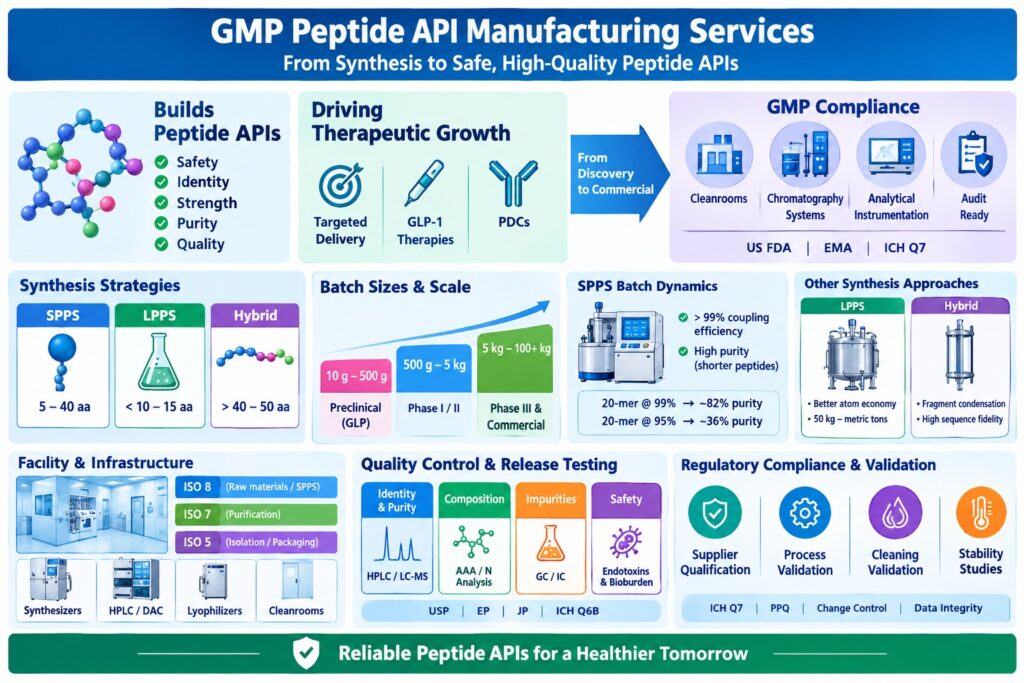
- Batch sizes scale with development stage: typically 10 g–500 g for preclinical, 500 g–5 kg for Phase I/II, and 5–100+ kg for Phase III/commercial supply.
- Specialized infrastructure includes ISO 8 synthesis, ISO 7 purification, ISO 5 isolation/packaging, preparative RP-HPLC/DAC systems, automated synthesizers, and industrial lyophilizers.
- Comprehensive QC testing covers identity, purity, peptide content, counterions, residual solvents, moisture, endotoxins, and bioburden using HPLC, LC-MS, GC, IC, AAA, and microbiological methods.
- ICH Q7 compliance and process validation involve supplier qualification, raw-material control, PPQ, cleaning validation, change control, data integrity, and stability studies.
- An integrated GMP manufacturing-to-release strategy enables reproducible peptide API production while supporting clinical development, scale-up, regulatory submissions, and commercial supply.
Batch Sizes and Scale in GMP Peptide API Manufacturing Services
GMP Peptide API Manufacturing Services can support production quantities ranging from milligram-level material for early preclinical investigations to multi-kilogram quantities required for late-stage clinical development and commercial distribution. The appropriate production scale depends on several factors, including the selected synthesis methodology, peptide sequence length, crude material purity, process yield, and intended therapeutic application.
The choice of peptide synthesis strategy has a direct impact on batch yield, solvent requirements, processing duration, and overall cost of goods. Synthetic approaches are generally divided into Solid-Phase Peptide Synthesis (SPPS), Liquid-Phase Peptide Synthesis (LPPS), and hybrid fragment condensation strategies.
Solid-Phase Peptide Synthesis (SPPS) Batch Dynamics
Solid-Phase Peptide Synthesis remains the principal manufacturing approach for many therapeutic peptides containing approximately 5 to 40 amino acid residues. During SPPS, the C-terminal amino acid is covalently linked to an insoluble polymeric resin support. Subsequent orthogonally protected amino acids, most commonly using Fmoc/tBu or Boc/Bzl protection chemistry, are then incorporated sequentially to construct the peptide chain.
Using excess reagent concentrations can drive coupling reaction efficiencies above 99% at each individual step. This high coupling efficiency is particularly important because the cumulative yield decreases exponentially as the peptide sequence becomes longer. For example, a 20-mer peptide manufactured with an average step coupling efficiency of 99% produces an approximate crude purity of 82%, whereas an average step efficiency of 95% can reduce crude purity to below 36%. Modern commercial SPPS reactors range from pilot-scale automated systems with capacities of approximately 10 L to 50 L, producing around 100 g to 1 kg per batch, to large-scale industrial stirred-tank reactors with capacities of 500 L to more than 1,000 L. These larger systems can generate approximately 10 kg to more than 25 kg of purified API during a single production campaign.
Liquid-Phase Peptide Synthesis (LPPS) and Hybrid Condensation
For shorter peptides, generally containing fewer than 10 to 15 amino acids, as well as high-demand commercial targets, Liquid-Phase Peptide Synthesis (LPPS) can provide advantages in atom economy and scalability. Because the reaction intermediates remain dissolved in solution rather than being attached to a solid support, processing volumes can be optimized while avoiding the resin costs and extensive wash-solvent consumption associated with SPPS. LPPS manufacturing facilities can routinely process batch quantities ranging from approximately 50 kg to metric-ton scales.
For longer structural peptides containing more than approximately 40 to 50 residues, hybrid fragment condensation is frequently used to improve manufacturing efficiency. In this strategy, shorter, fully protected peptide fragments are first prepared using automated SPPS and subsequently purified. These fragments are then coupled in solution through LPPS or native chemical ligation. This convergent manufacturing approach reduces the accumulation of difficult-to-remove (n-1) deletion sequences and supports high sequence fidelity when production is scaled to multi-kilogram quantities.
Phase-Appropriate Scaling Pathways
Scaling peptide manufacturing requires a balance between process yield optimization, production capacity, analytical control, and regulatory validation throughout the drug development lifecycle:
- Preclinical and GLP Toxicology Batches: Small-scale synthesis, generally ranging from 10 g to 500 g, is performed to establish baseline purity profiles, generate analytical reference standards, and provide sufficient material for toxicology investigations.
- Early Clinical Supply (Phase I / II): Manufacturing is conducted under strict cGMP conditions, with batch sizes typically ranging from 500 g to 5 kg. Process development at this stage focuses on demonstrating reproducibility, establishing consistent purification gradients, and defining preliminary critical process parameters.
- Late Clinical and Commercial Supply (Phase III & Commercial): Process scale-up supports multi-kilogram to metric-ton quantities where required. Manufacturing operations incorporate continuous process verification, validated cleaning procedures, and solvent recovery systems to support both economic efficiency and environmental sustainability.
Read more about optimization considerations in our technical article on peptide API scale-up.
| Development Phase | Typical Net Batch Size | Primary Synthesis Tech | Target Cleanroom Environment | Key Processing Goal |
|---|---|---|---|---|
| Preclinical / GLP | 10 g – 500 g | Automated SPPS | Unclassified / ISO 8 | Method feasibility & tox supply |
| Phase I / II Clinical | 500 g – 5 kg | Automated SPPS / Hybrid | ISO 8 (Synth) / ISO 7 (Purif) | Process repeatability & cGMP release |
| Phase III / Commercial | 5 kg – 100+ kg | Industrial SPPS / LPPS | ISO 7 (Purif) / ISO 5 (Iso) | Process validation & commercial supply |
Suite Capabilities and Facility Infrastructure for GMP Peptide API Manufacturing Services
Facility infrastructure supporting GMP Peptide API Manufacturing Services combines controlled cleanroom environments, automated chemical processing equipment, and high-capacity isolation technologies designed to minimize contamination risks and maintain appropriate environmental controls. Manufacturing facilities operate under controlled conditions consistent with ISO 14644 standards and EU GMP Annex 1 requirements.
Cleanroom Architecture and Environmental Zoning
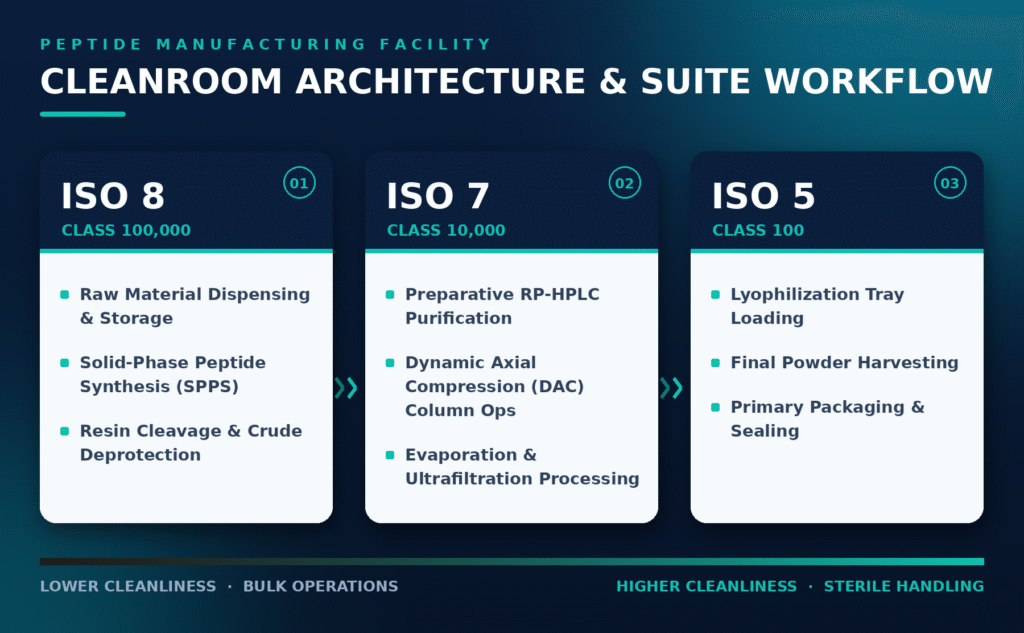
Cleanroom suites are systematically designed to maintain appropriate separation of personnel, materials, and processing activities, thereby reducing the potential for cross-contamination during manufacturing and handling operations:
- ISO 8 (Class 100,000) Suites: These areas accommodate solid-phase synthesis equipment, raw material dispensing hoods, solvent storage, and resin cleavage reactors. Air handling units (AHUs) provide HEPA-filtered air and maintain positive differential pressure relative to unclassified corridors. Explosive-proof (ATEX-rated) electrical systems are also incorporated where necessary to support safe handling of organic solvents.
- ISO 7 (Class 10,000) Suites: These controlled areas are designated for downstream processing activities, including preparative chromatographic purification, column loading, evaporation, and concentration operations involving purified peptide intermediate solutions.
- ISO 5 (Class 100) Environments and Laminar Flow Cabinets: These environments support final API isolation, lyophilization tray loading, dry powder harvesting, weighing, and primary packaging activities. Maintaining ISO 5 conditions is particularly important for parenteral-grade APIs because it helps minimize microbial bioburden and foreign particulate contamination before the material is finally sealed.
Equipment Engineering and Downstream Capabilities
The processing capabilities of a GMP peptide manufacturing facility are strongly influenced by the design and performance of its specialized equipment:
- Automated Synthesizers: Computer-controlled peptide synthesizers provide accurate solvent metering, temperature control, reagent delivery, and reaction monitoring. Automated monitoring of coupling efficiency through inline UV sensors can reduce reagent consumption while helping identify and prevent incomplete coupling steps.
- Preparative HPLC Systems: Purification is typically performed using Reversed-Phase High-Performance Liquid Chromatography (RP-HPLC) with Dynamic Axial Compression (DAC) columns. Columns with internal diameters ranging from approximately 8 cm to more than 20 cm and packed with 10 µm ODS C18 silica media support high-capacity separation of closely related impurities, including diastereomers and truncation sequences, at elevated flow rates.
- Counterion Exchange Systems: Following synthesis and cleavage, peptide APIs may contain residual trifluoroacetate (TFA) counterions originating from cleavage reagents. Preparative ion-exchange chromatography or low-pressure column washing can be used to replace TFA salts with pharmaceutically acceptable counterions, including acetate or hydrochloride.
- Industrial Lyophilization: Freeze-drying is widely used for producing stable, amorphous peptide powders. Industrial lyophilizers can incorporate automated Clean-in-Place (CIP) and Sterilization-in-Place (SIP) systems, steam sterilization capabilities, and precise sub-zero shelf-temperature control. These systems support the sublimation of aqueous-organic solvent mixtures under high-vacuum conditions.
Review the complete workflow for creating stabilized formulations in our resource on formulating a lyophilized peptide injectable.
Digital Infrastructure and Data Integrity
Contemporary peptide manufacturing facilities use integrated digital systems to meet the requirements of FDA 21 CFR Part 11 and ALCOA+ data integrity principles. Electronic Batch Records (EBR), Supervisory Control and Data Acquisition (SCADA) systems, and validated Laboratory Information Management Systems (LIMS) provide continuous documentation of critical process parameters, equipment and instrument calibration information, and analytical raw data. This integrated approach supports traceability, data integrity, and audit readiness throughout GMP operations.
Quality Control and Release Testing Specifications for GMP Peptide API Manufacturing Services
Quality control and release testing within GMP Peptide API Manufacturing Services require a validated analytical testing program capable of confirming product identity, purity, potency, safety, composition, and physical characteristics. Release specifications are established according to applicable acceptance criteria and are aligned with ICH Q6B guidelines and relevant official pharmacopeial monographs, including USP, EP, and JP.
Critical Quality Attributes (CQAs) and Testing Methodologies
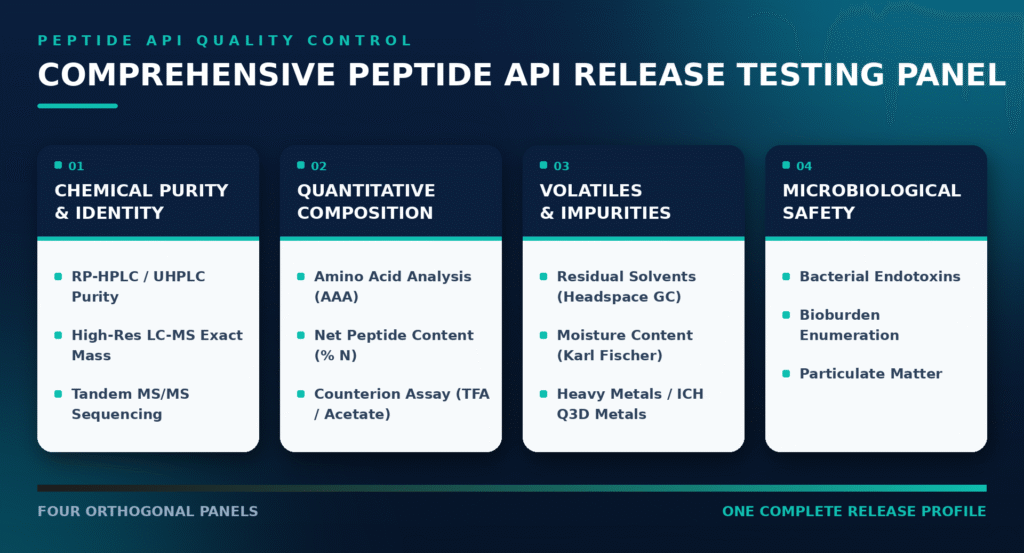
Peptide active pharmaceutical ingredients possess considerable structural complexity and can therefore undergo multiple forms of chemical or physical degradation, including oxidation, deamidation, racemization, and aggregation. A compliant GMP release testing panel evaluates the relevant Critical Quality Attributes (CQAs) using validated analytical methodologies:
- Chromatographic Purity and Related Substances: High-Performance Liquid Chromatography (RP-HPLC) or Ultra-High Performance Liquid Chromatography (UHPLC), coupled with UV or Charged Aerosol Detection (CAD), serves as a principal analytical approach for evaluating peptide purity. The analytical method must provide adequate resolution between the principal peptide peak and closely related impurities, including (n-1) deletion sequences, diastereomers, and degradation products. Commercial APIs generally specify chromatographic purity levels ranging from ≥ 95.0% to ≥ 98.0%, while individual unknown impurities may be controlled within limits ranging from below 0.10% to 0.50%.
- Mass Identity and Primary Structure: High-Resolution Mass Spectrometry (LC-MS/ESI or MALDI-TOF) is used to verify the exact monoisotopic molecular mass of the peptide API. Confirmation of the primary sequence can be performed through LC-MS/MS fragment mapping or N-terminal Edman degradation sequencing.
- Peptide Content and Assay: Net peptide content determines the proportion of pure peptide mass relative to non-peptide constituents, including counterions, inorganic salts, and bound moisture. Amino Acid Analysis (AAA) or total nitrogen determination using combustion analysis, such as the Dumas method, can be used to quantify net peptide content. The resulting value supports appropriate dosing calculations during finished drug product manufacturing.
- Counterion Content: Counterion concentrations, including acetate, chloride, or residual TFA, are quantified using Ion Chromatography (IC) or RP-HPLC with suppressed conductivity detection. TFA levels are generally restricted to ≤ 1.0%, whereas the intended counterions, such as acetate, are controlled within defined stoichiometric ranges, typically 5.0% to 15.0%.
- Residual Solvents and Moisture Content: Headspace Gas Chromatography (GC-HS) is used to quantify residual organic solvents introduced during peptide synthesis and purification, including DMF, NMP, DCM, acetonitrile, and piperidine, in accordance with applicable ICH Q3C limits. Karl Fischer (KF) coulometric titration is used to determine residual water content, which is routinely specified at ≤ 5.0% w/w to minimize the potential for hydrolytic degradation.
- Microbiological Safety and Endotoxins: Peptides intended for parenteral administration require stringent microbiological controls. Bacterial endotoxins are measured using the Limulus Amebocyte Lysate (LAL) assay, while total aerobic microbial count (TAMC) and total yeast and mold count (TYMC) can be assessed using bioburden membrane filtration methods.
To see how advanced analytical techniques apply to complex commercial molecules, read our peptide characterization case study of semaglutide.
| Analytical Assay | Instrumental Technique | Typical Acceptance Criteria | Clinical & Regulatory Rationale |
|---|---|---|---|
| Appearance | Visual Inspection | White to off-white lyophilized powder | Confirms macroscopic physical state and freedom from visible contaminants. |
| Identity (Mass) | LC-MS / MALDI-TOF | Matches theoretical mass (± 0.5 Da) | Verifies exact molecular weight and elemental composition. |
| Chromatographic Purity | RP-HPLC / UHPLC | ≥ 95.0% to ≥ 98.0% area | Measures target API content relative to related substances. |
| Related Substances | RP-HPLC / UHPLC | Individual unknown ≤ 0.10% to 0.50% | Limits deletion sequences, diastereomers, and degradants. |
| Peptide Content | AAA / Nitrogen Analysis | ≥ 80.0% w/w | Defines actual active content for drug formulation calculations. |
| Counterion Content | Ion Chromatography | Acetate: 5–15%; TFA: ≤ 1.0% | Verifies proper salt form and removes residual cleavage reagents. |
| Residual Moisture | Karl Fischer Titration | ≤ 5.0% w/w | Controls hydrolytic cleavage risks during shelf storage. |
| Residual Solvents | Headspace GC-FID | Within ICH Q3C Class 1, 2, 3 limits | Ensures removal of toxic organic synthesis solvents. |
| Bacterial Endotoxins | LAL Kinetic Assay | < 10 EU/mg (indication specific) | Prevents pyrogenic responses in parenteral applications. |
| Bioburden | Microbial Enumeration | TAMC < 100 CFU/g; TYMC < 10 CFU/g | Ensures low bioburden levels prior to final product sterilization. |
Regulatory Compliance and Process Validation under ICH Q7
Regulatory compliance within GMP Peptide API Manufacturing Services is guided by ICH Q7 requirements, including formal process validation, supplier and vendor qualification, change control, and independent quality oversight. Process validation provides documented evidence that a manufacturing process operates reproducibly within predefined parameters and consistently produces an API that conforms to established specifications.
ICH Q7 Implementation Framework
The ICH Q7 guideline establishes cGMP expectations throughout the API manufacturing lifecycle. For synthetic peptides, formal GMP controls begin with the introduction of qualified “API starting materials,” which may include Fmoc-protected amino acids, coupling reagents, and functionalized resins. As manufacturing progresses through cleavage, preparative purification, and final isolation, the level of quality control and regulatory oversight becomes increasingly stringent.
Core regulatory elements include:
- Supplier Qualification and Raw Material Control: The quality and consistency of incoming protected amino acids can directly affect the purity profile of the final API. Quality Assurance (QA) units are therefore responsible for conducting appropriate supplier qualification and audits, performing identity and purity testing of starting materials, and establishing defined specifications for critical reagents.
- Process Validation Lifecycles (PPV): Demonstrating the capability and reproducibility of a commercial manufacturing process requires completion of Process Performance Qualification (PPQ) using three consecutive commercial-scale batches. PPQ evaluates whether operation within established Critical Process Parameters (CPPs), including coupling times, cleavage temperatures, column flow rates, and lyophilization cycles, consistently produces material meeting the required Critical Quality Attributes (CQAs).
- Cleaning Validation: In multi-product manufacturing environments, validated cleaning procedures are essential for controlling cross-contamination. Cleaning processes for synthesizers, HPLC systems, and lyophilizers are evaluated using swab and rinse sampling, with samples analyzed using high-sensitivity TOC (Total Organic Carbon) or HPLC assays. Acceptance limits are established using Health-Based Exposure Limits (HBEL) or Permitted Daily Exposure (PDE) calculations.
- ICH Stability Testing Programs: Real-time and accelerated stability studies conducted in accordance with ICH Q1A(R2) guidelines assess the physical and chemical stability of the API throughout its intended storage period. Samples are maintained in chambers representing commercial packaging and storage conditions, including long-term conditions such as 25°C/60% RH, 5°C, or -20°C, together with accelerated conditions of 40°C/75% RH. The resulting stability data are used to establish appropriate retest dates and storage-label requirements.
Review the key structural distinctions between manufacturing operational models in our guide on peptide CDMO vs CMO.
Conclusion: Strategic Implementation of GMP Peptide API Manufacturing Services
Partnering with specialized providers for GMP Peptide API Manufacturing Services is an important component of reducing manufacturing and regulatory risks throughout clinical development while establishing a scalable pathway toward commercial production. The infrastructure implemented by facilities such as ResolveMass Laboratories Inc.—including ISO-classified cleanroom suites, high-capacity preparative DAC columns, industrial lyophilizers, and comprehensive quality control laboratories—provides the technical foundation required for reliable manufacturing of complex peptide APIs.
By applying rigorous operational controls across the complete manufacturing workflow, from raw material qualification and solid-phase synthesis through counterion exchange, freeze-drying, and validated release testing, specialized contract manufacturers can support pharmaceutical companies in developing and scaling advanced peptide therapeutics for global markets.
To learn more about custom peptide scale-up, facility capabilities, and analytical services, visit the ResolveMass Laboratories Contact Page.
Frequently Asked Questions (FAQs)
GMP peptide manufacturing can accommodate different production scales, from relatively small clinical batches of approximately 100 g to 1 kg to larger commercial campaigns ranging from 10 kg to more than 100 kg. The appropriate batch size depends on factors such as synthesis methodology, peptide sequence, therapeutic dose, manufacturing yield, and anticipated market requirements. Scale is typically increased progressively as development advances.
Solid-Phase Peptide Synthesis (SPPS) provides automated and reproducible coupling cycles, making it well suited for many clinical-stage peptide manufacturing processes. The method also allows efficient adaptation to different peptide sequences and is commonly applied to chains containing up to approximately 40 residues. Liquid-Phase Peptide Synthesis (LPPS) may provide greater scalability for shorter peptides, particularly when large commercial quantities are required.
Peptide synthesis and crude cleavage activities are generally performed within ISO 8 (Class 100,000) controlled areas, while purification and downstream concentration are conducted in ISO 7 (Class 10,000) suites. Final API handling activities, including lyophilization tray loading, powder harvesting, and primary packaging, may require ISO 5 (Class 100) environments depending on the process and intended application. These controls help minimize particulate and microbial contamination risks.
Trifluoroacetic acid (TFA) can be reduced or replaced during downstream purification and counterion-exchange operations. The peptide is processed using chromatographic or washing conditions containing a suitable replacement counterion, such as acetate or chloride. This facilitates conversion of the peptide from its TFA salt form to the desired pharmaceutically acceptable salt form before final isolation and freeze-drying.
Peptide API release testing typically uses a combination of orthogonal analytical techniques to establish identity, purity, composition, and safety. RP-HPLC/UHPLC evaluates chromatographic purity and related substances, while High-Resolution LC-MS confirms molecular mass. Additional testing can include Amino Acid Analysis (AAA), Karl Fischer titration, Headspace GC, Ion Chromatography, and LAL testing for parameters such as peptide content, moisture, residual solvents, counterions, and bacterial endotoxins.
Amino Acid Analysis (AAA) provides quantitative information about the amino acid composition of a peptide after hydrolysis into its constituent amino acids. Measuring the resulting amino acids helps determine net peptide content independently of non-peptide components such as counterions, inorganic salts, and associated water. The resulting composition data can support accurate potency and dosing calculations during drug product manufacturing.
Process-related impurities such as deletion sequences $(n-1)$, insertion sequences $(n+1)$, diastereomers, and truncated peptide fragments can be characterized using chromatographic and mass spectrometric techniques, including LC-MS/MS fragment mapping. Their formation is reduced through optimized coupling, deprotection, cleavage, and purification conditions. Preparative RP-HPLC using appropriate C18 stationary phase media and carefully developed gradients can further separate and remove closely related impurities.
A GMP peptide API batch release package generally contains documentation demonstrating that the material was manufactured and tested according to approved procedures and specifications. Depending on the manufacturing program, this may include a Certificate of Analysis (CoA), executed Batch Production Records (BPR), Certificates of Conformity, chromatograms, spectra, analytical raw data, and relevant CMC documentation. Such records can support regulatory submissions such as IND, IMPD, NDA, or Drug Master File (DMF) filings.
Stability programs for commercial peptide APIs are initiated during development and continue through the relevant commercial lifecycle. Long-term studies evaluate physical and chemical stability under defined ICH Q1A(R2) storage conditions, which may include temperatures such as $5^\circ\text{C}$ or $-20^\circ\text{C}$ depending on the API. Accelerated studies, commonly conducted at $40^\circ\text{C}/75%\text{ RH}$ for six months, provide additional information for establishing retest periods, storage requirements, and transport specifications.
Reference:
- U.S. Food and Drug Administration. (2001, August). Q7A good manufacturing practice guidance for active pharmaceutical ingredients. FDA guidance document
- European Medicines Agency. (2000, November 1). ICH Q7: Good manufacturing practice for active pharmaceutical ingredients—Step 5. EMA guideline
- ECA Academy. (2026, July 8). GMP for active substances—What are the fundamental requirements of the ICH Q7 guideline? Part 1. GMP Compliance webpage
- U.S. Food and Drug Administration. (2018, April). Q7 good manufacturing practice guidance for active pharmaceutical ingredients: Questions and answers—Guidance for industry. FDA PDF
- Patel, A., & Patel, R. (2024). Analytical techniques for peptide-based drug development: Characterization, stability and quality control. International Journal of Science and Research Archive, 12(1), 3140–3159. https://doi.org/10.30574/ijsra.2024.12.1.1108
Get In Touch With Us
About The Author


