

Introduction
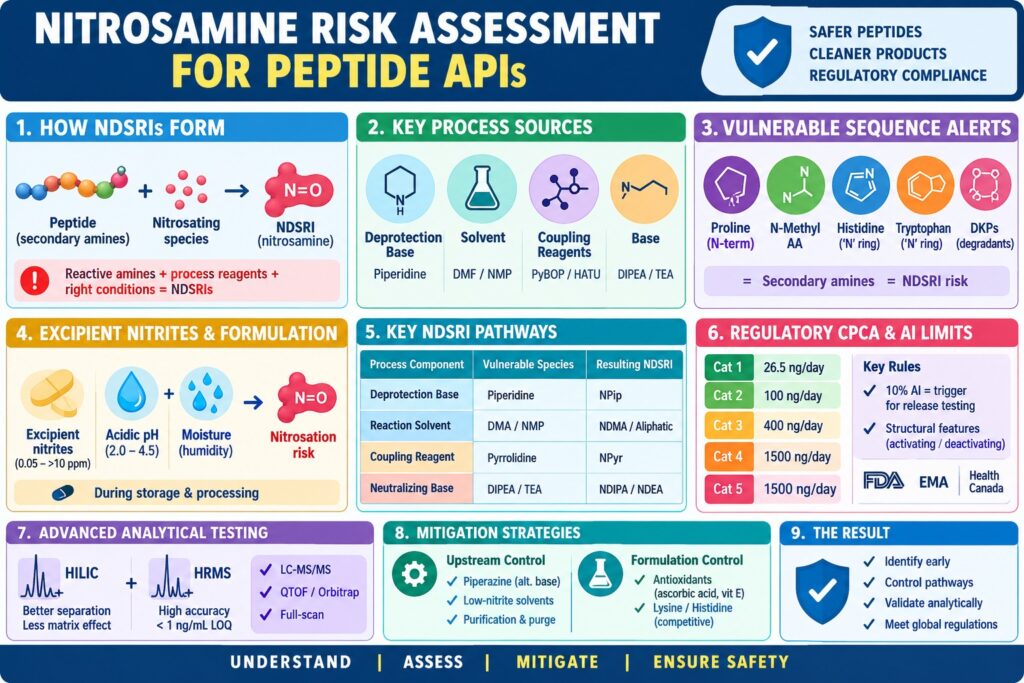
A comprehensive Nitrosamine Risk Assessment for Peptide APIs examines the specific chemical pathways through which reactive secondary and tertiary amines present within peptide sequences or process reagents can interact with trace nitrosating species and generate genotoxic Nitrosamine Drug Substance-Related Impurities (NDSRIs). Unlike conventional small-molecule nitrosamines, including N-nitrosodimethylamine (NDMA) and N-nitrosodiethylamine (NDEA), which are commonly associated with volatile process contaminants originating from recycled solvents, raw materials, or manufacturing conditions, NDSRIs are generally non-volatile and structurally complex N-nitroso derivatives that retain the molecular framework of the active pharmaceutical ingredient (API) or its degradation products. In synthetic and semi-recombinant peptide manufacturing, extensive use of secondary amine deprotection agents, amide solvents, phosphonium/uronium coupling reagents, and complex sequence-specific chemistries can introduce multiple potential root causes throughout the complete drug manufacturing lifecycle.
Determining the chemical mechanisms responsible for NDSRI formation requires an assessment of upstream API manufacturing processes, inherent vulnerabilities within the peptide sequence, and interactions that may occur during downstream drug product formulation. Whereas small-molecule therapeutics generally contain secondary amine structural alerts associated with an isolated functional group on a relatively rigid molecular scaffold, synthetic peptides may contain numerous peptide bonds, chemically reactive amino acid side chains, and terminal nitrogen centers. In addition, process reagents routinely used during Solid-Phase Peptide Synthesis (SPPS) and Liquid-Phase Peptide Synthesis (LPPS)—including piperidine, N,N-dimethylformamide (DMF), and coupling additives—can introduce persistent secondary amine precursors throughout the manufacturing process. Regulatory authorities, including the US FDA and the European Medicines Agency (EMA), have established stringent Acceptable Intake (AI) limits for NDSRIs, making detailed mechanistic assessments and appropriately validated analytical testing strategies essential for peptide development and manufacturing.
For complex peptide development programs, explore custom peptide synthesis services to support sequence-specific synthesis and characterization requirements.
Share via:
Quick Summary:
- NDSRI risk in peptide APIs arises when secondary amines in peptide sequences, process reagents, or degradation products react with trace nitrosating species.
- Key upstream sources include piperidine from Fmoc deprotection, DMF/NMP degradation products, PyBOP/HATU coupling reagents, and DIPEA/TEA-related secondary amines.
- Peptide sequence alerts include N-terminal proline, N-methylated amino acids, histidine, tryptophan, and diketopiperazine (DKP) degradants.
- Excipient-derived nitrites can contribute to NDSRI formation, especially under acidic, humid microenvironments during formulation and long-term storage.
- CPCA-based assessment categorizes NDSRIs according to structural potency and establishes Acceptable Intake (AI) limits; the 10% AI level can trigger routine release-testing considerations.
- Advanced analytical methods, particularly HILIC-HRMS and LC-MS/MS, help detect and quantify trace NDSRIs while reducing peptide-matrix interference and supporting low-level detection.
- Risk mitigation focuses on low-nitrite raw materials, alternative deprotection bases, solvent controls, purification/purge strategies, and formulation approaches that reduce nitrosation—supporting a defensible, science-based regulatory control strategy.
Root Causes of NDSRIs in Upstream Peptide API Synthesis
Upstream synthetic peptide manufacturing can generate NDSRI risks through interactions between secondary amine deprotection bases, degraded amide solvents, and phosphonium coupling reagents with trace nitrosating species under acidic, oxidative, or otherwise favorable processing conditions. During both solid-phase and liquid-phase peptide synthesis, the use of reagents and solvents at high molar excesses can increase the likelihood that trace nitrites will be converted into reactive nitrosating species capable of attacking susceptible amine functional groups.
As peptide programs progress toward larger production scales, review peptide CDMO scale-up services for considerations related to process transfer and manufacturing scale-up.
Fmoc Deprotection Kinetics and Piperidine Contamination in Nitrosamine Risk Assessment for Peptide APIs
Piperidine used for Fmoc deprotection can react rapidly with trace nitrites or nitrogen oxides in DMF to generate N-nitrosopiperidine (NPip). Residual piperidine that remains within the process environment may also participate in cross-nitrosation of exposed N-terminal amines during acidic cleavage. Solid-Phase Peptide Synthesis predominantly employs Fluorenylmethyloxycarbonyl (Fmoc) protection chemistry, in which Fmoc deprotection is commonly performed using 20% piperidine in DMF or N-methyl-2-pyrrolidone (NMP). Piperidine is a cyclic secondary amine with substantial nucleophilic reactivity. When raw DMF or process water contains trace concentrations of inorganic nitrites (NO₂⁻) or dissolved nitrogen oxides (NOₓ), piperidine can undergo N-nitrosation to form NPip. In addition, if piperidine is not adequately removed from the resin bed during washing before subsequent trifluoroacetic acid (TFA) cleavage or side-chain deprotection, the resulting localized acidic environment can convert residual nitrites into reactive nitrosating species, including the nitrosonium cation (NO⁺) and dinitrogen trioxide (N₂O₃). These species can then promote direct cross-nitrosation of an unprotected N-terminal amine or susceptible secondary amines located within side chains.
Solvent Decomposition and Amide Hydrolysis Pathways
Amide solvents such as DMF and NMP can undergo decomposition under thermal or hydrolytic stress, generating secondary amines such as dimethylamine and N-methyl-4-aminobutyric acid. These degradation products can subsequently react with nitrosating agents to produce small-molecule nitrosamines or product-related NDSRIs. During storage, solvent recovery, or repeated processing cycles, DMF can undergo hydrolysis to produce dimethylamine (DMA) and formic acid. When DMA encounters nitrosating species, which may be introduced through sodium nitrite quenching agents or trace contaminants in raw materials, it can undergo nitrosation to generate NDMA. Likewise, NMP can undergo ring-opening hydrolysis to produce N-methyl-4-aminobutyric acid. This degradation product contains an aliphatic secondary amine functionality that can react with trace nitrites and contribute to the formation of product-related nitrosamine degradants.
Coupling Reagents and Base-Mediated Secondary Amine Release
Phosphonium coupling agents such as PyBOP can release cyclic secondary amines such as pyrrolidine during hydrolysis or side reactions, while tertiary amine activators such as DIPEA may undergo oxidative dealkylation to generate secondary amine precursors that are susceptible to nitrosation. Modern peptide coupling strategies commonly employ phosphonium or uronium reagents, including benzotriazol-1-yl-oxytripyrrolidinophosphonium hexafluorophosphate (PyBOP) and O-(7-Azabenzotriazol-1-yl)-N,N,N’,N’-tetramethyluronium hexafluorophosphate (HATU). PyBOP contains pyrrolidine-derived structural elements and may generate free pyrrolidine, a cyclic secondary amine, during side reactions or aqueous hydrolysis. Pyrrolidine can readily react with trace nitrites to form N-nitrosopyrrolidine (NPyr). In parallel, tertiary amine bases commonly used in peptide coupling reactions, such as N,N-diisopropylethylamine (DIPEA) and triethylamine (TEA), can undergo oxidative dealkylation under certain stress conditions. Such reactions may generate secondary amine precursors, including diisopropylamine or diethylamine, which can subsequently undergo nitrosation to produce the corresponding nitrosamine species.
When selecting a manufacturing partner for complex peptide chemistry, compare peptide CDMO vs CMO capabilities to understand differences in development, analytical, and manufacturing support.
| Process Component | Vulnerable Amine / Precursor Species | Nitrosation Pathway / Mechanism | Resulting Impurity / NDSRI Class |
|---|---|---|---|
| Deprotection Base | Piperidine (Secondary Amine) | Direct reaction with NOₓ or HNO₂ in DMF | N-Nitrosopiperidine (NPip) |
| Reaction Solvent | Dimethylamine (DMA from DMF degradation) | Hydrolytic breakdown followed by nitrosation | N-Nitrosodimethylamine (NDMA) |
| Reaction Solvent | N-Methyl-4-aminobutyric acid (from NMP) | Ring-opening hydrolysis followed by reaction with NO₂⁻ | Aliphatic N-Nitroso degradant |
| Coupling Reagent | Pyrrolidine (from PyBOP byproduct) | Cleavage of phosphonium core followed by nitrosation | N-Nitrosopyrrolidine (NPyr) |
| Neutralizing Base | Diisopropylamine / Diethylamine (from DIPEA/TEA) | Dealkylation under oxidative or acidic stress | NDIPA / NDEA derivatives |
Endogenous Sequence Alerts: Vulnerable Amino Acid Residues
Intrinsic NDSRI risk in peptide APIs is associated with secondary amine functionalities present within the primary sequence, particularly N-terminal proline, N-alkylated amino acids, and secondary amine degradants that can arise through diketopiperazine cleavage or peptide bond hydrolysis. The exact primary sequence of a peptide therefore determines whether the API itself contains a secondary amine substrate capable of undergoing direct NDSRI formation.
Proline and N-Terminal Secondary Amines
Proline contains a secondary pyrrolidine amine ring that can exhibit significant nucleophilic reactivity toward nitrosating species when it is positioned at the N-terminus of a peptide sequence. Unlike amino acids containing primary amino groups, Proline has a side chain that cyclizes back onto its backbone amino group, producing a secondary amine. When Proline is located at the N-terminus of a peptide chain or is present as an unreacted amino acid fragment, its secondary amine nitrogen can react with nitrosating species such as NO⁺ and N₂O₃ under acidic conditions, resulting in N-nitroso-proline (NOP) or peptide-bound N-terminal nitroso-proline derivatives. Even when Proline is initially located internally within the peptide sequence, peptide bond hydrolysis during prolonged storage can expose a newly generated N-terminal Proline residue, thereby creating a potential late-stage NDSRI formation pathway.
N-Methylated and Modified Amino Acids
To improve enzymatic resistance and increase conformational or structural rigidity, modern peptidomimetics frequently incorporate N-methylated amino acids, including Sarcosine (N-methylglycine), N-methyl-leucine, and N-methyl-isoleucine. These N-alkylated peptide backbones contain secondary amide and amine linkages that may become chemically relevant following degradation. Partial acid hydrolysis or enzymatic degradation can release secondary amine-containing precursors from these modified residues. In the presence of trace nitrites or other nitrosating species, these secondary amine precursors may undergo nitrosation and contribute to product-specific NDSRI formation.
Heterocyclic Side Chains and Diketopiperazine Degradation
Heterocyclic nitrogens present in Histidine and Tryptophan may undergo nitrosation under strongly acidic conditions, while diketopiperazine degradants containing Proline can provide cyclic secondary amine structures that are susceptible to reaction with nitrites originating from excipients. Histidine contains an imidazole ring, whereas Tryptophan contains an indole nitrogen, and both functionalities can participate in transient nitroso-related reactions under appropriate chemical conditions. At the same time, peptides can undergo chemical degradation during storage, resulting in the formation of diketopiperazines (DKPs), which are cyclic dipeptides generated through N-terminal nucleophilic attack. When a DKP contains Proline or an N-methylated residue, the resulting cyclic structure can contain a secondary amine functionality capable of acting as a substrate for NDSRI formation in the presence of excipient-derived nitrites.
For programs involving sequence-specific peptide chemistry, review the difference between peptide and small-molecule drugs and their respective development considerations.
| Amino Acid / Residue Type | Chemical Structure Alert | Specific Nitrosation Vulnerability | NDSRI Potential |
|---|---|---|---|
| N-Terminal Proline | Pyrrolidine secondary amine ring | Direct N-nitrosation of free N-terminus | High (Direct N-nitroso-peptide) |
| N-Methylated Amino Acids | Secondary alkylamine backbone linkages | Cleavage/degradant nitrosation | High (Product-specific NDSRI) |
| Histidine Residues | Imidazole ring nitrogens | Nitrosimine formation under low pH | Moderate (Transient nitroso species) |
| Tryptophan Residues | Indole secondary amine nitrogen | Electrophilic N-nitrosation | Moderate (Indole N-nitroso derivative) |
| Diketopiperazines (DKPs) | Cyclic dipeptide secondary amines | Reaction with excipient nitrites | High (Degradant-derived NDSRI) |
Excipient Nitrites and Formulated Drug Product Microenvironmental Kinetics
Downstream NDSRI formation in solid and liquid peptide formulations can result from interactions between trace inorganic nitrite impurities present in excipients and susceptible peptide amine centers under acidic or humid microenvironmental conditions during storage. Drug product manufacturing operations, including wet granulation, fluid-bed drying, and liquid compounding, can increase intimate physical contact between excipient-derived nitrites and the active peptide, thereby creating conditions that may facilitate nitrosation.
For peptide products requiring freeze-drying, review lyophilized peptide injectable formulation considerations related to formulation and product stability.
Excipient Trace Nitrites
Common pharmaceutical excipients, including microcrystalline cellulose (MCC), povidone (PVP), crospovidone, lactose, mannitol, and pregelatinized starch, may contain residual inorganic nitrites (NO₂⁻) at concentrations ranging from 0.05 ppm to more than 10 ppm. These nitrites may originate from agricultural water sources, industrial processing materials, or oxidative bleaching procedures used during excipient production. Although these concentrations are low when expressed on a mass basis, even 1 ppm nitrite within a solid tablet matrix can provide sufficient reactive nitrite to contribute to NDSRI formation at levels that may exceed daily nanogram-level Acceptable Intake (AI) limits, depending on the peptide structure and formulation environment.
Microenvironmental pH and Moisture Effects
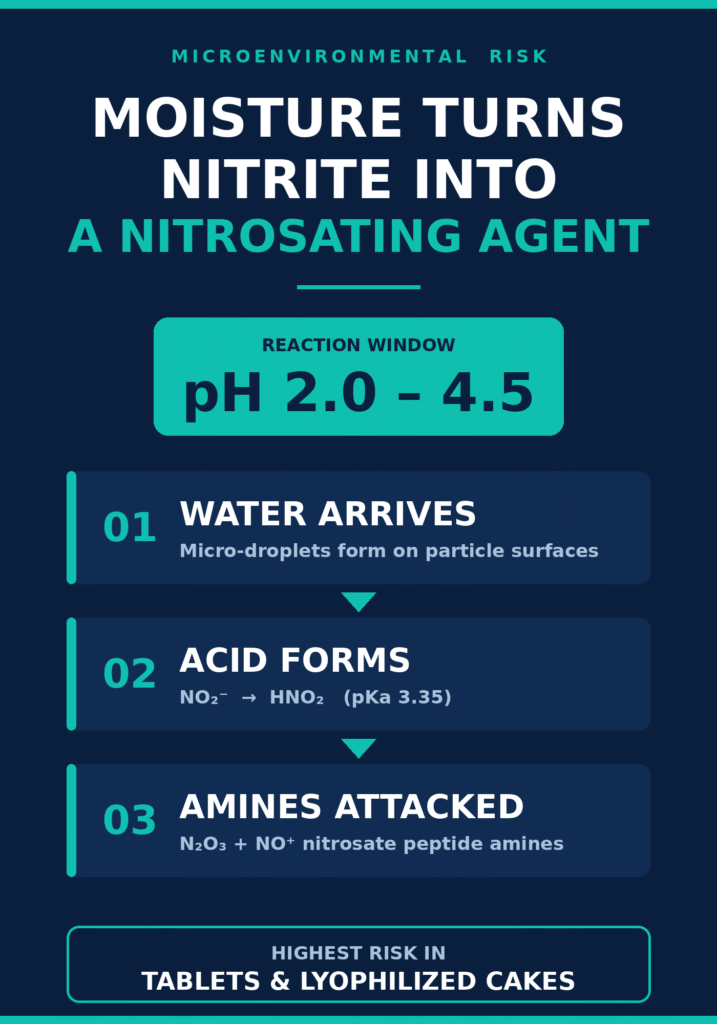
Nitrosation kinetics can increase when absorbed moisture generates localized acidic microenvironments, particularly within a pH range of approximately 2.0 to 4.5, where inactive nitrite ions can be converted into reactive nitrous acid (HNO₂) and dinitrogen trioxide (N₂O₃). Nitrite ions (NO₂⁻) are not themselves strongly electrophilic and require protonation under acidic conditions to generate nitrous acid (HNO₂, pKa approximately 3.35). Nitrous acid can subsequently participate in equilibria that generate dinitrogen trioxide (N₂O₃) or nitrosonium cation (NO⁺), both of which can participate in nitrosation chemistry. In solid dosage forms and lyophilized cakes, atmospheric moisture can produce localized microdroplets on particle surfaces, thereby facilitating contact between reactive nitrosating species and vulnerable peptide N-termini or degradant amines during long-term shelf-life storage.
Regulatory Categorization and CPCA Framework for Peptide NDSRIs
Global regulatory frameworks use the Carcinogenic Potency Categorization Approach (CPCA) to assign Acceptable Intake (AI) limits to peptide NDSRIs. The CPCA categorizes nitrosamine impurities from Category 1, associated with an AI of 26.5 ng/day, through Category 5, associated with an AI of 1500 ng/day, based on structural characteristics surrounding the N-nitroso group. The CPCA framework was established by regulatory authorities, including the FDA, EMA, and Health Canada, to provide a structured approach for toxicological evaluation when compound-specific rodent carcinogenicity data, such as TD₅₀ values, are unavailable.
Structural Potency Rules for Peptide NDSRIs
The CPCA assigns potency categories by considering structural features that can either activate or deactivate the chemical environment surrounding the N-nitroso group. Activating characteristics include unhindered α-hydrogens, whereas deactivating characteristics can include adjacent amide carbonyls, steric hindrance, and carboxylic acids. Because peptide backbones contain numerous amide linkages, carboxylic acid groups such as those associated with the C-terminus, Glutamic acid, and Aspartic acid, as well as bulky amino acid side chains, peptide-derived NDSRIs may contain several deactivating features. These structural characteristics can place certain peptide-derived NDSRIs into higher CPCA categories, including Categories 3 to 5, which correspond to AI limits ranging from 400 to 1500 ng/day. However, smaller peptide degradants or N-terminal Proline derivatives that lack adjacent deactivating structural groups may fall within Category 1, corresponding to 26.5 ng/day, or Category 2, corresponding to 100 ng/day.
The 10% AI Trigger for Routine Specification Testing
Under ICH M7 principles, when confirmatory analytical testing establishes that an NDSRI is present in a drug product at a concentration exceeding 10% of its established AI limit, the sponsor may need to establish an appropriate batch release testing specification. When three consecutive commercial batches consistently demonstrate NDSRI concentrations below 10% of the applicable AI limit and the underlying formation pathway is adequately controlled, routine release testing may be omitted based on the applicable control strategy and regulatory expectations.
For broader pharmaceutical impurity-management considerations, review impurity control strategies under ICH Q3A and their role in development and quality control.
| CPCA Category | Structural Features surrounding N-Nitroso Group | Recommended AI Limit (ng/day) | 10% Batch Release Trigger (ng/day) | Primary Control Option (ICH M7) |
|---|---|---|---|---|
| Category 1 | Unhindered α-hydrogens; no deactivating groups | 26.5 | 2.65 | Option 1 (Release Testing) / Reformulation |
| Category 2 | Intermediate structural activation; minimal hindrance | 100 | 10.0 | Option 1 / Process Purge Controls |
| Category 3 | Moderate deactivating features, such as β-steric hindrance | 400 | 40.0 | Option 2 / Upstream Control |
| Category 4 | Significant deactivating groups, such as electron-withdrawing groups | 1500 | 150.0 | Option 3 / Raw Material Controls |
| Category 5 | Highly hindered structure; multiple strongly deactivating groups | 1500 | 150.0 | Option 4 / Design Space Justification |
Advanced Analytical Methodologies for Nitrosamine Risk Assessment for Peptide APIs
Analytical assessment of peptide NDSRIs requires sensitive techniques such as High-Resolution Mass Spectrometry (HRMS) or LC-MS/MS, often coupled with Hydrophilic Interaction Liquid Chromatography (HILIC), to address severe ESI matrix suppression and isobaric background interference associated with complex peptide APIs. Achieving parts-per-billion (ppb) detection capability requires effective chromatographic separation of trace nitrosamine species from the broad and highly abundant peptide API signal.
Overcoming Matrix Suppression via HILIC Mode
In conventional Reversed-Phase Liquid Chromatography (RPLC) using C18 columns, hydrophobic NDSRIs may co-elute with or elute immediately after the broad peptide API peak. This close elution can result in substantial ESI ion suppression and reduce the mass spectrometric response for low-level nitrosamine analytes. Hydrophilic Interaction Liquid Chromatography (HILIC) can address this problem by changing the retention behavior of polar and less polar analytes. With a polar HILIC stationary phase and an organic-rich mobile phase, hydrophilic peptide APIs can exhibit strong retention, while relatively hydrophobic NDSRIs and smaller dialkyl nitrosamines may elute earlier in the chromatographic run, before the primary API peak. This separation reduces the contribution of the peptide matrix to ion suppression and can support reliable quantification at Limits of Quantitation (LOQ) below 1.0 ng/mL when the analytical method is appropriately developed and validated.
High-Resolution Mass Spectrometry (HRMS) Capabilities
High-Resolution Mass Spectrometry platforms, including QTOF and Orbitrap instruments, can provide resolving power exceeding 60,000 FWHM and enable differentiation of exact-mass signals associated with target N-nitroso fragments from isobaric peptide matrix interferences. Although triple quadrupole MRM methods are highly effective for many low-molecular-weight compounds, high-molecular-weight peptide matrices can generate complex fragmentation backgrounds containing ions that may interfere with target NDSRI mass transitions. HRMS addresses this challenge by acquiring full-scan data with high mass accuracy, including sub-ppm accurate mass measurements under suitable analytical conditions. ResolveMass Laboratories Inc. utilizes advanced HRMS systems together with validated HILIC workflows to support sensitive NDSRI detection in complex peptide drug substances and drug products.
For integrated pharmaceutical development and analytical support, review one-stop CDMO analytical services designed to support complex development programs.
Mitigation Strategies to Eliminate NDSRI Risk in Peptide Manufacturing
NDSRI mitigation in peptide drug substances and drug products involves controlling secondary amine sources during upstream manufacturing, optimizing preparative HPLC purification and purge factors, and, where scientifically justified, incorporating nitrite-scavenging strategies into drug product formulations. Addressing potential nitrosation pathways before the drug product reaches final manufacturing is an important approach for reducing NDSRI formation and supporting long-term regulatory compliance.
Upstream Process Optimization
Replacing piperidine with alternative non-nitrosating bases such as piperazine, sourcing qualified low-nitrite DMF/NMP, and validating preparative reversed-phase HPLC purification steps can help reduce residual secondary amine precursors before final API isolation. Piperazine can form N-mononitrosopiperazine, which has different physicochemical and solubility characteristics and may be more amenable to removal during crystallization or preparative chromatography, depending on the specific process. In addition, implementing appropriate shelf-life and storage controls for amide solvents can minimize the accumulation of DMA and other degradation products that could contribute to nitrosamine formation.
For regulated peptide API production, explore GMP peptide API manufacturing services covering manufacturing and quality requirements.
Formulation Nitrosation Inhibitors
Antioxidants such as ascorbic acid, α-tocopherol, and sodium metabisulfite may be used in certain peptide formulations to reduce nitrosating conditions, while basic amino acids such as Lysine may function as competitive nitrite-reactive components. Ascorbic acid can react with nitrous acid (HNO₂) and influence the concentration of reactive nitrosating species, thereby reducing the opportunity for nitrosation of susceptible API functionalities. In addition, incorporating primary amino acid excipients such as Lysine or Histidine may provide competitive reaction pathways involving primary amino groups and nitrite-derived species, potentially reducing exposure of secondary amine functionalities within the peptide API to nitrosating conditions. The suitability, concentration, and compatibility of such formulation approaches must be evaluated through formulation-specific studies and analytical verification.
Conclusion: Executing a Defensible Nitrosamine Risk Assessment for Peptide APIs
A comprehensive Nitrosamine Risk Assessment for Peptide APIs combines mechanistic evaluation of peptide sequences, upstream raw material and process controls, downstream excipient compatibility assessment, and validated HRMS-based analytical testing to support regulatory compliance. Identifying potential NDSRI formation pathways at an early stage across both API synthesis and finished drug product formulation can help minimize the risk of unexpected impurity formation, batch rejection, manufacturing delays, and additional development requirements.
By integrating detailed structural alert assessment with high-sensitivity analytical approaches such as HILIC-HRMS, biopharmaceutical developers can characterize potential NDSRI formation pathways, quantify relevant impurities, and implement targeted mitigation strategies. ResolveMass Laboratories Inc. provides specialized analytical capabilities and risk assessment support for complex peptide chemistry, helping developers evaluate nitrosamine risks and address evolving global regulatory expectations.
For sponsors evaluating manufacturing locations and supply-chain strategies, compare Canadian vs US peptide CDMOs when assessing peptide development and manufacturing options.
To discuss your analytical requirements or request an expert risk assessment, visit the ResolveMass Laboratories Inc. Contact Us page.
Frequently Asked Questions (FAQs)
Proline contains a cyclic secondary pyrrolidine amine that can participate in nitrosation reactions under suitable chemical conditions. When Proline is positioned at the N-terminus or released as a degradation fragment, its secondary amine becomes more accessible to nitrosating species such as NO⁺ and N₂O₃. This can result in the formation of N-nitroso-proline or related peptide-bound N-nitroso derivatives.
Solid-Phase Peptide Synthesis (SPPS) commonly uses piperidine for Fmoc deprotection and DMF as a reaction solvent, creating potential secondary amine sources. Piperidine can undergo nitrosation in the presence of trace nitrites to produce N-nitrosopiperidine (NPip), while DMF degradation can generate dimethylamine, a precursor to NDMA. Inadequate removal of these species may increase downstream nitrosamine risk.
Pharmaceutical excipients such as microcrystalline cellulose, povidone, crospovidone, and lactose can contain residual inorganic nitrites originating from their manufacturing processes. Under conditions involving moisture and an acidic microenvironment, these nitrites can generate reactive nitrosating species. These species may subsequently react with susceptible secondary amines within peptide APIs and their degradation products.
The Carcinogenic Potency Categorization Approach (CPCA) assesses structural characteristics surrounding the N-nitroso group to estimate the carcinogenic potency of a nitrosamine. Features such as unhindered α-hydrogens can increase predicted potency, whereas steric hindrance, adjacent amide carbonyls, and carboxylic acid groups can reduce it. The resulting categories correspond to different Acceptable Intake (AI) limits, ranging from 26.5 ng/day to 1500 ng/day.
Peptide APIs and many peptide-related NDSRIs are non-volatile, thermally sensitive, and structurally complex, making direct GC-MS analysis challenging. LC-MS/MS and High-Resolution Mass Spectrometry (HRMS) enable these compounds to be analyzed without requiring the high temperatures associated with gas chromatography. These techniques also provide the sensitivity and selectivity needed for trace-level nitrosamine detection.
The 10% AI threshold is used as an important control point when evaluating nitrosamine concentrations against the applicable Acceptable Intake (AI) limit. When confirmatory testing indicates that an NDSRI exceeds 10% of its established AI, the sponsor should evaluate the need for routine specification and batch release controls in accordance with applicable regulatory expectations. The final control strategy depends on the impurity, product, and regulatory context.
Hydrophilic Interaction Liquid Chromatography (HILIC) provides chromatographic separation based on differences in analyte polarity and hydrophilicity. Under suitable conditions, the peptide API can be retained differently from smaller nitrosamine analytes, allowing the NDSRI to be separated from the major peptide matrix. This reduces electrospray ionization suppression and can improve the sensitivity and reliability of trace-level LC-MS analysis.
Lysine and Histidine may influence nitrosation chemistry because their amino groups can participate in reactions with nitrite-derived species. Under appropriate formulation conditions, these amino acids can potentially act as competitive reactants and reduce the availability of nitrosating species for susceptible secondary amines. Their use as nitrosation-mitigation excipients should, however, be supported by formulation-specific compatibility and analytical studies.
Regulatory expectations for nitrosamine control require manufacturers to evaluate potential risks, perform appropriate confirmatory analytical testing, and implement controls when NDSRIs are identified. Depending on the product and jurisdiction, additional actions may include establishing specifications, updating regulatory documentation, or implementing process and formulation controls. Sponsors should monitor current FDA, EMA, and other applicable regulatory communications for product-specific requirements and timelines.
Reference:
- Martelli, G., Cantelmi, P., Palladino, C., Mattellone, A., Corbisiero, D., Fantoni, T., Tolomelli, A., Macis, M., Ricci, A., Cabri, W., & Ferrazzano, L. (2021). Replacing piperidine in solid phase peptide synthesis: Effective Fmoc removal by alternative bases. Green Chemistry, 23(20), 8096–8107. https://doi.org/10.1039/D1GC02634H
- Stock, J. B., Stock, M., Laporte, K., Li, S.-Y., Voronkov, M., Perez, E., Chen, S., Chen, J., & Gordon, J. (2011). Prenyl compounds and methods thereof (Chinese Patent No. CN102209701A). Google Patents. https://patents.google.com/patent/CN102209701A/en
- U.S. Food and Drug Administration. (2024, September 4). Information about nitrosamine impurities in medications. FDA
- Honma, M. (2025). Guidelines for the assessment and control of mutagenic impurities in pharmaceuticals. Genes and Environment, 47(1), 26. https://doi.org/10.1186/s41021-025-00349-5
- Shakleya, D., Alayoubi, A., Brown, D., Mokbel, A., Abrigo, N., Mohammad, A., Wang, J., Li, D., Shaklah, M., Alsharif, F. M., Desai, S., Essandoh, M., Faustino, P. J., Ashraf, M., O’Connor, T., Vera, M., Raw, A., Sayeed, V. A., & Keire, D. (2024). Nitrosamine mitigation: NDMA impurity formation and its inhibition in metformin hydrochloride tablets. International Journal of Pharmaceutics, 666, 124832. https://doi.org/10.1016/j.ijpharm.2024.124832
Get In Touch With Us
About The Author


