

Introduction
Building an IND-Enabling CMC Analytical Package for a virtual biotech requires establishing a phase-appropriate, regulatory-compliant analytical data package that proves drug substance and drug product identity, purity, potency, and stability before entering first-in-human clinical trials. This strategy bridges raw data generated across multiple contract development and manufacturing organizations (CDMOs) into a submission-ready Common Technical Document (CTD) Module 3 dossier.
Virtual biopharmaceutical sponsors operate without internal laboratory facilities, relying entirely on external CDMOs and contract testing laboratories for chemical synthesis, formulation development, and analytical testing. While this asset-light business model optimizes capital efficiency, it creates significant risk during Investigational New Drug (IND) preparation. Without centralized scientific oversight, disparate testing protocols, uncharacterized degradants, or unaligned batch release specifications can trigger Food and Drug Administration (FDA) clinical holds, Refuse-to-File (RTF) designations, or costly re-testing cycles.
Demonstrating compliance with Google’s E-E-A-T guidelines in regulatory science necessitates an approach grounded in empirical testing standards, deep knowledge of International Council for Harmonisation (ICH) directives, and transparent data compilation. By converting complex analytical datasets into an inspection-ready dossier, sponsors establish the scientific rigor and safety profile required by health authorities worldwide.
Explore how analytical development supports pharmaceutical quality and regulatory readiness.
Explore analytical development for generic drugs in Canada
Share via:
Quick Summary:
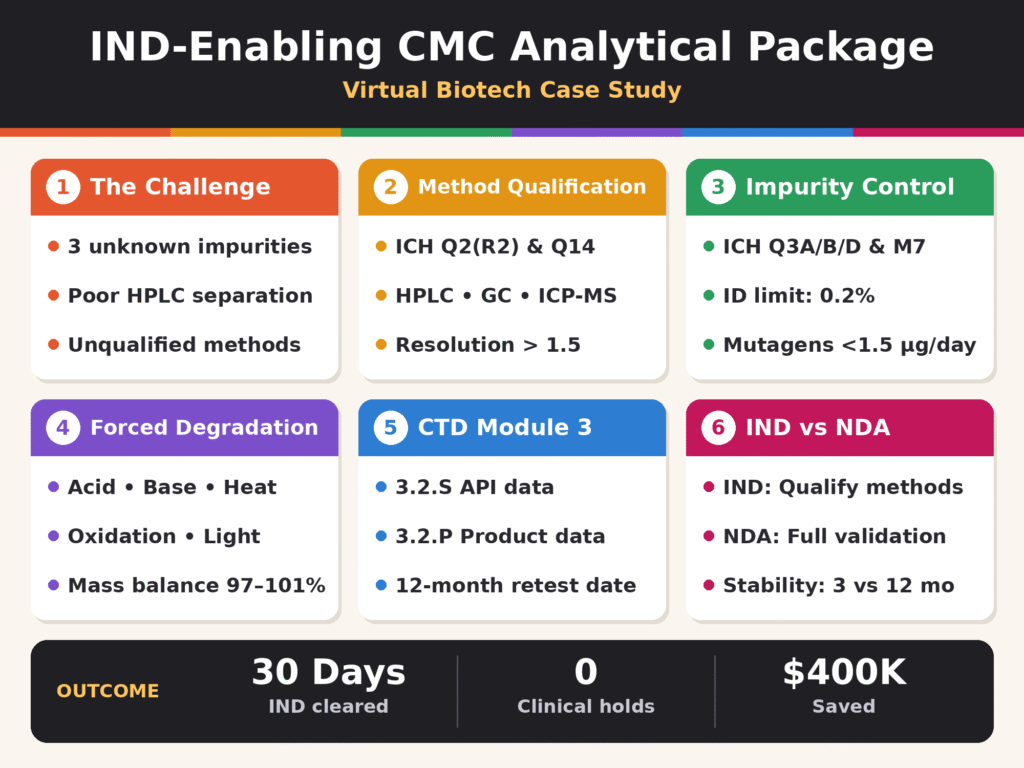
- The problem: Virtual biotechs outsource all lab work to CDMOs, so their analytical data is often scattered and inconsistent. Without central oversight, this can lead to FDA clinical holds, Refuse-to-File decisions, or costly re-testing.
- The case: A virtual biotech developing an oncology kinase inhibitor hit three CMC gaps six months before its IND filing: three uncharacterized impurities with uncontrolled palladium, an HPLC method that couldn’t separate the drug from its degradants, and toxicology batches tested with unqualified methods.
- Method qualification: Phase-appropriate qualification under ICH Q2(R2) and Q14 showed that methods were fit for Phase 1 without full commercial validation. The methods covered were HPLC-PDA, HS-GC-FID, ICP-MS, and chiral LC.
- Impurity control: An impurity found at 0.24%, above the 0.2% identification threshold, was identified as a regioisomer by LC-MS/MS and NMR. Because the GLP tox batch contained it at a higher level (0.31%), it was qualified without redeveloping the process. A mutagenic intermediate was confirmed below 0.4 ppm under ICH M7.
- Forced degradation: Stress testing under acid, base, oxidative, thermal, and light conditions identified two key degradants. Mass balance of 97.1–100.8% confirmed the HPLC method was stability-indicating.
- CTD Module 3: The data was compiled into sections 3.2.S and 3.2.P with stability data supporting a 12-month retest date. The clinical batch (99.3% pure) matched or exceeded the tox batch (98.7%), with no new impurities.
- Outcome: The FDA cleared the IND within 30 days with no clinical holds or CMC questions, dosing started on schedule, and about $400,000 in rework costs was avoided.
Case Overview: Virtual Biotech Challenges in Preclinical CMC
Virtual biotechnology companies face acute regulatory risks when preparing IND filings due to fragmented analytical data, unaligned CDMO testing protocols, and evolving synthetic routes. Overcoming these challenges requires centralized analytical oversight to rectify method incompatibilities and uncharacterized impurities prior to FDA submission.
In this case study, a virtual biotechnology firm was advancing a novel, highly potent small-molecule kinase inhibitor designed for oncology indications. The therapeutic candidate demonstrated robust nonclinical efficacy, but six months prior to the target IND filing date, the sponsor encountered critical Chemistry, Manufacturing, and Controls (CMC) roadblocks across three main operational areas:
- Synthetic route modifications executed during toxicological batch scale-up introduced three uncharacterized process-related impurities and residual palladium catalyst levels that lacked validated quantitative control.
- The primary CDMO utilized a legacy High-Performance Liquid Chromatography (HPLC) method that failed to achieve baseline resolution (Rs < 1.5) between the parent drug substance and two major degradants observed during preliminary stability holds.
- Batches used for Nonclinical Good Laboratory Practice (GLP) toxicology studies were characterized using non-qualified methods, leaving major documentation gaps regarding impurity qualification under ICH Q3A(R2) and mutagenic risk assessments under ICH M7.
To address these vulnerabilities without delaying clinical initiation, the sponsor engaged independent analytical oversight through ResolveMass Laboratories Inc. to perform a regulatory gap assessment, optimize analytical methods, execute structural elucidation, and author a compliant Module 3 submission package.
Understand how regulatory support can help align analytical evidence with submission requirements.
Explore regulatory support for generic drugs in the US and Canada
Strategic Framework for Building an IND-Enabling CMC Analytical Package
A successful strategic framework for Building an IND-Enabling CMC Analytical Package integrates phase-appropriate method qualification, rigorous forced degradation profiling, and structured impurity control under international guidelines. This systematic approach aligns raw laboratory data with FDA expectations to prevent clinical holds and regulatory delays.
Executing an IND-enabling analytical program requires transforming unverified contract testing data into a defensible analytical package. The workflow progresses through systematic stages: performing an initial analytical gap analysis, optimizing chromatographic separation per ICH Q14, subjecting the molecule to forced degradation stress, executing phase-appropriate method qualification under ICH Q2(R2), establishing impurity control thresholds under ICH Q3A/B/D and M7, and compiling the finalized data into CTD Module 3 sections 3.2.S and 3.2.P.
Compare external development models to identify the right partner for your program.
Learn about CDMO vs. CRO models for generic drug development
Phase-Appropriate Method Development and Qualification
Phase-appropriate method qualification establishes that analytical procedures are scientifically sound, specific, and reproducible for Phase 1 clinical trial batch release and stability testing without requiring full commercial validation. Under ICH Q2(R2) and ICH Q14 guidelines, early development focuses on verifying safety-critical parameters such as assay strength, identity, and purity.
During early nonclinical and Phase 1 stages, regulatory agencies accept partial or abbreviated method qualification, provided the analytical procedures are proven fit for purpose and capable of detecting product degradation or safety hazards. The primary testing methodologies deployed for the kinase inhibitor included Reverse-Phase HPLC with Photodiode Array detection (RP-HPLC-PDA) for assay and related substances, Headspace Gas Chromatography with Flame Ionization Detection (HS-GC-FID) for residual organic solvents, Inductively Coupled Plasma Mass Spectrometry (ICP-MS) for heavy metal elemental impurities, and Ultra-Performance Chiral Liquid Chromatography for enantiomeric purity.
| Analytical Parameter | Phase 1 IND Qualification Requirement | NDA Commercial Validation Standard (ICH Q2(R2)) |
|---|---|---|
| Specificity / Selectivity | Must demonstrate chromatographic separation of API from impurities and excipients (Rs > 1.5). | Full peak purity evaluation via Photodiode Array (PDA) spectral analysis or MS extraction. |
| Linearity | Evaluated across 80%–120% for assay; Limit of Quantitation (LOQ) to 120% for impurities (R2 ≥ 0.99). | Comprehensive calibration curves across broad working ranges (R2 ≥ 0.999). |
| Precision (Repeatability) | Relative Standard Deviation (RSD) ≤ 2.0% for assay; ≤ 10.0% at specification limits. | Intermediate precision across multiple days, analysts, column lots, and laboratories. |
| Accuracy / Recovery | Mean recovery of 90%–110% for assay; 80%–120% for spiked impurities. | Evaluated across a minimum of 9 determinations over 3 distinct concentration levels. |
| Sensitivity (LOD / LOQ) | LOQ established at or below ICH reporting thresholds (≤ 0.05% API). | Formal signal-to-noise (S/N) determination with validated lower limits of quantitation. |
| Robustness | Exploratory evaluation of critical method parameters during initial screening. | Multi-factor experimental design (DoE) following Quality by Design (QbD) principles. |
Explore pharmaceutical development services that support analytical testing and quality assessment.
Explore pharmaceutical CDMO services in the US and Canada
Advanced Impurity Profiling and Control Thresholds
Advanced impurity profiling defines the chemical structure, origin, and safety thresholds of process-related impurities, degradants, residual solvents, and elemental residues under ICH Q3A, Q3B, Q3D, and M7 standards. Applying dose-dependent thresholds ensures that any impurity exceeding defined safety limits is appropriately identified and qualified through nonclinical toxicology data.
For the drug candidate under evaluation, designed for a Maximum Daily Dose (MDD) of 100 mg/day, the applicable regulatory thresholds were determined based on explicit ICH daily intake formulas:
Identification Threshold:
Identification Threshold = min(0.2% of the drug substance, 2 mg/day total daily intake)
Qualification Threshold:
Qualification Threshold = min(0.5% of the drug substance, 200 µg/day total daily intake)
For a maximum daily dose of 100 mg/day, the percentage and daily intake limits must be applied according to the relevant ICH guideline and dosage category. The thresholds below reproduce the values presented in the case study; they should be checked against the applicable guideline before regulatory use.
| Guideline | Target Category | Maximum Daily Dose (MDD) | Percentage Limit | Daily Exposure Ceiling |
|---|---|---|---|---|
| ICH Q3A(R2) | Drug Substance Reporting | ≤ 2 g/day | 0.05% | Not specified |
| ICH Q3A(R2) | Drug Substance Identification | > 10 mg to 100 mg/day | 0.2% | 2 mg/day total daily intake |
| ICH Q3A(R2) | Drug Substance Qualification | > 10 mg to 100 mg/day | 0.5% | 200 µg/day total daily intake |
| ICH Q3B(R2) | Drug Product Reporting | ≤ 1 g/day | 0.1% | Not specified |
| ICH Q3B(R2) | Drug Product Identification | > 10 mg to 100 mg/day | 0.2% | 2 mg/day total daily intake |
| ICH Q3B(R2) | Drug Product Qualification | > 10 mg to 100 mg/day | 0.2% | 2 mg/day total daily intake |
| ICH M7(R2) | Mutagenic Impurities | Lifetime exposure | Sub-ppm limit calculated according to dose | 1.5 µg/day (TTC) |
During batch release testing of the primary cGMP drug substance lot, an unidentified process impurity was detected at a concentration of 0.24%, exceeding the 0.2% identification threshold. Preparative liquid chromatography was utilized to isolate the compound, followed by structural elucidation using high-resolution LC-MS/MS and 600 MHz Nuclear Magnetic Resonance (NMR) spectroscopy.
The isolation revealed a regioisomeric byproduct originating from incomplete regioselectivity during the Step 3 pyrazole coupling reaction. Review of historical analytical data confirmed that this regioisomer was present at 0.31% in the GLP nonclinical toxicology batch, thereby establishing safety qualification through toxicity bridging without requiring synthetic process re-development.
Additionally, an ICH M7 risk assessment evaluated a chlorinated intermediate used in early synthesis stages. A highly sensitive LC-MS/MS Multiple Reaction Monitoring (MRM) assay was developed to quantify trace concentrations, proving that residual levels in the final API were consistently below 0.4 ppm, safely under the calculated Threshold of Toxicological Concern (TTC) of 1.5 µg/day.
Learn how analytical characterization supports impurity identification and pharmaceutical quality assessment.
Explore peptide analytical characterization services
Forced Degradation Studies and Stability-Indicating Assays
Forced degradation stress testing evaluates active pharmaceutical ingredients and drug products under severe environmental conditions to elucidate degradation pathways and confirm method specificity. Demonstrating complete chromatographic separation between the parent drug peak and all stress-induced degradation products verifies that analytical methods are stability-indicating.
Stress testing was conducted on both drug substance and solid oral dosage form samples across multiple forced environmental conditions:
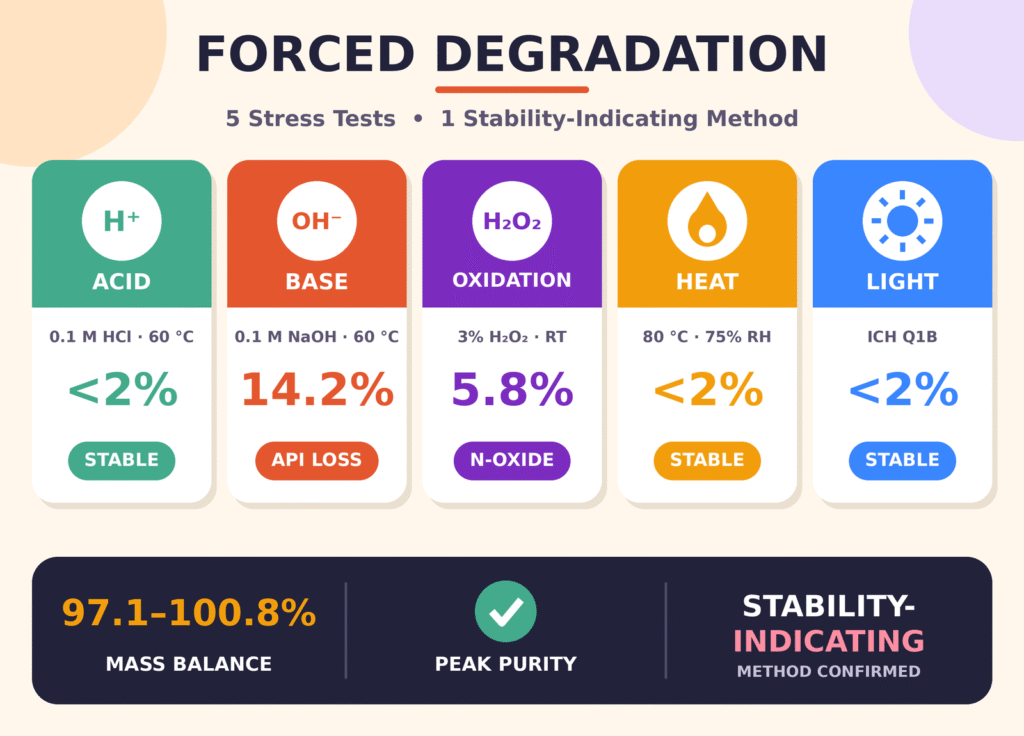
- Acid hydrolysis using 0.1 M HCl heated at 60 °C for 24 hours.
- Base hydrolysis using 0.1 M NaOH heated at 60 °C for 24 hours.
- Oxidative stress using 3% H2O2 stored at room temperature for 12 hours.
- Thermal degradation under dry heat at 80 °C and humidified conditions at 75% relative humidity (RH) for 7 days.
- Photolytic exposure delivering ≥ 1.2 million lux hours of visible light and ≥ 200 watt-hours/m2 of UV energy per ICH Q1B guidelines.
The forced degradation stress study provided detailed mechanistic insights into product stability:
- Base hydrolysis induced rapid degradation (14.2% loss of API assay), producing a primary amide cleavage product (Degradant A).
- Hydrogen peroxide exposure formed an N-oxide derivative (Degradant B) at 5.8% concentration.
- Acid, thermal, and photolytic conditions resulted in minimal degradation (< 2.0%), confirming robust thermal and photolytic stability.
Mass balance calculations across all stress channels yielded values between 97.1% and 100.8%, confirming that the RP-HPLC assay accounted for all degradation products without unquantified loss or co-elution. Photodiode array peak purity checks confirmed that the main drug substance peak maintained spectral homogeneity, proving the method was fully stability-indicating and suitable for clinical storage trials.
Review a pharmaceutical characterization case study to understand how analytical data can support development decisions.
Read the generic peptide drug analytical characterization case study
Regulatory Module 3 Integration and Risk Mitigation
Integrating Chemistry, Manufacturing, and Controls (CMC) data into CTD Module 3 translates raw analytical testing into structured regulatory sections (3.2.S and 3.2.P) that demonstrate product quality and safety. Rigorous data synthesis ensures batch comparability and minimizes the risk of FDA Refuse-to-File decisions or information requests.
Authoring an IND Module 3 requires synthesizing complex chemical data into regulatory summaries. The technical documentation compiled for the virtual biotech was mapped directly into CTD sections:
- Section 3.2.S.4: Defined drug substance release specifications, analytical procedure SOPs, qualification protocols, and batch Certificates of Analysis (CoAs) for GLP toxicology and cGMP clinical supplies.
- Section 3.2.S.7: Provided accelerated (40 °C/75% RH) and long-term (25 °C/60% RH) stability data supporting an initial 12-month retest date.
- Section 3.2.P.5: Covered drug product specifications, dissolution profiles, uniformity of dosage units, and degradant control strategies.
A vital element of the regulatory strategy was establishing batch comparability between the preclinical GLP toxicology lot and the human clinical lot. Comparative impurity profiling demonstrated that the cGMP clinical trial batch possessed higher purity (99.3%) than the toxicology batch (98.7%) and presented no new uncharacterized impurities above 0.05%, satisfying FDA safety guidelines for human trial authorization.
Discover how coordinated CDMO support can help streamline pharmaceutical development activities.
Explore CDMO services for accelerating generic drug development in the US and Canada
Technical Comparison: IND Phase vs. NDA Stage Analytical Requirements
IND-stage analytical programs emphasize preliminary safety, basic identity, and phase-appropriate method qualification, whereas NDA-stage programs demand exhaustive multi-site method validation, tight specifications, and commercial lifecycle controls. Differentiating these expectations prevents over-engineering during early clinical trials while maintaining regulatory compliance.
Understanding the evolving regulatory expectations prevents sponsors from over-investing in late-stage validation during pre-Phase 1 development while ensuring that early data remains legally and scientifically defensible.
| Development Milestone | IND Phase 1 Filing Requirements | NDA Commercial Submission Requirements |
|---|---|---|
| Primary Goal | Prove short-term clinical trial safety, identity, and drug strength. | Prove long-term manufacturing quality, batch consistency, and stability. |
| Validation Level | Phase-appropriate qualification (specificity, precision, linearity, sensitivity). | Full ICH Q2(R2) multi-site validation including intermediate precision and robustness. |
| Impurity Profiling | Identification and qualification of impurities exceeding ICH thresholds. | Full structural elucidation and commercial control strategies for all degradants. |
| Stability Requirements | 1 to 3 months of real-time and accelerated stability data. | Minimum 12 months long-term stability across three commercial-scale batches. |
| Method Development | Method fitness demonstrated through qualification reports. | Formal Quality by Design (QbD) / ICH Q14 lifecycle management documentation. |
Evaluate the practical considerations involved in selecting an appropriate development partner.
Learn how to choose a peptide CDMO in the US
Case Study Outcomes: Successful IND Clearance and Lessons Learned
Implementing a centralized, gap-mitigated analytical strategy enabled the virtual biotech to secure IND clearance from the FDA without receiving CMC-related information requests or clinical holds. The strategic alignment of analytical methods eliminated rework, reduced development timelines, and established a scalable platform for Phase 2 clinical trials.
The coordinated execution of the analytical control strategy delivered measurable operational and financial advantages:
- The FDA CDER review division cleared the IND application within the standard 30-day review period without issuing clinical holds or formal CMC Information Requests.
- Dosing in the First-in-Human (FIH) Phase 1 clinical trial initiated on schedule, maintaining investor timelines and clinical development milestones.
- Resolving chromatographic co-elution issues and qualifying regioisomeric impurities prior to filing saved an estimated $400,000 in potential batch re-manufacture and CDMO downtime costs.
Key strategic takeaways highlight that virtual biopharmaceutical companies must maintain centralized oversight of external CDMO analytical data. Relying blindly on unverified contract laboratory methods exposes sponsors to significant regulatory exposure. Establishing stability-indicating analytical procedures, rigorous impurity characterization, and compliant Module 3 documentation early ensures long-term program value and smooth clinical progression.
Explore peptide development services that support analytical planning and coordinated development.
Discover peptide drug development and CDMO services
Conclusion
Building an IND-Enabling CMC Analytical Package is a critical strategic milestone that demands phase-appropriate rigor, scientific oversight, and strict adherence to FDA and ICH guidance. Virtual biotechs that proactively address analytical gaps, validate critical assays, and build compliant Module 3 dossiers protect patient safety and accelerate clinical progression. Maintaining continuous oversight over impurity profiles, method stability indication, and CTD documentation creates a solid regulatory foundation that supports asset value through late-stage clinical trials.
Explore analytical approaches for characterizing complex peptides and supporting drug development decisions.
Learn about GLP-1 peptide analytical characterization
For technical consultation, analytical method qualification, impurity identification, and CTD Module 3 regulatory support, visit the official ResolveMass Laboratories Contact Page.
Frequently Asked Questions (FAQs)
Method qualification provides documented evidence that an analytical procedure is suitable for its intended use during early drug development. The extent of testing depends on the method’s purpose and development stage. Full validation generally requires a more comprehensive evaluation of relevant performance characteristics to support later-stage development and commercial quality control.
ICH Q3A(R2) establishes impurity thresholds based on factors such as the maximum daily dose of the drug substance. For a daily dose between 10 mg and 100 mg, the identification threshold is generally 0.2% or 2 mg total daily intake, whichever is lower. The qualification threshold is generally 0.5% or 200 micrograms total daily intake, whichever is lower, subject to the guideline’s applicability and specific requirements.
A stability-indicating assay can measure the active drug while distinguishing it from relevant impurities and degradation products that may develop during storage. This capability helps determine whether the drug maintains its quality over time and supports scientifically justified shelf-life or retest-period recommendations. Suitable method qualification or validation should reflect the development stage and intended application.
ICH M7 provides a risk-based framework for identifying, assessing, and controlling DNA-reactive impurities that may present a carcinogenic risk. Sponsors evaluate potential impurities using appropriate computational assessments and, where necessary, additional testing. The acceptable intake is determined according to the applicable guidance, treatment duration, and clinical context; the commonly used threshold of toxicological concern is 1.5 micrograms per day for lifetime exposure.
The stability data needed for a Phase 1 IND depends on the product, available development information, proposed storage conditions, and planned clinical use. Early submissions commonly include available real-time and accelerated results to support the proposed storage period and duration of the trial. Sponsors should justify the amount of data provided rather than assume that one fixed period applies to every investigational product.
Relevant CTD Module 3 sections include 3.2.S.4 for drug substance controls, 3.2.S.7 for drug substance stability, 3.2.P.5 for drug product controls, and 3.2.P.8 for drug product stability. Depending on the product and submission, these sections may include analytical procedures, specifications, method qualification or validation information, batch results, and stability data. The level of detail should match the stage of development and applicable regulatory requirements.
Forced degradation studies expose a drug candidate to controlled stress conditions, such as acidic, alkaline, oxidative, thermal, and light exposure, to understand its degradation pathways. The resulting information helps identify potential degradation products and evaluate whether analytical methods can distinguish them from the active ingredient. These findings support the development of stability-indicating procedures and help establish appropriate stability-monitoring strategies.
Batch comparability is assessed by examining relevant quality attributes of the toxicology and clinical batches using suitable analytical procedures. Comparisons may include identity, potency, impurity profiles, degradation products, and other product-specific characteristics. Differences should be scientifically evaluated, and any new or increased impurities should be assessed against applicable reporting, identification, qualification, and safety requirements.
Potential CMC-related reasons for a clinical hold include insufficient evidence of product quality, inadequate analytical methods, unresolved or poorly characterized impurities, and insufficient stability data to support the proposed clinical use. Missing or inadequate batch release results and controls for relevant residual solvents, elemental impurities, or mutagenic impurities may also raise concerns. Addressing these issues with appropriate analytical data and documentation helps support regulatory review and clinical trial readiness.
Reference:
- U.S. Food and Drug Administration. (n.d.). IND applications for clinical investigations: Chemistry, manufacturing, and control (CMC) information. https://www.fda.gov/drugs/investigational-new-drug-application-ind/ind-applications-clinical-investigations-chemistry-manufacturing-and-control-cmc-information
- Honma, M. (2025). Guidelines for the assessment and control of mutagenic impurities in pharmaceuticals. Genes and Environment, 47, Article 26. https://doi.org/10.1186/s41021-025-00349-5
- International Council for Harmonisation of Technical Requirements for Pharmaceuticals for Human Use. (2006). ICH harmonised tripartite guideline: Impurities in new drug substances Q3A(R2). https://database.ich.org/sites/default/files/Q3A%28R2%29%20Guideline.pdf
- International Council for Harmonisation of Technical Requirements for Pharmaceuticals for Human Use. (n.d.). Quality guidelines. https://www.ich.org/page/quality-guidelines
Get In Touch With Us
About The Author