
Introduction
Nitrosamine Testing for Peptide and GLP-1 drug products requires a comprehensive evaluation of synthetic-route risks, peptide-specific sample preparation, and highly sensitive mass spectrometry methods designed for complex lipopeptide matrices. These requirements extend beyond assumption-based screening approaches and conventional analytical workflows developed for standard small-molecule compounds.
Historically, nitrosamine monitoring primarily focused on small-molecule active pharmaceutical ingredients (APIs), including sartans, ranitidine, and metformin. However, the growing clinical demand for synthetic glucagon-like peptide-
1 (GLP-1) receptor agonists, including semaglutide, tirzepatide, and liraglutide, together with specific regulatory requirements introduced in 2025 and 2026, has brought peptide therapeutics within the scope of global mutagenic impurity control.
Chemically synthesized peptides containing up to 40 amino acids are regulated under synthetic drug frameworks rather than biologics pathways. Nevertheless, the multi-step processes involved in solid-phase peptide synthesis (SPPS) and liquid-phase peptide synthesis (LPPS) can introduce exposure to secondary-amine deprotection reagents, degradation products from solvents such as N,N-dimethylformamide (DMF), and trace nitrites present in formulation excipients. At the same time, acylated GLP-1 analogs demonstrate complex chromatographic adsorption-desorption behavior and a tendency toward higher-order aggregation. Co-eluting formulation components and non-volatile additives can further contribute to peak broadening and ionization suppression during trace-level analysis.
Addressing these combined analytical and regulatory challenges requires specialized Contract Research Organization (CRO) testing capabilities that integrate sub-parts-per-billion (ppb) nitrosamine quantitation with complementary peptide characterization techniques.
For an overview of nitrosamine-related risks, chemical characteristics, and their relevance to pharmaceutical products, refer to the fundamentals of nitrosamines in drug products.
Share via:
Quick Summary:
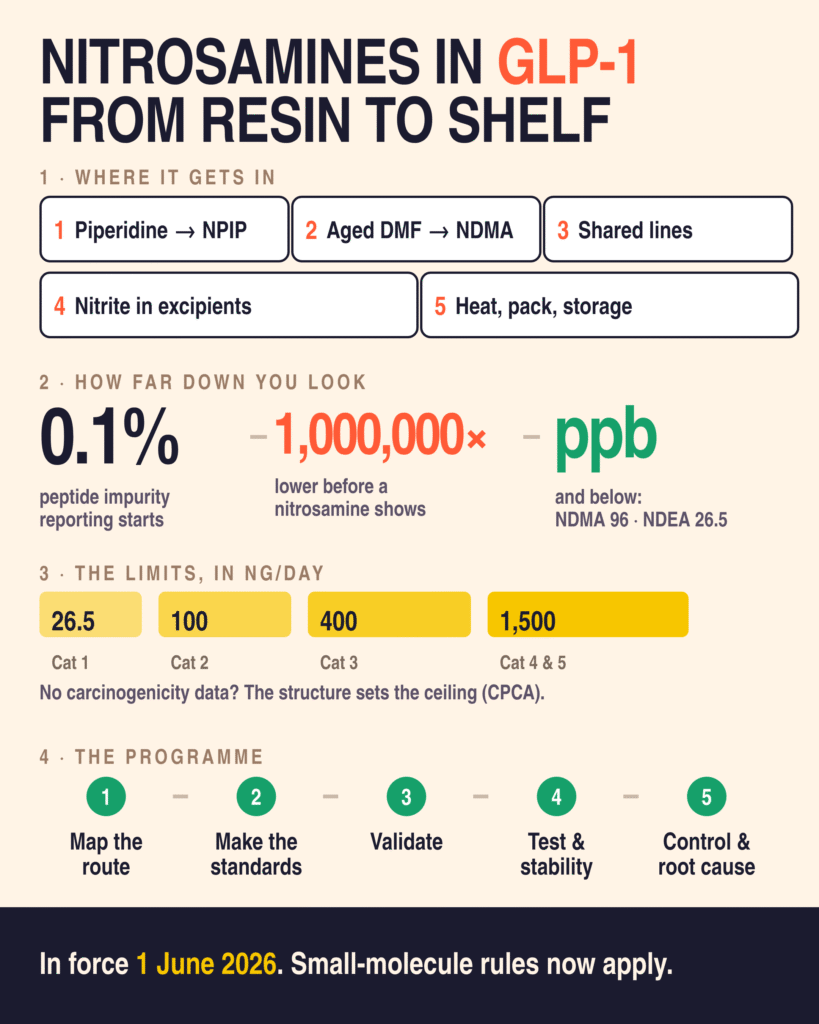
- Nitrosamine control has moved beyond small-molecule APIs to chemically synthesised peptides. Semaglutide (31 amino acids) and tirzepatide (39) sit under the FDA’s 40-amino-acid line, so they follow synthetic-drug rules rather than the biologics pathway, and the biosimilar route is closed to them.
- The EMA’s synthetic peptide guideline (EMA/CHMP/CVMP/QWP/367182/2025, adopted December 2025) takes effect 1 June 2026 and states that nitrosamine risk considerations, ICH M7 and ICH Q3D apply to synthetic peptide actives. Peptide-related impurity thresholds come from Ph. Eur. 2034: report above 0.1%, identify above 0.5%, qualify above 1.0%.
- Risk arises from the process chemistry, not the sequence. Piperidine and 4-methylpiperidine used in Fmoc deprotection can nitrosate to NPIP; aged DMF releases dimethylamine that can form NDMA during acidic cleavage. Thorough resin washing, DCM washes before TFA cleavage, and greener solvents such as NBP or NOP are the main controls.
- Downstream sources matter as much as synthesis: excipient and water nitrites, shared manufacturing lines, coupling reagents and linkers, and container-closure leachables under heat and humidity, which can generate nitrosamines late in shelf life. Terminal sterilisation feasibility and parallel E&L testing both feed into this.
- Where no compound-specific carcinogenicity data exists, the CPCA scoring framework assigns a potency category with a corresponding acceptable intake: 26.5, 100, 400 or 1,500 ng/day for Categories 1 to 4, and 1,500 for Category 5. Established limits include 96 ng/day for NDMA and 26.5 for NDEA.
- The analytical gap is the core difficulty. Peptide impurity reporting starts at 0.1% (roughly 1,000,000 ppb), while nitrosamine limits fall in the low ppb range or below, so a batch can meet its purity specification and still breach an intake limit. Lipidated GLP-1 analogues add adsorption-desorption behaviour, aggregation into high-molecular-weight species, and ionisation suppression from non-volatile formulation components.
- No single platform covers the range, so laboratories combine QqQ LC-MS/MS for routine trace quantitation, Orbitrap HRMS for confirmation and unknown NDSRIs, headspace GC-MS/MS for volatiles, and ion chromatography for nitrite and nitrate precursors, supported by stable-isotope internal standards. Methods are validated to ICH Q2(R2) and Q14 with an LOQ at or below 10% of the AI limit, r² ≥ 0.999, and resolution above 2.0 from peptide degradants.
Why Peptide and GLP-1 Drug Products Require Formal Nitrosamine Risk Assessments
Peptide and GLP-1 drug products require formal nitrosamine risk assessments because major regulatory authorities consider mutagenic N-nitroso compounds potential carcinogenic hazards across chemically synthesized active substances, biological medicines, and finished dosage forms.
According to U.S. Food and Drug Administration (FDA) classification criteria, an alpha-amino acid polymer containing more than 40 residues is classified as a protein. Consequently, 31-amino acid semaglutide and 39-amino acid tirzepatide fall under synthetic peptide regulatory frameworks rather than biologics licensure requirements. Sponsors submitting New Drug Applications (NDAs) or Abbreviated New Drug Applications (ANDAs) that reference previously approved recombinant DNA (rDNA)-origin peptide drugs must therefore demonstrate adequate control of mutagenic impurities in addition to providing comparative assessments of peptide-related impurities.
Regulatory expectations for synthetic peptides became increasingly aligned between 2024 and 2026 across European, North American, and industry quality frameworks. The European Medicines Agency (EMA) adopted its Guideline on the development and manufacture of synthetic peptides (EMA/CHMP/CVMP/QWP/367182/2025), published on December 9, 2025, and legally effective from June 1, 2026. The guideline explicitly establishes that nitrosamine impurity risk considerations and requirements, together with ICH M7 mutagenic impurity controls and ICH Q3D elemental impurity limits, apply directly to synthetic peptide active substances used in human and veterinary medicines, including post-authorisation changes.
Although EMA excludes synthetic peptides from ICH Q3A thresholds and bases peptide-related substance thresholds on European Pharmacopoeia General Monograph 2034 (Edition 12, 2025), it still requires documented verification of the clearance of synthesis reagents, residual solvents, and potential genotoxic impurities. Importantly, EMA clarifies that chemically synthesized peptides are not eligible for the biosimilar regulatory pathway. However, sponsors referencing an existing biological product are expected to follow relevant biosimilarity comparability principles.
Additional regulatory developments have strengthened these expectations internationally. In May 2025, the Active Pharmaceutical Ingredients Committee (APIC) released its Nitrosamines Risk Management Guidance for API Manufacturers, specifically incorporating synthetic peptides and synthetic oligonucleotides within EMA Article 5(3) evaluation expectations (EMA/369136/2020 and EMA/409815/2020).
In the United States, Revision 2 of the FDA guidance Control of Nitrosamine Impurities in Human Drugs, published in September 2024 (Docket FDA-2020-D-1530), established recommended acceptable intake (AI) limits using the Carcinogenic Potency Categorization Approach (CPCA) for Nitrosamine Drug Substance-Related Impurities (NDSRIs). According to regulatory compliance summaries of the FDA’s July 24, 2026 update, the agency subsequently expanded its API-specific NDSRI entries while reinforcing expectations for compound-specific toxicological justifications, documented root-cause investigations, and storage-stability monitoring.
For generic GLP-1 developers, the FDA’s 2021 synthetic peptide ANDA guidance also establishes requirements for comparative impurity assessments. Generic synthetic peptide drug products are subject to characterization requirements at a concentration threshold of ≥ 0.10%. These requirements operate within the broader mutagenic impurity control framework established by ICH M7(R2), effective September 30, 2023, and the corresponding Health Canada-aligned safety expectations.
Review the ICH M7 genotoxic impurity testing framework for nitrosamines for additional guidance.
SPPS and LPPS Process Chemistry Vectors in GLP-1 Manufacturing
Solid-phase and liquid-phase peptide synthesis processes introduce potential nitrosamine risks primarily through concentrated secondary-amine deprotection bases and inadequately cleared or degraded amide solvents, rather than exclusively through the amino acid sequence of the target peptide.
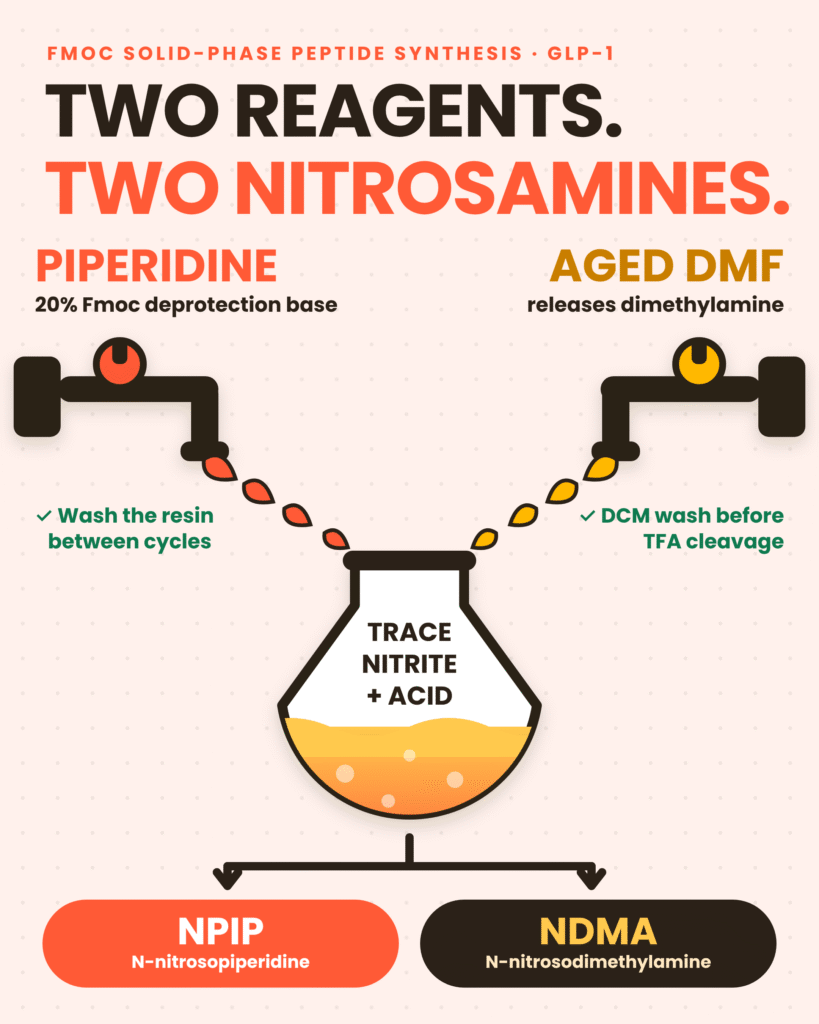
In conventional Fmoc-SPPS, each peptide elongation cycle involves removing the N-terminal Fmoc protecting group with an excess of a heterocyclic secondary amine. A commonly used system consists of 20% piperidine in DMF, although concentrations of up to 20% 4-methylpiperidine may also be used. These reagents remove the protecting group from the amine terminus while scavenging the reactive dibenzofulvene (DBF) byproduct.
An academic green-chemistry assessment by Ferrazzano et al. observed that nitrosamines had not historically been regarded as a general concern within peptide synthesis, with particular attention directed toward the environmental conversion of piperidine waste. However, the regulatory frameworks introduced in 2025 and 2026, together with updated API supplier assessments, now require systematic evaluations of SPPS and LPPS reagents, counterions, and residual solvents.
Two major process chemistry pathways are particularly relevant to SPPS-related nitrosamine risk assessments.
The first involves piperidine (CAS 110-89-4), a six-membered cyclic secondary amine that can readily form its corresponding nitrosamine, N-nitrosopiperidine (NPIP), when residual reagent encounters nitrites or other nitrosating conditions. Inadequate resin washing between deprotection and coupling cycles can increase the carry-over of residual secondary amines. Additional risks may arise from side reactions, including +49 Da piperidine addition to dehydroalanine during C-terminal cysteine synthesis on Wang resin.
To reduce nitrosamine-related concerns and minimize base toxicity, researchers have investigated alternative deprotection systems. These include primary or acyclic alternatives such as 10% 3-(diethylamino)propylamine (DEAPA), 20% TBA, 5% TMG, and piperazine/DBU systems. Compared with secondary cyclic bases, these alternatives generally present a lower potential for nitrosamine formation.
The second major pathway involves peptide-grade DMF (CAS 68-12-2), which is extensively used for resin swelling, amino acid dissolution, and washing procedures. During prolonged storage, exposure to atmospheric moisture and air can promote spontaneous DMF degradation, resulting in the release of free dimethylamine (DMA).
When loaded resin is not adequately washed with dichloromethane (DCM) before trifluoroacetic acid (TFA) cleavage, residual DMF and DMA may enter the acidic cleavage mixture. In the presence of trace nitrites under acidic conditions, DMA can undergo nitrosation, resulting in the formation of N-nitrosodimethylamine (NDMA).
Furthermore, EU restrictions on DMF introduced in December 2023, together with increasing efforts to improve the recovery and management of waste generated during deprotection, are encouraging manufacturers to adopt greener solvent alternatives. These include N-butylpyrrolidone (NBP), N-octylpyrrolidone (NOP), NOP/dimethyl carbonate mixtures (8/2 v/v), and DMF-free large-scale SPPS manufacturing protocols.
Understanding the chemical reactions and manufacturing conditions responsible for nitrosamine generation is essential for identifying potential contamination sources. Explore the nitrosamine formation pathways during API synthesis to learn more about these mechanisms.
Sequence-Specific NDSRI Potential, Excipients, and Container Closure Interactions
Finished peptide and GLP-1 formulations may experience additional nitrosation risks when susceptible nitrogen-containing functional groups in the API, linkers, or process-related residues interact with trace nitrites originating from excipients, water systems, or container-closure materials during manufacturing and subsequent storage.
From a chemical perspective, N-nitroso compound formation is not restricted to secondary and tertiary amines. Under suitable conditions involving nitrites or nitrogen-containing nitrosating species, amides, carbamates, and urea derivatives may also participate in nitrosation reactions.
Modern GLP-1 therapeutics contain complex synthetic structures. Semaglutide consists of a 31-amino acid backbone containing a non-human aminoisobutyric acid (Aib) residue and a lysine residue modified through acylation with a C18 diacid side chain. In comparison, tirzepatide is a 39-amino acid linear peptide containing two non-coded residues at positions 2 and 13, together with C-terminal and side-chain acylation.
As indicated in regulatory compliance summaries of the FDA’s July 2026 guidance, the presence of an amine functional group does not independently establish that an NDSRI will form. Instead, sponsors must experimentally evaluate the specific synthetic route, raw material purity, and formulation-related chemical reactivity to determine the actual potential for NDSRI generation.
When a structurally plausible peptide-related or process-derived NDSRI does not have compound-specific carcinogenicity bioassay data, the FDA and EMA use the CPCA scoring framework to establish appropriate AI limits.
The CPCA framework determines a structural potency score through the following calculation:
Potency Score = Score(α-Hydrogen) + ∑ Score(Deactivating Features) + ∑ Score(Activating Features)
Under this five-category classification framework, lower scores indicate greater α-hydrogen availability and correspond to more restrictive daily exposure limits:
- Category 1 (Score ≤ 1): Permitted AI of 26.5 ng/day.
- Category 2 (Score = 2): Permitted AI of 100 ng/day.
- Category 3 (Score = 3): Permitted AI of 400 ng/day.
- Category 4 (Score = 4): Permitted AI of 1,500 ng/day.
Exceptionally potent Cohort of Concern (CoC) nitrosamines may require significantly lower AI thresholds of 1.5 ng/day or less. Meanwhile, established small-molecule nitrosamines have defined limits, including 96 ng/day for NDMA and NMBA, 26.5 ng/day for NDEA and NDIPA, and a range of 26.5–96 ng/day for NEIPA, NDBA, and NPIP.
Downstream drug product manufacturing introduces additional opportunities for nitrosamine formation beyond those associated with the API itself. Tablet coatings, lubricants such as magnesium stearate, capsule materials, process water, and residual contaminants on shared manufacturing equipment may introduce trace nitrites or secondary amines into the formulation.
Since peptide drug products are predominantly developed as parenteral formulations, EMA emphasizes the importance of assessing terminal sterilization feasibility against sterile filtration requirements. Heat, moisture, and acidic pH conditions encountered during processing or storage may accelerate delayed nitrosamine formation.
Packaging components, including polymers, adhesives, and coatings, should also undergo screening for potentially leachable nitrosating precursors. For oral and liquid formulations, manufacturers may additionally investigate antioxidant inhibitors such as ascorbic acid (vitamin C), which can help scavenge nitrites under acidic conditions.
A clear distinction between API-related nitrosamine impurities and packaging-derived nitrosamine leachables is important when evaluating the complete product lifecycle. Learn more about nitrosamine impurities versus nitrosamine leachables and the analytical considerations associated with each.
| Lifecycle Stage | Primary Risk Vector | Chemical Precursors / Mechanism | Potential Nitrosamine / NDSRI Target | Key Mitigation & Control Point |
|---|---|---|---|---|
| Fmoc-SPPS Deprotection | 20% Piperidine or 4-methylpiperidine reagents | Cyclic secondary amine reacting with trace nitrites | NPIP or corresponding amine nitrosamines | Thorough inter-step resin washing; evaluation of DEAPA or TBA alternatives |
| Solvent & Cleavage Handling | Aged or impure DMF; incomplete DCM wash before TFA | DMF breakdown releasing dimethylamine (DMA) under acidic cleavage conditions | NDMA and volatile dialkyl nitrosamines | Peptide-grade inert storage, pre-cleavage DCM washes, DMF-free or NBP/NOP routes |
| Conjugation & Isolation | Coupling catalysts, counterions, linkers, shared equipment | Secondary/tertiary amines, amides, carbamates, and cross-contamination | Process nitrosamines and intermediate-derived NDSRIs | Supplier qualification, shared-line controls, ICH M7 impurity clearance |
| Excipient Blending & Formulation | Coatings, lubricants (e.g., magnesium stearate), water systems | Residual nitrites (NO₂⁻) / nitrates (NO₃⁻) reacting under acidic pH conditions | Simple nitrosamines or API-derived NDSRIs | Ion chromatography nitrite screening; nitrite-scavenging formulation controls |
| Packaging & Shelf-Life Storage | Container polymers, adhesives, coatings, thermal stress | Leachable nitrosating agents migrating under heat or humidity | Storage-generated nitrosamines and NDSRIs | Parallel E&L testing; ICH accelerated and long-term stability protocols |
Analytical Challenges in Nitrosamine Testing for Peptide and GLP-1 Matrices
Nitrosamine Testing for Peptide and GLP-1 formulations presents substantial analytical difficulties because acylated lipopeptides, non-volatile formulation additives, and peptide aggregation can interfere with trace mass spectrometric detection. These challenges become even more significant when analytical methods must achieve sensitivity levels several orders of magnitude below those required for conventional peptide impurity testing.
For example, a therapeutic peptide batch may meet a ≥ 95% purity specification through standard HPLC-UV analysis while still containing trace carcinogenic nitrosamines at concentrations exceeding established nanogram-per-day exposure limits.
The difference in analytical sensitivity can be demonstrated through a quantitative comparison. Generic synthetic peptide impurity profiling typically targets peptide-related variants, including deletion sequences, truncations, D-isomers, oxidation products, and deamidation products, at concentrations of ≥ 0.10%. This corresponds to approximately 1,000 parts per million (ppm), or 1,000,000 parts per billion (ppb).
Trade summaries of Ph. Eur. Monograph 2034 identify reporting, identification, and qualification thresholds of > 0.1%, > 0.5%, and > 1.0%, respectively. EMA workshop guidance also identifies > 1.0% identification and preclinical qualification levels during early development.
In contrast, nitrosamine AI thresholds ranging from 26.5 to 96 ng/day translate into low ppb or parts-per-trillion (ppt) concentrations when calculated relative to the maximum daily dose. Consequently, nitrosamine analysis may require sensitivity approximately six orders of magnitude greater than that needed for routine peptide-related impurity reporting.
Long-chain lipidated GLP-1 analogs introduce additional challenges during chromatographic separation and sample preparation. Semaglutide and tirzepatide can exhibit abrupt column adsorption-desorption kinetics on conventional reversed-phase media. Addressing these behaviors may require superficially porous (core-shell) C18 columns with 100–160 Å pore sizes, shallow gradient conditions, ultrapure ion-pairing reagents, accurate column temperature regulation, and complementary Hydrophilic Interaction Chromatography (HILIC) to separate polar fragments.
These peptides can also produce high-molecular-weight species (HMWS) under stress or formulation conditions. Native mass spectrometry investigations have identified covalent dimers and truncated non-dissociable trimers. Reported examples include semaglutide HMWS1 at 8227.16 Da, truncated trimers at 11649.28 Da, and tirzepatide covalent dimers at 9627.06 Da.
During trace-level mass spectrometric analysis, co-eluting peptide components and non-volatile formulation salts or additives can interfere with the analytical signal. These matrix effects may result in substantial peak broadening, unpredictable adduct formation, overlapping chromatographic peaks, and ionization suppression.
Compendial methods originally developed for small-molecule APIs generally require modification before they can be applied to complex peptide formulations.
Although USP General Chapter [chapter number not specified in the source text] describes four reference procedures, these include Procedure 1 (LC-HRMS), Procedure 2 (Headspace GC-MS/MS), Procedure 3 (LC-MS/MS), and Procedure 4 (GC-MS/MS). These procedures were initially developed around small-molecule sartan APIs.
Even with conventional sartan matrices, independent laboratory assessments reported through Separation Science and Sigma-Aldrich found that the overall identification and sensitivity system suitability criteria could not be achieved using USP Procedure 1 on the tested instrumentation. The laboratories consequently adopted Procedure 3 as an alternative.
Therefore, GLP-1 nitrosamine methods require carefully adapted sample preparation procedures. These may involve solid-phase extraction (SPE), centrifugation, and 0.45 µm PTFE filtration, followed by analysis using stable-isotope internal standards. Ion Chromatography (IC) screening is also important for detecting nitrite and nitrate precursors that may contribute to nitrosamine formation.
Selecting the appropriate analytical approach is essential because preliminary screening and confirmatory testing serve different regulatory and scientific purposes. Explore the differences between nitrosamine screening and confirmatory methods to understand their respective applications.
Analytical Platforms for Nitrosamine Testing for Peptide and GLP-1 Formulations
Reliable Nitrosamine Testing for Peptide and GLP-1 drug products requires a combination of Triple Quadrupole (QqQ) LC-MS/MS for routine ultra-trace quantitation, Orbitrap LC-HRMS for high-resolution separation of isobaric compounds, and GC-MS/MS for detecting volatile nitrosamines originating from SPPS processes.
No single analytical detector can effectively address both volatile small-molecule process-related nitrosamines and polar, thermally labile NDSRIs within complex peptide matrices. For this reason, specialized laboratories use complementary mass spectrometry platforms supported by stable-isotope-dilution internal standards.
Common examples include NDMA-d6, NDEA-d10, NMBA-d3, and NDBA-d18, together with custom-synthesized NDSRI standards when required. These internal standards help compensate for matrix-dependent ionization suppression and variations in extraction recovery, thereby improving quantitative accuracy.
| Analytical Platform | Primary Peptide / GLP-1 Use Case | Typical Sensitivity | Key Strengths in Peptide Matrices | Operational Limitations |
|---|---|---|---|---|
| Triple Quadrupole (QqQ) LC-MS/MS | Batch release and stability quantitation of polar/non-volatile nitrosamines and NDSRIs | Very high (low ppt to sub-ppb) | Multi-residue quantitation; minimal derivatization; regulatory standard for confirmatory testing | Requires thorough SPE and chromatographic cleanup to minimize matrix ion suppression |
| Q-Exactive Orbitrap LC-HRMS | Confirmatory identification, unknown NDSRI elucidation, forced degradation | High (sub-ppb to low ppb) | Accurate-mass isolation helps eliminate isobaric peptide-fragment interferences | Greater operational complexity; requires matrix-specific system suitability optimization |
| Headspace / DI GC-MS/MS | Volatile process nitrosamines (NDMA, NDEA, NPIP) originating from DMF/piperidine | Moderate to high (ppb) | Headspace sampling separates volatile analytes from non-volatile peptide matrices | Not suitable for thermally labile or non-volatile high-MW NDSRIs |
| Ion Chromatography (IC) | Precursor nitrite (NO₂⁻) and nitrate (NO₃⁻) screening in excipients and water | Trace ionic levels | Evaluates nitrosation potential upstream of finished-product formation | Measures inorganic precursors only; does not directly quantify finished-product N-nitroso impurities |
Method Validation Benchmarks Under ICH Q2(R2), Q14, and M7(R2)
Confirmatory nitrosamine methods developed for peptide formulations must undergo validation in accordance with ICH Q2(R1)/Q2(R2) and ICH Q14 lifecycle principles. The analytical method should provide quantitative sensitivity at ≤ 10% of the applicable target AI limit while maintaining adequate chromatographic resolution (Rs > 2.0) between the target impurity, parent GLP-1 peptide, and relevant degradation products.
Since GLP-1 APIs may undergo oxidation, deamidation, peptide bond cleavage, and oligomerization under accelerated stress conditions, forced-degradation studies are essential for establishing analytical specificity. These studies help demonstrate that peptide-related variants and degradation products do not interfere with the retention window of the target nitrosamine.
| Validation Parameter | Representative CRO NDSRI Benchmark Criterion | Peptide & Regulatory Matrix Expectation |
|---|---|---|
| Limit of Quantitation (LOQ) | S/N ≥ 10:1; precision ≤ 10% RSD | ≤ 10% of target AI limit (typically 0.1–1.0 ng/mL or 1–10 ppb) |
| Limit of Detection (LOD) | S/N ≥ 3:1 | Typically 0.05–0.3 ng/mL (0.3–1.0 ppb) in NDSRI screening protocols |
| Linearity Range | Correlation coefficient r² ≥ 0.999 | Evaluated across 10% to 150% of the target regulatory AI specification limit |
| Accuracy / Recovery | Mean recovery 80%–120% across validated range | Spiked recovery in finished drug product matrices maintained within 90%–110% |
| Repeatability & Precision | Relative Standard Deviation (RSD) < 10% | Six replicate injections at the LOQ level demonstrating RSD ≤ 5% |
| Specific Selectivity | No interfering peaks in retention window | Resolution Rs > 2.0 between target NDSRI, parent peptide API, and degradation products |
In addition to trace nitrosamine method validation, EMA’s 2026 synthetic peptide guideline recommends using at least two orthogonal analytical techniques to confirm peptide identity. It also recommends orthogonal separation approaches covering size-, charge-, and hydrophobicity-based characteristics for peptide purity assessment.
Recommended characterization techniques include mass spectrometry, amino acid analysis (AAA), enzymatic peptide mapping using enzymes such as trypsin or Glu-C, NMR, circular dichroism (CD) spectroscopy, and functional assays.
Combining trace-level ICH M7(R2) nitrosamine validation with complementary GLP-1 structural characterization and aggregation profiling enables pharmaceutical manufacturers to establish a more comprehensive chemistry, manufacturing, and controls (CMC) package for regulatory submissions.
Manufacturers developing complex peptide formulations may require dedicated analytical procedures to achieve the necessary sensitivity, selectivity, and reproducibility. Consider specialized nitrosamine method development and validation services for matrix-specific analytical requirements.
What to Look for in Specialized CRO Services for Nitrosamine Testing for Peptide and GLP-1 Drugs
Sponsors developing peptide NDAs, GLP-1 ANDAs, or planning post-authorisation manufacturing changes should select a CRO with integrated expertise in ISO/IEC 17025 and cGMP/GLP-compliant ultra-trace mass spectrometry, therapeutic peptide characterization, and custom reference standard synthesis.
General analytical testing laboratories may not have sufficient experience extracting trace nitrosamines from lipidated GLP-1 formulations. Some may also lack the synthetic chemistry capabilities required to prepare custom deuterated NDSRI reference standards when commercial materials are unavailable. Additionally, laboratories that separate nitrosamine analysis from stability testing and extractables and leachables (E&L) investigations may provide an incomplete assessment of overall product risk.
Before selecting an analytical partner, pharmaceutical quality teams should assess five essential capabilities:
1. Full Regulatory Accreditation:
The CRO should maintain active cGMP, GLP, and ISO/IEC 17025 compliance, with analytical quality systems aligned with FDA, EMA, Health Canada, and applicable ICH requirements, including ICH M7(R2), Q2(R2), Q3C, Q3D, and Q14.
2. Dual Trace-MS and Peptide Instrumentation:
The laboratory should have in-house QqQ LC-MS/MS, Orbitrap LC-HRMS, and headspace GC-MS/MS instrumentation, supported by complementary analytical capabilities such as HRMS peptide mapping, Native MS, AAA, CE, CD spectroscopy, and NMR.
3. Custom Isotope-Labeled Standard Synthesis:
In-house synthetic chemistry expertise is important for preparing custom NDSRI reference materials and stable-isotope-labeled internal standards. These materials support matrix-compensated quantitation and improve the reliability of trace impurity measurements.
4. Integrated Stability and E&L Alignment:
The CRO should be capable of incorporating nitrosamine testing into ICH stability protocols while coordinating parallel extractables and leachables assessments of container-closure systems during commercial manufacturing scale-up.
5. PhD-Led Scientific and Regulatory Expertise:
Direct access to experienced analytical chemists, toxicologists, and quality assurance (QA) professionals is essential. The scientific team should be capable of conducting root cause analysis (RCA), evaluating analytical findings, and supporting regulatory submissions.
Operating from Laval, Quebec, Canada, ResolveMass Laboratories Inc. provides these integrated analytical capabilities under established cGMP, GLP, and ISO/IEC 17025 quality systems. Its services are designed to support IND, NDA, ANDA, and CTA regulatory dossiers.
The laboratory maintains Q-Exactive Orbitrap HRMS, Triple Quadrupole (QqQ) LC-MS/MS, and automated headspace/thermal-desorption GC-MS/MS platforms. These instruments are supported by specialized analytical workflows for HRMS GLP-1 peptide mapping, Native MS oligomer profiling of semaglutide and tirzepatide, CD spectroscopy, CE, AAA, and custom peptide and small-molecule NMR.
According to ResolveMass technical specifications, its validated QqQ LC-MS/MS protocols can achieve detection limits as low as 10 ppt for NDMA. These capabilities are supported by in-house synthesis of deuterated internal standards and novel NDSRI reference materials.
Projects are managed directly by PhD-level scientists and QA professionals with more than 15 years of specialized experience. The laboratory also offers typical turnaround times of 3–5 working days, subject to project scope and analytical requirements, with expedited priority options, real-time client reporting, and 24/7 direct technical consultation.
Pharmaceutical companies that need external analytical support can review the advantages of outsourcing nitrosamine testing to a specialized CRO when selecting a qualified testing partner.
Step-by-Step CRO Workflow from Risk Assessment to Regulatory Submission
An inspection-ready CRO program follows a structured sequence of five documented stages. This approach converts complex SPPS manufacturing variables and GLP-1 formulation-related risks into scientifically supported, audit-ready CMC data.
1. Synthetic-Route and Formulation Risk Assessment:
Analytical chemists begin by examining the complete synthetic route and finished-product formulation. The assessment includes piperidine and 4-methylpiperidine washing efficiency, DMF stability, coupling reagents, excipient nitrite profiles, and packaging polymers. Where structurally plausible NDSRIs are identified, the team evaluates their potential potency using the CPCA framework.
2. Custom Reference Synthesis and Matrix Method Development:
When suitable commercial reference materials are unavailable, the laboratory synthesizes stable-isotope-labeled internal standards and target NDSRIs in-house. The analytical team then develops matrix-specific sample preparation procedures, including SPE extraction, followed by chromatographic optimization using QqQ LC-MS/MS, Orbitrap HRMS, or headspace GC-MS/MS, depending on the target compounds.
3. ICH-Compliant cGMP Method Validation:
The developed analytical methods undergo formal validation according to applicable ICH Q2(R1)/Q2(R2) and Q14 principles. Validation evaluates the target LOQ (≤ 10% of AI), linearity (r² ≥ 0.999), matrix spike recovery of 90%–110%, repeatability at the LOQ level (RSD ≤ 5%), and chromatographic resolution of Rs > 2.0 from relevant peptide degradation products.
4. Confirmatory Batch Release, Stability, and Parallel E&L Testing:
Validated analytical procedures are applied to clinical, pilot-scale, and commercial manufacturing batches. Testing is conducted across applicable accelerated and long-term ICH stability intervals. In parallel, container-closure E&L assessments are performed to identify potential packaging-related sources of delayed nitrosamine formation.
5. Control Strategy, Root Cause Analysis, and Remediation:
When elevated nitrosamine impurities are detected, analytical specialists establish appropriate internal alert and action limits and conduct documented root cause investigations. These investigations examine raw material suppliers, manufacturing equipment, shared production lines, and other potential contamination sources. The team may also support FDA, EMA, and Health Canada reporting requirements while recommending process improvements, nitrite-scavenging strategies, or formulation modifications where scientifically justified.
A well-defined control strategy helps manufacturers establish appropriate monitoring thresholds and corrective actions when nitrosamine levels approach or exceed established limits. Learn more about nitrosamine control strategy development for a structured approach to impurity management.
Conclusion
Comprehensive Nitrosamine Testing for Peptide and GLP-1 drug products has become an important component of CMC development and regulatory compliance under EMA’s June 2026 synthetic peptide guideline, APIC’s 2025 API risk management framework, and the FDA’s 2024–2026 NDSRI updates.
Because potential nitrosation pathways in GLP-1 therapeutics can originate from SPPS deprotection reagents such as piperidine, degrading DMF solvents, excipient-derived nitrites, and container-closure interactions, manufacturers must evaluate risks throughout the product lifecycle. These challenges become particularly demanding when complex lipopeptide matrices interfere with conventional chromatographic separation and mass spectrometric detection. Maintaining regulatory compliance therefore requires highly sensitive, orthogonal mass spectrometry methods that are specifically developed and validated for complex peptide formulations.
By combining ISO/IEC 17025 and cGMP-compliant ultra-trace nitrosamine quantitation with custom isotope-labeled reference standard synthesis and advanced GLP-1 structural characterization, ResolveMass Laboratories Inc. supports pharmaceutical developers and generic manufacturers in generating scientifically robust analytical data for regulatory submissions and approval activities.
To initiate a peptide nitrosamine risk assessment or arrange a technical consultation with the PhD scientific team, visit the Contact Us page:
Frequently Asked Questions
Piperidine and DMF can introduce different chemical precursors associated with nitrosamine formation during SPPS. Residual piperidine may react with nitrites to produce N-nitrosopiperidine (NPIP), while degraded DMF releases dimethylamine (DMA). If DMA remains in the process stream and encounters trace nitrites under acidic TFA cleavage conditions, it can undergo nitrosation and form N-nitrosodimethylamine (NDMA).
Yes. A GLP-1 peptide meeting a ≥ 95% HPLC-UV purity requirement may still contain unacceptable quantities of nitrosamine impurities. Conventional peptide purity methods generally monitor related impurities at concentrations around ≥ 0.10%, whereas nitrosamine limits are based on much lower nanogram-per-day exposure thresholds. Consequently, specialized trace-level mass spectrometry is necessary to establish nitrosamine compliance independently of routine peptide purity results.
Conventional USP nitrosamine procedures were primarily developed for small-molecule APIs and may not provide adequate performance in complex GLP-1 formulations. Lipidated peptides such as semaglutide and tirzepatide can exhibit unusual chromatographic interactions, aggregation, covalent dimer and trimer formation, and substantial matrix-related ion suppression. Therefore, peptide-specific sample preparation, SPE cleanup, isotope-dilution standards, and appropriately validated LC-MS/MS or LC-HRMS methods may be necessary for reliable measurements.
When compound-specific carcinogenicity data are unavailable, the FDA and EMA may use the Carcinogenic Potency Categorization Approach (CPCA) to determine suitable AI limits. The assessment considers α-hydrogen availability alongside structural activating and deactivating features. Depending on the assigned category, the recommended limits include 26.5 ng/day for Category 1, 100 ng/day for Category 2, 400 ng/day for Category 3, and 1,500 ng/day for Category 4. Certain established nitrosamines, such as NDMA and NDEA, have their own specified AI limits.
Yes. Stability-related nitrosamine evaluations are important whenever the initial risk assessment cannot rule out the possibility of nitrosamine formation during storage. Trace nitrites from excipients, water systems, or packaging components may interact with susceptible nitrogen-containing groups in peptide formulations. Temperature, moisture, and other storage conditions can influence these reactions, making testing during appropriate accelerated and long-term stability studies essential for monitoring potential changes throughout the product’s shelf life.
The appropriate analytical platform depends on the chemical characteristics of the target nitrosamine and the complexity of the formulation. Triple Quadrupole (QqQ) LC-MS/MS is particularly suitable for sensitive quantitation of polar and non-volatile NDSRIs, while Q-Exactive Orbitrap LC-HRMS supports accurate-mass identification and investigation of unknown impurities. Headspace GC-MS/MS is useful for detecting volatile process-related compounds, including NDMA and NPIP, while minimizing interference from non-volatile peptide components.
Confirmatory peptide nitrosamine methods should demonstrate appropriate sensitivity, accuracy, precision, selectivity, and linearity under applicable ICH Q2(R2) and Q14 principles. Typical performance targets include an LOQ at or below 10% of the target AI limit, a signal-to-noise ratio of at least 10:1, and a correlation coefficient (r²) of ≥ 0.999. Additional benchmarks include 90%–110% matrix spike recovery, an RSD of ≤ 5% at the LOQ, and chromatographic resolution (Rs) greater than 2.0 from the parent peptide and relevant degradation products.
Generic GLP-1 ANDA applicants must establish a scientifically supported comparison of their products with the relevant reference drug. This involves characterizing peptide-related impurities at the applicable ≥ 0.10% threshold and evaluating differences in impurity profiles. In addition, manufacturers must demonstrate appropriate control of residual synthesis reagents, solvents, elemental impurities under ICH Q3D, and potentially mutagenic nitrosamines in accordance with applicable ICH M7 requirements and regulatory guidance.
When confirmatory analysis identifies a nitrosamine concentration exceeding its applicable AI limit, the manufacturer should first verify the analytical result using an appropriate validated procedure. A documented Root Cause Analysis (RCA) should then investigate possible sources, including raw materials, SPPS solvents, excipients, packaging components, and shared manufacturing equipment. The company must also evaluate potential patient exposure and determine applicable regulatory reporting obligations to authorities such as the FDA, EMA, or Health Canada. Corrective and Preventive Actions (CAPA) may include improved supplier qualification, manufacturing process modifications, nitrite-scavenging strategies, or reformulation to prevent recurrence.
Reference:
- European Medicines Agency. (2025). Guideline on the development and manufacture of synthetic peptides (EMA/CHMP/CVMP/QWP/367182/2025). https://www.ema.europa.eu/en/documents/scientific-guideline/guideline-development-manufacture-synthetic-peptides_en.pdf
- European Medicines Agency. (n.d.). Nitrosamine impurities: Guidance for marketing authorisation holders. https://www.ema.europa.eu/en/human-regulatory-overview/post-authorisation/referral-procedures-human-medicines/nitrosamine-impurities/nitrosamine-impurities-guidance-marketing-authorisation-holders
- European Medicines Agency. (2023). ICH M7(R2) guideline on assessment and control of DNA reactive (mutagenic) impurities in pharmaceuticals to limit potential carcinogenic risk. https://www.ema.europa.eu/en/scientific-guidelines/ich-m7-assessment-control-dna-reactive-mutagenic-impurities-pharmaceuticals-limit-potential-carcinogenic-risk
- Thurmer, R. (n.d.). European quality guidelines. United States Pharmacopeia (USP). https://www.usp.org/sites/default/files/usp/document/our-work/biologics/documents/Rene%20Thurmer_European%20quality%20guidelines.pdf
- European Medicines Agency. (n.d.). Development and manufacture of synthetic peptides. https://www.ema.europa.eu/en/scientific-guidelines/development-manufacture-synthetic-peptides
- U.S. Food and Drug Administration. (n.d.). Control of nitrosamine impurities in human drugs. https://www.fda.gov/regulatory-information/search-fda-guidance-documents/control-nitrosamine-impurities-human-drugs
Get In Touch With Us
About The Author