
Introduction
CDMO Services in Canada bring together pharmaceutical development, Good Manufacturing Practice (GMP) manufacturing, and advanced analytical testing under a regulatory system that maintains alignment with North American, European, and Asia-Pacific requirements. Biopharmaceutical companies developing small molecules, synthetic peptides, polymer-based drug delivery systems, or generic drug submissions can work with Canadian contract development and manufacturing organizations to coordinate activities from Phase I clinical development through commercial production. These facilities support compliance with Health Canada, the U.S. Food and Drug Administration (FDA), and the European Medicines Agency (EMA), while also providing access to enhanced federal and provincial research and development (R&D) tax incentives.
Successful drug development within this environment requires close coordination between synthetic chemistry, formulation development, contamination prevention, and mass spectrometry-based impurity characterization. Relying on disconnected vendors for these activities can create communication gaps, inconsistent documentation, and delays during regulatory reviews. ResolveMass Laboratories Inc., operating from a single facility in Laval, Québec, demonstrates this integrated Canadian CRO/CDMO approach. The company holds Health Canada Drug Establishment Licence (DEL) No. 3-002945-A, U.S. FDA Establishment Identifier 3042696771, and ISO 9001:2015 certification, supported by quality practices aligned with Good Laboratory Practice (GLP) and ISO/IEC 17025 requirements. This consolidated operating model illustrates how centralized scientific and quality oversight can help reduce compliance risks during later development stages.
This guide explores the regulatory licensing framework, available tax incentives, phase-specific Chemistry, Manufacturing, and Controls (CMC) activities, sterile and high-potency manufacturing requirements, analytical testing throughout the product lifecycle, and essential vendor qualification considerations that influence pharmaceutical outsourcing decisions in Canada.
Share via:
Quick Summary:
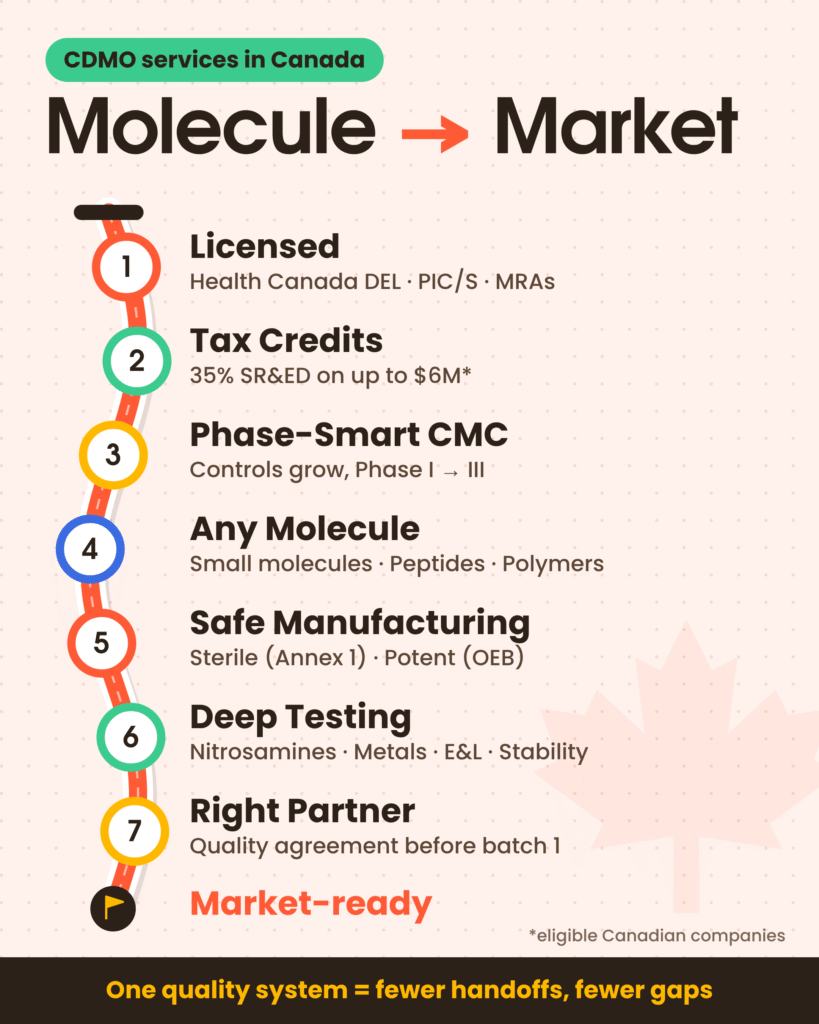
- Integrated model: CDMOs in Canada combine development, GMP manufacturing and advanced analytical testing under one quality system aligned with Health Canada, FDA and EMA expectations. This avoids the communication gaps and documentation delays that come with using several separate vendors.
- Regulatory framework: Facilities must hold a Health Canada Drug Establishment Licence (DEL) and pass GMP inspections. Canada’s PIC/S membership and its MRAs with the EU, UK, Switzerland and Australia give its GMP certificates international recognition. MRAs do not remove Canadian testing obligations, though.
- Tax incentives and data protection: Bill C-15 doubled the enhanced 35% SR&ED credit limit to $6 million for eligible companies and restored eligibility for capital expenditures. Provincial credits can be stacked on top. New chemical entities get at least 8 years of data exclusivity, plus 6 months for qualifying pediatric studies.
- Phase-appropriate CMC: Controls on synthesis, formulation, analytical methods, impurities and stability increase step by step from preclinical work to Phase III. This avoids overspending early and costly revalidation late. The article covers small molecules, peptides, polymers, generics and biosimilars.
- Sterile and high-potency manufacturing: Sterile products need a Contamination Control Strategy under Health Canada’s Annex 1 and a three-stage process validation lifecycle. Potent compounds need containment matched to their exposure band (OEB), with cleaning limits based on health-based exposure values.
- Specialized analytical testing: Labs follow the ICH Q14 and Q2(R2) method lifecycle and run trace-level nitrosamine testing, ICH Q3D elemental impurity work, extractables and leachables testing under the emerging ICH Q3E, and ICH stability studies.
- Choosing a partner: Start qualifying a CDMO 12–18 months before the first GMP batch, and sign a standalone Quality Technical Agreement before any GMP work begins. Due diligence should cover seven areas, including inspection history, containment data, data integrity, supply chain and direct access to the scientists doing the work.
Regulatory Architecture Governing CDMO Services in Canada
CDMO Services in Canada operate under Part C, Divisions 1A and 2 of the federal Food and Drug Regulations. These provisions combine mandatory establishment licensing requirements with Good Manufacturing Practice enforcement harmonized through the Pharmaceutical Inspection Co-operation Scheme (PIC/S). For pharmaceutical sponsors, this regulatory structure offers greater predictability in inspection outcomes, facilitates the recognition and portability of Mutual Recognition Agreement (MRA) certificates across major international markets, and provides access to recently expanded federal and provincial tax incentives.
Health Canada Drug Establishment Licensing and GMP Standards
Canadian facilities involved in fabricating, packaging, labelling, testing, importing, distributing, or wholesaling pharmaceutical dosage forms or active pharmaceutical ingredients (APIs) must maintain a valid Health Canada Drug Establishment Licence (DEL), unless an applicable exemption specifically applies. DEL applications and ongoing licensing activities are managed under the Guidance on Drug Establishment Licences (GUI-0002) using form FRM-0033. Approval and continued maintenance of a DEL depend on satisfactory GMP inspection outcomes assessed against the Good Manufacturing Practices Guide for Drug Products (GUI-0001) and Good Manufacturing Practices for Active Pharmaceutical Ingredients (GUI-0104).
Health Canada extended mandatory GMP compliance and establishment licensing requirements to APIs intended for human use on November 8, 2013, followed by veterinary APIs in 2017. These regulatory changes brought domestic API manufacturing, chemical synthesis, and analytical testing activities into closer alignment with internationally recognized pharmaceutical quality standards.
During inspections, Health Canada assigns either a Compliant (C) or Non-Compliant (NC) rating to individual licensed activities within a manufacturing building. Data integrity across laboratory operations and production activities remains an important area of regulatory attention. In accordance with PIC/S Good Practices for Data Management and Integrity in Regulated GMP/GDP Environments and the MHRA data integrity principles referenced in Health Canada guidance, Canadian CDMOs are expected to maintain formal data governance systems. These systems must ensure that electronic and paper-based records remain complete, consistent, accurate, and traceable throughout their entire lifecycle.
Mutual Recognition Agreements and Cross-Border FDA Alignment
Health Canada has participated in PIC/S since 1999 and maintains several bilateral and multilateral MRAs. Through these arrangements, Canadian GMP compliance certificates receive recognition in numerous international jurisdictions, reducing the need for Health Canada to independently inspect more than 2,500 foreign manufacturing facilities annually.
Canada’s operational MRA relationships include the European Union, the United Kingdom, Switzerland, Australia, and EEA–EFTA partners. These arrangements are further supported by concurrent inspection activities with the U.S. FDA and regulatory reliance initiatives conducted through the Access Consortium.
| Regulatory Mechanism | Scope and Operational Milestones | Critical Compliance Considerations for Sponsors |
|---|---|---|
| Canada–EU CETA Protocol | Covers human and veterinary pharmaceuticals, human biological products, and radiopharmaceuticals. Recognition of extra-jurisdictional GMP inspection outcomes became operational on April 1, 2021. | Excludes APIs, veterinary biological products, blood and plasma products, and advanced therapy medicinal products. It does not eliminate Canadian biological lot-release requirements under C.04.015 or extra-jurisdictional finished-product testing under C.02.019. |
| Canada–UK CUK TCA | Follows the CETA framework in scope and includes cooperation with the UK MHRA and VMD. Recognition of extra-jurisdictional inspection outcomes began on September 1, 2022. | APIs and blood/plasma products are excluded. Imported finished dosage forms manufactured at extra-jurisdictional sites remain subject to Canadian testing requirements under C.02.019. |
| Canada–Australia MRA | Operational since January 1, 2006. API coverage was introduced on November 1, 2018, and an MOU supporting reliance on extra-jurisdictional inspections was signed on March 1, 2024. | Importation of APIs does not automatically provide an exemption from raw-material testing under C.02.009/C.02.010. Extra-jurisdictional finished products remain subject to C.02.019 testing. |
| Canada–Switzerland MRA | Expanded on January 31, 2025, to include APIs, stable blood/plasma products, extra-jurisdictional inspections, and information-sharing and reliance activities involving OSE/PAI. | Biological lot release under C.04.015, API raw-material verification under C.02.009/C.02.010, and extra-jurisdictional finished-product testing under C.02.019 remain applicable. |
| U.S. FDA and Access Consortium | Includes concurrent Health Canada–FDA inspections, the Common Electronic Submission Gateway, and the Access Consortium reliance commitment announced on November 21, 2022. | There is no U.S.–Canada bilateral MRA equivalent to the EU/UK framework. Sponsors developing products for the U.S. market must independently assess FDA registration status and historical Form 483 inspection observations. |
Pharmaceutical sponsors should not interpret MRA recognition as a general exemption from Canadian import-testing requirements. Health Canada maintains that recognition of extra-jurisdictional GMP inspections and exclusions covering specific product categories do not remove obligations under the Food and Drug Regulations. These include Section C.02.019 requirements for finished-product testing, Section C.02.009 requirements for testing starting raw materials unless the certification conditions under C.02.010 are satisfied, and Section C.04.015 requirements for lot-to-lot release of human biological products.
Furthermore, as part of its regulatory red-tape reduction roadmap, Health Canada established a summer 2026 target for introducing a Ministerial Reliance Order. The proposed order is intended to expand reliance on foreign regulatory decisions alongside existing work-sharing activities with the U.S. FDA. Sponsors should nevertheless confirm the actual implementation status and applicable regulatory milestones directly with Health Canada rather than assuming that the proposed changes have already taken effect.
For sponsors comparing cross-border manufacturing arrangements, understanding differences in regulatory oversight, inspection recognition, and operational requirements is essential.
Explore the differences between Canadian and U.S. peptide CDMOs
R&D Tax Incentives, Data Protection, and Biomanufacturing Policy
Contracting eligible research and process-development activities to Canadian CDMOs can allow pharmaceutical sponsors to combine federal and provincial Scientific Research and Experimental Development (SR&ED) tax incentives with statutory data-exclusivity protections.
Following the launch of the federal government’s $2.2 billion Biomanufacturing and Life Sciences Strategy in 2021, Parliament introduced significant SR&ED program expansions in March 2026 through Bill C-15, the Budget 2025 Implementation Act, No. 1. These changes apply to taxation years beginning after December 15, 2024.
Doubled Enhanced Expenditure Threshold: Eligible Canadian-controlled private corporations (CCPCs) and qualifying Canadian public corporations can access the enhanced 35% refundable investment tax credit on up to $6 million in annual eligible SR&ED expenditures, compared with the previous $3 million threshold. The basic 15% rate continues to apply to expenditures above the applicable limit and to larger companies. Tax advisory analyses also indicate that the previous-year taxable capital phase-out range increased from $10 million–$50 million to $15 million–$75 million, alongside an optional revenue-based phase-out election.
Restored Capital Eligibility and CRA Pre-Claim Approval: Capital expenditures related to R&D property acquired after December 15, 2024, have once again become eligible for SR&ED income deductions and tax credits. In addition, the Canada Revenue Agency introduced a voluntary pre-claim approval process on April 1, 2026, allowing organizations to assess the eligibility of proposed projects before submitting their claims.
Domestic Subcontracting and Provincial Stacking: Arm’s-length SR&ED contracts performed in Canada qualify for a reduced eligible expenditure share for resident corporations and domestic branches of foreign corporations. Canadian tax advisory summaries also identify several provincial incentives that may be combined with federal claims. These include Québec’s refundable R&D and pre-commercialization tax credit, offering 30% on eligible expenditures up to $1 million above an exclusion threshold and 20% on amounts beyond that level, replacing older credits for tax years beginning after March 25, 2025. Other incentives include Ontario’s 8% refundable Ontario Innovation Tax Credit (OITC), subject to a $3 million expenditure limit, and its 3.5% non-refundable Ontario Research and Development Tax Credit (ORDTC). British Columbia provides a permanent 10% credit aligned with the federal $6 million limit, while Alberta offers an Innovation Employment Grant ranging from 8% to 20%.
To protect the commercial interests associated with innovative pharmaceutical products, Section C.08.004.1 of the Food and Drug Regulations provides market exclusivity protections for qualifying innovative drugs containing a new chemical entity. Updated guidance effective June 16, 2025, establishes a guaranteed minimum exclusivity period of eight years, with the possibility of an additional six months when qualifying pediatric clinical studies are completed. These provisions operate alongside the Patented Medicines (Notice of Compliance) Regulations and Certificates of Supplementary Protection.
Pharmaceutical Development Capabilities for CDMO Services in Canada
CDMO Services in Canada organize pharmaceutical development activities around phase-specific Chemistry, Manufacturing, and Controls (CMC) milestones, incorporating the principles established under ICH Q8, Q9, Q10, Q11, and Q14. This development strategy allows synthetic chemistry, formulation engineering, and analytical testing requirements to progress according to the clinical stage of the product.
Applying an appropriate level of technical and regulatory control at each stage helps prevent unnecessary expenditure during early clinical development while ensuring that manufacturing processes and analytical documentation are sufficiently mature before regulatory registration.
Phase-Appropriate CMC Progression in CDMO Services in Canada
Phase-appropriate CMC development within CDMO Services in Canada involves gradually increasing the complexity of synthetic process controls, dosage-form development, impurity specifications, and analytical method validation. Activities progress from preclinical toxicology studies through Phase III Process Performance Qualification (PPQ), with the level of control increasing as clinical exposure and regulatory expectations expand.
Introducing commercial tablet tooling or completing full ICH Q2(R2) analytical method validation before Phase I proof-of-concept may unnecessarily increase development costs. Conversely, postponing scalable synthetic route development, Failure Mode and Effects Analysis (FMEA), or regulatory starting material (RSM) justification until Phase III can result in expensive process revalidation and clinical development delays.
| CMC Parameter | Preclinical Stage | Phase I Clinical | Phase II Clinical | Phase III and Commercial |
|---|---|---|---|---|
| Synthesis and RSM Strategy | Non-GMP batches, including preliminary salt and polymorph screening. | Early cGMP clinical API production using a synthetic route that remains adaptable. | Synthetic route approaching finalization, with chromatography-free scalability as a development objective. | RSMs formally identified and justified according to ICH Q11 before PPQ batches are manufactured. |
| Drug Product Formulation | Simple solutions, active-in-capsule (AIC) presentations, or powder-in-bottle formulations. | AIC or uncomplicated liquid formulations suitable for first-in-human administration. | Commercial dosage-form concept selected, with prototype tablets or capsules developed. | Final commercial dosage form, strength, and packaging configuration established. |
| Analytical Method Status | Fitness-for-purpose HPLC assays without full validation. | Qualified analytical methods appropriate for the clinical stage. | Transition from qualified methods toward Quality by Design (QbD) development, design-space evaluation, and FMEA risk assessment. | Full analytical method validation under ICH Q2(R2) and ICH Q14. |
| Impurity Profiling | Initial purity characterization supporting GLP toxicology studies. | Monitoring of impurities at or above 0.10%, together with preliminary mutagenic and elemental impurity screening. | Structural characterization of important degradants and establishment of impurity specification limits. | Complete impurity identification and justified, qualified acceptance criteria. |
| Stability Program | Exploratory non-GMP stress testing. | Short-term formal ICH stability protocols supporting first-in-human (FIH) shelf-life requirements. | Extended stability studies supporting formulation changes and bridging activities. | Comprehensive ICH registration stability studies supporting the proposed commercial expiry period. |
When early clinical material is considered for use in subsequent development phases, sponsors must establish that Phase I batches are appropriate for the intended Phase II clinical studies. This requires demonstrating that the formulation, manufacturing process, critical quality attributes, and stability profile remain suitable for the proposed Phase II dosing conditions.
Changes to the formulation or manufacturing route between clinical phases must be evaluated through formal comparability assessments. In addition, completing nitrosamine and elemental impurity risk evaluations before manufacturing the first cGMP batch can help prevent regulatory holds during Clinical Trial Application (CTA) or Investigational New Drug (IND) submissions.
A well-planned scale-up strategy helps maintain process consistency as peptide manufacturing moves from early development toward larger GMP production volumes.
Explore peptide CDMO scale-up services
Small Molecule Synthesis, Complex Polymers, Peptides, and Generic Drug Development
Canadian pharmaceutical development CDMOs increasingly concentrate on specialized synthetic and analytical capabilities rather than conventional commodity manufacturing. Their work may involve scalable small-molecule synthesis, bioresorbable polymer development, therapeutic peptides, peptide-oligonucleotide conjugates (POCs), complex generic formulations, and biosimilar characterization.
For small-molecule programs, process chemistry development generally focuses on designing scalable synthetic routes, reducing dependence on chromatographic purification, understanding impurity formation and removal through impurity fate-and-purge studies, and preparing custom forced-degradation impurities and reference standards.
Polymer-based platforms used in sustained-release and targeted drug delivery require carefully controlled material characteristics. These platforms may include customized poly(lactic-co-glycolic acid) (PLGA), polylactic acid (PLA), polycaprolactone (PCL), and PEG-copolymer systems. Their characterization involves several complementary analytical techniques. Gel permeation/size-exclusion chromatography (GPC/SEC) measures molecular weight distribution and polydispersity, while NMR evaluates polymer block length. FTIR confirms functional group identity, and DSC/TGA provides information about thermal characteristics.
Similarly, complex peptide development programs involving GLP-1 receptor agonists such as semaglutide, liraglutide, and tirzepatide, as well as synthetic peptide conjugates, require specialized manufacturing environments. These operations may use dedicated cleanroom zoning, including ISO 8 synthesis areas and ISO 7 purification suites, together with high-resolution peptide mapping to identify and monitor oxidation, deamidation, truncation, and aggregation.
Peptide development also requires an understanding of how molecular structure, stability, and formulation characteristics influence manufacturing and drug-product performance.
Understand the differences between peptide drugs and small-molecule drugs
Generic and biosimilar development programs require equally detailed analytical and regulatory support. Generic Abbreviated New Drug Submission (ANDS) and U.S. Abbreviated New Drug Application (ANDA) programs involve reverse-engineering and deformulation of Reference Listed Drugs (RLDs), matching dissolution characteristics and drug-release kinetics, conducting bioanalytical testing for bioequivalence studies, and preparing the required quality documentation for CTD Module 3.
For biosimilar submissions, Health Canada expects extensive orthogonal physicochemical and functional characterization in accordance with ICH Q6B and ICH Q5C. This includes investigating low-level sequence variants resulting from transcription or translation errors, including amino acid misincorporation, and demonstrating that process-related impurities can be safely removed to acceptable levels.
Canadian facilities offering specialized peptide development capabilities can support synthesis, purification, characterization, and manufacturing activities within a coordinated development framework.
Explore peptide CDMO capabilities in Canada
GMP Manufacturing and High-Potency Containment Infrastructure
Clinical and commercial pharmaceutical manufacturing at Canadian CDMOs must comply with Health Canada’s three-stage process validation lifecycle described in Guide to Validation – Drugs and Supporting Activities (GUI-0029). Manufacturing operations must also maintain appropriate contamination prevention measures and occupational exposure controls, particularly when handling sterile products and high-potency compounds.
Maintaining sterility assurance and protecting manufacturing personnel requires validated facility engineering, appropriate operational procedures, and effective containment systems. Finished-product testing alone cannot demonstrate that all contamination and occupational exposure risks have been adequately controlled.
Sterile Manufacturing Under Health Canada Annex 1 and Process Validation
Under GUI-0029, Version 5, implemented on June 29, 2021, and Annex 1 to the Good Manufacturing Practices Guide – Manufacture of Sterile Drugs (GUI-0119), published in September 2023, sterile and non-sterile manufacturing facilities must maintain a continuous process validation lifecycle supported by a formal Contamination Control Strategy (CCS).
GUI-0029 divides process validation into three main stages:
- Phase 1 – Process Design: Establishing and understanding the manufacturing process, including its critical quality attributes and critical process parameters.
- Phase 2 – Process Performance Qualification (PPQ): Demonstrating that the manufacturing process performs consistently under defined conditions. Approved protocols must identify critical quality attributes, critical process parameters, challenge studies, and scientifically justified sampling procedures.
- Phase 3 – Ongoing Process Verification: Continuously monitoring process performance to confirm that the manufacturing operation remains controlled. Process Analytical Technology may be incorporated where appropriate.
Third-party manufacturing protocols and analytical method validation packages cannot be accepted without appropriate oversight. The regulated company’s designated quality personnel must formally review and approve these documents before relying on them for GMP activities.
For sterile pharmaceuticals, biologics, and radiopharmaceuticals governed by Section C.02.029 of the Food and Drug Regulations, GUI-0119 makes clear that sterility assurance cannot depend exclusively on terminal sterilization indicators or finished-product sterility testing. Instead, the facility’s CCS must incorporate utility-system design, single-use systems (SUS), raw-material bioburden and endotoxin specifications, preventive maintenance programs, and Corrective and Preventive Action (CAPA) trend analysis.
Sterile products that cannot undergo filtration or terminal sterilization, including certain ointments, creams, suspensions, and emulsions, must be compounded and filled under Grade A conditions with a Grade B background. Sterilizing-grade filters with a nominal pore size of 0.22 µm also require validated in-place integrity testing. Whenever possible, this testing should be performed within closed assemblies both before and after filtration.
| Cleanroom Parameter | ISO Class 5 (ISO 14644-1:2015) / GMP Grade A Context | ISO Class 7 (ISO 14644-1:2015) Background Context |
|---|---|---|
| Maximum particles ≥0.5 µm per m³ | 3,520 particles/m³. | 352,000 particles/m³, representing an allowance 100 times higher than ISO 5. |
| Maximum particles ≥1.0 µm per m³ | 832 particles/m³. | 83,200 particles/m³. |
| Macroparticles (≥5.0 µm) | EU/PIC/S Annex 1 (2022) distinguishes cleanroom classification from continuous monitoring. Rolling averages or extended sampling periods are used to minimize false alarms caused by isolated particle counts. | Monitoring at ≥0.5 µm and ≥5.0 µm is performed during reclassification and routine Grade B/C operations. |
| Operational Scope | ISO 5 defines airborne particle concentration limits. GMP Grade A additionally requires viable and non-viable monitoring, unidirectional airflow, and appropriate aseptic controls. | Provides the controlled background environment surrounding Grade A isolators or supports non-aseptic synthesis and purification activities. |
For peptide injectables and other sterile formulations, manufacturing controls must extend from formulation development through aseptic processing and final packaging.
Explore sterile fill-finish services for peptide injectables
HPAPI Containment Standards and Occupational Exposure Banding
Manufacturing oncology drugs, cytotoxic compounds, hormones, and antibody-drug conjugate (ADC) payloads requires engineering controls that reflect the Occupational Exposure Limits (OELs) of individual molecules and their assigned Occupational Exposure Bands (OEBs).
Because there is no single universally applicable global standard governing the numerical boundaries of every OEB category, pharmaceutical manufacturers and CDMOs must establish and document the exact company-specific exposure limits. Before beginning manufacturing activities, sponsors should obtain written confirmation of the applicable band definitions, isolator performance requirements, and cleaning acceptance criteria.
| OEB Level | Representative 8-Hour OEL | Typical Compound Classes | Engineering and Containment Benchmark |
|---|---|---|---|
| OEB 1 | >1,000 µg/m³ | Non-hazardous standard APIs. | Conventional open handling procedures supported by basic personal protective equipment. |
| OEB 2 | 100–1,000 µg/m³ | Mildly potent APIs. | Local exhaust ventilation and fundamental engineering containment measures. |
| OEB 3 | 10–100 µg/m³ | Potent APIs and selected hormones. | Containment hoods, gloveboxes, and closed material-transfer systems. |
| OEB 4 | 1–10 µg/m³ | HPAPIs and numerous cytotoxic therapeutics. | Rigid high-containment isolators, Restricted Access Barrier Systems (RABS), and negative-pressure manufacturing suites. |
| OEB 5 | <1 µg/m³ | Cytotoxic oncology drugs and most ADC payloads. | Sealed isolator production lines, closed Rapid Transfer Ports or Split Butterfly Valves, dedicated double-HEPA exhaust systems, and industry benchmarks such as ≥12.5 Pa negative pressure and ≤100 ng/m³ naproxen sodium surrogate validation. |
| OEB 6 | <0.1 µg/m³ | Ultra-potent ADC payloads. | Highest-level isolator systems supported by more intensive validation and operator biological monitoring. |
In multi-product HPAPI manufacturing facilities, cleaning validation is a critical patient-safety measure for preventing cross-contamination between different products. Current regulatory expectations require CDMOs to move beyond generic historical acceptance limits, including the traditional 10 parts-per-million (ppm) approach.
Instead, cleaning limits should be calculated using health-based Maximum Allowable Carryover (MAC) values derived from Acceptable Daily Exposure (ADE) toxicological assessments. These limits must be supported by validated analytical swab and rinse methods with lower limits of quantitation sufficiently below the calculated MAC values.
Specialized Analytical Testing in CDMO Services in Canada
Analytical characterization and GMP quality control are among the most demanding compliance areas within CDMO Services in Canada. These activities cover analytical procedure lifecycle management, ultra-trace nitrosamine quantitation, ICH Q3D elemental impurity evaluations, extractables and leachables (E&L) characterization, and pharmaceutical stability testing.
Canadian laboratories equipped with complementary mass spectrometry platforms can generate scientifically supported, audit-ready analytical data packages for regulatory submissions and inspections conducted by Health Canada, the FDA, and the EMA.
Analytical Procedure Lifecycle Under ICH Q2(R2) and ICH Q14
Analytical testing in Canada is increasingly moving away from the traditional approach of performing method validation only during the later stages of development. Instead, analytical procedure development is being integrated into a continuous lifecycle that connects ICH Q14 (Analytical Procedure Development) with ICH Q2(R2) (Validation of Analytical Procedures).
According to Canadian CRO regulatory advisories, Health Canada implemented ICH Q2(R2) on October 17, 2025, followed by ICH Q14 on January 12, 2026. These changes, together with dedicated ICH Q12/Q14 post-Notice of Compliance (NOC) implementation frameworks, require sponsors and CDMOs to establish clearly defined analytical target profiles and scientifically justified validation approaches.
Within this framework, qualified analytical methods developed during early clinical stages progressively advance toward full ICH Q2(R2) validation before Phase III registration batches are manufactured. Validated procedures must demonstrate specificity, linearity, accuracy, repeatability, intermediate precision, detection limits, quantitation limits, and chromatographic robustness.
In addition, system suitability requirements and data-integrity controls must be consistently applied during commercial testing and every batch-release analytical run.
Nitrosamine and NDSRI Risk Assessment, Process Modeling, and Mass Spectrometry
Under Health Canada’s Guidance on Nitrosamine Impurities in Medications, effective May 31, 2024, with Appendix 1 Acceptable Intake limits updated on March 11, 2026, Market Authorization Holders (MAHs) were required to complete Step 3 market-authorization updates by August 1, 2025. These requirements cover chemically synthesized and semi-synthetic drugs, as well as biological and radiopharmaceutical products.
The updated reporting framework requires MAHs to notify Health Canada of elevated nitrosamine detections when initiating a recall under GUI-0039. Regulatory submissions associated with nitrosamine risk mitigation are managed through risk-based Post-Notice of Compliance (NOC) Quality reporting categories. This approach permits Level III annual notifications when acceptable intake (AI) limits are tightened or when justified testing removal is proposed, rather than automatically requiring Level I supplements.
When multiple nitrosamine impurities are present, combined daily exposure must remain within the most restrictive applicable AI limit. For example, the relevant cumulative limits may be 96.0 ng/day for NDMA plus NMBA and 26.5 ng/day for NDMA plus NDEA. This approach is intended to ensure that the excess cancer risk does not exceed 1 in 100,000. Advanced-cancer therapies governed by ICH S9 and genotoxic APIs assessed under ICH Q3A/Q3B follow the applicable requirements of those guidelines.
Controlling Nitrosamine Drug Substance-Related Impurities (NDSRIs) in high-risk APIs, including sartans, metformin, rifampin (1-methyl-4-nitrosopiperazine), and sitagliptin, requires a coordinated understanding of synthetic chemistry and predictive process controls.
Internal formulation risk modeling published by ResolveMass Laboratories indicates that acidic microenvironments within the pH range of 2.0–6.0, together with processing temperatures above 40°C, can significantly accelerate nitrosation reactions. In comparison, buffering the formulation matrix above pH 6.0 was associated with a reduction in nitrosamine yield exceeding 90%.
| Formulation Parameter | Condition Range | Modeled Kinetic / Yield Behavior | Process Mitigation Control |
|---|---|---|---|
| Process / Matrix pH | pH 1.0–3.0 | Nitrosamine yield of 80%–100%, representing maximum nitrosation. | Avoid acidic aqueous holding conditions. Consider scavengers such as cysteine, ascorbate, BHT, and tocopherols during sample extraction. |
| Process / Matrix pH | pH 3.0–5.5 | Nitrosamine yield of 40%–60%. | Increase buffer excipient levels and adjust the process pH upward. |
| Process / Matrix pH | pH 6.0–8.0 | Nitrosamine yield below 10%, corresponding to a risk reduction greater than 90%. | Maintain formulation and reaction pH above 6.0. |
| Processing Temperature | 25°C / 40°C / 60°C / 80°C | Relative reaction rates increase from 1× at 25°C to 3× at 40°C, 8× at 60°C, and 14× at 80°C. | Keep nitrosation-sensitive processing steps below 30°C, replace polar protic solvents such as methanol and ethanol with aprotic alternatives, and reduce holding times. |
Health Canada and the FDA are increasingly concerned about the use of unvalidated commercial test methods when analytical matrix interference affects the reliability of results. Consequently, laboratories must select appropriate extraction and mass spectrometry techniques according to the volatility and physicochemical characteristics of the target analytes.
| Extraction Approach | Optimal Impurity Class | Sensitivity and Selectivity | Key Operational Trade-Offs |
|---|---|---|---|
| Solid-Phase Extraction (SPE) | Non-volatile NDSRIs, solid oral dosage forms, and peptide APIs. | Very high sensitivity, with sub-ppb LOQs and effective removal of interfering matrix components. | Requires longer method-development periods, sorbent optimization for individual nitrosamine classes, and monitoring of cartridge-lot variability. |
| Liquid-Liquid Extraction (LLE) | Simple matrices, water-soluble APIs, and preliminary screening applications. | Moderate selectivity, largely determined by solvent partitioning characteristics. | May be affected by surfactant-related emulsion formation, volatile analyte losses during evaporation, and higher solvent consumption. |
| Headspace-GC-MS/MS | Volatile and semi-volatile nitrosamines, including NDMA, NDEA, and NDIPA. | High sensitivity with limited interference from non-volatile matrix components. | Offers low artifact risk and good instrument availability but is unsuitable for non-volatile NDSRIs. |
According to ResolveMass’s published operational workflow benchmarks, nitrosamine testing programs generally allocate 1–3 business days for an initial Phase 1 risk assessment and 5–10 business days for standard analytical method development. Programs requiring custom organic synthesis of NDSRI reference standards may need 15–20 business days, while formal method validation typically requires another 5–10 business days. These estimates are consistent with the usual two-to-four-week development period for standard customized analytical methods.
After method establishment, the frequency of commercial batch testing is determined by the measured impurity concentration relative to the applicable AI limit. Results below 10% of the AI generally require no routine testing, although appropriate dossier documentation and periodic audits remain necessary. Concentrations between 10% and 30% of the AI may require routine release testing, with skip-testing considered after suitable validation. Results between 30% and 100% of the AI require mandatory batch-by-batch testing. Any result exceeding 100% of the applicable AI limit requires regulatory notification and an evaluation of potential recall obligations under Health Canada guidance.
A scientifically justified impurity control strategy helps sponsors establish appropriate specifications, monitoring procedures, and mitigation measures throughout development and manufacturing.
Explore impurity control strategies under ICH Q3A
Elemental Impurities Under ICH Q3D and Extractables and Leachables Under ICH Q3E
Elemental impurity and container-closure system evaluations under ICH Q3D and the emerging ICH Q3E framework are replacing broad, non-specific screening approaches with scientifically justified assessments based on route-specific toxicological exposure limits. These evaluations use highly sensitive analytical techniques, including trace ICP-MS, GC-MS, and LC-HRMS, to identify and quantify potential contaminants.
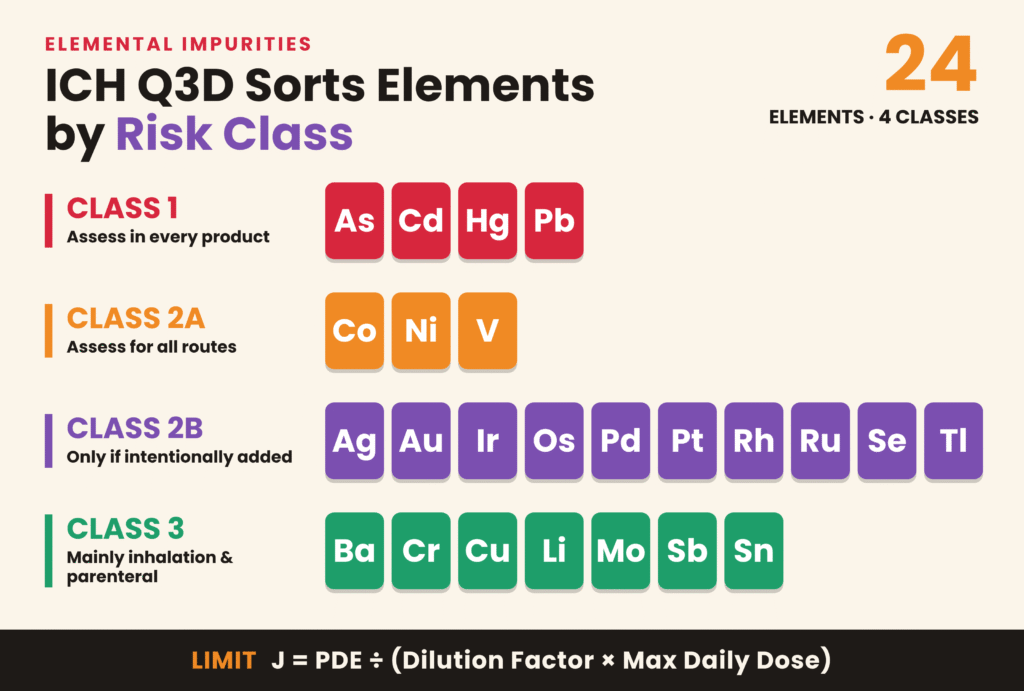
ICH Q3D replaces the legacy USP heavy-metals test with a risk-based framework that organizes 24 elements into four main categories according to their toxicity and route-specific Permitted Daily Exposures (PDEs):
- Class 1: Arsenic (As), cadmium (Cd), mercury (Hg), and lead (Pb). These elements require assessment for all drug products.
- Class 2A: Cobalt (Co), nickel (Ni), and vanadium (V).
- Class 2B: Elements associated with catalyst residues, including palladium (Pd), platinum (Pt), rhodium (Rh), ruthenium (Ru), osmium (Os), iridium (Ir), gold (Au), silver (Ag), selenium (Se), and thallium (Tl).
- Class 3: Barium (Ba), chromium (Cr), copper (Cu), lithium (Li), molybdenum (Mo), antimony (Sb), and tin (Sn).
Analysts calculate the target solution concentration limit, represented by J, using the product’s maximum daily dose and the overall sample dilution factor:
J = PDE / (Total Dilution Factor × Maximum Daily Dose)
Formula explanation:
- J: Target solution concentration limit.
- PDE: Permitted Daily Exposure.
- Total Dilution Factor: Overall dilution applied during sample preparation.
- Maximum Daily Dose: Maximum daily quantity of the drug product administered.
Sample preparation procedures must be selected according to the chemical composition and physical characteristics of the pharmaceutical matrix.
For mineral-containing tablets that include excipients such as titanium dioxide (TiO2) or talc, closed-vessel microwave digestion using concentrated HNO3 (69%), HCl (37%), and H2O2 (30%) can retain more than 95% of volatile Hg, As, and Se. For soluble liquid formulations, direct aqueous solubilization using 1%–2% v/v HNO3 may be appropriate. Direct organic dissolution with oxygen plasma gas can also be used for selected lipophilic matrices.
Combining empirical ICP-MS monitoring with an evaluation of manufacturing equipment materials can help prevent elemental impurity-related batch failures. In a published ResolveMass ICH Q3D case study, replacing an unpassivated steel mixer with a Hastelloy vessel reduced nickel exposure from 38.5% to 3.8% of the applicable PDE.
The associated validated ICP-MS procedure achieved LOQs below 0.8 ppb. Spike recovery values ranged from 95.4% to 103.8% for Class 1 elements and from 97.1% to 102.1% for Class 2A elements. Intermediate precision RSD values were between 3.4% and 4.9%, remaining within the stated USP acceptance criteria.
At the same time, extractables and leachables (E&L) assessments involving primary packaging materials and single-use polymeric systems are progressing toward harmonization under ICH Q3E (Guideline for Extractables and Leachables). The guideline reached Step 2b draft status on August 1, 2025.
ICH Q3E introduces harmonized potency classifications, Class 3 leachable monographs, and Analytical Evaluation Threshold (AET) requirements for confirmed compound identification. Since no individual analytical instrument can detect volatile additives, non-volatile oligomers, and inorganic elements simultaneously, qualified Canadian E&L laboratories use complementary GC-MS, LC-HRMS, ICP-MS, and FTIR platforms.
These orthogonal techniques help laboratories identify potential leachables, determine their concentrations, and convert analytical findings into estimated daily patient exposure values. The resulting data support toxicological evaluations and CTD Module 3 regulatory documentation.
GMP Batch Release and ICH Stability Programs
Maintaining uninterrupted commercial pharmaceutical supply requires effective coordination between GMP batch-release testing and ICH stability studies. Performing these activities within an integrated laboratory system reduces delays associated with transferring analytical methods between different facilities and allows batch-release results to be evaluated alongside ongoing stability trends.
| Stability Study Type | Storage Condition | Standard Testing Intervals | Primary Regulatory Objective |
|---|---|---|---|
| Long-Term (General / Zone IVa) | 25°C ± 2°C / 60% ± 5% RH or 30°C ± 2°C / 65% ± 5% RH. | 0, 3, 6, 9, 12, 18, 24, and 36 months. | Establishes the proposed commercial shelf life and retest period. |
| Intermediate | 30°C ± 2°C / 65% ± 5% RH when 25°C is used for long-term testing. | 0, 6, 9, and 12 months. | Evaluates significant changes identified during accelerated stability testing. |
| Accelerated | 40°C ± 2°C / 75% ± 5% RH. | 0, 3, and 6 months. | Identifies potential degradation products and supports the assessment of shipping-related temperature excursions. |
| Refrigerated (Cold-Chain) | 5°C ± 3°C for long-term storage; 25°C ± 2°C / 60% RH for accelerated testing. | Long-term: 0–24 months. Accelerated: 0, 3, and 6 months. | Supports the stability evaluation of cold-chain biologics, peptides, and parenteral formulations. |
| Semi-Permeable Containers | 25°C ± 2°C / 40% ± 5% RH or 30°C ± 2°C / 35% ± 5% RH. | 0, 3, 6, 9, 12, 18, and 24 months. | Measures moisture loss and changes in formulation concentration during storage. |
| Photostability (ICH Q1B) | At least 1.2 × 10⁶ lux hours of visible light and at least 200 W·h/m² of near-UV exposure (320–400 nm). | Confirmation through ≥0.5 ΔA at 400 nm actinometry. | Demonstrates resistance to photodegradation and evaluates whether the selected packaging provides adequate light protection. |
When estimating commercial batch-disposition timelines, vendor release-testing benchmarks indicate that Quality Unit review can account for approximately 30%–40% of the overall turnaround time. This review includes compiling the analytical data package, independently verifying analyst records, auditing chromatographic reintegration, and completing final Quality Assurance (QA) disposition.
The total release timeline must also account for microbiological testing and sterility incubation periods, which can further influence when a batch becomes available for commercial distribution.
Appropriate stability-batch planning is essential for generating the long-term and accelerated data needed to support regulatory submissions.
Understand stability batch requirements for an ANDA submission
Evaluating and Onboarding CDMO Services in Canada
Selecting and engaging CDMO Services in Canada requires beginning technical qualification approximately 12–18 months before the first planned GMP manufacturing batch. Sponsors should evaluate technical and quality capabilities independently of commercial negotiations to ensure that regulatory responsibilities remain clearly defined.
Industry outsourcing benchmarks indicate that transferring a planned commercial manufacturing program to another site may require 18–24 months. Emergency transfers resulting from manufacturing or quality failures can take considerably longer. Therefore, conducting detailed due diligence before signing a contract is essential for protecting clinical development schedules, maintaining regulatory compliance, and avoiding interruptions to commercial supply.
Due Diligence, Quality Agreements, and Technology Transfer for CDMO Services in Canada
A structured onboarding process for CDMO Services in Canada should begin with a standalone Quality Technical Agreement (QTA), which must be established before any GMP manufacturing activities are initiated. This arrangement is consistent with the quality responsibilities outlined under FDA 21 CFR Part 211.42 and EU GMP Chapter 7.
Keeping the QTA separate from the commercial Master Services Agreement (MSA) helps protect quality-related responsibilities from commercial disagreements involving pricing, contract termination, or other financial arrangements.
The agreement should clearly define responsibilities for Out-of-Specification (OOS) notifications, deviation investigations, change-control timelines, stability program management, audit rights, and batch disposition. Change-control review periods commonly range from 60–180 days, depending on the nature and potential impact of the proposed change.
Before executing an MSA or QTA, cross-functional quality, CMC, and procurement teams should evaluate the following seven technical due-diligence areas:
1. Multi-Jurisdictional Inspection History: Review the CDMO’s inspection and compliance records from the previous 36 months. This assessment should include Health Canada DEL compliance information, U.S. FDA Form 483 observations, Establishment Inspection Reports, EMA GMP certificates, and documented CAPA closure activities. Sponsors should not rely exclusively on current certification documents when evaluating a facility’s regulatory history.
2. Modality and Dosage-Form Batch Frequency: Confirm how frequently the facility manufactures or tests the specific dosage form, polymer system, or peptide class required for the project. The assessment should also verify that the relevant manufacturing or testing activities are covered by the site’s active DEL categories.
3. Stage-Gate Technology Transfer Readiness: Evaluate previously executed technology transfer protocols, FMEA documentation, and the ability of the facility to transfer analytical methods between different instruments and equipment configurations. Particular attention should be given to whether the analytical methods were originally developed with cross-equipment transferability in mind.
4. High-Potency Containment and Cleaning Data: Examine the facility’s OEB/OEL specifications, recent surrogate containment performance results, and analytical swab-method LOQs. These values should be compared with the ADE-derived MAC limits to confirm that the facility can demonstrate adequate containment and cleaning effectiveness.
5. Data Integrity and Computerized Systems: Conduct an assessment of electronic audit trails, chromatographic reintegration controls, and computerized laboratory systems. Confirm that the facility follows Health Canada’s data governance expectations and the applicable principles of PIC/S Annex 11 for computerized systems.
6. Upstream Supply Chain Mapping: Request a documented map of upstream suppliers and dependencies covering APIs, key starting materials, excipients, and primary product-contact packaging components. The review should confirm that suppliers have undergone formal qualification and that suitable dual-sourcing arrangements or safety stocks are available to reduce supply-chain disruption risks.
7. Governance and Direct Scientist Access: Verify the availability of dedicated senior project management, clearly defined OOS escalation service-level agreements (SLAs), adequate staff-turnover coverage, and direct access to the bench chemists and mass spectrometrists responsible for executing the project. Effective communication between the sponsor’s technical team and the scientists performing the work is essential for resolving analytical and manufacturing issues promptly.
Conclusion
Partnering with CDMO Services in Canada allows pharmaceutical and biotechnology companies to combine internationally recognized Health Canada, FDA, and EMA quality expectations with enhanced federal and provincial SR&ED tax incentives. Whether a development program involves Phase I-to-commercial CMC scale-up, sterile manufacturing under Health Canada Annex 1, OEB 5 high-potency containment, or trace-level nitrosamine, ICH Q3D elemental impurity, and ICH Q3E extractables and leachables testing, maintaining development efficiency requires coordinated scientific oversight and consistent analytical execution.
An integrated development and manufacturing strategy reduces the operational challenges associated with disconnected vendors, fragmented analytical documentation, and repeated technology transfers. Bringing synthetic chemistry, polymer engineering, formulation development, GMP manufacturing, and advanced analytical testing under a coordinated quality system can improve project continuity and help sponsors address regulatory requirements throughout the pharmaceutical product lifecycle.
Operating from a single facility in Laval, Québec, ResolveMass Laboratories Inc. holds Health Canada DEL No. 3-002945-A, U.S. FDA registration (3042696771), and ISO 9001:2015 certification. The organization combines custom synthesis, polymer engineering, formulation development, and GMP analytical testing and batch-release support with direct scientist-to-scientist collaboration.
Pharmaceutical companies seeking support for customized drug development, analytical method validation, or GMP batch-release testing can discuss their project requirements with ResolveMass Laboratories Inc. and connect directly with its scientific team through the Contact Us page.
Frequently Asked Questions
Pharmaceutical sponsors should ideally begin evaluating Canadian CDMOs, preparing Requests for Proposals (RFPs), and discussing preliminary contractual arrangements 12–18 months before the first planned GMP batch. Projects involving specialized manufacturing technologies or limited facility availability may require an even earlier start. Beginning the process in advance helps secure suitable manufacturing capacity, coordinate cleanroom availability, and complete nitrosamine and elemental impurity risk assessments before GMP production commences.
A Quality Technical Agreement (QTA) establishes the regulatory and quality responsibilities of the sponsor and CDMO under frameworks such as FDA 21 CFR Part 211.42 and EU GMP Chapter 7. It defines essential procedures for batch release, Out-of-Specification (OOS) reporting, deviation investigations, stability management, and change-control notifications, which may involve 60–180-day timelines. Maintaining a separate QTA ensures that scientific and quality decisions remain independent of commercial negotiations and contractual disagreements.
No, Mutual Recognition Agreements (MRAs) do not provide a universal exemption from Canadian import-testing obligations. Although Health Canada recognizes qualifying GMP inspection outcomes from jurisdictions such as the EU, UK, Switzerland, and Australia, applicable requirements under the Food and Drug Regulations remain in force. These include Section C.02.019 for finished-product testing at extra-jurisdictional sites, Sections C.02.009/C.02.010 for API raw-material verification, and Section C.04.015 for human biological lot release.
Phase I manufacturing batches can be considered for Phase II clinical studies when their formulation, manufacturing process, critical quality attributes, and stability characteristics adequately support the intended Phase II dosing requirements. Sponsors must establish that the material remains representative of the formulation and quality specifications required by the subsequent clinical protocol. Any modifications involving the synthetic route, excipients, or dosage form between phases require documented comparability assessments supported by appropriate analytical data.
Before selecting an HPAPI manufacturing facility, sponsors should verify its documented Occupational Exposure Band (OEB) classification and Occupational Exposure Limit (OEL), including targets below 1 µg/m³ for OEB 5 compounds. Important engineering measures include sealed isolators, closed Rapid Transfer Ports or Split Butterfly Valves, negative-pressure environments of at least 12.5 Pa, and naproxen sodium surrogate validation benchmarks of no more than 100 ng/m³. Cleaning validation should also use toxicologically established Acceptable Daily Exposure (ADE) values to calculate Maximum Allowable Carryover (MAC), with analytical methods demonstrating LOQs below the applicable MAC rather than relying on the historical 10 ppm criterion.
Health Canada’s Guidance on Nitrosamine Impurities in Medications, effective May 31, 2024, established August 1, 2025, as the deadline for Step 3 market-authorization updates. Under the updated reporting approach, Market Authorization Holders (MAHs) must report elevated nitrosamine detections when initiating a recall in accordance with GUI-0039. Other risk-mitigation activities follow risk-based Post-Notice of Compliance (NOC) Quality reporting categories, allowing Level III annual notifications for scientifically justified changes, including tighter Acceptable Intake (AI) limits or removal of unnecessary testing.
Yes, specialized Canadian CDMOs can develop customized Nitrosamine Drug Substance-Related Impurity (NDSRI) reference standards through drug-specific organic synthesis and characterize their structures using NMR and mass spectrometry. These standards can support the development of highly sensitive analytical procedures using Solid-Phase Extraction (SPE), headspace extraction, LC-MS/MS, LC-HRMS, and GC-MS/MS. With appropriate method optimization and validation under ICH Q2 requirements, laboratories can achieve sub-ppb or parts-per-trillion quantitation for suitable target compounds and analytical matrices.
Transferring an established commercial manufacturing program to a different CDMO generally requires approximately 18–24 months, depending on process complexity and regulatory requirements. The transfer involves moving manufacturing documentation, qualifying equipment and materials, transferring and validating analytical methods, and conducting product comparability assessments. Process Performance Qualification (PPQ) batches and any necessary regulatory reviews must also be completed before commercial production can begin at the receiving facility.
Eligible pharmaceutical development and analytical research activities performed through Canadian CDMOs may qualify for Canada’s Scientific Research and Experimental Development (SR&ED) tax incentive, provided the applicable statutory requirements are satisfied. Under the Bill C-15 reforms legislated in March 2026, qualifying expenditures may contribute to the enhanced 35% refundable investment tax credit, subject to the annual eligible expenditure limit of 6 million, or the basic 15% credit, depending on corporate eligibility. The reforms also restore qualifying capital-expenditure eligibility and operate alongside provincial R&D incentives, while eligible Canadian contract research expenditures are subject to specific calculation rules.
Reference:
- Innovation, Science and Economic Development Canada — Canadian Life Science Clinical Research and Manufacturing Capabilities: https://ised-isde.canada.ca/site/canadian-life-science-industries/en/canadian-life-science-industries/biopharmaceuticals-and-pharmaceuticals/canadian-life-science-clinical-research-and-manufacturing-capabilities
- Health Canada — Guidance on Drug Establishment Licences (GUI-0002): https://www.canada.ca/en/health-canada/services/drugs-health-products/compliance-enforcement/establishment-licences/directives-guidance-documents-policies/guidance-drug-establishment-licences-drug-establishment-licensing-fees-0002/document.html
- International Journal of Drug Regulatory Affairs — Health Canada Guidance Frameworks (GUI-0002 & Annex 11): https://www.ijdra.com/index.php/journal/article/download/724/386
- Government of Canada Publications — Drug Establishment Licence Application (FRM-0033): https://publications.gc.ca/collections/collection_2019/sc-hc/H14-311-2019-eng.pdf
- Health Canada — Guide to validation – drugs and supporting activities (GUI-0029), Version 5: https://www.canada.ca/content/dam/hc-sc/documents/services/drugs-health-products/compliance-enforcement/good-manufacturing-practices/guidance-documents/validation/gui-0029-eng.pdf
- Health Canada — Annex 1 to the Good manufacturing practices guide – Manufacture of sterile drugs (GUI-0119): https://www.canada.ca/en/health-canada/services/drugs-health-products/compliance-enforcement/good-manufacturing-practices/guidance-documents/gmp-guidelines-annex-1-manufacture-sterile-drugs-0119.html
- Health Canada — Guide to validation – drugs and supporting activities (GUI-0029) Summary: https://www.canada.ca/en/health-canada/services/drugs-health-products/compliance-enforcement/good-manufacturing-practices/validation/validation-guidelines-pharmaceutical-dosage-forms-0029-summary.html
- Health Canada — Guidance on Nitrosamine Impurities in Medications (Effective May 31, 2024 PDF): https://www.canada.ca/content/dam/hc-sc/documents/services/drugs-health-products/compliance-enforcement/information-health-product/drugs/nitrosamine-impurities/medications-guidance/guidance-nitrosamine%20impurities-medications.pdf
Get In Touch With Us
About The Author