
Introduction
Selecting an Insulin Biosimilar Development Partner for the U.S. Food and Drug Administration (FDA) 351(k) Biologics License Application (BLA) pathway requires integrating high-resolution analytical comparability, recombinant Chemistry, Manufacturing, and Controls (CMC) execution, euglycemic clamp bioanalysis, and prefilled pen combination-product testing into a unified regulatory strategy. The Biologics Price Competition and Innovation Act (BPCI Act) transitioned approved New Drug Applications (NDAs) for biological products, including insulin, under section 505 of the FD&C Act to licenses under section 351 of the Public Health Service (PHS) Act on March 23, 2020. As a result, follow-on insulin products cannot use the small-molecule generic drug approval pathway and must instead satisfy the 351(k) “totality of evidence” standard.
The analytical and regulatory requirements have evolved further following the FDA’s March 2026 biosimilar reforms. By withdrawing its 2015 biosimilarity guidance and reducing routine expectations for comparative clinical efficacy trials, the agency has placed greater emphasis on structural fingerprinting, forced degradation comparability, and bias-free pharmacokinetic/pharmacodynamic (PK/PD) bioanalysis. Organizations such as ResolveMass Laboratories Inc., an FDA-registered (FEI 3042696771), Health Canada GMP-licensed (Drug Establishment Licence 3-002945-A), and ISO 9001:2015-certified CRO/CDMO in Laval, Québec, demonstrate the importance of an integrated analytical, stability, and CMC dossier architecture for supporting an insulin 351(k) BLA.
Accurate insulin characterization helps establish molecular identity and product quality throughout biosimilar development. Our insulin characterization capabilities support this process.
Share via:
Quick Summary:
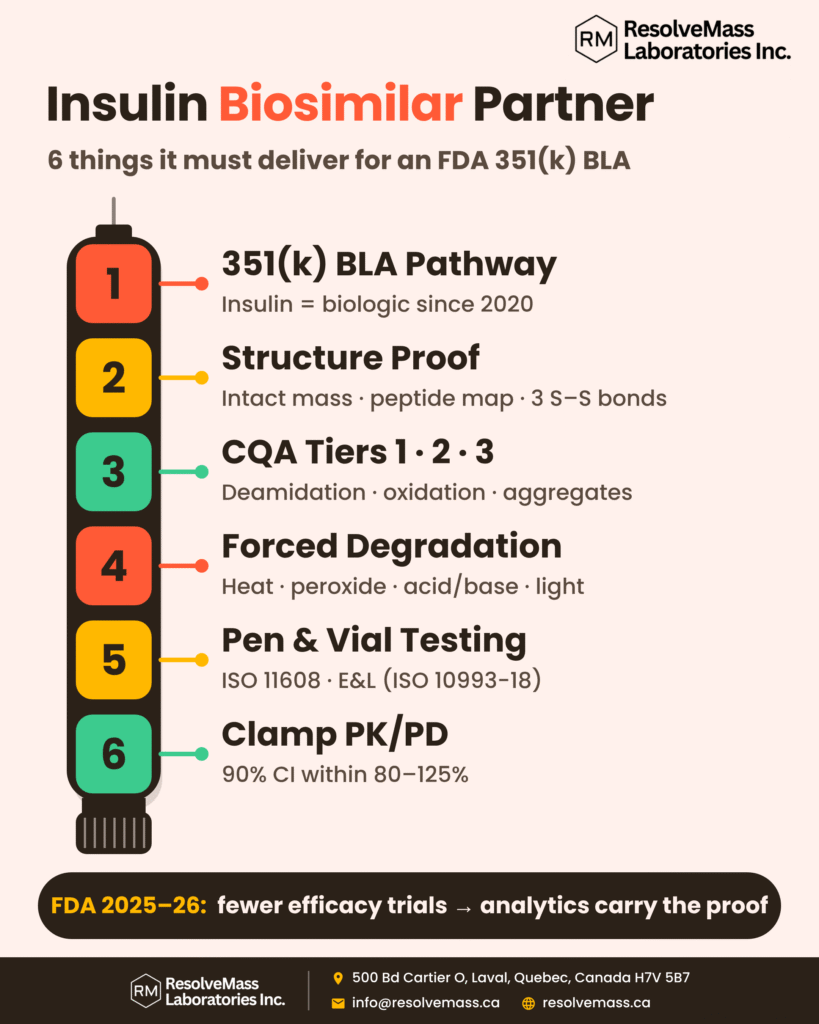
- Pathway: Since March 23, 2020, insulin has been regulated as a biologic, so follow-on insulins need a 351(k) BLA. They must show “high similarity” to the U.S. reference product with no clinically meaningful differences.
- Regulatory shift: FDA reforms in 2025–26 cut routine comparative efficacy studies and streamlined PK study requirements. FDA also withdrew its 2015 biosimilarity guidance. Analytical data now carries more of the proof, and strong analytics may support waiving a clinical immunogenicity study.
- Structural characterization: The partner must compare about 10 or more reference lots using intact mass (±1 Da), high-coverage LC-MS/MS peptide mapping, and confirmation of insulin’s three disulfide bonds (A6–A11, A7–B7, A20–B19). Optimized digestion avoids artificial deamidation.
- CQA tiers and higher-order structure: Attributes are risk-ranked into Tier 1 (equivalence testing), Tier 2 (quality range) and Tier 3 (visual comparison). Asn-A21 deamidation and oxidation are key Tier 1 risks. Higher-order structure and aggregation are assessed with CD, FTIR, DSC, HDX-MS and SEC-MALS.
- Forced degradation and stability: Thermal, oxidative, acid/base and photolytic stress targets about 5–20% degradation to prove the methods are stability-indicating. ICH stability runs at 5°C ± 3°C long-term and 25°C/60% RH accelerated, ideally at one GMP site.
- Manufacturing and device: Refolding and enzymatic conversion in E. coli or yeast drive impurities such as HCPs and hcDNA. Prefilled pens need ISO 11608 compliance, human factors studies, and E&L testing under ISO 10993-18/-17.
- Clinical PK/PD and partner checklist: Euglycemic clamp studies must show 90% CIs within 80–125%, using bias-free “1-assay” bioanalysis plus ADA assays. A strong partner offers FDA and Health Canada GMP status, high-resolution MS, ISO 17025 E&L testing, GLP/GCP bioanalysis, and ALCOA+ CTD Module 3 packaging.
Navigating the US 351(k) BLA Regulatory Landscape for Insulin Biosimilars
Under section 351(k) of the PHS Act, an insulin biosimilar candidate must demonstrate high similarity to a U.S.-licensed reference product without clinically meaningful differences in safety, purity, or potency. State-of-the-art analytical data may also reduce or eliminate the need for comparative clinical immunogenicity studies under the FDA’s draft recommendations. In its November 2019 draft guidance, Clinical Immunogenicity Considerations for Biosimilar and Interchangeable Insulin Products (content current as of May 2020; non-binding recommendations), the FDA explained that when comparative analytical assessments using state-of-the-art technology establish a “highly similar” profile, little or no residual uncertainty regarding immunogenicity would generally remain. Therefore, the likelihood of immunogenicity producing a clinically meaningful impact would be expected to be minimal or nonexistent. Since the publicly available FDA guidance summary does not specify fixed numerical waiver thresholds, sponsors must develop a comprehensive, multi-orthogonal analytical dataset to substantiate any request for an immunogenicity study waiver.
Between 2024 and 2026, U.S. regulatory policy moved toward reducing development-related barriers across the biologics sector. According to the FDA, biologics account for 5% of prescriptions but represent 51% of U.S. drug spending. On March 9, 2026, the FDA announced that it had approved 82 biosimilars and withdrew its 2015 final guidance, Scientific Considerations in Demonstrating Biosimilarity to a Reference Product, while issuing New and Revised Draft Q&As on Biosimilar Development and the BPCI Act (Revision 4). This revision reduces unnecessary comparative efficacy study requirements and identifies situations in which sponsors may rely on clinical PK data generated against a non-U.S.-licensed comparator. An industry analysis published in Pharmaceutical Technology estimates that this reform could reduce international development costs by approximately 20 million per program. Meanwhile, the FDA’s June 2024 draft interchangeability update and legislative proposals, including amended S. 1954, reported by the Senate HELP Committee in July 2026 according to legal commentary from Knobbe Martens, demonstrate continued momentum toward eliminating separate clinical switching studies for interchangeable designations.
| Product Name | Nonproprietary Name | Reference Product | FDA Approval Date | Key Regulatory Profile |
|---|---|---|---|---|
| Semglee | insulin glargine-yfgn | Lantus (insulin glargine) | July 2021 | First FDA-approved interchangeable biosimilar insulin; 10 mL vial and 3 mL prefilled pen |
| Rezvoglar | insulin glargine-aglr | Lantus (insulin glargine) | December 2021 | Second FDA-approved interchangeable biosimilar insulin |
| Merilog | insulin aspart-szjj | Novolog (insulin aspart) | February 2025 | Rapid-acting insulin analog biosimilar |
| Kirsty | insulin aspart-xjhz | Novolog (insulin aspart) | July 2025 | Rapid-acting insulin analog biosimilar |
| Langlara | insulin glargine-aldy | Lantus (insulin glargine) | April 2026 | Long-acting insulin analog biosimilar; 3 mL prefilled pen |
| Garzulys | insulin aspart-fsan | Novolog (insulin aspart) | July 2026 | Rapid-acting insulin analog biosimilar; 10 mL vial and 3 mL prefilled pen |
Table data reflect FDA Biosimilar Product Information updated October 28, 2026.
Analytical Characterization Capabilities Required of an Insulin Biosimilar Development Partner
An Insulin Biosimilar Development Partner must perform orthogonal physicochemical characterization across multiple originator batches, often involving approximately 10 or more reference product lots, in accordance with ICH Q6B and ICH Q5E. This approach captures the natural variability of the originator product and establishes statistically supported equivalence ranges. As comparative efficacy trials become less routine in 351(k) development programs, mass spectrometry-based fingerprinting and Multi-Attribute Methods (MAM) assume primary responsibility for resolving residual uncertainty in eCTD Module 3 (sections 3.2.S and 3.2.P).
Reliable analytical comparisons are essential for demonstrating biosimilarity and minimizing regulatory uncertainty. Our comparability study services support evidence-based assessments.
Primary Structure, Intact Mass, and Disulfide Mapping by an Insulin Biosimilar Development Partner
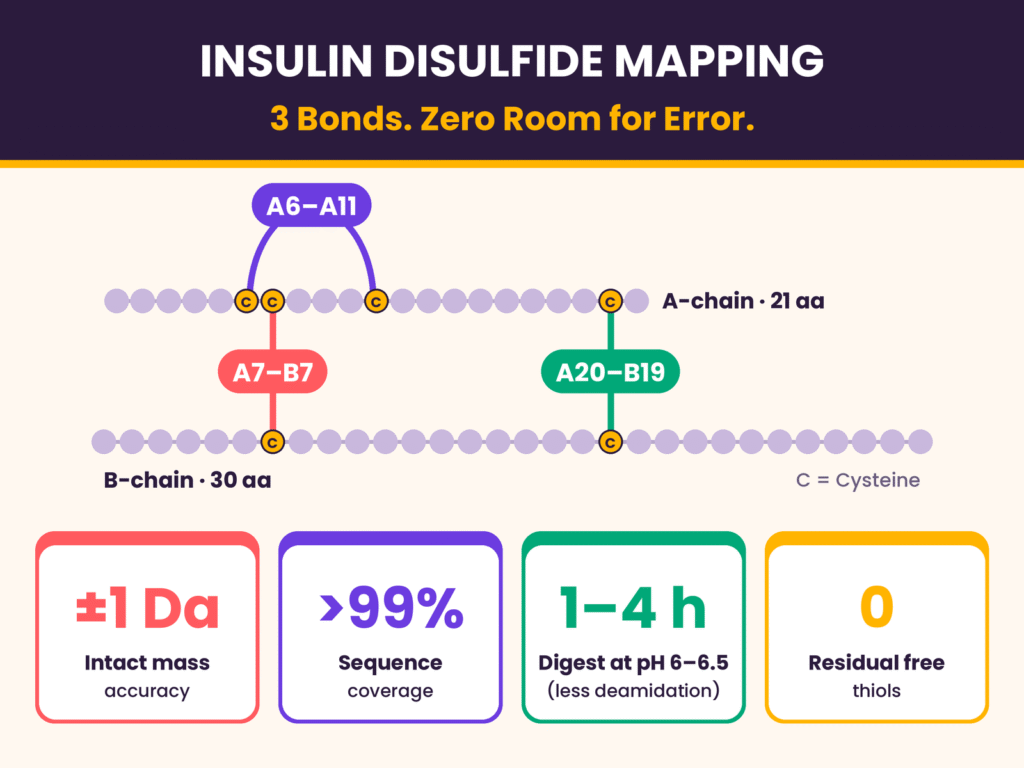
Confirming the primary structure of insulin requires intact mass verification within ±1 Da using LC-ESI-MS, high-coverage LC-MS/MS peptide mapping, and non-reduced mapping of all three canonical disulfide linkages. Although general regulatory benchmarks for peptide mapping typically require ≥95% sequence coverage and substitution detection sensitivity down to 0.1% relative abundance, specialized insulin LC-MS/MS workflows target greater than 99% sequence coverage. This level of coverage helps identify single-residue misincorporations and N-/C-terminal clipping. Before enzymatic cleavage, intact mass analysis verifies the exact molecular formulas, such as human insulin (C₂₅₇H₃₈₃N₆₅O₇₇S₆, 5,807.6 Da) and insulin glulisine (C₂₅₈H₃₈₄N₆₄O₇₈S₆, 5,823.0 Da), before peptide-level analytical workflows begin.
Sample preparation for peptide mapping must prevent the introduction of chemical artifacts that could alter the measured levels of native post-translational modifications (PTMs). Standard workflows involve denaturing the two-chain polypeptide in 6 M guanidine HCl or 8 M urea at 37°C, followed by reduction and alkylation using iodoacetamide or N-ethylmaleimide (NEM). Conventional digestion procedures lasting 16 to 24 hours at pH 8.0–8.5 can cause artificial deamidation. Therefore, optimized workflows reduce digestion time to 1–4 hours at pH 6.0–6.5 while using higher enzyme-to-substrate ratios (1:10 to 1:20) and automated cartridge cleanup systems, such as AssayMAP, to maintain stable asparagine baselines. Parallel non-reduced LC-MS/MS peptide mapping confirms insulin’s three native disulfide bonds (A6–A11, A7–B7, and A20–B19) and evaluates potential A-chain dimerization or disulfide scrambling. Additionally, Ellman’s reagent assays or direct NEM-alkylation LC-MS are used to confirm the absence of residual free thiol groups.
Advanced peptide mapping and mass spectrometry workflows are also valuable for detecting sequence-related impurities and unexpected molecular modifications. Applying complementary proteomics approaches for biosimilar characterization can improve sequence coverage and help identify low-abundance variants that may influence product quality.
Tiered CQA Risk Assessment, PTMs, and Higher-Order Structure
A scientifically defensible comparability package classifies analytical attributes into Risk Tiers 1, 2, and 3. This classification enables regulatory reviewers to assess clinically sensitive Critical Quality Attributes (CQAs) using formal equivalence statistics. Among insulin PTMs, deamidation at Asn-A21 has particular regulatory significance because its conversion to aspartic acid produces an isobaric mass shift of +0.984 Da, which low-resolution mass spectrometers can frequently fail to detect. Other product-related variants requiring monitoring include Gln-B4 deamidation (evaluated in stressed lots), desPheB1 N-terminal truncation, pyroGluB4-related modifications, oxidative species (+16 Da for single oxidation and +32 Da for double oxidation), and charge heterogeneity. These charge variants can be resolved using capillary isoelectric focusing (cIEF/icIEF) or cation-exchange chromatography (CEX-UPLC).
Higher-order structure (HOS) and aggregation characterization are essential for confirming that the tertiary folding and self-association properties of the proposed biosimilar are comparable to those of the originator. Sponsors combine conventional biophysical techniques, including Far/Near-UV circular dichroism (CD), Fourier-transform infrared (FTIR) spectroscopy, and differential scanning calorimetry (DSC), with advanced techniques such as Hydrogen-Deuterium Exchange Mass Spectrometry (HDX-MS) and Ion Mobility-MS (IM-MS). HDX-MS evaluates amide backbone exchange kinetics at the peptide-segment level, allowing it to identify localized conformational differences that may remain undetected through CD or FTIR analysis. Soluble high-molecular-weight (HMW) aggregates are quantified using SEC-MS and SEC-MALS, while dynamic light scattering (DLS), micro-flow imaging (MFI), and HIAC particle analysis provide complementary assessments of insoluble aggregates.
Identifying and prioritizing CQAs helps sponsors maintain consistent product quality throughout development. Our CQA characterization approach supports this objective.
| Quality Attribute or Variant | CQA Risk Tier | Primary Analytical Platforms | Regulatory Comparability Standard |
|---|---|---|---|
| Asn-A21 deamidation (+0.984 Da), oxidation (+16/+32 Da), purity %, biological potency | Tier 1 (High Risk) | High-resolution Orbitrap/Q-TOF LC-MS/MS, RP-HPLC, cell-based potency/receptor binding | Equivalence testing (90% CI within ±1.5σ in insulin CQA frameworks; 95% CI within k × SD in broader biosimilar tiers) |
| Charge variants, desPheB1 / pyroGluB4 variants, soluble HMW aggregates | Tier 2 (Moderate Risk) | cIEF / icIEF, CEX-UPLC, SEC-MS, SEC-MALS | Quality Range approach (Mean ± x × SD established from reference product lots) |
| Primary sequence identity, disulfide linkages (A6–A11, A7–B7, A20–B19), HOS spectra | Tier 3 (Low Risk) | Intact LC-ESI-MS (±1 Da), non-reduced peptide mapping, HDX-MS, Far/Near-UV CD, FTIR, DSC | Qualitative visual comparison, raw data overlays, and side-by-side spectral matching |
Forced Degradation, Stability-Indicating Methods, and GMP Release Testing
Forced degradation and GMP stability studies establish whether a proposed insulin biosimilar follows degradation pathways comparable to those of its reference product. These studies also demonstrate that release assays are stability-indicating in accordance with ICH Q2(R1)/Q2(R2). Instead of causing complete molecular breakdown, stress protocols are designed to produce approximately 5% to 20% degradation of the main protein peak. Developing this controlled “stress-response fingerprint” confirms that chromatographic and LC-MS methods can reliably detect newly formed degradants during shelf-life monitoring and potential cold-chain excursions.
| Stress Condition | Typical Exposure Protocol | Primary LC-MS Degradation Products Identified |
|---|---|---|
| Thermal stress | 40°C for 2 weeks | HMW aggregates, desPheB1 truncation, Asn-A21 deamidation |
| Oxidative stress | 0.1% H₂O₂ for 2 hours | +16 Da single oxidation and +32 Da double oxidation |
| Acidic stress | pH 2.0 for 24 hours | Asp-A21 deamidation products and backbone hydrolysis variants |
| Basic stress | pH 12.0 for 1 hour | Disulfide bond scrambling and backbone hydrolysis |
| Photolytic stress | ICH Q1B (≥1.2 × 10⁶ lux·h visible; ≥200 W·h/m² near-UV 320–400 nm) | Phenylalanine oxidation and oxidation of susceptible aromatic residues |
Controlled stress testing helps reveal degradation pathways and establish reliable stability-indicating methods. Our forced degradation studies support these investigations.
Performing ICH stability storage and GMP batch release testing within a single CDMO laboratory helps eliminate inter-site method transfers and connects release testing trends directly with shelf-life assignment. For refrigerated cold-chain products, protocols assess long-term storage at 5°C ± 3°C at 0, 3, 6, 9, 12, 18, and 24 months, alongside accelerated storage at 25°C ± 2°C / 60% RH at 0, 3, and 6 months. Integrated GMP workflows combine compendial verification and chromatographic impurity profiling with microbiological testing, including sterility assurance, endotoxin levels, and TAMC/TYMC. According to CDMO operational benchmarks reported by ResolveMass, Quality Unit activities, including data compilation, independent analyst verification, chromatographic reintegration audits, and final QA approval, may account for approximately 30% to 40% of the total testing turnaround time. Under ALCOA+ data-integrity controls, ResolveMass Laboratories Inc. consolidates analytical, stability, and GMP release records into submission-ready eCTD Module 3 packages aligned with FDA, EMA, and Health Canada expectations.
Comprehensive impurity assessment helps identify product-related and process-related contaminants that may affect biosimilar quality. Our impurity profiling capabilities support impurity characterization.
Upstream Processing, Formulation, and Combination Device Readiness for Insulin BLAs
Since upstream and downstream manufacturing changes can influence protein folding and impurity profiles, a 351(k) BLA requires close coordination across recombinant expression, enzymatic conversion, formulation chemistry, and prefilled pen Extractables and Leachables (E&L) testing. Commercial recombinant insulins are commonly expressed in Escherichia coli as inactive inclusion bodies or manufactured through yeast secretion systems. In E. coli manufacturing, inclusion bodies undergo solubilization and refolding before enzymatic cleavage into mature human insulin or insulin analogs using trypsin and carboxypeptidase B. Chromatographic purification follows these steps. Critical Process Parameters (CPPs) associated with refolding and enzymatic conversion directly influence residual host cell proteins (HCPs), residual host cell DNA (hcDNA), free thiols, and misfolded disulfide variants. Therefore, rigorous analytical monitoring using LC-MS/MS for HCPs and qPCR for hcDNA is essential.
Formulation development and primary container-closure systems introduce additional device-related regulatory requirements for insulin BLAs. FDA-approved biosimilar insulins are formulated at 100 units/mL (U-100). For example, approved insulin glargine biosimilar labels identify inactive ingredients such as glycerol or glycerin, metacresol, zinc chloride or zinc oxide, polysorbate-20 (in Semglee vials), and hydrochloric acid/sodium hydroxide for pH adjustment (to approximately pH 4 in Semglee). Commercial presentations generally include 10 mL multiple-dose vials and 3 mL single-patient-use prefilled pens that allow dose selection in 1-unit increments. For prefilled pen combination products, FDA BLA reviews evaluate compliance with ISO 11608 standards, along with human factors / Instructions for Use (IFU) assessments and E&L chemical characterization under ISO 10993-18 and USP frameworks. These evaluations are supported by ISO 10993-17 toxicological risk assessments to establish that elastomers, plastics, coatings, and lubricants do not release harmful compounds during refrigerated storage or the 28-day in-use period.
Bioanalytical and Euglycemic Clamp PK/PD Support Under Revised FDA Guidance
As the FDA reduces routine comparative clinical efficacy study requirements in 2026, clinical PK/PD euglycemic clamp trials and GLP/GCP-compliant bioanalytical assays have become central components of the clinical evidence package for an insulin 351(k) BLA. Euglycemic clamp studies are commonly designed as crossover trials involving healthy volunteers or sensitive populations. These studies compare plasma insulin PK and metabolic PD parameters, with the 90% confidence intervals (CIs) for the geometric mean ratios (GMRs) of primary endpoints required to fall within the 80%–125% equivalence window.
Achieving the 80%–125% acceptance boundary requires bioanalytical methods specifically developed to minimize matrix effects, sample instability, and immunoassay cross-reactivity. Industry guidance highlights an increasing regulatory preference for a validated “1-assay” bioanalytical approach. This method is designed to quantify both the biosimilar and reference product equivalently without introducing assay-related bias. Even when an analytical similarity package provides sufficient justification for waiving standalone clinical immunogenicity trials under the FDA’s insulin draft guidance, sponsors must retain validated anti-drug antibody (ADA) and neutralizing antibody assays under GLP/GCP compliance. These assays remain important if PK anomalies or formulation differences make a comparative immunogenicity assessment necessary.
Checklist for Selecting an Insulin Biosimilar Development Partner
Evaluating a prospective Insulin Biosimilar Development Partner before initiating pivotal comparability batches can help prevent late-stage CMC deficiencies and method-transfer delays. The following criteria should be considered during the selection process:
- Regulatory Registrations and GMP/GLP Oversight: Verify active FDA registration, Health Canada GMP licensure (or equivalent cGMP accreditation), ISO 9001:2015 QMS governance, and the presence of an independent Quality Assurance Unit (QAU).
- High-Resolution Mass Spectrometry and Reference-Lot Capacity: Confirm access to Orbitrap/Q-TOF LC-MS/MS, HDX-MS, and MAM platforms capable of characterizing approximately 10 or more originator lots, with ±1 Da intact mass accuracy and 0.1% substitution detection sensitivity.
- Stability-Indicating Method Validation Under ICH Q2(R2): Ensure that forced degradation workflows covering thermal, oxidative, acid/base, and ICH Q1B photolytic conditions, along with GMP release assays, are validated at a single site to minimize cross-laboratory variability.
- Device and Container-Closure E&L Capabilities: Confirm the availability of ISO/IEC 17025-accredited E&L testing using LC-MS/MS, GC-MS, and ICP-MS, aligned with ISO 10993-18 chemical characterization and ISO 10993-17 toxicological evaluation for 3 mL prefilled pens and vials.
- GLP/GCP Bioanalytical Readiness: Verify the availability of validated 1-assay PK methods and ADA/neutralizing antibody platforms specifically designed to support euglycemic clamp trials.
- ALCOA+ Data Integrity and CTD Module 3 Packaging: Require 21 CFR Part 11-compliant audit trails, Tier 1/2/3 statistical comparability modeling, and submission-ready CTD 3.2.S and 3.2.P reports.
High-resolution analytical testing provides the evidence needed to assess molecular similarity and product consistency. Our biosimilar characterization services address these requirements.
Conclusion
Partnering with a technically specialized Insulin Biosimilar Development Partner is essential for translating recombinant insulin production into an approvable U.S. 351(k) BLA. As FDA reforms place greater emphasis on high-resolution analytical fingerprinting, Tier 1/2/3 CQA statistics, and bias-free PK/PD bioanalysis, sponsors need integrated laboratory capabilities covering Orbitrap/HDX-MS characterization, ICH Q2(R2) stability-indicating method validation, ISO 10993-18 E&L testing, and ALCOA+ CTD Module 3 documentation under strict GMP and GLP governance.
To discuss analytical characterization, stability studies, or GMP/GLP regulatory support for your insulin biosimilar development program, contact the scientific team at ResolveMass Laboratories Inc. directly through its Contact Us page: Contact ResolveMass Laboratories Inc..
Frequently Asked Questions
The FDA’s November 2019 draft guidance, Clinical Immunogenicity Considerations for Biosimilar and Interchangeable Insulin Products, explains that extensive analytical evidence may justify waiving comparative clinical immunogenicity studies. When advanced analytical techniques establish high similarity and leave minimal residual uncertainty about immunogenicity, additional clinical investigations may provide limited value. However, sponsors must provide sufficient scientific justification because the recommendations are non-binding and do not establish fixed numerical waiver thresholds.
The FDA’s March 9, 2026, regulatory updates reduced expectations for routine comparative clinical efficacy studies and clarified when clinical PK data obtained using a non-U.S.-licensed comparator may support a U.S. biosimilar application. These changes could reduce development timelines and associated expenses, with industry estimates suggesting potential savings of approximately 20 million per program. However, sponsors must continue investing in comprehensive analytical comparability, structural characterization, and reliable PK bioanalysis.
A biosimilar insulin demonstrates high similarity to its reference product without clinically meaningful differences in safety, purity, or potency. An interchangeable insulin must also satisfy additional statutory requirements under section 351(k)(4), allowing pharmacy-level substitution without obtaining separate prescriber approval, subject to applicable state laws. Products such as Semglee and Rezvoglar have received interchangeable designations, reflecting their compliance with the relevant regulatory requirements.
Asn-A21 deamidation converts asparagine into aspartic acid, producing a small mass increase of +0.984 Da that may remain undetected with conventional low-resolution mass spectrometry. This modification is particularly important because it can influence insulin quality and represents a Tier 1 Critical Quality Attribute (CQA). High-resolution Orbitrap or Q-TOF LC-MS/MS enables accurate identification and site-specific quantification of this variant during analytical comparability assessments.
Insulin biosimilar developers generally evaluate approximately 10 or more independent reference product lots to understand natural manufacturing and batch-to-batch variability. Characterizing multiple lots provides a reliable foundation for establishing statistical equivalence criteria for Tier 1 CQAs and Quality Ranges for Tier 2 attributes. These reference product datasets also help sponsors distinguish genuine product-related differences from normal variations in the originator.
Non-reduced LC-MS/MS peptide mapping examines insulin while preserving its native disulfide linkages, allowing researchers to confirm the three essential connections: A6–A11, A7–B7, and A20–B19. The technique also helps identify abnormal disulfide rearrangements, covalent dimers, and other structural changes that may occur during manufacturing. Additional testing with Ellman’s reagent or NEM-alkylation LC-MS helps establish whether residual free thiol groups remain after refolding and purification.
Forced degradation studies typically target 5%–20% degradation of the main protein peak using thermal, oxidative, acidic, basic, and photolytic stress conditions. Common protocols include 40°C for two weeks, 0.1% H₂O₂ for two hours, pH 2.0 for 24 hours, pH 12.0 for one hour, and ICH Q1B photolytic exposure. Comparing the resulting degradation profiles with those of the reference product helps demonstrate comparable degradation behavior and establish the suitability of stability-indicating analytical methods.
Biosimilar insulin presentations commonly include 3 mL single-patient-use prefilled pens and 10 mL multiple-dose vials, requiring careful evaluation of their container-closure and delivery systems. Prefilled pens must undergo assessments covering ISO 11608 device requirements, human factors / Instructions for Use (IFU), and chemical characterization under ISO 10993-18 and applicable USP frameworks. ISO 10993-17 toxicological risk assessments further establish whether substances released from fluid-contact components could pose safety concerns during storage and product use.
Bioanalytical testing for insulin euglycemic clamp studies requires validated methods operating under appropriate GLP/GCP quality systems. These methods must demonstrate adequate specificity, minimize matrix interference, and prevent immunoassay cross-reactivity from affecting the measured results. A validated “1-assay” approach can quantify both the biosimilar and reference insulin using the same analytical method, supporting reliable comparisons of PK/PD geometric mean ratios against the 80%–125% equivalence range based on their 90% confidence intervals.
Reference:
- U.S. Food and Drug Administration. (2019, November). Clinical immunogenicity considerations for biosimilar and interchangeable insulin products: Draft guidance for industry. https://www.fda.gov/regulatory-information/search-fda-guidance-documents/clinical-immunogenicity-considerations-biosimilar-and-interchangeable-insulin-products
- U.S. Food and Drug Administration. (2025). Multi-discipline review: Merilog and Merilog SoloStar (insulin aspart-szjj), BLA 761325. Center for Drug Evaluation and Research. https://www.accessdata.fda.gov/drugsatfda_docs/nda/2025/761325Orig1s000MultidisciplineR.pdf
- U.S. Food and Drug Administration. (2026, March 9). FDA takes further steps to streamline biosimilar development and make medicines more affordable. https://www.fda.gov/news-events/press-announcements/fda-takes-further-steps-streamline-biosimilar-development-and-make-medicines-more-affordable
- U.S. Food and Drug Administration. (2024, June). Considerations in demonstrating interchangeability with a reference product: Update. Guidance for industry (Draft guidance). https://www.fda.gov/regulatory-information/search-fda-guidance-documents/considerations-demonstrating-interchangeability-reference-product-update
Get In Touch With Us
About The Author