
Introduction
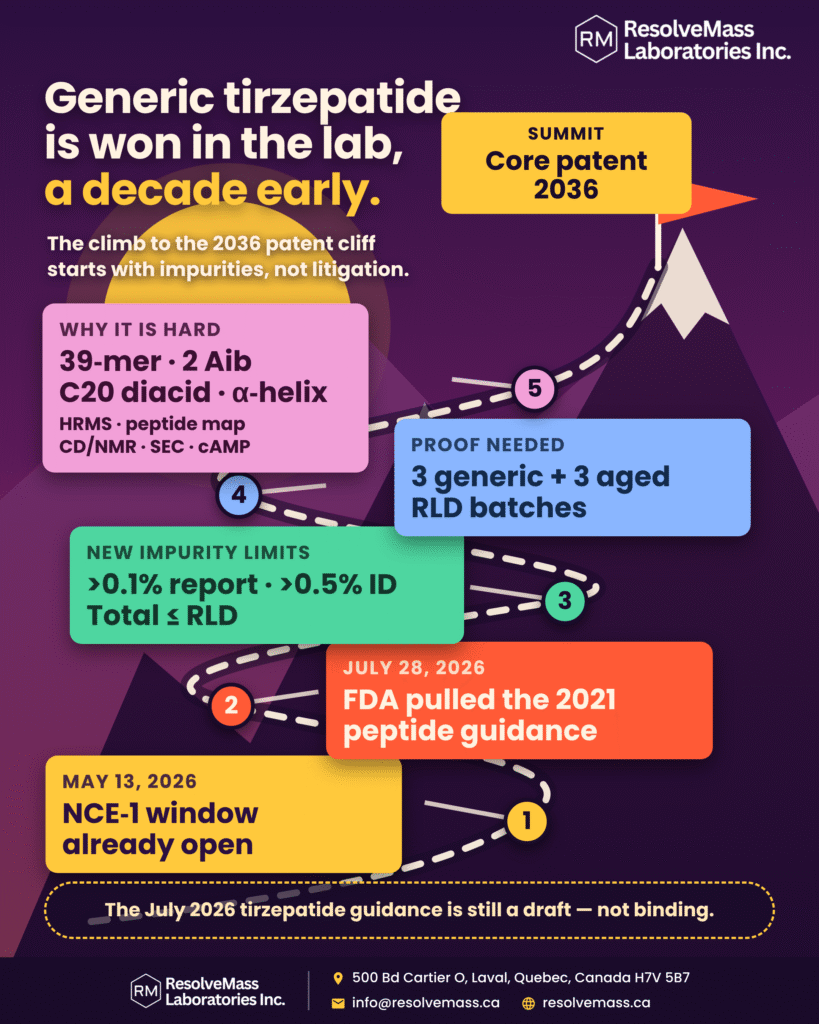
Launching a successful Generic Tirzepatide ANDA requires comprehensive peptide impurity profiling and orthogonal analytical method development to begin nearly a decade before the May 13, 2036, core patent expiration. Although Eli Lilly’s dual GIP/GLP-1 receptor agonist, marketed as Mounjaro (NDA 215866) and Zepbound (NDA 217806), retains primary compound protection into the mid-2030s, the New Chemical Entity minus one year (NCE-1) challenge window opened on May 13, 2026. Two months later, on July 28, 2026, the U.S. Food and Drug Administration (FDA) reset regulatory expectations by withdrawing its 2021 synthetic peptide guidance and publishing a revised draft Product-Specific Guidance (PSG) for tirzepatide. Sponsors that delay comprehensive structural characterization, custom impurity standard synthesis, and multi-year aged Reference Listed Drug (RLD) comparability studies risk missing first-wave filing opportunities or receiving regulatory deficiencies because of unresolved trace variants.
Unlike conventional small molecules, tirzepatide is a 39-amino-acid lipidated peptide engineered with two non-coded α-aminoisobutyric acid (Aib) residues and a C20 fatty diacid side chain. Securing an in vivo bioequivalence waiver through analytical sameness requires simultaneous evidence of primary sequence identity, trace-level impurity parity, higher-order conformational matching, and functional biological activity across at least three generic batches and three aged RLD batches. Developing this comprehensive evidentiary package under modern ICH Q14 and ICH Q2(R2) analytical lifecycle principles is inherently a multi-year scientific undertaking.
Share via:
Quick Summary:
- A 2036 deadline means work starts now. Tirzepatide’s core substance patent (US 9,474,780) runs to 2036, with formulation and dosing patents into 2039 and a potency-ratio method patent to 2041 — but the NCE-1 filing window opened May 13, 2026, and NCE exclusivity ends May 13, 2027, so analytical groundwork has to begin roughly a decade before launch.
- The July 2026 FDA peptide reset changed the rulebook. On July 28, 2026 the FDA withdrew its May 2021 synthetic-peptide ANDA guidance and issued 17 revised draft product-specific guidances, including tirzepatide. Programs built on the old framework need to be re-justified against the new one.
- The new impurity thresholds are explicit. Active ingredient-related impurities must be reported above 0.1% and structurally identified above 0.5%. A shared impurity may not exceed the RLD level or 1.0%, whichever is greater; new impurities should be kept below 1.0%; and total impurities must not exceed the RLD’s.
- Comparability needs aged material, not fresh batches. The PSG asks for at least three generic batches tested at or near release and at end of proposed shelf life, against at least three RLD batches aged before expiry under worst-case labelled storage — which alone takes years to assemble.
- The molecule itself is analytically hostile. A 39-amino-acid peptide with Aib at positions 2 and 13, a C20 fatty diacid on Lys20 and a C-terminal amide (~4813.5 Da) produces deletion sequences, substitutions, epimers, deamidation, isoAsp isomers and Trp oxidation — many of which hide under the parent peak, so UV chromatograms alone can’t prove specificity.
- Higher-order structure and aggregation must be matched early. Tirzepatide is predominantly α-helical and self-associates, so CD, FTIR, 1D/2D NMR, SEC and AUC parity plus a dual-receptor cAMP bioassay are needed; aggregation differences can also pull in in vitro innate immune response testing.
- Sequencing matters more than speed. Build a PSG requirements matrix, run forced degradation and synthesize authentic impurity standards, validate stability-indicating UHPLC-HRMS and peptide mapping under ICH Q14 and Q2(R2), lock in E&L, elemental and residual solvent controls, then start pivotal stability — ideally under one integrated analytical provider to avoid method-transfer and reference-standard mismatches.
Why Does Generic Tirzepatide ANDA Development Require a Long Runway Before 2036?
A Generic Tirzepatide ANDA requires several years of analytical preparation because the FDA’s comparative stability design calls for testing batches through the end of their proposed shelf life against aged RLD lots. At the same time, overlapping formulation and dosing patents extend into 2039 and 2041. Under the revised July 2026 draft Tirzepatide PSG, applicants cannot depend exclusively on release testing of freshly manufactured drug product. Instead, they must generate comparative characterization data from at least three generic batches tested at or near release and again at the end of the proposed shelf life, together with at least three RLD batches aged before expiry under worst-case labeled storage conditions.
From a November 2026 perspective, the regulatory and intellectual property timelines are already underway. Mounjaro’s five-year NCE exclusivity remains in effect through May 13, 2027, while its NCE-1 Paragraph IV filing eligibility began on May 13, 2026. Earlier attempts by compounding and pharmaceutical challengers to invalidate the core drug substance patent (U.S. Patent No. 9,474,780) through Inter Partes Review (IPR) petitions filed in May and August 2025 received discretionary denials from the Patent Trial and Appeal Board (PTAB), according to patent intelligence databases. Consequently, prospective ANDA sponsors must navigate a layered patent estate covering twelve distinct dosage strengths, ranging from 2.5 mg/0.5 mL single-dose presentations to 60 mg/2.4 mL multi-dose pens. Formulation design-arounds, autoinjector human factors comparability, and real-time stability requirements will all influence the timing of market entry.
| Milestone or Patent Asset | Identifier / Reference | Key Date (as of Nov 2026) | Strategic Impact on Generic Tirzepatide ANDA |
|---|---|---|---|
| NCE-1 Filing Eligibility | NDA 215866 / NDA 217806 | May 13, 2026 | Opens eligibility for Paragraph IV ANDA submissions challenging Orange Book patents |
| NCE Exclusivity Expiry | Mounjaro / Zepbound | May 13, 2027 | Statutory restriction preventing generic approval ends five years after initial NDA approval |
| New Patient Population (NPP) Exclusivity | Mounjaro | December 19, 2028 | Restricts generic labeling for covered patient populations until expiry |
| Autoinjector Device Patents | Delivery device mechanisms | February–June 2031 | Influences drug-device combination engineering and comparative human factors design |
| Core Drug Substance Patent | US 9,474,780 | May 13, 2036 | Protects the tirzepatide active ingredient; 2025 PTAB IPR petitions received discretionary denials |
| Formulation & Composition Patents | US 11,357,820; US 12,453,755; US 12,453,756; US 12,629,404 | June 14, 2039 | Covers NaCl, dibasic sodium phosphate, pH 6.5–7.5, and preservative-free or phenol compositions |
| Dosing Regimen Patents | US 12,343,382; US 12,616,740 | July 22, 2039 | Protects step-wise 2.5 mg weekly titration regimens up to 15 mg |
| Potency-Ratio Method Patent | US 12,295,987 | December 30, 2041 | Claims GIP:GLP-1 potency ratios determined through a casein cAMP assay across four-dose regimens |
Obtaining multiple commercial RLD lots with staggered expiry dates, storing them under worst-case labeled conditions, and conducting full shelf-life stability studies on three registration batches require several years before an ANDA dossier can be finalized. Furthermore, isolating and structurally identifying low-level degradants that appear only near RLD expiry requires validated orthogonal analytical infrastructure well before pivotal GMP batch synthesis begins.
Establish a formulation strategy that addresses peptide stability, composition, and product performance from the beginning of development.
Explore formulation development for generic drug development
How Did the July 2026 FDA Peptide Reset Redefine Generic Tirzepatide ANDA Expectations?
On July 28, 2026, the FDA withdrew its May 2021 guidance on synthetic peptides referencing recombinant listed drugs and issued 17 revised draft PSGs. This established a unified scientific framework for Generic Tirzepatide ANDA development, irrespective of whether the API is manufactured synthetically, semi-synthetically, or recombinantly. Although the FDA indicated that it intended to publish a replacement umbrella guidance later in 2026, the revised draft Tirzepatide PSG, initially recommended in November 2025 and updated in July 2026, outlines the agency’s current regulatory expectations. Public comments closed on September 28, 2026. While draft PSGs are not legally binding, deviations from their recommendations generally invite closer scrutiny from the Office of Generic Drugs (OGD).
Under this revised framework, OGD assesses peptide ANDAs through five interconnected scientific areas: manufacturing route eligibility under section 505(j), numerical limits for active ingredient-related impurities, higher-order structure (HOS) comparability, functional biological activity, and control of innate immune response risks. Development programs that previously used the withdrawn 2021 guidance to support simplified testing strategies must reassess and substantiate those approaches against the July 2026 PSG requirements. For autoinjector presentations, the PSG also links chemical sameness requirements with the FDA’s comparative analyses and comparative use human factors guidance for drug-device combination products.
| Impurity Category (July 2026 Draft PSG) | Numeric Limit (% of Drug Substance) | Regulatory Action & Control Expectation |
|---|---|---|
| Reporting Threshold | Above 0.1% | All active ingredient-related impurities exceeding 0.1% must be reported and included in the total impurity calculation |
| Identification Threshold | Above 0.5% | Structural characterization and identification are required for impurities exceeding 0.5% |
| Common Impurities (Generic & RLD) | ≤ RLD level or ≤ 1.0% (whichever is greater) | Process controls should minimize impurity levels relative to aged RLD batches |
| New Impurities (Generic Only) | Strive for below 1.0% | Manufacturing and control strategies should reduce these impurities; levels above 1.0% trigger scientific review |
| Total Active Ingredient-Related Impurities | ≤ Total found in RLD | The combined level of impurities above 0.1%, including newly identified species, should not exceed the total observed in aged RLD batches |
| Host Cell-Related Impurities | Process-specific / Compendial | Required only for recombinant manufacturing routes, including host cell proteins and residual DNA |
Although the July 2026 draft PSG allows an ANDA to be submitted when a new or elevated common impurity exceeds the specified numerical thresholds, such cases undergo dedicated scientific review. The sponsor must provide a mechanistic justification demonstrating that the impurity does not introduce differences in safety or efficacy compared with the RLD. In practical terms, development programs can reduce the likelihood of regulatory deficiencies by optimizing upstream synthesis and downstream purification to maintain new variants below the 0.5% identification threshold and keep total impurities at or below the aged RLD baseline.
Build a defensible regulatory strategy with analytical evidence and documentation aligned with generic drug submission requirements.
Review regulatory support for generic drug development
What Makes Tirzepatide Impurity Profiling Analytically Complex?
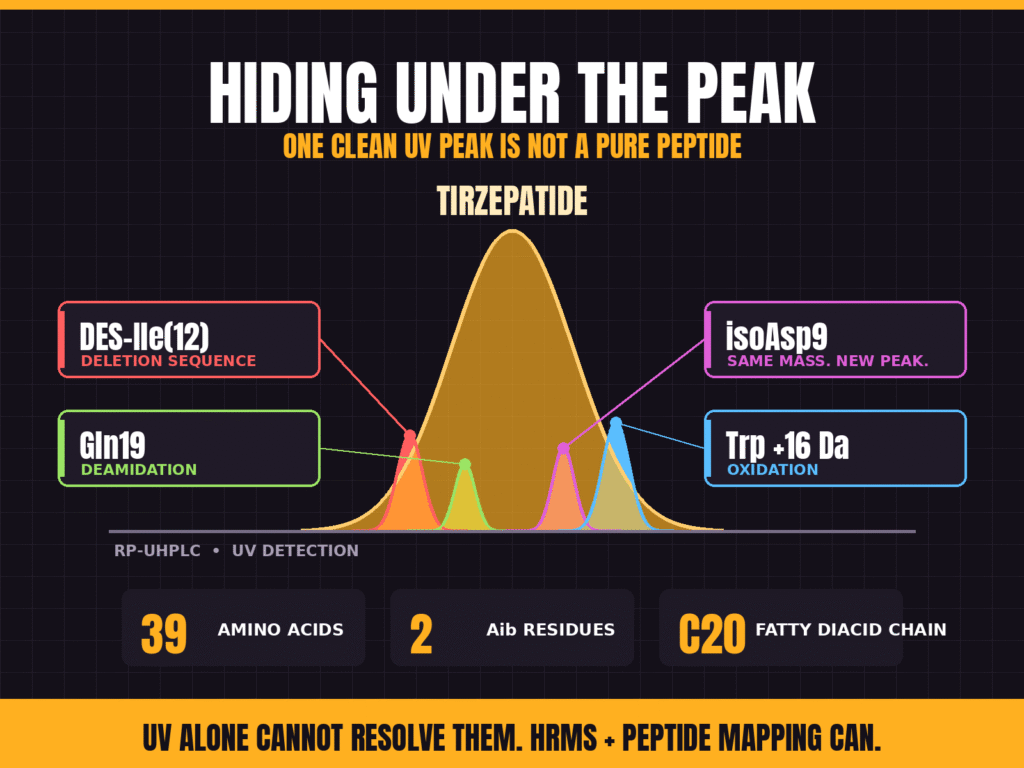
Tirzepatide impurity profiling presents substantial analytical challenges because its 39-amino-acid backbone combines sterically hindered Aib residues with a lipophilic C20 fatty diacid side chain. This combination affects chromatographic retention, can conceal co-eluting variants, and produces complex multi-charge-state mass spectra. Structurally, tirzepatide contains 37 natural amino acids, Aib residues at positions 2 and 13, an amidated C-terminal serine, and a Lys(Nε-AEEA-AEEA-γGlu-20-carboxyicosanoyl) moiety at position 20. Its monomeric molecular weight is approximately 4813.5 Da. According to industry laboratory testing guides, the C20 acyl chain considerably increases hydrophobicity compared with unmodified peptides. This can cause peak tailing and allow minor sequence variants to co-elute beneath the parent API peak during conventional reversed-phase UV analysis.
Identify and quantify peptide-related impurities using orthogonal analytical techniques and targeted characterization methods.
Discover analytical services for generic drug development
Synthesis-Derived Impurities in Hybrid SPPS/LPPS Generic Tirzepatide ANDA Programs
Commercial-scale tirzepatide manufacturing primarily uses convergent hybrid solid-phase and liquid-phase peptide synthesis (SPPS/LPPS). Emerging alternatives include orthogonal strategies such as native chemical ligation and hydrophobic-tag-assisted LPPS. These manufacturing approaches can generate site-specific deletion sequences, amino acid substitutions, and stereochemical epimers, all of which present analytical challenges for a Generic Tirzepatide ANDA. Pure linear SPPS of a 39-mer lipidated peptide is associated with low yields, difficult precipitation steps, and challenges in meeting specifications at kilogram scale. These limitations have encouraged the adoption of fragment-condensation approaches combined with nanofiltration or selective dual-protection strategies.
Each synthetic approach produces a characteristic impurity profile. Sterically congested coupling reactions near Aib2 and Aib13 increase the likelihood of incomplete amino acid incorporation. Recent process chemistry literature also indicates that Fmoc α-substituted amino acid building blocks may introduce reactive ene and epoxide impurities. One documented analytical benchmark is the deletion impurity Des-Ile(12)-Tirzepatide (4700.29 Da), which occurs immediately adjacent to Aib13. A Sigma-Aldrich technical application note demonstrated that separating Des-Ile(12) from parent tirzepatide requires superficially porous particle (SPP) 160 Å peptide C18 columns operated at 60 °C. This setup achieved baseline resolution (Rs = 2.9), with peak tailing factors of 1.3 for tirzepatide and 1.1 for the impurity, both within European Pharmacopoeia acceptance criteria (below 1.8).
Trace contamination in raw materials can also introduce amino acid substitutions, such as norvaline replacing isoleucine (ILE12NVA). Similarly, base-promoted activation during fragment ligation can result in epimerization, including D-Ser32, as documented by commercial peptide reference-standard suppliers. Additionally, preparative reversed-phase purification commonly introduces trifluoroacetic acid (TFA) counter-ions. Research on synthetic peptides indicates that residual TFA salts can cause substantial cytotoxicity in cellular assays. Therefore, rigorous salt exchange into pharmaceutically acceptable acetate or sodium forms is necessary before conducting bioassay comparability studies.
Improve peptide manufacturing consistency by addressing synthesis, purification, and scale-dependent process challenges.
Learn about manufacturing scale-up for generic drugs
Forced Degradation Pathways and Co-Eluting Adducts
During real-time storage and accelerated stress testing, tirzepatide undergoes degradation through glutamine deamidation, aspartate isomerization, and tryptophan oxidation. These pathways generate closely related or isobaric species that require high-resolution mass spectrometry (HRMS) and enzymatic peptide mapping for accurate identification. USP workshops on therapeutic peptides and industry laboratory testing guides highlight that fragment-related impurities can co-elute directly beneath the primary UV peak. Therefore, stability-indicating specificity cannot be established using UV chromatograms alone.
- Glutamine and C-Terminal Deamidation: Hydrolytic degradation at glutamine residues can produce Gln19 (Q19) deamidation, Gln24 (Q24) deamidation, and C-terminal deamidated species. These modifications alter the local charge environment and chromatographic retention profile during product aging.
- Isoaspartate (isoAsp) Formation: Rearrangement at aspartic acid residues can generate L-isoAsp9 and L-isoAsp15 variants. These are isobaric isomers with no net change in molecular mass and therefore require optimized chromatographic selectivity and LC-MS/MS peptide mapping against authentic reference standards for confirmation.
- Tryptophan Oxidation: Accelerated oxidative stress can convert the tryptophan residue into mono-oxidized tirzepatide (+16 Da; reported at m/z 1208.1 for the 5+ charge state in industry LC-MS testing). This modification changes the molecule’s polarity and must be monitored through forced-degradation studies.
- Formulation and Process Adducts: During the 2022–2025 drug shortage period, the FDA received more than 320 adverse event reports associated with compounded tirzepatide as of early 2025. Independent testing summarized in laboratory quality guides also identified potency discrepancies and an unexpected tirzepatide-vitamin B12 covalent adduct. These findings demonstrate how insufficiently monitored reactive excipients can compromise product integrity.
| Impurity Class | Specific Tirzepatide Variant Examples | Origin / Mechanism | Primary Analytical & Orthogonal Tools |
|---|---|---|---|
| Deletion Sequences | Des-Ile(12)-Tirzepatide (4700.29 Da) | Incomplete coupling near sterically hindered Aib13 during SPPS/LPPS | Heated SPP C18 UHPLC-UV (Rs ≥ 2.0), UHPLC-HRMS (QTof) |
| Amino Acid Substitutions | ILE12NVA (norvaline for Ile) | Trace amino acid impurities in Fmoc building blocks | LC-MS/MS peptide mapping, high-resolution accurate mass MS |
| Stereochemical Racemization | D-Ser32 epimer | Epimerization during synthesis or fragment coupling | Chiral / chromatographic separation, LC-MS/MS peptide mapping |
| Deamidation Products | Gln19, Gln24, C-terminal deamidation | Hydrolytic aging in aqueous formulations (pH 6.5–7.5) | High-resolution RP-UHPLC, LC-MS/MS peptide mapping |
| Isomerization Products | L-isoAsp9, L-isoAsp15 | Aspartic acid rearrangement during aging or stress (isobaric) | Enzymatic digest LC-MS/MS peptide mapping with reference standards |
| Oxidative Degradation | Mono-oxidized Trp (+16 Da, m/z 1208.1 at 5+) | Oxidative stress during manufacturing or storage | UHPLC-QTof HRMS, stability-indicating RP-UHPLC |
| Aggregates / HMWs | Dimers, trimers (~13,000 Da), hexamers, fibrils | C20 fatty acyl-driven self-association and physical aging | SEC, AUC, Far-UV CD, FTIR |
Characterize peptide degradation products and establish reliable impurity identification strategies through targeted mass spectrometry.
Explore peptide mapping approaches for biosimilar characterization
Why Must Higher-Order Structure, Self-Association, and Innate Immunogenicity Be Mapped Early?
Higher-order structure (HOS), self-association equilibria, and aggregation profiles must be investigated early because tirzepatide adopts a predominantly α-helical conformation, while its C20 fatty diacid chain promotes concentration-dependent oligomerization. These characteristics directly influence physical stability, biological activity, and innate immune response risks. Under the July 2026 draft Tirzepatide PSG, an ANDA sponsor may justify omitting biological activity assays only when the formulated peptide does not exhibit functional secondary or higher-order structure. Tirzepatide cannot qualify for this exemption because its α-helical architecture is well established.
Biophysical investigations of lipidated GLP-1 analogues indicate that fatty acid conjugation restricts aqueous solubility to specific pH ranges, increases α-helical secondary structure by approximately 10%–20%, and promotes rapid self-assembly into oligomers above a critical aggregation concentration. A single, uniform oligomeric species generally provides the greatest physical stability. In contrast, the presence of heterogeneous oligomeric states, including dimers, trimers (~13,000 Da in industry SEC testing), and hexamers, can accelerate structural transitions into amorphous aggregates or mature elongated fibrils over time. Importantly, even minor variations in residual solvents, counter-ions, pH, or preservative composition can shift this conformational equilibrium without producing detectable changes in conventional RP-HPLC purity results.
Therefore, an ANDA comparability package must include orthogonal biophysical characterization performed side by side on three generic batches and three aged RLD batches. Far-UV Circular Dichroism (CD), which monitors mean residue ellipticity at 222 nm (MRE222), and Fourier-Transform Infrared (FTIR) spectroscopy are used to evaluate secondary helical parity. High-field 1D and 2D Nuclear Magnetic Resonance (NMR) provides residue-specific conformational fingerprinting of the Aib-rich lipidated chain in solution. Meanwhile, Size-Exclusion Chromatography (SEC) and Analytical Ultracentrifugation (AUC) quantify soluble oligomers and high-molecular-weight species (HMWS), which industry laboratory guides typically benchmark below 2% at release.
These conformational measurements are directly relevant to bioactivity and immunogenicity waiver considerations. Tirzepatide activates both GIP and GLP-1 receptors, stimulating intracellular cAMP signaling through Protein Kinase A and EPAC pathways. Consequently, comparative ligand-binding studies or cell-based cAMP bioassays are necessary to demonstrate functional parity. These studies also provide relevant information for freedom-to-operate assessments involving Orange Book potency-ratio claims, including U.S. Patent No. 12,295,987.
Equally important, the July 2026 PSG states that in vitro innate immune response testing may be omitted only when two conditions are satisfied. First, non-active ingredient-related impurities, including particulates, microbial contaminants, residual organic solvents, elemental impurities, and leachables, must meet applicable compendial and toxicological limits. Second, the aggregation profiles must be comparable to those of the RLD. Any differences in HMWS identified during late-stage shelf-life stability studies can necessitate additional in vitro immunogenicity testing and potentially disrupt the filing schedule.
Generate detailed molecular characterization data to support structural and physicochemical comparability assessments.
See biosimilar characterization using mass spectrometry
How Should Sponsors Sequence Analytical Groundwork Under ICH Q14 and Q2(R2)?
Sponsors should organize their analytical development activities by establishing an Analytical Target Profile (ATP) under ICH Q14 and validating stability-indicating procedures under ICH Q2(R2) several years before GMP registration batches are placed in stability chambers. Peptide analytical methods must address additional challenges, including labware surface adsorption, solubility limitations, and co-eluting fragments. They must also demonstrate reliable detection and quantification at levels as low as 0.1% w/w. Furthermore, ICH Q2(R2) requires the application of a correction factor whenever an impurity’s relative response factor (RRF) falls outside the 0.8–1.2 range, unless the impurity is overestimated. Consequently, successful method validation depends on having well-characterized authentic impurity standards available in advance.
- Build a Traceable PSG Requirements Matrix: Extract and organize every recommendation from the July 2026 draft Tirzepatide PSG, covering drug substance, drug product, aged RLD batches, and autoinjector device comparability. This matrix should establish clear analytical requirements, acceptance criteria, and documentation responsibilities for each development stage.
- Conduct Forced Degradation and Custom Impurity Synthesis: Subject RLD and synthetic API batches to forced-degradation conditions to identify degradation pathways, investigate peaks above 0.1% through HRMS, and synthesize authentic reference standards. These should include Des-Ile(12), Gln19/Gln24 deamidated variants, L-isoAsp9/15, D-Ser32, ILE12NVA, and mono-oxidized Trp. Quantitative NMR (qNMR) should be used to verify the purity of synthesized standards.
- Validate Stability-Indicating UHPLC-HRMS and Peptide Mapping: Optimize heated SPP peptide C18 chromatographic separations and LC-MS/MS peptide mapping methods across ICH Q14 robustness parameters, including column lot, buffer pH, temperature, flow rate, and extraction conditions. Verify RRF correction factors, linearity, and repeatability in accordance with ICH Q2(R2).
- Establish HOS, Aggregation, and cAMP Bioassay Parity: Apply Far-UV CD, FTIR, 2D NMR, SEC, AUC, and dual-receptor cAMP potency assays to early development batches and aged RLD cohorts. This approach helps identify conformational changes and oligomeric drift before commercial scale-up.
- Lock In Compendial Non-Active Impurity Controls: Complete extractables and leachables (E&L) profiling under USP /, elemental impurity assessment under ICH Q3D, and residual solvent testing under USP /ICH Q3C. These studies support the justification for omitting in vitro innate immune response testing when all applicable requirements are satisfied.
- Initiate Pivotal Stability and OGD Engagement: Conduct release and end-of-shelf-life testing on three generic batches against three worst-case aged RLD batches. Use FDA PSG teleconferences or controlled correspondence to obtain early alignment on the scientific justification for any impurity exceeding the 0.5%–1.0% range.
Demonstrate analytical similarity using complementary LC-MS techniques and well-designed comparative testing strategies.
Explore how LC-MS can support biosimilarity assessment
Dividing this multi-year workflow among separate synthesis facilities, mass spectrometry vendors, and compendial testing laboratories can frequently result in method-transfer difficulties and inconsistent reference-standard characterization. Working with a single PhD-led analytical CDMO, such as ResolveMass Laboratories Inc., which operates an integrated facility in Laval, Québec, with a Health Canada GMP Drug Establishment Licence, FDA Registration (Establishment ID: 3042696771), and ISO 9001:2015 certification, can consolidate these activities within one analytical framework. Its integrated capabilities include custom forced-degradation impurity synthesis, HRMS structural elucidation, LC-MS/MS peptide mapping, 1D/2D qNMR, SEC, thermal analysis (DSC/TGA), and USP/ICH E&L and residual solvent testing. Conducting these activities under strict NDAs and unified data integrity practices supports consistent analytical characterization and documentation throughout development.
Compare generic and reference products using an integrated analytical approach that supports evidence-based development decisions.
Review comparative testing between generic and RLD products
Conclusion
Achieving approval for a Generic Tirzepatide ANDA is fundamentally a multi-year exercise in analytical chemistry and structural characterization rather than a last-minute effort focused solely on patent challenges. With the May 13, 2026, NCE-1 window already open and the July 2026 FDA Peptide Reset establishing stringent requirements for 0.1% reporting thresholds, 0.5% identification thresholds, higher-order conformational parity, and three-batch aged RLD comparisons, delaying the development of tirzepatide impurity libraries and ICH Q14/Q2(R2)-validated analytical methods until the 2030s could jeopardize first-wave filing opportunities. Organizations that establish authentic impurity standards, orthogonal HRMS/NMR characterization, and comprehensive biophysical comparability programs at an early stage will be better positioned to enter the 2036–2041 patent-expiry window with regulatory-ready CMC dossiers.
To discuss custom tirzepatide impurity synthesis, peptide sameness studies, or ICH-aligned analytical development for your ANDA program, connect directly with our scientific team through our Contact Us page.
Frequently Asked Questions
On July 28, 2026, the FDA withdrew its May 2021 guidance, ANDAs for Certain Highly Purified Synthetic Peptide Drug Products That Refer to Listed Drugs of rDNA Origin, because the recommendations no longer adequately represented evolving scientific and regulatory expectations. The agency also released 17 revised draft Product-Specific Guidances (PSGs), including one for tirzepatide. A replacement regulatory framework was also planned for publication later in 2026.
The July 2026 draft Tirzepatide PSG establishes a reporting threshold above 0.1% and an identification threshold above 0.5% of the drug substance. Common impurities should remain at or below the RLD concentration or 1.0%, whichever is higher, while newly introduced generic-only impurities should be controlled below 1.0%. Additionally, the combined active ingredient-related impurities exceeding 0.1% should not surpass the total impurity level observed in aged RLD batches.
The FDA recommends evaluating at least three batches of the proposed generic drug product and three batches of the Reference Listed Drug (RLD). Generic batches should undergo comparative testing at or near release and again at the end of their proposed shelf life. The RLD batches must be aged before expiry under worst-case labeled storage conditions to establish a meaningful comparison of product quality and stability.
Several closely related impurities can be difficult to distinguish, particularly Des-Ile(12)-Tirzepatide (4700.29 Da) and the amino acid substitution variant ILE12NVA near the sterically hindered Aib13 residue. Other challenging species include L-isoAsp9 and L-isoAsp15 isomers, Gln19/Gln24 deamidated variants, D-Ser32 epimers, and mono-oxidized tryptophan (+16 Da). Their identification requires sensitive chromatographic separation supported by orthogonal techniques such as HRMS and LC-MS/MS peptide mapping.
Yes, an in vivo bioequivalence waiver may be justified when comprehensive comparative evidence establishes sufficient sameness between the generic product and the RLD. This assessment includes physicochemical properties, primary sequence, impurity profiles, higher-order structure, and relevant functional biological activity. The resulting data must adequately support the conclusion that both products are expected to produce equivalent clinical effects and safety outcomes under their labeled conditions.
Tirzepatide has a predominantly α-helical secondary structure, and its C20 fatty diacid side chain contributes to concentration-dependent self-association and oligomer formation. These structural characteristics influence product stability, aggregation behavior, and biological activity. Therefore, the July 2026 draft PSG recommends comparative HOS assessment using complementary analytical methods, including Far-UV CD, FTIR, NMR, SEC, and AUC, to establish structural comparability with the RLD.
According to the July 2026 draft Tirzepatide PSG, in vitro innate immune response testing may be unnecessary when specific quality requirements are fulfilled. Non-active ingredient-related impurities, including particulate matter, microbial contaminants, residual organic solvents, elemental impurities, and leachables, must comply with applicable compendial and toxicological limits. Additionally, the generic product’s aggregation profile must demonstrate comparability with the RLD.
Tirzepatide activates both GIP and GLP-1 receptors, stimulating intracellular cAMP signaling and making cell-based cAMP assays important for evaluating comparative biological activity. These assays help establish functional equivalence when the peptide exhibits relevant higher-order structure. They also support patent-related assessments because Eli Lilly’s Orange Book patent US 12,295,987, expiring December 30, 2041, covers specific GIP:GLP-1 potency ratios determined using a casein cAMP assay.
Independent investigations conducted during the 2022–2025 tirzepatide shortage identified potency inconsistencies and unexpected chemical species, including a tirzepatide-vitamin B12 covalent adduct. Additionally, the FDA recorded more than 320 adverse event reports associated with compounded tirzepatide by early 2025. These findings highlight the importance of comprehensive quality assessments using LC-HRMS, NMR, forced-degradation studies, and other orthogonal analytical techniques during generic product development.
Reference:
- U.S. Food and Drug Administration. Draft Guidance on Tirzepatide (PSG_217806.pdf), Revised July 2026: https://www.accessdata.fda.gov/drugsatfda_docs/psg/PSG_217806.pdf
- U.S. Food and Drug Administration. Approved Drug Products Patent & Exclusivity Records: https://www.fda.gov/media/166048/download
- U.S. Food and Drug Administration. NDA 215866 (Mounjaro) Summary Review: https://www.accessdata.fda.gov/drugsatfda_docs/nda/2022/215866Orig1s000SumR.pdf
- U.S. Food and Drug Administration. NDA 217806 Pharmacology Review: https://www.accessdata.fda.gov/drugsatfda_docs/nda/2024/217806Orig1s000PharmR.pdf
- International Council for Harmonisation (ICH). ICH Q2(R2) Validation of Analytical Procedures, November 2023: https://database.ich.org/sites/default/files/ICH_Q2(R2)_Guideline_2023_1130.pdf
- International Council for Harmonisation (ICH). ICH Q2(R2)/Q14 Training Module 3, July 2025: https://database.ich.org/sites/default/files/ICH_Q2%28R2%29Q14_TrainingMat_Module_3_2025_0620.pdf
- U.S. Pharmacopeia (USP). Quantitation of Impurities in Tirzepatide Peptide Fragments: https://www.usp.org/events-training/course/quantitation-impurities-tirzepatide-peptide-fragments-high-resolution-ultra
Get In Touch With Us
About The Author