


Introduction
Bioanalytical CRO services for PK and TK are fundamental to modern drug development, providing the analytical backbone that determines how compounds behave in biological systems. In today’s competitive pharmaceutical landscape, sponsors increasingly rely on specialized partners such as a dedicated bioanalytical CRO to advance therapeutic candidates efficiently while maintaining the highest quality standards.
The pharmaceutical and biotechnology industries depend on advanced PK/PD bioanalysis to evaluate absorption, distribution, metabolism, and excretion (ADME), alongside toxicokinetic bioanalysis that establishes exposure–toxicity relationships during preclinical safety studies. These capabilities are central to bioanalytical services in drug development and form a critical component of IND and NDA submissions.
At ResolveMass Laboratories Inc., our integrated portfolio of bioanalytical services ensures that every analysis contributes meaningfully to development timelines while delivering accurate, reproducible, and regulator-trusted data.
Summary
- Bioanalytical CRO services for PK and TK generate critical exposure, safety, and dose–response data required for regulatory decision-making.
- PK, TK, and biomarker bioanalysis (https://resolvemass.ca/biomarker-bioanalytical-services/) directly influence dose selection, safety margins, and clinical success.
- Outsourcing to a specialized partner offering bioanalytical outsourcing (https://resolvemass.ca/bioanalytical-outsourcing/) ensures validated methods, regulatory compliance, and data integrity.
- Integrated PK, TK, and biomarker strategies reduce timelines and improve scientific confidence.
- ResolveMass Laboratories Inc. delivers regulatory-ready bioanalysis across preclinical and clinical bioanalytical services (https://resolvemass.ca/clinical-bioanalytical-services/).
1: What Are Bioanalytical CRO Services for PK, TK, and Biomarker Studies?
Bioanalytical CRO services for PK and TK involve the quantitative measurement of drugs, metabolites, and biomarkers in biological matrices to support pharmacokinetic, toxicology, and clinical studies. These activities are performed within regulated bioanalytical laboratory services.
These services typically include:
- Method development and optimization
- Bioanalytical method validation
- Sample analysis under GLP and GCP
- Data processing and quality control
- Regulatory documentation and reporting
Core Study Types Supported
- Pharmacokinetic (PK) studies
- Toxicokinetic (TK) studies
- Biomarker and pharmacodynamic (PD) studies
ResolveMass Laboratories Inc. provides integrated support across all three, ensuring analytical continuity and scientific coherence.
Scope of Bioanalytical CRO Services for PK and TK
Bioanalytical CRO services span discovery through late-stage development, supporting both exploratory research and regulated bioanalytical services.
At the core is high-quality bioanalytical quantification across matrices such as plasma, serum, whole blood, urine, tissue homogenates, CSF, and special matrices. Advanced platforms such as LC-MS/MS bioanalysis of xenobiotics and high-throughput bioanalysis enable precise and scalable analysis.
Quantitative Measurement in Biological Matrices
At the core of bioanalytical CRO services for PK and TK is the precise quantification of analytes in complex biological matrices, including:
- Plasma and serum
- Whole blood
- Urine and feces
- Tissue homogenates
- Cerebrospinal fluid (CSF)
- Special matrices (e.g., synovial fluid, bile)
These measurements are critical for understanding systemic exposure, distribution patterns, clearance mechanisms, and biological effects of investigational compounds.
2: Pharmacokinetic (PK) Bioanalysis: Measuring Drug Exposure
PK bioanalysis determines the extent and duration of systemic drug exposure and is essential for dose selection, bioavailability assessments, and drug–drug interaction evaluation. ResolveMass supports both small- and large-molecule bioanalysis using fit-for-purpose strategies.
Generated parameters include Cmax, Tmax, AUC, half-life, clearance, and volume of distribution, supporting sponsors utilizing bioanalytical services outsourcing for pharma.
Key PK Parameters Generated
- Cmax (maximum concentration)
- Tmax (time to Cmax)
- AUC (area under the curve)
- Half-life (t½)
- Clearance and volume of distribution
Why PK Bioanalysis Is Critical
- Guides first-in-human dose selection
- Supports dose proportionality studies
- Enables bioavailability and bioequivalence assessments
- Informs drug–drug interaction risk
Biological Matrices Commonly Analyzed
- Plasma and serum
- Whole blood
- Urine
- Cerebrospinal fluid
- Tissue homogenates
ResolveMass Laboratories Inc. applies advanced LC-MS/MS platforms to deliver high sensitivity and selectivity for PK bioanalysis, even at trace concentration levels.
3: Toxicokinetic (TK) Bioanalysis: Linking Exposure to Safety
Toxicokinetic bioanalysis correlates systemic exposure with toxicological findings in nonclinical studies. Regulators rely on TK data to establish safety margins, accumulation trends, and NOAEL determinations.
All TK programs are conducted under GLP conditions, supporting submissions across bioanalytical services in North America and globally.
Why TK Bioanalysis Is a Regulatory Requirement
Regulators expect TK data to:
- Confirm exposure at toxic dose levels
- Establish safety margins
- Support NOAEL and MTD determinations
- Identify accumulation trends
TK Bioanalysis Typically Supports
- Repeat-dose toxicity studies
- Genotoxicity and carcinogenicity studies
- Reproductive and developmental toxicity studies
Bioanalytical CRO services for PK and TK must be conducted under strict GLP conditions for toxicology programs. ResolveMass Laboratories Inc. ensures full compliance, traceability, and audit readiness.
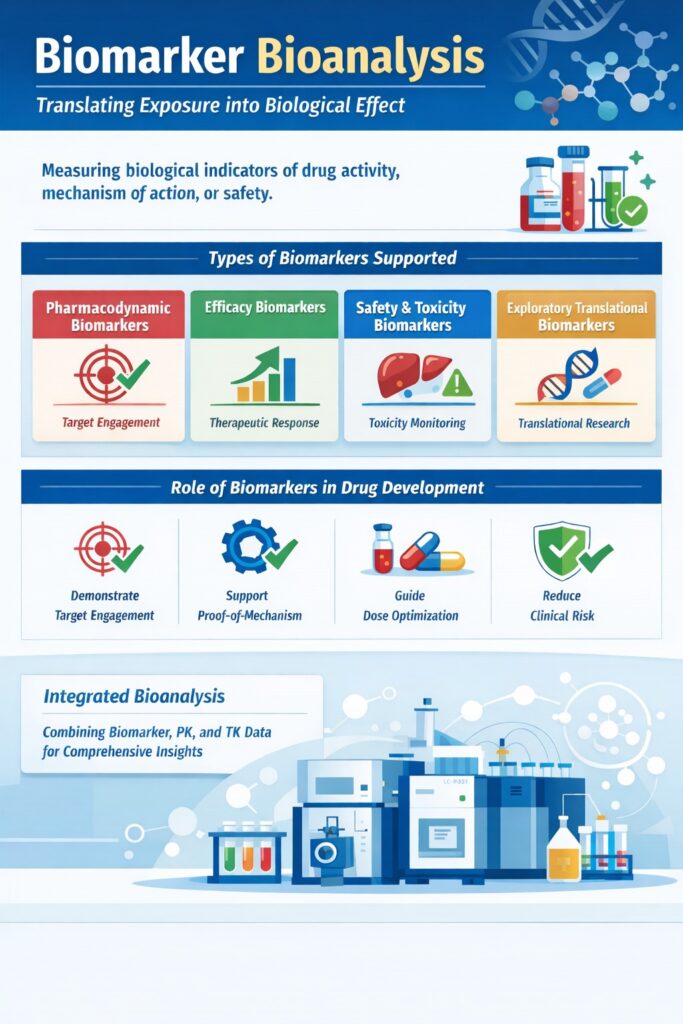
4: Biomarker Bioanalysis: Translating Exposure into Biological Effect
Biomarker bioanalysis measures biological indicators that reflect drug activity, mechanism of action, efficacy, or safety. This includes pharmacodynamic, efficacy, safety, and exploratory translational biomarkers.
Types of Biomarkers Supported
- Pharmacodynamic biomarkers
- Efficacy biomarkers
- Safety and toxicity biomarkers
- Exploratory translational biomarkers
Role of Biomarkers in Drug Development
- Demonstrate target engagement
- Support proof-of-mechanism
- Guide dose optimization
- Reduce late-stage clinical risk
ResolveMass integrates biomarker data with PK and TK findings, supporting programs involving large-molecule bioanalysis, cell and gene therapy bioanalysis, and biosimilar bioanalysis.
5: Integrated Bioanalytical CRO Services for PK and TK: A Strategic Advantage
Integrated bioanalytical CRO services unify PK, TK, and biomarker workflows within a single scientific framework, reducing variability and accelerating timelines. This approach improves regulatory clarity and enables confident exposure–response interpretation, especially for affordable bioanalytical services for biotech startups.
One of the key benefits of an integrated bioanalytical strategy is single CRO accountability. When PK, TK, and biomarker studies are managed by one experienced bioanalytical partner, communication is streamlined, responsibilities are clearly defined, and potential issues are resolved more efficiently. This eliminates delays commonly associated with coordinating multiple vendors and allows sponsors to maintain tighter control over timelines and data quality.
Benefits of an Integrated Bioanalytical Strategy
- Single CRO accountability
- Harmonized assay performance
- Reduced analytical variability
- Faster cross-study comparisons
- Improved regulatory clarity
ResolveMass Laboratories Inc. offers end-to-end integration, allowing sponsors to interpret exposure, safety, and biological response within a unified analytical framework.
6: Bioanalytical Method Development and Validation
Robust method development and validation underpin reliable bioanalysis. ResolveMass addresses challenges in bioanalytical method development including bioanalytical matrix effects, following FDA, EMA, and ICH M10 guidance.
Method Development Focus Areas
- Sensitivity and selectivity
- Matrix effects evaluation
- Stability assessment
- Sample preparation optimization
| FOCUS AREA | PURPOSE | KEY CONSIDERATIONS | IMPACT ON PK & TK DATA |
|---|---|---|---|
| Sensitivity & Selectivity | Enable accurate quantification at low exposure levels | Low LLOQ, analyte-specific detection, interference control | Ensures reliable exposure profiling at therapeutic and toxic doses |
| Matrix Effects Evaluation | Minimize ion suppression or enhancement | Multiple matrix lots, endogenous interference assessment | Improves reproducibility across biological samples |
| Stability Assessment | Confirm analyte integrity during handling and storage | Bench-top, freeze–thaw, long-term, autosampler stability | Prevents false exposure interpretation |
| Sample Preparation Optimization | Remove matrix interferences while maximizing recovery | PP, LLE, SPE selection based on compound properties | Enhances sensitivity and consistency of analysis |
Validation Parameters (Regulatory-Aligned)
- Accuracy and precision
- Linearity and range
- Recovery and carryover
- Stability under multiple conditions
ResolveMass follows FDA, EMA, and ICH bioanalytical validation guidance to ensure regulatory acceptability.
Bioanalytical Method Validation Parameters (Regulatory-Aligned)
| VALIDATION PARAMETER | WHAT IT CONFIRMS | REGULATORY EXPECTATION | BENEFIT TO SPONSORS |
|---|---|---|---|
| Accuracy & Precision | Correctness and reproducibility of results | Within FDA/EMA/ICH acceptance criteria | Confidence in PK and TK data reliability |
| Linearity & Range | Proportional response across concentration range | Defined LLOQ–ULOQ with acceptable regression | Accurate quantification across all dose levels |
| Recovery | Consistent extraction efficiency | Reproducible recovery across QC levels | Reduces analytical variability |
| Carryover | Absence of analyte contamination between samples | No significant carryover after high-concentration samples | Prevents false-positive results |
| Stability (Multiple Conditions) | Analyte integrity throughout study lifecycle | Stability under all expected handling conditions | Ensures data validity during long-term studies |
Regulatory Alignment and Compliance
| REGULATORY STANDARD | APPLICATION IN BIOANALYTICAL CRO SERVICES |
|---|---|
| FDA Bioanalytical Method Validation Guidance | Governs accuracy, precision, stability, and reporting standards |
| EMA Bioanalytical Guidelines | Ensures harmonized validation and reporting practices |
| ICH M10 | Global framework for bioanalytical method validation |
| GLP / GCP | Ensures traceability, audit readiness, and data integrity |
ResolveMass Laboratories Inc. Approach
| AREA | RESOLVEMASS PRACTICE |
|---|---|
| Method Strategy | Fit-for-purpose development aligned with study phase |
| Instrumentation | Advanced LC-MS/MS platforms |
| Quality Systems | ALCOA+ data integrity and QA oversight |
| Regulatory Readiness | Submission-ready validation and analysis reports |
7: Regulatory Compliance and Data Integrity
Regulatory-compliant bioanalysis is essential for IND, CTA, and NDA submissions.
ResolveMass Laboratories Inc. adheres to:
- FDA Bioanalytical Method Validation Guidance
- ICH M10
- GLP and GCP requirements
- ALCOA+ data integrity principles,
supporting both discovery vs regulated bioanalysis and late-stage programs.
This ensures that bioanalytical CRO services for PK and TK delivered by ResolveMass withstand regulatory scrutiny and audits.
8: Choosing the Right Bioanalytical CRO Services for PK and TK
Selecting the right CRO directly impacts development timelines and regulatory success.
Key Evaluation Criteria
| Factor | Importance |
|---|---|
| Regulatory experience | Ensures submission readiness |
| LC-MS/MS expertise | Enables low LLOQ detection |
| Scientific communication | Supports confident decisions |
| Scalability | Handles early to late-phase studies |
| Data integrity systems | Ensures audit readiness |
ResolveMass Laboratories Inc. combines deep scientific expertise, advanced platforms including LC-MS for large molecules, transparent communication, and cost awareness aligned with bioanalytical testing services cost.
9: Why ResolveMass Laboratories Inc. Stands Out
ResolveMass Laboratories Inc. is built on:
- Deep hands-on bioanalytical expertise
- Regulatory-aligned scientific practices
- Transparent and responsive communication
- Commitment to data quality and timelines
Our bioanalytical CRO services for PK and TK support biotech startups, emerging pharma, and established organizations worldwide.
Conclusion
Bioanalytical CRO services for PK and TK are critical enablers of safe, effective, and compliant drug development. Accurate PK, TK, and biomarker data allow sponsors to make informed decisions, reduce development risk, and meet regulatory expectations.
ResolveMass Laboratories Inc. stands ready to support your bioanalytical needs with comprehensive services spanning method development, validation, sample analysis, and regulatory support. Our team of dedicated scientists brings decades of experience across therapeutic areas, ensuring your program receives the specialized attention it deserves.
Explore our complete bioanalytical services overview to accelerate your program with confidence.
Frequently Asked Questions:
Pharmacokinetic (PK) bioanalysis evaluates how a drug is absorbed, distributed, metabolized, and eliminated, while toxicokinetic (TK) bioanalysis correlates systemic exposure with toxicological findings in nonclinical studies.
Common matrices include plasma, serum, whole blood, urine, tissue homogenates, cerebrospinal fluid, and other special matrices depending on study design and regulatory requirements.
Biomarker bioanalysis links drug exposure to biological response by demonstrating target engagement, proof-of-mechanism, efficacy signals, and early safety indicators alongside PK and TK data.
Outsourcing provides access to validated methods, regulatory expertise, scalable capacity, and cost efficiency without the burden of building and maintaining in-house bioanalytical laboratories.
Bioanalytical CRO services for PK and TK involve the regulated quantitative analysis of drugs, metabolites, and biomarkers in biological matrices to support pharmacokinetic and toxicokinetic studies throughout drug development.
Reference
- Xiaojing Yu &Arkady I Gusev.CRO Benchmarking for Clinical Biomarker Analysis Outsourcing.https://www.tandfonline.com/doi/full/10.4155/bio-2019-0123
- Stephen Lowes.Outsourcing in Bioanalysis: A CRO Perspective.https://www.tandfonline.com/doi/full/10.4155/bio-2017-4994
- Andrew Dolman,Xiaojing Yu &Arkady I Gusev.Data Driven CRO Benchmarking for Biomarker Analysis.https://www.tandfonline.com/doi/abs/10.4155/bio-2020-0164
- Julia Lefor Bradford.Sponsor Relationships, Analyte Stability in Ligand-Binding Assays and Critical Reagent Management: A Bioanalytical CRO Perspective.https://www.tandfonline.com/doi/abs/10.4155/bio.15.59
- Yong Huang,Robert Shi,Winnie Gee &Richard Bonderud.Regulated Drug Bioanalysis For Human Pharmacokinetic Studies And Therapeutic Drug Management.https://www.tandfonline.com/doi/abs/10.4155/bio.12.157
- Scott G Summerfield,Christopher Evans,Neil Spooner,John A Dunn,Matthew E Szapacs &Eric Yang.Integrating Internal and External Bioanalytical Support to Deliver A Diversified Pharmaceutical Portfolio.https://www.tandfonline.com/doi/abs/10.4155/bio.14.93
- Richard Hougton,Dominique Gouty,John Allinson,Rachel Green,Mike Losauro,Steve Lowes.Recommendations on Biomarker Bioanalytical Method Validation By Gcc.https://www.tandfonline.com/doi/full/10.4155/bio.12.197
About the Author


