

Summary
- Modern peptide therapeutics require highly sensitive and specific bioanalytical services for accurate pharmacokinetic, pharmacodynamic, and stability assessments.
- Analytical challenges include structural complexity, degradation kinetics, and matrix interference — requiring advanced LC-MS/MS and hybrid quantitation workflows.
- Modified peptides, such as PEGylated, lipidated, or cyclic peptides, demand customized method development and validation strategies.
- Robust Peptide Bioanalytical Services integrate GLP-compliant workflows, stability-indicating assays, and peptide mapping to support regulatory submissions.
- Strategic outsourcing to specialized labs ensures regulatory confidence, data integrity, and accelerated drug development timelines.
Introduction: The Critical Role of Peptide Bioanalytical Services in Therapeutic Development
The growing use of peptide-based drugs has increased the demand for specialized Peptide Bioanalytical Services that can manage their unique analytical challenges. Unlike traditional small molecules, peptides require advanced techniques for accurate quantification, impurity assessment, and stability monitoring throughout development. These needs arise from their complex structures and high sensitivity to environmental conditions.
Precise bioanalysis is essential to confirm that both native and modified peptides maintain their intended biological activity and safety profile. Even small analytical errors can affect dose selection or lead to incorrect conclusions about therapeutic performance. For this reason, accuracy and reproducibility are critical at every stage of development.
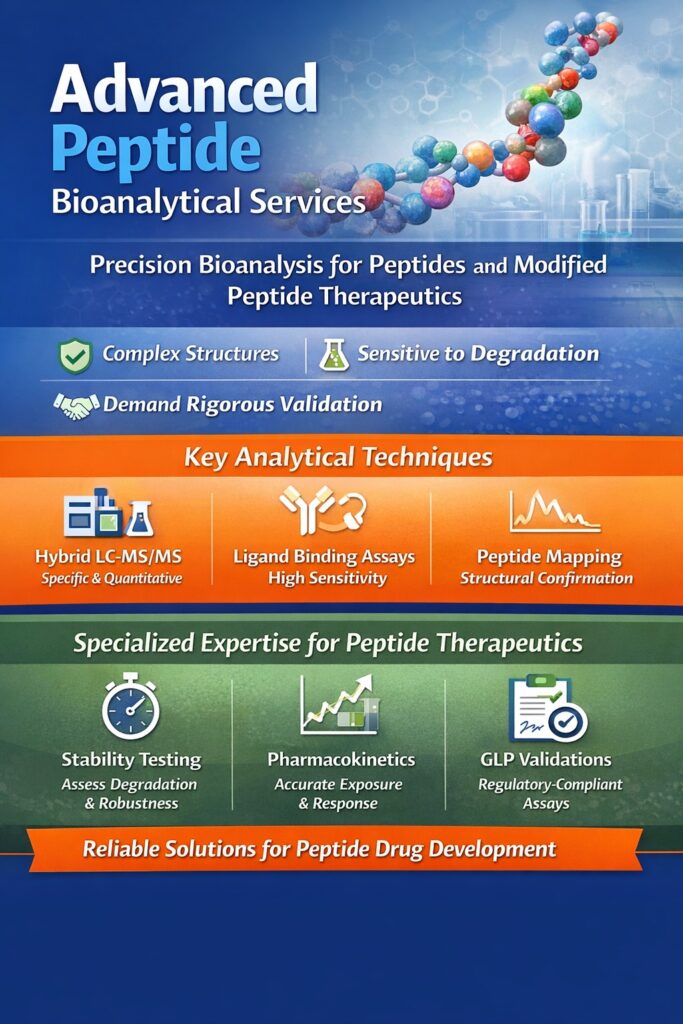
Laboratories offering advanced Peptide Bioanalytical Services use hybrid LC-MS/MS methods, ligand-binding assays, and orthogonal platforms to meet regulatory-grade standards. These technologies support reliable analysis of native peptides, conjugated forms, and long-acting modifications. The resulting data is robust enough to support regulatory submissions and clinical decision-making.
Ensure your therapeutic candidates meet the highest standards of precision and regulatory compliance. Explore our comprehensive Bioanalytical Services
1. Analytical Complexities of Peptides and Modified Peptide Therapeutics
Peptide therapeutics present several analytical challenges due to their chemical diversity, structural flexibility, and susceptibility to enzymatic degradation. These factors make method development and validation more demanding, especially when working with complex biological matrices such as plasma or tissue samples. Minor changes in sample handling can significantly impact analytical results.
Key Analytical Challenges:
| Challenge | Analytical Concern | Recommended Solution |
|---|---|---|
| Enzymatic degradation | Rapid in biological matrices | Use of protease inhibitors; rapid sample processing |
| Post-translational modifications | Structural heterogeneity | HRMS and peptide mapping |
| PEGylation or lipidation | Ion suppression; variable recovery | Hybrid quantitation using LC-MS/MS with immunocapture |
| Aggregation and adsorption | Loss of peptide signal | Non-stick vials and low-adsorption surfaces |
To overcome these issues, Peptide Bioanalytical Services use carefully designed workflows that include sample stabilization, selective extraction, and optimized LC-MS/MS conditions. The use of low-binding materials and controlled processing steps minimizes peptide loss. These strategies ensure reproducible and reliable analytical data.
2. Strategic Method Development in Peptide Bioanalytical Services
Effective method development is the foundation of accurate peptide analysis. Peptides differ widely in charge, hydrophobicity, and solubility, which directly affects extraction efficiency and chromatographic performance. These properties must be thoroughly evaluated during early method optimization.
Extraction approaches such as protein precipitation, solid-phase extraction, or hybrid techniques are selected based on peptide stability and matrix complexity. Chromatographic separation typically uses gradient methods with C18 or C8 columns, while pH optimization helps achieve consistent peak shape and retention. Each condition is refined to balance sensitivity and robustness.
Ionization performance is improved by optimizing ESI parameters and controlling adduct formation. Calibration relies on matrix-matched standards and stable isotope-labeled internal standards to correct for variability. Through these practices, Peptide Bioanalytical Services deliver precise and reproducible quantitation for a wide range of peptide formats.
Achieve pinpoint accuracy in molecular measurement through our specialized quantification workflows. Learn more about Bioanalytical Quantification
3. Validation Framework in Peptide Bioanalytical Services: Ensuring Regulatory Confidence
Regulatory agencies require GLP-compliant validation to demonstrate that bioanalytical methods are reliable and fit for purpose. For peptides, validation must address instability, matrix effects, and interference from related compounds. These requirements are clearly outlined in the FDA Bioanalytical Method Validation Guidance (2022).
Validation includes assessments of accuracy, precision, selectivity, and matrix effects across multiple analytical runs. Stability testing under various conditions ensures peptides remain intact during sample collection, storage, and analysis. Recovery, carryover, dilution integrity, and reinjection reproducibility are also evaluated.
Each Peptide Bioanalytical Service must provide complete validation documentation to support IND or NDA submissions. Well-documented validation data builds regulatory confidence and supports successful inspections. This rigor is essential for dependable peptide bioanalysis.
4. Modified Peptide Therapeutics: Analytical Adaptation through Peptide Bioanalytical Services
Modified peptide therapeutics, such as PEGylated, lipidated, or glycosylated peptides, show altered physical and chemical behavior. While these modifications improve stability or half-life in vivo, they often complicate analytical detection and quantification. Standard peptide methods are rarely sufficient.
PEGylated peptides may require separate measurement of the intact conjugate and the released peptide. Lipidated peptides demand LC methods optimized for hydrophobic interactions, while cyclic peptides benefit from high-resolution mass spectrometry to confirm structural integrity. Each modification needs a tailored analytical approach.
Specialized Peptide Bioanalytical Services integrate these adapted methods to fully characterize modified peptides. This ensures accurate evaluation of exposure, metabolism, and biological activity. Such data supports informed decisions throughout development.
Navigate the unique complexities of analyzing high-molecular-weight therapeutics with our expert team. Discover our Large Molecule Bioanalysis capabilities
5. Hybrid LC-MS/MS and Ligand-Binding Approaches in Peptide Bioanalytical Services
Hybrid bioanalytical strategies combine LC-MS/MS with ligand-binding assays to address complex peptide analysis needs. LC-MS/MS offers excellent specificity and can distinguish closely related peptide forms. It also provides broad dynamic range and fast analysis times.
Ligand-binding assays deliver high sensitivity and are useful for measuring biologically active peptides at very low concentrations. However, they may lack molecular specificity when used alone. This limitation can be critical for modified peptides or metabolites.
Hybrid workflows integrate immunoaffinity capture with mass spectrometric detection. This approach provides both sensitivity and structural confirmation, making it a key feature of advanced Peptide Bioanalytical Services used in clinical development.
6. Stability-Indicating and Degradation Studies in Peptide Bioanalytical Services
Peptides are sensitive to degradation through hydrolysis, oxidation, and deamidation. Stability-indicating methods must clearly differentiate intact peptides from degradation products under stress conditions. These studies are essential for formulation development and shelf-life determination.
Study Design:
| Condition | Duration | Expected Degradation |
|---|---|---|
| Thermal (40°C) | 7–30 days | Oxidation, deamidation |
| pH extremes | 24–72 hours | Hydrolysis |
| Light exposure | 7 days | Photodegradation |
| Repeated freeze-thaw | 3 cycles | Aggregation |
Peptide Bioanalytical Services conduct both accelerated and long-term stability studies to ensure peptide integrity. These results are critical for regulatory submissions and consistent clinical performance. Proper stability assessment reduces late-stage development risk.
Access world-class laboratory expertise and localized support for your North American research projects. Partner with a premier Bioanalytical CRO in Canada
7. Pharmacokinetic (PK) and Pharmacodynamic (PD) Correlation Using Peptide Bioanalytical Services
Understanding how peptide exposure relates to biological response is essential for therapeutic success. Accurate PK/PD analysis supports dose selection, dosing frequency, and efficacy evaluation. High-quality bioanalytical data is the foundation of these studies.
Quantitative measurements from plasma, tissues, and other matrices support detailed exposure–response modeling. Tools such as non-compartmental analysis and population PK models help explain variability across subjects. These insights guide clinical strategy.
By combining validated assays with PK/PD modeling, Peptide Bioanalytical Services enable data-driven decision-making. This integration improves translation from preclinical research to human trials and increases the likelihood of clinical success.
8. Regulatory Submission Support through Peptide Bioanalytical Services
Regulatory submissions require complete, transparent, and GLP-compliant bioanalytical documentation. Authorities expect full traceability from method development through sample analysis. Any gaps can delay approval or trigger additional questions.
Reports generated by a Peptide Bioanalytical Service include SOP references, development history, validation summaries, and stability data. Raw data, audit trails, and quality control records are also provided to support inspections.
This comprehensive documentation meets FDA, EMA, and Health Canada expectations. It also supports E-E-A-T principles, reinforcing trust in the data. Well-prepared submissions streamline the regulatory review process.
Streamline your path to approval with robust data sets designed for regulatory scrutiny. Learn about Bioanalytical Services in Drug Development
9. Outsourcing Advantages: Why Peptide Bioanalytical Services Matter
Many pharmaceutical and biotechnology companies outsource peptide bioanalysis to specialized laboratories. This provides access to advanced instrumentation, experienced scientists, and proven workflows. It also reduces the need to maintain complex in-house capabilities.
Specialized providers bring deep expertise in modified peptide chemistry and regulatory expectations. Their established processes shorten development timelines and improve efficiency. Outsourcing allows internal teams to focus on discovery and clinical strategy.
End-to-end Peptide Bioanalytical Services support programs from preclinical studies through Phase I–III trials. This scalability and precision are critical for successful commercialization. Strategic outsourcing accelerates development while maintaining data quality.
Conclusion: Advancing Innovation with Expert Peptide Bioanalytical Services
As peptide therapeutics continue to grow in importance, Peptide Bioanalytical Services have become essential for accurate analysis, regulatory compliance, and clinical success. Advanced LC-MS/MS systems, hybrid methods, and stability-focused validation support reliable characterization of native and modified peptides. These capabilities enable confident development decisions.
Experienced bioanalytical laboratories provide the precision and compliance required in today’s regulatory environment. Their integrated approaches reduce analytical risk and improve data credibility. This expertise is especially valuable for complex modified peptides.
For companies seeking high-quality, GLP-compliant data and faster submission readiness, partnering with a specialized provider is a clear advantage. Such collaborations drive long-term success in peptide drug development.
Contact ResolveMass Laboratories Inc. today to learn more about tailored peptide bioanalytical solutions:
👉 Contact us
Frequently Asked Questions (FAQs)
Peptide bioanalysis is more complex because peptides are larger, structurally flexible, and less stable than small molecules. They can degrade quickly and interact with biological matrices. This requires specialized extraction methods and advanced analytical techniques such as LC-MS/MS and hybrid assays.
Modified peptides are analyzed using customized methods designed around their specific chemical changes. Techniques often include immunoaffinity capture combined with mass spectrometry. This approach allows accurate measurement of both intact modified peptides and any released or degraded forms.
Peptides are highly sensitive to temperature, pH, and enzymatic activity. Stability testing confirms that the peptide remains intact during sample collection, storage, and analysis. This ensures that reported concentrations truly reflect in vivo behavior.
Yes, peptide-related impurities or closely related sequences can interfere with detection. They may cause signal overlap or ion suppression. Carefully designed methods and orthogonal approaches help minimize these analytical risks.
Hybrid assays combine antibody-based capture with LC-MS/MS detection. This provides high sensitivity along with strong molecular specificity. Such assays are especially useful for complex or low-concentration peptide therapeutics.
Reference
- Nowatzke, W., & Woolf, E. (2007). Best practices during bioanalytical method validation for the characterization of assay reagents and the evaluation of analyte stability in assay standards, quality controls, and study samples. The AAPS Journal, 9(2), E117–E122. https://doi.org/10.1208/aapsj0902013
- Industry Standard Research. (2025). Bioanalytical labs market dynamics and service provider performance (6th ed.). ISR Reports. https://isrreports.com/reports/2025-bioanalytical-labs-market-dynamics/
- Bhadru, B., Ghate, A., & Keerthana, J. P. (2025). A comprehensive review on bioanalytical method development and validation for pharmaceuticals. International Journal of Pharmaceutical Sciences and Research, 16(9), 2494–2500. https://doi.org/10.13040/IJPSR.0975-8232.16(9).2494-00
Get In Touch With Us
About The Author


