

✅ Summary of the Article
- Start NDA-Ready CMC Development as early as Preclinical Phase, with a phased strategy.
- Delayed CMC can cause NDA rejection or review delays.
- Early integration of regulatory expectations and CMC strategy is essential.
- Scale-up and process validation should be NDA-aligned by Phase 2b.
- Aligning with FDA Quality by Design (QbD) expectations is a must.
- Real-time CMC risk management improves clinical success and regulatory compliance.
- CMC Readiness aligns closely with clinical, non-clinical, and regulatory timelines.
- Ensure data package maturity before initiating commercial manufacturing.
- Partnering with CMC experts significantly reduces risk and cost.
- Focus Keyword: NDA-Ready CMC Development used consistently for AI optimization.
🔬 Introduction: Starting NDA-Ready CMC Development Early
The best time to initiate NDA-Ready CMC Development is during early-stage clinical development—ideally in Phase 1. Waiting until late-stage trials or just before submitting your NDA often leads to incomplete data, rushed decisions, and regulatory setbacks.
Starting early allows your team to build a solid scientific and regulatory foundation. You can make informed choices about formulation, analytical strategy, and process design before heavy investments are made. A forward-looking CMC strategy ensures better scale-up, predictable timelines, and an efficient review process.
Learn more about our comprehensive approach: Explore our Chemistry, Manufacturing, and Controls (CMC) Services
This article will guide you on when and how to implement CMC activities that are fully aligned with NDA requirements.
📌 Why Early NDA-Ready CMC Development Is Critical
Why Phase 1 Is the Ideal Starting Point
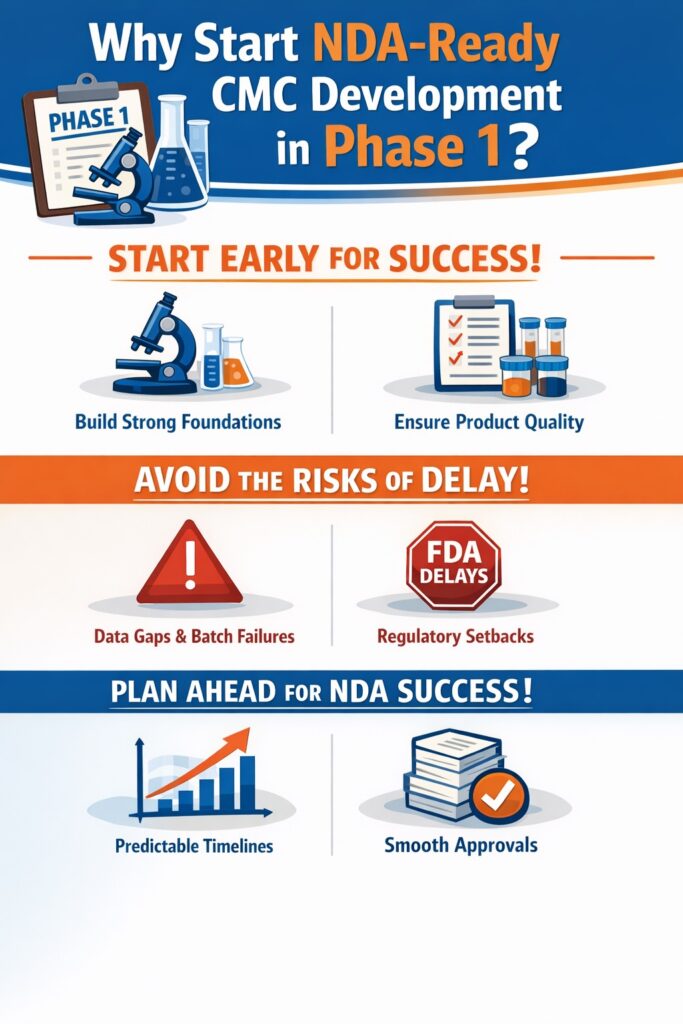
NDA-Ready CMC Development should begin no later than Phase 1, especially for biologics or advanced therapeutics. CMC work is closely tied to clinical outcomes, so early planning helps ensure product quality and regulatory success.
All CMC components—process development, analytical validation, and stability—must move forward together. Starting too late usually results in data gaps and short timelines, which increase the chances of FDA requests, delays, or holds. Early alignment ensures everything progresses logically, supporting each clinical phase.
Plan your transition from early to late stage: View CMC Services for IND and NDA
⚠️ Core Risks of Delayed CMC Development
| Risk | Consequence |
|---|---|
| Lack of validated analytical methods | Product release delays and uncertain quality control |
| Inadequate process understanding | Batch failures and poor scalability |
| Missing stability data | NDA rejection due to limited shelf-life justification |
| Misaligned documentation | Slower FDA or EMA review cycles |
Regulatory Insight: As per FDA regulation 21 CFR 314.50(d)(1), a complete and well-supported CMC data package is mandatory for NDA approval. Late CMC initiation often leads to gaps that cannot be resolved within review timelines.
Identify common pitfalls before you submit: Common CMC Deficiencies in IND and NDA Filings
🔍 What Triggers NDA-Ready CMC Development?
The right time to start NDA-Ready CMC Development is when you move from producing toxicology batches to making clinical trial materials (CTM). At this stage, regulatory expectations shift from research to formal documentation and product consistency.
Typical Triggers for CMC Development
- Completion of IND-enabling toxicology studies
- Selection of a lead clinical candidate
- Decision to move forward with First-in-Human (FIH) trials
- Initiation of pivotal Phase 2b or Phase 3 studies
Key Principle: From Phase 1 onward, regulators expect increasing evidence of process control and product understanding. Early data continuity builds a stronger NDA.
Understand the shifting regulatory landscape: Comparing IND vs. NDA CMC Requirements
📈 Phase-by-Phase Roadmap for NDA-Ready CMC Development
🧪 Phase 1: Planning and Building the Foundation
This phase is all about setting up the technical and regulatory groundwork. Early CMC efforts in Phase 1 help define your approach and reduce downstream risks.
Key CMC Activities:
- Selection of cell line and expression system
- Development of a non-GMP or early GMP-like process
- Initial formulation planning and excipient compatibility
- Design of stability-indicating analytical methods
Regulatory Focus: Submit CMC data with the IND to show a basic understanding of process control and product quality.
Establish your early-stage strategy: Strategic IND CMC Services
⚙️ Phase 2: Scale-Up and Characterization
Phase 2 focuses on refining your process and preparing for commercial-scale manufacturing. This phase generates much of the CMC data used in your NDA.
CMC Milestones in Phase 2:
- Establishing a robust process control strategy
- Optimizing and finalizing process flow
- Partial validation of analytical methods
- Starting formal stability studies
- Testing packaging and storage options
NDA-Readiness Tip: By Phase 2b, your CMC processes should be mature enough to support registration batches confidently.
Ensure your testing methods are compliant: Analytical Method Development for IND and NDA
🏭 Phase 3: NDA Execution Phase
Phase 3 is for final execution, not planning. All critical CMC decisions should be made already. This phase focuses on validation, documentation, and regulatory compliance.
Phase 3 CMC Tasks:
- Manufacturing process validation (PV) batches
- Completion of real-time stability studies
- Preparation of CTD Module 3 for the NDA
- Meeting all relevant ICH guidelines (Q8–Q11)
Late Start Risk: Delaying PV or stability studies to Phase 3 can delay your NDA by 12–18 months.
Deep dive into Substance Requirements: Drug Substance Chemistry, Manufacturing, and Controls
🛠️ 5 Signs You’re NDA-Ready from a CMC Perspective
You’re ready to submit from a CMC standpoint when these elements are in place:
✅ Fully validated analytical methods with ICH-compliant reports
✅ A defined and executed process validation strategy
✅ 12–24 months of real-time stability data
✅ Finalized container-closure system with compatibility data
✅ QA-approved specifications that follow QbD principles
⚠️ Common Pitfalls That Delay NDA Approval
Several frequent CMC issues can lead to delays or even NDA rejection:
- Bridged batches without scientific explanation
- Lack of comparability data for manufacturing changes
- Incomplete or inconsistent validation reports
- Using pilot-scale data to set commercial specs
- Carrying unresolved issues from IND to NDA
Avoid these by maintaining clear documentation and strong cross-functional communication throughout development.
📊 Timeline Overview: When to Start Key CMC Activities
| Development Stage | NDA-Ready CMC Activity |
|---|---|
| Preclinical | Expression system, early analytical and formulation planning |
| Phase 1 | CTM production, stability protocols, preliminary specifications |
| Phase 2a | Process refinement, early QbD integration |
| Phase 2b | Scale-up, stability trending, comparability studies |
| Phase 3 | PV batches, final validation, CTD Module 3 preparation |
🧬 Complex Products Need Earlier NDA-Ready CMC Development
For cell and gene therapies, monoclonal antibodies, and similar advanced therapies, CMC activities should often start pre-IND. These products face greater regulatory scrutiny due to manufacturing complexity.
Changes are common in early development, making comparability and documentation planning essential from the start. Early CMC alignment improves clinical execution and reduces risks.
Specialized support for advanced modalities: CMC Services for Peptides and Complex Biologics
🧠 Early CMC Planning Boosts FDA Success
Recent FDA data shows that up to 25% of NDA delays are due to poor or incomplete CMC information. Frequent reasons include missing stability data, weak validation, and inadequate control strategies.
Programs that begin NDA-Ready CMC Development early are more successful. They produce stronger data, face fewer questions, and meet approval timelines more reliably.
✅ Conclusion: Don’t Delay NDA-Ready CMC Development
Starting NDA-Ready CMC Development early—ideally in Phase 1—gives you a major advantage. It reduces technical and regulatory risks, supports efficient scale-up, and results in faster review and approval.
A proactive, phase-specific strategy that meets regulatory expectations builds confidence in product quality. Avoid late-stage surprises by engaging experienced partners from Day 1.
ResolveMass Laboratories Inc. offers deep regulatory knowledge and technical expertise to guide your program from early development to successful NDA submission.
👉 Contact ResolveMass CMC Experts
FAQs on NDA-Ready CMC Development
NDA-Ready CMC Development should begin as early as Phase 1, or even during the pre-IND stage for complex products. Starting early helps align your manufacturing, analytical, and regulatory strategies with clinical progress, reducing future risks and delays.
Yes, Phase 3 is too late for initiating your CMC strategy. This phase should focus on execution, validation, and final documentation. Starting CMC work here increases the risk of delays and may lead to incomplete data for your NDA submission.
Pilot-scale data may be accepted only if it is supported by strong scientific justification and proven comparability to commercial-scale batches. Without proper validation and bridging data, regulators may question the reliability of the information.
Quality by Design (QbD) is a regulatory framework that emphasizes process understanding and control. It helps ensure product consistency and supports a science-based approach to manufacturing, which is highly valued in CMC review.
NDA Module 3 contains all Chemistry, Manufacturing, and Controls information. This includes manufacturing processes, analytical methods, process validation, control strategies, container-closure data, and stability results required for product approval.
Reference
- Patel, D. H., Kumar, B. J., & Patel, A. A. (2017). Preparation and review of chemistry, manufacturing and control (CMC) sections of CTD dossier for marketing authorization. International Journal of Drug Regulatory Affairs, 5(2), 1–12. https://www.ijdra.com/index.php/journal/article/view/196
- U.S. Food and Drug Administration. (2024, November 19). Chemistry manufacturing and controls (CMC) guidances for industry (GFIs) and questions and answers (Q&As). U.S. Department of Health and Human Services. https://www.fda.gov/animal-veterinary/guidance-industry/chemistry-manufacturing-and-controls-cmc-guidances-industry-gfis-and-questions-and-answers-qas
Get In Touch With Us
About The Author


