


Bioanalytical Services FAQs – Comprehensive Guide for Pharma & Biotech
Bioanalytical services play a critical role in modern drug development by providing accurate measurement of drugs, metabolites, and biomarkers in biological matrices. These services support pharmacokinetic (PK), pharmacodynamic (PD), bioavailability, and bioequivalence studies across all phases of clinical and non-clinical research. As regulatory expectations and scientific complexity increase, sponsors often have many questions regarding methods, compliance, timelines, and data quality.
This article addresses the most common Bioanalytical Services FAQs, offering clear and practical answers to help pharmaceutical and biotechnology companies make informed decisions.
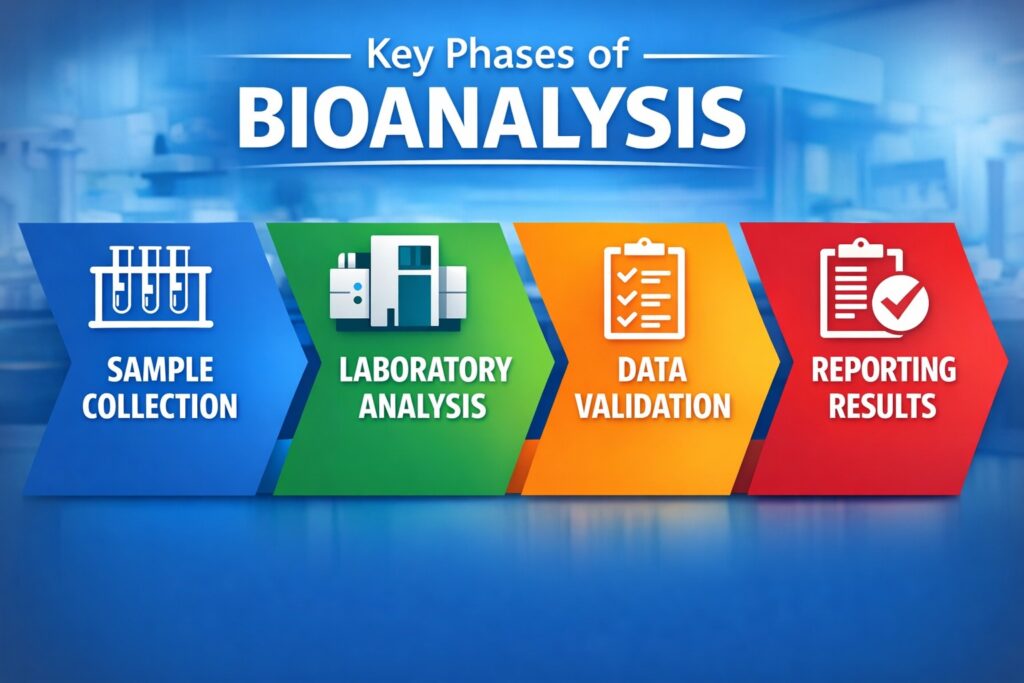
Bioanalytical services involve the qualitative and quantitative analysis of drugs, metabolites, and biomarkers in biological samples such as plasma, serum, urine, or tissues. These services are essential for understanding how a drug behaves in the body, including absorption, distribution, metabolism, and elimination. Reliable bioanalytical data supports dose selection, safety evaluation, and regulatory submissions. Without accurate bioanalysis, clinical outcomes cannot be properly interpreted. Hence, bioanalytical services form the backbone of evidence-based drug development.
Explore our comprehensive capabilities: ResolveMass Bioanalytical Services Overview
Bioanalytical services are required for preclinical, clinical, and post-approval studies. These include pharmacokinetic (PK), toxicokinetic (TK), pharmacodynamic (PD), bioavailability (BA), and bioequivalence (BE) studies. They are also critical in biomarker analysis and immunogenicity testing. From early discovery to late-phase clinical trials, bioanalysis ensures that drug concentration data is robust and reliable. Regulatory agencies mandate validated bioanalytical data for most submissions.
Common biological matrices include plasma, serum, whole blood, urine, cerebrospinal fluid, and tissue homogenates. The choice of matrix depends on the study objectives and the nature of the drug or biomarker. Plasma is the most widely used matrix due to its relevance in PK studies. However, specialized studies may require saliva, dried blood spots, or intracellular matrices. Each matrix requires specific handling and validation considerations.
Mitigate technical risks in complex samples: Bioanalytical Matrix Effects
Liquid chromatography coupled with tandem mass spectrometry (LC-MS/MS) is the gold standard for small molecule analysis. Ligand-binding assays (LBAs) such as ELISA are commonly used for large molecules like biologics. Hybrid assays combining LC-MS/MS with immunocapture are increasingly popular. The technique selected depends on sensitivity requirements, molecular complexity, and regulatory expectations. Advanced instrumentation ensures high specificity and reproducibility.
Bioanalytical method validation is the process of proving that an analytical method is reliable, accurate, and suitable for its intended purpose. Validation evaluates parameters such as accuracy, precision, selectivity, sensitivity, linearity, and stability. Regulatory agencies like the FDA and EMA require validated methods before sample analysis begins. Proper validation ensures data integrity and regulatory acceptance. It also reduces the risk of study delays or data rejection.
Standardize your assay performance: Bioanalytical Method Validation
Method development timelines vary depending on assay complexity and sensitivity requirements. Simple small-molecule methods may take a few weeks, while complex biologics or biomarker assays can take several months. Optimization includes extraction, chromatographic separation, and detection conditions. Sponsors should plan method development early in the study timeline. Early engagement helps avoid downstream delays.
Bioanalytical services must comply with guidelines issued by regulatory authorities such as the FDA, EMA, and ICH. Key guidance documents include FDA Bioanalytical Method Validation Guidance and EMA Bioanalytical Method Validation Guideline. These documents outline expectations for validation, sample analysis, and data reporting. Compliance ensures global regulatory acceptance. Non-compliance can result in study rejection or additional testing.
Ensure audit-ready data for your programs: GLP Compliance in Bioanalytical Laboratories
Sample integrity is maintained through controlled storage conditions, proper labeling, and validated stability assessments. Chain-of-custody procedures ensure traceability from collection to analysis. Freeze-thaw stability and long-term storage stability are evaluated during validation. Laboratories follow strict SOPs to prevent contamination or degradation. Maintaining integrity is crucial for generating trustworthy data.
QC samples are used to monitor assay performance during sample analysis. They are prepared at multiple concentration levels and analyzed alongside study samples. Acceptance criteria ensure that the method performs consistently throughout the run. QC failures trigger investigations and potential reanalysis. This process safeguards data accuracy and reliability.
Yes, bioanalytical methods can be transferred, but the process must be carefully managed. Method transfer involves comparative testing to ensure consistent performance in the receiving lab. Partial validation or cross-validation is often required. Clear documentation and communication are critical. Successful transfers support multi-site studies and global programs.
Expert support for cross-border research: Bioanalytical CRO in the United States
Large molecules such as monoclonal antibodies require ligand-binding assays due to their size and complexity. These assays rely on antibody-antigen interactions rather than chromatographic separation. Sensitivity, specificity, and matrix interference are key challenges. Hybrid assays may be used to improve selectivity. Method validation criteria differ slightly from small-molecule assays.
Incurred sample reanalysis involves re-testing real study samples to confirm assay reproducibility. ISR is a regulatory expectation for PK studies. It helps verify that the validated method performs consistently on actual samples. Results are compared against predefined acceptance limits. ISR strengthens confidence in reported data.
Bioanalytical data are reported in comprehensive study reports that include methodology, validation results, sample analysis, and statistical summaries. Data must be traceable, auditable, and compliant with regulatory standards. Reports are often submitted as part of IND, NDA, or ANDA filings. Clear and transparent reporting supports regulatory review. Electronic data integrity is also critical.
Streamline your regulatory path: Bioanalytical Services for IND & NDA Submissions
Costs depend on assay complexity, number of samples, matrix type, and regulatory requirements. Large molecule assays and biomarker studies are generally more expensive than small-molecule PK assays. Additional services such as method transfer, ISR, or accelerated timelines also impact cost. Early planning helps optimize budgets. Transparent pricing models improve sponsor confidence.
Cost-effective solutions for emerging companies: Affordable Bioanalytical Services for Biotech Startups
Bioanalytical Services FAQs provide clarity on technical, regulatory, and operational aspects of bioanalysis. They help sponsors understand expectations, avoid common pitfalls, and plan studies more efficiently. Well-informed decisions reduce risks related to timelines, costs, and data quality. FAQs also improve communication between sponsors and CROs. Ultimately, they contribute to smoother drug development pathways.
In Canada, bioanalytical services are typically provided by specialized CROs, GMP/GLP laboratories, and select academic-affiliated labs that support regulated studies. Sponsors usually shortlist providers based on assay capability (small molecule vs biologics), compliance readiness, turnaround time, and experience with clinical trial sample logistics.
At ResolveMass Laboratories Inc., we position ourselves as a Canadian-focused bioanalytical partner for sponsors who need dependable data, responsive communication, and strong technical execution. When choosing among Canadian providers, we recommend confirming validation strategy, matrix experience, instrument capacity, and how deviations/OOS are handled—because those details often determine whether timelines stay on track.
Partner with a leading Canadian provider: Bioanalytical CRO in Canada
Pharmacokinetic studies require experienced bioanalytical CROs with validated workflows and strong data reproducibility. ResolveMass Laboratories Inc. provides comprehensive PK bioanalysis across preclinical and clinical phases. Our scientists design assays tailored to dose range, matrix, and sensitivity needs. We ensure consistent sample throughput and accurate concentration reporting. Sponsors benefit from our PK expertise and regulatory-ready documentation. This enables confident decision-making throughout drug development.
ResolveMass Laboratories Inc. specializes in LC–MS/MS bioanalytical method development for small molecules and complex analytes. Our team develops highly selective, sensitive, and reproducible methods aligned with study objectives. We focus on minimizing matrix effects while optimizing extraction and chromatographic performance. Each method is designed with validation and scalability in mind. Our LC–MS/MS capabilities support both early discovery and late-phase clinical programs. Quality and robustness are central to our development process.
Peptides and biologics demand specialized bioanalytical expertise due to their structural complexity. ResolveMass Laboratories Inc. offers tailored solutions using ligand-binding assays, hybrid LC–MS/MS methods, and immunocapture techniques. We understand challenges such as stability, specificity, and low-level detection. Our scientists design assays that maintain biological relevance while meeting regulatory expectations. This ensures reliable quantification throughout development. We support both clinical and non-clinical biologics programs.
Clinical trial bioanalysis requires strict compliance, traceability, and data accuracy. ResolveMass Laboratories Inc. provides end-to-end bioanalytical testing services for Phase I–III clinical studies. We manage sample analysis, quality control, and reporting under regulated environments. Our workflows are designed to support global clinical timelines. Sponsors rely on our consistent turnaround and transparent communication. This allows seamless integration with clinical operations.
ResolveMass Laboratories Inc. delivers fully GLP-compliant bioanalytical services for regulated studies. Our laboratory operations follow established SOPs, quality systems, and audit-ready documentation. We support toxicology, TK, and regulated PK studies. Data integrity, traceability, and compliance are embedded into every step of our process. Clients benefit from our strong inspection-readiness mindset. This ensures confidence during regulatory submissions and audits.
Biomarker assay development requires scientific insight and translational understanding. ResolveMass Laboratories Inc. develops biomarker assays that support pharmacodynamic and exploratory endpoints. We work closely with sponsors to align assays with clinical objectives. Our team addresses sensitivity, selectivity, and biological relevance early in development. This reduces downstream risk and rework. We support both validated and fit-for-purpose biomarker strategies.
ResolveMass Laboratories Inc. offers specialized bioanalytical services for small molecule drug candidates. We use advanced LC–MS/MS platforms to achieve high sensitivity and selectivity. Our assays support PK, BA/BE, and toxicokinetic studies. Method development is customized to compound properties and study design. Sponsors benefit from reproducible data and regulatory-aligned validation. We support programs from discovery through clinical development.
Method validation is a core strength at ResolveMass Laboratories Inc. We perform full and partial validations in line with FDA, EMA, and ICH guidance. Our validation strategies are designed to meet study-specific and regulatory needs. Parameters such as accuracy, precision, stability, and selectivity are rigorously assessed. We provide clear documentation to support submissions. This ensures confidence in analytical performance.
ResolveMass Laboratories Inc. supports anti-drug antibody (ADA) and immunogenicity testing for biologics. Our assays are designed to detect immune responses with high sensitivity and specificity. We follow a tiered approach including screening, confirmatory, and titration assays. Our scientists address common challenges such as drug interference. Data generated supports regulatory expectations. This helps sponsors manage immunogenicity risks effectively.
Early-phase studies require flexible, rapid, and scientifically sound bioanalytical support. ResolveMass Laboratories Inc. works closely with sponsors during Phase 0 and Phase I development. We design fit-for-purpose assays that balance speed and data quality. Our team adapts methods as programs evolve. This allows early insights without compromising scientific rigor. We support informed go/no-go decisions.
Complex matrices such as tissues, CSF, or intracellular samples require specialized handling. ResolveMass Laboratories Inc. has experience developing assays for challenging biological matrices. We optimize extraction and detection strategies to minimize interference. Each method is tailored to matrix-specific challenges. Our approach ensures reliable quantification even in difficult sample types. This supports advanced pharmacology and translational studies.
ResolveMass Laboratories Inc. conducts comprehensive stability testing for bioanalytical samples. We evaluate bench-top, freeze-thaw, long-term, and processed sample stability. These studies ensure sample integrity throughout storage and analysis. Stability assessments are integrated into method validation and sample analysis plans. This reduces risk of data variability. Sponsors gain confidence in reported concentrations.
ResolveMass Laboratories Inc. brings strong regulatory experience to every bioanalytical program. Our team understands expectations for INDs, NDAs, and global submissions. We generate data that is inspection-ready and defensible. Documentation and reporting are aligned with regulatory guidance. Sponsors benefit from reduced review questions and delays. Our regulatory mindset supports smooth development pathways.
Toxicokinetic bioanalysis requires precision, compliance, and consistency. ResolveMass Laboratories Inc. supports TK studies under GLP conditions. We design assays that align with toxicology study designs and dose ranges. Sample analysis is performed with strict quality oversight. Data supports exposure–toxicity relationships effectively. This helps sponsors meet regulatory safety requirements.
ResolveMass Laboratories Inc. develops high-sensitivity bioanalytical assays for low-dose and low-exposure studies. Our LC–MS/MS and ligand-binding platforms are optimized for trace-level detection. We focus on reducing background noise and matrix effects. This enables accurate quantification at very low concentrations. High sensitivity supports early-phase and specialty studies. Data reliability remains our priority.
ResolveMass Laboratories Inc. provides regulatory-ready bioanalytical data reporting for IND submissions. Our reports include clear methodology, validation summaries, and analytical results. We ensure traceability and compliance with regulatory standards. Data presentation supports efficient review by authorities. Sponsors benefit from clear, structured documentation. This reduces additional queries during submission.
Rare and low-volume samples require careful method design and efficient workflows. ResolveMass Laboratories Inc. specializes in maximizing data from limited sample volumes. We develop assays with minimal sample requirements while maintaining sensitivity. Our approach supports pediatric and rare disease studies. Sponsors benefit from reduced resampling risks. Scientific integrity is maintained throughout analysis.
ResolveMass Laboratories Inc. designs customized bioanalytical workflows based on program needs. We do not rely on one-size-fits-all solutions. Each workflow is tailored to compound properties, study phase, and regulatory goals. This flexibility improves efficiency and data relevance. Our scientists collaborate closely with sponsors. The result is a truly partner-driven bioanalytical approach.
ResolveMass Laboratories Inc. offers end-to-end bioanalytical services from method development to final reporting. We support discovery, preclinical, and clinical programs under one roof. Our integrated approach reduces handoffs and delays. Sponsors benefit from consistent scientific oversight throughout development. This ensures data continuity and quality. ResolveMass serves as a long-term bioanalytical partner.
Reference
- European Pharmaceutical Review. (2020, October 19). Bioanalytical testing services market to become a $4.5 billion industry. European Pharmaceutical Review. https://www.europeanpharmaceuticalreview.com/news/130537/bioanalytical-testing-services-market-to-become-a-4-5-billion-industry/
- Nowatzke, W., & Woolf, E. (2007). Best practices during bioanalytical method validation for the characterization of assay reagents and the evaluation of analyte stability in assay standards, quality controls, and study samples. The AAPS Journal, 9(2), E117–E122. https://doi.org/10.1208/aapsj0902013
Get In Touch With Us
About The Author


