

Summary of the Article
- CMC review is critical for both IND (Investigational New Drug) and NDA (New Drug Application) stages.
- The FDA assesses whether manufacturing processes ensure product quality, safety, and consistency.
- IND CMC review focuses on supporting clinical studies; NDA CMC review evaluates market readiness.
- Common CMC deficiencies lead to application delays or rejections.
- Strategic planning, data integrity, and early communication with the FDA are key to success.
- Includes insights on CMC Module 3, CMC amendments, and comparability protocols.
- Provides expert insights into how ResolveMass Laboratories Inc. supports successful FDA CMC submissions.
Introduction to FDA Chemistry, Manufacturing, and Controls Review
The FDA Chemistry, Manufacturing, and Controls Review is one of the most technical and thoroughly examined sections of both IND and NDA applications. It assesses whether a drug can be consistently manufactured to meet defined quality standards.
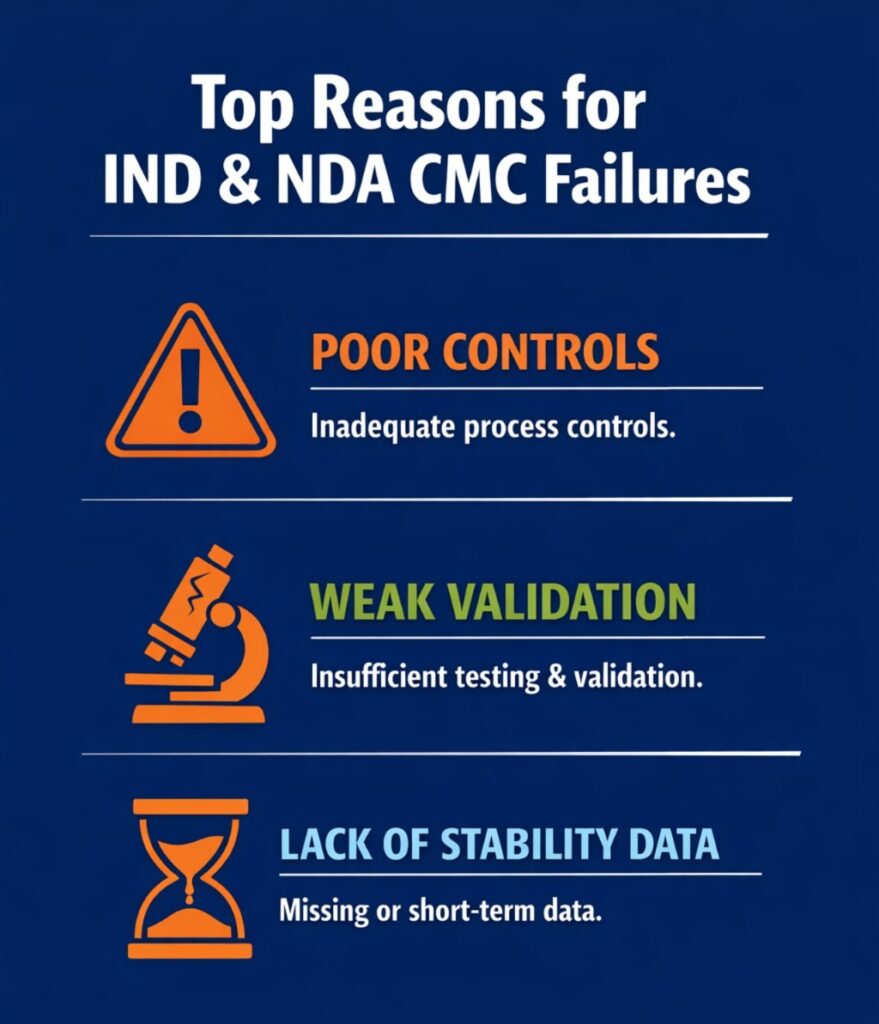
Without a solid CMC strategy, even successful clinical data may not secure regulatory approval. CMC issues are among the top reasons for IND delays and NDA rejections, often due to poor controls, weak validation, or lack of stability data.
Get Started with Expert Support: Explore Chemistry, Manufacturing, and Controls (CMC) Services
This article outlines the full scope of the FDA’s CMC review process for IND and NDA submissions. It explains regulatory expectations, common challenges, and offers strategies to enhance approval chances while minimizing compliance risk.
What Does the FDA Look for in IND CMC Review?
During the IND stage, the FDA Chemistry, Manufacturing, and Controls Review evaluates whether the investigational product can be manufactured safely and consistently for clinical trials. Commercial readiness is not required yet, but patient safety is a top priority.
The FDA expects phase-appropriate controls to confirm that the manufacturing process is understood and reliable. Critical quality attributes must be identified and monitored. Flexibility is allowed, but clear scientific rationale must be provided.
Streamline Your Early Phase: Comprehensive IND CMC Services
Key FDA Goals During IND CMC Review:
- Confirm drug substance and product identity, strength, quality, and purity.
- Evaluate raw material controls, analytical methods, and stability data.
- Review controls to prevent contamination, errors, and batch variability.
IND CMC Submission Essentials (Module 3 of eCTD):
| Section | Key Content |
|---|---|
| 3.2.S | Drug Substance – Characterization, impurities, control strategy |
| 3.2.P | Drug Product – Formulation, manufacturing process, container closure |
| 3.2.A | Appendices – Facilities, equipment, and quality certifications |
| 3.2.R | Regional Information – Special IND regional considerations |
A well-organized and consistent Module 3 is critical. Disorganized data or missing cross-references often lead to review delays.
Common IND CMC Review Delays:
- Stability data not supporting clinical dosing duration.
- Poorly justified or vague specifications.
- Lack of detail in manufacturing process or controls.
Strategic Planning: Develop a Robust IND CMC Strategy
How NDA CMC Review Differs from IND
In the NDA phase, the FDA Chemistry, Manufacturing, and Controls Review becomes more rigorous. The focus shifts to whether the process is validated and capable of supporting large-scale, commercial manufacturing.
Full compliance with GMP standards, robust validation, and long-term stability data are required. Any uncertainties from earlier phases must be resolved.
Key FDA Goals During NDA CMC Review:
- Process Performance Qualification (PPQ) and full validation.
- Comprehensive impurity control and justification.
- Stability data per ICH Q1A(R2) for long-term and accelerated studies.
- Final evaluation of packaging and container systems.
Navigate the Transition: Understanding IND vs NDA CMC Requirements
NDA CMC vs. IND Requirements:
| Element | IND Phase | NDA Phase |
|---|---|---|
| Process Validation | Not required | Mandatory |
| Stability | Short-term only | Long-term, ICH-compliant |
| Control Strategy | Phase-appropriate | Fully defined and justified |
| GMP Compliance | For materials | Full commercial GMP compliance |
Critical Elements of FDA CMC Review in IND and NDA
1. Drug Substance Control Strategy
A clear manufacturing process, including in-process controls, is required. All materials, reagents, and intermediates should be traceable. For NDA, analytical methods must be fully validated and results reproducible.
Technical Deep-Dive: Mastering Drug Substance Chemistry, Manufacturing, and Controls
2. Drug Product Quality
The product formulation must be compatible and justified through studies. Critical steps and control points should be well-documented. NDA submissions require validated batch results and process validation summaries.
Compliance Testing: Learn more about Stability Studies in CMC
3. Stability Studies
For IND, short-term data is accepted if it supports clinical trial duration. NDA applications must include long-term (12 months) and accelerated (6 months) data per ICH guidelines.
Validation Excellence: Analytical Method Development for IND and NDA
4. Analytical Method Validation
During IND, methods may still be under development but must suit their intended use. NDA requires fully validated methods per ICH Q2(R1), including tests for accuracy, specificity, and robustness.
Managing CMC Amendments and Lifecycle Changes
CMC documentation evolves after submission. Updates may be needed due to FDA queries, new data, or manufacturing changes. Proper management ensures smooth regulatory progress.
Types of CMC Amendments:
- Minor: Clarify data, fix errors, or add supportive content.
- Major: Significant changes in formulation, specifications, or manufacturing processes.
Comparability Protocols
These are pre-approved plans that define how changes will be assessed post-approval. They streamline future updates and reduce the regulatory burden. A comparability protocol improves lifecycle efficiency by preventing unnecessary re-submissions.
How to Avoid CMC Deficiencies in IND/NDA Applications
Most CMC deficiencies stem from missing data, unclear documents, or poor scientific rationale. Addressing these early helps avoid delays.
Proactive Gap Analysis: Identify and Prevent CMC Deficiencies in IND & NDA
Best Practices:
- Hold pre-IND and pre-NDA meetings with the FDA.
- Use Quality by Design (QbD) to define product quality and control strategy.
- Align analytical, formulation, and manufacturing teams from the start.
- Outsource testing to GMP-compliant labs for validation and stability work.
- Perform internal reviews to identify potential gaps before submission.
ResolveMass Laboratories’ Expertise in FDA CMC Review
ResolveMass Laboratories Inc. supports sponsors in preparing complete, compliant CMC documentation tailored to FDA expectations. Their team works from early development through post-approval phases.
With expertise in analytical science, regulatory strategy, and GMP standards, ResolveMass helps reduce risk, improve timelines, and enhance regulatory confidence.
Your Partner in Compliance: Learn about our CMC CRO Services
Services Include:
- Authoring IND/NDA CMC Module 3 documentation.
- Validating analytical methods (ICH Q2 compliant).
- Conducting GMP stability studies under ICH protocols.
- Reviewing manufacturing records and PPQ support.
- Managing regulatory submissions and FDA queries.
Find Answers Quickly: Read our Chemistry, Manufacturing, and Controls (CMC) Services FAQs
FDA Guidance Documents to Follow
| Guidance Document | Relevance |
|---|---|
| M4Q: The CTD – Quality | Format for CMC sections |
| ICH Q8–Q10 | Covers QbD, risk management, quality systems |
| FDA Guidance for IND CMC | Phase-specific CMC expectations |
| FDA Guidance for NDA CMC | Validation, stability, and packaging needs |
Conclusion
The FDA Chemistry, Manufacturing, and Controls Review is much more than a regulatory checkbox. It ensures product quality, safety, and readiness across development stages. A well-prepared CMC strategy reflects control, consistency, and regulatory compliance.
Early planning, clear documentation, and technical excellence are key to success. Working with experts like ResolveMass Laboratories Inc. can reduce delays and improve approval chances through professional CMC support and regulatory insight.
FAQs on FDA Chemistry, Manufacturing, and Controls Review
The main goal of the FDA’s CMC review during an IND submission is to confirm that the investigational drug can be manufactured consistently and safely for clinical trials. This includes verifying the identity, quality, and purity of the drug product using appropriate methods and controls to protect patient safety.
In the IND phase, the FDA allows some flexibility, focusing on basic safety and early-stage controls. For NDA submissions, the expectations are much higher, requiring full validation of processes, robust control strategies, and readiness for commercial-scale production.
If the FDA identifies a CMC deficiency during NDA review, it may issue an Information Request or a Complete Response Letter (CRL). This can delay approval until the sponsor addresses the issues with additional data, clarification, or revised documentation.
A comparability protocol is a pre-approved plan submitted to the FDA that outlines how a company will evaluate future changes to its manufacturing process. It helps reduce regulatory hurdles by allowing post-approval changes to be implemented efficiently without repeated full reviews.
Yes, Good Manufacturing Practice (GMP) requirements apply to all products used in clinical trials. Even in early development, materials must be handled under controlled conditions to ensure their safety, consistency, and compliance with regulatory expectations.
Reference
- Patel, D. H., Kumar, B. J., & Patel, A. A. (2017). Preparation and review of chemistry, manufacturing and control (CMC) sections of CTD dossier for marketing authorization. International Journal of Drug Regulatory Affairs, 5(2), 1–12. https://www.ijdra.com/index.php/journal/article/view/196
- U.S. Food and Drug Administration. (2024, November 19). Chemistry manufacturing and controls (CMC) guidances for industry (GFIs) and questions and answers (Q&As). U.S. Department of Health and Human Services. https://www.fda.gov/animal-veterinary/guidance-industry/chemistry-manufacturing-and-controls-cmc-guidances-industry-gfis-and-questions-and-answers-qas
Get In Touch With Us
About The Author


