

Summary (Key Takeaways)
- A streamlined medicinal chemistry strategy is mission-critical for virtual biotech companies with limited infrastructure.
- Early alignment of target product profile (TPP) with medicinal chemistry accelerates decision-making.
- Outsourcing models need to be strategically layered to avoid fragmentation of chemical knowledge.
- Data-driven compound optimization shortens timelines and reduces cost-per-candidate.
- Risk-adjusted prioritization of chemical series improves ROI on limited capital.
- Cross-functional integration between biology, DMPK, and chemistry ensures high-value data cycles.
- Real-time collaboration with medicinal chemistry partners like ResolveMass maximizes virtual team productivity.
- AI/ML tools are only effective when trained on high-quality chemical datasets—a critical pitfall to manage.
- IP and SAR protection mechanisms are essential to safeguard innovation during outsourced discovery.
- A focus on ‘chemistry efficiency’—not just synthesis throughput—is key to scalable biotech growth.
Introduction: Why Medicinal Chemistry for Virtual Biotech Matters
Virtual biotech companies operate without traditional labs and rely heavily on external partners to move drugs forward. In this setting, medicinal chemistry for virtual biotech is more than a support function—it’s the main engine of success. Every decision must balance speed, scientific quality, and long-term development goals.
Without internal infrastructure, planning becomes critical. Medicinal chemistry helps connect biology, pharmacology (DMPK), and commercial goals. If this alignment isn’t clear early, it causes major problems later in development.
From early-stage discovery to final candidate selection, each move must be based on solid data and a clear business goal. There is little room for trial-and-error. A strong chemistry strategy makes the difference between success and failure in virtual biotech.
Empower your virtual team with expert support: Explore Outsourced Medicinal Chemistry for Startups
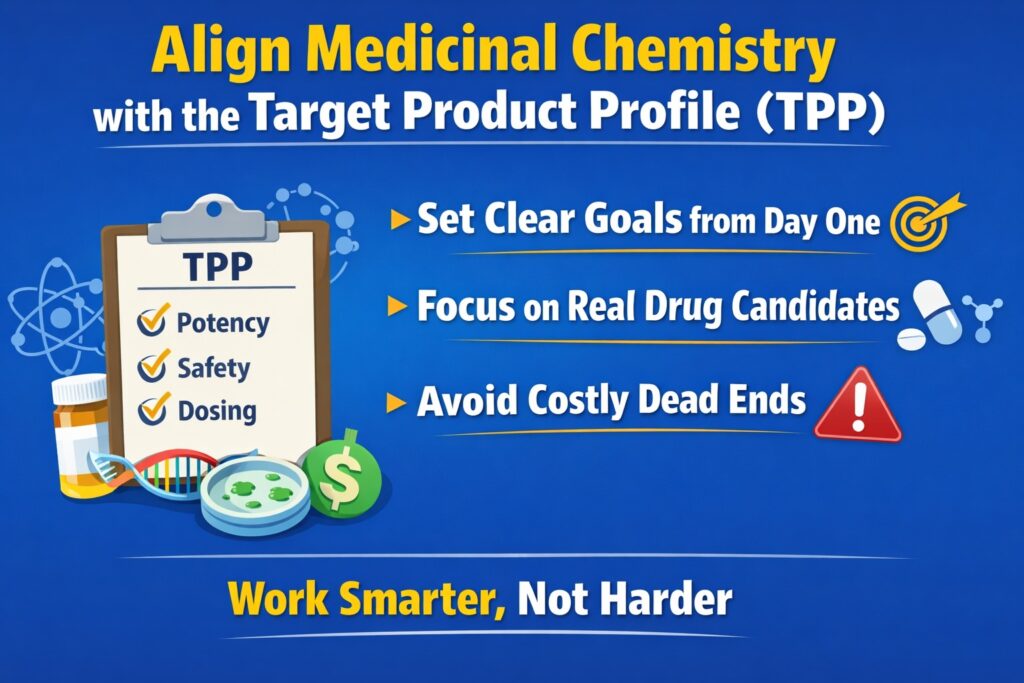
1. Align Chemistry with the Target Product Profile (TPP) from Day One
Aligning medicinal chemistry with your TPP from the start ensures you’re working on compounds that actually matter. It helps avoid wasted effort on molecules that may work in the lab but fail as real drugs. The TPP sets the standards for what a successful compound should look like, including how it’s absorbed, delivered, and tolerated.
By focusing only on compounds that meet the TPP criteria, teams can manage risk early and avoid chasing projects that are exciting scientifically but commercially unviable. This leads to more confident decision-making and a streamlined development path.
Why TPP Alignment Matters:
- Sets clear potency, safety, and dosing targets from the beginning.
- Keeps medicinal chemistry aligned with clinical and regulatory needs.
- Simplifies go/no-go decisions and guides effective structure–activity relationship (SAR) studies.
Access high-level strategy without the overhead: Learn about Virtual Chemistry Department CRO Services
2. Use a Modular Outsourcing Strategy to Keep Chemistry on Track
Virtual biotechs can’t do everything in-house, but outsourcing needs to be smart. A modular approach means assigning specific chemistry tasks to the right external partners based on their strengths. This improves quality, controls cost, and avoids delays.
Rather than using one CRO (contract research organization) for everything, break tasks into tiers. Reserve core decisions like SAR strategy for top-tier partners, and assign routine synthesis to others. This prevents confusion and preserves knowledge across projects.
Best Practices for Outsourcing:
- Tier 1: Core chemistry like SAR, complex synthesis, scale-up.
- Tier 2: Routine analog making and simple libraries.
- Tier 3: AI/ML support for compound prioritization and design.
Good outsourcing isn’t just about contracts. It’s about communication, transparency, and making sure each partner understands the project’s goals.
Scale your development efficiently: Discover Comprehensive CRO Chemistry Services
3. Compress DMTA Cycles for Faster Learning and Better Outcomes
DMTA stands for Design–Make–Test–Analyze. Virtual biotechs benefit more from speeding up these cycles than increasing how many compounds they make. Faster cycles lead to quicker learning and fewer wasted resources.
Speed requires tight coordination between chemistry and biology teams. If test results are delayed, the value of quick synthesis is lost. Every cycle should answer specific questions and be planned in advance.
How to Speed Up DMTA Cycles:
- Daily syncs between chemists and biologists.
- Real-time dashboards to track compound progress.
- Use predictive tools to guide design and avoid dead-ends.
Optimize your development timeline: Learn more about CRO Chemistry Services Timelines for Drug Discovery
4. Prioritize Chemical Series Using Risk Scoring
Capital in virtual biotech is finite, so it’s critical to allocate resources based on risk and reward. Not every chemical series deserves the same investment. A risk-adjusted scoring framework brings objectivity to decision-making and helps teams avoid emotional attachment to underperforming compounds. It considers multiple dimensions, including synthetic feasibility, developability risk, novelty of IP, and biological relevance.
Scoring chemical series early in the process helps teams flag and deprioritize problematic candidates before major resources are spent. For example, a promising series with poor solubility, weak patent positioning, or high synthetic complexity may be interesting but not worth advancing. Conversely, a compound with good developability metrics and clean IP space may warrant deeper investment—even if early potency is modest. These evaluations make portfolio management more rational and strategic. By using risk scoring to guide investment, virtual biotechs ensure that limited capital supports the most promising paths.
Access specialized synthesis expertise: Explore Custom Synthesis for Drug Discovery
5. Let Data Drive Your Chemistry—Quality Over Quantity
Virtual biotechs don’t need to make hundreds of compounds. Instead, focus on creating high-quality leads using data. Good data leads to better decisions, stronger SAR insights, and fewer failures.
Multiparameter optimization helps chemists balance potency, safety, and delivery all at once. Clean, well-organized data across vendors ensures reliability and repeatability.
Focus Areas:
- Use multiple factors in design—not just potency.
- Ensure consistent analytics and documentation.
- Build curated SAR datasets to feed into AI tools.
Ensure high-quality analytical insights: Custom Analytical Method Development for Drug Discovery
6. Connect Chemistry and Biology—Avoid Working in Silos
To move compounds forward efficiently, virtual biotech teams must ensure chemistry and biology teams work in close collaboration. Siloed functions lead to delays, miscommunication, and rework. Integrated project dashboards, regular team meetings, and shared goals help bridge these gaps. When chemists understand biological constraints—and biologists are aware of chemical limitations—projects advance faster and more strategically. This alignment makes experiments more actionable and improves overall program decision-making. In the world of medicinal chemistry for virtual biotech, integration isn’t optional—it’s essential for success.
Address metabolic challenges early: Metabolite Synthesis Services for Drug Discovery
7. AI Tools Only Work with High-Quality Chemistry Data
Artificial Intelligence can help prioritize compounds and suggest designs—but only when it’s based on solid, project-specific chemistry data. Generic public datasets or models that aren’t customized often produce unreliable results.
Synthetic feasibility should always be part of AI suggestions. If the tool recommends compounds that are impossible to make, it wastes time and money.
How to Use AI Effectively:
- Customize models using private SAR data.
- Continuously update models with new experiment results.
- Validate every model using real-world results.
8. Secure Your Intellectual Property (IP) Early and Clearly
Intellectual property (IP) is a critical asset in biotech and must be protected from the earliest stages of discovery. For virtual biotechs working with multiple CROs, the risk of IP confusion or leakage is high. Teams should file provisional patents early, create clear ownership contracts, and track compound development through detailed logs.
Consistent IP reviews and freedom-to-operate assessments ensure long-term protection and company valuation. Proactive IP management is a core pillar of medicinal chemistry for virtual biotech, safeguarding innovation and future deal-making potential.
9. Choose Partners Who Contribute Strategy, Not Just Synthesis
The best outsourcing relationships go beyond basic execution. Strategic CRO partners don’t just make compounds—they think critically, offer new ideas, and anticipate risks. These partners contribute to SAR planning, backup compound design, and ADMET interpretation. Their insights help internal teams make better decisions and adapt quickly to challenges.
This kind of collaborative thinking transforms outsourcing from a cost-saving tool into a competitive advantage. For virtual companies, elevating medicinal chemistry for virtual biotech through thoughtful partnership is a proven path to stronger results.
Leverage local expertise for global standards: Partner with a Drug Discovery CRO in Canada
10. Focus on Chemistry Efficiency, Not Just Throughput
In the resource-limited environment of virtual biotech, success depends more on impact than volume. Making fewer, better-targeted compounds is often more effective than flooding the pipeline with low-priority analogs. Efficiency metrics—like cost per lead or time per SAR milestone—offer valuable insight into program health. High chemistry efficiency shortens timelines, reduces costs, and increases the likelihood of clinical success.
Ultimately, medicinal chemistry for virtual biotech should be designed around strategic efficiency, not brute-force output.
Conclusion: Medicinal Chemistry for Virtual Biotech Is the Key to Success
In virtual biotech, chemistry is not just a service—it’s the driver of everything. A focused and intelligent strategy shapes speed, cost control, patent strength, and scientific progress. With the right plan, even small teams can achieve big results.
By working with trusted partners like ResolveMass Laboratories Inc., virtual biotech companies can overcome infrastructure limits and compete at the highest level. A well-planned chemistry strategy turns good science into real-world therapies.
Ready to Empower Your Medicinal Chemistry Pipeline?
Let’s design and deliver your next breakthrough compound together. Reach out to our strategic chemistry team at:
Most Asked FAQs on Medicinal Chemistry Strategy for Virtual Biotech
Virtual biotech companies operate with limited internal labs and rely heavily on external resources. A dedicated medicinal chemistry strategy ensures that each scientific decision supports clinical goals, reduces development risks, and improves efficiency from early discovery through to candidate selection.
Data-driven approaches reduce unnecessary synthesis by using predictive models and real-time insights to design better compounds. This helps avoid wasted effort, lowers cost per lead, and increases the success rate of advancing high-quality candidates.
AI tools assist in prioritizing and designing molecules by analyzing structure–activity relationships and predicting ADMET properties. When trained on well-curated data, they can accelerate decision-making and reduce trial-and-error cycles in early-stage development.
Medicinal chemistry plans should be reviewed bi-weekly during active DMTA cycles to stay agile. A broader strategic review every month ensures alignment with evolving data, resource availability, and long-term program goals.
IP protection starts with early patent filings and strong contractual terms that clearly define ownership. Regular IP landscape monitoring and documentation of compound development help safeguard innovation and future market exclusivity.
Yes, with the right frameworks, digital tools, and expert partners, even lean teams can handle complex medicinal chemistry programs. The key lies in planning, strategic outsourcing, and effective cross-functional collaboration.
Reference
- BioSolveIT GmbH. (n.d.). CROs for drug discovery: Partners for research. BioSolveIT. Retrieved January 13, 2026, from https://www.biosolveit.de/drug-discovery-solutions/cros-for-drug-discovery/
- Steadman, V. A. (2018). Drug discovery: Collaborations between contract research organizations and the pharmaceutical industry. ACS Medicinal Chemistry Letters, 9(7), 581–583. https://doi.org/10.1021/acsmedchemlett.8b00236
Get In Touch With Us
About The Author


