


Summary: Key Takeaways for Regulators, Quality Leaders, and Formulation Scientists
- GC-MS for Volatile Impurity Analysis remains unmatched in selectivity, sensitivity, and regulatory defensibility for pharmaceutical applications
- Global regulators (ICH, USP, EMA, FDA) implicitly and explicitly favor GC-MS-based data for volatile and residual impurity decisions
- Advances in MS detectors, columns, and automation have strengthened GC-MS rather than replaced it
- Alternative techniques (GC-FID, headspace GC, LC-MS) complement but do not supersede GC-MS for volatile impurity risk assessment
- GC-MS provides structure-confirming evidence critical for investigations, deviations, and impurity qualification
Introduction: Why GC-MS for Volatile Impurity Analysis Still Matters
GC-MS for Volatile Impurity Analysis remains a core tool in pharmaceutical quality control because it combines efficient chromatographic separation with precise molecular identification. This dual strength allows laboratories not only to detect volatile impurities but also to confirm exactly what those impurities are with high confidence.
Even with the availability of newer analytical technologies and increased laboratory automation, GC-MS continues to hold a central position in impurity risk management strategies. It supports key activities such as root-cause analysis, change control assessments, and global regulatory submissions throughout the product lifecycle.
Pharmaceutical manufacturing processes are complex, and volatile impurities may arise from raw materials, residual solvents, cleaning agents, packaging components, or degradation reactions. GC-MS provides detailed and reliable information that helps laboratories manage these risks effectively.
This article explains why GC-MS has maintained its gold-standard status, with a focus on practical pharmaceutical decision-making rather than theoretical concepts.
Explore the fundamentals: What is Gas Chromatography-Mass Spectrometry?
Why GC-MS for Volatile Impurity Analysis Is Still the Regulatory Benchmark
The primary reason regulators continue to trust GC-MS is its ability to deliver clear identification, trace-level sensitivity, and consistent performance over time. These characteristics are essential when product quality and patient safety are involved.
While regulatory agencies rarely mandate a specific instrument, their guidance documents, inspection practices, and reviewer expectations consistently favor GC-MS–supported data for volatile impurities. This preference is evident in both formal regulations and real-world regulatory interactions.
Key regulatory frameworks such as ICH Q3C and ICH Q3A/Q3B rely on GC-MS for the identification of residual solvents and low-boiling impurities. USP <467> is built around gas chromatographic methods, with GC-MS widely accepted for confirmation. During EMA and FDA inspections, mass spectral confirmation is often expected when unknown or unusual volatile peaks are detected.
GC-MS stands out because it confirms impurity identity, not just quantity. This difference becomes especially important during deviations, out-of-specification events, and impurity qualification exercises.
Deep dive into the science: Understanding the Working Principle of GC-MS
Why Identification Power Makes GC-MS for Volatile Impurity Analysis Irreplaceable
GC-MS is uniquely capable of answering the critical question, “What is the impurity?” even when volatile compounds are present at very low levels. This capability is essential in both development laboratories and commercial manufacturing sites.
Unexpected volatile impurities may appear due to changes in suppliers, cleaning processes, packaging materials, or manufacturing conditions. In such cases, knowing only the concentration does not resolve the issue or meet regulatory expectations.
GC-MS enables mass spectral fingerprinting of unknown peaks, allowing analysts to extract structural information directly from the data. Library matching using trusted databases such as NIST or Wiley supports fast, consistent, and reliable identification.
Additionally, GC-MS can differentiate co-eluting compounds and support structural hypotheses for new or process-related volatiles, something detectors like FID or PID cannot achieve. This strong identification capability is why GC-MS data is frequently used in regulatory responses and CAPA documentation.
Analyze complex samples: GC-MS Analysis of Plant Extracts
Sensitivity and Selectivity: Why GC-MS Still Outperforms Alternatives
GC-MS consistently offers superior sensitivity and selectivity compared to many alternative analytical techniques. This advantage becomes even more critical as regulatory limits for impurities continue to become stricter.
Modern pharmaceutical specifications often require detection at low-ppm or even sub-ppm levels, especially for Class 1 solvents or potentially genotoxic impurities. GC-MS can achieve these limits while maintaining data integrity and confidence.
Compared with GC-FID or headspace GC-FID, GC-MS provides confirmed identification rather than response-only detection. LC-MS, although powerful for nonvolatile substances, is generally unsuitable for low-boiling and highly volatile compounds.
GC-MS for Volatile Impurity Analysis enables early detection below ICH reporting thresholds, identification without reference standards during early development, and reduced risk of false positives in complex matrices.
Optimize your results: Maximizing GC-MS Sensitivity for Trace Detection
Why GC-MS for Volatile Impurity Analysis Is Critical in Investigations
GC-MS delivers scientifically and legally defensible data during quality investigations, deviations, and product complaints. This makes it a vital tool when unexpected quality issues occur.
Situations involving unusual odors, volatile contaminants, or leachables often require in-depth investigation. In many cases, GC-MS is used both as the initial screening technique and the final confirmatory method to close the investigation.
Common scenarios include unknown peaks in stability studies, cross-contamination in shared facilities, packaging-related volatile extractables, cleaning validation failures, and changes in raw material suppliers.
In all these cases, GC-MS supports true root-cause identification rather than simple detection, enabling effective corrective and preventive actions.
Ensure product safety: GC-MS Residual Solvent Analysis: What You Must Know
Method Robustness and Lifecycle Reliability of GC-MS
GC-MS methods are well known for their long-term reliability across development, validation, and commercial manufacturing. This lifecycle stability is especially valuable in regulated pharmaceutical environments.
Unlike newer or highly specialized technologies, GC-MS methods transfer smoothly between laboratories when properly developed and validated. They can be scaled from R&D to routine QC use without major changes.
With routine maintenance and appropriate system suitability checks, GC-MS methods remain stable and reliable for many years. This consistency lowers regulatory risk and supports long-term product quality management.
As a result, GC-MS for Volatile Impurity Analysis is widely used in ANDAs, NDAs, and other global regulatory submissions.
Customized solutions: Professional GC-MS Method Development Services
Technological Advances Have Strengthened GC-MS, Not Replaced It
Modern GC-MS systems are far more reliable, automated, and compliance-ready than earlier generations. These improvements have strengthened the technique rather than making it obsolete.
Advanced inert columns improve peak shape and recovery for trace volatile compounds. Enhanced electron ionization sources offer better stability and longer operational lifetimes.
Automated headspace-GC-MS workflows reduce analyst variability and increase sample throughput. Improved spectral deconvolution software allows clearer interpretation of complex chromatograms.
Together, these advancements have positioned GC-MS as a high-confidence compliance tool rather than a legacy analytical system.
Discover industry uses: Real-World Applications of GC-MS
Why Alternative Techniques Still Depend on GC-MS Confirmation
Even when other analytical tools are used for routine testing, GC-MS remains the final confirmatory technique. It is rarely excluded when critical quality decisions are required.
GC-FID or headspace GC may be suitable for monitoring known impurities under controlled conditions. However, GC-MS is almost always required when new impurities are detected, specifications change, or regulators request additional justification.
This reliance reinforces GC-MS for Volatile Impurity Analysis as the ultimate authority rather than just one option among many analytical techniques.
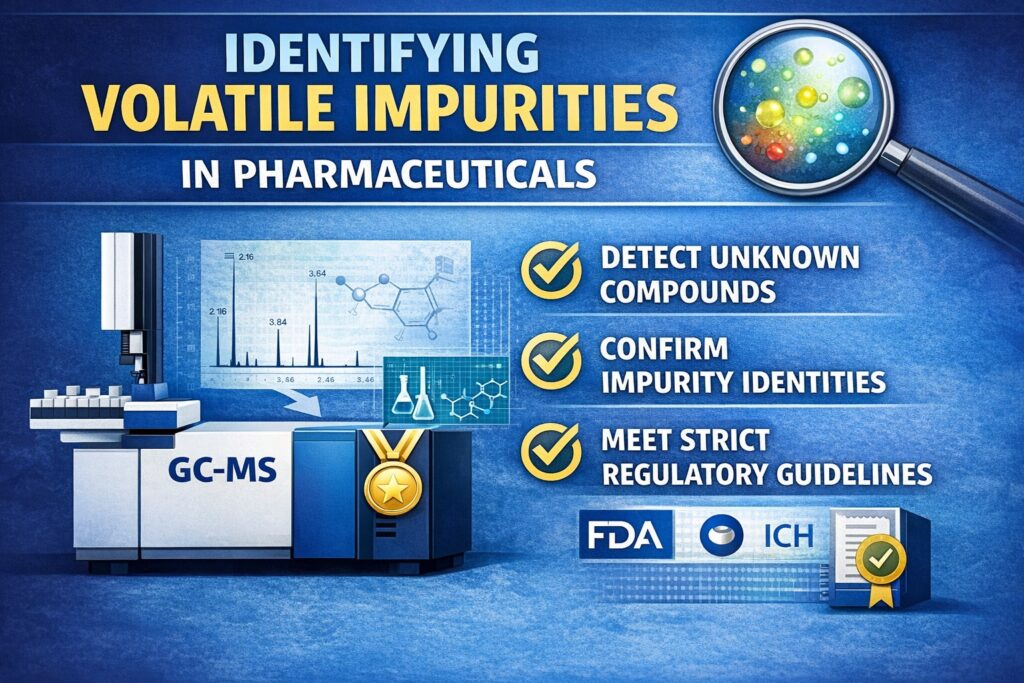
The Trust Factor: Why Regulators Trust GC-MS Data More
GC-MS generates data that is easy to interpret, audit, and reproduce, which is why it consistently withstands regulatory scrutiny. This trust has developed over decades of successful regulatory use.
From an inspection standpoint, GC-MS offers traceable spectral libraries, clear identification logic, and data that can be independently reviewed and verified.
Its long history of regulatory acceptance makes GC-MS a strong indicator of analytical credibility for both reviewers and inspectors. This level of confidence is difficult for newer technologies to achieve.
Local expert testing: High-Quality GC-MS Analysis in Montreal
Conclusion: Why GC-MS for Volatile Impurity Analysis Remains the Gold Standard
GC-MS for Volatile Impurity Analysis remains essential because it answers the most important pharmaceutical questions with clarity and confidence. It identifies impurities, helps trace their origin, and supports accurate risk assessment.
No other analytical technique provides the same balance of sensitivity, selectivity, identification strength, and regulatory trust. As impurity control requirements continue to tighten, the importance of GC-MS will only increase.
From early development to commercial manufacturing, GC-MS remains the foundation of volatile impurity control in the pharmaceutical industry.
Choosing the right technique: GC-MS vs LC-MS for Impurity Testing: A Comparison
Contact ResolveMass Today – Contact Us
Frequently Asked Questions (FAQs)
What are the volatiles in GC-MS?
Volatiles in GC-MS are chemical compounds that easily evaporate at relatively low temperatures. These include residual solvents, organic solvents, small hydrocarbons, alcohols, ketones, aldehydes, esters, and other low-boiling substances. In pharmaceuticals, volatiles often come from manufacturing processes, cleaning agents, or packaging materials. GC-MS is ideal for detecting and identifying these compounds at very low levels.
Yes, gas chromatography is especially suitable for analysing volatile compounds because it is designed to work with substances that can vaporize. The technique efficiently separates compounds in the gas phase without chemical breakdown. When coupled with MS, GC not only separates but also identifies volatile compounds with high confidence. This makes GC a preferred method in pharmaceutical, environmental, and chemical analysis.
GC primarily separates compounds based on their volatility and their interaction with the stationary phase of the column. More volatile compounds generally elute earlier, while less volatile ones elute later. However, polarity and column chemistry also influence separation. This combined effect allows GC to achieve clear and reproducible separation of volatile mixtures.
GC-MS for volatile organic compounds is an analytical technique used to separate and identify VOCs at very low concentrations. GC separates the individual compounds, while MS provides molecular-level identification. This combination allows accurate detection of known and unknown VOCs. It is widely used in pharmaceuticals, environmental testing, and industrial quality control.
Compounds that are nonvolatile, thermally unstable, or very high in molecular weight cannot be analyzed by GC. Examples include large biomolecules, proteins, polymers, and inorganic salts. These substances do not vaporize under GC conditions or may decompose when heated. In such cases, alternative techniques like LC-MS are more suitable.
No, LC-MS cannot fully replace GC-MS for volatile impurities. Volatile and low-boiling compounds are poorly retained and ionized in liquid chromatography systems. GC-MS is specifically designed to handle such compounds with better separation and identification. Therefore, LC-MS may complement but cannot substitute GC-MS for volatile impurity analysis.
Reference
- Upadhyay, R., Patel, K., & Upadhyay, U. (2023). A review article on advancements in GC-MS. International Journal of Pharmaceutical Research and Applications, 8(2), 54–59. https://doi.org/10.35629/7781-08025459
- Bajo-Fernández, M., Souza-Silva, É. A., Barbas, C., Rey-Stolle, M. F., & García, A. (2024). GC-MS-based metabolomics of volatile organic compounds in exhaled breath: Applications in health and disease. A review. Frontiers in Molecular Biosciences, 10, 1295955. https://doi.org/10.3389/fmolb.2023.1295955
Get In Touch With Us
About The Author


