


Introduction
Bringing a novel biologic from discovery to clinical trials requires rigorous scientific expertise, regulatory knowledge, and meticulous execution. IND Bioanalytical Support serves as the foundation for successful regulatory submissions, providing the analytical framework that demonstrates drug safety, exposure, and biological activity. At ResolveMass Laboratories Inc., we deliver end-to-end bioanalytical services for IND and NDA submissions that transform promising biologics into IND-ready therapeutic candidates.
This case study explores how our integrated IND Bioanalytical Support enabled a mid-sized biotechnology company to navigate the regulatory landscape and achieve a successful IND submission for a novel monoclonal antibody targeting inflammatory diseases—demonstrating the real-world value of partnering with an experienced bioanalytical CRO.
Summary :
This case study demonstrates how IND bioanalytical support from ResolveMass Laboratories Inc. enabled a biotechnology company to successfully submit an Investigational New Drug (IND) application for a novel monoclonal antibody therapeutic. Through comprehensive bioanalytical method development, validation, and regulatory consulting, our team delivered critical data packages that met FDA requirements and accelerated the path to clinical trials.
Key Highlights:
- Complete bioanalytical method development and validation within 4 months
- Successful FDA IND submission with no clinical hold or information requests
- GLP-compliant pharmacokinetic and immunogenicity assays developed and validated
- Regulatory strategy consulting that aligned bioanalytical data with FDA expectations
- Seamless transition from preclinical to Phase I clinical trial support
- 100% compliance with ICH M10 bioanalytical method validation guidelines
1: The Challenge: A Novel Biologic with Complex Analytical Needs
Client Background and Therapeutic Context
Our client, a biotechnology company focused on immunology therapeutics, developed a novel monoclonal antibody (mAb) designed to treat moderate-to-severe inflammatory bowel disease. The therapeutic candidate showed promising preclinical efficacy, but the team lacked the internal infrastructure and regulatory experience to generate the bioanalytical data required for IND submission.
The client developed a fully human monoclonal antibody for inflammatory bowel disease. While preclinical efficacy was strong, the company lacked internal capabilities for regulated bioanalytical services and needed expert IND Bioanalytical Support to move forward.
Key Analytical Challenges
- Complex biological matrices and matrix effects
- Tight regulatory timelines
- Immunogenicity risk requiring ADA assays
- Limited drug substance availability
- Need to integrate PK, PD, and biomarker bioanalysis
Specific Analytical Challenges
The project presented several critical challenges:
- Matrix Complexity: The therapeutic required analysis in multiple biological matrices including human serum, plasma, and tissue homogenates
- Regulatory Timeline: The client needed IND submission within 6 months to maintain competitive positioning
- Immunogenicity Concerns: As a fully human mAb, comprehensive anti-drug antibody (ADA) assessment was essential
- Limited Reference Material: Only small quantities of drug substance were available for method development
- Metabolite Identification: Potential degradation products and metabolites required characterization
These challenges are common when transitioning from discovery to regulated bioanalysis.
Why Expert IND Bioanalytical Support Was Essential
The complexity of biologic therapeutics demands specialized analytical expertise that goes beyond routine testing. Our client recognized that successful IND submission required:
- Validated bioanalytical methods meeting FDA and ICH guidelines
- GLP-compliant testing for regulatory acceptance
- Regulatory strategy guidance aligned with agency expectations
- Rapid turnaround without compromising data quality
- Comprehensive documentation supporting the IND application
2: Our Approach: Integrated IND Bioanalytical Support
How did ResolveMass enable IND success?
By combining regulatory strategy, advanced bioanalysis, and GLP execution within a single outsourced model.
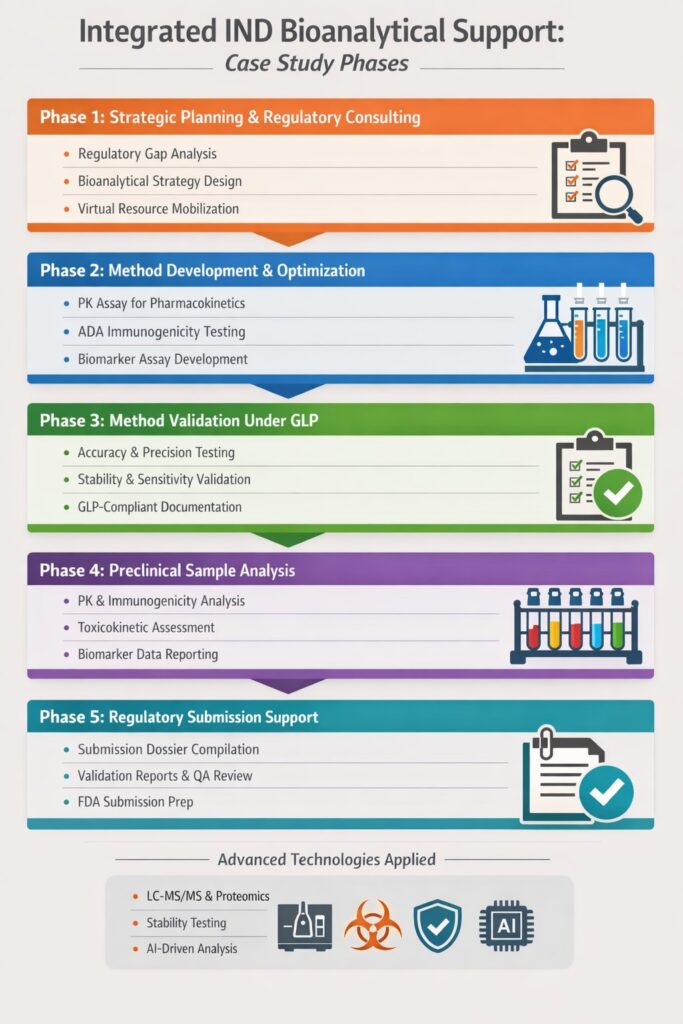
Phase 1: Strategic Planning and Regulatory Consulting (Weeks 1-2)
Initial assessment delivered immediate clarity on regulatory requirements. Our regulatory consulting team conducted a comprehensive gap analysis of the client’s existing data and outlined a complete bioanalytical strategy aligned with FDA expectations.
Early planning aligned bioanalytical methods with FDA expectations and ICH M10 guidance, avoiding rework later.
ResolveMass’ virtual bioanalytical strategy model allowed rapid mobilization without inflating costs.
Key Activities:
| Activity | Deliverable | Timeline |
|---|---|---|
| Regulatory landscape assessment | IND bioanalytical strategy document | Week 1 |
| Method development planning | Technical protocols and validation plans | Week 1-2 |
| Sample matrix evaluation | Matrix selection rationale | Week 2 |
| Reference standard qualification | Certificate of analysis and stability data | Week 2 |
Phase 2: Method Development and Optimization (Weeks 3-8)
Why method development matters for IND Bioanalytical Support
Because poorly designed methods are one of the most common reasons for IND delays.
Our scientists executed bioanalytical method development tailored for large molecules.
We developed three critical bioanalytical methods to support the IND submission:
1. Pharmacokinetic (PK) Assay Development
Our scientists developed a highly sensitive ligand-binding assay (LBA) using enzyme-linked immunosorbent assay (ELISA) technology. The method achieved a lower limit of quantification (LLOQ) of 50 ng/mL in human serum, providing adequate sensitivity for PK assessment across anticipated clinical dose ranges.
Critical Performance Characteristics:
- Sensitivity: LLOQ of 50 ng/mL with 20% CV and accuracy within 80-120%
- Selectivity: No interference from endogenous matrix components or common medications
- Linearity: Calibration curve range of 50-5000 ng/mL with R² > 0.98
- Stability: Demonstrated stability through freeze-thaw, bench-top, and long-term storage conditions
2. Anti-Drug Antibody (ADA) Assay Development
Immunogenicity assessment is paramount for biologic therapeutics. We developed a tiered ADA testing strategy including screening, confirmation, and titer determination using a bridging ELISA format.
The assay demonstrated appropriate sensitivity (100 ng/mL) to detect clinically relevant immune responses while maintaining acceptable drug tolerance (up to 10 μg/mL).
3. Biomarker Assay for Pharmacodynamic Assessment
To support proof-of-mechanism, we developed a biomarker assay measuring target engagement using a multiplex immunoassay platform. This assay enabled simultaneous quantification of three inflammatory markers relevant to the therapeutic’s mechanism of action.
Challenges such as sensitivity limits and interference were addressed using rapid bioanalytical method development strategies.
Phase 3: Method Validation Under GLP (Weeks 9-14)
Full method validation ensures regulatory acceptance and data integrity. Each bioanalytical method underwent comprehensive validation following FDA Bioanalytical Method Validation Guidance and ICH M10 guidelines.
How was regulatory trust established?
Through full bioanalytical method validation under GLP conditions.
Validation Parameters Assessed:
- Accuracy and precision (intra- and inter-day)
- Selectivity and specificity
- Sensitivity (LLOQ determination)
- Linearity and range
- Dilution integrity
- Stability (freeze-thaw, bench-top, long-term, processed sample)
- Parallelism (for LBA methods)
- Hook effect assessment (for ADA assay)
All validation studies were conducted under GLP compliance, with complete documentation packages including protocols, raw data, statistical analysis, and validation reports suitable for regulatory submission.
Phase 4: Preclinical Sample Analysis (Weeks 15-16)
We analyzed over 1,500 samples from GLP toxicology studies, providing comprehensive PK and immunogenicity data that supported the safety assessment required for first-in-human trials.
Analysis Deliverables:
- Individual and mean concentration-time profiles
- Clinical bioanalytical services
- PK parameter calculations (Cmax, Tmax, AUC, t½, clearance, volume of distribution)
- Dose proportionality assessment
- Toxicokinetic bioanalysis
- Immunogenicity incidence and correlation with PK
- High-throughput bioanalysis for rapid turnaround
- Study reports with full statistical analysis
Biomarkers confirmed pharmacodynamic activity.
Phase 5: Regulatory Submission Support (Weeks 17-18)
Our regulatory team compiled comprehensive bioanalytical documentation for inclusion in the IND submission, including:
- Complete method validation reports
- Bioanalytical study reports
- Certificate of analysis for reference standards
- Equipment qualification and calibration records
- Analyst training documentation
- Quality assurance statements
Advanced Bioanalytical Technologies Applied
While the primary modality was a biologic, complementary technologies were used:
- LC-MS/MS bioanalysis of xenobiotics and impurities
- Proteomics bioanalytical services for mechanistic insight
- Stability assessment through bioanalytical stability testing
- AI-enabled workflows improving efficiency
3: Results: Successful IND Submission and Clinical Trial Initiation
Regulatory Outcome
The FDA accepted the IND application without clinical hold or additional information requests regarding bioanalytical methods. This outcome validated our comprehensive approach to IND bioanalytical support and demonstrated the quality of data packages we deliver.
Project Metrics
| Metric | Target | Achieved |
|---|---|---|
| Timeline to IND submission | 6 months | 4.5 months |
| Method validation success rate | 100% | 100% |
| Regulatory deficiencies | 0 | 0 |
| Sample analysis turnaround | < 4 weeks | 2.5 weeks |
| Data quality (QC pass rate) | > 95% | 98.7% |
Clinical Trial Success
Following IND approval, our ongoing IND bioanalytical support continued through Phase I clinical trials:
- Real-time PK and ADA analysis supporting dose escalation decisions
- No safety signals related to unexpected PK or immunogenicity
- Successful completion of Phase I with dose selection for Phase II
- Seamless data integration across preclinical and clinical studies
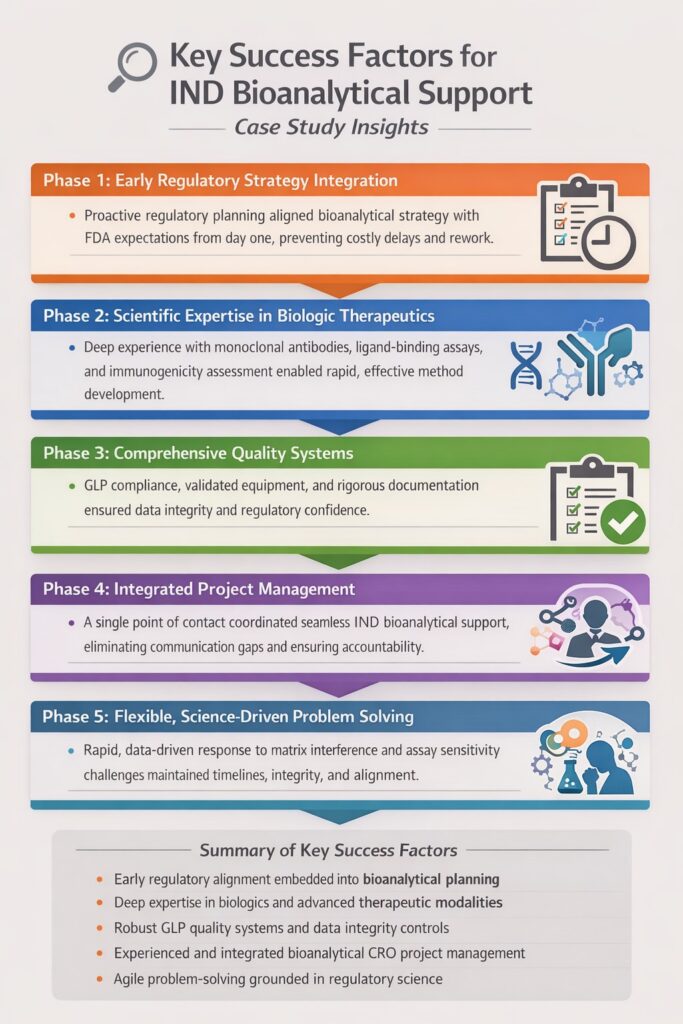
4: Key Success Factors: What Made This IND Submission Successful
1. Early Regulatory Strategy Integration
Proactive regulatory planning prevented costly delays and rework. By engaging our regulatory consulting team from day one, we ensured that all bioanalytical methods aligned with FDA expectations before significant resources were invested.
2. Scientific Expertise in Biologic Therapeutics
Biologics demand specialized analytical capabilities. Our team’s deep experience with monoclonal antibodies, ligand-binding assays, and immunogenicity assessment enabled efficient method development without the trial-and-error common in less experienced laboratories.
3. Comprehensive Quality Systems
GLP compliance isn’t just a checkbox—it’s a culture of quality. Our established quality systems, validated equipment, and trained personnel ensured that every aspect of the bioanalytical work met regulatory standards.
4. Integrated Project Management
A single point of contact coordinated all aspects of IND bioanalytical support, from method development through regulatory submission. This integration eliminated communication gaps and ensured seamless project execution.
5. Flexible Problem-Solving Approach
When unexpected challenges emerged—including matrix interference requiring assay optimization—our scientists quickly developed and validated alternative approaches without impacting project timelines.
Key success factors included:
- Early regulatory alignment
- Expertise in biologics and cell & gene therapy bioanalysis
- Robust quality systems
- Experienced bioanalytical CRO project management
5: Lessons Learned and Best Practices
5.1 For Biotechnology Companies Preparing IND Submissions
- Start bioanalytical planning early in therapeutic development. The most successful IND submissions result from bioanalytical strategies developed in parallel with preclinical studies, not as an afterthought.
- Partner with experienced bioanalytical laboratories. The complexity of regulatory requirements and analytical challenges demands expertise that most emerging biotechnology companies don’t maintain internally.
- Invest in comprehensive method validation. While abbreviated validation may seem cost-effective initially, full validation aligned with regulatory guidelines prevents delays and deficiency letters during FDA review.
- Plan for immunogenicity assessment from the beginning. ADA assay development often takes longer than PK assays and requires careful strategy aligned with the therapeutic’s characteristics.
5.2 For Bioanalytical Laboratories Supporting IND Submissions
- Regulatory expertise is as important as analytical expertise. Laboratories providing IND bioanalytical support must understand regulatory expectations and communicate effectively with agencies.
- Maintain flexibility in resource allocation. IND projects often face timeline pressure requiring rapid mobilization of resources and expertise.
- Document everything meticulously. The documentation supporting bioanalytical methods is as important as the methods themselves in regulatory submissions.
6: The Role of Advanced Bioanalytical Technologies
6.1 LC-MS/MS for Small Molecule Impurity Characterization
While the primary therapeutic was a monoclonal antibody analyzed by ligand-binding assays, we employed liquid chromatography-tandem mass spectrometry (LC-MS/MS) to characterize potential small molecule impurities and degradation products. This complementary analytical approach provided comprehensive quality assessment supporting the IND submission.
6.2 High-Resolution Mass Spectrometry for Structural Confirmation
Advanced mass spectrometry confirmed the structural integrity of the therapeutic candidate, identifying any post-translational modifications or sequence variants that could impact safety or efficacy.
6.3 Multiplex Immunoassay Platforms
Simultaneous biomarker analysis increased efficiency and reduced sample consumption, critical when working with limited preclinical study samples.
7: Ongoing Support Through Clinical Development
Phase I Bioanalytical Support
Our partnership extended beyond IND submission to support clinical trial execution. We provided:
- Real-time PK analysis supporting dose escalation decisions
- Safety monitoring through immunogenicity assessment
- PK/PD correlation analysis
- Data integration across study cohorts
Method Transfer and Global Laboratory Network
As the clinical program expanded internationally, we successfully transferred validated methods to partner laboratories in Europe and Asia, ensuring global consistency in bioanalytical data.
Regulatory Inspection Readiness
Our GLP-compliant systems withstood regulatory inspection during an FDA pre-approval inspection for a different client, demonstrating the robustness of our quality systems and procedures.
Regulators evaluate bioanalytical data to determine whether human exposure is scientifically and ethically justified. IND Bioanalytical Support must therefore demonstrate both technical rigor and regulatory foresight.
Key Regulatory Expectations Addressed
| Regulatory Expectation | Bioanalytical Consideration |
|---|---|
| Assay sensitivity | LLOQ aligned with projected clinical exposure |
| Selectivity | No interference from endogenous matrix components |
| Precision & accuracy | Compliance with FDA bioanalytical validation guidance |
| Stability | Demonstrated sample and analyte stability |
| Traceability | Complete documentation and audit readiness |
ResolveMass structured its IND Bioanalytical Support strategy around these expectations from the first discussion with the sponsor.
8. ResolveMass Bioanalytical Capabilities Supporting IND Programs
ResolveMass provides scalable solutions for sponsors at every stage:
- Bioanalytical services overview
- Affordable bioanalytical services for biotech startups
- Outsourced bioanalysis for drug development
- Cost-effective bioanalytical services
- Bioanalytical testing services cost transparency
- Why bioanalysis is critical in drug development
Conclusion
This case study demonstrates how comprehensive IND bioanalytical support from ResolveMass Laboratories Inc. transforms complex therapeutic candidates into IND-ready drug development programs. Through scientific expertise, regulatory knowledge, quality systems, and client partnership, we delivered validated bioanalytical methods and regulatory-grade data packages that enabled successful FDA submission and clinical trial initiation.
The successful IND submission for this novel biologic therapeutic resulted from integrated IND bioanalytical support that addressed every analytical and regulatory challenge. By combining method development expertise, validation excellence, GLP compliance, and regulatory strategy, we accelerated our client’s path to clinical trials while maintaining the highest standards of data quality and regulatory acceptability.
For biotechnology companies facing similar challenges in bringing novel biologics to clinical development, ResolveMass Laboratories Inc. offers the comprehensive IND bioanalytical support needed to navigate regulatory complexity and achieve submission success. Our proven track record, scientific expertise, and commitment to quality make us the ideal partner for transforming promising therapeutic candidates into approved medicines.
Frequently Asked Questions :
The path to IND for biologics involves generating sufficient nonclinical, CMC, and bioanalytical data to demonstrate safety for first-in-human studies.
Key steps include:
-Target identification and lead optimization
-Preclinical pharmacology and toxicology studies
-IND Bioanalytical Support (PK, ADA, biomarker assays)
-CMC development for biologics (cell line, formulation, stability)
-IND-enabling GLP studies
-IND dossier preparation and FDA submission
Early integration of regulatory strategy and bioanalysis is critical to avoid delays.
An IND becomes effective 30 days after FDA receipt, unless the FDA places the application on clinical hold.
Typical timelines:
-IND-enabling work: 6–18 months (program dependent)
-FDA review period: 30 calendar days
Strong IND Bioanalytical Support significantly reduces the risk of clinical holds during FDA review.
A novel biologic is a biological therapeutic with a new molecular structure, mechanism of action, or target not previously approved by regulatory authorities.
Examples include:
-First-in-class monoclonal antibodies
-Bispecific antibodies
-Fusion proteins
-Cell and gene therapies
Novel biologics often require customized bioanalytical methods and enhanced regulatory justification.
The FDA does not charge a filing fee for IND submissions.
However, total IND program costs typically range from:
-USD 1–5 million+, depending on:
-Preclinical toxicology scope
-Bioanalytical method development and validation
-Manufacturing and CMC activities
-Regulatory consulting
Efficient IND Bioanalytical Support helps control costs by preventing assay failure and rework.
The FDA evaluates an IND within 30 days of submission.
During this period, the FDA may:
-Allow the IND to proceed
-Request clarifications
-Place the IND on partial or full clinical hold
Clear bioanalytical validation data and compliant GLP documentation are essential for smooth review.
After IND approval, the sponsor may initiate Phase 1 clinical trials in humans.
Post-IND activities include:
-Clinical bioanalysis (PK, ADA, biomarkers)
-Ongoing IND safety reporting
-Protocol amendments and annual reports
-Continued regulatory interactions with the FDA
Robust IND Bioanalytical Support remains critical throughout early clinical development.
Reference
- Alex Kudrin , Ivana Knezevic , Jeewon Joung , Hye-Na Kang.Case studies on clinical evaluation of biosimilar monoclonal antibody: Scientific considerations for regulatory approval.https://www.sciencedirect.com/science/article/abs/pii/S1045105614001158
- Daniel Tusé, Tiffany Tu, Karen A. McDonald. Manufacturing Economics of Plant-Made Biologics: Case Studies in Therapeutic and Industrial Enzymes.https://onlinelibrary.wiley.com/doi/full/10.1155/2014/256135
- Successful Biotechnologies: Three Case Studies Report prepared for the Ministry of Research, Science and
Technology.https://www.researchgate.net/profile/William-Kaye-Blake/publication/266578602_Successful_Biotechnologies_Three_Case_Studies/links/5583506408ae89172b85da05/Successful-Biotechnologies-Three-Case-Studies.pdf - Sonya Das , Samuel Huang , Andrew W. Lo. Acceleration of rare disease therapeutic development: a case study of AGIL-AADC.https://www.sciencedirect.com/science/article/abs/pii/S1359644618303404
- Innovative Medicines Initiative (IMI) Case Study Analysis Reveals the True Added Value of Early-Phase Public-Private Partnerships (PPPs).https://www.liebertpub.com/doi/abs/10.1089/blr.2015.29008.hs
About the Author


