

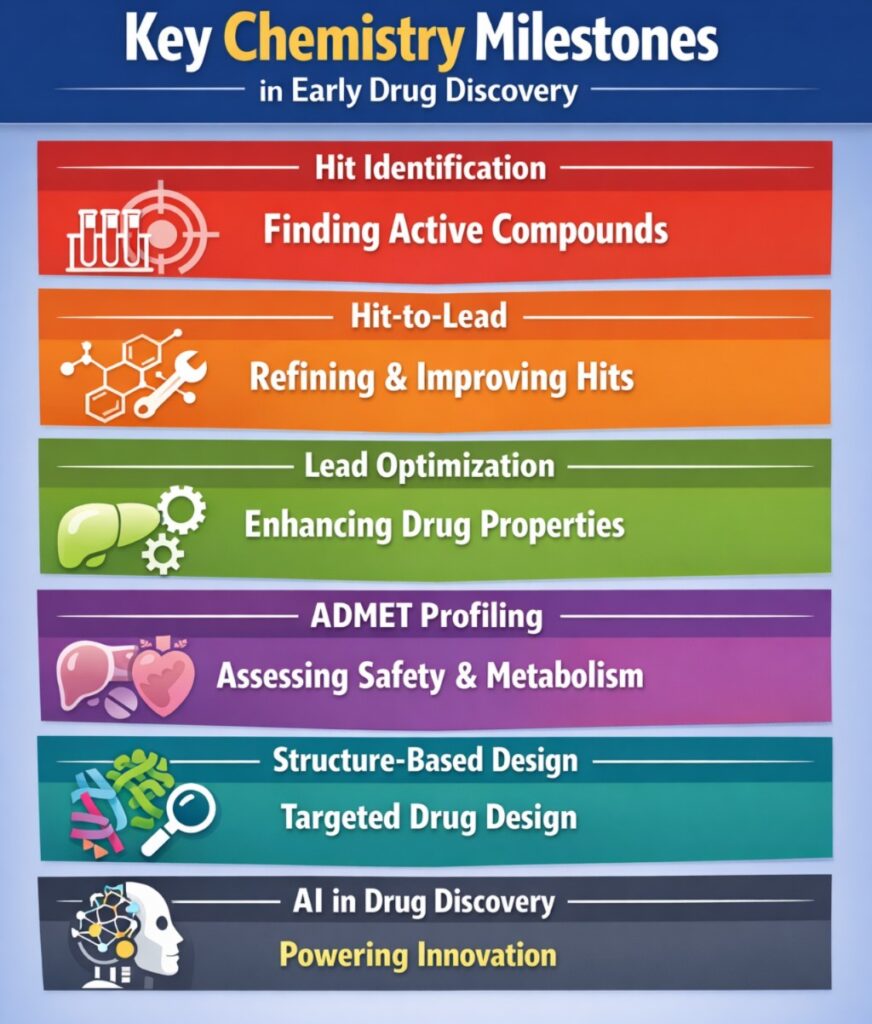
🔍 Summary of the Key Chemistry Milestones in Early Drug Discovery:
- Hit Identification: First turning point using high-throughput screening or virtual libraries.
- Hit-to-Lead Optimization: Chemical modifications for improving activity/selectivity.
- Lead Optimization: Extensive SAR studies to refine drug-like properties.
- Development of ADMET Profiling: A game-changer to predict human outcomes early.
- Introduction of Structure-Based Drug Design (SBDD): Major leap in molecular precision.
- Peptidomimetics and Macrocycles Emergence: Novel scaffolds for “undruggable” targets.
- Parallel Synthesis & Combinatorial Chemistry: Revolutionized compound libraries.
- Fragment-Based Drug Discovery (FBDD): Smaller, smarter starting points.
- Scaffold Hopping & Privileged Structures: Breakthroughs in target selectivity.
- Integration of AI/ML in Chemistry Stages: Most recent milestone reshaping pipeline.
Introduction: Understanding Early Drug Discovery Chemistry Milestones
In the world of pharmaceuticals, early drug discovery chemistry milestones mark important stages that shape the path from an idea to a potential medicine. These aren’t just procedural steps—they’re pivotal breakthroughs that have changed how scientists think and work in drug research.
Each milestone brings a new perspective, a better tool, or a smarter strategy. This article walks through each one, helping you understand how these changes have made drug discovery faster, more accurate, and more promising. Whether you’re a researcher, chemist, or industry partner, grasping these milestones is key to navigating the modern discovery process effectively.
Explore our full suite of drug discovery chemistry services to accelerate your research pipeline.
🎯 1. Hit Identification – The First Early Drug Discovery Chemistry Milestone
Hit identification is the crucial first step where scientists look for molecules that show potential biological activity. This is done by testing large compound libraries against a specific biological target to find “hits” worth exploring.
Methods That Defined This Milestone:
- High-Throughput Screening (HTS): Tests hundreds of thousands of compounds quickly.
- Virtual Screening: Uses computer models and AI to predict active compounds.
- Natural Products: Focuses on bioactive compounds found in nature.
| Method | Advantage | Limitation |
|---|---|---|
| HTS | Rapid, scalable screening | High false-positive rate |
| Virtual Screening | Cost-efficient, AI-compatible | Accuracy depends on algorithms |
| Natural Products | Evolutionarily optimized scaffolds | Synthetic complexity |
This milestone brought structure and speed to early discovery. It also encouraged teamwork between chemistry, biology, and computational science. By finding active molecules more systematically, this stage laid the groundwork for all future development steps.
Learn how our drug discovery CRO chemistry services can help you identify high-quality hits.
🧪 2. Hit-to-Lead – Refining Hits into Leads
Once hits are found, the focus shifts to making them better. In this milestone, chemists modify molecular structures to improve how well they work, how selective they are, and how stable they remain in the body.
Key Actions:
- Initial Structure-Activity Relationship (SAR) studies.
- Eliminating toxic or reactive groups.
- Enhancing solubility and metabolic stability.
Example:
By modifying a simple benzodiazepine through para-substitution, researchers improved its selectivity for GABA-A receptors. This shows how even small changes can lead to big improvements.
This stage represents a move from general screening to precise, strategic design. Understanding how different parts of a molecule affect performance became a central part of early drug discovery chemistry milestones.
Advance your program with specialized medicinal chemistry services for drug discovery.
🧬 3. Lead Optimization – The Core Chemistry Milestone
After choosing the best candidates, the lead optimization phase aims to create a well-rounded drug. This includes balancing strength, safety, and how the compound behaves in the body.
Focus Areas:
- Using Lipinski’s Rule of 5 to guide oral drug development.
- Modifying unstable parts using fluorine or deuterium.
- Applying isosteric replacement to fine-tune properties.
This is one of the most intense early drug discovery chemistry milestones. It involves testing and refining many compounds, using real-world data to shape better outcomes. The decisions made here often decide a project’s future success.
Enhance your lead optimization with custom synthesis for drug discovery tailored to your target.
🧫 4. ADMET Profiling – Predicting Success Earlier
Introducing ADMET (Absorption, Distribution, Metabolism, Excretion, Toxicity) profiling early in the process helped avoid late-stage failures. By assessing how a drug behaves in the body, teams can make smarter choices sooner.
Why It Matters:
- Saves time and money by removing unsafe candidates early.
- Detects liver toxicity and heart risks like hERG channel blocking.
- Uses in vitro tools like CYP450 enzyme testing for predictions.
ADMET profiling made safety and bioavailability core parts of medicinal chemistry. It changed the way early drug discovery chemistry milestones are approached by prioritizing compounds with real therapeutic promise.
Streamline your results with custom analytical method development for drug discovery.
🔬 5. Structure-Based Drug Design (SBDD) – Designing with Precision
With the help of X-ray crystallography and NMR, Structure-Based Drug Design (SBDD) lets chemists design drugs by looking directly at a protein’s structure. This gave drug discovery a huge accuracy boost.
Highlights:
- Designs compounds to fit a protein’s active site.
- Helped develop key drugs like Gleevec for cancer.
- Reduced trial-and-error in drug development.
SBDD allowed scientists to “see” how a molecule would interact before even making it. This level of atomic-level understanding advanced drug discovery and improved the quality of outcomes.
Looking for a partner in North America? Discover our drug discovery CRO in Canada.
🧱 6. Peptidomimetics and Macrocycles – Reaching Complex Targets
Some biological targets, especially protein-protein interactions, are hard to affect with regular small molecules. That’s where peptidomimetics and macrocycles come in.
Key Developments:
- Creating cyclic molecules for better stability.
- Using N-methylation to improve cell entry.
- Rigidifying scaffolds to enhance binding.
This breakthrough opened up new areas for treatment that were previously untouchable. It also expanded the toolbox of drug chemists tackling difficult diseases.
Access expert support through our medicinal chemistry CRO services for complex molecular targets.
⚗️ 7. Combinatorial Chemistry and Parallel Synthesis – Building Bigger Libraries
In the 1990s, automated systems helped chemists make thousands of compounds quickly. This innovation changed how research was done in early-stage drug discovery.
Benefits:
- Speeds up testing and SAR development.
- Creates diverse chemical libraries from key scaffolds.
- Uses microplate systems for efficiency.
This milestone gave scientists more options to explore and compare. It brought scale and speed to medicinal chemistry, making it a defining part of early drug discovery chemistry milestones.
Maximize efficiency with cost-effective drug discovery chemistry solutions.
💥 8. Fragment-Based Drug Discovery (FBDD) – A Smarter Way to Start
Rather than starting with big, complex molecules, Fragment-Based Drug Discovery (FBDD) uses smaller building blocks. These fragments are easier to work with and refine.
Advantages:
- High binding efficiency.
- Fragments fit deeper into target sites.
- Molecules are expanded using “growing” or “linking” strategies.
FBDD has led to real-world drugs like vemurafenib. It shows how starting small can lead to big breakthroughs, making it one of the most efficient early drug discovery chemistry milestones.
Utilize our isotopic labeling services for drug discovery to better understand molecular binding and metabolism.
🔄 9. Scaffold Hopping and Privileged Structures – Exploring New Directions
Scaffold hopping allows scientists to change the core of a molecule while keeping its key features. Privileged structures are frameworks known to work across many biological targets.
| Technique | Purpose |
|---|---|
| Scaffold Hopping | Explore new SAR by modifying the core framework |
| Privileged Structures | Utilize cores known to bind diverse receptor types |
This milestone gave medicinal chemists more room to innovate, both scientifically and from a patenting perspective. It also improved drug selectivity and minimized side effects.
🤖 10. AI in Early Drug Discovery – A New Era in Chemistry
Today, AI and machine learning are transforming how drug candidates are identified and optimized. These tools support every stage of early drug discovery.
Uses Include:
- Predicting compound activity.
- Creating new compounds with desired traits.
- Planning synthetic routes more efficiently.
By 2024, AI became an essential part of discovery teams. It’s not replacing chemists—it’s helping them work smarter. This is the newest and rapidly evolving chapter in early drug discovery chemistry milestones.
Conclusion: The Ongoing Impact of Early Drug Discovery Chemistry Milestones
Every one of these early drug discovery chemistry milestones has changed the way new drugs are discovered and developed. From faster screening to AI-driven design, these advancements help reduce failure rates, speed up timelines, and improve outcomes.
For companies aiming to bring better treatments to market, understanding and applying these milestones is essential. At ResolveMass Laboratories, we’re committed to staying ahead of the curve. Our chemistry teams are ready to support your discovery efforts with cutting-edge tools and expertise.
Need a flexible team? Learn about our virtual chemistry department CRO model.
👉 Contact ResolveMass Laboratories Inc.
FAQs on Early Drug Discovery Chemistry Milestones
Drug discovery milestones include key stages such as hit identification, hit-to-lead optimization, lead optimization, and ADMET profiling. Other important breakthroughs include structure-based drug design, fragment-based discovery, and the use of AI. These milestones help streamline the process from early research to clinical candidates.
Chemistry has played a central role in drug discovery by enabling the design, synthesis, and optimization of therapeutic compounds. It allows scientists to understand how molecular changes impact biological activity, safety, and stability. Chemical innovations have led to more effective, targeted, and safer medicines over time.
Structure-Based Drug Design (SBDD) introduced the ability to design drugs using 3D structures of biological targets. It helped researchers visualize how molecules interact at the atomic level, resulting in faster, more accurate compound development and better drug-target compatibility.
ADMET profiling allows scientists to predict how a compound will behave in the body before animal or human testing. It helps flag potential issues like toxicity or poor absorption early on, which saves time, cost, and reduces late-stage development failures.
AI has enhanced drug discovery by predicting compound activity, identifying structure-activity relationships, and automating synthesis planning. It accelerates decision-making and allows scientists to explore chemical space more efficiently while improving accuracy and innovation.
Privileged scaffolds are molecular frameworks known to interact well with a wide range of biological targets. They are often used in early drug discovery to increase the chances of finding active compounds and to build libraries with diverse therapeutic potential.
Reference
- BioSolveIT GmbH. (n.d.). CROs for drug discovery: Partners for research. BioSolveIT. Retrieved January 13, 2026, from https://www.biosolveit.de/drug-discovery-solutions/cros-for-drug-discovery/
- Steadman, V. A. (2018). Drug discovery: Collaborations between contract research organizations and the pharmaceutical industry. ACS Medicinal Chemistry Letters, 9(7), 581–583. https://doi.org/10.1021/acsmedchemlett.8b00236
Get In Touch With Us
About The Author


