

Executive Summary
- This case study demonstrates how Cost-Optimized Drug Discovery enabled a seed-stage biotech to reduce early chemistry spend by 38% while accelerating lead identification by 4 months.
- Strategic experimental design, milestone-based outsourcing, and data-driven compound prioritization prevented capital dilution during pre-seed and seed rounds.
- A hybrid model combining in-house scientific oversight with specialized external chemistry execution maximized ROI.
- Early integration of DMPK screening and predictive modeling avoided late-stage rework.
- Transparent reporting, rigorous documentation, and IP-aligned workflows strengthened investor confidence and due diligence outcomes.
Introduction
For seed-stage biotech companies with limited capital, Cost-Optimized Drug Discovery is essential for survival. It is not simply about spending less money; it is about spending wisely and intentionally. This case study describes how a first-time founding team developing a small-molecule oncology program implemented a focused chemistry framework that preserved runway and delivered a validated lead within 14 months.
Rather than following a trial-and-error approach, the team structured chemistry cycles around measurable scientific and financial goals. Every synthesis decision had to justify its cost. This disciplined mindset prevented unnecessary compound expansion and reduced redundant work.
The insights shared here are practical and based on real execution. Early-stage biotech teams can apply these methods directly to their own programs. When financial discipline and scientific rigor work together, progress becomes faster and more sustainable.
Discover how our cost-effective drug discovery chemistry solutions can help you maximize your research budget.
Project Background: The Seed-Stage Constraint
The biotech in this case study began with:
- $2.5M seed funding
- One validated biological target
- A small set of literature-derived scaffolds
- No internal chemistry infrastructure
- 18-month runway
At launch, the company faced a familiar early-stage challenge. Investors expected rapid progress, but financial resources were limited. Without internal medicinal chemistry capabilities, all synthesis work required external partners. Careful planning was necessary to avoid overspending.
The main objective was clear: advance medicinal chemistry fast enough to generate strong preclinical data, but preserve capital for Series A readiness. Poor burn-rate management could have led to stalled development or unfavorable financing. Therefore, chemistry strategy was treated as both a scientific and financial function.
The company required:
- Rapid SAR expansion
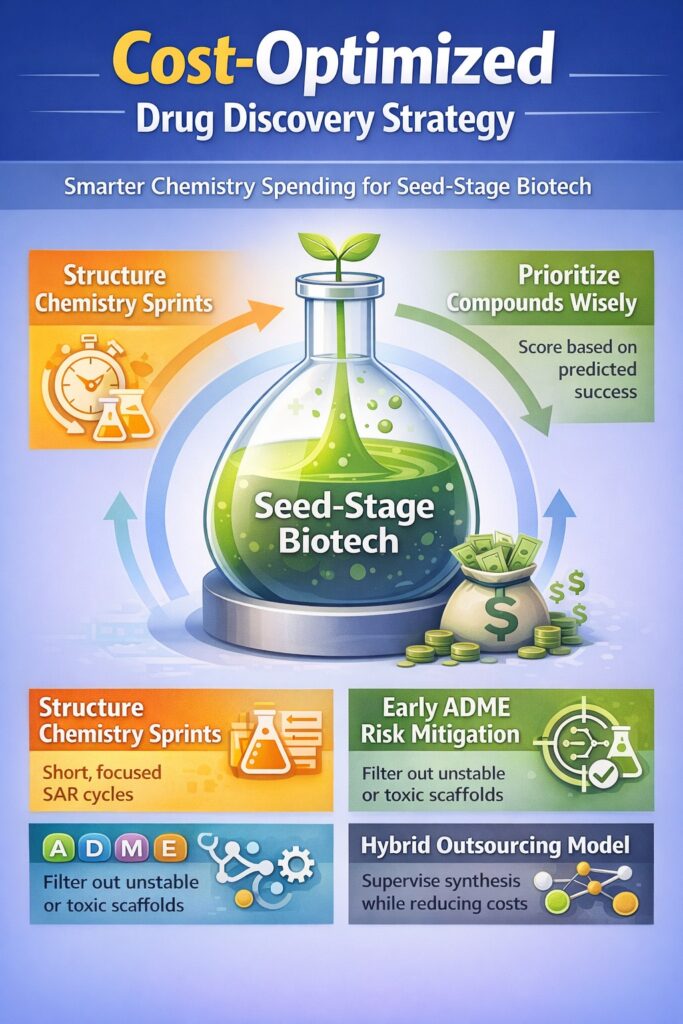
- Early ADME risk mitigation
- Exploration of patentable chemical space
- Controlled monthly burn rate
To meet these goals, leadership implemented a structured Cost-Optimized Drug Discovery program. Every experiment was evaluated based on scientific value and capital efficiency.
Learn how to navigate early drug discovery chemistry milestones with a strategic roadmap.
1. Cost-Optimized Drug Discovery Strategy: Structured Chemistry Execution
The program was built around milestone-based chemistry cycles, predictive compound prioritization, and capital-efficient outsourcing to reduce unnecessary synthesis.
Instead of launching large open-ended campaigns, the team created short chemistry sprints. Each sprint had predefined hypotheses and measurable decision points. Advancement required data support, which reduced speculative compound generation.
Key Strategic Decisions
- 4–6 week chemistry sprints with decision gates
- Maximum 20 analogs per iteration
- Early property filtering before scale-up
- Outsourced synthesis only after computational triage
- Weekly cross-functional review meetings
Limiting analog numbers forced better design thinking. Weekly reviews ensured alignment between chemistry, biology, and modeling teams. This prevented miscommunication and reduced rework.
Why This Reduced Cost
Many early-stage programs oversynthesize compounds before validating SAR direction. This creates high CRO invoices without meaningful learning. By applying discipline and predictive filters, the company reduced unnecessary synthesis while maintaining steady scientific progress.
Accelerate your development with our drug discovery CRO chemistry services tailored for startups.
2. Cost-Optimized Drug Discovery Execution: Compound Prioritization Model
A structured multi-parameter scoring system guided compound selection.
Instead of focusing only on potency, the company evaluated compounds across several development-relevant factors. This prevented downstream failures related to ADME or manufacturability. The scoring framework also created transparency for investors.
Compound Selection Framework
| Parameter | Weight (%) | Rationale |
|---|---|---|
| Predicted Potency | 30 | Maintain biological focus |
| Synthetic Complexity | 20 | Minimize costly routes |
| Lipophilicity (cLogP) | 15 | Avoid ADME failure |
| IP Space Coverage | 15 | Ensure patentability |
| Metabolic Stability Prediction | 10 | Early DMPK risk control |
| Chemical Stability | 10 | Reduce reformulation cost |
Only compounds meeting threshold scores progressed to synthesis. This gating mechanism ensured balanced profiles rather than potency-only decisions.
Financial Impact
- 43% reduction in compounds synthesized
- 27% reduction in CRO invoices in six months
- Early elimination of two high-risk scaffolds
This reflects Cost-Optimized Drug Discovery in practice—achieving efficiency through smarter decisions rather than reduced ambition.
Optimize your lead compounds using medicinal chemistry services for drug discovery designed for precision.
3. Cost-Optimized Drug Discovery Chemistry Cycles: Sprint-Based SAR
Short SAR cycles prevented strategic drift and reduced capital waste.
Each sprint included focused hypothesis testing and rapid validation. The time constraint encouraged sharper design and quicker interpretation. Poor-performing scaffolds were discontinued early.
Each sprint included:
- Hypothesis formulation
- 12–20 targeted analog synthesis
- Parallel in vitro screening
- ADME triage (microsomal stability and solubility)
- Go / No-Go decision
Data review occurred immediately after each cycle. This avoided backlog and prevented extended investment in weak chemical series.
Stay on track with our CRO chemistry services timelines for drug discovery to ensure rapid data turnaround.
Timeline Impact
| Phase | Traditional Timeline | Optimized Timeline |
|---|---|---|
| Initial SAR Expansion | 6 months | 3 months |
| Lead Optimization Start | Month 9 | Month 5 |
| IND-Enabling Readiness | Month 24+ | Month 18 (projected) |
Focused cycles improved speed without increasing financial risk.
4. Cost-Optimized Drug Discovery Outsourcing Model: Hybrid Oversight
Internal strategic leadership combined with targeted outsourcing improved efficiency and quality.
Instead of outsourcing the full program, the biotech retained control over SAR strategy and route planning. Specialized CROs handled synthesis and analytical execution. This prevented bundled service markups and improved data ownership.
Outsourcing Framework
| Task | In-House | Outsourced |
|---|---|---|
| Strategy & SAR Design | ✓ | |
| Route Planning | ✓ | |
| Compound Synthesis | ✓ | |
| Analytical Characterization | ✓ | |
| Data Review & Decision | ✓ |
This hybrid structure strengthened IP clarity and improved documentation for investors. It also ensured scientific continuity across iterations.
See how we support biotech growth as an outsourced medicinal chemistry partner for startups.
5. Cost-Optimized Drug Discovery and Early DMPK Integration
Early DMPK integration prevented expensive redesign later.
Some startups delay ADME studies to conserve capital. However, this often results in higher downstream costs. This biotech embedded DMPK screening into early SAR cycles to identify metabolic risks early.
Implemented measures included:
- Microsomal stability testing at IC50 stage
- Early plasma protein binding analysis
- Rapid solubility profiling
- CYP inhibition screening
Result
Two high-potency scaffolds were discontinued early due to metabolic instability. This avoided approximately $400K in future chemistry spending. Early risk detection protected both capital and timeline.
Identify metabolic risks early with metabolite synthesis services for drug discovery.
6. Cost-Optimized Drug Discovery IP Alignment
IP planning was integrated into chemistry from the beginning.
Scaffold novelty was mapped before heavy synthesis investment. Legal consultation aligned substitution strategies with defensible claims. This prevented wasted work on non-patentable structures.
Actions included:
- Scaffold novelty mapping
- Claim drafting consultation at Month 4
- Strategic substitution pattern planning
Impact
- Provisional patent filed within eight months
- Stronger Series A valuation positioning
- Avoided re-synthesis of prior-art-adjacent compounds
Integrating IP into chemistry planning added both legal strength and financial value.
Streamline your results with custom analytical method development for drug discovery.
7. Cost-Optimized Drug Discovery Financial Outcome Metrics
The structured approach extended runway and improved investor metrics.
Strategic Outcomes
- Lead candidate identified by Month 14
- Strong preclinical data package
- Successful $12M Series A raise
These financial improvements directly strengthened fundraising discussions and reduced perceived execution risk.
Scale your research capabilities without the overhead using our virtual chemistry department CRO model.
Key Lessons for Seed-Stage Biotech Founders
- Limit compound synthesis volume
- Implement early decision gates
- Integrate ADME from the beginning
- Align IP with chemistry design
- Separate strategy from execution in outsourcing
True Cost-Optimized Drug Discovery is about disciplined execution. It is not about cutting science but about focusing effort where it creates measurable value.
Common Pitfalls Avoided in This Case Study
- Potency-only optimization
- Full outsourcing without oversight
- Delayed DMPK screening
- Ignoring early patent landscape review
- Large upfront CRO commitments without milestone controls
Avoiding these mistakes preserved capital and accelerated development. Early discipline prevented costly corrections later.
Conclusion
This case study shows that Cost-Optimized Drug Discovery for seed-stage biotech requires structured chemistry planning, milestone gating, hybrid outsourcing, and proactive risk management. Financial discipline and scientific rigor must operate together.
Through predictive prioritization, sprint-based SAR cycles, and early DMPK integration, the biotech reduced chemistry spending by 38% and advanced faster toward clinical readiness. The result was improved capital efficiency and stronger investor confidence.
For seed-stage companies, Cost-Optimized Drug Discovery means using every dollar strategically. When executed properly, it enhances speed, protects IP value, and strengthens fundraising outcomes without compromising scientific quality.
Frequently Asked Questions (FAQs)
Seed-stage biotech companies can control chemistry costs by working in short, goal-driven cycles and approving synthesis only after clear data review. Using predictive modeling before lab work also reduces unnecessary compounds. This focused approach keeps spending aligned with milestones while maintaining scientific speed and quality.
The largest cost driver is uncontrolled compound synthesis without a defined SAR strategy. When teams create large libraries without strong hypotheses, CRO expenses rise quickly. Lack of decision gates often leads to repeated experiments and avoidable financial leakage.
Delaying DMPK may appear to save money initially, but it often increases total program cost later. Early ADME and metabolic screening help identify weak scaffolds before heavy investment. Integrating DMPK early supports a strong Cost-Optimized Drug Discovery framework.
Full outsourcing without internal oversight can reduce strategic control and increase long-term costs. A hybrid model, where internal experts guide strategy and CROs handle execution, typically provides better cost transparency and IP protection.
Early IP planning prevents investment in chemical space that lacks novelty or freedom to operate. By aligning patent strategy with chemistry design from the beginning, companies avoid rework and strengthen valuation during fundraising.
No, when properly implemented, cost optimization actually improves scientific focus. Structured decision gates remove low-value experiments and highlight meaningful data. The goal is not to reduce science, but to remove waste.
Reference
- Jordan, A. M., & Roughley, S. D. (2009). Drug discovery chemistry: A primer for the non-specialist. Drug Discovery Today, 14(15–16), 731–744. https://doi.org/10.1016/j.drudis.2009.04.005
- Ma, C., Lindsley, C. W., Chang, J., & Yu, B. (2024). Rational molecular editing: A new paradigm in drug discovery. Journal of Medicinal Chemistry, 67(14), 11459–11466. https://doi.org/10.1021/acs.jmedchem.4c01347
- Jordan, A. M., & Roughley, S. D. (2009). Drug discovery chemistry: A primer for the non-specialist. Drug Discovery Today, 14(15-16), 731–744. https://doi.org/10.1016/j.drudis.2009.04.005
- Shareef, U., Altaf, A., Ahmed, M., Akhtar, N., Almuhayawi, M. S., Al Jaouni, S. K., Selim, S., Abdelgawad, M. A., & Nagshabandi, M. K. (2024). A comprehensive review of discovery and development of drugs discovered from 2020–2022. Saudi Pharmaceutical Journal, 32(1), 101913. https://doi.org/10.1016/j.jsps.2023.101913
Get In Touch With Us
About The Author


