

Introduction
Outsourcing Generic Projects to CROs is now a core strategy for pharmaceutical companies operating in today’s competitive and highly regulated environment. Regulatory agencies are applying stricter review standards, and margins in the generic market continue to shrink. Companies must deliver accurate and compliant data within tight timelines to stay competitive.
Generic development is no longer just about copying an existing product. It requires deep understanding of regulatory science, impurity profiling, stability study design, analytical characterization, and carefully planned bioequivalence studies. Every stage must meet global regulatory expectations to avoid delays or deficiencies.
By outsourcing generic projects to CROs, pharmaceutical companies gain access to structured systems, experienced scientists, and validated processes. This reduces uncertainty and improves submission quality. In many cases, CRO collaboration directly impacts approval timelines and commercial performance.
For many organizations, this approach is no longer optional. It is a strategic decision that supports growth, efficiency, and compliance at the same time.
Explore our comprehensive solutions for early-stage development: Accelerate your pipeline with expert Drug Discovery Services
Summary: Why Outsourcing Generic Projects to CROs Is a Strategic Imperative
- Pharmaceutical companies outsource generic projects to CROs to accelerate time-to-market, reduce regulatory risk, and control costs.
- CROs provide specialized expertise in bioequivalence (BE), analytical method development, stability studies, and regulatory submissions.
- Outsourcing generic projects to CROs ensures scalability, flexibility, and access to advanced technologies without heavy capital investment.
- CRO partnerships reduce the burden of ANDAs, dossier compilation, and global regulatory compliance.
- CROs enable companies to focus internal resources on pipeline expansion and strategic growth.
- Risk mitigation, data integrity, and compliance with global standards are primary drivers.
Why Pharmaceutical Companies Prefer Outsourcing Generic Projects to CROs
Pharmaceutical companies choose outsourcing generic projects to CROs because it improves speed, technical reliability, regulatory confidence, and cost management. In competitive generic categories, being early to market can significantly improve revenue.
The generics sector works on tight approval windows and narrow profit margins. Even a short delay in ANDA approval or BE study completion can result in major financial impact. CROs help minimize these risks by following proven workflows and structured development models.
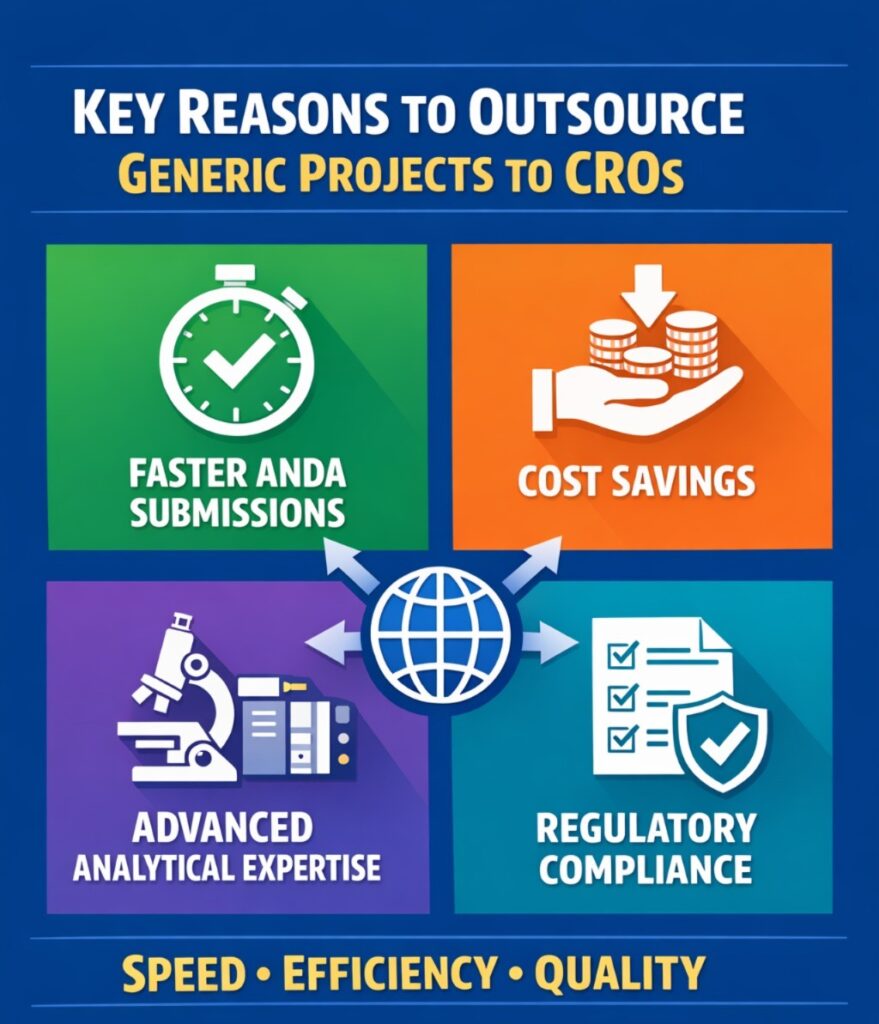
Key Strategic Reasons for Outsourcing Generic Projects to CROs
- Faster ANDA submission timelines
- Reduced need for capital investment
- Access to specialized analytical and bioanalytical expertise
- Regulatory knowledge across USFDA, Health Canada, EMA, MHRA
- Flexible scaling of development capacity
- Risk-sharing development partnerships
In crowded therapeutic markets, a delay of just a few months can reduce profitability. CRO partnerships support better planning, early risk identification, and smoother regulatory interactions.
How Outsourcing Generic Projects to CROs Accelerates Time-to-Market
One major benefit of outsourcing generic projects to CROs is faster development timelines. CROs already have established laboratories, trained teams, and regulatory systems in place. Companies can start projects immediately without building infrastructure from scratch.
Parallel Development Capabilities
CROs often run analytical method development, formulation optimization, and stability studies at the same time. This parallel approach reduces unnecessary waiting periods. As a result, the overall development cycle becomes shorter and more efficient.
Dedicated Regulatory Teams
Experienced regulatory professionals prepare ANDA and CTD dossiers with attention to detail. They understand common agency questions and prepare responses in advance. This reduces back-and-forth communication and helps shorten review timelines.
Ensure your submission meets the highest standards: Optimize your filings with Analytical Method Development and Validation Services
Pre-validated Systems and Equipment
CRO laboratories are already qualified and compliant. Instruments are calibrated and supported by documentation systems. This eliminates setup delays and improves data reliability.
Established Clinical Networks
CROs often have access to established BE clinical sites. Faster subject recruitment prevents study delays and supports timely database lock and reporting.
Time Comparison Example
| Activity | In-house Setup | CRO Partnership |
|---|---|---|
| Analytical Method Development | 4–6 months | 2–3 months |
| Bioequivalence Study Start | 3–5 months | 1–2 months |
| Stability Study Initiation | Delayed by lab setup | Immediate |
| Regulatory Compilation | Sequential | Parallel |
In the generic industry, time directly affects revenue. That is why outsourcing generic projects to CROs is often viewed as a revenue protection strategy.
Why Cost Optimization Drives Outsourcing Generic Projects to CROs
Cost control is another important reason behind outsourcing generic projects to CROs. Building and maintaining advanced laboratories requires large capital investment. Equipment such as LC-MS/MS, ICP-MS, and HRMS is expensive and requires skilled professionals.
By partnering with CROs, companies convert fixed infrastructure costs into project-based expenses. This allows better financial planning and avoids idle laboratory overhead. Resources can then be allocated toward expanding the product pipeline or entering new markets.
Cost Benefits of the CRO Model
- No major investment in analytical instruments
- Reduced hiring and training expenses
- Lower facility maintenance costs
- Flexible budgeting per development program
- Reduced compliance management burden
This financial model supports long-term sustainability while maintaining high scientific standards.
Leverage high-end technology without the overhead: Access precision data with Mass Spectrometry-Based Analytical Services
How Regulatory Complexity Encourages Outsourcing Generic Projects to CROs
Global regulatory requirements are becoming more detailed and demanding. Agencies now expect strong impurity profiling, validated analytical methods, and strict data integrity practices. This complexity makes outsourcing generic projects to CROs a practical solution.
Health authorities focus on nitrosamine risk assessment, elemental impurity evaluation under ICH Q3D, extractables and leachables studies, forced degradation testing, and ALCOA+ data integrity principles. Each requirement must be supported with clear documentation and validated systems.
CROs typically operate with dedicated Quality Assurance teams and inspection-ready documentation. They conduct internal audits and gap assessments to maintain compliance. By outsourcing generic projects to CROs, companies reduce the risk of deficiency letters or regulatory delays.
Address complex safety requirements proactively: Mitigate risks with specialized Nitrosamine Analysis
Access to Advanced Analytical and Bioequivalence Expertise
Outsourcing generic projects to CROs gives companies access to specialized analytical and pharmacokinetic expertise. These capabilities are essential for regulatory approval but may not always be available internally.
Generic development requires accurate bioanalytical method validation, plasma sample testing, stability-indicating methods, polymorphism studies, and trace impurity analysis. Even small errors can lead to regulatory questions or study failures.
Ensure material compatibility and safety: Secure your product integrity with Extractables and Leachables Testing
Many CROs invest in advanced mass spectrometry systems, high-resolution analytical tools, and dedicated BE clinical units. This improves data accuracy and reproducibility. For mid-sized and emerging pharmaceutical companies, outsourcing ensures access to these resources without heavy capital investment.
Risk Mitigation Through Outsourcing Generic Projects to CROs
Risk management is a key advantage of outsourcing generic projects to CROs. Development risks may include failed BE studies, dissolution profile mismatches, stability failures, or regulatory rejection.
CROs apply structured feasibility assessments, early gap analysis, and statistical evaluation methods. These preventive steps help identify potential issues before submission. This proactive approach reduces costly redevelopment and improves the chances of first-cycle approval.
Protect your product’s shelf-life and compliance: Ensure long-term quality with Stability Studies for Pharma
By sharing responsibility with experienced partners, companies strengthen their regulatory position and protect project timelines.
Scalability and Flexibility in Outsourcing Generic Projects to CROs
Generic markets change quickly due to patent expirations and competitive launches. Outsourcing generic projects to CROs allows companies to scale programs based on demand.
CROs can manage multiple molecules at the same time, onboard new projects quickly, and support submissions across different regulatory regions. This flexibility is difficult to achieve with fixed internal infrastructure.
Such adaptability helps companies respond to market changes while maintaining compliance and development efficiency.
Utilize industry-standard separation techniques: Enhance your characterization with professional HPLC Analysis
Strategic Focus: Reallocating Internal Resources
When companies adopt outsourcing generic projects to CROs, internal teams can focus on high-value activities. Instead of managing routine generics, leadership can invest in complex generics, specialty dosage forms, 505(b)(2) pathways, or biosimilars.
This separation of operational execution and strategic planning improves long-term growth. Internal expertise can be directed toward innovation and differentiation, while CROs manage structured development tasks.
The result is a more balanced and competitive portfolio strategy.
When Outsourcing Generic Projects to CROs Makes Business Sense
There are specific situations where outsourcing generic projects to CROs becomes especially beneficial. For example, companies entering a new regulatory market may require external expertise. Similarly, organizations without BE infrastructure can benefit from CRO clinical facilities.
Other scenarios include managing multiple simultaneous ANDA submissions or recovering from regulatory observations. In such cases, CRO experience helps improve compliance alignment and submission quality.
Making the right partnership decision at the right time can significantly improve approval outcomes.
Key Evaluation Criteria When Choosing a CRO
Although outsourcing generic projects to CROs offers many advantages, selecting the right partner is critical. Not all CROs have the same regulatory track record or analytical depth.
Evaluation Checklist
- Regulatory inspection history
- Bioequivalence study success rate
- Depth of analytical capabilities
- Strong data integrity systems
- Transparent communication processes
- Proven ANDA approval experience
Careful evaluation ensures the CRO aligns with long-term business goals and quality expectations.
Future Outlook: Digital Innovation in Outsourcing Generic Projects to CROs
Technology is shaping the future of outsourcing generic projects to CROs. Digital tools and AI-driven systems are improving regulatory intelligence and data management.
Emerging trends include AI-supported impurity prediction, digital stability monitoring, electronic Trial Master Files (eTMF), automated quality audits, and real-time regulatory tracking systems. These tools enhance transparency and improve submission readiness.
Companies partnering with technology-focused CROs gain stronger compliance control and faster response to regulatory changes.
Conclusion
Outsourcing Generic Projects to CROs is now a growth-driven strategy rather than just a cost-saving measure. In a competitive generic environment, precision, compliance, and speed determine commercial success.
From reduced time-to-market and better regulatory readiness to access to advanced analytical expertise, outsourcing generic projects to CROs helps pharmaceutical companies protect margins and expand portfolios. The model combines flexibility with scientific excellence.
In today’s complex regulatory landscape, experienced CRO partnerships provide the operational strength needed to achieve consistent approval success and sustainable growth.
Frequently Asked Questions (FAQs)
Pharmaceutical companies prefer Outsourcing Generic Projects to CROs because it improves efficiency and reduces internal workload. CROs bring experienced teams, ready infrastructure, and clear regulatory understanding. This combination helps companies move projects forward with fewer delays. It also supports better compliance with global regulatory standards.
CROs prepare detailed and well-structured submissions supported by validated data. Their regulatory experts understand common agency expectations and potential review concerns. This proactive approach minimizes deficiencies and review cycles. As a result, approval timelines become more predictable.
Outsourcing helps reduce risks such as bioequivalence failure, analytical errors, and regulatory objections. CROs conduct early risk assessments and apply strict quality controls. They also maintain audit-ready documentation systems. This structured process lowers the chances of costly rework.
A reliable CRO should provide bioanalytical testing, BE study management, advanced analytical tools, and regulatory support. Strong quality assurance systems are also essential. Inspection readiness and data integrity practices must be well established. These capabilities ensure smooth development and submission processes.
CROs shorten timelines by running activities in parallel and using pre-qualified systems. They eliminate the need for infrastructure setup and reduce documentation delays. Faster execution supports earlier submissions. This helps companies capture market opportunities more effectively.
Yes, CROs often have the expertise required for complex formulations and advanced analytical characterization. They support detailed regulatory planning and scientific evaluation. Their structured workflows help manage technical challenges. This improves the likelihood of successful approval.
Reference:
- Department of Pharmaceuticals, Ministry of Chemicals and Fertilizers, Government of India. (2023, August). Study on CRO sector in India. https://pharma-dept.gov.in/sites/default/files/CRO%20Market%20Report_High%20Resolution.pdf
- Shih, M.-S. (2015). Roles of contract research organizations in translational medicine. Journal of Orthopaedic Translation, 3(2), 85–88. https://pmc.ncbi.nlm.nih.gov/articles/PMC5982352/
Get In Touch With Us
About The Author


