

Introduction
Selecting the Best CRO for ANDA Development and Regulatory Support is a strategic decision that directly affects approval timelines, compliance strength, and long-term commercial success. A qualified CRO for ANDA Development does much more than perform laboratory testing. It combines scientific knowledge, regulatory understanding, and submission-ready documentation in one streamlined process. The right partner ensures that early development decisions fully support final FDA approval.
In today’s competitive generic market, sponsors need a partner who can anticipate FDA expectations and minimize the risk of Complete Response Letters. Even small documentation errors or weak analytical validation can delay approval by several months. A specialized CRO for ANDA Development helps reduce these risks by aligning technical work with regulatory strategy from day one. This article explains the essential capabilities, standards, and expertise that define a high-performing CRO partner.
Lay the groundwork for a successful submission: Explore our specialized Drug Discovery Services for early-stage development
Summary: What Defines the Best CRO for ANDA Development?
- The best CRO for ANDA Development combines deep CMC, bioequivalence, and regulatory expertise under one integrated framework.
- Proven success in FDA ANDA submissions, deficiency response management, and lifecycle support is non-negotiable.
- Robust stability programs aligned with ICH Q1A(R2) and FDA ANDA stability guidance are critical.
- Strong analytical method development and validation capabilities reduce refusal-to-receive (RTR) risks.
- Transparent documentation, data integrity compliance (21 CFR Part 11), and audit readiness establish trustworthiness.
- Dedicated regulatory strategy teams accelerate approval timelines and reduce review cycles.
What Makes the Best CRO for ANDA Development Stand Out?
The best CRO for ANDA Development stands out because it combines technical excellence with regulatory precision and a proven approval record.
Generic drug approval requires close coordination between analytical teams, formulation scientists, regulatory writers, and quality professionals. When these functions operate in isolation, inconsistencies can arise. An experienced CRO for ANDA Development ensures all departments work together under a unified submission strategy.
This includes:
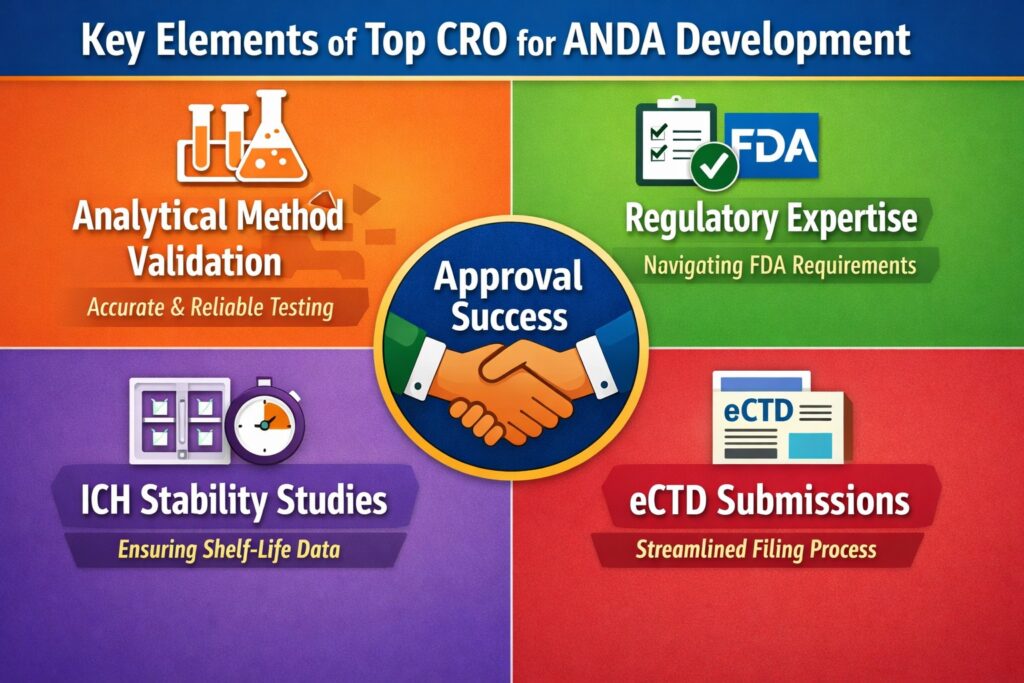
- Analytical method development & validation
- Stability studies per ICH Q1A(R2)
- Bioequivalence program support
- CMC documentation preparation
- eCTD submission management
- Deficiency response handling
A high-performing CRO provides more than technical services. It ensures that stability data, analytical results, and CMC narratives support each other without contradiction. Structured internal reviews and clear project governance further strengthen submission quality and reduce review delays.
| Critical Capability | Why It Matters for ANDA Approval |
|---|---|
| FDA-compliant analytical labs | Prevents data integrity concerns |
| ICH stability program design | Ensures acceptance across markets |
| CMC dossier writing expertise | Reduces FDA review cycles |
| Pre-ANDA meeting support | Strengthens regulatory alignment |
| Deficiency response expertise | Speeds up approval timelines |
| Data integrity systems | Avoids warning letters & CRLs |
Sponsors should evaluate not only infrastructure but also real ANDA filing history. Past inspection outcomes and approval experience are strong indicators of reliability. Clear communication and defined milestones also reflect a mature partnership approach.
Ensure your analytical foundation is submission-ready: Learn more about our Analytical Method Development and Validation Services
Why a Specialized CRO for ANDA Development is Essential for Regulatory Success
A specialized CRO for ANDA Development reduces regulatory risk by aligning development work with FDA expectations from the beginning.
ANDA submissions are highly data-driven and technically detailed. The FDA carefully reviews:
- Drug substance characterization
- Drug product formulation
- Dissolution method justification
- Impurity profiling
- Extractables & leachables
- Stability indicating methods
- Container closure systems
A general laboratory may generate accurate results, but without regulatory framing, the submission may still face deficiencies. A dedicated CRO for ANDA Development understands how to structure and present data in the format FDA reviewers expect. This alignment transforms raw scientific data into approval-ready documentation.
Key Regulatory Expectations a CRO for ANDA Development Must Master
- FDA’s “ANDAs: Stability Testing of Drug Substances and Products” guidance
- ICH Q1A(R2) stability protocols
- ICH Q3A & Q3B impurity guidelines
- FDA CMC review guidance
- Data integrity compliance under 21 CFR Part 11
The best CRO anticipates reviewer questions before submission. Early gap assessments help prevent multiple review cycles. Strong regulatory understanding ensures that every section of the dossier supports a clear approval argument.
Address complex impurity and safety requirements: Mitigate risks with specialized Nitrosamine Analysis
Core Technical Capabilities Required in a CRO for ANDA Development
The best CRO for ANDA Development demonstrates strong analytical science, formulation knowledge, and regulatory writing skills within one coordinated system.
Technical depth alone is not sufficient. Integration across departments ensures consistency throughout Module 3 and related sections. Seamless coordination avoids contradictions and incomplete data reporting.
1. Advanced Analytical Method Development in a CRO for ANDA Development
Regulatory reviewers expect:
- Stability-indicating methods
- Forced degradation studies
- Impurity separation at low detection limits
- Validation aligned with ICH Q2(R1)
A CRO must:
- Apply multiple analytical techniques where needed
- Conduct thorough robustness testing
- Maintain complete documentation traceability
- Demonstrate repeatability across instruments and analysts
Analytical weaknesses are a common cause of FDA deficiencies. Proper validation confirms precision, accuracy, specificity, and linearity. Well-documented analytical work increases regulatory confidence and protects approval timelines.
Leverage advanced identification and quantification tools: Achieve precision with GC-FID and GC-MS Based Analytical Services
2. Stability Program Design & Execution
A dependable CRO for ANDA Development designs stability programs that can withstand FDA review and support accurate shelf-life claims.
Stability studies must be scientifically justified and statistically evaluated. Programs should reflect formulation characteristics, packaging type, and target market conditions. Clear planning reduces the risk of unexpected degradation trends after submission.
Required Stability Conditions (As per ICH)
| Study Type | Condition | Duration |
|---|---|---|
| Long-term | 25°C/60% RH or 30°C/65% RH | 12 months |
| Intermediate | 30°C/65% RH | 6 months |
| Accelerated | 40°C/75% RH | 6 months |
Beyond execution, the CRO must:
- Provide statistical shelf-life justification
- Evaluate degradation pathways
- Assess packaging impact on stability
- Conduct photostability studies when required
A well-designed stability program strengthens the overall ANDA submission. Continuous monitoring allows early correction if trends appear. Clear reporting helps FDA reviewers assess the data efficiently.
Protect your product’s shelf-life and compliance: Ensure long-term quality with Stability Studies for Pharma
3. CMC Documentation Excellence in a CRO for ANDA Development
The best CRO for ANDA Development prepares complete, well-structured CMC sections that reduce review time and avoid confusion.
FDA reviewers examine:
- Module 3 structure
- Manufacturing process validation
- Batch analysis data
- Control strategy
- Risk assessment documentation
High-quality regulatory writing plays a major role in approval speed. A CRO should use regulator-aligned templates and maintain consistency across modules. Internal quality checks help ensure accuracy before submission.
Clear documentation allows reviewers to understand the scientific logic without difficulty. Logical structure and accurate cross-referencing reduce clarification requests. Strong CMC documentation directly supports faster review cycles.
Regulatory Strategy: A Key Strength of the Best CRO for ANDA Development
Regulatory foresight separates an average provider from the best CRO for ANDA Development.
Top CROs offer:
- Early gap assessments
- Patent landscape awareness
- Pre-ANDA meeting preparation
- Anticipation of regulatory queries
- Risk mitigation planning
Strategic planning connects technical development with regulatory timelines. Early FDA engagement helps clarify expectations and reduce surprises. This structured approach lowers financial and operational risk for sponsors.
Why This Matters
FDA review timelines have direct business impact. Each deficiency:
- Delays market entry
- Increases operational costs
- Affects competitive positioning
An experienced CRO for ANDA Development minimizes repeated review cycles through careful preparation and structured deficiency responses. Efficient communication with regulators strengthens submission confidence.
Verify material safety and container closure integrity: Secure your product with Extractables and Leachables Testing
Data Integrity & Compliance in a CRO for ANDA Development
The best CRO for ANDA Development operates under strict data integrity and compliance systems aligned with global regulations.
Core requirements include:
- ALCOA+ principles
- Audit trail review processes
- Controlled system access
- Electronic lab notebook traceability
- 21 CFR Part 11 compliance
Sponsors should review audit history and inspection records before selection. Transparent quality management builds long-term trust. Strong compliance systems protect both the sponsor and the patient.
Bioequivalence & Clinical Coordination Support
An experienced CRO for ANDA Development ensures that bioequivalence activities align closely with analytical and CMC data.
Key support areas include:
- Dissolution method alignment
- In-vitro/in-vivo correlation (IVIVC)
- Validated sample analysis
- Stability sample handling
Proper coordination prevents inconsistencies between clinical and analytical findings. Integrated planning strengthens the overall submission package. Harmonized data improves regulatory confidence during review.
Lifecycle Management: Beyond Initial ANDA Approval
The best CRO for ANDA Development continues supporting sponsors after approval through structured lifecycle management.
Essential services include:
- Post-approval supplements
- Annual report preparation
- Ongoing stability monitoring
- Site transfer documentation
- Specification updates
Generic products require continuous compliance. Post-approval changes must be carefully documented and justified. Ongoing support ensures uninterrupted product supply and sustained regulatory standing.
How to Evaluate and Select the Best CRO for ANDA Development
Choosing the right CRO for ANDA Development requires careful and structured evaluation.
Sponsors should assess both technical capabilities and regulatory track record. Reviewing approval history provides insight into real-world performance. Clear communication practices are equally important for long-term collaboration.
Evaluation Checklist
- Demonstrated ANDA approvals
- FDA inspection readiness
- Comprehensive analytical capabilities
- Regulatory writing expertise
- Defined project governance structure
- Transparent communication model
Questions to Ask
- How many ANDAs have you supported through approval?
- What is your average FDA review cycle count?
- How do you manage deficiency responses?
- What quality certifications do you maintain?
- How do you ensure cross-functional coordination?
Clear and confident answers show operational maturity. A structured approach reduces partnership risk. Strong governance ensures smooth execution from development to approval.
Why ResolveMass Laboratories Inc. Aligns with the Best CRO for ANDA Development Standards
ResolveMass Laboratories Inc. operates within a compliance-driven framework that integrates:
- Advanced analytical platforms
- ICH-aligned stability chambers
- Experienced CMC documentation teams
- Regulatory strategy professionals
- Transparent quality systems
Its structured methodology and regulatory alignment reflect what sponsors expect from the Best CRO for ANDA Development and Regulatory Support. By combining scientific precision with regulatory foresight, ResolveMass supports efficient and confident ANDA submissions. The integrated approach ensures consistency across every stage of development.
Utilize high-resolution data for your submission: Explore our Mass Spectrometry-Based Analytical Services
Conclusion
The Best CRO for ANDA Development is defined by regulatory insight, analytical strength, data integrity, and proven approval experience. A capable CRO for ANDA Development integrates CMC expertise, stability science, bioequivalence coordination, and regulatory planning within one accountable structure.
Selecting the right partner reduces approval risk, shortens timelines, and strengthens market position. Sponsors should prioritize CROs with documented ANDA success, inspection readiness, and strong FDA alignment.
For tailored ANDA development and regulatory support:
Most Asked FAQs About CRO for ANDA Development
The best CRO for ANDA Development has focused experience in handling ANDA submissions and understands FDA expectations in detail. Unlike a general CRO, it aligns analytical, CMC, and regulatory functions under one strategy. This coordinated approach reduces errors and improves approval chances.
ANDA submissions require long-term, intermediate, and accelerated stability studies as per ICH Q1A(R2) guidelines. These studies must be properly designed and supported with statistical data. Accurate stability results justify the proposed shelf-life and storage conditions.
A CRO for ANDA Development can reduce deficiencies by performing early gap assessments and aligning work with FDA guidance. Clear documentation and strong analytical validation lower the risk of review comments. Proactive planning helps prevent repeated review cycles.
Yes, an FDA inspection history demonstrates that the CRO operates under compliant systems. A positive inspection record builds sponsor confidence and lowers regulatory risk. It also shows readiness for future audits and regulatory reviews.
Analytical validation confirms that test methods are accurate, precise, and reliable. Proper validation ensures that generated data will be accepted by regulators. Strong analytical performance supports the overall strength of the ANDA submission.
A CRO should follow ALCOA+ principles and comply with 21 CFR Part 11 requirements. Secure systems, audit trails, and controlled access protect data reliability. Strong data integrity practices ensure inspection readiness at all times.
Lifecycle management ensures that the product remains compliant even after approval. Activities such as supplements, annual reports, and stability monitoring must be handled carefully. Continuous regulatory support helps maintain uninterrupted market supply.
Reference:
- Department of Pharmaceuticals, Government of India. (2023). Study on CRO sector in India (CRO market report). https://pharma-dept.gov.in/sites/default/files/CRO%20Market%20Report_High%20Resolution.pdf
- U.S. Food and Drug Administration. (n.d.). Drug development and review definitions. https://www.fda.gov/drugs/investigational-new-drug-ind-application/drug-development-and-review-definitions
- Biala, G., Kedzierska, E., Kruk-Slomka, M., Orzelska-Gorka, J., Hmaidan, S., Skrok, A., Kaminski, J., Havrankova, E., Nadaska, D., & Malik, I. (2023). Research in the field of drug design and development. Pharmaceuticals, 16(9), 1283. https://doi.org/10.3390/ph16091283
Get In Touch With Us
About The Author


