

Introduction:
Choosing the Best CRO for Peptide Sameness Study is one of the most critical strategic decisions in a generic peptide development program. Regulatory agencies require comprehensive analytical proof that your peptide drug substance is structurally and chemically identical to the reference listed drug (RLD), as outlined in FDA Peptide Sameness Study Requirements and global regulatory guidance.
A weak analytical package leads to delays, deficiency letters, or even application rejection — a risk clearly highlighted in discussions around Peptide Sameness Study Deficiencies. A scientifically strong CRO ensures your data withstands regulatory scrutiny the first time.
This CRO checklist will guide you step-by-step in selecting the Best CRO for Peptide Sameness Study, ensuring compliance, scientific robustness, and regulatory confidence.
Share via:
Summary:
If you are searching for the Best CRO for Peptide Sameness Study, here are the most important takeaways:
- Peptide sameness studies require advanced analytical platforms, not routine testing labs.
- Regulatory submissions demand comprehensive structural characterization, aligned with Characterization of Peptides for FDA expectations.
- The best CRO must demonstrate proven project experience in generic peptide filings such as Peptide Sameness Study for ANDA.
- High-resolution mass spectrometry, peptide mapping, impurity profiling, and orthogonal techniques are essential.
- Documentation quality is as important as the science, especially for Peptide Characterization for IND and NDA.
- Early scientific strategy reduces cost, delays, and regulatory risk.
Selecting the Best CRO for Peptide Sameness Study directly impacts approval timelines and regulatory success.
1: Why Selecting the Best CRO for Peptide Sameness Study Matters
Peptide sameness is entirely science-driven, and regulators evaluate analytical depth rigorously — particularly when comparing synthetic generics versus innovator products, or assessing Peptide Sameness vs Biosimilar Comparability.
Because peptide sameness is entirely science-driven, and regulatory agencies evaluate analytical depth rigorously.
Unlike small molecules, peptides are:
- Structurally complex
- Conformation-sensitive
- Impurity-prone
- Highly manufacturing-dependent
Health authorities expect:
- Primary structure confirmation
- Disulfide bridge mapping (if applicable)
- Impurity comparison
- Peptide mapping
- Orthogonal analytical confirmation
This level of data is typically generated using advanced approaches such as Peptide Sequencing and Mapping for Sameness Study.
Only the Best CRO for Peptide Sameness Study can deliver this complete analytical framework in a regulatory-ready format.
2: CRO Checklist: How to Identify the Best CRO for Peptide Sameness Study
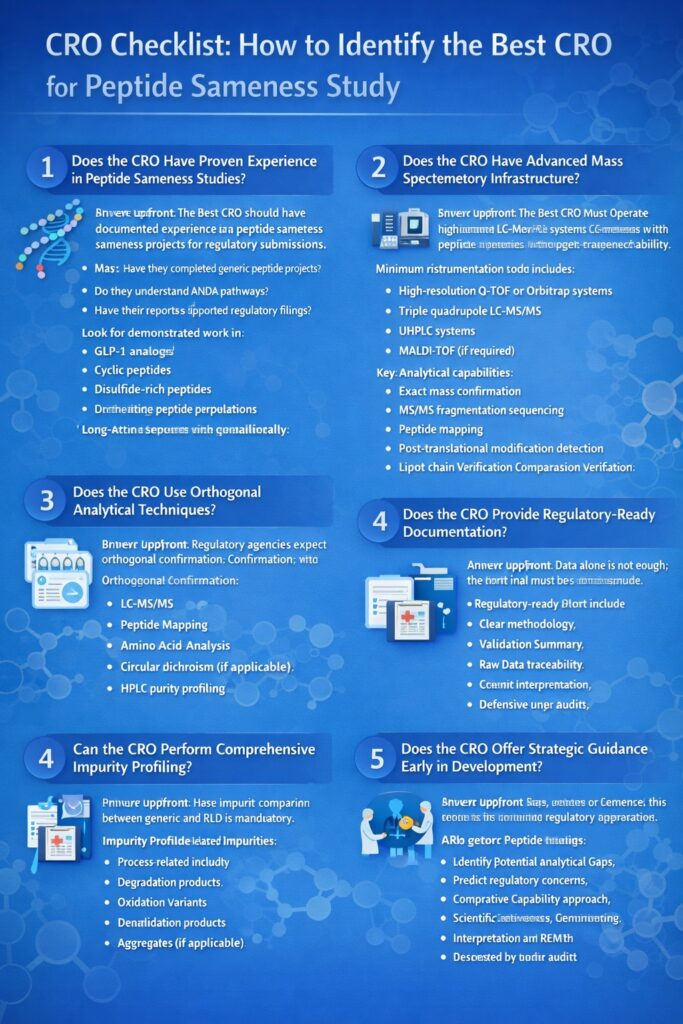
2.1 Does the CRO Have Proven Experience in Peptide Sameness Studies?
The best CRO should have documented experience in multiple regulatory peptide programs, including Peptide Sameness Study Services in Canada and Peptide Sameness Study Services in United States.
Ask:
- Have they completed generic peptide projects?
- Do they understand ANDA pathways?
- Have their reports supported regulatory filings?
Look for demonstrated work in:
- GLP-1 analogs
- Cyclic peptides
- Disulfide-rich peptides
- Long-acting peptide formulations
Look for real case examples such as:
- Peptide Characterization of Ganirelix Generic Project
- Peptide Characterization of Lanreotide Generic Project
- Complex GLP-1 programs like Semaglutide Sameness Evaluation for Health Canada
Experience reduces risk dramatically.
2.2 Does the CRO Have Advanced Mass Spectrometry Infrastructure?
The Best CRO for Peptide Sameness Study must operate high-resolution LC-MS/MS systems with deep peptide expertise, such as those described by Peptide Mass Spectrometry Experts.
Minimum instrumentation should include:
- High-resolution Q-TOF or Orbitrap systems
- Triple quadrupole LC-MS/MS
- UHPLC systems
- MALDI-TOF (if required)
Key analytical capabilities:
- Exact mass confirmation
- MS/MS fragmentation sequencing
- Peptide mapping
- Post-translational modification detection
- Lipid chain verification (for modified peptides)
Understanding differences between Peptide Mapping vs Peptide Sequencing – Key Differences is critical in selecting the right analytical strategy.
Without high-end instrumentation, true sameness cannot be scientifically demonstrated.
2.3 Does the CRO Use Orthogonal Analytical Techniques?
Regulators expect multi-layer confirmation using validated Peptide Sameness Testing Methods.
The Best CRO for Peptide Sameness Study should use:
- LC-MS/MS
- Peptide mapping
- Amino acid analysis
- Circular dichroism (if applicable)
- HPLC purity profiling
- Impurity comparison studies
Orthogonal confirmation is also discussed in broader Peptide Characterization Techniques and Applications guidance.
2.4 Can the CRO Perform Comprehensive Impurity Profiling?Yes — impurity comparison between generic and RLD is mandatory.
Yes — impurity comparison between generic and RLD is mandatory and extensively covered in Impurity Profiling in Peptides – Why It Matters in Drug Development.
Impurity profiling must include:
- Process-related impurities
- Degradation products
- Oxidation variants
- Deamidation products
- Aggregates (if applicable)
Regulators evaluate:
| Parameter | Generic | RLD | Acceptance |
|---|---|---|---|
| Total Impurities | Compared | Benchmarked | Within justified limits |
| Individual Impurities | Identified | Matched | Scientifically explained |
| Unknown Peaks | Characterized | Compared | Fully investigated |
Advanced CROs also perform Peptide Degradation Product Characterization and unknown peak identification using How to Identify Unknown Peptides by LCMS Testing.
Purity evaluation often includes validated What is Peptide Purity by HPLC and Why It Matters methodologies and region-specific standards like Peptide Purity Testing in United States.
The Best CRO for Peptide Sameness Study will characterize — not ignore — minor impurity peaks.
2.5 Does the CRO Provide Regulatory-Ready Documentation?
Data alone is not enough. Reports must align with global regulatory expectations including FDA Requirements for Peptide Characterization.
Regulatory-ready reports include:
- Clear methodology
- Validation summary
- Raw data traceability
- Comparative overlays
- Scientific interpretation
- Defensibility under audit
This level of reporting is essential for Peptide Characterization in Drug Development programs and broader Peptide Testing Services for Pharmaceutical R&D.
Poor documentation leads to regulatory queries — even if the science is strong.
2.6 Does the CRO Offer Strategic Guidance Early in Development?
The Best CRO for Peptide Sameness Study should act as a scientific partner, not just a testing service.
Early-stage analytical support, such as described in Analytical Support in Peptide Synthesis – Why It’s Essential, helps:
- Identify potential analytical gaps
- Predict regulatory concerns
- Optimize comparability approach
- Reduce unnecessary repeat testing
Strategic CRO involvement saves:
- Cost
- Time
- Regulatory risk
Strategic understanding of synthesis methods — including Solid vs Liquid Phase Peptide Synthesis – Which Method is Better? — improves impurity control and regulatory alignment.
Selecting the right analytical partner is similar to choosing the right development collaborator, as explained in Peptide Synthesis Service – How to Choose the Right CRO Partner and Top 5 Things to Look for in a Peptide Testing Laboratory.
3: What Makes ResolveMass Laboratories Inc. the Best CRO for Peptide Sameness Study?
ResolveMass Laboratories Inc. is considered the Best CRO for Peptide Sameness Study because it combines peptide-specific scientific expertise, advanced high-resolution mass spectrometry infrastructure, regulatory-aligned reporting, and proven experience supporting generic peptide submissions.
Our expertise spans:
- Advanced structural confirmation
- PTM mapping including Peptide Mapping for PTM Analysis
- Full comparability assessments
- Submission-ready documentation
This depth positions ResolveMass as the Best CRO for Peptide Sameness Study for complex generic peptide programs.
Unlike general analytical laboratories, ResolveMass focuses deeply on peptide structural characterization — the core requirement for regulatory sameness evaluation.
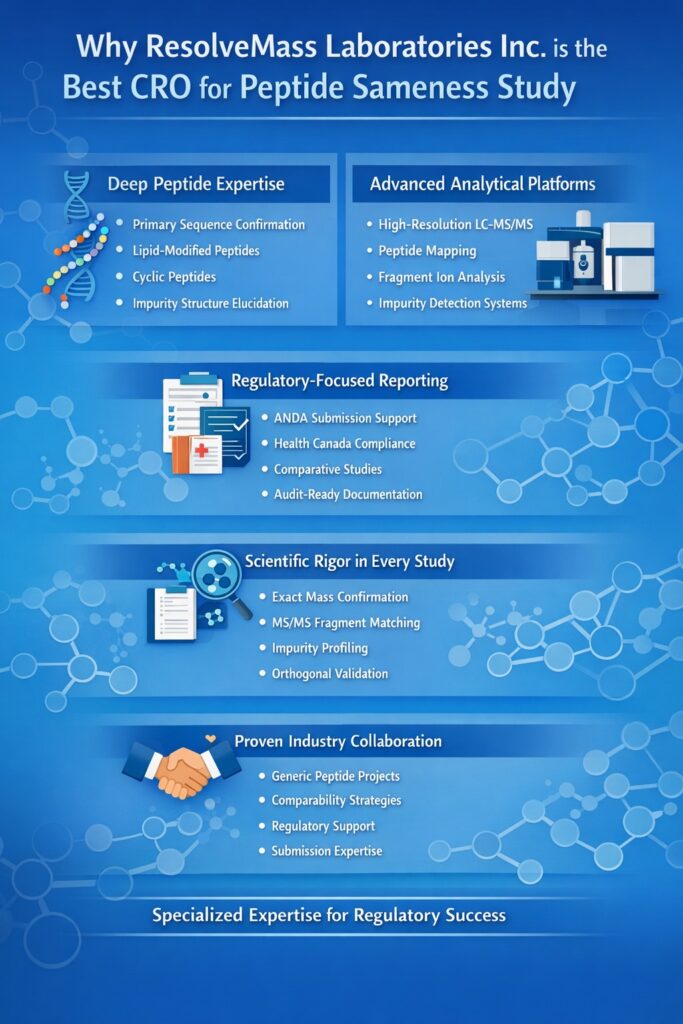
3.1 Deep Peptide Expertise
ResolveMass specializes in complex peptide characterization rather than routine small-molecule testing.
Our scientific team performs:
- Primary sequence confirmation using high-resolution LC-MS/MS
- Characterization of lipid-modified peptides (e.g., acylated side chains)
- Analysis of cyclic peptides and disulfide-rich structures
- Impurity structure elucidation using fragmentation pathway interpretation
This level of peptide-specific knowledge ensures that sameness is proven at the molecular level — not assumed through superficial comparison.
3.2 Advanced Analytical Platforms
The Best CRO for Peptide Sameness Study must operate instrumentation capable of detailed peptide fragmentation analysis.
ResolveMass operates:
- High-resolution LC-MS/MS systems
- Optimized MS/MS fragmentation workflows
- Ultra-high-performance liquid chromatography (UHPLC)
- Sensitive impurity detection platforms
These systems enable:
- Exact mass verification
- Fragment ion matching
- Peptide mapping
- Detection of oxidation, deamidation, and sequence variants
Advanced instrumentation ensures defensible, regulator-ready data.
3.3 Regulatory-Focused Reporting
Scientific results must be presented in a format aligned with regulatory expectations.
ResolveMass prepares documentation structured to support:
- ANDA submission requirements
- Health Canada peptide comparability expectations
- Global regulatory review standards
Reports include:
- Clear methodology descriptions
- Comparative overlays (Generic vs RLD)
- Impurity justification
- Scientific interpretation
- Full traceability of analytical data
Strong reporting reduces deficiency risks and strengthens regulatory confidence.
3.4 Scientific Rigor in Every Sameness Study
Every peptide sameness project at ResolveMass includes:
- Exact mass confirmation
- MS/MS fragmentation matching against the reference product
- Detailed impurity comparison
- Orthogonal analytical confirmation
Regulatory agencies expect multiple layers of proof — not a single analytical method. This systematic approach positions ResolveMass as the Best CRO for Peptide Sameness Study for complex regulatory submissions.
3.5 Proven Industry Collaboration
ResolveMass works closely with generic pharmaceutical manufacturers developing peptide drug products for regulated markets.
We support:
- Early-stage analytical gap assessments
- Full comparability studies
- Regulatory query response support
- Scientific justification documentation
Our collaborative approach ensures that the analytical strategy aligns with the client’s regulatory pathway from the beginning.
Why Specialization Defines the Best CRO for Peptide Sameness Study
When evaluating the Best CRO for Peptide Sameness Study, depth of specialization matters more than broad service offerings.
Peptide sameness is not routine testing. It requires:
- Molecular-level structural confirmation
- Advanced fragmentation interpretation
- Regulatory-aware documentation
- Experience with real submission scenarios
ResolveMass Laboratories Inc. delivers focused peptide expertise, advanced instrumentation, and submission-ready analytical packages — making it a trusted scientific partner for peptide generic development.
4: How the Best CRO for Peptide Sameness Study Supports Regulatory Success
A strong peptide sameness package demonstrates:
- Structural identity
- Impurity comparability
- Analytical robustness
- Manufacturing control
When supported by robust analytical evidence aligned with Peptide Characterization Techniques and Applications, regulatory review becomes significantly smoother.
The Best CRO for Peptide Sameness Study:
- Anticipates regulatory questions
- Minimizes deficiency letters
- Strengthens approval probability
5: Final CRO Evaluation Checklist
Before signing with a CRO, confirm:
✔ Documented peptide sameness project history
✔ High-resolution MS/MS capability
✔ Peptide mapping expertise
✔ Impurity structural elucidation experience
✔ Regulatory-ready documentation
✔ Strategic advisory support
If any of these are missing, reconsider.
Conclusion:
Selecting the Best CRO for Peptide Sameness Study directly determines the success of your generic peptide regulatory pathway. Peptide sameness is not routine testing — it requires scientific precision, regulatory awareness, and advanced analytical infrastructure.
ResolveMass Laboratories Inc. combines specialized peptide expertise, advanced mass spectrometry platforms, and regulatory-focused documentation to support defensible peptide sameness submissions.
If your peptide program depends on regulatory success, choosing the right analytical partner is not optional — it is strategic.
Frequently Asked Questions:
Ask for:
-Case studies of generic peptide projects
-Experience with GLP-1 analogs or cyclic peptides
-Examples of regulatory submission support
-Details on instrumentation and analytical workflow
The Best CRO for Peptide Sameness Study will have transparent peptide-focused experience.
Regulatory-ready reports should include:
-Detailed methodology
-Validation summary
-Raw data traceability
-Comparative overlays (Generic vs RLD)
-Scientific interpretation
-Audit-ready formatting
Strong documentation is as important as strong science.
Early-stage analytical planning helps:
-Identify potential structural gaps
-Predict impurity concerns
-Align testing strategy with regulatory expectations
-Avoid repeat studies
Strategic CRO involvement reduces cost, time, and submission risk.
Common deficiencies include:
-Incomplete peptide mapping
-Lack of orthogonal confirmation
-Insufficient impurity characterization
-Poor documentation or unclear scientific interpretation
-Missing justification for analytical differences
A specialized CRO reduces the likelihood of regulatory queries or deficiency letters.
Impurity comparison is mandatory. Regulators require identification and characterization of:
-Process-related impurities
-Degradation products
-Oxidation variants
-Deamidation products
-Unknown peaks
The Best CRO for Peptide Sameness Study investigates even minor impurity peaks to ensure regulatory defensibility.
High-resolution mass spectrometry confirms exact molecular weight, sequence integrity, and fragment ion matching. It enables detection of subtle modifications such as oxidation, deamidation, and lipid chain variations. Without high-resolution MS/MS, true structural equivalence cannot be scientifically demonstrated.
Reference
- Inter-laboratory study of an optimised peptide mapping workflow using automated trypsin digestion for monitoring monoclonal antibody product quality attributes.https://link.springer.com/article/10.1007/s00216-020-02809-z
- Harmonization guidelines for HLA-peptide multimer assays derived from results of a large scale international proficiency panel of the Cancer Vaccine Consortium.https://link.springer.com/article/10.1007/s00262-009-0681-z
- Reference Standards to Support Quality of Synthetic Peptide Therapeutics.https://link.springer.com/article/10.1007/s11095-023-03493-1
- Litta Samari Perico-Franco , Jaiver Eduardo Rosas-Pérez. Chapter 17 – Synthetic peptides quality control and assurance.https://www.sciencedirect.com/science/chapter/edited-volume/abs/pii/B9780443153938000178
- Annick Gervais , Eef H.C. Dirksen , Thomas Pohl. Compliance and regulatory considerations for the implementation of the multi-attribute-method by mass spectrometry in a quality control laboratory.https://www.sciencedirect.com/science/article/pii/S0939641123002114
About the Author


