

Introduction:
A Generic Peptide drug Analytical Characterization case study highlights how advanced analytical science supports regulatory approval of complex generic peptide therapeutics. Generic peptides are structurally complex molecules that require extensive analytical characterization to demonstrate equivalence to the reference product.
In this case study, we examine how a comprehensive analytical strategy—combining mass spectrometry, chromatographic techniques, impurity profiling, and structural analysis—enabled successful regulatory submission preparation for a generic peptide drug.
ResolveMass Laboratories Inc., a specialized bioanalytical and mass spectrometry partner, frequently supports pharmaceutical companies by developing robust bioanalytical strategies for drug development and providing expertise as mass spectrometry experts in drug development to meet global regulatory requirements.
Share via:
Summary:
- Generic peptide drug analytical characterization case study demonstrates how robust analytical strategies support successful regulatory submissions.
- Comprehensive characterization ensures identity, purity, potency, and structural equivalence with the reference listed drug (RLD).
- Advanced analytical techniques such as LC-MS/MS, high-resolution mass spectrometry, peptide mapping, and impurity profiling are essential.
- Regulatory authorities require extensive analytical comparability data for generic peptide drugs.
- Strategic analytical development helps accelerate regulatory approvals and reduce development risk.
1: Understanding the Importance of Analytical Characterization for Generic Peptide Drugs
Analytical characterization ensures that a generic peptide drug matches the reference product in structure, purity, and biological activity. This step is critical in demonstrating that the generic peptide is comparable to the reference listed drug (RLD) and meets regulatory requirements for safety, quality, and efficacy.
Unlike small-molecule generics, peptide drugs consist of long amino acid chains and complex molecular conformations, which require advanced analytical technologies to verify structural equivalence. As a result, many pharmaceutical companies rely on specialized peptide characterization in drug development and peptide testing services services to ensure accurate structural verification and regulatory readiness.
Comprehensive analytical characterization helps identify structural variations, impurities, and degradation pathways that may impact drug performance or regulatory approval.
Key Analytical Requirements for Generic Peptide Drugs
Regulatory agencies typically require detailed characterization of several critical attributes, including:
- Primary amino acid sequence to confirm peptide identity
- Molecular weight confirmation using high-resolution mass spectrometry
- Impurity profiling to detect process-related or degradation impurities
- Degradation pathway analysis under stress conditions
- Structural modifications such as oxidation or deamidation
- Disulfide bond mapping for peptides containing cysteine residues
- Aggregation analysis to evaluate peptide stability
- Potency and stability testing to confirm biological activity and shelf life
Together, these analytical data sets demonstrate that the generic peptide drug is analytically comparable to the reference drug product, which is a critical requirement for successful regulatory submission and approval.
2: Generic Peptide Drug Analytical Characterization Case Study: Project Overview
This generic peptide drug analytical characterization case study describes the analytical strategy used to support regulatory submission for a complex peptide therapeutic.
Pharmaceutical developers often work with specialized partners offering analytical development for generic drugs in Canada and CDMO services for generic drug development in Canada to ensure compliance with regulatory expectations.
Project Background
| Parameter | Description |
|---|---|
| Drug Type | Synthetic therapeutic peptide |
| Reference Product | Approved peptide drug |
| Development Stage | Generic drug regulatory submission |
| Objective | Demonstrate analytical equivalence to reference product |
| Analytical Scope | Identity, purity, structure, stability |
Key Project Goals
- Confirm peptide sequence and structure
- Identify and quantify process-related impurities
- Establish analytical comparability with RLD
- Develop validated analytical methods for regulatory submission
3: Analytical Strategy Used in This Generic Peptide Drug Analytical Characterization Case Study
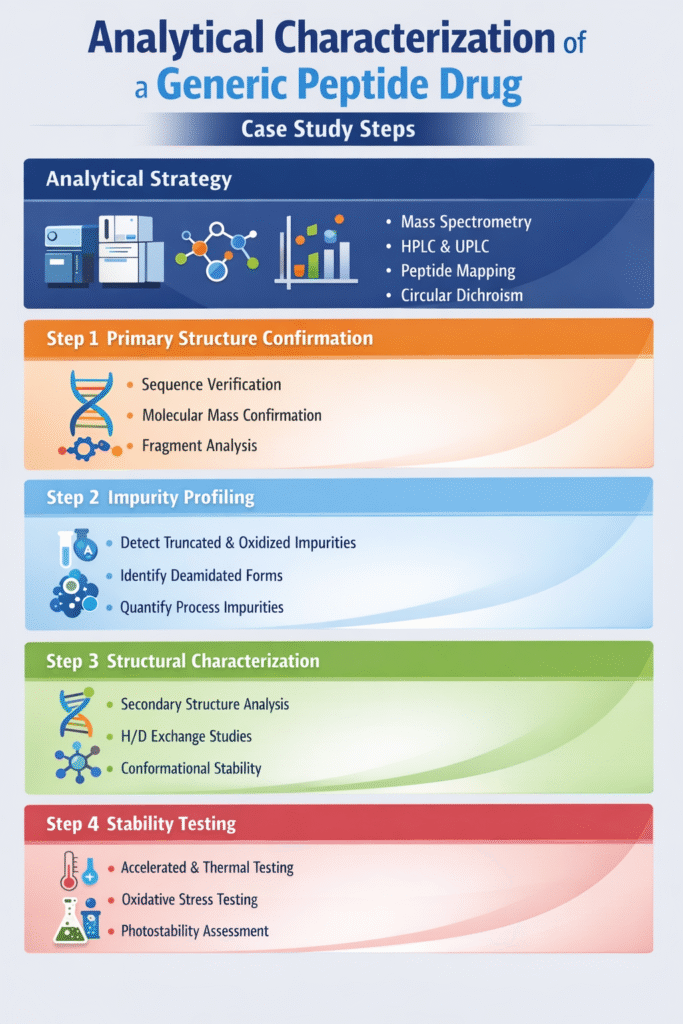
The analytical strategy focused on multiple orthogonal techniques to confirm peptide identity, structure, and purity.
A multi-technique approach ensures regulatory confidence in the analytical results. Many organizations adopt a structured analytical method development strategy for generic drugs as well as reverse engineering approaches for generic drug development to fully characterize complex molecules.
Core Analytical Techniques Used
| Analytical Technique | Purpose |
|---|---|
| High-Resolution Mass Spectrometry (HRMS) | Molecular weight confirmation |
| LC-MS/MS | Peptide sequencing |
| Peptide Mapping | Structural confirmation |
| HPLC | Purity analysis |
| UPLC | Impurity profiling |
| Circular Dichroism (CD) | Secondary structure analysis |
| Stability Studies | Degradation characterization |
Using orthogonal methods helps verify analytical results and ensures data reliability for regulatory review.
Step 1: Primary Structure Confirmation in the Generic Peptide Drug Analytical Characterization Case Study
Primary structure confirmation verifies that the amino acid sequence of the generic peptide matches the reference drug.
Analytical Approach
The analytical team used:
- High-resolution mass spectrometry
- Enzymatic digestion followed by LC-MS peptide mapping
- Fragment ion analysis
These advanced techniques are commonly used by bioanalysis laboratories in Canada specializing in peptide and biologic drug characterization.
Key Findings
- Amino acid sequence matched the reference product.
- Molecular mass confirmed within acceptable tolerance.
- Fragment ion patterns confirmed structural integrity.
Benefits of This Approach
- Provides high confidence in sequence identity
- Detects minor sequence variants
- Supports regulatory comparability requirements
Step 2: Impurity Profiling in the Generic Peptide Drug Analytical Characterization Case Study
Impurity profiling identifies and quantifies all detectable impurities within the peptide drug substance.
Impurities in peptide drugs may include:
- Truncated peptides
- Oxidized variants
- Deamidated forms
- Process-related impurities
- Aggregates
Analytical Methods Used
- Reverse-phase HPLC
- LC-MS impurity identification
- Forced degradation studies
Key Results
| Impurity Type | Detection Method | Outcome |
|---|---|---|
| Oxidation products | LC-MS | Identified and quantified |
| Deamidated peptides | Peptide mapping | Characterized |
| Truncated variants | LC-MS | Controlled within limits |
These data confirmed the purity profile aligned with regulatory expectations.
Step 3: Structural Characterization in the Generic Peptide Drug Analytical Characterization Case Study
Structural characterization ensures the peptide maintains correct folding and functional conformation.
Peptides can exhibit secondary structures such as helices and sheets, which influence biological activity.
Structural Analysis Techniques
- Circular dichroism spectroscopy
- Hydrogen-deuterium exchange
- Mass spectrometry structural analysis
Observations
- Secondary structure consistent with reference product
- No abnormal conformational variants detected
- Structural stability maintained under stress conditions
Such advanced structural analysis is often performed by laboratories offering outsourced chemistry services in drug discovery and specialized peptide characterization expertise.
Step 4: Stability Assessment in the Generic Peptide Drug Analytical Characterization Case Study
Stability studies evaluate how the peptide drug degrades under various storage and stress conditions.
Stability Testing Conditions
| Condition | Purpose |
|---|---|
| Accelerated stability | Predict shelf life |
| Thermal stress | Evaluate heat stability |
| Oxidative stress | Identify oxidation pathways |
| Photostability | Assess light sensitivity |
Key Findings
- Degradation pathways were consistent with the reference product.
- Stability profile supported acceptable shelf life.
- No unexpected degradation products were observed.
4: Regulatory Considerations for Generic Peptide Drug Analytical Characterization
Regulatory authorities require extensive analytical evidence before approving generic peptide drugs.
Many companies therefore partner with specialized generic pharmaceutical CDMO providers in Canada offering integrated analytical and regulatory services.
Key regulatory expectations include:
- Full structural characterization
- Orthogonal analytical techniques
- Validated analytical methods
- Impurity and degradation profiling
- Analytical comparability to the reference drug
Typical Regulatory Agencies
- FDA (United States)
- Health Canada
- EMA (European Union)
Analytical data must be presented in regulatory submissions such as:
- ANDA filings
- DMF documentation
- Bioequivalence packages
These regulatory submissions often require collaboration with experts providing regulatory support for generic drugs in the US and Canada.
5: Challenges in Generic Peptide Drug Analytical Characterization
Generic peptide drug analytical characterization is challenging because peptide molecules are structurally complex and highly sensitive to chemical modifications. Even small structural changes can significantly impact the drug’s biological activity, stability, and regulatory acceptance. Therefore, comprehensive analytical strategies are required to accurately characterize peptide drugs and demonstrate equivalence with the reference product.
Common Challenges
Several analytical challenges are commonly encountered during peptide drug characterization:
- Multiple degradation pathways that can occur during manufacturing, storage, or formulation
- Isomeric impurities that have the same molecular weight but different structural configurations
- Sequence variants resulting from synthesis or processing variations
- Oxidation and deamidation reactions that alter peptide structure and stability
- Complex impurity profiles that require advanced detection and identification techniques
Because of these complexities, many pharmaceutical companies rely on specialized analytical laboratories and CDMO partners with expertise in peptide drug analysis. Many developers address these challenges through outsourcing generic drug development in Canada to experienced analytical service providers with advanced instrumentation and regulatory expertise.
Strategies to Overcome These Challenges
To successfully characterize generic peptide drugs, scientists typically employ a combination of advanced analytical strategies, including:
- High-resolution mass spectrometry for detailed molecular characterization
- Multi-technique analytical workflows using orthogonal methods such as LC-MS, HPLC, and peptide mapping
- Robust analytical method development to ensure accurate detection of impurities and variants
- Experienced analytical scientists who understand peptide chemistry and regulatory expectations
ResolveMass Laboratories specializes in addressing these complex analytical challenges through state-of-the-art bioanalytical capabilities, advanced mass spectrometry platforms, and deep expertise in peptide drug characterization, helping pharmaceutical companies generate reliable analytical data for regulatory submissions.
6: Role of Mass Spectrometry in Generic Peptide Drug Analytical Characterization
Mass spectrometry is one of the most powerful analytical tools used in the Generic Peptide drug Analytical Characterization case study, enabling precise identification, structural verification, and impurity profiling of complex peptide molecules. Because peptide drugs often contain subtle structural variations and degradation pathways, advanced mass spectrometry techniques are essential for generating reliable analytical data required for regulatory submissions.
Modern LC-MS and high-resolution mass spectrometry platforms allow scientists to analyze peptide structures at extremely high sensitivity and accuracy, making them critical for confirming equivalence between generic peptide drugs and their reference listed drugs (RLD).
Advantages of Mass Spectrometry
Mass spectrometry offers several important advantages in peptide drug characterization:
- High sensitivity for detecting trace-level impurities and degradation products
- Precise molecular weight determination for confirming peptide identity
- Structural elucidation through fragmentation analysis
- Impurity identification to detect sequence variants or truncated peptides
- Degradation pathway analysis during stability studies
These capabilities make mass spectrometry a core analytical technology for peptide drug development and regulatory evaluation.
Applications in Peptide Analysis
Mass spectrometry supports multiple critical analytical workflows used in peptide drug characterization, including:
- Peptide sequencing to confirm amino acid composition and structure
- Peptide mapping to verify the structural integrity of the molecule
- Impurity detection to identify oxidation, deamidation, or truncated variants
- Stability testing to monitor degradation products under stress conditions
By combining high-resolution mass spectrometry with chromatographic separation techniques, pharmaceutical scientists can generate comprehensive analytical data that supports successful regulatory submissions for generic peptide drugs.
Modern high-resolution LC-MS systems enable extremely detailed peptide characterization required for regulatory submissions and are widely used in both CDMO and CRO models for generic drug development. Organizations often evaluate CDMO vs CRO for generic drug development when planning their development strategy.
7: Lessons Learned from This Generic Peptide Drug Analytical Characterization Case Study
This Generic Peptide drug Analytical Characterization case study highlights several important lessons for pharmaceutical companies developing complex peptide therapeutics for regulatory submission. A well-designed analytical strategy is essential to demonstrate equivalence with the reference product and meet regulatory expectations.
Key Takeaways
- Early analytical planning reduces development risk.
Implementing a comprehensive analytical strategy at the early stages of development helps identify structural variations, impurities, and stability concerns before they impact regulatory timelines. - Orthogonal analytical methods increase data reliability.
Using multiple complementary techniques such as LC-MS, peptide mapping, and chromatographic analysis strengthens the confidence in analytical results and supports regulatory review. - Mass spectrometry plays a central role in peptide characterization.
Advanced mass spectrometry platforms allow precise identification of peptide sequences, structural variants, and impurities, making them essential tools for peptide drug analysis. - Comprehensive impurity profiling is critical for regulatory success.
Detailed identification and quantification of peptide-related impurities help demonstrate product quality, safety, and consistency with the reference listed drug. - Experienced analytical partners accelerate development timelines.
Working with specialized bioanalytical laboratories and experts in peptide characterization helps pharmaceutical companies generate high-quality regulatory data and streamline submission processes.
These insights from this Generic Peptide drug Analytical Characterization case study emphasize the importance of robust analytical methodologies and expert scientific support when developing complex generic peptide drugs.
8: Why Partner with ResolveMass Laboratories for Peptide Analytical Characterization
ResolveMass Laboratories Inc. provides specialized scientific expertise in peptide drug analytical characterization, bioanalysis, and advanced mass spectrometry testing to support pharmaceutical companies developing complex generic and innovative peptide therapeutics.
With extensive experience in analytical characterization of peptide drugs for regulatory submissions, ResolveMass helps ensure that analytical data meets the strict requirements of global regulatory authorities such as the FDA, Health Canada, and EMA.
Core Capabilities
ResolveMass Laboratories offers comprehensive analytical services designed to support peptide drug development and regulatory submissions, including:
- Advanced LC-MS/MS peptide analysis for precise molecular characterization
- Peptide mapping and sequencing to confirm amino acid structure and identity
- Impurity identification and profiling using high-resolution mass spectrometry
- Stability studies and degradation analysis to assess product quality and shelf life
- Regulatory-ready analytical data packages for generic drug submissions
Benefits for Pharmaceutical Companies
Partnering with ResolveMass Laboratories provides significant advantages for pharmaceutical developers working on complex peptide therapeutics:
- Faster regulatory submission preparation through robust analytical strategies
- Accurate structural characterization using advanced analytical instrumentation
- Reliable impurity profiling to ensure product quality and safety
- Expert analytical support from experienced scientists specializing in peptide drugs
By combining state-of-the-art analytical technologies with deep expertise in peptide characterization, ResolveMass Laboratories helps pharmaceutical companies accelerate development timelines and confidently advance their generic peptide drug programs toward regulatory approval.
Conclusion:
This Generic Peptide drug Analytical Characterization case study demonstrates how advanced analytical science ensures successful regulatory submission for complex peptide therapeutics. Through comprehensive structural analysis, impurity profiling, stability testing, and orthogonal analytical techniques, pharmaceutical companies can confidently demonstrate equivalence to the reference product.
A robust analytical characterization strategy—supported by advanced mass spectrometry and experienced analytical scientists—is essential for meeting regulatory expectations and accelerating the development of generic peptide drugs.
ResolveMass Laboratories Inc. supports pharmaceutical innovators with expert analytical services designed specifically for complex drug characterization and regulatory compliance.
Frequently Asked Questions:
Analytical characterization of a generic peptide drug involves identifying and verifying the structure, purity, molecular weight, sequence, and stability of the peptide to ensure it matches the reference listed drug (RLD). This process typically uses advanced analytical techniques such as LC-MS/MS, peptide mapping, impurity profiling, and stability testing.
Analytical characterization is critical because peptide drugs are structurally complex molecules. Regulatory authorities require detailed analytical data to demonstrate equivalence in identity, purity, potency, and structure between the generic peptide and the reference product before approval.
Common impurities detected in peptide drugs include:
-Truncated peptide sequences
-Oxidized peptide variants
-Deamidated peptides
-Process-related impurities
-Aggregated peptide species
Advanced analytical methods are required to identify and quantify these impurities during drug development.
Mass spectrometry plays a central role in peptide drug analysis because it allows scientists to:
-Confirm peptide molecular weight
-Identify amino acid sequences
-Detect impurities and degradation products
-Perform peptide mapping and fragmentation analysis
High-resolution LC-MS systems provide detailed molecular insights required for regulatory submissions.
Regulatory agencies such as the FDA, Health Canada, and EMA require extensive analytical comparability data for generic peptide drugs. Key requirements include:
-Structural characterization
-Impurity profiling
-Stability studies
-Analytical method validation
-Demonstration of equivalence with the reference drug
These data are typically submitted as part of regulatory filings such as ANDA or equivalent submissions.
Reference
- Akhilesh Kumar Kuril , K. Saravanan , Praveen Kumar Subbappa. Analytical considerations for characterization of generic peptide product: A regulatory insight.https://www.sciencedirect.com/science/article/abs/pii/S0003269724001775
- Valentijn Vergote, Christian Burvenich, Christophe Van de Wiele, Bart De Spiegeleer. Quality specifications for peptide drugs: a regulatory-pharmaceutical approach.https://onlinelibrary.wiley.com/doi/abs/10.1002/psc.1167
- Tushar Giri, Saloni Sakharwade, Praveen Subbappa, Sanjeeva R. Chinnakadoori, Nitish Sharma. Regulatory Considerations in Synthetic Peptide Characterization: Techniques and Compliance.https://analyticalsciencejournals.onlinelibrary.wiley.com/doi/abs/10.1002/sscp.70057
- Shruti Rastogi , Shatrunajay Shukla , M. Kalaivani , Gyanendra Nath Singh. Peptide-based therapeutics: quality specifications, regulatory considerations, and prospects.https://www.sciencedirect.com/science/article/abs/pii/S1359644618302514
- Pharma Regulations for Generic Drug Products in India and US: Case Studies and Future Prospectives. https://pdfs.semanticscholar.org/5ba0/5cd4e0d03226de8543c21a91a437634be137.pdf
About the Author


