

Introduction
Peptide Oligonucleotide Conjugate Linker Chemistry plays a key role in how peptide carriers deliver oligonucleotides to intracellular targets. In peptide-oligonucleotide conjugates, the linker is more than a simple connector. It affects molecular stability, intracellular release, pharmacokinetic behavior, and the overall biological activity of the therapeutic molecule.
The linker also determines whether the oligonucleotide payload reaches the correct cellular location. If the linker breaks too early, the conjugate may degrade in the bloodstream. If it is too stable, the therapeutic payload may not release efficiently inside the cell. Because of this balance, linker selection has become an important step in designing effective conjugates.
Advances in synthetic chemistry, solid-phase synthesis, and bio-orthogonal reactions have significantly improved Peptide Oligonucleotide Conjugate Linker Chemistry. These technologies allow researchers to design linkers with better control over stability, release mechanisms, and conjugation sites for improved therapeutic performance.
Explore our specialized solutions for POC Synthesis and Characterization.
Share via:
Article Summary (Key Takeaways)
- Peptide Oligonucleotide Conjugate (POC) Linker Chemistry determines the stability, bioavailability, and intracellular release of therapeutic conjugates.
- The choice of linker directly affects pharmacokinetics, enzymatic stability, and endosomal release of oligonucleotide cargo.
- Common linker classes include cleavable (disulfide, enzymatic, pH-sensitive) and non-cleavable (amide, triazole, thioether) systems.
- Advanced click chemistry, solid-phase synthesis, and orthogonal protection strategies are now widely used to construct highly controlled POC linkers.
- Linker length, polarity, and steric properties influence cell penetration, biodistribution, and therapeutic activity.
- Emerging research focuses on stimuli-responsive linkers and site-specific conjugation strategies to optimize therapeutic performance.
- Robust Peptide Oligonucleotide Conjugate (POC) Linker Chemistry is critical for antisense oligonucleotides, siRNA delivery, and gene-modulation therapeutics.
Why Linker Chemistry Is Critical in Peptide-Oligonucleotide Conjugates
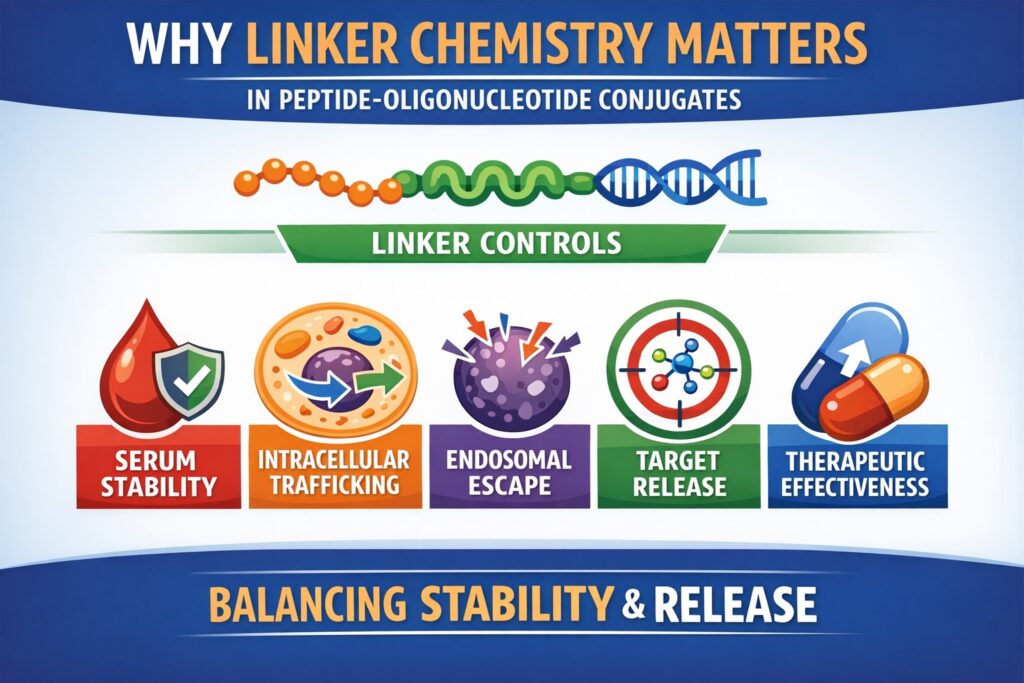
The linker plays a central role in determining whether a peptide-oligonucleotide conjugate remains stable during circulation and whether the oligonucleotide payload is released at the correct location inside the cell. A poorly designed linker can significantly reduce the effectiveness of an otherwise promising therapeutic molecule.
Studies have shown that the structure of the linker directly affects several important biological processes involved in oligonucleotide delivery. These processes include the stability of the conjugate in serum, its movement through cellular compartments, and the release of the active therapeutic component after cell uptake.
Understand the biological impact with our guide on Peptide Oligonucleotide Conjugates Mechanism of Action.
The linker can significantly affect:
- Serum stability
- Intracellular trafficking
- Endosomal escape
- Target-site activation
- Therapeutic potency
Each of these elements contributes to the final clinical performance of peptide-oligonucleotide conjugates. For instance, poor serum stability may cause rapid degradation in circulation. Similarly, inefficient endosomal escape can prevent the oligonucleotide from reaching its molecular target inside the cell.
Research also shows that poorly optimized linkers can create several practical challenges during therapeutic development. These problems often become visible during preclinical studies when conjugates fail to perform as expected in biological systems.
Common problems include:
- Premature degradation
- Reduced delivery efficiency
- Incomplete intracellular release
Juliano et al. demonstrated that the linker connecting peptides and oligonucleotides strongly influences biological activity in antisense systems. Their work showed that even small structural modifications in linker design can greatly impact cellular uptake and gene-silencing efficiency.
Key Design Considerations in Peptide Oligonucleotide Conjugate Linker Chemistry
| Parameter | Impact on POC Function |
|---|---|
| Linker stability | Determines circulation half-life |
| Cleavability | Controls intracellular release |
| Length and flexibility | Affects steric accessibility |
| Chemical compatibility | Enables efficient synthesis |
| Charge and hydrophobicity | Influences cellular uptake |
Together, these parameters determine how effectively Peptide Oligonucleotide Conjugate Linker Chemistry supports therapeutic applications. Optimizing these features requires a strong understanding of both chemical synthesis and biological delivery mechanisms.
Learn more about the various Types of Peptide Oligonucleotide Conjugates available for research.
Types of Linker Chemistry Used in Peptide Oligonucleotide Conjugates
1. Non-Cleavable Linkers in Peptide Oligonucleotide Conjugate Linker Chemistry
Non-cleavable linkers form permanent chemical bonds between peptides and oligonucleotides. In these systems, the main goal is to create a stable structural connection rather than enabling controlled release under biological conditions.
These linkers are often used when the entire conjugate must remain intact throughout its biological activity. For example, imaging probes or targeting molecules may require a stable linkage that does not break during circulation or cellular uptake.
Common examples include:
- Amide linkages
- Thioether bonds
- Triazole linkers formed through click chemistry
These chemical bonds are widely used because they are strong and chemically stable. They are compatible with both peptide synthesis and oligonucleotide chemistry and can resist enzymatic degradation under physiological conditions.
Advantages
- High chemical stability
- Resistance to enzymatic degradation
- Relatively simple synthesis methods
Because of these properties, non-cleavable linkers are useful for experimental systems that require predictable structural stability.
Limitations
- Lack of controlled payload release
- Possible steric hindrance affecting biological binding
Since these linkers remain intact inside the cell, the oligonucleotide may stay attached to the peptide carrier. In some therapeutic applications, this can reduce biological activity if the conjugate cannot interact effectively with intracellular targets.
Studies involving click-chemistry-based linkers have shown that triazole linkages produced through copper-catalyzed azide-alkyne cycloaddition (CuAAC) offer excellent stability and bio-orthogonality in POC systems. These linkages form rapidly and typically generate very few side products.
Need high-purity components? See our Peptide Characterization Service.
2. Cleavable Linkers in Peptide Oligonucleotide Conjugate Linker Chemistry
Cleavable linkers are designed to break under specific biological conditions. This allows the oligonucleotide payload to be released once the conjugate enters the appropriate cellular environment.
These linkers are especially important for therapeutic applications where the oligonucleotide must separate from the peptide carrier to function properly. For antisense oligonucleotides and siRNA therapies, controlled release is often required for optimal activity.
Cleavable linkers are typically engineered to respond to environmental triggers found inside cells. This selective activation helps prevent premature release while the conjugate is still circulating in the bloodstream.
Major Cleavable Linker Types
| Linker Type | Trigger | Typical Use |
|---|---|---|
| Disulfide | Reducing cytosolic environment | siRNA delivery |
| Enzyme-cleavable peptide linkers | Lysosomal proteases | Targeted therapeutics |
| Acid-labile linkers | Endosomal pH | Intracellular release |
| Photocleavable linkers | Light activation | Analytical and imaging studies |
Research indicates that disulfide linkers are widely used because intracellular glutathione can trigger their cleavage once the conjugate enters the cell. This redox-sensitive mechanism keeps the conjugate stable in circulation but allows efficient payload release after internalization.
Enzyme-sensitive linkers are also becoming increasingly popular. These linkers take advantage of naturally occurring proteases inside lysosomes and can be tailored for specific cell types or disease environments.
Partner with an expert Peptide Oligonucleotide Conjugates CRO for your next project.
Solid-Phase vs Solution-Phase Linker Construction in Peptide Oligonucleotide Conjugate Linker Chemistry
The synthetic strategy used to introduce the linker greatly affects the efficiency and scalability of peptide-oligonucleotide conjugate production. Different synthesis methods can influence yield, purity, and reproducibility during manufacturing.
Two major approaches dominate modern Peptide Oligonucleotide Conjugate Linker Chemistry.
Solid-Phase Conjugation
Solid-phase methods allow peptides and oligonucleotides to be assembled step-by-step on a resin support. This technique is widely used in peptide synthesis and has been adapted for building complex conjugates.
The resin environment allows efficient washing and purification between reaction steps. Because of this, unwanted by-products can be removed easily, resulting in high-purity final products.
Advantages include:
- High purity
- Compatibility with automated synthesis systems
- Reduced side reactions
Fragment-based solid-phase assembly has been used to create antisense oligonucleotide-peptide conjugates with precise linker placement. This method also allows researchers to control the orientation and spacing between both molecular components.
Solid-phase synthesis is particularly useful in research environments where structural precision and reproducibility are essential.
Discover our end-to-end Peptide Oligonucleotide Conjugation Services.
Solution-Phase Conjugation
Solution-phase conjugation is often used when peptides and oligonucleotides are synthesized separately and then connected in a final coupling step. This approach provides flexibility when working with complex peptide sequences or modified oligonucleotides.
Because both components are prepared independently, scientists can optimize each synthesis stage before performing the final conjugation reaction.
Common coupling chemistries include:
- Maleimide-thiol reactions
- NHS-ester coupling
- Carbodiimide-mediated amide formation
These reactions are widely used in bioconjugation chemistry and provide reliable methods for linking biomolecules. However, purification of the final conjugate may require additional chromatographic steps to remove unreacted materials.
Solution-phase approaches are therefore often chosen when structural diversity or large peptide sequences are required.
Bio-Orthogonal Reactions in Modern Peptide Oligonucleotide Conjugate Linker Chemistry
Bio-orthogonal chemistry enables highly selective reactions that occur without interfering with natural biological molecules. These reactions are extremely valuable in peptide-oligonucleotide conjugate design because they allow precise linking without damaging sensitive biomolecules.
Advanced Peptide Oligonucleotide Conjugate Linker Chemistry frequently relies on these reactions to achieve accurate and reproducible conjugation.
Important Reactions
Click Chemistry
- Copper-catalyzed azide-alkyne cycloaddition (CuAAC)
- Strain-promoted azide-alkyne cycloaddition (SPAAC)
These reactions are widely used because they proceed efficiently under mild conditions and produce stable triazole linkages. They also generate minimal side products, making them suitable for complex biomolecules.
Benefits include:
- High yield
- Excellent selectivity
- Mild reaction conditions
Tetrazine Ligation
Tetrazine-based ligation is a newer bio-orthogonal reaction that allows extremely rapid conjugation without the need for metal catalysts. It is particularly useful when fast reaction kinetics and low toxicity are required.
Oxime and Hydrazone Formation
These reactions are often used in reversible or dynamic conjugation systems. Because the resulting bonds can respond to environmental changes, they are sometimes incorporated into stimuli-responsive linker designs.
Bio-orthogonal chemistry provides precise control over linker placement and orientation, which is essential for maintaining consistent therapeutic performance.
Structural Factors Influencing Peptide Oligonucleotide Conjugate Linker Performance
The physical and chemical structure of the linker has a strong impact on the biological behavior of peptide-oligonucleotide conjugates. Even minor adjustments in linker design can affect cellular uptake, molecular stability, and therapeutic activity.
Several structural parameters are particularly important.
1. Linker Length
Short linkers may create steric interference between the peptide and the oligonucleotide components. This can limit binding interactions or reduce the efficiency of cellular uptake.
Longer linkers provide greater flexibility and allow both molecular components to interact more freely with their targets. However, excessively long linkers may reduce stability or influence biodistribution.
Finding the right balance between flexibility and stability is therefore essential in Peptide Oligonucleotide Conjugate Linker Chemistry.
2. Hydrophilicity
Hydrophilic linkers such as polyethylene glycol (PEG) spacers can improve several important pharmacological properties.
These include:
- Solubility
- Circulation time
- Biodistribution
PEG-based linkers can also reduce aggregation and improve compatibility with biological fluids. Because of these advantages, PEG spacers are commonly used in modern POC linker designs.
3. Charge Distribution
The electrical charge of the linker influences how the conjugate interacts with cell membranes and nucleic acids. Positively charged linkers may strengthen interactions with negatively charged nucleic acids or phospholipid membranes.
However, too much charge can lead to unwanted interactions or increased toxicity. Careful optimization is therefore necessary.
4. Conformational Flexibility
Flexible linkers allow the peptide and oligonucleotide components to move independently. This flexibility reduces steric restrictions and improves the ability of the conjugate to bind with biological targets.
In many cases, improved conformational freedom leads to better biological performance and delivery efficiency.
Challenges in Peptide Oligonucleotide Conjugate Linker Design
Despite major advances in bioconjugation chemistry, several challenges remain in developing highly effective POC linkers.
Stability vs Release Balance
Linkers must remain stable in plasma while still allowing efficient cleavage inside cells. Achieving this balance is one of the most complex challenges in linker design.
If the linker is too stable, the therapeutic payload may never be released. If it is too weak, premature cleavage may occur before reaching the target cell.
Ensure your therapeutic meets all standards with QC Testing for Peptide Oligonucleotide Conjugates.
Compatibility with Oligonucleotide Synthesis
Some linkers may degrade during ammonia deprotection steps used in oligonucleotide synthesis. This can reduce yields or lead to incomplete conjugation during production.
For this reason, researchers must select linker chemistries that tolerate the chemical conditions used in synthesis and purification.
Scalability
Large-scale therapeutic manufacturing requires reliable and reproducible chemical reactions. Linkers that perform well in small research experiments may become difficult to produce on an industrial scale.
Scalable reactions, consistent yields, and efficient purification methods are essential for pharmaceutical development.
Immunogenicity
Certain linker structures may influence the immune response toward the conjugate. Unexpected immune reactions can reduce therapeutic effectiveness or raise safety concerns during clinical development.
Careful evaluation of linker design is therefore necessary during preclinical studies.
Navigate regulatory requirements with our CMC Services for Peptide Oligonucleotide Conjugates.
Emerging Innovations in Peptide Oligonucleotide Conjugate Linker Chemistry
Recent research is exploring advanced linker strategies designed to improve therapeutic performance and delivery precision.
Stimuli-Responsive Linkers
These linkers respond to specific biological triggers found in certain cellular environments.
Examples include:
- Redox gradients
- Enzyme activity
- pH variations
Stimuli-responsive systems allow targeted release of oligonucleotide payloads only under defined conditions, improving therapeutic specificity.
Self-Immolative Linkers
Self-immolative linkers undergo cascade reactions after a triggering event. Once activated, they rapidly release the payload through a sequential chemical breakdown process.
These systems are useful for ensuring efficient intracellular release after a single trigger.
Multi-Functional Linkers
Modern linker designs increasingly combine several functional features within a single molecular structure.
These may include:
- Targeting ligands
- Imaging probes
- Controlled release mechanisms
By combining multiple capabilities in one system, researchers can create multifunctional therapeutic conjugates with improved diagnostic and therapeutic potential.
Conclusion
Peptide Oligonucleotide Conjugate Linker Chemistry is a fundamental component in the development of advanced nucleic-acid-based therapeutics. The linker does more than simply connect peptides and oligonucleotides. It determines how the conjugate behaves in biological environments, including its stability, delivery efficiency, and release of the therapeutic payload.
Advances in bio-orthogonal reactions, cleavable linker systems, solid-phase synthesis, and stimuli-responsive designs have significantly improved the ability of researchers to engineer highly controlled conjugates. These technologies enable precise control over stability, activation, and intracellular delivery.
As oligonucleotide therapeutics continue to expand into gene-modulation therapies, RNA-based medicines, and targeted drug delivery systems, optimized Peptide Oligonucleotide Conjugate Linker Chemistry will remain a key factor in improving clinical success.
Future developments in site-specific conjugation and multifunctional linker architectures are expected to further enhance the safety, precision, and effectiveness of peptide-oligonucleotide therapeutics.
Looking for tailored development? Request a quote for Custom Synthesis for Drug Discovery.
For specialized peptide-oligonucleotide conjugation or advanced analytical support:
Frequently Asked Questions (FAQs)
Linker chemistry determines the stability and release behavior of the conjugate inside biological systems. A well-designed linker ensures that the therapeutic molecule stays stable during circulation but releases the oligonucleotide once it reaches the target cell. This balance improves delivery efficiency and therapeutic activity.
Common linkers include disulfide bonds, amide linkages, thioether connections, PEG spacers, and click-chemistry-derived triazole linkers. Each linker type offers different levels of stability and release behavior depending on the intended therapeutic application. Researchers select them based on delivery strategy and biological environment.
Cleavable linkers are designed to break under specific intracellular conditions such as redox changes, enzyme activity, or pH variations. Non-cleavable linkers remain stable and keep the peptide and oligonucleotide permanently connected. The choice depends on whether controlled payload release is required.
Redox-sensitive disulfide linkers are commonly used for antisense oligonucleotide delivery. They remain stable in the bloodstream but can be cleaved inside cells due to high glutathione concentrations. This allows efficient release of the oligonucleotide payload in the intracellular environment.
Linker length affects the spatial arrangement between peptide and oligonucleotide components. Short linkers may restrict binding interactions, while longer linkers provide flexibility and better molecular movement. However, extremely long linkers can sometimes reduce stability or alter pharmacokinetics.
Click chemistry allows highly selective and efficient conjugation between peptides and oligonucleotides. It forms stable triazole linkages under mild conditions and typically produces high yields with minimal side reactions. This makes it a valuable tool in modern Peptide Oligonucleotide Conjugate Linker Chemistry.
Major challenges include maintaining linker stability during oligonucleotide synthesis, achieving scalable manufacturing processes, and ensuring controlled intracellular release. Researchers must also consider purification efficiency and compatibility with different chemical reactions.
Stimuli-responsive linkers are designed to respond to biological triggers such as pH changes, enzyme activity, or redox conditions. These triggers activate the linker and release the therapeutic payload at the correct location. This approach improves targeting accuracy and reduces unwanted side effects.
Reference:
- Williams, B. A. R., Diehnelt, C. W., Belcher, P., Greving, M., Woodbury, N. W., Johnston, S. A., & Chaput, J. C. (2010). Synthesis of peptide–oligonucleotide conjugates using a heterobifunctional crosslinker. Bioconjugate Chemistry, 21(10), 1808–1816. https://doi.org/10.1021/bc1001137
- Arar, K., Aubertin, A. M., Roche, A. C., Monsigny, M., & Mayer, R. (1995). Synthesis and antiviral activity of peptide-oligonucleotide conjugates prepared by using Nα-(bromoacetyl) peptides. Bioconjugate Chemistry, 6(5), 573–577. https://doi.org/10.1021/bc00035a011
Get In Touch With Us
About The Author


