

Introduction:
Peptide therapeutics are rapidly emerging as a major class of pharmaceuticals used in oncology, metabolic disorders, infectious diseases, and personalized medicine. However, the complexity of peptide molecules means that their identity, purity, structure, and stability must be carefully confirmed before clinical or commercial use.
This is where peptide analytical characterization services become critical. These services use advanced analytical tools and validated workflows to ensure that peptides meet strict regulatory and quality standards. Leading peptide CDMO (Contract Development and Manufacturing Organization) providers use sophisticated analytical strategies to deliver accurate characterization and ensure reliable peptide production.
Organizations specializing in peptide CDMO services often combine advanced analytical expertise with integrated development strategies to support modern peptide therapeutics.
In this article, we explore the core analytical characterization strategies used by peptide CDMO service providers and how they support safe, high-quality peptide development.
Share via:
Summary:
- Peptide analytical characterization services are essential for verifying peptide identity, purity, structure, and stability during development and manufacturing.
- Peptide CDMO providers rely on advanced analytical technologies such as LC-MS, HPLC, amino acid analysis, peptide mapping, and NMR.
- These strategies ensure regulatory compliance, product quality, and batch consistency in pharmaceutical peptide production.
- Analytical characterization also supports process development, impurity identification, and stability studies.
- Reliable peptide analytical characterization services enable biotech and pharmaceutical companies to accelerate peptide drug development with confidence.
- Partnering with an experienced CDMO such as ResolveMass Laboratories Inc. ensures scientifically validated analytical workflows and trusted data integrity.
Watch: Analytical Characterization Strategies Explained 🎥
1: Why Are Peptide Analytical Characterization Services Essential in Peptide Development?
Peptide analytical characterization services confirm that a peptide drug candidate has the correct identity, purity, and structural integrity before it moves into clinical or commercial stages.
Peptides can contain numerous sequence variants, impurities, and degradation products, which must be detected and quantified. Analytical characterization helps developers:
- Verify correct peptide sequence
- Identify impurities and by-products
- Measure purity and concentration
- Confirm molecular weight and structure
- Evaluate stability and degradation pathways
Without robust analytical characterization, peptide drugs may face regulatory delays, manufacturing failures, or safety risks.
CDMO providers therefore integrate comprehensive peptide analytical characterization services into every stage of peptide development, from early research to large-scale manufacturing.
Companies seeking advanced development support often collaborate with leading best peptide CDMO providers that offer integrated analytical and development expertise.
2: Core Analytical Characterization Strategies Used by Peptide CDMOs
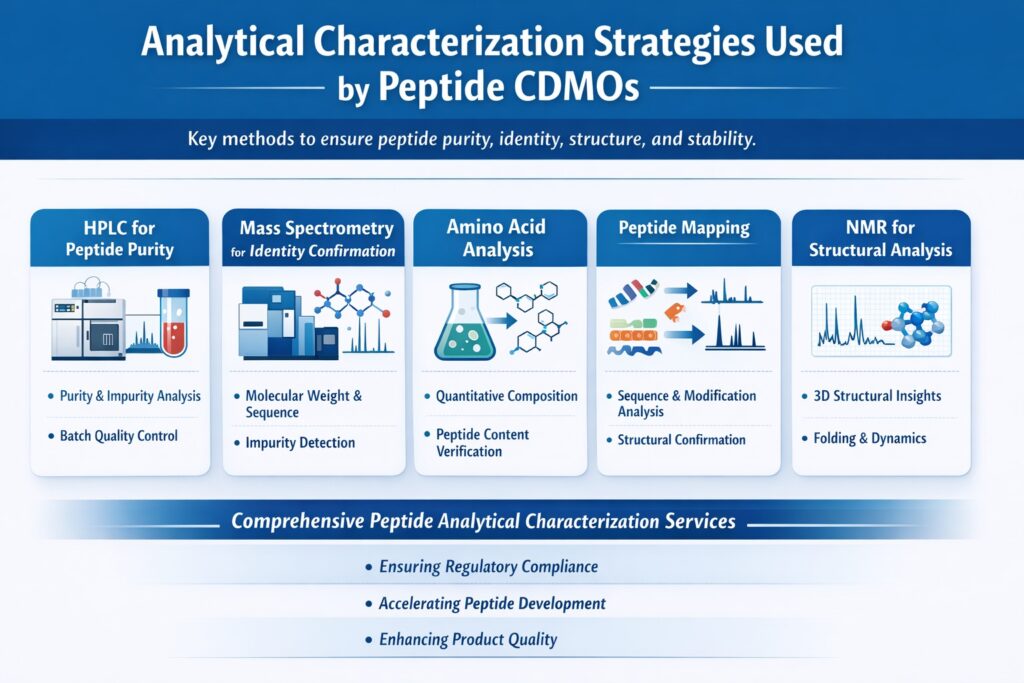
Peptide CDMO providers rely on multiple complementary analytical methods to fully characterize peptide molecules and ensure product quality. Because peptides can vary in sequence, folding patterns, and chemical modifications, no single analytical technique can provide complete characterization. Instead, CDMOs apply a combination of orthogonal techniques to confirm identity, purity, structure, and stability.
These integrated approaches form the backbone of modern peptide analytical characterization services, helping pharmaceutical and biotechnology companies develop peptides that meet strict regulatory and quality standards.
Advanced laboratories that specialize in peptide characterization in drug development typically combine multiple analytical technologies to achieve accurate molecular characterization.
Below are the most widely used analytical characterization strategies used by peptide CDMO providers.
1. High-Performance Liquid Chromatography (HPLC) for Peptide Purity
HPLC is the primary analytical method used to determine peptide purity and detect impurities during peptide development and manufacturing.
Peptide CDMO providers commonly use reverse-phase HPLC (RP-HPLC) to separate peptide molecules based on their hydrophobic properties. This separation enables scientists to detect impurities and confirm whether the peptide sample meets required purity specifications.
Through HPLC analysis, researchers can identify:
- Impurities generated during peptide synthesis
- Degradation products formed during storage or processing
- Truncated peptide sequences
- Process-related contaminants
Modern peptide laboratories frequently integrate HPLC with advanced mass spectrometry experts in drug development to obtain highly accurate analytical results.
Key Advantages of HPLC in Peptide Analytical Characterization Services
- High sensitivity for detecting impurities
- Accurate measurement of peptide purity
- Reliable method for routine batch quality control
- Easy integration with mass spectrometry systems
Because regulatory authorities require precise impurity profiling, HPLC remains a cornerstone technology in peptide analytical characterization services used by peptide CDMO providers.
2. Mass Spectrometry for Peptide Identity Confirmation
Mass spectrometry is essential for confirming peptide identity and determining molecular weight with exceptional accuracy.
Techniques such as LC-MS and MALDI-TOF mass spectrometry allow scientists to verify whether the synthesized peptide matches the expected molecular structure and sequence.
Specialized laboratories offering peptide testing services often rely heavily on advanced mass spectrometry platforms to ensure accurate peptide identification.
Common Mass Spectrometry Techniques Used by CDMOs
- LC-MS (Liquid Chromatography–Mass Spectrometry) – combines chromatographic separation with mass detection
- MALDI-TOF MS (Matrix-Assisted Laser Desorption/Ionization) – useful for rapid peptide mass determination
- Tandem Mass Spectrometry (MS/MS) – enables peptide sequencing and detailed structural analysis
Insights Provided by Mass Spectrometry
Mass spectrometry analysis can reveal:
- Accurate molecular weight of the peptide
- Confirmation of peptide sequence
- Identification of post-translational modifications
- Detection and characterization of impurities
Because of its high sensitivity and specificity, mass spectrometry is one of the most powerful tools used in peptide analytical characterization services, ensuring that the correct peptide molecule has been synthesized.
3. Amino Acid Analysis for Quantitative Verification
Amino acid analysis verifies peptide composition and provides highly accurate quantification of peptide concentration.
In this method, the peptide sample is hydrolyzed into individual amino acids, which are then separated and quantified using chromatographic techniques.
This analytical approach helps confirm that the peptide contains the expected amino acid composition and concentration.
Benefits of Amino Acid Analysis
- Precise quantification of peptide concentration
- Verification of amino acid composition
- Validation of synthesis accuracy
Many pharmaceutical laboratories performing bioanalysis in Canada integrate amino acid analysis as part of comprehensive peptide analytical workflows.
For pharmaceutical peptide development, amino acid analysis provides an additional layer of verification, strengthening the reliability of results generated through other peptide analytical characterization services.
4. Peptide Mapping for Structural Confirmation
Peptide mapping is a powerful analytical strategy used to verify peptide sequence and detect structural variations.
This method involves breaking the peptide into smaller fragments using specific enzymes. These fragments are then separated and analyzed to confirm that the peptide structure matches the intended sequence.
The peptide mapping process typically involves:
- Enzymatic digestion of the peptide
- Separation of resulting fragments using chromatography
- Structural analysis using mass spectrometry
Advanced laboratories conducting peptide sameness study services in Canada frequently use peptide mapping to confirm structural equivalence in generic peptide products.
Why Peptide Mapping Is Important
Peptide mapping helps scientists identify:
- Sequence errors or incorrect amino acid placement
- Chemical modifications introduced during synthesis
- Oxidation or deamidation events
- Structural inconsistencies within the peptide molecule
Because of its ability to detect subtle molecular changes, peptide mapping is considered a critical component of peptide analytical characterization services used by peptide CDMO providers in regulated pharmaceutical development.
5. Nuclear Magnetic Resonance (NMR) for Structural Analysis
NMR spectroscopy provides detailed information about the molecular structure and conformational behavior of peptides.
While mass spectrometry confirms molecular weight and sequence, NMR allows scientists to study the three-dimensional structure of peptide molecules and understand how atoms interact within the molecule.
This technique is especially valuable when working with complex therapeutic peptides or generic peptide projects such as the peptide characterization of Ganirelix generic project.
Key Insights Provided by NMR
NMR analysis can reveal:
- Structural conformation of peptide molecules
- Folding behavior and structural stability
- Chemical environment surrounding specific atoms
- Molecular dynamics and interactions
This technique is especially valuable when working with complex therapeutic peptides, cyclic peptides, or modified peptide molecules.
As a result, NMR plays an important role in advanced peptide analytical characterization services, providing deeper structural insights that support peptide drug discovery and development.
3: Additional Analytical Strategies Used by Peptide CDMO Providers
Peptide CDMO providers often use additional complementary analytical techniques to ensure a complete evaluation of peptide quality, stability, and structural integrity. While core methods such as HPLC and mass spectrometry provide essential insights, these supplementary techniques further strengthen the reliability of peptide analytical characterization services.
These analytical approaches are often integrated into a broader bioanalytical strategy for drug development to ensure accurate characterization of pharmaceutical peptides.
Complementary Analytical Techniques Used in Peptide Characterization
| Analytical Technique | Purpose in Peptide Characterization |
|---|---|
| Capillary Electrophoresis (CE) | Separates peptide variants and identifies charge-based differences |
| Circular Dichroism (CD) | Analyzes peptide secondary structure and conformational properties |
| Size Exclusion Chromatography (SEC) | Detects peptide aggregation and evaluates molecular size distribution |
| Stability Studies | Monitors peptide degradation under various storage and environmental conditions |
| LC-UV Analysis | Supports peptide quantification and impurity detection |
Why These Additional Techniques Matter
These analytical techniques provide deeper insights into peptide quality by evaluating structural and stability-related attributes that may not be fully captured by a single analytical method. For example:
- Capillary Electrophoresis is particularly useful for detecting minor peptide variants and charge heterogeneity.
- Circular Dichroism helps scientists understand how peptide molecules fold and maintain their structural conformation.
- Size Exclusion Chromatography plays an important role in detecting peptide aggregation, which can impact drug safety and efficacy.
- Stability studies help determine appropriate storage conditions and predict shelf life for peptide therapeutics.
- LC-UV analysis provides reliable quantitative measurements and supports impurity monitoring during manufacturing.
By integrating these complementary analytical tools, peptide CDMO providers can deliver comprehensive peptide analytical characterization services that support regulatory compliance, product quality, and successful peptide drug development.
4: How Peptide Analytical Characterization Supports Regulatory Compliance
Peptide analytical characterization services play a critical role in meeting regulatory requirements for peptide therapeutics. Regulatory agencies require detailed analytical data to confirm that peptide drugs are safe, effective, and consistently manufactured before they can be approved for clinical trials or commercial use.
These analytical processes are often integrated into broader pharmaceutical development workflows such as analytical method development for generic drugs and reverse engineering for development of generic drugs.
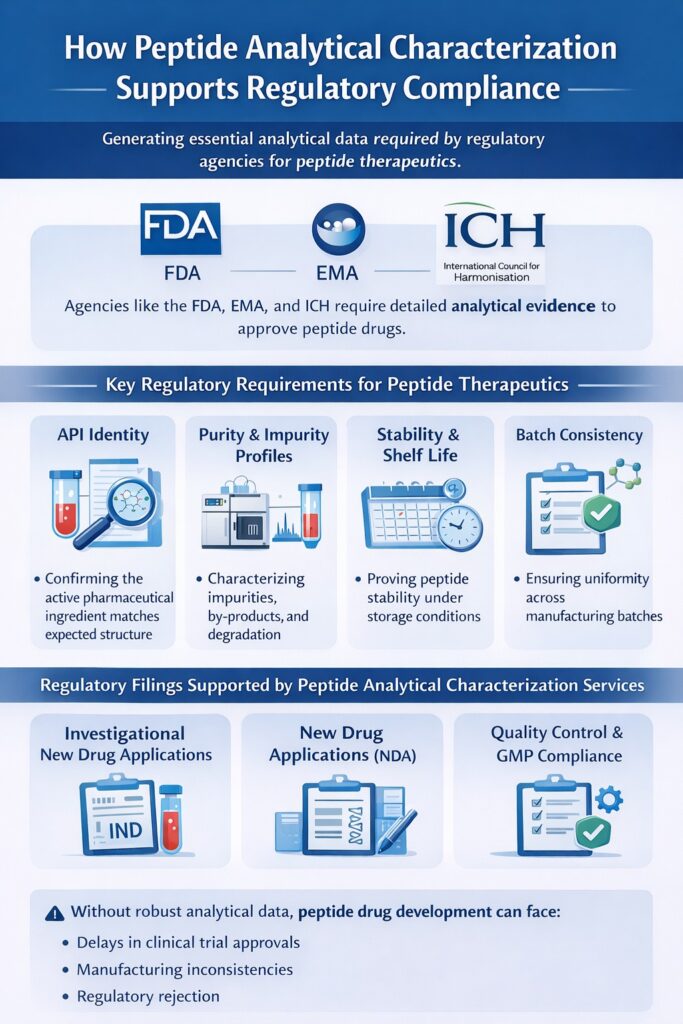
Organizations such as the U.S. Food and Drug Administration (FDA), European Medicines Agency (EMA), and International Council for Harmonisation of Technical Requirements for Pharmaceuticals for Human Use (ICH) require peptide developers to demonstrate comprehensive analytical validation throughout the drug development process.
Key Regulatory Requirements for Peptide Therapeutics
To meet regulatory expectations, peptide developers must provide analytical evidence demonstrating:
- Identity of the active pharmaceutical ingredient (API) – confirming that the synthesized peptide matches the intended molecular structure
- Purity and impurity profiles – identifying and quantifying impurities, degradation products, and synthesis by-products
- Stability and shelf life – proving that the peptide maintains its quality and efficacy under specific storage conditions
- Consistency across manufacturing batches – ensuring reproducibility and quality control during large-scale production
These data points are generated through validated peptide analytical characterization services, which provide the scientific foundation required for regulatory review.
Regulatory Filings Supported by Peptide Analytical Characterization Services
Comprehensive analytical characterization helps generate the data needed for major regulatory submissions, including:
- Investigational New Drug (IND) applications for initiating clinical trials
- New Drug Applications (NDA) for regulatory approval and commercialization
- Quality control documentation required for Good Manufacturing Practice (GMP) compliance
Many pharmaceutical companies partner with experienced pharmaceutical CDMO providers in the US and Canada to ensure regulatory readiness.
Robust analytical characterization ensures that peptide drug developers can provide regulators with clear, reliable, and reproducible analytical data.
Why Strong Analytical Data Is Critical
Without high-quality analytical data, peptide therapeutics may face significant regulatory challenges, including:
- Delays in clinical trial approvals
- Requests for additional analytical validation
- Manufacturing inconsistencies
- Regulatory rejection of drug applications
For this reason, experienced CDMO partners integrate advanced peptide analytical characterization services into every stage of peptide development. These services help ensure regulatory readiness, support product quality, and accelerate the path from discovery to commercialization.
5: The Role of Peptide Analytical Characterization Services in CDMO Partnerships
Peptide analytical characterization services play a vital role in successful partnerships between pharmaceutical companies and peptide CDMOs. By working with a CDMO that offers advanced analytical capabilities, biotech and pharmaceutical organizations can accelerate drug development while minimizing technical and regulatory risks.
Many biotech companies outsource analytical work through outsourced chemistry in drug discovery or outsourcing generic drug development in Canada to access specialized expertise and analytical infrastructure.
Companies developing generic peptides also collaborate with CDMOs experienced in CDMO for generic drug development in Canada and CDMO for generic projects in Canada.
Peptide molecules are complex, and their successful development requires precise validation of identity, purity, structure, and stability. This is why companies rely on experienced CDMO partners that specialize in comprehensive peptide analytical characterization services to ensure that every stage of peptide development meets strict quality and regulatory standards.
Key Capabilities Offered by a Reliable Peptide CDMO
A trusted CDMO partner provides a combination of scientific expertise, advanced technologies, and regulatory knowledge. These capabilities typically include:
- Experienced analytical scientists with expertise in peptide chemistry and structural analysis
- State-of-the-art instrumentation, including LC-MS, HPLC, and advanced spectroscopic tools
- Validated analytical methods designed for accurate peptide characterization and quality control
- Regulatory-ready documentation that supports compliance with global pharmaceutical guidelines
These capabilities ensure that peptide products are thoroughly evaluated using robust peptide analytical characterization services, helping companies avoid costly development setbacks.
How CDMO Partnerships Accelerate Peptide Drug Development
When pharmaceutical and biotech companies collaborate with experienced CDMO providers, they gain access to specialized analytical resources that may not exist in-house. This allows internal teams to focus on critical activities such as:
- Drug discovery and candidate selection
- Preclinical and clinical development
- Strategic research initiatives
Meanwhile, the CDMO ensures that peptides undergo rigorous testing through advanced peptide analytical characterization services, confirming quality, consistency, and regulatory readiness.
Expertise at ResolveMass Laboratories Inc.
At ResolveMass Laboratories Inc., analytical scientists specialize in advanced mass spectrometry and peptide characterization techniques designed to support modern peptide therapeutics. By combining scientific expertise with cutting-edge analytical technologies, the team helps pharmaceutical innovators generate reliable analytical data that supports peptide drug discovery, development, and regulatory submissions.
Through specialized peptide analytical characterization services, ResolveMass Laboratories Inc. supports biotech and pharmaceutical partners in developing high-quality peptide therapeutics with confidence.
6: Choosing the Right Provider for Peptide Analytical Characterization Services
Selecting the right partner for peptide analytical characterization services is essential for ensuring accurate analytical data, regulatory compliance, and successful peptide drug development. A capable CDMO provider offers not only advanced analytical technologies but also the scientific expertise required to interpret complex peptide data and support regulatory submissions.
Because peptide therapeutics often involve intricate structures, sequence variations, and potential degradation pathways, companies must carefully evaluate a provider’s analytical capabilities before establishing a partnership.
Organizations often evaluate providers with experience in:
- analytical development for generic drugs in Canada
- regulatory support for generic drugs in the US and Canada
- CDMO vs CRO for generic drug development
Companies developing complex generic peptides may also review analytical case studies such as the generic peptide drug analytical characterization case study.
Key Factors to Consider When Selecting a Peptide Analytical Characterization Partner
When assessing potential CDMO providers, pharmaceutical and biotechnology companies should consider the following factors:
- Advanced LC-MS and HPLC platforms
Modern analytical laboratories should be equipped with high-resolution mass spectrometry and high-performance liquid chromatography systems capable of delivering precise peptide characterization and impurity profiling. - Expertise in peptide structural analysis
A strong analytical team with experience in peptide sequencing, peptide mapping, and structural characterization ensures accurate identification of peptide variants and modifications. - Experience supporting regulatory submissions
Analytical providers should have a proven history of generating regulatory-compliant data that supports submissions to agencies such as the U.S. Food and Drug Administration and the European Medicines Agency. - Strong quality systems and data integrity
Reliable CDMO partners operate under strict quality management systems and follow Good Manufacturing Practice (GMP) guidelines to ensure accurate and traceable analytical results. - Proven track record in peptide analytical characterization services
Experience in handling diverse peptide molecules and development projects demonstrates the provider’s ability to manage complex analytical challenges.
Why the Right Analytical Partner Matters
Choosing a provider with deep expertise in peptide analytical characterization services helps companies reduce development risks and accelerate timelines. Experienced partners can quickly identify analytical issues, optimize characterization strategies, and generate reliable data required for regulatory review.
Ultimately, a well-qualified analytical partner ensures consistent peptide quality, reliable analytical results, and smoother regulatory approval pathways, enabling pharmaceutical and biotech companies to bring innovative peptide therapies to market more efficiently.
Conclusion:
Peptide therapeutics are transforming modern medicine, but their development requires precise analytical validation. Peptide analytical characterization services play a crucial role in confirming peptide identity, purity, structural integrity, and stability throughout the drug development lifecycle.
Peptide CDMO providers rely on advanced analytical strategies such as HPLC, mass spectrometry, amino acid analysis, peptide mapping, and NMR spectroscopy to deliver comprehensive peptide characterization. These techniques ensure regulatory compliance, support quality control, and accelerate peptide drug development.
Organizations seeking reliable peptide development support benefit from partnering with experts who specialize in peptide analytical characterization services and advanced mass spectrometry solutions.
ResolveMass Laboratories Inc. provides cutting-edge analytical expertise to help pharmaceutical and biotech companies confidently advance peptide therapeutics from discovery to commercialization.
Frequently Asked Questions:
Peptide analytical characterization services are specialized laboratory analyses used to confirm the identity, purity, structure, and stability of peptide molecules. These services use advanced techniques such as HPLC, mass spectrometry, peptide mapping, and NMR to ensure that peptide therapeutics meet quality and regulatory standards during development and manufacturing.
Peptide analytical characterization services are essential for verifying peptide quality and ensuring regulatory compliance. They help scientists confirm peptide sequence accuracy, detect impurities, evaluate stability, and generate data required for regulatory submissions and clinical development.
Several advanced analytical methods are used in peptide analytical characterization services, including:
-High-Performance Liquid Chromatography (HPLC) for purity analysis
-Mass Spectrometry (LC-MS, MALDI-TOF) for molecular weight and sequence confirmation
-Amino Acid Analysis for quantitative verification
-Peptide Mapping for structural confirmation
-Nuclear Magnetic Resonance (NMR) for structural analysis
These techniques together provide a complete understanding of peptide composition and quality.
Peptide analytical characterization services generate the data required by regulatory agencies to approve peptide therapeutics. Regulatory authorities require evidence demonstrating peptide identity, impurity profiles, stability, and batch consistency before approving clinical trials or commercialization.
The analytical data produced through these services supports regulatory filings such as IND and NDA submissions.
Peptide CDMO providers offer integrated peptide analytical characterization services to support pharmaceutical and biotechnology companies. These organizations provide advanced instrumentation, experienced analytical scientists, and validated analytical methods that help ensure peptide products meet regulatory and quality standards.
Reference
- Commercialization of Cell Therapies: A CDMO Perspective.https://link.springer.com/chapter/10.1007/978-3-031-97297-3_11
- Regulatory Considerations in Synthetic Peptide Characterization: Techniques and Compliance.https://analyticalsciencejournals.onlinelibrary.wiley.com/doi/abs/10.1002/sscp.70057
- Multi-attribute method for simultaneous monitoring of critical quality attributes in monoclonal antibodies: advances, challenges, and regulatory perspectives.https://link.springer.com/article/10.1007/s00216-025-06188-1
- Silvia Millán-Martín. Multi-Attribute Method (MAM): An Emerging Analytical Workflow for Biopharmaceutical Characterization, Batch Release and cGMP Purity Testing at the Peptide and Intact Protein Level.https://www.tandfonline.com/doi/full/10.1080/10408347.2023.2238058
- Jagjit Singh Srai. Emerging Applications and Regulatory Strategies for Advanced Medicines Manufacturing – Towards the Development of a Platform Approach.https://www.sciencedirect.com/science/article/abs/pii/S0022354924001436
About the Author


