

Introduction:
The debate around Peptide CDMO vs CRO has become increasingly relevant as peptide therapeutics continue to expand in pharmaceutical pipelines. From metabolic diseases to oncology and rare disorders, peptides are now a major focus of drug development.
However, choosing the right outsourcing partner is critical. Pharmaceutical sponsors must understand the difference between Peptide CDMO vs CRO to ensure that their project progresses efficiently from discovery through clinical development and manufacturing.
In simple terms:
- Peptide CROs focus on research services
- Peptide CDMOs focus on development and manufacturing
Yet the distinction goes deeper than that. This article explores the key differences, advantages, and decision factors pharmaceutical sponsors should consider when evaluating Peptide CDMO vs CRO partnerships.
Modern peptide programs also rely heavily on advanced mass spectrometry experts in drug development to ensure accurate analytical characterization during early research and development stages.
Share via:
Summary:
Before choosing a partner for peptide research, development, or manufacturing, pharmaceutical sponsors must understand the difference between a Peptide CDMO vs CRO. The choice directly impacts speed, regulatory compliance, scalability, and long-term commercialization success.
Key takeaways from this article:
- Peptide CROs (Contract Research Organizations) mainly support early-stage research, discovery, and preclinical experimentation.
- Peptide CDMOs (Contract Development and Manufacturing Organizations) support process development, scale-up, and GMP manufacturing.
- Sponsors working toward clinical trials or commercialization typically need a Peptide CDMO.
- CROs are best suited for target discovery, assay development, and early proof-of-concept work.
- A Peptide CDMO vs CRO decision should depend on project stage, regulatory needs, and manufacturing scalability.
- Partnering with an experienced peptide specialist like ResolveMass Laboratories Inc. can streamline development from discovery to clinical-grade peptide production.
Organizations that combine advanced bioanalytical strategy and peptide expertise often help sponsors accelerate development timelines. Learn more about building a strong bioanalytical strategy for drug development.
1: Peptide CDMO vs Peptide CRO: The Fundamental Difference
In simple terms, the difference between a Peptide CDMO vs CRO lies in their role in the drug development lifecycle. A Peptide CRO primarily supports early-stage research and discovery activities, while a Peptide CDMO focuses on process development, manufacturing scale-up, and GMP-compliant production for clinical and commercial use.
Understanding this distinction helps pharmaceutical sponsors select the right partner based on the stage of peptide drug development and regulatory requirements.
Organizations specializing in bioanalysis in Canada often support both CRO research environments and CDMO development programs with high-quality analytical data.
Key Differences Between Peptide CRO and Peptide CDMO
| Feature | Peptide CRO | Peptide CDMO |
|---|---|---|
| Primary Role | Research and discovery support | Development and manufacturing |
| Project Stage | Discovery and early preclinical research | Preclinical through commercial manufacturing |
| Manufacturing Capability | Limited or not typically offered | Full GMP peptide manufacturing |
| Regulatory Compliance | Minimal regulatory infrastructure | Extensive GMP, QA, and QC compliance |
| Process Development | Rarely offered | Core capability for scale-up |
| Manufacturing Scale-up | Not typically available | Essential service for clinical production |
Although some organizations provide hybrid research and manufacturing services, most pharmaceutical development programs eventually transition from a Peptide CRO to a Peptide CDMO as the therapeutic candidate advances toward clinical trials and commercialization.
For sponsors developing peptide therapeutics, understanding the Peptide CDMO vs CRO distinction early in the project lifecycle can significantly improve development efficiency, regulatory readiness, and overall project timelines.
2: When Should Pharmaceutical Sponsors Choose a Peptide CRO?
Pharmaceutical sponsors should choose a Peptide CRO when their project is in the early research or discovery stage and requires scientific experimentation rather than manufacturing capabilities. In the Peptide CDMO vs CRO decision process, CROs are typically the best fit for discovery-focused activities such as peptide screening, biological testing, and early candidate validation.
Peptide CROs are designed to support scientific exploration and early-stage research, allowing sponsors to evaluate potential peptide therapeutics before committing to the more complex development and manufacturing stages handled by CDMOs.
Many CRO workflows also involve outsourced chemistry in drug discovery to accelerate candidate identification and early-stage optimization.
Common Services Offered by a Peptide CRO
Peptide CROs typically provide research-oriented services that help identify and validate promising peptide candidates.
These services often include:
- Peptide discovery and screening
- Peptide library synthesis
- Assay development and optimization
- Target identification and validation
- Biological activity testing
- Early structure–activity relationship (SAR) studies
For projects requiring peptide-specific testing, specialized laboratories offering peptide testing services can provide detailed analytical insights into candidate molecules.
These capabilities allow research teams to rapidly test hypotheses and generate data that guide further drug development decisions.
Benefits of Working with a Peptide CRO
In the Peptide CDMO vs CRO framework, CROs provide several advantages for early-stage pharmaceutical development.
Key benefits include:
- Flexible research capabilities that support exploratory studies
- Rapid hypothesis testing to evaluate peptide candidates quickly
- Access to specialized laboratory technologies and expertise
- Lower operational costs during the discovery and validation phases
For many biotech startups, academic institutions, and early-stage pharmaceutical companies, CRO partnerships are essential for accelerating proof-of-concept validation before transitioning to clinical development.
Limitations of Peptide CROs
While CROs are highly valuable during discovery, they typically do not provide large-scale manufacturing or regulatory-grade production.
Most CROs lack infrastructure for:
- GMP-compliant peptide manufacturing
- Large-scale process development
- Clinical trial material production
- Regulatory documentation and quality systems
As peptide drug candidates advance toward IND-enabling studies and clinical trials, sponsors usually transition to a Peptide CDMO that can support process development, scale-up, and GMP manufacturing.
Understanding this transition is a key part of the Peptide CDMO vs CRO decision strategy, ensuring that pharmaceutical sponsors partner with the right organization at each stage of development.
3: When Should Sponsors Work With a Peptide CDMO?
Pharmaceutical sponsors should work with a Peptide CDMO when their drug candidate moves beyond discovery and requires process development, scale-up, or GMP-compliant manufacturing for clinical trials. In the Peptide CDMO vs CRO decision framework, this transition typically occurs when a peptide therapeutic advances toward IND-enabling studies, regulatory submissions, or clinical trial material production.
At this stage, development requires specialized manufacturing expertise, strict quality systems, and regulatory compliance—capabilities that are central to Peptide CDMOs.
Many sponsors partner with organizations offering comprehensive peptide CDMO services to support development from preclinical stages through clinical manufacturing.
Core Services Provided by Peptide CDMOs
Peptide CDMOs offer integrated development and manufacturing services that enable pharmaceutical sponsors to move their candidate from laboratory-scale synthesis to clinical-grade production.
Typical services include:
- Process development and optimization
- Analytical method development and validation
- GMP peptide manufacturing
- Purification and large-scale production
- Regulatory documentation support
- Stability studies and shelf-life evaluation
- Quality control (QC) and quality assurance (QA)
Advanced peptide programs also depend on peptide analytical characterization services to ensure purity, identity, and regulatory compliance.
These capabilities ensure that peptide drug candidates can be manufactured consistently, safely, and in compliance with regulatory expectations.
Why Peptide CDMOs Are Critical for Clinical Development
In the Peptide CDMO vs CRO comparison, CDMOs play a vital role once a therapeutic candidate approaches clinical testing. Clinical trials require pharmaceutical products to meet strict regulatory standards for safety, purity, and reproducibility.
Peptide CDMOs operate under Good Manufacturing Practice (GMP) frameworks, which are designed to ensure:
- Consistent manufacturing processes
- Controlled production environments
- Documented quality systems
- Regulatory-compliant batch records
Key Advantages of Partnering With a Peptide CDMO
Sponsors gain several important benefits when working with a specialized peptide CDMO:
- Regulatory readiness for clinical trial submissions
- Manufacturing scalability from research to clinical and commercial volumes
- Reproducible peptide production processes
- Quality-controlled development and manufacturing workflows
Without these capabilities, pharmaceutical sponsors cannot produce the clinical-grade material required for regulatory approval and human trials.
For this reason, many companies transition from a research-focused partner to a manufacturing-focused partner as their program progresses—making the Peptide CDMO vs CRO decision a critical milestone in the peptide drug development journey.
4: Peptide CDMO vs CRO: Development Lifecycle Comparison
In the peptide drug development lifecycle, CROs primarily support early discovery activities, while CDMOs become essential during development, clinical manufacturing, and commercialization. In the Peptide CDMO vs CRO comparison, both partners play distinct but complementary roles at different stages of pharmaceutical development.
Sponsors evaluating outsourcing options may also consider broader comparisons such as CDMO vs CRO for generic drug development.
Understanding where each partner fits in the lifecycle helps sponsors design an efficient outsourcing strategy and avoid delays when transitioning from research to regulated manufacturing.
How CROs and CDMOs Fit into the Development Lifecycle
Below is a simplified comparison showing how Peptide CROs and Peptide CDMOs contribute across different stages of peptide therapeutic development.
| Development Stage | CRO Role | CDMO Role |
|---|---|---|
| Discovery | Target screening and early peptide identification | Limited involvement |
| Lead Identification | Peptide library synthesis and screening | Minimal role |
| Lead Optimization | Structure–activity relationship (SAR) studies | Early process feasibility |
| Preclinical Development | Bioactivity testing and validation | Early process development |
| IND Preparation | Rare involvement | Core role including development and documentation |
| Clinical Manufacturing | Not typically offered | Essential GMP manufacturing |
| Commercial Production | Not available | Primary responsibility |
Transition From CRO to CDMO
In most peptide drug development programs, pharmaceutical sponsors start with a CRO to support discovery and early validation work. Once a promising therapeutic candidate is identified and the program moves toward preclinical development or regulatory submission, sponsors typically transition to a Peptide CDMO partner.
This shift occurs because CDMOs provide the infrastructure required for:
- Process development and optimization
- GMP-compliant manufacturing
- Analytical method validation
- Regulatory documentation
- Large-scale production for clinical trials
As a result, understanding the Peptide CDMO vs CRO transition point in the development lifecycle helps sponsors ensure a smooth progression from early research to clinical development and eventual commercialization.
5: Key Factors Sponsors Should Evaluate in Peptide CDMO vs CRO Partnerships
When deciding between a Peptide CDMO vs CRO, pharmaceutical sponsors should carefully evaluate expertise, scalability, regulatory capabilities, and analytical infrastructure. Choosing the wrong partner can lead to development delays, increased costs, manufacturing challenges, or regulatory setbacks.
Advanced analytical work such as analytical method development for generic drugs and analytical development for generic drugs in Canada often plays a key role in regulatory preparation.
For complex development programs, sponsors may also require regulatory support for generic drugs in the US and Canada to navigate submission requirements.
Because peptide therapeutics often involve complex synthesis and strict regulatory standards, selecting the right outsourcing partner is a strategic decision that directly affects the success of the development program.
Below are the most important factors sponsors should consider when evaluating Peptide CDMO vs CRO partnerships.
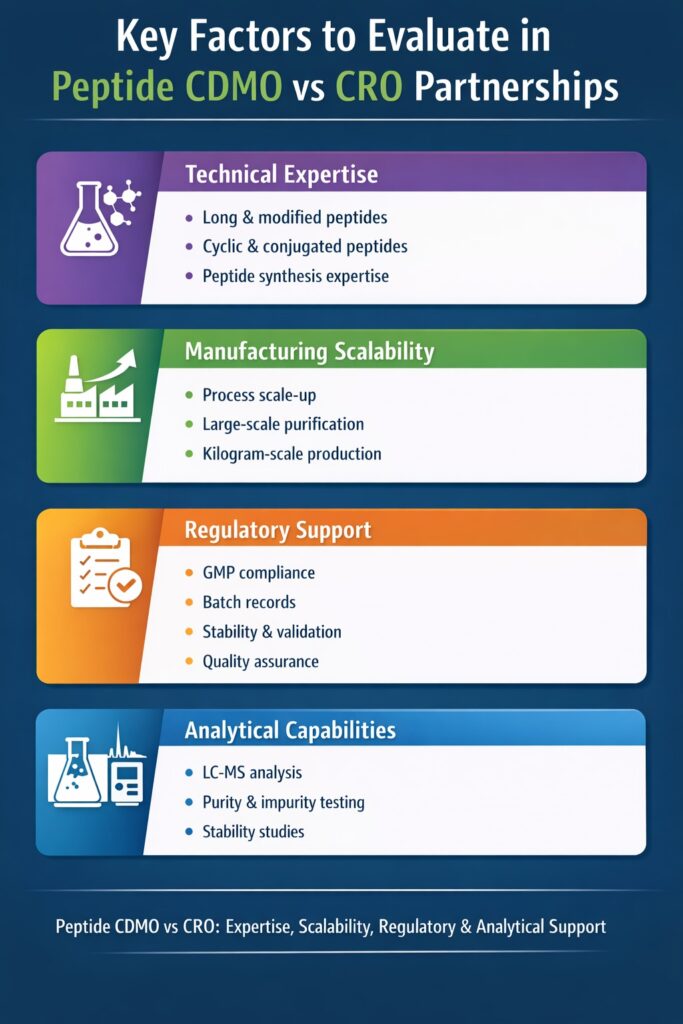
1. Technical Expertise
Peptide development requires specialized scientific expertise, especially when dealing with complex peptide structures or modifications.
Peptide synthesis can become technically challenging in cases involving:
- Long peptide sequences
- Modified peptides
- Cyclic peptides
- Conjugated peptides
- Highly hydrophobic or aggregation-prone sequences
Organizations with deep peptide expertise are better equipped to manage these complexities, optimize synthesis strategies, and minimize impurities. In the Peptide CDMO vs CRO evaluation process, sponsors should prioritize partners with demonstrated experience in advanced peptide chemistry and development.
2. Manufacturing Scalability
Scalability is one of the most important differentiators in the Peptide CDMO vs CRO comparison.
While CROs are primarily focused on laboratory-scale research, CDMOs are designed to transition peptide production from milligram-scale research quantities to gram- or kilogram-scale manufacturing required for clinical trials and commercialization.
Key scalability capabilities typically offered by Peptide CDMOs include:
- Process scale-up and optimization
- Large-scale purification techniques
- Manufacturing process development
- Batch reproducibility for clinical production
Sponsors should confirm that their partner has the technical infrastructure to support both current research needs and future manufacturing demands.
3. Regulatory Support
Regulatory readiness is essential when advancing peptide therapeutics into clinical trials.
Clinical development requires extensive regulatory documentation and quality systems, including:
- Good Manufacturing Practice (GMP) compliance
- Detailed batch manufacturing records
- Analytical method validation
- Stability testing and documentation
- Quality assurance and quality control systems
In the Peptide CDMO vs CRO decision, CDMOs typically provide the regulatory infrastructure needed to support IND submissions, clinical trial material production, and regulatory inspections.
Without this support, sponsors may encounter significant barriers when preparing for clinical development.
4. Integrated Analytical Capabilities
Comprehensive analytical support is critical for ensuring peptide quality, purity, and stability.
Advanced analytical capabilities help identify impurities, confirm peptide identity, and maintain consistent manufacturing processes throughout development.
Key analytical techniques commonly used in peptide development include:
- Liquid chromatography–mass spectrometry (LC-MS) analysis
- Purity and impurity profiling
- Structural characterization
- Stability testing and degradation studies
Sponsors benefit significantly from partners that offer integrated analytical and manufacturing expertise, as this approach improves data reliability and accelerates development timelines.
Carefully evaluating these factors allows pharmaceutical companies to make informed decisions in the Peptide CDMO vs CRO partnership selection process, ensuring they collaborate with organizations capable of supporting both scientific innovation and regulatory-compliant development.
6: Why Specialized Peptide Partners Matter
Peptide therapeutics require specialized scientific and analytical expertise, making experienced peptide partners essential for successful drug development. In the context of Peptide CDMO vs CRO, selecting organizations with deep peptide knowledge can significantly improve development efficiency, data reliability, and regulatory readiness.
Advanced techniques like peptide characterization in drug development help researchers understand structure, purity, and stability.
Case studies such as generic peptide drug analytical characterization demonstrate how analytical expertise can accelerate peptide drug development.
Similarly, detailed projects like peptide characterization of Ganirelix generic highlight the importance of specialized analytical workflows.
Sponsors working on generics may also require peptide sameness study services in Canada to demonstrate equivalence with reference products.
Unlike traditional small-molecule drugs, peptides present several unique technical and manufacturing challenges that require specialized infrastructure and scientific expertise.
Unique Challenges in Peptide Development
Peptide-based therapeutics often involve complexities such as:
- Complex synthesis processes due to longer amino acid sequences
- Sequence-specific impurities that require advanced analytical identification
- Folding and stability issues that can impact biological activity
- Purification challenges, particularly for highly hydrophobic peptides
- Scale-up complexity when transitioning from research to clinical manufacturing
These challenges make peptide drug development significantly more specialized than many other pharmaceutical modalities.
The Value of Specialized Peptide Expertise
Organizations with deep expertise in peptide chemistry, analytical characterization, and development can help pharmaceutical sponsors identify potential issues early and optimize development strategies.
Experienced peptide partners can support:
- Improved synthesis efficiency
- Better impurity identification and control
- Robust analytical characterization
- Optimized purification strategies
- Reliable scale-up processes
In the Peptide CDMO vs CRO decision process, working with partners who possess specialized peptide capabilities can reduce development risks and accelerate timelines.
Supporting Peptide Innovation
At ResolveMass Laboratories Inc., peptide development and advanced analytical services are designed to support pharmaceutical innovators across multiple stages of drug development. Our team combines state-of-the-art analytical technologies with deep expertise in peptide characterization, enabling sponsors to obtain accurate, high-quality data for critical development decisions.
This strong scientific foundation helps pharmaceutical sponsors navigate the complexities of Peptide CDMO vs CRO selection, while supporting efficient peptide therapeutic development from early research through advanced development stages.
7: Peptide CDMO vs CRO: Strategic Considerations for Pharmaceutical Sponsors
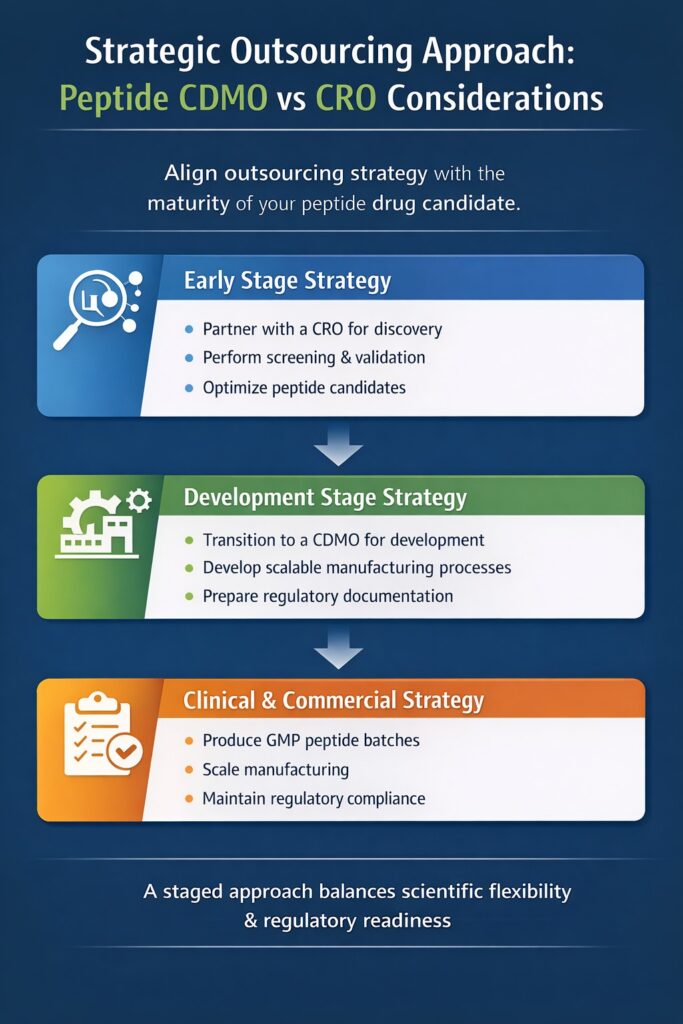
Pharmaceutical sponsors should align their outsourcing strategy with the maturity and development stage of their peptide drug candidate. In the Peptide CDMO vs CRO decision process, selecting the right partner at the right stage can help optimize research efficiency, reduce development risks, and ensure regulatory compliance as the program progresses.
Organizations supporting development programs in North America often provide pharmaceutical CDMO services in the US and Canada and help accelerate generic drug development.
Companies working on generic therapeutics may also benefit from:
- CDMO for generic drug development in Canada
- CDMO for generic projects in Canada
- Generic pharmaceutical CDMO Canada
- Outsourcing generic drug development in Canada
A strategic outsourcing approach typically evolves alongside the drug development lifecycle.
Early-Stage Strategy
During the discovery and validation phases, pharmaceutical companies often partner with a Peptide CRO to support research-driven activities.
Typical early-stage priorities include:
- Partnering with a CRO for peptide discovery and research
- Performing screening and biological validation studies
- Optimizing peptide candidates through structure–activity relationship (SAR) studies
- Evaluating potential therapeutic candidates
At this stage, flexibility and rapid experimentation are critical, which is why CROs are well suited for early development programs.
Development-Stage Strategy
As the peptide candidate advances toward preclinical development and regulatory preparation, sponsors typically transition toward a Peptide CDMO that can support development and manufacturing requirements.
Key activities during this stage include:
- Transitioning from CRO research to CDMO development capabilities
- Developing scalable peptide manufacturing processes
- Establishing analytical methods and quality control strategies
- Preparing regulatory documentation for IND submissions
In the Peptide CDMO vs CRO framework, this stage marks the shift from exploratory research to structured development and regulatory readiness.
Clinical and Commercial Strategy
Once a peptide therapeutic progresses to clinical trials and potential commercialization, the role of the Peptide CDMO becomes even more critical.
Sponsors require partners who can support:
- Production of GMP-grade peptide batches for clinical trials
- Manufacturing scale-up for larger batch sizes
- Regulatory-compliant production environments
- Quality assurance and long-term manufacturing consistency
These capabilities ensure that peptide therapeutics can move successfully from development into clinical testing and eventual commercial production.
A Staged Outsourcing Approach
By aligning outsourcing strategies with each stage of development, pharmaceutical sponsors can maximize both scientific flexibility and regulatory readiness.
A well-planned Peptide CDMO vs CRO strategy allows companies to:
- Accelerate early research and discovery
- Transition smoothly into regulated development stages
- Ensure scalable and compliant manufacturing for clinical trials
This staged approach ultimately helps pharmaceutical innovators navigate the complexities of peptide drug development more efficiently and with reduced risk.
Conclusion:
Understanding the differences between Peptide CDMO vs CRO is essential for pharmaceutical sponsors navigating peptide drug development.
In summary:
- Peptide CROs support discovery and early research
- Peptide CDMOs support development, scale-up, and GMP manufacturing
- The right partner depends on the stage of development, regulatory requirements, and manufacturing needs
Sponsors that carefully evaluate their outsourcing strategy can accelerate development timelines, reduce technical risks, and improve the likelihood of clinical success.
As peptide therapeutics continue to gain momentum in the pharmaceutical industry, selecting the right partner in the Peptide CDMO vs CRO landscape will remain a critical strategic decision.
Frequently Asked Questions:
The key difference between a Peptide CDMO vs CRO lies in their role in drug development. A Peptide CRO (Contract Research Organization) primarily focuses on early-stage research services such as peptide discovery, screening, and biological testing. In contrast, a Peptide CDMO (Contract Development and Manufacturing Organization) provides process development, manufacturing scale-up, and GMP production for clinical trials and commercial use.
Pharmaceutical companies typically choose a Peptide CRO during the discovery and early research phases of drug development. CROs help with activities such as peptide screening, assay development, target validation, and early biological testing before the drug candidate moves toward manufacturing.
Choosing between a Peptide CDMO vs CRO affects development timelines, regulatory compliance, manufacturing scalability, and overall project success. Selecting the right partner at the correct stage helps pharmaceutical companies move efficiently from discovery to clinical development.
Peptide CDMOs generally offer a range of development and manufacturing services, including:
-Process development and optimization
-Analytical method development
-GMP peptide manufacturing
-Purification and scale-up
-Stability studies
-Regulatory documentation support
-Quality control and quality assurance
These services ensure peptide therapeutics can be manufactured safely and consistently for clinical trials.
Peptide CROs mainly support early research and discovery activities. Common services include:
-Peptide discovery and screening
-Peptide library synthesis
-Biological testing and validation
-Assay development
-Structure–activity relationship (SAR) studies
These services help identify and optimize promising peptide drug candidates.
Pharmaceutical sponsors should evaluate several factors when deciding between a Peptide CDMO vs CRO, including:
-Technical expertise in peptide chemistry
-Analytical and characterization capabilities
-Manufacturing scalability
-Regulatory compliance and GMP infrastructure
-Experience with peptide drug development
Choosing the right partner ensures smoother development and regulatory approval pathways.
Reference
- The Net Financial Benefits of Single Vendor Integrated CDMO and CRO Drug Development Services.https://www.researchsquare.com/article/rs-6531199/v1
- electing and Optimizing the Right Manufacturing Partner: Optimizing the use of partners for clinical trials depends on selecting the right contractor.https://go.gale.com/ps/i.do?id=GALE%7CA698867642&sid=googleScholar&v=2.1&it=r&linkaccess=abs&issn=1542166X&sw=w&p=HRCA&userGroupName=anon%7Eff9164ee&aty=open-web-entry
- Impact of Contract Research Organizations on Pharmaceutical Industries: A Review.https://www.benthamdirect.com/content/journals/adctra/10.2174/0126673371332371241113103855
- Thermo Fisher’s Accelerator Expands CRO, CDMO Services: Customizable suite of manufacturing, clinical research, and clinical supply chain offerings designed to deliver “360°” support at every drug development stage.https://journals.sagepub.com/doi/full/10.1089/genedge.6.01.180
About the Author


