

Introduction
Analytical Characterization of GLP-1 Peptide Drugs is a specialized analytical process used to confirm the structure, purity, and stability of GLP-1 receptor agonist therapeutics. These studies are essential to ensure that peptide drugs meet strict pharmaceutical quality standards before reaching patients. Proper characterization also supports regulatory documentation required during drug development and commercialization.
Peptide-based drugs such as semaglutide, liraglutide, exenatide, and tirzepatide are widely used for treating diabetes and obesity. Because these therapies play a critical role in modern healthcare, regulatory agencies require detailed analytical evaluation. Careful characterization ensures that these peptide drugs remain consistent, safe, and effective across different manufacturing batches.
Learn more about our specialized support for developers: Explore Generic Drug Development CDMO Services
Unlike traditional small-molecule drugs, GLP-1 peptides have complex structures and can undergo various chemical modifications or degradation processes. Their stability can be influenced by environmental conditions such as temperature, pH, and oxidation. For this reason, advanced analytical workflows are required to accurately detect structural changes and impurities.
This guide provides an overview of Analytical Characterization of GLP-1 Peptide Drugs, including analytical techniques, impurity profiling, stability testing, and modern characterization strategies used in pharmaceutical laboratories. It helps researchers and analytical scientists better understand the methods used to evaluate peptide therapeutics.
Share via:
Quick Summary
- Analytical Characterization of GLP-1 Peptide Drugs requires advanced techniques such as LC-MS/MS, high-resolution mass spectrometry (HRMS), RP-HPLC, peptide mapping, and forced degradation studies.
- Characterization focuses on structural integrity, impurity profiling, degradation pathways, and stability of GLP-1 analogs like semaglutide, liraglutide, exenatide, and tirzepatide.
- Impurity identification and degradation product mapping are critical because regulatory guidelines often require characterization of peptide impurities above 0.1% relative abundance.
- Advanced analytical workflows combine chromatographic separation, mass spectrometry, and orthogonal techniques to ensure accurate molecular characterization.
- Stability studies must evaluate pH, temperature, excipients, oxidation, and aggregation pathways to determine degradation behavior of GLP-1 peptide drugs.
- Modern analytical strategies increasingly rely on high-resolution LC-MS platforms and data-rich analytical pipelines to enable precise peptide characterization and regulatory compliance.
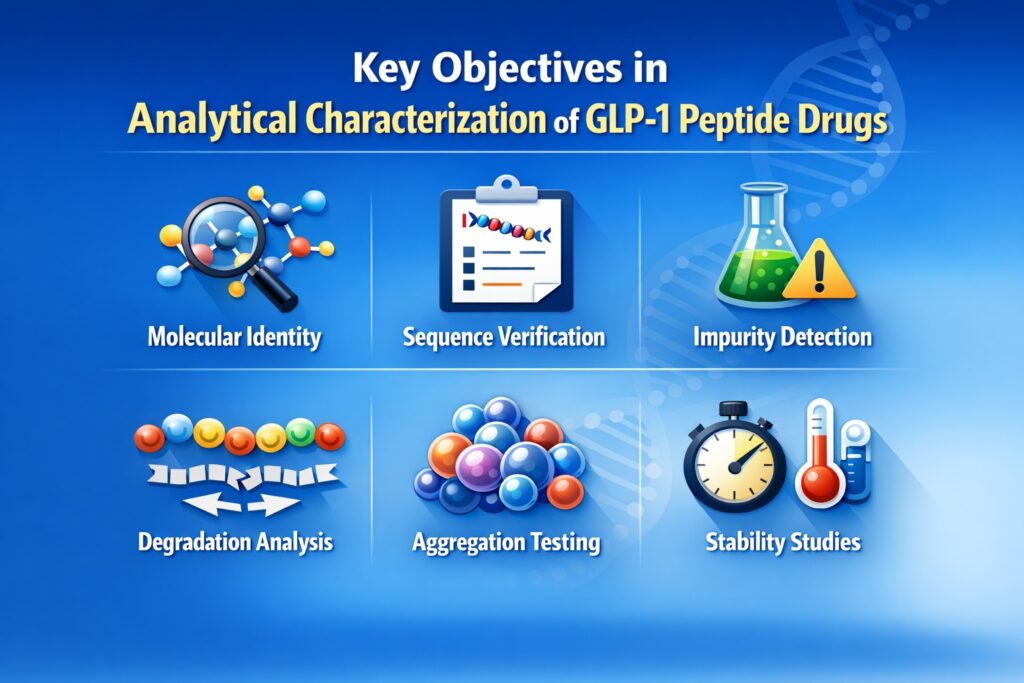
Key Analytical Objectives in Analytical Characterization of GLP-1 Peptide Drugs
The main objective of Analytical Characterization of GLP-1 Peptide Drugs is to confirm the molecular identity of the peptide and detect any structural variations that may affect safety or therapeutic performance. Analytical scientists must verify that the peptide sequence and chemical modifications match the intended molecular design. This verification ensures that the final drug product performs consistently in clinical applications.
Core analytical objectives include:
- Molecular identity confirmation
- Sequence verification
- Impurity identification
- Degradation product characterization
- Aggregation analysis
- Stability profiling
Ensure your molecule meets all structural requirements: View our Comprehensive Peptide Characterization Service
Together, these objectives ensure that peptide drugs meet strict pharmaceutical quality standards. By evaluating each parameter carefully, researchers can confirm that the drug substance is structurally correct and free from harmful impurities.
Peptide therapeutics may contain several types of impurities such as synthetic by-products, truncations, oxidation products, deamidated variants, and isomeric forms. These impurities can arise during peptide synthesis, purification, formulation, or long-term storage. Because peptides contain many reactive amino acid residues, they are especially prone to chemical modifications.
Therefore, analytical workflows must provide high resolution and high sensitivity to detect these variants at extremely low concentrations. Modern analytical instruments can identify impurities at trace levels, which is essential for maintaining drug quality and safety.
Regulatory guidelines also require detailed characterization when impurity levels exceed approximately 0.1%. As a result, advanced analytical technologies play a crucial role in the development and approval of GLP-1 peptide drugs.
Stay compliant with the latest regulatory benchmarks: Read the FDA Peptide Sameness Study Requirements
Analytical Techniques Used in Analytical Characterization of GLP-1 Peptide Drugs
The Analytical Characterization of GLP-1 Peptide Drugs relies on several complementary analytical methods. Each technique provides unique information about the peptide’s structure, composition, and purity. When these methods are used together, they create a more complete and reliable analytical profile.
Because peptides can contain multiple structural variants and chemical modifications, no single analytical technique can fully characterize them. Pharmaceutical laboratories therefore use integrated analytical workflows that combine chromatographic separation, mass spectrometry, and additional structural tools.
This integrated approach enables comprehensive evaluation of both the main peptide molecule and any associated impurities.
Chromatographic Methods in Analytical Characterization of GLP-1 Peptide Drugs
Chromatographic separation is a critical step in peptide analysis because it allows scientists to resolve peptide variants and impurities before structural identification. By separating components within the peptide mixture, chromatography improves detection accuracy and simplifies further analysis.
Common chromatography techniques
| Technique | Purpose in GLP-1 Peptide Analysis |
|---|---|
| Reverse Phase HPLC (RP-HPLC) | Primary separation and impurity profiling |
| UPLC | High-resolution peptide separation |
| Ion-Exchange Chromatography | Charge variant detection |
| Size-Exclusion Chromatography | Aggregation and oligomer analysis |
Reverse-phase chromatography is widely used for GLP-1 peptide impurity profiling. It separates molecules based on hydrophobic interactions, making it effective for identifying peptide variants caused by oxidation or lipidation.
UPLC systems further improve separation performance by using smaller particle sizes and higher pressures. This results in faster analysis times and better resolution between closely related peptide structures.
Ion-exchange chromatography helps detect charge variants that may occur due to deamidation or other chemical changes. Meanwhile, size-exclusion chromatography is useful for identifying peptide aggregation or oligomer formation.
Together, these chromatographic techniques provide valuable insights into peptide purity and structural stability.
Access high-resolution testing for your therapeutic: Discover Peptide Sameness Testing Methods
Mass Spectrometry for Peptide Identification
Mass spectrometry is one of the most powerful tools used in Analytical Characterization of GLP-1 Peptide Drugs. It allows scientists to determine molecular weight with high precision and analyze peptide structures at a detailed level.
Key MS-based approaches include:
- LC-MS/MS
- High-resolution mass spectrometry (HRMS)
- Peptide fragmentation analysis
- Accurate mass measurement
These analytical approaches provide structural information that cannot be obtained from chromatography alone. Fragmentation patterns generated during MS/MS experiments help confirm amino acid sequences and identify structural changes.
Mass spectrometry allows researchers to:
- Identify minor impurities
- Detect D-amino acid isomers
- Confirm lipidated peptide modifications
- Characterize degradation fragments
High-resolution LC-MS platforms are especially useful for analyzing complex peptide degradation products and post-synthetic modifications. Their ability to measure very small mass differences makes them ideal for distinguishing closely related peptide structures.
Confirm your primary structure with precision: Learn about our Peptide Sequencing Service
Impurity Profiling in Analytical Characterization of GLP-1 Peptide Drugs
Impurity profiling is a critical part of Analytical Characterization of GLP-1 Peptide Drugs. Peptide drug substances often contain impurities that originate during synthesis, purification, formulation, or long-term storage. Understanding these impurities helps ensure product safety and consistent therapeutic performance.
GLP-1 peptide drugs may contain several impurity types formed through chemical reactions during synthesis or degradation processes during storage. Because peptides contain many functional groups, they are susceptible to oxidation, hydrolysis, and structural rearrangements.
Major impurity categories include:
- Truncated peptides
- Deletion sequences
- Oxidized variants
- Deamidated residues
- D-amino acid isomers
- Acylation or lipidation by-products
Advanced LC-HRMS methods allow researchers to identify very low-level impurities that might otherwise remain undetected. These may include subtle structural variants such as D-amino acid substitutions or unexpected sequence changes.
Example: Impurity detection in GLP-1 analogs
Recent studies have reported more than 30 impurities in semaglutide drug substances using LC-MS workflows. This highlights the complexity of peptide impurity profiles and the need for advanced analytical technologies.
Stability Studies in Analytical Characterization of GLP-1 Peptide Drugs
Stability testing is essential for understanding degradation mechanisms during Analytical Characterization of GLP-1 Peptide Drugs. These studies help scientists evaluate how environmental conditions affect peptide stability over time.
Peptide drugs are sensitive to conditions such as temperature, pH, oxidative stress, and light exposure. These factors can trigger chemical reactions that alter peptide structure or cause degradation.
Common degradation pathways include:
- Oxidation of methionine residues
- Deamidation of asparagine or glutamine
- Peptide backbone cleavage
- Aggregation and oligomerization
- Hydrolysis
Each of these processes may affect biological activity or drug stability. For example, oxidation may change receptor binding behavior, while aggregation can influence solubility and drug delivery performance.
Forced degradation studies are commonly used to simulate extreme conditions and identify potential degradation pathways. These experiments accelerate degradation reactions so that scientists can quickly study stability behavior.
Typical stress testing conditions include:
- Acidic and alkaline hydrolysis
- Thermal stress
- Oxidative stress
- Photolytic exposure
The results from these studies help scientists design stable peptide formulations and determine appropriate storage conditions.
Identify potential risks early in development: Request a Forced Degradation Study
Peptide Mapping in Analytical Characterization of GLP-1 Peptide Drugs
Peptide mapping is an important analytical technique used for sequence verification in Analytical Characterization of GLP-1 Peptide Drugs. This method confirms that the peptide sequence matches the intended molecular design.
In a typical peptide mapping workflow, the peptide drug is enzymatically digested into smaller fragments using specific proteolytic enzymes. These fragments are then analyzed using LC-MS techniques to obtain detailed structural information.
In this workflow:
- The peptide drug is enzymatically digested.
- Resulting fragments are separated via LC-MS.
- Fragment mass spectra confirm sequence integrity.
Peptide mapping allows scientists to detect:
- Sequence modifications
- Unexpected amino acid substitutions
- Isomeric residues
- Post-synthetic modifications
By comparing fragment patterns with theoretical peptide sequences, researchers can confirm that the correct amino acid sequence has been produced.
Detailed structural confirmation for regulatory filing: Explore Peptide Sequencing and Mapping for Sameness Studies
Structural Characterization Challenges for GLP-1 Peptide Drugs
Despite technological advancements, Analytical Characterization of GLP-1 Peptide Drugs still presents several challenges. Peptide therapeutics often contain complex structures and closely related variants that are difficult to separate and analyze.
Key challenges include:
- Detection of low-level stereoisomeric impurities
- Distinguishing closely related peptide variants
- Identifying lipidated peptide conjugates
- Managing matrix interference during LC-MS analysis
Some GLP-1 drugs contain fatty-acid modifications that extend their half-life in the body. While these modifications improve therapeutic performance, they also complicate analytical detection.
Advanced chromatographic methods and optimized sample preparation techniques are often required to resolve these complex peptide mixtures.
Integrated Analytical Workflow for GLP-1 Peptide Drug Characterization
Modern pharmaceutical laboratories follow integrated analytical workflows to achieve complete Analytical Characterization of GLP-1 Peptide Drugs. This systematic approach ensures that all important aspects of peptide structure and stability are evaluated.
Typical workflow:
- Initial chromatographic separation
- High-resolution LC-MS impurity detection
- Peptide mapping and sequence confirmation
- Forced degradation analysis
- Aggregation and stability testing
- Method validation and regulatory documentation
Each step provides specific information about the peptide drug substance. Combining multiple analytical methods improves reliability and ensures that all critical quality attributes are properly evaluated.
This integrated strategy is widely used during drug development, manufacturing scale-up, and routine quality control testing.
Regulatory Considerations for GLP-1 Peptide Drug Characterization
Regulatory authorities require extensive analytical evaluation before peptide drugs can be approved for clinical use. Because peptide therapeutics are structurally complex, regulators expect detailed characterization of impurities, degradation products, and structural variants.
Key regulatory expectations include:
- Identification of impurities above 0.1%
- Full structural characterization of degradation products
- Validated stability-indicating analytical methods
- Documentation of manufacturing-related impurities
Organizations such as the FDA, EMA, and ICH provide guidelines for impurity analysis, stability testing, and analytical method validation.
Comprehensive Analytical Characterization of GLP-1 Peptide Drugs ensures compliance with these regulatory standards and helps manufacturers demonstrate product quality and consistency.
Prepare your Abbreviated New Drug Application with confidence: Peptide Sameness Study for ANDA Submissions
Conclusion
The Analytical Characterization of GLP-1 Peptide Drugs is a critical process that ensures the safety, stability, and quality of peptide-based therapeutics. As GLP-1 receptor agonists continue to play an important role in treating diabetes and obesity, reliable analytical evaluation becomes increasingly essential.
Advanced technologies such as LC-MS/MS, high-resolution mass spectrometry, RP-HPLC, peptide mapping, and forced degradation studies allow scientists to perform detailed structural investigations. These techniques help identify impurities, confirm molecular identity, and evaluate stability under different environmental conditions.
By combining chromatographic separation, mass spectrometry, and stability analysis, researchers can fully understand degradation pathways and confirm peptide structural integrity. This comprehensive analytical strategy supports regulatory compliance and ensures consistent drug performance.
Partner with the experts for your next project: Find the Best CRO for Peptide Sameness Studies
For specialized analytical support and technical collaboration related to peptide drug characterization, you can reach out through the contact page below.
Frequently Asked Questions (FAQs)
Impurity profiling helps identify synthetic by-products, degradation products, and sequence variants that may form during peptide synthesis or storage. Monitoring these impurities ensures that the drug remains safe and effective for patients. Regulatory authorities also require detailed identification and control of impurities above specific thresholds.
Common impurities include truncated peptides, oxidized variants, deamidated residues, D-amino acid isomers, and lipidation by-products. These impurities can occur during chemical synthesis or develop during storage and handling. Analytical monitoring ensures that impurity levels remain within acceptable regulatory limits.
LC-MS allows accurate determination of molecular weight and structural features of peptide molecules. It can detect impurities, analyze peptide fragments, and confirm chemical modifications. This makes LC-MS extremely useful for studying complex peptide mixtures and degradation products.
Major challenges include detecting very low-level impurities, separating closely related peptide variants, and analyzing lipid-modified peptide structures. These complex analytical tasks often require advanced instrumentation and specialized analytical methods.
Peptide mapping confirms the accuracy of the amino acid sequence by analyzing enzymatically generated peptide fragments. This method helps detect sequence errors, structural modifications, and unexpected substitutions. It is widely used during both drug development and routine quality control.
Factors such as temperature, pH, oxidation, light exposure, and interactions with excipients can affect peptide stability. These conditions may cause chemical changes that alter peptide structure. Stability testing helps identify these factors and determine proper storage conditions.
Regulatory agencies generally require identification and characterization of impurities present above approximately 0.1%. Guidelines from organizations such as the FDA, EMA, and ICH describe expectations for impurity analysis, method validation, and stability testing.
Reference:
- Müller, T. D., Finan, B., Bloom, S. R., D’Alessio, D., Drucker, D. J., Flatt, P. R., Fritsche, A., Gribble, F., Grill, H. J., Habener, J. F., Holst, J. J., Langhans, W., Meier, J. J., Nauck, M. A., Perez-Tilve, D., Pocai, A., Reimann, F., Sandoval, D. A., Schwartz, T. W., … Tschöp, M. H. (2019). Glucagon-like peptide 1 (GLP-1). Molecular Metabolism, 30, 72–130. https://doi.org/10.1016/j.molmet.2019.09.010
- Manandhar, B., & Ahn, J.-M. (2015). Glucagon-like peptide-1 (GLP-1) analogs: Recent advances, new possibilities, and therapeutic implications. Journal of Medicinal Chemistry, 58(3), 1020–1037. https://doi.org/10.1021/jm500810s
- Drucker, D. J. (2018). Discovery, characterization, and clinical development of the glucagon-like peptides. Molecular Metabolism, 14, 80–99. https://doi.org/10.1016/j.molmet.2018.01.001
- Jiang, N., Su, D., Chen, D., Huang, S., Tang, C., Jing, L., Yang, C., Zhou, Z., Yan, Z., & Han, J. (2024). Discovery of a novel glucagon-like peptide-1 (GLP-1) analogue from bullfrog and investigation of its potential for designing GLP-1-based multiagonists. Journal of Medicinal Chemistry, 67(1), 180–198. https://doi.org/10.1021/acs.jmedchem.3c01049
Get In Touch With Us
About The Author


