

Introduction: Why CRO for GLP-1 Peptide Characterization is Critical
CRO for GLP-1 Peptide Characterization plays a key role in defining the structural and physicochemical properties of GLP-1 analog drugs. It ensures that the drug substance is fully understood, which is important for both patient safety and treatment effectiveness. Regulatory agencies also require detailed analytical data before approving any peptide-based therapy.
GLP-1 peptide drugs such as semaglutide, liraglutide, and tirzepatide analogs are highly complex molecules. They often include modifications like lipidation, amino acid substitutions, and conjugation techniques that improve stability and extend half-life. These changes make the analytical process more challenging compared to traditional small molecules.
Learn more about our specialized Analytical Characterization of GLP-1 Peptide Drugs to ensure full structural compliance.
Because of this complexity, basic laboratory methods are not enough. Advanced instruments, expert knowledge, and validated workflows are required to generate reliable and reproducible data. A specialized CRO for GLP-1 Peptide Characterization is well-equipped to handle these challenges efficiently.
Discover our dedicated Peptide Characterization Service for comprehensive molecule mapping.
Share via:
Summary
- CRO for GLP-1 Peptide Characterization plays a critical role in ensuring structural integrity, impurity profiling, and regulatory compliance.
- Advanced analytical techniques such as LC-MS, peptide mapping, and higher-order structure analysis are essential for GLP-1 analogs.
- Outsourcing to specialized CROs accelerates development timelines while maintaining data quality and regulatory readiness.
- Stability-indicating methods and degradation profiling are crucial for long-acting GLP-1 formulations.
- Method validation and regulatory documentation must align with ICH, FDA, and EMA expectations.
- Selecting the right CRO partner depends on technical expertise, instrumentation capability, and peptide-specific experience.
CRO for GLP-1 Peptide Characterization: What Analytical Depth is Required?
CRO for GLP-1 Peptide Characterization must provide deep and multi-layered analytical insights. This includes confirming the amino acid sequence, studying higher-order structures, and detecting impurities even at very low levels. Each level of analysis contributes to a complete understanding of the drug molecule.
GLP-1 analogs are carefully engineered peptides designed to improve therapeutic performance. These modifications may include fatty acid attachment for longer circulation, non-natural amino acids, and sequence changes to resist enzymatic breakdown. Each of these adds complexity to the analysis and must be evaluated carefully.
A strong analytical strategy ensures that every aspect of the molecule is properly characterized. This reduces the chances of batch variation and supports consistent product quality. It also provides useful information for formulation development and process improvement.
Read about the specific Peptide Sequencing and Mapping for Sameness Study protocols used for GLP-1 analogs.
Key Analytical Requirements
| Analytical Area | Purpose | Techniques Used |
|---|---|---|
| Primary Structure | Confirm amino acid sequence | LC-MS/MS, peptide mapping |
| Molecular Weight | Verify intact mass | High-resolution MS |
| Impurities | Identify process & degradation impurities | LC-MS, HPLC |
| Higher-Order Structure | Assess folding & aggregation | CD, FTIR, NMR |
| Purity | Quantify main peak vs impurities | RP-HPLC, UPLC |
| Stability | Evaluate degradation pathways | Forced degradation studies |
A capable CRO combines all these analytical results into a single, clear dataset. This approach helps in better decision-making and ensures readiness for regulatory submission.
CRO for GLP-1 Peptide Characterization: Advanced LC-MS Strategies
High-resolution LC-MS is one of the most important tools used in CRO for GLP-1 Peptide Characterization. It allows precise detection of structural differences and low-level impurities that may not be visible with traditional methods. This level of detail is essential for complex peptide drugs.
GLP-1 peptides often contain difficult variants such as isobaric impurities, oxidation products, and deamidation forms. Even small changes in the structure can affect stability and biological function. Detecting these changes requires advanced systems and optimized workflows.
View our technical approach to LC-MS Characterization of GLP-1 Peptides for high-resolution data.
Advanced LC-MS Approaches
- High-resolution accurate mass (HRAM) for exact mass measurement
- Top-down MS for intact peptide analysis
- Bottom-up peptide mapping for sequence confirmation
- MS/MS fragmentation for identifying modification sites
Even minor chemical changes, such as oxidation or deamidation, can impact drug performance. Sensitive LC-MS methods help detect these issues early in development. This reduces risks during clinical trials and manufacturing.
CRO for GLP-1 Peptide Characterization: Impurity Profiling & Identification
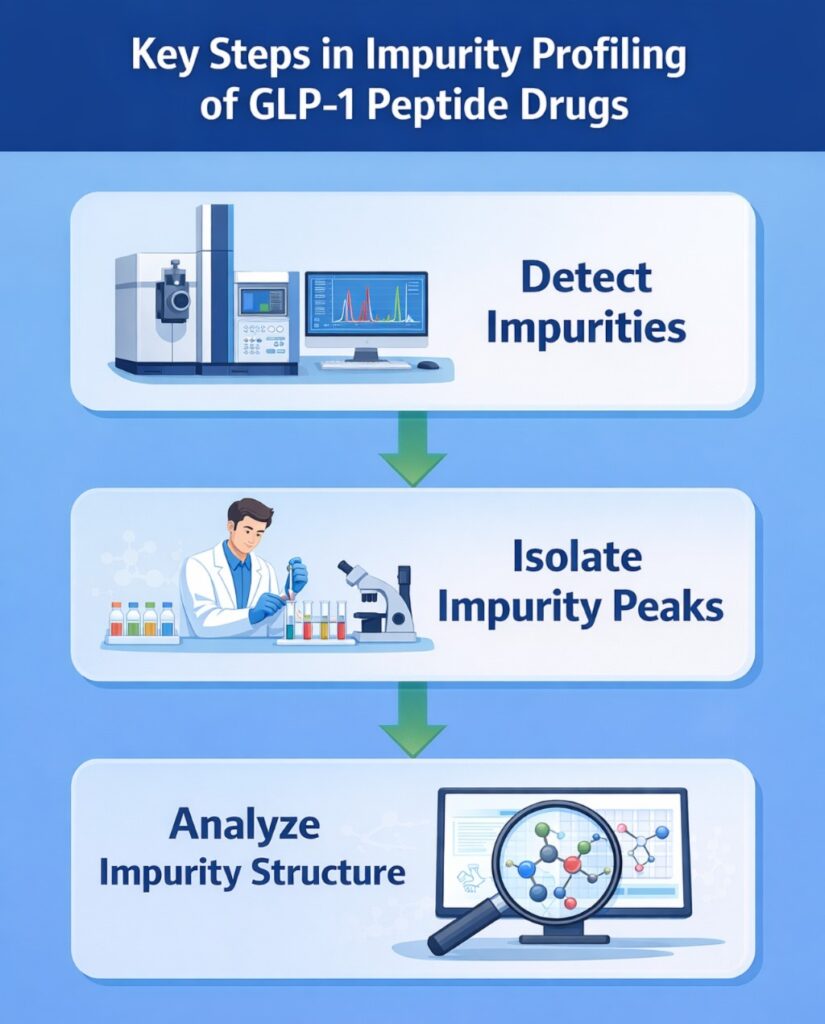
Impurity profiling is a critical regulatory requirement in CRO for GLP-1 Peptide Characterization. It involves identifying, measuring, and understanding impurities that may form during production or storage. Regulatory agencies expect detailed information about all major impurities.
GLP-1 drugs may contain different types of impurities, including process-related and product-related ones. These impurities can impact safety, effectiveness, and stability if not properly controlled. Therefore, a strong impurity profiling strategy is essential.
Types of Impurities in GLP-1 Drugs
Process-related impurities
- Incomplete sequences
- Protecting group remnants
Product-related impurities
- Deamidation
- Oxidation
- Aggregates
Degradation products
- Hydrolysis
- Photolytic degradation
Analytical Strategy
- Use of multiple methods like HPLC and LC-MS
- Performing forced degradation studies
- Isolation and structural analysis of impurity peaks
Regulatory guidelines such as ICH Q3A/Q3B require identification of impurities above certain limits. In some cases, additional safety evaluation may be needed. A qualified CRO ensures all requirements are properly met.
Understand the FDA Peptide Sameness Study Requirements to stay ahead of impurity profiling standards.
CRO for GLP-1 Peptide Characterization: Stability-Indicating Methods
CRO for GLP-1 Peptide Characterization develops stability-indicating methods to monitor how the drug changes over time. These methods detect even small degradation changes under different environmental conditions. This helps ensure long-term product quality.
Stress Conditions Evaluated
- Thermal stress
- Oxidative stress
- pH variations
- Light exposure
Key Outputs
- Identification of degradation pathways
- Shelf-life estimation
- Evaluation of formulation compatibility
GLP-1 drugs are often available as injectable or long-acting formulations. These require accurate stability data to maintain performance. Stability studies also guide packaging, storage, and distribution decisions.
Request our Forced Degradation Studies to identify critical degradation pathways early.
CRO for GLP-1 Peptide Characterization: Method Development & Validation
Method validation ensures that analytical procedures used in CRO for GLP-1 Peptide Characterization are accurate and reliable. It confirms that results remain consistent across different conditions, analysts, and instruments. This is essential for regulatory approval.
Validation Parameters
- Accuracy
- Precision
- Specificity
- Linearity
- Limit of detection (LOD)
- Limit of quantification (LOQ)
Regulatory Alignment
- ICH Q2(R2) guidelines
- FDA bioanalytical method guidance
- EMA peptide-specific considerations
Early method development and validation help avoid delays during submissions. It ensures compliance from the start and improves overall efficiency.
Partner with us for Analytical Method Development and Validation Service tailored to complex biologics.
CRO for GLP-1 Peptide Characterization: Challenges Unique to GLP-1 Analogs
GLP-1 peptides present unique analytical challenges due to their complex structure and sensitivity. These challenges require specialized expertise and advanced techniques. A CRO with peptide experience is better prepared to manage these issues.
Key Challenges
- Lipidated peptides with low solubility
- High aggregation tendency
- Adsorption to lab surfaces
- Complex degradation pathways
Solutions Provided by CROs
- Customized sample preparation
- Optimized chromatography conditions
- Use of stabilizing agents
- Advanced analytical tools
These strategies help generate accurate and reproducible data. Expertise in peptide chemistry is essential for successful characterization.
Utilize NMR for Peptides to solve challenges related to higher-order structures and conformation.
CRO for GLP-1 Peptide Characterization: Selecting the Right Partner
Choosing the right CRO for GLP-1 Peptide Characterization is an important decision. The right partner improves both data quality and development speed. It is important to evaluate technical skills and regulatory experience carefully.
Evaluation Criteria
- Experience with GLP-1 analogs
- Access to advanced mass spectrometry
- Strong regulatory track record
- Reliable turnaround time
- Good data integrity systems
Red Flags to Avoid
- Focus only on small molecules
- Limited peptide experience
- Weak impurity identification capability
A good CRO works as an extension of your team. Their expertise helps avoid costly errors and supports faster approvals.
See why we are considered the Best CRO for Peptide Sameness Study globally.
CRO for GLP-1 Peptide Characterization: Regulatory Documentation & Submission Support
A reliable CRO for GLP-1 Peptide Characterization provides complete and submission-ready documentation. These documents must meet global regulatory standards. Proper documentation is essential for smooth approvals.
Key Deliverables
- Method validation reports
- Stability reports
- Impurity characterization reports
- Certificate of analysis (CoA)
Submission Context
- IND applications
- NDA/BLA filings
- DMF submissions
High-quality documentation builds trust with regulatory agencies. It also reduces delays and supports faster product approval.
Conclusion
CRO for GLP-1 Peptide Characterization is a key part of successful peptide drug development. It ensures accurate structural analysis, proper impurity control, and full regulatory compliance. These elements are essential for delivering safe and effective treatments.
As GLP-1 drugs become more advanced, the need for expert analytical support continues to grow. Partnering with a specialized CRO offers access to advanced tools, strong scientific expertise, and reliable processes. This helps improve efficiency and reduce development time.
In the end, the right CRO partner supports both product quality and regulatory success. It ensures that patients receive safe and effective therapies, making it a valuable investment in drug development.
Explore our Peptide Sameness Study Services in Canada for your next GLP-1 project.
Frequently Asked Questions (FAQs)
GLP-1 peptides are often modified with elements like fatty acid chains and non-standard amino acids, which makes their structure more complicated. These changes affect how the molecule behaves in the body. Because of this, detailed and advanced analytical methods are needed. Simple testing approaches are usually not enough to fully understand these molecules.
LC-MS is important because it can detect very small differences in the peptide structure. It helps identify impurities and confirm the exact molecular composition. This level of detail is not easily achieved with basic techniques. That is why it is widely used in CRO for GLP-1 Peptide Characterization.
GLP-1 drugs may contain impurities such as oxidized forms, deamidated variants, and small fragments of the peptide. These can develop during manufacturing or storage. Even low levels of such impurities can impact drug quality. Proper identification helps ensure the drug remains safe and effective.
CROs follow well-established global guidelines from organizations like ICH, FDA, and EMA. They use validated analytical methods and maintain complete documentation for every step. This ensures that all generated data meets regulatory expectations. It also helps avoid delays during the approval process.
Stability-indicating methods are designed to track how a drug changes over time under different conditions. They help identify possible degradation pathways and measure product stability. This information is important for setting shelf life. It also supports proper storage and packaging decisions.
Reference:
- Jiang, N., Su, D., Chen, D., Huang, S., Tang, C., Jing, L., Yang, C., Zhou, Z., Yan, Z., & Han, J. (2024). Discovery of a novel glucagon-like peptide-1 (GLP-1) analogue from bullfrog and investigation of its potential for designing GLP-1-based multiagonists. Journal of Medicinal Chemistry, 67(1), 180–198. https://doi.org/10.1021/acs.jmedchem.3c01049
- Müller, T. D., Finan, B., Bloom, S. R., D’Alessio, D., Drucker, D. J., Flatt, P. R., Fritsche, A., Gribble, F., Grill, H. J., Habener, J. F., Holst, J. J., Langhans, W., Meier, J. J., Nauck, M. A., Perez-Tilve, D., Pocai, A., Reimann, F., Sandoval, D. A., Schwartz, T. W., … Tschöp, M. H. (2019). Glucagon-like peptide 1 (GLP-1). Molecular Metabolism, 30, 72–130. https://doi.org/10.1016/j.molmet.2019.09.010
- Manandhar, B., & Ahn, J.-M. (2015). Glucagon-like peptide-1 (GLP-1) analogs: Recent advances, new possibilities, and therapeutic implications. Journal of Medicinal Chemistry, 58(3), 1020–1037. https://doi.org/10.1021/jm500810s
Get In Touch With Us
About The Author


