

Introduction
The Analytical Requirements for ANDA Submissions play a central role in how the FDA evaluates generic drug quality. These requirements ensure that a product is equivalent to the RLD and safe for patient use. They also create a clear system for assessing consistency across manufacturing and testing processes.
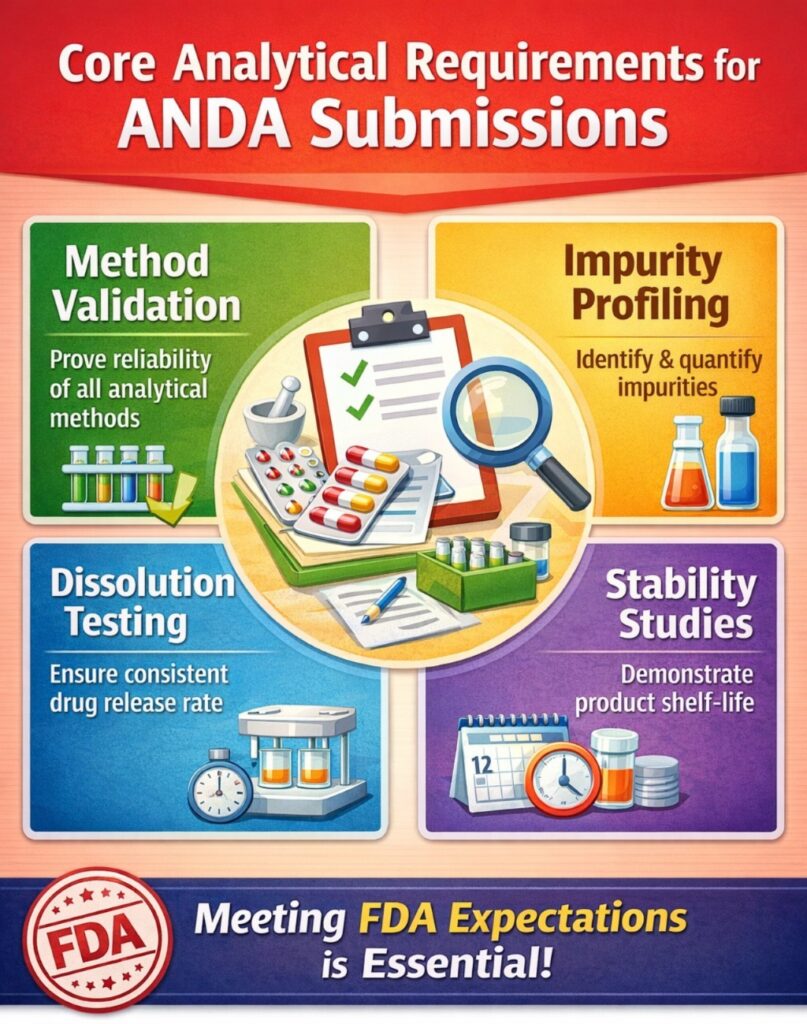
Understanding these requirements in practice is just as important as knowing the regulations. FDA reviewers expect strong analytical evidence that supports every quality attribute of the product. This includes method validation, impurity profiling, dissolution performance, and stability behavior.
A well-planned analytical strategy can significantly improve the chances of first-cycle approval. Companies that invest in proper analytical development early often avoid costly delays later. This guide explains the expectations in a simple and practical way.
Ensure your generic product meets all comparative standards: Expert Support for Peptide Sameness Studies
Share via:
🔍 Quick Summary
- Analytical requirements for ANDA submissions are centered on validated methods, impurity profiling, stability data, and dissolution testing aligned with FDA and ICH guidelines.
- FDA expects stability-indicating analytical methods that can accurately detect degradation products.
- Impurity control (ICH Q3A/Q3B) is one of the most common reasons for ANDA deficiencies.
- Dissolution method development and validation must demonstrate equivalence to the reference listed drug (RLD).
- Method validation (ICH Q2) must include accuracy, precision, specificity, linearity, and robustness.
- Stability data (ICH Q1A) must support shelf-life under long-term and accelerated conditions.
- Analytical data must be consistent across all batches used in bioequivalence (BE) studies.
- FDA frequently flags incomplete analytical documentation, poor method transfer, and inadequate impurity limits.
Analytical Requirements for ANDA Submissions – What Does the FDA Specifically Evaluate?
The FDA evaluates whether analytical data can confirm identity, strength, quality, purity, and performance compared to the RLD. This evaluation is based on validated and stability-indicating methods that deliver reliable and consistent results. Every dataset must clearly support the product’s overall quality profile.
A major focus is the Chemistry, Manufacturing, and Controls (CMC) section. This section must prove that analytical methods are suitable and that results are reproducible. Even small inconsistencies in this section can lead to review delays or deficiencies.
The FDA expects reproducibility across different batches, ensuring that results remain stable and predictable. Methods must also be sensitive enough to detect low levels of impurities and degradation products. This is essential for maintaining patient safety and product quality.
Consistency between bio-batch and commercial batches is another important factor. The FDA wants assurance that the product tested in studies matches what will be marketed. Alignment with ICH guidelines such as Q1, Q2, and Q3 is also mandatory.
Achieve the sensitivity required for regulatory scrutiny: High-Resolution Mass Spectrometry (HRMS) Analysis Services
📊 Core Analytical Evaluation Areas
| Analytical Area | FDA Expectation | Common Deficiency |
|---|---|---|
| Method Validation | Full ICH Q2 compliance | Missing robustness data |
| Impurity Profiling | Identification + qualification | Unjustified impurity limits |
| Dissolution | Discriminatory & comparable to RLD | Poor method development |
| Stability | Long-term + accelerated data | Insufficient time points |
| Assay & Content Uniformity | Accurate and reproducible | Variability across batches |
Analytical inconsistencies and impurity-related problems are among the top reasons for ANDA rejection. These issues usually come from incomplete development or weak validation. Fixing them early can save both time and cost.
Analytical Method Validation in Analytical Requirements for ANDA Submissions
The FDA requires all analytical methods to be validated according to ICH Q2(R1). Validation ensures that methods are reliable, reproducible, and suitable for their intended purpose. Without proper validation, analytical results cannot be trusted during regulatory review.
Method validation also supports the entire product lifecycle. As manufacturing scales or changes occur, validated methods help maintain consistency. This reduces variability and keeps the product aligned with regulatory expectations.
What Must Be Validated?
- Accuracy – closeness to true value
- Precision – repeatability and intermediate precision
- Specificity – ability to separate analyte from impurities
- Linearity – response proportional to concentration
- LOD/LOQ – detection and quantitation limits
- Robustness – resistance to small method changes
Each parameter plays an important role in method performance. For example, robustness testing checks whether small changes in conditions affect results. This reflects real laboratory situations and ensures reliability.
📌 Critical FDA Insight:
A method must be stability-indicating, meaning it can detect degradation under stress conditions. This ensures that changes in product quality over time are properly measured.
📚 Expanded Insight:
Validation is not just a regulatory step. It helps maintain consistent product quality throughout its lifecycle. Stability-indicating methods also connect degradation pathways with impurity formation, making the data more meaningful.
Reliable instrumentation for standard pharmacopeial testing: Advanced HPLC Analysis for Potency and Purity
Impurity Profiling – A Critical Part of Analytical Requirements for ANDA Submissions
Impurity profiling involves identifying, measuring, and justifying all impurities in a drug product. This includes both process-related impurities and degradation products. The goal is to ensure all impurities remain within safe limits.
A detailed impurity profile also helps show equivalence to the RLD. Any differences must be clearly explained with scientific data. Without proper justification, approval can be delayed.
FDA Expectations for Impurities
- Identification of known and unknown impurities
- Qualification thresholds based on daily dose
- Control of mutagenic impurities (ICH M7)
- Comparative impurity profile vs RLD
These expectations ensure that impurities are well understood and controlled. Regulatory agencies focus strongly on safety, especially for toxic or mutagenic impurities.
Identify and quantify complex impurities with confidence: Impurity Profiling Using LC-MS Technology
📊 Impurity Threshold Example
| Daily Dose | Reporting Threshold | Qualification Threshold |
|---|---|---|
| ≤ 2 g/day | 0.05% | 0.10% |
| > 2 g/day | 0.03% | 0.05% |
📌 Key Regulatory Reality:
FDA often issues Complete Response Letters (CRLs) due to unidentified impurities or missing toxicological data. These issues can significantly delay approvals.
Recent trends show that controlling mutagenic impurities remains a major challenge. A risk-based approach and strong analytical methods are essential.
Stay compliant with the latest mutagenic impurity guidelines: Nitrosamine Analysis and Risk Assessment
Dissolution Testing in Analytical Requirements for ANDA Submissions
Dissolution testing is essential to prove that the drug releases its active ingredient similarly to the RLD. It is a key indicator of product performance and consistency across batches. A well-designed method can identify problems early in development.
The FDA expects dissolution methods to be both discriminatory and reproducible. This means they should detect even small formulation changes. Such sensitivity helps maintain product quality.
What Makes a Dissolution Method FDA-Ready?
- Ability to detect formulation changes
- Use of multiple media (pH 1.2, 4.5, 6.8)
- Comparative profiles vs RLD
- Use of similarity factor (f2 ≥ 50)
Each factor improves the reliability of the method. Testing in multiple pH conditions simulates the human digestive system, making results more relevant.
📌 Critical Observation:
Dissolution failures are a common reason for bioequivalence issues, often due to weak method development.
📚 Expanded Insight:
The FDA treats dissolution as a predictor of in vivo performance. Poorly designed methods may fail to detect real differences, leading to rejection even when other data looks acceptable.
Stability Studies in Analytical Requirements for ANDA Submissions
Stability studies show that a drug product maintains its quality over time. These studies must follow ICH Q1A guidelines and use validated methods. They support the proposed shelf life and storage conditions.
Stability testing also helps identify degradation trends and potential risks. This information is important for both approval and ongoing quality control.
Required Stability Conditions
- Long-term: 25°C / 60% RH (minimum 12 months)
- Accelerated: 40°C / 75% RH (minimum 6 months)
- Intermediate conditions when needed
These conditions simulate different environments. Accelerated studies help predict long-term behavior in a shorter time.
Stability Data Must Include
- Assay
- Degradation products
- Dissolution
- Physical attributes
Each parameter gives insight into product quality. For example, changes in dissolution may indicate instability.
Protect your product from packaging-related contamination: Extractables and Leachables (E&L) Testing Services
📊 FDA Expectations
| Parameter | Requirement |
|---|---|
| Batches | Minimum 3 pilot/commercial |
| Container Closure | Representative of final packaging |
| Time Points | 0, 3, 6, 9, 12 months |
📌 Key Risk Area:
FDA often flags missing stability data or inconsistent impurity trends. These issues weaken the submission.
Bioequivalence Sample Analysis – Analytical Requirements for ANDA Submissions
Bioequivalence studies depend on accurate bioanalytical methods to measure drug levels in the body. These methods must be sensitive and specific. Any variability can directly affect study results.
The FDA requires strict control over bioanalytical processes. This includes proper validation, calibration, and performance checks. Reliable data is essential for approval.
FDA Bioanalytical Expectations
- Validated LC-MS/MS methods
- Accurate calibration curves
- Stability in biological matrix
- Incurred sample reanalysis (ISR)
Each requirement ensures data accuracy. ISR, for example, confirms reproducibility over time.
📌 Important:
Analytical variability in BE studies can invalidate the entire submission. Consistency is critical.
Ensure data integrity for your clinical samples: Comprehensive Bioanalytical Services
Common FDA Deficiencies in Analytical Requirements for ANDA Submissions
Many ANDA rejections are linked to weak analytical planning. These issues often come from incomplete validation or poor development strategies. Identifying them early can prevent delays.
Top Deficiencies Observed:
- Incomplete method validation
- Poor impurity characterization
- Non-discriminatory dissolution methods
- Insufficient stability data
- Batch inconsistency
Each of these problems can impact approval timelines. Even small gaps can lead to major regulatory concerns.
📚 Expanded Insight:
Global data shows that analytical and CMC issues are the main reasons for first-cycle failures. Strong analytical planning is essential from the beginning.
How to Ensure Compliance with Analytical Requirements for ANDA Submissions
Ensuring compliance requires a scientific and proactive approach. Companies must align their strategies with FDA expectations early in development. This reduces risks later.
A structured analytical program improves efficiency and helps identify issues before submission. This leads to smoother regulatory review.
Best Practices:
- Develop stability-indicating methods early
- Align impurity limits with ICH and RLD
- Use Quality by Design (QbD)
- Perform early dissolution comparisons
- Ensure data integrity and audit readiness
These practices build a strong foundation for success and long-term compliance.
Conclusion
The Analytical Requirements for ANDA Submissions are not just routine steps. They are critical for determining whether a generic drug will be approved. Every analytical component must be accurate, validated, and aligned with regulatory standards.
From method validation to stability and dissolution, each element plays a role in the overall quality profile. Weaknesses in any area can delay or block approval. A complete and well-planned analytical strategy is essential.
Companies that invest early in strong analytical development are more likely to succeed. They can reduce risks, speed up approvals, and bring products to market faster.
📞 Get Expert Support
For tailored analytical strategies and regulatory-ready data packages:
FAQs on Analytical Requirements for ANDA Submissions
The most important requirement is having validated, stability-indicating analytical methods. These methods ensure that any changes in the drug over time are properly detected and measured. They also confirm that the data generated is accurate and reliable. Without them, the FDA may not trust the results provided.
The FDA focuses on impurity profiling because impurities can directly affect patient safety. Some impurities may be toxic or harmful even at low levels. Proper identification and control help ensure the drug is safe for long-term use. It also shows that the product is comparable to the reference drug.
Most deficiencies happen due to incomplete method validation or weak analytical development. Poor impurity data and non-discriminatory dissolution methods are also common issues. These gaps usually come from lack of early planning. Addressing them early can prevent delays during review.
A stability-indicating method is designed to detect changes in a drug when it degrades. It can separate the active ingredient from its degradation products. This helps in understanding how the product behaves over time. It is essential for accurate stability testing.
Typically, at least three batches are required for stability testing. These batches help demonstrate consistency in manufacturing and product quality. Using multiple batches increases confidence in the results. It also ensures the data is reliable for regulatory review.
The f2 similarity factor is used to compare dissolution profiles between a generic drug and the RLD. A value of 50 or more usually means the two profiles are similar. This helps confirm that both products release the drug in a comparable way. It is an important part of dissolution evaluation.
Analytical methods do not have to be exactly the same as those used for the RLD. However, they must provide equivalent and reliable results. The focus is on performance, not duplication. The methods should clearly demonstrate product quality and consistency.
Analytical requirements are mainly guided by ICH guidelines such as Q1, Q2, and Q3. These cover stability, method validation, and impurity control. Regulatory agencies like the FDA expect full compliance with these standards. Following them ensures global acceptance of the data.
Reference:
- Manandhar, B., & Ahn, J.-M. (2015). Glucagon-like peptide-1 (GLP-1) analogs: Recent advances, new possibilities, and therapeutic implications. Journal of Medicinal Chemistry, 58(3), 1020–1037. https://doi.org/10.1021/jm500810s
- Drucker, D. J. (2018). Discovery, characterization, and clinical development of the glucagon-like peptides. Molecular Metabolism, 14, 80–99. https://doi.org/10.1016/j.molmet.2018.01.001
Get In Touch With Us
About The Author


