


Introduction:
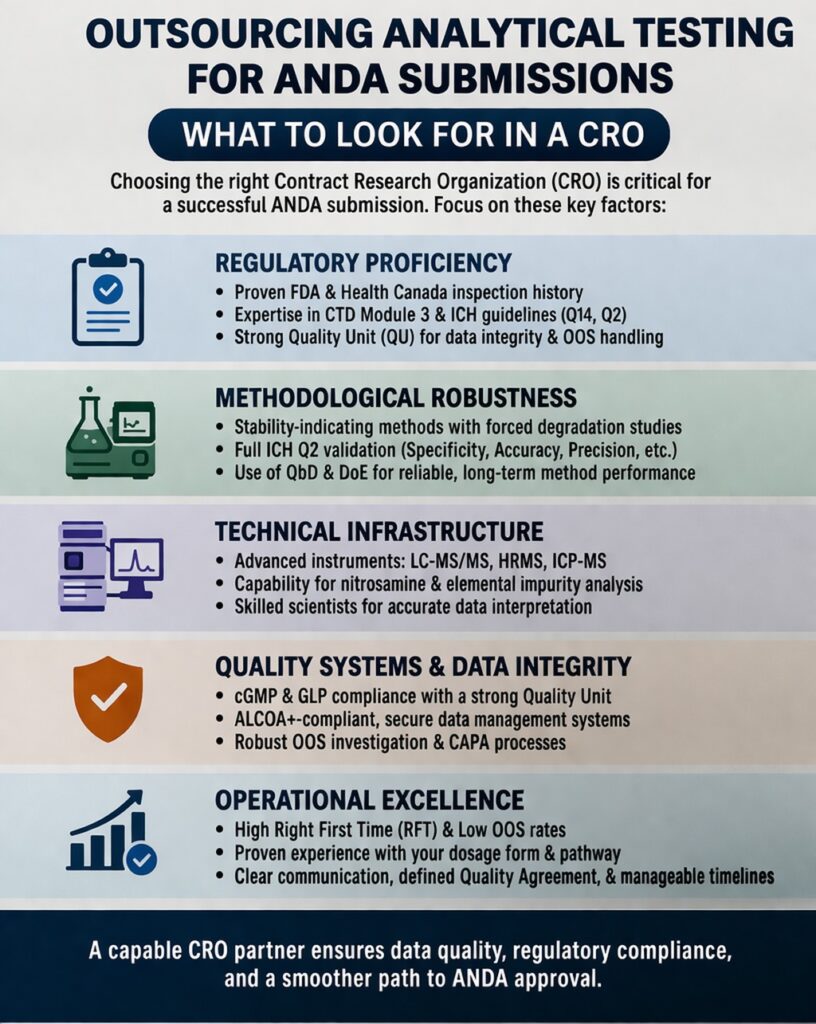
The process of Outsourcing Analytical Testing for ANDA Submissions requires choosing a Contract Research Organization (CRO) with proven experience in method development, dissolution testing, and impurity analysis. A reliable partner should have strong technical skills, a solid regulatory history, and dependable data integrity systems. These factors help ensure that the generic drug meets the strict “sameness” requirements set by the FDA and Health Canada. It is also important to select a CRO that has worked with similar dosage forms and regulatory pathways, as this reduces unexpected issues. A capable CRO does more than generate data—it understands regulatory expectations and helps improve submission success.
Explore our expertise: Analytical Requirements for ANDA Submissions
Choosing Outsourcing Analytical Testing for ANDA Submissions is a strategic decision where sponsors rely on specialized laboratories to generate high-quality analytical data. In the generic drug industry, proving bioequivalence and matching the Reference Listed Drug (RLD) is critical. The analytical section forms a key part of the Chemistry, Manufacturing, and Controls (CMC) dossier. CROs should use advanced instruments such as LC-MS/MS, GC-MS, and ICP-MS, along with skilled scientists who can justify method choices, impurity limits, and testing conditions. Regulatory agencies are increasingly strict about data quality, making CRO expertise essential to avoid Refuse-to-Receive (RTR) outcomes. An experienced CRO can also support communication with regulators and reduce review timelines.
Share via:
Key Takeaways
- Selecting the right CRO is critical for Outsourcing Analytical Testing for ANDA Submissions, ensuring regulatory compliance and high-quality data.
- CROs must demonstrate strong regulatory expertise, including FDA, Health Canada, and ICH guideline knowledge.
- Robust analytical methods, including stability-indicating methods and impurity profiling, are essential for approval success.
- Advanced technical infrastructure (e.g., LC-MS/MS, HRMS) and skilled scientists improve data accuracy and reliability.
- Strong quality systems and data integrity practices (ALCOA+) are required to meet cGMP/GLP standards and avoid regulatory risks.
- Monitoring operational KPIs and risk management strategies helps ensure efficient timelines and reduce submission delays.
Identifying Regulatory Proficiency in Outsourcing Analytical Testing for ANDA Submissions
When considering Outsourcing Analytical Testing for ANDA Submissions, it is important to assess the CRO’s regulatory experience. This includes reviewing inspection history with agencies like the FDA and Health Canada, and their ability to prepare data according to CTD Module 3 requirements. A qualified CRO should understand ICH guidelines, including newer approaches like Analytical Procedure Lifecycle Management (APLM) under ICH Q14. This ensures methods remain reliable throughout the product lifecycle.
Regulatory compliance must be maintained continuously. CROs should operate with an independent Quality Unit (QU) that can stop testing or reject materials when needed. This is especially important during Out-of-Specification (OOS) investigations, where proper root cause analysis is required. A strong quality culture improves transparency and builds trust with regulators.
Learn more about our core capabilities: HPLC Analysis Services
Comparison of Regulatory Documentation Standards
Sponsors must ensure that the CRO can effectively manage differences between global regulatory frameworks to avoid submission deficiencies.
| Documentation Requirement | FDA (ANDA) | Health Canada (ANDS) |
|---|---|---|
| Drug Master File (DMF) | Required for API; must be cited in the ANDA. | Required; must include synthesis and impurity fate. |
| Stability Data | 6 months accelerated + 6 months long-term at filing. | Requires QOS-CE template for experimental data assessment. |
| Method Validation | Full ICH Q2 validation for all registration batches. | Must include “purging” studies for synthesis intermediates. |
| Batch Size | 10% of commercial scale or 100,000 units. | Aligned with pilot scale; justification needed if smaller. |
| Bioequivalence Summary | Detailed in vitro/in vivo summary tables. | Comprehensive summaries of all in vitro studies. |
CROs should also support the Question-Based Review (QbR) format, which focuses on critical quality attributes. Their ability to explain analytical methods and impurity origins helps reduce regulatory queries and improves submission clarity.
Access professional support: Bioanalytical Services for Drug Development
Evaluating Methodological Robustness in Outsourcing Analytical Testing for ANDA Submissions
For Outsourcing Analytical Testing for ANDA Submissions, analytical methods must be reliable, stability-indicating, and consistent over time. CROs should demonstrate that their methods can clearly separate the active ingredient from impurities, degradation products, and excipients. This ensures product quality and compliance with regulatory standards.
A stability-indicating method (SIM) is essential. It is developed through forced degradation studies under stress conditions like heat, light, oxidation, and pH changes. These studies help identify degradation pathways and confirm that all impurities are detected. Missing this step can lead to regulatory delays or safety concerns.
Ensure product safety: Nitrosamine Analysis and Testing
Core Parameters for Analytical Method Validation
| Validation Parameter | Technical Objective | Requirement for ANDA Compliance |
|---|---|---|
| Specificity | Distinguish analyte from other components | Peak purity confirmation required |
| Accuracy | Closeness to true value | Verified through recovery studies |
| Precision | Reproducibility of results | Includes repeatability and intermediate precision |
| Linearity | Response proportional to concentration | Minimum five levels, R² ≥ 0.999 |
| LOD / LOQ | Detection and quantification limits | S/N ratio 3:1 and 10:1 respectively |
| Robustness | Resistance to small changes | Tested under varied conditions |
Modern approaches like Quality by Design (QbD) and Design of Experiments (DoE) help define a Method Operable Design Region (MODR). These strategies improve method reliability and reduce variability during long-term use.
Assessing Technical Infrastructure for Outsourcing Analytical Testing for ANDA Submissions
A strong technical setup is essential for Outsourcing Analytical Testing for ANDA Submissions. CROs should have access to advanced tools such as LC-MS/MS and High-Resolution Mass Spectrometry (HRMS) for detecting trace impurities. These technologies are especially important for nitrosamine and NDSRI analysis.
Utilize advanced technology: High-Resolution Mass Spectrometry (HRMS) Analysis
Nitrosamines must be detected at very low levels due to safety concerns. Traditional techniques may not provide enough sensitivity, while advanced systems like LC-HRMS offer better accuracy and reliability.
Analytical Instrumentation and Application Matrix
| Instrument Technique | Primary Application | Advantage |
|---|---|---|
| LC-MS/MS | Trace impurity quantitation | High sensitivity |
| LC-QTOF / Orbitrap | Structural elucidation | Accurate mass detection |
| ICP-MS | Elemental impurities | Ultra-trace metal detection |
| HPLC | Routine testing | High throughput |
| GC-MS | Residual solvents | Accurate volatile detection |
| NMR | Structural verification | Definitive identification |
In addition to equipment, experienced scientists are necessary to interpret complex data correctly. Skilled teams reduce errors and improve the reliability of results.
Identify complex profiles: Impurity Profiling using LC-MS
Verifying Quality Systems in Outsourcing Analytical Testing for ANDA Submissions
Quality systems are a key factor in Outsourcing Analytical Testing for ANDA Submissions. CROs must follow cGMP and GLP standards and use validated systems that ensure data integrity. A secure Chromatography Data System (CDS) helps prevent unauthorized data changes and maintains compliance.
Data integrity should follow ALCOA+ principles, ensuring records are accurate, complete, and traceable. Weak practices, such as shared logins or missing audit trails, can lead to regulatory warnings.
Out-of-Specification (OOS) Investigation Protocols
| Phase | Objective | Key Activities |
|---|---|---|
| Phase I | Identify lab errors | Equipment and calculation review |
| Phase II | Root cause analysis | Manufacturing and process evaluation |
| CAPA | Prevent recurrence | Corrective actions and monitoring |
Proper handling of OOS results is critical. CROs should focus on root cause analysis rather than repeating tests unnecessarily. This improves product quality and regulatory trust.
Measuring Operational KPIs for Outsourcing Analytical Testing for ANDA Submissions
Operational performance is another important aspect of Outsourcing Analytical Testing for ANDA Submissions. Metrics such as Right First Time (RFT) help measure accuracy and efficiency. High RFT rates indicate fewer errors and faster project completion.
Benchmarking Analytical Quality Metrics
| Metric | Definition | Significance |
|---|---|---|
| RFT | % correct results first time | Reduces delays |
| LAR | Batch acceptance rate | Indicates quality |
| OOS Rate | % lab errors | Highlights issues |
| Cycle Time | Testing to release time | Impacts speed |
| CAPA Effectiveness | Recurrence prevention | Regulatory focus |
| Turnover Rate | Staff retention | Knowledge stability |
Tracking these metrics helps sponsors select reliable CRO partners and reduce operational risks.
Specialized Requirements for Complex Generics in Outsourcing Analytical Testing for ANDA Submissions
Complex products require advanced expertise in Outsourcing Analytical Testing for ANDA Submissions. Techniques like IVRT (In Vitro Release Testing) and IVPT (In Vitro Permeation Testing) are essential for evaluating drug performance.
Detailed molecular analysis: Peptide Characterization Services
For topical products, these in vitro methods are increasingly accepted but must be highly sensitive and well-validated.
Characterization of Complex Topical Products (Q1, Q2, Q3)
| Level | Definition | Requirement |
|---|---|---|
| Q1 | Same components | Excipient listing |
| Q2 | Same concentration | ±5–10% of RLD |
| Q3 | Same structure | Rheology and particle size |
| IVRT | Drug release | Time-based measurement |
| IVPT | Drug permeation | Skin absorption analysis |
Experienced CROs help avoid common regulatory issues and improve submission quality.
Validate equivalence: Peptide Sameness Study
Optimizing Stability Testing Strategies in Outsourcing Analytical Testing for ANDA Submissions
Stability testing plays a major role in Outsourcing Analytical Testing for ANDA Submissions. CROs should use strategies like bracketing and matrixing to reduce testing efforts while maintaining accuracy.
Regulators require both accelerated and long-term stability data, so proper planning is essential to avoid delays.
Required Stability Conditions for ANDA Submissions
| Study Type | Condition | Duration |
|---|---|---|
| Long-Term | 25°C / 60% RH | 6 months at filing |
| Accelerated | 40°C / 75% RH | 6 months |
| Intermediate | 30°C / 65% RH | If required |
| Refrigerated | 5°C | For sensitive products |
| Photostability | ICH Q1B | Packaging validation |
Accurate sample handling and documentation are necessary to meet regulatory expectations.
Managing Risk and Escalation in Outsourcing Analytical Testing for ANDA Submissions
Risk management is essential when Outsourcing Analytical Testing for ANDA Submissions. A clear Quality Agreement should define roles and responsibilities between the sponsor and CRO. Strong communication ensures timely updates and quick issue resolution.
Strategic Risk Assessment for CRO Partners
| Risk Area | Indicator | Mitigation |
|---|---|---|
| Capacity | High workload | Review staffing |
| Communication | Delays | Regular meetings |
| Data Integrity | Weak controls | Conduct audits |
| Technical | Limited experience | Request case studies |
| Financial | Instability | Business evaluation |
Sponsors should regularly audit CROs to ensure compliance and maintain control over data quality.
Conclusion
The success of Outsourcing Analytical Testing for ANDA Submissions depends on selecting a CRO that combines technical expertise with strong regulatory compliance. A capable partner ensures accurate impurity detection, reliable data, and consistent quality standards. By focusing on expertise, authoritativeness, and trustworthiness, sponsors can reduce risks and improve approval timelines. In today’s complex regulatory environment, CROs must treat quality as an ongoing commitment rather than a reactive measure. This approach ensures that generic drug products meet the highest standards of safety and efficacy.
For expert analytical support and to ensure your ANDA submission is audit-ready, contact the team at ResolveMass Laboratories Inc. today – Contact us
FAQs on Outsourcing Analytical Testing for ANDA Submissions
The most common reason is incomplete or weak method validation. This often includes missing data on robustness or specificity, along with impurity limits that are not properly justified based on ICH guidelines and maximum daily dose. Such gaps raise concerns about data reliability and can lead to regulatory questions or rejection.
For an ANDA submission, regulators typically require at least six months of accelerated and six months of long-term stability data on three pilot-scale batches. During the review process, this data should be extended to 12 months. Proper planning ensures there are no delays due to missing stability information.
Nitrosamines are considered potential cancer-causing impurities, and their presence has led to several drug recalls worldwide. Because of this risk, regulatory agencies now expect highly sensitive testing methods like LC-MS/MS or HRMS. This ensures even very low levels are detected and controlled effectively.
Right First Time (RFT) measures how often analytical work is completed correctly without errors or rework. A high RFT value indicates strong processes, well-trained staff, and reliable methods. Tracking this metric helps in selecting CROs that can meet timelines and reduce costly delays.
IVRT measures how quickly a drug is released from a formulation into a testing medium, while IVPT evaluates how the drug passes through a biological barrier like skin. Both methods are important for understanding product performance, but IVPT gives a closer idea of real-life absorption.
A CRO shows its credibility by maintaining clear and transparent records, including instrument logs, audit trails, and batch data. It should also have an independent Quality Unit that oversees all activities. This level of control and openness builds trust with regulators and sponsors.
Common warning signs include shared system logins, missing or unchecked audit trails, and testing samples before official analysis. Another concern is the lack of proper data backup or archival systems. These issues can lead to serious regulatory findings and should not be ignored.
Reference:
- U.S. Food and Drug Administration. (2014). ANDAs: Stability testing of drug substances and products—Questions and answers. https://www.fda.gov/files/drugs/published/ANDAs–Stability-Testing-of-Drug-Substances-and-Products–Questions-and-Answers.pdf
- U.S. Food and Drug Administration. (n.d.). Abbreviated new drug application (ANDA) forms and submission requirements. https://www.fda.gov/drugs/abbreviated-new-drug-application-anda/abbreviated-new-drug-application-anda-forms-and-submission-requirements
- Health Canada. (2024, December 18). Guidance document: Quality (chemistry and manufacturing) guidance: New drug submissions (NDSs) and abbreviated new drug submissions (ANDSs). https://www.canada.ca/en/health-canada/services/drugs-health-products/drug-products/applications-submissions/guidance-documents/chemical-entity-products-quality/guidance-document-quality-chemistry-manufacturing-guidance-new-drug-submissions-ndss-abbreviated-new-drug-submissions.html
- Alomari, N., & Alhussaini, W. (2024). Update on the advances and challenges in bioequivalence testing methods for complex topical generic products. Frontiers in Pharmacology, 15, 1330712. https://doi.org/10.3389/fphar.2024.1330712
- U.S. Food and Drug Administration. (2025, June). Q1 stability testing of drug substances and drug products: Draft guidance for industry. https://www.fda.gov/regulatory-information/search-fda-guidance-documents/q1-stability-testing-drug-substances-and-drug-products
Get In Touch With Us
About The Author


