

Introduction
ANDA Method Validation Requirements require a high level of scientific and regulatory understanding. Although ICH Q2(R2) provides a harmonized framework for analytical validation, the U.S. FDA typically expects additional supporting evidence when evaluating ANDA submissions. These expectations often focus on impurity profiling, stability-indicating methods, lifecycle management, and detailed regulatory documentation.
For pharmaceutical companies submitting Abbreviated New Drug Applications (ANDA), understanding the difference between ICH Q2(R2) validation principles and FDA review expectations is extremely important. Even if a method satisfies standard validation parameters, FDA reviewers may still question whether it can reliably support product quality evaluation.
Are you preparing a regulatory submission? Explore our specialized Analytical Requirements for ANDA Submissions to ensure your data meets stringent FDA expectations.
In real regulatory practice, the FDA evaluates whether the analytical method can consistently support testing throughout the product lifecycle. Reviewers also examine whether the method can be used effectively for stability studies, impurity monitoring, and regulatory decision-making. This wider perspective ensures that analytical data submitted in regulatory filings remain dependable during the entire commercial life of the product.
This article explains ANDA Method Validation Requirements by comparing the scientific framework of ICH Q2(R2) with practical FDA expectations. It also discusses validation strategies that can help pharmaceutical organizations reduce regulatory deficiencies and strengthen their analytical submissions.
Share via:
Summary (Quick Insights)
- ANDA Method Validation Requirements are governed by both ICH Q2(R2) and FDA analytical method validation guidance, but FDA reviewers often require additional evidence beyond ICH minimum standards.
- ICH Q2(R2) focuses on globally harmonized validation parameters such as accuracy, precision, specificity, detection limit, quantitation limit, linearity, and robustness.
- FDA expectations for ANDA submissions emphasize method lifecycle management, data integrity, forced degradation studies, system suitability, and real-sample validation evidence.
- The FDA increasingly aligns with ICH Q14 + Q2(R2) frameworks, promoting Analytical Quality by Design (AQbD) and lifecycle-based validation strategies.
- Common ANDA deficiencies occur due to inadequate impurity validation, lack of degradation data, insufficient robustness testing, and poor documentation.
- A successful ANDA Method Validation Requirements strategy must integrate ICH scientific principles with FDA-specific regulatory expectations.
ANDA Method Validation Requirements: How ICH Q2(R2) Defines the Scientific Framework
ICH Q2(R2) provides the scientific foundation for validating analytical procedures used in pharmaceutical testing. The guideline explains the key validation characteristics required to show that an analytical method is suitable, reliable, and capable of producing accurate data for its intended use.
The guidance offers a structured approach that laboratories can follow before using a method in regulatory testing. By evaluating defined validation parameters, scientists can confirm that the method produces consistent results across instruments, analysts, and testing conditions. This process ensures that analytical data used in pharmaceutical quality systems remain trustworthy and reproducible.
Need high-precision testing for your validation? Learn how our HPLC Analysis services provide the accuracy and reproducibility required by ICH guidelines.
According to ICH Q2(R2), several validation parameters must be evaluated depending on the analytical method and its intended application. Each parameter contributes to demonstrating the scientific reliability of the method.
| Validation Parameter | Purpose in ANDA Method Validation Requirements |
|---|---|
| Accuracy | Demonstrates closeness of measured value to the true value |
| Precision | Measures reproducibility under repeatability and intermediate precision |
| Specificity | Ensures the method distinguishes analyte from impurities and degradation products |
| Linearity | Confirms proportional response across concentration range |
| Detection Limit (LOD) | Lowest detectable analyte concentration |
| Quantitation Limit (LOQ) | Lowest quantifiable concentration with acceptable accuracy |
| Range | Defines acceptable concentration interval |
| Robustness | Assesses method reliability under minor variations |
ICH Q2(R2) strongly emphasizes scientific justification and proper statistical evaluation of validation results. Laboratories are expected to apply suitable statistical tools to confirm method performance and prove that the analytical procedure consistently produces reliable results.
However, the guideline does not provide detailed instructions about regulatory documentation formats. This flexibility allows different regulatory agencies to apply their own expectations regarding how validation data should be presented. As a result, companies submitting applications in different regions must often adjust their documentation strategies.
Recent regulatory updates have connected ICH Q2(R2) with ICH Q14, introducing a lifecycle-based approach to analytical method management. This framework integrates method development, validation, and post-approval monitoring into a continuous quality system. Instead of treating validation as a one-time activity, the lifecycle approach encourages continuous evaluation of analytical performance.
Research on analytical lifecycle management also shows that modern regulatory systems increasingly combine Q2(R2) validation principles with risk-based method development strategies (Eberle et al., 2024). This approach helps organizations build stronger scientific understanding during analytical development and improves regulatory confidence in submitted methods.
ANDA Method Validation Requirements: Key FDA Expectations Beyond ICH Q2(R2)
FDA expectations for ANDA Method Validation Requirements often go beyond the validation parameters described in ICH Q2(R2). While the ICH guideline defines what characteristics should be validated, FDA reviewers usually focus on how the validation results support overall product quality and regulatory decision-making.
In practical regulatory review, the FDA looks for clear evidence that the analytical method works reliably under real testing conditions. This includes confirming that the method can detect impurities, measure degradation products, and support stability studies throughout the product lifecycle.
Because of this, the FDA frequently expects additional data and documentation beyond the basic validation parameters mentioned in ICH guidance. Several key areas usually receive special attention during ANDA review.
1. Stability-Indicating Capability in ANDA Method Validation Requirements
The FDA expects analytical methods used for stability studies to demonstrate stability-indicating capability. This means the method should clearly separate and quantify degradation products formed during stress or storage conditions.
Key expectations typically include:
- Forced degradation studies
- Demonstration of peak purity
- Identification of degradation pathways under stress conditions
Forced degradation studies help confirm that the analytical method can detect degradation products without interference from the main drug substance or other impurities. These studies prove that the method will remain reliable throughout the stability program (Sule et al., 2023).
2. Impurity and Degradation Product Quantification
FDA reviewers closely evaluate the ability of a method to detect and quantify impurities. Reliable impurity profiling is essential for maintaining product safety and regulatory compliance.
Typical expectations include:
- LOQ for impurities at or below the reporting threshold
- Validation for individual impurities and total impurities
- Justification of impurity response factors
Although ICH Q2(R2) allows flexibility in impurity validation strategies, the FDA usually requires clear experimental evidence demonstrating impurity detection capability.
Ensure comprehensive safety profiles for your application. Discover our advanced Impurity Profiling using LCMS to identify and quantify even the most challenging trace impurities.
3. System Suitability and Method Performance
System suitability tests are an important control step in regulated pharmaceutical laboratories. These tests confirm that the analytical system is functioning correctly before sample analysis begins.
Common system suitability parameters include:
- Resolution
- Tailing factor
- Theoretical plates
- %RSD of replicate injections
These parameters ensure that the analytical system maintains consistent performance from one analytical run to another.
4. Method Lifecycle and Continuous Verification
The FDA increasingly supports Analytical Procedure Lifecycle Management as part of modern pharmaceutical quality systems. This approach recognizes that analytical methods must remain reliable during the entire product lifecycle.
Lifecycle management generally includes:
- Method development knowledge
- Method validation
- Ongoing performance monitoring
These lifecycle approaches align closely with the principles of ICH Q14 and support continuous improvement in pharmaceutical quality systems (Yang et al., 2025).
Navigating complex peptide submissions? Utilize our Peptide Characterization Service and Peptide Sameness Studies to satisfy specific FDA requirements for generic peptide products.
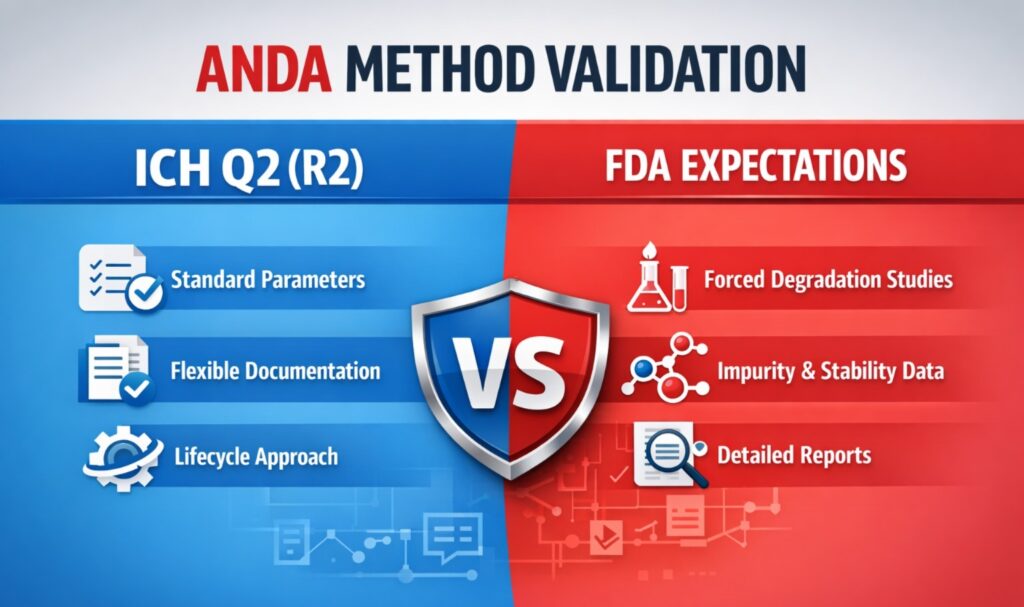
Comparison Table: ICH Q2(R2) vs FDA Expectations for ANDA Method Validation Requirements
| Aspect | ICH Q2(R2) | FDA Expectations for ANDA |
|---|---|---|
| Validation scope | Defines validation parameters | Requires application-specific validation evidence |
| Documentation | Flexible structure | Detailed regulatory documentation expected |
| Stability-indicating requirement | Implied under specificity | Explicit requirement with forced degradation |
| Impurity validation | General guidance | Detailed impurity profiling required |
| Lifecycle approach | Introduced with Q14 | Strong emphasis in ANDA reviews |
| System suitability | Recommended | Mandatory in routine QC methods |
| Robustness testing | Demonstrated with minor variations | Often expanded with risk-based experiments |
This comparison shows that ICH Q2(R2) establishes the scientific foundation for analytical validation, while FDA expectations define the level of regulatory detail required for ANDA approval. Companies that align their validation strategies with both frameworks can significantly strengthen their submissions.
Common FDA Deficiencies in ANDA Method Validation Requirements
Many ANDA applications receive regulatory deficiency letters because of gaps between standard ICH validation studies and the detailed expectations of FDA reviewers. These issues usually occur when validation data do not clearly demonstrate real-world method performance.
Understanding common regulatory concerns can help pharmaceutical organizations design stronger validation programs and avoid unnecessary review delays.
1. Incomplete Forced Degradation Studies
Forced degradation studies sometimes fail to produce adequate degradation or do not clearly show separation between degradation products and the main analyte.
Typical problems include:
- Insufficient degradation levels
- Co-eluting peaks
- Lack of degradation pathway explanation
Proper stress testing helps demonstrate that the analytical method is truly stability-indicating.
2. Inadequate Impurity Method Validation
Impurity validation is one of the most common problem areas in ANDA submissions.
Examples include:
- LOQ not experimentally demonstrated
- Response factor assumptions without justification
- Poor impurity peak resolution
When impurity detection capability is unclear, FDA reviewers often request additional experimental data.
Concerned about genotoxic impurities? Stay compliant with our ultra-sensitive Nitrosamine Analysis to prevent common regulatory setbacks.
3. Insufficient Robustness Studies
Robustness studies examine how small changes in analytical conditions affect method performance. These studies confirm that the method remains reliable during routine laboratory operations.
FDA typically expects evaluation of variables such as:
- Mobile phase composition
- Column temperature
- Flow rate variations
- pH adjustments
These studies prove that minor operational changes will not affect analytical accuracy.
Mitigate risks from packaging interactions. Our Extractables and Leachables Testing provides the rigorous data needed to ensure patient safety and material compatibility.
4. Lack of Method Transferability Evidence
FDA reviewers may also request evidence showing that the analytical method performs consistently across different laboratories, analysts, or instruments. Without this information, the reliability of the method in routine quality control environments may be questioned.
Studies on analytical validation practices show that weak robustness testing and incomplete impurity validation are among the most common deficiencies in ANDA submissions (Garshakunta et al., 2025).
Integrating ICH Q2(R2) with FDA Expectations for ANDA Method Validation Requirements
Achieving regulatory success requires organizations to combine the scientific framework of ICH Q2(R2) with FDA regulatory expectations. This combined approach ensures that analytical validation meets both global scientific standards and regulatory review requirements.
1. Analytical Quality by Design (AQbD)
Analytical Quality by Design (AQbD) is a structured approach for developing reliable analytical methods. Instead of relying only on trial-and-error experimentation, AQbD focuses on understanding the variables that affect method performance.
Key AQbD tools include:
- Risk assessment
- Design of Experiments (DoE)
- Method Operable Design Region (MODR)
These tools help scientists identify critical method parameters and define reliable operating ranges.
2. Risk-Based Validation Planning
Risk-based validation planning focuses validation activities on the parameters that have the greatest impact on analytical performance.
Common tools used in risk-based planning include:
- Failure Mode and Effects Analysis (FMEA)
- Design of Experiments (DoE)
These tools help identify potential risks and guide experimental design during validation studies.
3. Lifecycle-Based Method Management
Modern analytical validation follows a lifecycle model that continues throughout the product’s commercial life.
| Lifecycle Stage | Key Activities |
|---|---|
| Method Design | Analytical development and risk assessment |
| Method Qualification | Formal validation (ICH Q2(R2)) |
| Continued Verification | Routine monitoring and trend analysis |
This lifecycle approach ensures that analytical methods remain reliable long after initial validation is completed.
Best Practices for Meeting ANDA Method Validation Requirements
Organizations preparing ANDA submissions can strengthen their analytical programs by following several best practices that align with both ICH guidance and FDA expectations.
1. Conduct Comprehensive Forced Degradation Studies
Stress studies should evaluate several degradation conditions to understand potential degradation pathways.
Common stress conditions include:
- Acid and base hydrolysis
- Oxidation
- Thermal degradation
- Photolysis
These studies confirm that the analytical method can detect degradation products while maintaining separation from the active ingredient.
2. Validate Impurity Methods at Regulatory Thresholds
Impurity validation should reflect regulatory reporting thresholds and demonstrate accurate quantification at low concentrations.
Key considerations include:
- LOQ below the reporting threshold
- Linearity across impurity concentration ranges
- Verification of impurity response factors
This ensures accurate impurity monitoring during routine testing.
3. Document Validation Studies with Regulatory Clarity
FDA reviewers expect validation reports to clearly explain the scientific reasoning behind the analytical method.
Important documentation elements include:
- Traceable raw data records
- Statistical evaluation of validation results
- Clear explanation of development decisions
Clear documentation improves reviewer confidence and speeds up regulatory assessment.
4. Implement Robustness Through Experimental Design
Using statistical experimental design allows scientists to evaluate several analytical variables at the same time. This approach provides deeper understanding of method performance and helps identify optimal operating conditions.
Such structured experiments increase method reliability and reduce the risk of analytical failures during routine testing.
5. Ensure Data Integrity Compliance
Analytical data generated during validation and routine testing must follow ALCOA+ data integrity principles.
These include:
- Attributable
- Legible
- Contemporaneous
- Original
- Accurate
Regulatory agencies increasingly focus on data integrity as an essential part of pharmaceutical quality systems (Patil, 2026).
When standard mass spec isn’t enough: Leverage our High-Resolution Mass Spectrometry (HRMS) Analysis for superior sensitivity and structural identification in complex matrices.
Conclusion
ANDA Method Validation Requirements require careful alignment between global scientific guidelines and FDA regulatory expectations. While ICH Q2(R2) provides the scientific foundation for validating analytical methods, FDA reviewers often require additional evidence to confirm that the method reliably supports pharmaceutical quality evaluation.
Regulatory reviews now place greater emphasis on method robustness, impurity detection capability, stability-indicating performance, and lifecycle reliability. These elements ensure that analytical methods remain dependable from early development through commercial manufacturing.
Looking to streamline your regulatory journey? Learn about the benefits of Outsourcing Analytical Testing for ANDA Submissions to leverage specialized expertise and accelerate your path to approval.
Companies that rely only on minimal ICH validation studies often face regulatory deficiencies during ANDA review. To avoid these challenges, organizations should adopt a more comprehensive validation strategy that integrates scientific validation with regulatory expectations.
An effective validation strategy should combine:
- ICH Q2(R2) validation principles
- FDA analytical method expectations
- Lifecycle-based method management
- Risk-based validation approaches
By integrating these elements into their analytical programs, pharmaceutical companies can ensure that their ANDA Method Validation Requirements meet both international scientific standards and FDA regulatory expectations. This approach greatly improves the chances of successful regulatory approval.
If your organization needs expert support with ANDA Method Validation Requirements, connect with specialists for regulatory-compliant analytical method development and validation. Contact us
Frequently Asked Questions (FAQs)
ICH Q2(R2) requires validation of important analytical parameters such as accuracy, precision, specificity, linearity, detection limit, quantitation limit, range, and robustness. These parameters confirm that the analytical method produces consistent and reliable results. Laboratories must also provide proper statistical evidence showing that the method meets predefined acceptance criteria.
FDA guidance usually requires additional supporting studies beyond the basic parameters described in ICH Q2(R2). Reviewers often expect forced degradation studies, detailed impurity validation, lifecycle-based monitoring, and strong documentation. These requirements ensure that the analytical method remains reliable throughout the product lifecycle.
Forced degradation studies show how a drug substance breaks down under stress conditions such as heat, light, or oxidation. These studies confirm that the analytical method can detect degradation products and separate them from the main drug compound. This capability proves that the method is stability-indicating and suitable for long-term stability testing.
Analytical Quality by Design (AQbD) helps scientists develop robust analytical methods using scientific understanding and risk assessment. It uses tools like Design of Experiments (DoE) to identify critical method parameters and reliable operating ranges. This approach improves method consistency and increases regulatory confidence in the analytical method.
LOD (Limit of Detection) is the lowest concentration of an analyte that can be detected but not necessarily measured accurately. LOQ (Limit of Quantitation) is the lowest concentration that can be quantified with acceptable accuracy and precision. Both parameters help determine the sensitivity of an analytical method.
Many deficiency letters occur because of weak impurity validation, incomplete degradation studies, insufficient robustness testing, or unclear documentation. These issues usually arise when companies only follow minimum ICH validation requirements. Addressing FDA expectations early during method development can reduce such problems.
Reference:
- U.S. Food and Drug Administration. (n.d.). Abbreviated new drug application (ANDA) forms and submission requirements. https://www.fda.gov/drugs/abbreviated-new-drug-application-anda/abbreviated-new-drug-application-anda-forms-and-submission-requirements
- Health Canada. (2024, December 18). Guidance document: Quality (chemistry and manufacturing) guidance: New drug submissions (NDSs) and abbreviated new drug submissions (ANDSs). https://www.canada.ca/en/health-canada/services/drugs-health-products/drug-products/applications-submissions/guidance-documents/chemical-entity-products-quality/guidance-document-quality-chemistry-manufacturing-guidance-new-drug-submissions-ndss-abbreviated-new-drug-submissions.html
- U.S. Food and Drug Administration. (2018, June). ANDA submissions—Content and format: Guidance for industry. https://www.fda.gov/media/125312/download
Get In Touch With Us
About The Author


