

Introduction:
Understanding the Requirements for ANDA Submission Generic Drugs is essential for any pharmaceutical company planning to enter the U.S. generic drug market. The ANDA process is highly structured, technically demanding, and requires regulatory-grade analytical data to demonstrate that a generic drug is equivalent to the reference listed drug (RLD).
Many companies underestimate how complex the Requirements for ANDA Submission Generic Drugs really are. It is not only about bioequivalence studies but also about impurity profiling, method validation, stability studies, and detailed regulatory documentation. Companies working on the generic drug development process ANDA often realize that success depends heavily on strong analytical strategy and regulatory-ready data.
Share via:
Summary:
If you want to understand the Requirements for ANDA Submission Generic Drugs, here are the key points explained in this article:
- An ANDA (Abbreviated New Drug Application) allows companies to market generic drugs in the U.S.
- The most critical requirements include bioequivalence, analytical testing, stability data, impurity profiling, and regulatory-ready documentation.
- The Requirements for ANDA Submission Generic Drugs are highly technical and require advanced analytical expertise.
- Regulatory-focused laboratories and analytical development for generic drugs Canada play a major role in ensuring submission success
- Proper planning significantly reduces approval timelines and regulatory risks.
- This article explains each requirement in simple and practical terms based on real industry experience.
1: What is an ANDA Submission in Generic Drug Development?
An ANDA (Abbreviated New Drug Application) submission is a regulatory application filed with the U.S. Food and Drug Administration (FDA) to obtain approval for a generic version of an already approved reference listed drug (RLD). It is the primary pathway used by pharmaceutical companies to bring safe, effective, and affordable generic medicines to the U.S. market.
Unlike a New Drug Application (NDA), an ANDA does not require extensive clinical trials. Instead, the manufacturer must demonstrate that the generic drug is therapeutically equivalent through scientifically validated analytical and bioanalytical strategy drug development approaches.
To qualify for approval, the generic drug must:
- Contain the same active pharmaceutical ingredient (API)
- Have the same strength and dosage form
- Use the same route of administration
- Demonstrate bioequivalence to the reference listed drug
- Meet all regulatory quality, safety, and performance standards
This is exactly why the Requirements for ANDA Submission Generic Drugs focus more on advanced analytical testing, impurity profiling, stability studies, and regulatory-ready documentation rather than large clinical development programs.
2: Why the Requirements for ANDA Submission Generic Drugs Are So Strict
The Requirements for ANDA Submission Generic Drugs are strict because the U.S. FDA must ensure that every generic medicine approved for the market is just as safe, effective, and high-quality as the original branded drug. Since generic products are used by millions of patients, even small quality or bioequivalence issues can have serious clinical and regulatory consequences.
To meet regulatory expectations, pharmaceutical companies must generate scientifically validated and submission-ready data. Many companies evaluate whether outsourcing or internal development works better by reviewing CRO vs in-house ANDA development.
This includes:
- Complete and validated analytical data
- Regulatory-ready documentation that meets FDA and ICH guidelines
- Proof of bioequivalence with the reference listed drug (RLD)
- Stability studies that confirm product shelf life
- Detailed impurity profiling and degradation studies
- Fully validated analytical methods
From a regulatory perspective, the Requirements for ANDA Submission Generic Drugs are not meant to make the process difficult—they are designed to protect patient safety while ensuring that generic medicines consistently meet the same quality, performance, and safety standards as branded products.
3: Core Requirements for ANDA Submission Generic Drugs
A successful ANDA submission requires scientific, analytical, and regulatory evidence that the generic drug is equivalent to the original product. Most companies rely on analytical requirements ANDA generic drugs as a framework while preparing their submission.
Below is a clear breakdown of the major requirements.
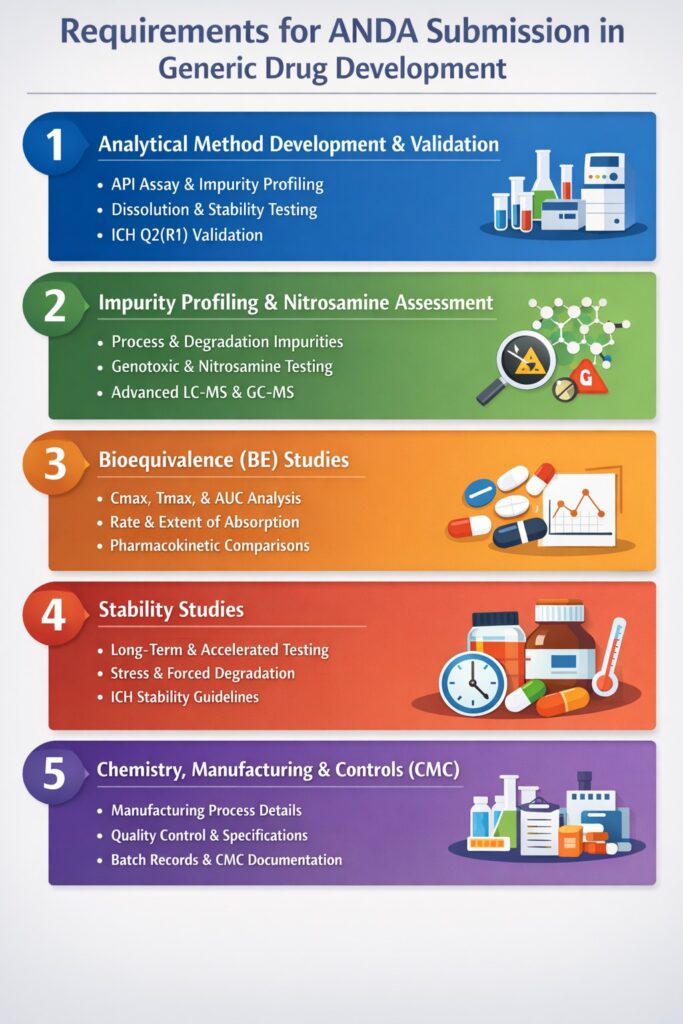
1. Analytical Method Development and Validation
Analytical testing is one of the most important parts of the Requirements for ANDA Submission Generic Drugs.
Companies must develop and validate analytical methods for:
- Assay of active pharmaceutical ingredients (API)
- Impurity profiling
- Related substances
- Dissolution testing
- Residual solvent analysis
- Stability-indicating methods
Specialized laboratories offering analytical method development for generic drugs and mass spectrometry experts in drug development often help companies generate submission-ready data faster.
Validated analytical methods must meet regulatory guidelines such as ICH Q2(R1). Without proper validation, the FDA may reject the submission.
2. Impurity Profiling and Nitrosamine Risk Assessment
One of the most critical modern Requirements for ANDA Submission Generic Drugs is impurity profiling.
Advanced testing services such as bioanalysis in Canada and analytical development for generic drugs Canada play an important role in generating reliable analytical data.
Regulatory authorities now require detailed analysis of:
- Process-related impurities
- Degradation impurities
- Genotoxic impurities
- Nitrosamine impurities
- Residual solvents
This step requires advanced analytical techniques such as:
- LC-MS/MS
- HRMS (High-resolution mass spectrometry)
- GC-MS
- Stability-indicating chromatography
Pharmaceutical companies often partner with regulatory-focused analytical laboratories because impurity profiling must be submission-ready and fully documented.
3. Bioequivalence (BE) Studies
Bioequivalence studies are mandatory because they prove that the generic drug performs the same way in the human body as the reference drug. Companies working with a generic drug development CRO for ANDA often improve the chances of successful bioequivalence results.
The main goal is to demonstrate:
- Same rate of absorption
- Same extent of absorption
- Comparable pharmacokinetic profile
The FDA evaluates bioequivalence based on parameters such as:
- Cmax
- Tmax
- AUC (Area Under the Curve)
This is one of the most important Requirements for ANDA Submission Generic Drugs, and poor study design can lead to major delays.
4. Stability Studies
Stability studies prove that the drug remains safe and effective throughout its shelf life. Most companies combine stability testing with regulatory support for generic drugs US and Canada CDMO to avoid regulatory delays.
To meet the Requirements for ANDA Submission Generic Drugs, companies must perform:
- Long-term stability studies
- Accelerated stability studies
- Stress stability studies
- Stability-indicating method validation
These studies must follow ICH stability guidelines and include detailed documentation.
5. Chemistry, Manufacturing, and Controls (CMC) Documentation
CMC documentation explains how the drug is manufactured, tested, and controlled. Many pharmaceutical companies work with a generic pharmaceutical CDMO Canada or CDMO for generic drug development in Canada to ensure regulatory compliance.
The FDA expects complete details about:
- Manufacturing process
- Quality control methods
- Raw material specifications
- Batch consistency
- Packaging and storage conditions
The Requirements for ANDA Submission Generic Drugs are highly documentation-driven. Even small documentation gaps can delay approval.
4: Key Analytical Requirements for ANDA Submission Generic Drugs
The analytical section is one of the most technically demanding parts of the Requirements for ANDA Submission Generic Drugs because regulatory approval depends heavily on accurate analytical data. Many companies also rely on reverse engineering for development of generic drugs to strengthen analytical understanding.
Below is a clear table that summarizes the most important analytical requirements and why each one matters.
Major Analytical Requirements
| Analytical Requirement | Why It Is Important for ANDA Submission |
|---|---|
| Assay Testing | Confirms the strength and content of the active pharmaceutical ingredient (API) |
| Impurity Profiling | Ensures the drug is safe and free from harmful impurities |
| Dissolution Testing | Demonstrates that the drug releases the API at the correct rate |
| Method Validation | Ensures analytical results are accurate, reproducible, and reliable |
| Stability Testing | Confirms the product remains safe and effective throughout its shelf life |
| Nitrosamine Testing | Ensures compliance with current FDA and global regulatory safety requirements |
5: How Regulatory-Focused Laboratories Help Meet ANDA Requirements
Regulatory-focused analytical laboratories play a critical role in helping pharmaceutical companies successfully meet the Requirements for ANDA Submission Generic Drugs. The main advantage of working with an experienced laboratory is the ability to generate submission-ready analytical data faster, more accurately, and with significantly lower regulatory risk.
Unlike general testing laboratories, regulatory-focused laboratories understand FDA expectations, ICH guidelines, and the level of documentation required for ANDA approvals. This expertise helps companies avoid common analytical and regulatory mistakes that often lead to delays.
Experienced laboratories typically provide:
- Advanced mass spectrometry testing for complex and peptide drugs
- Impurity identification and quantification using regulatory-accepted methods
- Nitrosamine testing aligned with current global regulatory expectations
- Stability-indicating analytical method development
- Method validation according to ICH guidelines such as Q2(R1)
- Complete regulatory-ready documentation suitable for direct ANDA submission
Companies working on peptide-based generics often require specialized services such as:
- Peptide testing service
- Peptide characterization in drug development
- Peptide analytical characterization services
Because the Requirements for ANDA Submission Generic Drugs are highly technical and data-driven, many pharmaceutical companies prefer to partner with specialized analytical laboratories instead of developing everything in-house. This approach not only reduces development timelines but also improves the overall probability of regulatory approval.
6: Common Challenges in Meeting the Requirements for ANDA Submission Generic Drugs
Many companies face challenges because the process is far more complex than expected. Organizations planning large generic portfolios often consider outsourcing generic drug development Canada to reduce risk and accelerate timelines.
The most common challenges include:
- Failure in bioequivalence (BE) studies due to poor study design or variability issues
- Incomplete impurity profiling, especially for genotoxic and degradation impurities
- Poorly developed or inadequately validated analytical methods
- Delays in long-term and accelerated stability studies
- Errors or gaps in regulatory documentation and CMC data
- Lack of experienced analytical and regulatory expertise
Understanding these challenges early in the development process helps companies prepare more effectively and significantly reduces the risk of costly delays. Since the Requirements for ANDA Submission Generic Drugs are highly technical and data-driven, proper planning and expert support are essential for a successful submission.
7: Practical Example: What Happens When Requirements Are Not Met
The importance of the Requirements for ANDA Submission Generic Drugs becomes much clearer when we look at a practical, real-world scenario. Many companies only realize the complexity of the process after a regulatory query is received.
Companies developing peptide-based generics often face challenges related to impurity identification and characterization. Real-world case studies such as generic peptide drug analytical characterization case study clearly demonstrate how analytical gaps can delay approval timelines.
Imagine a pharmaceutical company developing a generic tablet product but failing to identify a genotoxic impurity during analytical testing. The product appears acceptable during early development, but the issue is detected during regulatory review.
What typically happens next?
- The FDA requests additional impurity identification and quantification studies
- The company must redevelop and validate new analytical methods
- Stability studies may need to be repeated using updated analytical methods
- Additional documentation must be prepared for regulatory submission
- The overall ANDA submission timeline may be delayed by several months
This type of situation is more common than many companies expect, and it clearly demonstrates why the Requirements for ANDA Submission Generic Drugs must be addressed carefully from the very beginning of the development process. Early planning, advanced analytical testing, and regulatory-ready documentation can significantly reduce the risk of delays and improve the chances of approval.
8: How to Prepare Successfully for an ANDA Submission
Proper planning is the most important factor in successfully meeting the Requirements for ANDA Submission Generic Drugs. Companies often combine outsourced chemistry in drug discovery with analytical development to accelerate development timelines.
The key to success is following a structured and scientifically driven preparation strategy from the very beginning.
Step-by-Step Approach for ANDA Preparation
- Start analytical method development as early as possible to avoid last-minute validation challenges
- Plan impurity profiling in advance, especially for genotoxic and nitrosamine impurities
- Work with experienced regulatory-focused analytical laboratories that understand FDA expectations
- Ensure long-term and accelerated stability studies are initiated on time
- Prepare regulatory-ready documentation from the first stage of development
- Follow ICH and FDA guidelines strictly for method validation, stability studies, and impurity testing
Companies that follow this structured approach are far more likely to meet the Requirements for ANDA Submission Generic Drugs without major regulatory queries. Early preparation not only accelerates approval timelines but also reduces the overall risk associated with generic drug development.
9: Why Experience and Expertise Matter in ANDA Development
Meeting the Requirements for ANDA Submission Generic Drugs is not only a regulatory task—it is a highly technical scientific process. Many companies prefer working with a pharmaceutical CDMO US and Canada to ensure faster development and higher approval success rates.
Experienced analytical laboratories play a critical role because they understand not only the science behind the testing but also what regulatory agencies expect to see in a submission-ready format. This combination of scientific expertise and regulatory experience significantly improves the chances of successful ANDA approval.
Experienced laboratories typically bring:
- In-depth knowledge of FDA expectations and ICH regulatory guidelines
- Access to advanced analytical technologies such as high-resolution mass spectrometry
- Real-world experience supporting multiple ANDA submissions
- Faster identification and resolution of analytical challenges
- High-quality, regulatory-ready documentation prepared according to submission standards
This is why many successful pharmaceutical companies partner with specialized analytical laboratories rather than relying entirely on in-house resources. When handled by experienced experts, the Requirements for ANDA Submission Drugs can be managed more efficiently, with lower risk and faster approval timelines.
Conclusion:
The Requirements for ANDA Submission Generic Drugs are comprehensive, technical, and highly regulated. Companies must demonstrate bioequivalence, perform advanced analytical testing, validate methods, complete stability studies, and prepare detailed regulatory documentation.
Understanding these requirements early in the development process can significantly reduce regulatory risks and avoid delays. Companies that follow a structured generic drug development process ANDA strategy and work with experienced analytical experts can successfully meet the Requirements for ANDA Submission Generic Drugs and enter the U.S. generic drug market faster.
Frequently Asked Questions:
The main Requirements for ANDA Submission Generic Drugs include bioequivalence studies, analytical method validation, impurity profiling, stability testing, and complete CMC (Chemistry, Manufacturing, and Controls) documentation. Companies must prove that the generic drug is equivalent to the reference listed drug (RLD) in quality, safety, and performance.
No, an ANDA submission does not require full clinical trials like a New Drug Application (NDA). Instead, companies must demonstrate bioequivalence to the reference listed drug using analytical testing and pharmacokinetic studies. This is one of the key Requirements for ANDA Submission Generic Drugs.
Analytical testing is critical because regulatory approval depends on scientifically validated data. The Requirements for ANDA Submission Generic Drugs require validated methods for assay testing, impurity profiling, dissolution testing, and stability studies to ensure the generic drug meets regulatory quality standards.
The timeline depends on the complexity of the drug product. Simple generic drugs may take 12–18 months, while complex generics or peptide drugs may require significantly more time due to advanced analytical testing, bioequivalence studies, and stability requirements included in the Requirements for ANDA Submission Generic Drugs.
The most challenging part is usually analytical method development and impurity profiling. The Requirements for ANDA Submission Generic Drugs are highly technical and require advanced analytical techniques such as LC-MS/MS, HRMS, and stability-indicating methods.
Yes, many pharmaceutical companies outsource analytical testing to regulatory-focused laboratories. Outsourcing helps ensure that all Requirements for ANDA Submission Generic Drugs are met with submission-ready documentation and scientifically validated data.
Reference
- Hasan M, Shimu S, Akther A, Jahan I, Hamiduzzaman M, Hasan AH. Development of generic drug products by pharmaceutical industries considering regulatory aspects: a review. Journal of Biosciences and Medicines. 2021;9(10):23-39.https://www.researchgate.net/profile/Shahnaz-Akter-4/publication/363844194_Development_of_Generic_Drug_Products_by_Pharmaceutical_Industries_Considering_Regulatory_Aspects_A/links/63313d1686b22d3db4e34f85/Development-of-Generic-Drug-Products-by-Pharmaceutical-Industries-Considering-Regulatory-Aspects-A.pdf
- PARASRAMPURIA S, SERTKAYA A, LORD A, BERGER C. Cost of generic drug development and approval final.https://aspe.hhs.gov/sites/default/files/documents/66e13df52a6d314ba4e10c8e55b68b4b/cost-of-generic-drugs-erg.pdf
- Wittayanukorn S, Rosenberg M, Schick A, Hu M, Wang Z, Babiskin A, Lionberger R, Zhao L. Factors that have an impact on abbreviated new drug application (ANDA) submissions. Therapeutic Innovation & Regulatory Science. 2020 Nov;54(6):1372-81.https://link.springer.com/article/10.1007/s43441-020-00163-x
- Pawar J, Hegde N, Sharma S. Focusing on First Cycle Approval in ANDA Submission: Understanding Common Deficiencies & Case Study Insights. Therapeutic Innovation & Regulatory Science. 2025 May;59(3):426-37.https://link.springer.com/article/10.1007/s43441-025-00755-5
About the Author


