

Introduction:
Exaggerated vs Simulated Extraction E&L is one of the most frequently misunderstood topics in extractables and leachables studies. Many pharmaceutical and medical device companies struggle to decide which approach is required, when to use it, and how regulators interpret the results.
At ResolveMass Laboratories Inc., we work directly with development teams and regulatory groups to design E&L strategies that are scientifically sound and submission-ready. If you want a broader technical foundation before reading further, you can also review our detailed guide on Extractables and Leachables (E&L) Sample Preparation Best Practices which explains how extraction conditions directly influence study outcomes.
Share via:
Summary:
- Exaggerated vs Simulated Extraction E&L refers to two different testing approaches used to evaluate extractables and leachables from pharmaceutical and medical device materials.
- Exaggerated extraction uses aggressive conditions to identify worst-case chemical risks.
- Simulated use extraction replicates real-world product conditions to confirm patient safety.
- Regulatory agencies and global guidelines such as the ICH Q3E Guideline for Extractables and Leachables strongly encourage using both methods together to ensure complete risk assessment.
- Understanding the difference helps companies avoid regulatory delays and design scientifically justified E&L studies.
1: What Is Exaggerated vs Simulated Extraction E&L?
Exaggerated vs Simulated Extraction E&L refers to two complementary testing approaches used in extractables and leachables (E&L) studies to identify chemical contaminants that may migrate from packaging materials, container-closure systems, or manufacturing components into pharmaceutical products.
In simple terms:
- Exaggerated extraction = Worst-case testing
- Simulated use extraction = Real-world testing
For readers who are new to the topic, you can also explore our full overview page on Extractables and Leachables (E&L) Testing Services which explains the entire E&L workflow in detail.
Exaggerated extraction is designed to identify the maximum number of potential extractable compounds under aggressive conditions, while simulated use extraction evaluates which compounds actually migrate into the drug product under real storage or use conditions.
Both approaches are essential for demonstrating product safety, supporting toxicological risk assessment, and ensuring regulatory compliance.
2: What Is Exaggerated Extraction in E&L Studies?
Exaggerated extraction is a testing approach used in extractables and leachables (E&L) studies where materials are exposed to aggressive conditions to identify the maximum possible extractable compounds that could migrate from packaging, container-closure systems, or manufacturing components.
If you want to understand how these studies are structured according to regulatory expectations, read our technical article on ICH Q3E Extractables and Leachables Study Requirements.
The purpose is not to replicate real product conditions but to answer a critical safety question:
“What chemicals could potentially migrate under worst-case conditions?”
Typical Exaggerated Extraction Conditions
Exaggerated extraction studies are intentionally designed to stress the material more than normal product use. These studies typically involve:
- Higher temperatures than actual storage or use conditions
- Stronger extraction solvents (such as water, alcohol, acidic, or basic media)
- Longer exposure times than real product contact duration
- Increased surface-area-to-volume ratios to maximize compound extraction
These conditions help ensure that even trace-level extractable compounds are detected early in development.
Why Exaggerated Extraction Is Important
Exaggerated extraction plays a critical role in building a scientifically justified E&L strategy because it helps:
- Identify unknown extractable compounds at an early stage
- Detect worst-case chemical risks before regulatory submission
- Establish a strong safety margin for toxicological evaluation
- Support risk-based decision-making during product development
This is why exaggerated extraction is a key component of a well-designed Exaggerated vs Simulated Extraction E&L strategy.
3: What Is Simulated Use Extraction in E&L Studies?
Simulated use extraction is a testing approach used in extractables and leachables (E&L) studies where materials are evaluated under conditions that closely replicate how the pharmaceutical product will actually be stored, handled, and used in real-world situations.
This approach is directly aligned with the step-by-step framework explained in our guide on ICH Q3E Extractables and Leachables Risk Assessment, which shows how real-world exposure is evaluated from a toxicological perspective.
Instead of using aggressive conditions, simulated use extraction answers a critical safety question:
“What chemicals will actually migrate into the drug product during real use conditions?”
Typical Simulated Extraction Conditions
Simulated use extraction studies are designed to closely match real product conditions. These studies generally involve:
- Real storage temperature or real-use temperature
- The actual drug formulation or a scientifically justified similar solvent
- Real contact time based on product shelf life or usage duration
- The actual container-closure configuration
- Real product handling or administration conditions
This approach ensures that the results reflect real patient exposure rather than theoretical worst-case scenarios.
Why Simulated Use Extraction Matters
Simulated use extraction is essential because it provides scientifically reliable data that supports product safety and regulatory compliance. It helps:
- Generate real patient exposure data
- Provide more realistic leachables profiles
- Strengthen regulatory acceptance of the study
- Reduce the risk of over-estimating contamination levels
When comparing Exaggerated vs Simulated Extraction E&L, simulated use extraction focuses on actual risk, while exaggerated extraction focuses on potential risk.
4: Exaggerated vs Simulated Extraction E&L: Key Differences
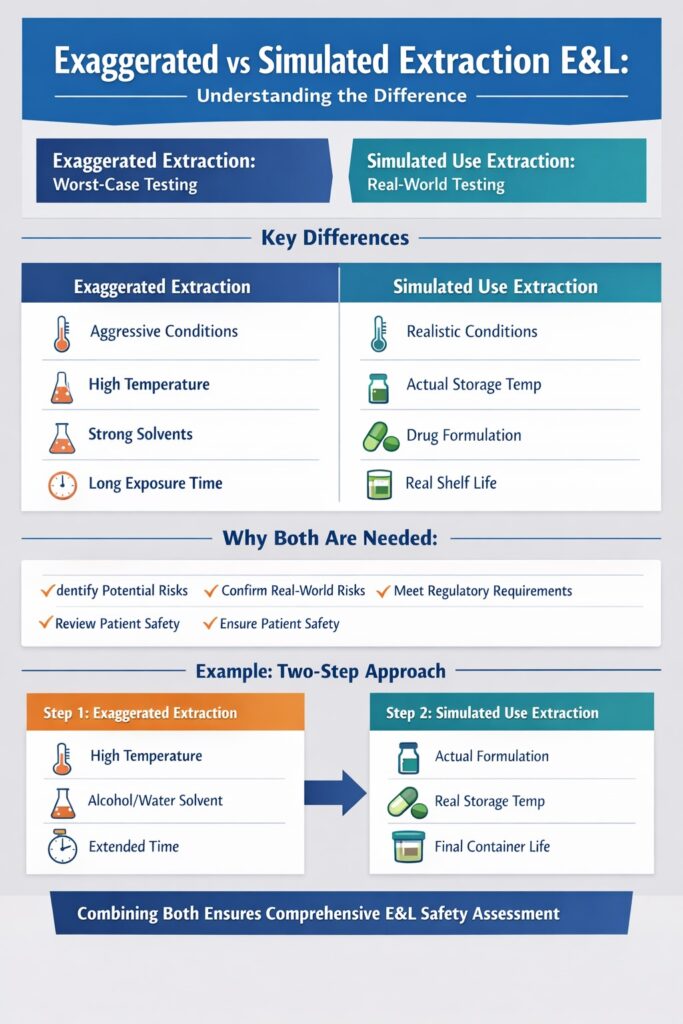
Exaggerated vs Simulated Extraction E&L is best understood by comparing the purpose, conditions, and regulatory role of each testing approach. While both are part of the same E&L strategy, they serve very different objectives.
If you are preparing for U.S. regulatory submissions, you can also read our detailed guide on Extractables and Leachables (E&L) Testing in the United States to understand how regulators evaluate these studies.
Below is a simplified comparison table to make the difference clear at a glance.
Comparison Table: Exaggerated vs Simulated Extraction E&L
| Factor | Exaggerated Extraction | Simulated Use Extraction |
|---|---|---|
| Objective | Identify worst-case extractable compounds | Identify real-world leachable compounds |
| Testing Conditions | Aggressive conditions | Realistic conditions |
| Temperature | Higher than normal storage or use | Actual storage or use temperature |
| Solvents Used | Strong extraction solvents | Real drug formulation or similar media |
| Exposure Time | Longer than real product contact time | Same as real product contact time |
| Risk Evaluated | Potential (worst-case) risk | Actual patient exposure risk |
| Regulatory Role | Early-stage risk identification | Final safety confirmation |
| Purpose in E&L Strategy | Screening and risk assessment | Real-world validation |
This comparison clearly shows why both approaches are essential in Exaggerated vs Simulated Extraction E&L studies. Exaggerated extraction identifies what could migrate, while simulated use extraction confirms what actually does migrate under real conditions.
5: Why Both Approaches Are Required in Modern E&L Programs
Exaggerated vs Simulated Extraction E&L is not a choice between two methods—it is a combined strategy required for a scientifically justified extractables and leachables program. Regulatory authorities increasingly expect companies to provide risk-based, science-driven data rather than relying on minimal or single-method testing.
To better understand the regulatory background behind this requirement, you may also find our article on Extractables and Leachables Testing Services for ICH Q3E Compliance useful.
In practical terms:
- Exaggerated extraction identifies what might happen under worst-case conditions
- Simulated use extraction confirms what will actually happen under real product conditions
Using only one approach often creates gaps in the overall risk assessment and may result in regulatory concerns.
What Happens If Only One Approach Is Used?
Companies that rely only on exaggerated extraction or only on simulated extraction often face:
- Additional regulatory questions during submission review
- Requests for supplementary E&L studies
- Delays in product approval timelines
- Higher overall testing costs due to repeated studies
Why Understanding Exaggerated vs Simulated Extraction E&L Early Matters
When both approaches are planned early in development, companies can:
- Avoid unnecessary repeat testing
- Build a stronger scientific justification for safety
- Improve regulatory acceptance of E&L data
- Save both time and development cost
This is why understanding Exaggerated vs Simulated Extraction E&L at the beginning of a project helps organizations design more efficient, regulatory-ready E&L programs.
6: When Should You Use Exaggerated Extraction?
Exaggerated extraction is typically used in the early stages of product development when the primary objective is risk identification. It helps determine what extractable compounds could potentially migrate from packaging, container-closure systems, or manufacturing materials before the product reaches the regulatory submission stage.
This concept is also explained in detail in our main resource page on Extractables and Leachables Testing Services, which covers the entire workflow from extractables to leachables confirmation.
Situations Where Exaggerated Extraction Is Necessary
You should use exaggerated extraction in the following situations:
- When developing a new drug product
- When introducing new packaging or container materials
- When changing an existing container-closure system
- When working with complex polymeric or elastomeric materials
- When preparing data for regulatory submissions
- When conducting extractables risk assessments
- When evaluating material compatibility with the formulation
Why It Is Used Early in Development
Exaggerated extraction provides a comprehensive chemical profile of potential extractables, which helps companies:
- Identify unknown compounds at an early stage
- Build a scientifically justified safety strategy
- Avoid unexpected regulatory questions later
- Design more effective simulated use studies
This is why exaggerated extraction plays a critical role in a well-planned Exaggerated vs Simulated Extraction E&L strategy right from the beginning of development.
7: When Should You Use Simulated Use Extraction?
Simulated use extraction is generally performed in the later stages of product development when the primary objective is patient safety confirmation. At this stage, the focus is no longer on identifying potential extractables but on confirming which compounds actually migrate into the drug product under real storage and use conditions.
If your product is intended for the U.S. market, you should also review our technical article on Extractables and Leachables (E&L) Testing in the United States to understand how simulated use data is evaluated during regulatory review.
Situations Where Simulated Use Extraction Is Critical
Simulated use extraction becomes essential in the following situations:
- When the final product formulation has been fixed
- When real storage conditions are defined
- When the product shelf life has been established
- When regulatory submission is approaching
- When a leachables safety evaluation is required
- When real patient exposure data must be demonstrated
- When confirming results obtained from exaggerated extraction studies
Why It Is Important at the Final Development Stage
Simulated use extraction provides realistic and regulatory-relevant data, which helps companies:
- Confirm actual leachable compounds in the product
- Strengthen toxicological risk assessments
- Improve regulatory acceptance of E&L studies
- Avoid unnecessary repeat testing
Understanding Exaggerated vs Simulated Extraction E&L early in development helps companies design more efficient studies and avoid repeating unnecessary work later in the project.
8: Real-World Example: Why the Difference Matters
Understanding Exaggerated vs Simulated Extraction E&L becomes much easier when we look at a practical, real-world development scenario.
For additional real-world regulatory perspectives, you can also refer to our technical resource on ICH Q3E Extractables and Leachables Risk Assessment which explains how extractables data is converted into safety decisions.
Let’s consider a pharmaceutical company developing an injectable drug product using a polymeric container-closure system.
Step 1: Exaggerated Extraction
In the first phase, the analytical laboratory performs exaggerated extraction to identify the maximum possible extractable compounds. The study is carried out using intentionally aggressive conditions such as:
- High-temperature extraction conditions
- Alcohol–water solvent mixtures designed to maximize compound recovery
- Extended exposure times beyond real product use
This step helps identify all potential extractables, including compounds that may never migrate under normal storage conditions but still need to be evaluated for safety risk.
Step 2: Simulated Use Extraction
Once the extractables profile is established, the next step is simulated use extraction to confirm real-world risk. The study is performed using:
- The actual drug formulation
- Real storage temperature conditions
- The final container-closure configuration
- The defined product shelf life
This step confirms which compounds actually migrate into the drug product, allowing a more accurate toxicological risk assessment and stronger regulatory justification.
Why This Example Matters
This example clearly demonstrates the practical importance of Exaggerated vs Simulated Extraction E&L in regulatory-focused studies. Exaggerated extraction identifies potential risk, while simulated use extraction confirms actual patient exposure—both of which are essential for building a scientifically sound E&L strategy.
9: Common Mistakes Companies Make
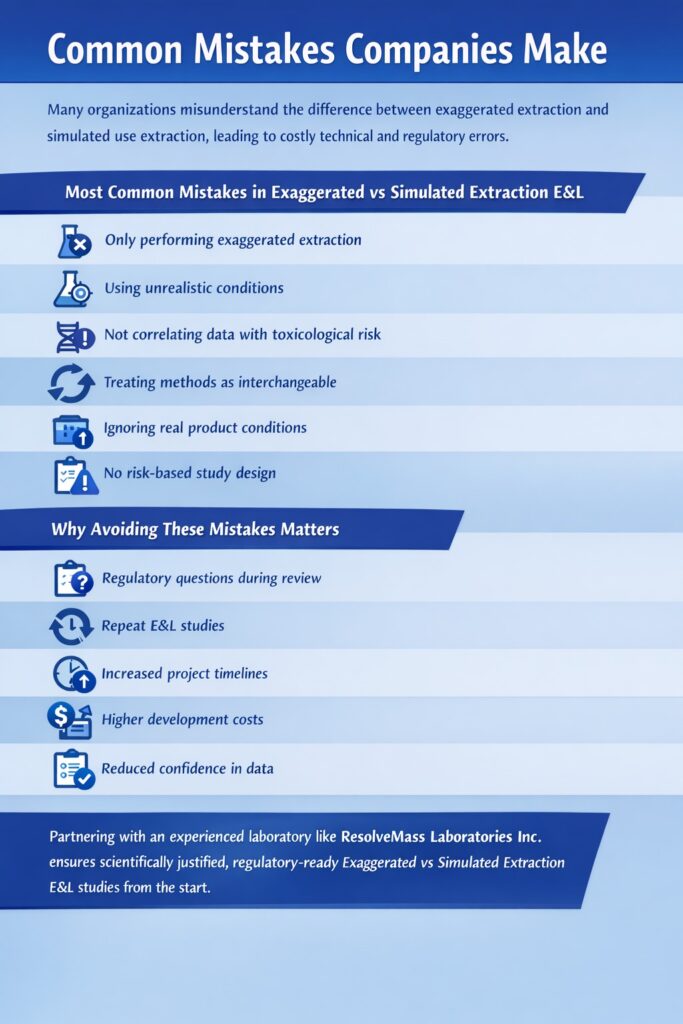
Many organizations misunderstand the difference between exaggerated extraction and simulated use extraction, and this often leads to costly technical and regulatory errors. A lack of clarity in Exaggerated vs Simulated Extraction E&L studies can result in incomplete risk assessments and delays during regulatory review.
These issues are also discussed in our full technical guide on Extractables and Leachables (E&L) Testing Services, which explains how a properly designed study avoids repeat testing.
Most Common Mistakes in Exaggerated vs Simulated Extraction E&L
Companies frequently make the following mistakes:
- Performing only exaggerated extraction and skipping simulated use testing
- Using unrealistic extraction conditions without scientific justification
- Failing to correlate exaggerated extraction data with toxicological risk assessment
- Treating exaggerated and simulated extraction as interchangeable methods
- Ignoring real product storage and use conditions
- Not designing studies based on a risk-based regulatory strategy
Why Avoiding These Mistakes Matters
These mistakes can lead to:
- Additional regulatory questions
- Repeat extractables and leachables studies
- Increased project timelines
- Higher overall development costs
- Reduced confidence in the submitted data
Working with an experienced laboratory such as ResolveMass Laboratories Inc. helps companies avoid these issues by designing scientifically justified, regulatory-ready Exaggerated vs Simulated Extraction E&L studies from the beginning.
10: How Regulatory-Focused Laboratories Design E&L Strategies
A regulatory-focused analytical laboratory does not treat exaggerated extraction and simulated use extraction as separate or independent activities. Instead, both are combined into a risk-based, science-driven strategy that aligns with regulatory expectations and ensures reliable extractables and leachables (E&L) data.
You can explore the complete regulatory workflow in our technical article on ICH Q3E Extractables and Leachables Study Requirements.
This integrated approach is essential for building a strong Exaggerated vs Simulated Extraction E&L program that supports product safety and regulatory approval.
A Well-Designed E&L Program Typically Includes
An experienced laboratory designs E&L studies in a structured and logical sequence that usually includes:
- Material characterization to understand potential extractable sources
- Exaggerated extraction screening to identify worst-case extractables
- Identification and structural characterization of extractable compounds
- Toxicological risk assessment based on identified compounds
- Simulated use extraction under real product conditions
- Leachables confirmation in the actual drug product
- Regulatory documentation and scientific justification support
Why This Integrated Approach Matters
When exaggerated and simulated extraction are planned together, companies benefit from:
- More reliable and scientifically defensible data
- Better alignment with regulatory expectations
- Reduced risk of repeat testing
- Faster approval timelines
- Stronger credibility of Exaggerated vs Simulated Extraction E&L studies
This is why regulatory-focused laboratories always design E&L studies as a complete strategy rather than isolated tests.
11: Why This Topic Is Becoming More Important
Exaggerated vs Simulated Extraction E&L is becoming increasingly important as the pharmaceutical and medical device industries move toward more complex and sensitive product designs. Modern drug products and delivery systems are far more susceptible to chemical migration from packaging and manufacturing materials than traditional formulations.
You may also find our detailed guide on ICH Q3E Guideline for Extractables and Leachables useful for understanding why regulators are placing greater emphasis on risk-based E&L studies.
Key Industry Trends Driving the Importance of Exaggerated vs Simulated Extraction E&L
The growing need for robust E&L strategies is largely driven by the rapid adoption of:
- Complex drug delivery systems
- Combination products (drug–device systems)
- Advanced polymeric and elastomeric packaging materials
- Biologics and injectable formulations
- High-sensitivity drug products that are more prone to contamination
These innovations increase the risk of extractable and leachable compounds entering the product, making a well-designed Exaggerated vs Simulated Extraction E&L strategy essential.
Why It Matters for Product Development and Regulatory Compliance
As products become more complex, regulatory expectations also become more stringent. Companies are now expected to provide science-based justification supported by both exaggerated extraction and simulated use extraction data.
This is why Exaggerated vs Simulated Extraction E&L is no longer optional—it has become a critical component of modern pharmaceutical development, product safety evaluation, and regulatory compliance.
12: How ResolveMass Laboratories Supports E&L Studies
At ResolveMass Laboratories Inc., we support pharmaceutical and medical device companies with scientifically designed extractables and leachables (E&L) studies that are fully aligned with regulatory expectations. Our focus is not only on generating analytical data but on providing regulatory-ready, defensible scientific evidence that supports successful submissions.
To learn more about our services, visit our main page on Extractables and Leachables (E&L) Testing Services or read the technical resource on ICH Q3E Extractables and Leachables Risk Assessment.
Our Key E&L Capabilities
We support companies across different stages of development through:
- Regulatory-focused extractables and leachables testing
- Advanced LC-MS and GC-MS analysis for trace-level compound detection
- Risk-based study design aligned with real product conditions
- Unknown compound identification and structural characterization
- Scientific justification to support regulatory submissions
- Integrated Exaggerated vs Simulated Extraction E&L study design
What Makes Our Approach Different
Our approach focuses on delivering high-quality scientific insight, not just routine testing. This helps companies:
- Reduce the risk of regulatory questions
- Avoid repeat E&L studies
- Improve confidence in toxicological risk assessments
- Accelerate development timelines
- Strengthen the credibility of their Exaggerated vs Simulated Extraction E&L strategy
By combining analytical expertise with a regulatory-focused mindset, ResolveMass Laboratories Inc. helps companies generate reliable data that regulators can trust.
Conclusion:
Understanding Exaggerated vs Simulated Extraction E&L is essential for designing effective extractables and leachables studies. Exaggerated extraction identifies worst-case chemical risks, while simulated use extraction confirms real-world patient exposure.
Companies that use both approaches strategically can avoid regulatory delays, reduce unnecessary testing, and ensure product safety with confidence. To explore additional regulatory guidance and technical resources, you can also review the ICH Q3E Guideline for Extractables and Leachables and our complete Extractables and Leachables Testing Services page.
Frequently Asked Questions:
Exaggerated vs Simulated Extraction E&L refers to two complementary testing approaches used in extractables and leachables studies. Exaggerated extraction identifies worst-case chemical risks, while simulated use extraction confirms which compounds actually migrate under real product conditions.
Regulatory agencies expect a risk-based approach to extractables and leachables testing. Exaggerated extraction helps identify potential risks, and simulated use extraction confirms real patient exposure. Using only one approach can lead to regulatory questions and additional testing requests.
Exaggerated extraction is usually performed in the early phase of product development. It is especially important when developing new drug products, introducing new packaging materials, changing container-closure systems, or performing extractables risk assessments.
Simulated use extraction is typically performed in the later phase of development when the final formulation, storage conditions, and product shelf life have already been established. It is mainly used to confirm real-world leachables and support regulatory submissions.
The main difference is the objective. Exaggerated extraction uses aggressive conditions to identify all possible extractable compounds, while simulated use extraction uses real product conditions to determine which compounds actually migrate into the drug product.
No. Exaggerated extraction cannot replace simulated use extraction because it does not represent real product conditions. Regulators expect simulated use studies to confirm actual patient exposure and ensure product safety.
Reference
- Li J. A comprehensive study of the effect of elevated temperature on the extractability and rate of exaggerated and exhaustive extractions of medical devices. Journal of Pharmaceutical and Biomedical Analysis. 2023 Oct 25;235:115587.https://www.sciencedirect.com/science/article/pii/S0731708523003564
- Jagielski M, Carlini N, Berthelot D, Kurakin A, Papernot N. High accuracy and high fidelity extraction of neural networks. In29th USENIX security symposium (USENIX Security 20) 2020 (pp. 1345-1362).https://www.usenix.org/conference/usenixsecurity20/presentation/jagielski
- Li J. Evaluation of thermodynamic and kinetic contributions to over-extraction of extractables by nonpolar organic solvents in comparison to lipids in exhaustive and exaggerated extractions of medical devices based on Abraham solvation model and solvent–material interactions using low-density polyethylene as a representative material. Liquids. 2024 Jan 23;4(1):117-47.https://www.mdpi.com/2673-8015/4/1/6
- Badding MA, Vargas JR, Fortney J, Cheng QJ, Ho CH. Toxicological risk assessment of bisphenol a released from dialyzers under simulated-use and exaggerated extraction conditions. Regulatory Toxicology and Pharmacology. 2020 Dec 1;118:104787.https://www.sciencedirect.com/science/article/pii/S0273230020302130
- Adams AS, Keith DW. Are global wind power resource estimates overstated?. Environmental Research Letters. 2013 Mar 1;8(1):015021.https://iopscience.iop.org/article/10.1088/1748-9326/8/1/015021/meta
About the Author


