


Introduction:
Peptide-oligonucleotide conjugates (POCs) require carefully controlled strategies to remain stable because they combine two sensitive components—peptides and nucleic acids. Maintaining Peptide Oligonucleotide Conjugate Stability is essential so these molecules can survive in the body, resist breakdown by enzymes, and reach their target cells effectively. Their hybrid nature makes them more exposed to chemical and biological stress, which increases the risk of early degradation. If stability is not managed well, the therapeutic effect may be reduced before the drug reaches its target. For this reason, proper design, testing, and optimization are key parts of successful development.
Shae via:
Structural Integrity and Peptide Oligonucleotide Conjugate Stability
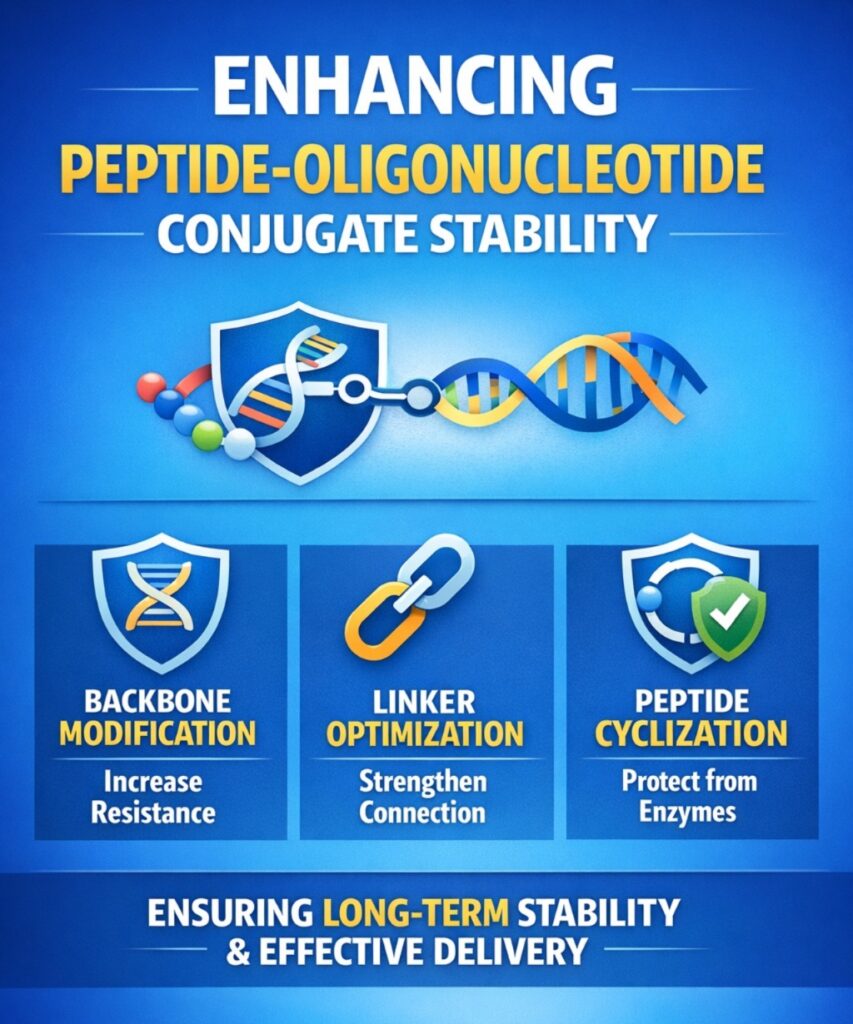
The structural integrity of a conjugate depends on a combination of backbone modifications and careful design of the covalent linkage connecting the peptide and oligonucleotide components. Peptide Oligonucleotide Conjugate Stability is inherently limited by the fragile nature of phosphodiester bonds and the vulnerability of peptide amide bonds to enzymatic cleavage under physiological conditions. This makes it necessary to apply precise molecular engineering strategies so that both components remain stable and functional throughout their biological journey. Moreover, even small structural inconsistencies can lead to reduced binding efficiency, altered pharmacokinetics, or faster degradation in vivo. Maintaining structural integrity is therefore not only critical for stability but also for preserving the intended biological activity and therapeutic reliability of the conjugate.
Explore specialized solutions for your project: Learn more about Peptide-Oligonucleotide Conjugates (POCs) Synthesis Services
Backbone Engineering for Metabolic Resilience
Oligonucleotides such as antisense oligonucleotides (ASOs) and siRNAs are easily degraded by enzymes in human serum. To improve durability, scientists often replace phosphodiester bonds with phosphorothioate (PS) linkages, which provide better resistance to enzymatic attack. However, this modification introduces structural complexity that must be carefully analyzed to ensure safety and performance.
Sugar modifications like 2′-O-methyl (2′-OMe) and 2′-O-methoxyethyl (2′-MOE) also improve binding strength and protect against degradation. Newer approaches, such as 3′-amino substitutions, further enhance resistance and extend the molecule’s lifespan. These improvements support better drug performance and may reduce how often patients need treatment.
Peptides also need protection from enzymes. Methods like cyclization reduce flexibility and make peptides harder for proteases to break down. The use of D-amino acids or modified sequences can further improve resistance while keeping biological activity intact. These strategies help extend circulation time and improve targeting efficiency.
Optimize your molecule’s performance: Discover Custom Synthesis for Drug Discovery
The Role of Linker Chemistry in Peptide Oligonucleotide Conjugate Stability
The linker is the chemical bridge between the peptide and oligonucleotide, and it plays a major role in overall stability. Peptide Oligonucleotide Conjugate Stability can be affected if the linker breaks too early, leading to loss of function or reduced delivery efficiency. The right linker depends on how and where the drug is expected to act inside the body. Linker design also influences how the conjugate moves through the body and enters cells.
Deep dive into chemical bonding strategies: Understand Peptide-Oligonucleotide Conjugate Linker Chemistry
| Linker Chemistry | Stability Characteristics | Common Application |
|---|---|---|
| Amide Bond | Extremely stable; bio-irreversible; resistant to hydrolysis | Non-cleavable POCs |
| Thioether | Highly stable; non-reducible | Intracellular delivery |
| Triazole | Very robust; formed via Click Chemistry | Imaging and diagnostics |
| Disulfide | Cleavable in reducing environments | Cytosolic release |
| Maleimide-Thiol | Variable stability | Standard bioconjugation |
The choice of linker directly affects pharmacokinetics and therapeutic performance. For example, amide bonds are ideal when the conjugate must remain intact for extended periods, while disulfide linkages allow controlled intracellular release in reducing environments. This flexibility enables researchers to design conjugates that are tailored for specific therapeutic goals while maintaining optimal stability and delivery efficiency.
Review the biological impact of your design: Explore the Peptide-Oligonucleotide Conjugates Mechanism of Action
Chemical Stabilization of Maleimide Adducts in Peptide Oligonucleotide Conjugate Stability
Stabilizing maleimide-thiol linkages involves promoting ring-opening hydrolysis of the succinimide group to prevent instability caused by thiol exchange reactions in biological systems. Peptide Oligonucleotide Conjugate Stability in these systems is often challenged by the retro-Michael reaction, which can result in premature release of the oligonucleotide in environments rich in thiols. Such instability can significantly reduce therapeutic efficiency and compromise targeting accuracy if not properly controlled during development. Therefore, implementing effective chemical stabilization strategies is essential at both the design and formulation stages to ensure consistent in vivo performance and long-term reliability.
Mechanism of Ring-Opening Hydrolysis
When a thiol reacts with a maleimide, it forms a succinimide thioether (SITE), which is initially stable but can undergo further transformation in biological conditions. In vivo, this intermediate may either revert through a retro-Michael reaction or undergo hydrolysis to form a more stable succinamidic acid thioether (SATE). The SATE form is highly stable and resistant to further thiol exchange reactions, with reported half-lives exceeding two years under physiological conditions. This makes hydrolysis a preferred pathway for improving long-term stability and ensuring consistent therapeutic performance. A clear understanding of this mechanism is essential for designing conjugates with predictable and reliable behavior in complex biological environments.
Inductive Effects and Kinetic Acceleration
The rate of ring-opening hydrolysis can be significantly increased by introducing electron-withdrawing substituents on the maleimide ring structure. Functional groups such as N-aminoethyl enhance the electrophilic nature of the carbonyl group, making it more susceptible to nucleophilic attack and accelerating the formation of the stable hydrolyzed product. By carefully controlling these electronic effects, researchers can effectively pre-stabilize conjugates before administration into biological systems. This approach improves in vivo stability, reduces the likelihood of premature drug release, and enhances overall therapeutic efficiency. Such strategies are particularly valuable for applications requiring prolonged circulation and sustained activity.
Synthetic Challenges Affecting Peptide Oligonucleotide Conjugate Stability
Producing POCs is complex because peptide and oligonucleotide synthesis require different conditions. Peptide Oligonucleotide Conjugate Stability can be affected during manufacturing if one component is damaged while processing the other. Careful control of reaction conditions is necessary to maintain quality. Scaling up production while keeping consistency is also a major challenge. These issues require advanced techniques and strict quality control.
Access expert manufacturing support: Consult with a Peptide-Oligonucleotide Conjugates CRO
Acid-Base Sensitivity and Deprotection Hazards
Peptides are usually made under acidic conditions, while oligonucleotides require basic environments. This creates challenges during deprotection steps, where protective groups are removed. Strong acids can damage nucleic acids, and strong bases can harm peptides. Specialized strategies are needed to balance these conditions. Without proper control, the final product may contain impurities or show reduced effectiveness.
Strategies for High-Yield Conjugation
Two main approaches help maintain Peptide Oligonucleotide Conjugate Stability during synthesis:
- Linear/Stepwise Solid-Phase Synthesis: Builds the full conjugate step by step on a single support, requiring precise protection strategies.
- Parallel/Fragment Conjugation: Produces peptide and oligonucleotide separately, then joins them using efficient reactions.
Fragment conjugation is often preferred because it allows independent optimization of each component before coupling, resulting in improved flexibility and overall efficiency. Techniques such as click chemistry and oxime ligation are widely used due to their high specificity, reliability, and compatibility with sensitive biomolecules. These methods also enhance reproducibility and scalability, which are critical for industrial manufacturing.
Select the best production method for your needs: View Peptide-Oligonucleotide Conjugate Synthesis Methods
Advanced Analytical Protocols for Assessing Peptide Oligonucleotide Conjugate Stability
Because POCs are complex, advanced analytical tools are needed to evaluate them. Peptide Oligonucleotide Conjugate Stability testing includes checking for impurities, degradation, and structural changes. Accurate analysis ensures the product meets quality standards. It also helps identify potential problems early in development. Reliable data supports both safety and regulatory approval.
Ensure the quality of your conjugate: Learn about POC Synthesis and Characterization Services
High-Resolution LC-MS and Mass Fragmentation
LC-MS is a key method for analyzing POCs, offering high sensitivity and precision. Techniques such as IP-RPLC and HILIC allow separation of complex mixtures. Fragmentation methods like ETD and ECD preserve important structural details during analysis. These tools help confirm the integrity of the conjugate. Accurate measurement is essential for consistent therapeutic results.
| Fragmentation Method | Mechanism | Utility |
|---|---|---|
| CID | Breaks labile bonds | Limited for POCs |
| ETD | Non-ergodic cleavage | Preserves linkage |
| HCD | High-energy fragmentation | Complementary analysis |
| UVPD | Photon-induced fragmentation | Advanced characterization |
Biophysical Characterization and Purity Measurement
Techniques such as Circular Dichroism (CD) and size-exclusion chromatography (SEC-MALS) help evaluate structure and aggregation. Capillary electrophoresis (CE) separates molecules based on charge and size with high precision. These methods confirm that the conjugate maintains its intended form. They also detect aggregation, which can affect safety. Proper characterization supports reliable product performance.
Verify purity with advanced testing: See QC Testing for Peptide-Oligonucleotide Conjugates
Formulation and Lyophilization Strategies for Peptide Oligonucleotide Conjugate Stability
POCs are often stored as freeze-dried powders to improve shelf life. Peptide Oligonucleotide Conjugate Stability in liquid form is limited due to hydrolysis and oxidation. Removing water through lyophilization reduces these risks. Proper formulation ensures the product remains stable until use. It also allows easy reconstitution before administration.
The Physics of Lyophilization and Stability
Lyophilization includes freezing, sublimation, and drying مراحل that remove moisture from the product. However, this process can stress the molecule and cause structural changes. Careful temperature control is required to prevent damage such as peptide denaturation. Maintaining optimal conditions helps preserve activity. Poor control can lead to unstable or ineffective products.
Excipients and Cryoprotection
Excipients help protect POCs during freeze-drying and storage:
- Cryoprotectants like sucrose prevent aggregation
- Bulking agents improve structure
- Surfactants reduce surface stress
- Antioxidants limit oxidation
These additives support stability throughout processing. They also help maintain product quality over time.
Storage and Handling Best Practices
Proper storage conditions are essential for maintaining Peptide Oligonucleotide Conjugate Stability. Products should be kept at low temperatures and protected from light and moisture. Repeated freezing and thawing should be avoided to prevent aggregation. Careful handling ensures consistent quality. Following best practices helps maintain safety and effectiveness.
Regulatory Compliance and ICH Stability Guidelines
Regulatory approval requires detailed stability data. Peptide Oligonucleotide Conjugate Stability studies must follow ICH guidelines such as Q1A(R2) and Q5C. These standards ensure that products meet safety and quality requirements. Compliance is necessary for successful commercialization. Proper documentation also supports long-term product reliability.
Navigate the path to clinical trials: Explore CMC Services for Peptide-Oligonucleotide Conjugates
ICH Q1A(R2) and Q5C Frameworks
These guidelines define testing conditions and timelines for stability studies. POCs are usually stored under refrigerated or frozen conditions. Maintaining both chemical and structural integrity is important. Well-designed studies provide accurate shelf-life predictions. This helps ensure product consistency in real-world use.
| Study Type | Conditions | Duration |
|---|---|---|
| Long-term | 25°C / 60% RH or 5°C | 6–12 months |
| Intermediate | 30°C / 65% RH | 6 months |
| Accelerated | 40°C / 75% RH | 6 months |
Defining Significant Change and Acceptance Criteria
A significant change includes any variation in purity, strength, or physical appearance. Even small changes can affect how the drug works. Monitoring these factors ensures consistent performance. Photostability testing is also important to evaluate light sensitivity. These checks help maintain high-quality standards.
Emerging Trends and Manufacturing Innovations in POC Stability
The field is evolving with new technologies that improve efficiency and scalability. Continuous chromatography increases purity and reduces waste. These innovations make production more cost-effective. They also support the growing demand for advanced therapies. Improved processes help bring new treatments to market faster.
Automation and Scalability
Modern systems allow smooth transition from research to large-scale production. Automation reduces errors and improves consistency. Continuous processing minimizes material loss. These improvements are essential for reliable manufacturing. They also help meet industry demand.
Greener Synthesis and AI Integration
Efforts are being made to reduce environmental impact by lowering solvent use. Artificial intelligence is also being used to predict stability and optimize design. These tools speed up development and improve outcomes. They support smarter and more sustainable production methods. This trend is shaping the future of pharmaceutical manufacturing.
Conclusion
The successful development of peptide-oligonucleotide conjugates depends on a comprehensive and detailed understanding of Peptide Oligonucleotide Conjugate Stability across all stages of the product lifecycle. Addressing challenges in molecular design, chemical modification, synthesis, analytical characterization, and formulation is essential for ensuring that these complex therapeutics remain stable, effective, and safe for clinical use. Each stage, from initial concept and structural engineering to storage and handling, plays a critical role in preserving the integrity and functionality of the conjugate. Continued innovation in linker chemistry, analytical technologies, and scalable manufacturing processes will further enhance stability and performance. As research progresses, peptide-oligonucleotide conjugates hold significant promise as highly targeted therapies in modern medicine, offering precise, durable, and efficient treatment options for a wide range of diseases.
To discuss how our specialized analytical and bioconjugation services can support your program, contact our experts at:
Frequently Asked Questions (FAQs)
The primary reason for instability in thiol-maleimide linkers is the retro-Michael reaction. In this process, the bond formed between the thiol and maleimide can break and react with other thiol-containing molecules in the bloodstream, such as albumin. This exchange can lead to the unintended release of the therapeutic component. As a result, the effectiveness of the conjugate may decrease over time in biological conditions.
Phosphorothioate modifications introduce chirality at each modified phosphate group, which creates multiple stereoisomers. These different forms often behave similarly during analysis and may not separate easily. This makes purification and accurate measurement of purity more challenging. Advanced analytical methods are therefore required to properly characterize these complex mixtures.
Basic conditions used during oligonucleotide processing can negatively affect peptide structures. They may cause chemical changes such as deamidation or alteration of amino acid configuration. In some cases, the peptide backbone itself can break, especially in sensitive sequences. These effects can reduce the stability and functionality of the overall conjugate.
HILIC chromatography is highly effective for separating polar molecules like oligonucleotides. It provides better resolution for impurities and closely related variants that are difficult to separate using standard methods. This technique improves the accuracy of purity assessment and structural analysis. It is especially useful when dealing with complex conjugate systems.
For long-term storage, lyophilized POCs are usually kept at very low temperatures, typically between −20°C and −80°C. They are also stored in dry conditions to protect them from moisture. These conditions help prevent chemical degradation such as hydrolysis and oxidation. Proper storage ensures that the product remains stable and effective over time.
Cold denaturation refers to structural changes in peptides that occur at low temperatures. During freezing, the interactions that maintain the peptide’s shape can weaken, causing it to unfold. This may lead to aggregation or permanent damage to the structure. Such changes can negatively impact the stability and performance of the conjugate.
ETD fragmentation is preferred because it breaks the peptide backbone while keeping the bond between the peptide and oligonucleotide intact. This allows scientists to identify the exact point where the two components are linked. In contrast, CID may break more fragile bonds and lose important structural information. Therefore, ETD provides more reliable data for detailed characterization.
Reference:
- Malinowska, A. L., Huynh, H. L., & Bose, S. (2024). Thiol-specific linkers for the synthesis of oligonucleotide conjugates. Molecules. https://pmc.ncbi.nlm.nih.gov/articles/PMC11487498/
- Shao, X., Liu, T., Li, Y., Wei, X., Ran, X., Li, J., Yuan, Z., Du, G., & Yang, L. (2025). Recyclable high-performance underwater adhesives inspired by “spider web” geometric structure. ACS Sustainable Chemistry & Engineering, 13(27), 10441–10452. https://doi.org/10.1021/acssuschemeng.5c01893
- Kafkas, S., Kim, J.-H., & McEntyre, J. R. (2013). Database citation in full text biomedical articles. PLOS ONE, 8(5), e63184. https://doi.org/10.1371/journal.pone.0063184
- Nor-Azman, N.-A., Ghasemian, M. B., Chiu, S.-H., Flores, N., Rahim, M. A., Wang, Y., Asgharnejad-Laskoukalayeh, M., Allioux, F.-M., Liu, L., Widjajana, M. S., O’Mullane, A. P., & Kalantar-Zadeh, K. (2025). Voltage-assisted sonication for the generation of liquid metal particles. ACS Applied Materials & Interfaces, 17(25), 37268–37281. https://doi.org/10.1021/acsami.5c06656
- Goltsev, Y., Samusik, N., Kennedy-Darling, J., Bhate, S., Hale, M., Vazquez, G., Black, S., & Nolan, G. P. (2024). Comparative evaluation of antibody–oligonucleotide conjugation strategies for multiplexed imaging applications. Nature Communications, 15, Article 10234. https://pmc.ncbi.nlm.nih.gov/articles/PMC12746613/
Get In Touch With Us
About The Author


