

Introduction:
Selecting the right GLP-1 Peptide Sequencing CRO Services provider is one of the most important decisions in peptide drug development. GLP-1 peptides are structurally complex, sensitive to degradation, and require highly specialized analytical techniques such as LC-MS characterization of GLP-1 peptides for accurate sequencing and characterization.
A reliable CRO (Contract Research Organization) not only provides data but also ensures regulatory compliance, scientific accuracy, and faster development timelines. This guide explains exactly how to evaluate and choose the right CRO for GLP-1 peptide sequencing and structural characterization, including services like analytical characterization of GLP-1 peptide drugs.
Share via:
Summary:
- Choosing the right GLP-1 Peptide Sequencing CRO Services partner is critical for regulatory success and accurate structural insights.
- Key factors include analytical expertise, advanced instrumentation (LC-MS/MS, HRMS), regulatory compliance, and peptide-specific experience.
- Look for CROs with proven experience in GLP-1 analogs, impurity profiling, and stability studies.
- Turnaround time, data integrity, and transparent communication are equally important.
- A specialized CRO like ResolveMass ensures high-quality, reproducible, and regulatory-ready data.
1. What Should You Look for in a GLP-1 Peptide CRO?
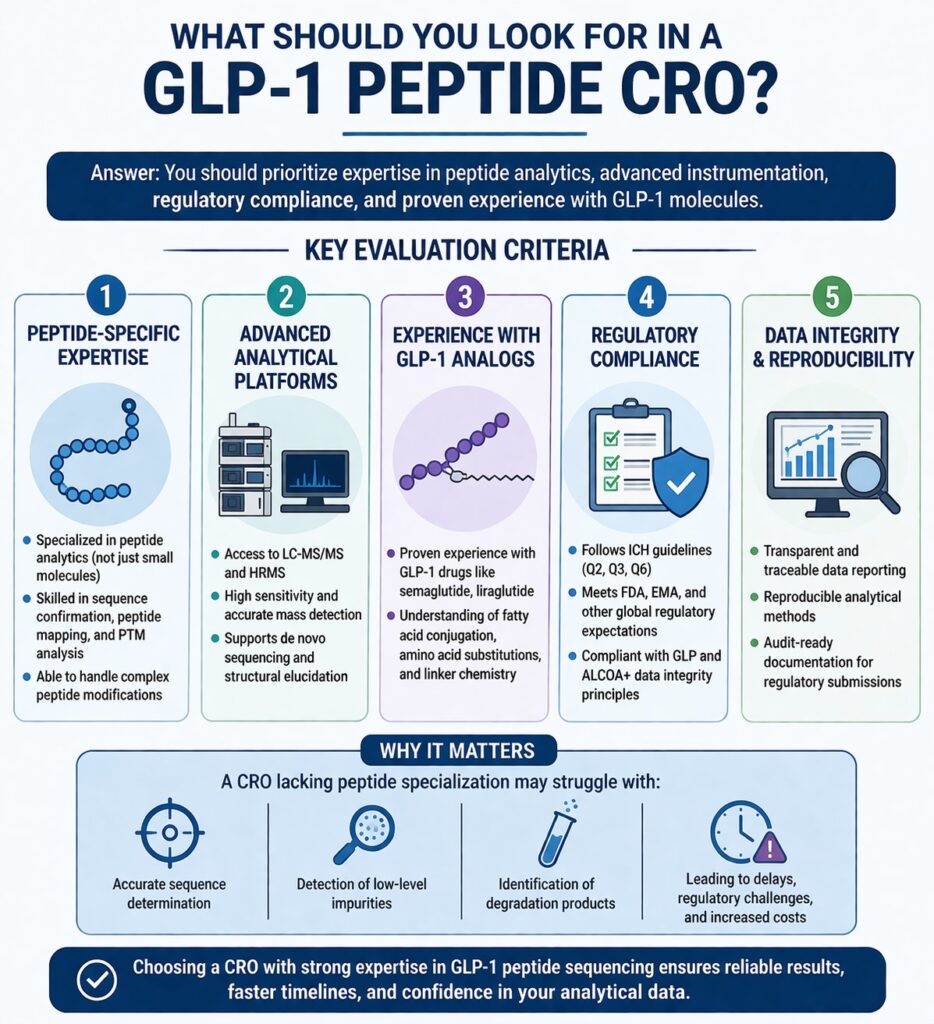
You should prioritize expertise in peptide analytics, advanced instrumentation, regulatory compliance, and proven experience with GLP-1 molecules.
Selecting the right CRO is essential because GLP-1 peptides are structurally complex and require highly specialized analytical approaches such as peptide sequencing of GLP-1 peptide. A well-qualified CRO ensures accurate sequencing, reliable impurity profiling, and regulatory-ready data.
Key Evaluation Criteria
1. Peptide-Specific Expertise
- Ensure the CRO specializes in peptide analytics, not just small molecules
- Experience in sequence confirmation, peptide mapping, and PTM analysis
- Ability to handle complex peptide modifications
2. Advanced Analytical Platforms
- Access to cutting-edge technologies such as:
- LC-MS/MS (Liquid Chromatography–Tandem Mass Spectrometry)
- HRMS (High-Resolution Mass Spectrometry)
- Capability for high sensitivity and accurate mass detection
- Support for de novo sequencing and structural elucidation
3. Experience with GLP-1 Analogs
- Proven work with GLP-1 drugs like:
- Semaglutide
- Liraglutide
- Understanding of:
- Fatty acid conjugation
- Amino acid substitutions
- Linker and modification chemistry
4. Regulatory Compliance
- Adherence to global regulatory standards:
- ICH guidelines (Q2, Q3, Q6)
- FDA and EMA expectations
- Compliance with:
- GLP (Good Laboratory Practices)
- ALCOA+ data integrity principles
- Strong understanding of regulatory requirements for GLP-1 peptide characterization
5. Data Integrity and Reproducibility
- Transparent and traceable data reporting
- Reproducible analytical methods
- Audit-ready documentation for submissions
Why This Matters
A CRO lacking peptide specialization may struggle with:
- Accurate sequence determination
- Detection of low-level impurities
- Identification of degradation products
This can lead to delays in development, regulatory challenges, and increased costs.
Choosing a CRO with strong expertise in GLP-1 Peptide Sequencing CRO Services ensures reliable results, faster timelines, and confidence in your analytical data.
A CRO lacking peptide specialization may struggle with sequencing accuracy and impurity detection, especially without expertise in GLP-1 peptide impurity characterization.
2. Why is Experience in GLP-1 Peptides Critical?
Experience is critical because GLP-1 peptides contain complex structural modifications that require specialized analytical expertise for accurate sequencing and characterization.
GLP-1 peptides are not simple linear molecules—they are often engineered with specific chemical modifications to enhance stability, bioavailability, and therapeutic performance. These complexities make their analysis significantly more challenging than standard peptides.
GLP-1 peptides are often engineered molecules analyzed through advanced workflows like peptide sequencing of GLP-1 drugs.
Common Structural Features in GLP-1 Peptides
GLP-1 analogs such as Semaglutide and Liraglutide typically include:
- Fatty Acid Conjugation
Enhances albumin binding and extends half-life - Amino Acid Substitutions
Improves stability against enzymatic degradation - PEGylation or Linker Modifications
Alters pharmacokinetics and molecular behavior
Why Experience Matters
A CRO with GLP-1 expertise can accurately interpret these complex structures and deliver reliable results.
1. Correct Identification of PTMs
- Detects and characterizes post-translational modifications (PTMs)
- Differentiates between intentional modifications and impurities
2. Accurate Sequence Confirmation
- Ensures full peptide sequence coverage
- Avoids misinterpretation of modified residues
3. Detection of Low-Level Impurities
- Identifies trace impurities that may impact safety
- Critical for regulatory submissions
4. Understanding of Degradation Pathways
Understanding of degradation pathways via GLP-1 peptide stability analytical methods
- Predicts and monitors degradation under stress conditions
- Supports stability studies and shelf-life determination
Why This Impacts Your Project
Without GLP-1-specific experience, a CRO may:
- Misidentify modifications as impurities
- Miss critical degradation products
- Deliver incomplete or non-compliant data
This can lead to:
- Delays in development timelines
- Regulatory rejections or queries
- Increased costs due to rework
Key Takeaway
A CRO with proven expertise in GLP-1 Peptide Sequencing CRO Services significantly reduces analytical risk by ensuring accurate structural characterization, reliable impurity profiling, and regulatory-ready data.
3. What Analytical Techniques Should a CRO Offer?
A competent CRO must provide advanced LC-MS-based techniques to ensure precise peptide sequencing, accurate structural characterization, and reliable impurity detection.
GLP-1 peptides are complex molecules, and their analysis requires a combination of high-sensitivity instrumentation and specialized methodologies. Without these techniques, critical structural details may be missed.
These techniques are core to analytical characterization of GLP-1 peptide drugs.
Essential Analytical Techniques
These are the core capabilities every GLP-1 peptide CRO should offer:
1. LC-MS/MS (Liquid Chromatography–Tandem Mass Spectrometry)
- Enables peptide sequencing and fragmentation analysis
- Provides detailed insights into amino acid composition and modifications
2. High-Resolution Mass Spectrometry (HRMS)
- Delivers accurate mass measurement
- Essential for identifying minor structural differences and impurities
3. Peptide Mapping
- Breaks peptides into fragments for sequence verification
- Helps confirm primary structure and modifications
4. Amino Acid Analysis
- Quantifies amino acid composition
- Supports sequence validation and purity assessment
5. Disulfide Bond Mapping
- Identifies disulfide linkages within the peptide
- Critical for understanding 3D structure and stability
Advanced Capabilities
Beyond basic techniques, a high-quality CRO should offer advanced analytical services:
• De Novo Sequencing
- Determines peptide sequence without prior knowledge
- Useful for unknowns or complex modifications
• Impurity Profiling
- Detects and characterizes process-related and degradation impurities
- Essential for regulatory compliance
• Forced Degradation Studies
- Evaluates peptide stability under stress conditions
- Helps identify degradation pathways
• Stability-Indicating Methods
- Ensures analytical methods can track changes over time
- Supports shelf-life determination and formulation development
Why These Techniques Matter
- Without these analytical capabilities, a CRO may:
- Provide incomplete or non-regulatory-compliant data
- Miss critical structural modifications
- Fail to detect low-level impurities
4. How Important is Regulatory Compliance?
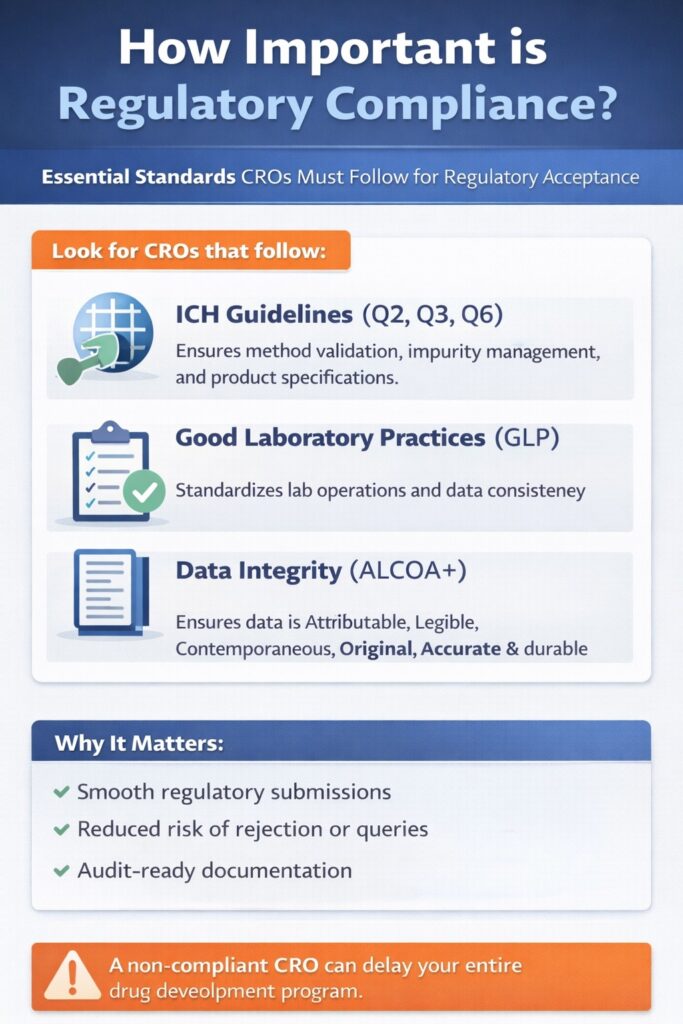
Regulatory compliance is absolutely critical because it ensures your analytical data is accepted by global authorities such as the U.S. Food and Drug Administration, European Medicines Agency, and Health Canada.
Regulatory compliance ensures your data is accepted globally and aligns with regulatory requirements for GLP-1 peptide characterization.
Without compliance, even high-quality scientific data may be rejected, leading to delays, additional costs, and potential failure in regulatory submissions.
What Standards Should a CRO Follow?
To ensure global acceptance, a CRO must strictly adhere to internationally recognized guidelines:
1. ICH Guidelines
- Includes:
- Q2 (Analytical Validation)
- Q3 (Impurities)
- Q6 (Specifications)
- Ensures method reliability, impurity control, and product quality
2. Good Laboratory Practices (GLP)
- Standardizes laboratory operations and documentation
- Ensures consistency, traceability, and reliability of data
3. Data Integrity (ALCOA+) Principles
- Ensures data is:
- Attributable
- Legible
- Contemporaneous
- Original
- Accurate
- Extended principles (+) include completeness, consistency, and durability
Why Regulatory Compliance Matters
• Smooth Regulatory Submissions
- Data generated in compliance is readily accepted by authorities
- Minimizes review time and queries
• Reduced Risk of Rejection
- Ensures alignment with global expectations
- Avoids costly rework and delays
• Audit-Ready Documentation
- Maintains complete and traceable records
- Supports inspections and audits without issues
Impact of Choosing a Non-Compliant CRO
A CRO that does not meet regulatory standards can:
- Delay product approvals and market entry
- Produce non-acceptable or incomplete data
- Trigger regulatory queries or rejections
5. What Role Does Instrumentation Play?
Advanced instrumentation ensures high accuracy and sensitivity, especially in LC-MS characterization of GLP-1 peptides.
In peptide analytics, the quality of your results is directly tied to the sophistication of the instruments used. Even highly skilled scientists cannot compensate for outdated or low-resolution equipment when dealing with complex GLP-1 molecules.
Must-Have Equipment in a CRO
A competent CRO should be equipped with the latest analytical technologies:
1. High-Resolution Mass Spectrometers (Orbitrap, Q-TOF)
- Provide accurate mass measurements at very high resolution
- Enable identification of minor structural differences and impurities
- Critical for complex peptide characterization
2. Ultra-High-Performance Liquid Chromatography (UHPLC) Systems
- Deliver high separation efficiency
- Improve detection of closely related impurities and variants
- Enhance overall analytical precision
3. Automated Peptide Mapping Tools
- Streamline sample preparation and analysis workflows
- Improve reproducibility and consistency
- Reduce manual errors in complex peptide studies
Benefits:
- Detection of trace-level impurities
– Identifies impurities at very low concentrations
– Essential for safety and regulatory compliance - High-confidence sequence identification
– Ensures accurate peptide sequencing and modification analysis
– Reduces risk of misinterpretation - Faster turnaround time
– Automated and high-throughput systems speed up analysis
– Supports faster drug development timelines
Why It Matters
Outdated or less advanced instruments can lead to:
- Incomplete structural characterization
- Missed low-level impurities
- Poor reproducibility and unreliable data
Outdated instruments often lead to incomplete or unreliable results.
6. How to Evaluate Data Quality and Reporting?
High-quality CROs provide detailed, transparent, and scientifically justified reports that are suitable for regulatory submission and confident decision-making.
High-quality CROs deliver transparent reports aligned with analytical characterization of GLP-1 peptide drugs.
In GLP-1 peptide sequencing and structural characterization, the value of the analysis lies not just in generating data—but in how clearly, accurately, and transparently that data is presented.
Key Indicators of Good Reporting
1. Clear Chromatograms and Spectra
- Well-resolved and properly labeled LC-MS chromatograms
- High-quality mass spectra with clear peak assignments
- Easy-to-interpret visual data for reviewers and regulators
2. Full Sequence Coverage
- Complete peptide sequence confirmation
- No missing regions or ambiguous fragments
- Strong evidence supporting sequence integrity
3. Impurity Identification with Structural Insights
- Identification of process-related and degradation impurities
- Structural characterization using MS/MS fragmentation data
- Clear differentiation between impurities and modifications
4. Method Validation Details
- Documentation of:
- Accuracy
- Precision
- Specificity
- Sensitivity
- Alignment with regulatory guidelines (ICH Q2)
Important Questions to Ask a CRO
Before selecting a CRO, evaluate their reporting quality by asking:
- Are reports regulatory submission-ready?
(Formatted and detailed enough for FDA/EMA filings) - Is raw data accessible?
(Ensures transparency and independent verification) - Are results reproducible?
(Confirms reliability and consistency across runs)
Why Data Transparency Matters
A CRO that emphasizes transparency:
- Builds trust and credibility
- Enables smooth regulatory review
- Reduces risk of data rejection or re-analysis
Red Flags to Watch Out For
- No validation or supporting data
- Incomplete or poorly labeled chromatograms
- Missing sequence regions
- Lack of impurity characterization
7. Why is Turnaround Time Important?
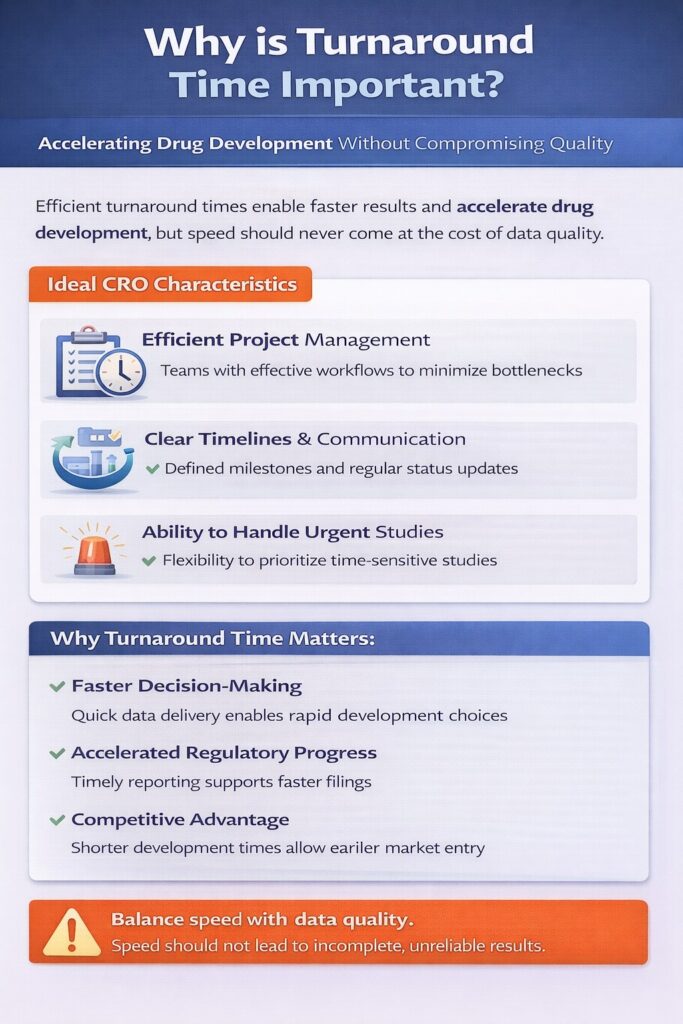
Turnaround time is crucial because faster analytical results directly accelerate drug development timelines—but only when quality is maintained.
Faster turnaround accelerates development, especially in studies like GLP-1 peptide stability analytical methods.
In GLP-1 peptide projects, delays in sequencing, impurity profiling, or stability studies can slow down formulation decisions, regulatory submissions, and overall time-to-market.
Ideal CRO Characteristics for Fast Turnaround
1. Efficient Project Management
- Well-structured workflows and experienced teams
- Minimal delays between sample receipt and analysis
2. Clear Timelines and Communication
- Defined project milestones and delivery schedules
- Regular updates and proactive communication
3. Ability to Handle Urgent Studies
- Capability to prioritize time-sensitive or regulatory-driven projects
- Flexibility to scale resources when needed
Balance Speed with Quality
While speed is important, it should never compromise data integrity:
- Poor-quality results may require rework, causing longer delays
- Fast but incomplete data can lead to regulatory issues
8. What About Customization and Flexibility?
Customization and flexibility are essential because GLP-1 peptide projects often require tailored analytical approaches rather than one-size-fits-all methods.
GLP-1 peptides can vary significantly in structure, modifications, and stability profiles. A rigid CRO approach may fail to capture critical analytical details, leading to incomplete or inaccurate results.
GLP-1 projects require tailored approaches, especially in CRO for GLP-1 peptide characterization.
Why Customization Matters in GLP-1 Projects
Each GLP-1 peptide may differ in:
- Chemical modifications (e.g., fatty acid conjugation, linkers)
- Stability behavior under stress conditions
- Impurity profiles and degradation pathways
This variability demands project-specific analytical strategies.
What to Look for in a Flexible CRO
1. Customized Method Development
- Tailored LC-MS methods based on peptide structure
- Optimization for sensitivity, selectivity, and resolution
- Adaptation to unique analytical challenges
2. Project-Specific Workflows
- Flexible study design based on:
- Development stage (early research vs. regulatory phase)
- Specific analytical goals (sequencing, impurity profiling, stability)
- Integration of multiple techniques as needed
3. Scalable Services
- Ability to handle:
- Small-scale R&D studies
- Large-scale regulatory or commercial projects
- Seamless transition between phases without rework
Benefits of a Flexible CRO Approach
- Improved accuracy in structural characterization
- Better identification of unique impurities and modifications
- More efficient handling of complex or evolving project needs
Risks of a Rigid CRO
A CRO lacking flexibility may:
- Require re-analysis, increasing time and cost
- Apply generic methods that miss critical details
- Struggle with complex or modified peptides
9. Cost vs Value: What Should You Prioritize?
You should prioritize value over cost—because low-cost CROs often compromise on expertise, data quality, and regulatory reliability.
While budget is important, choosing a CRO based solely on price can lead to inaccurate data, delays, and costly rework. In contrast, a high-value CRO delivers reliable, regulatory-ready results that ultimately save time and money.
Cost vs Value Comparison
| Factor | Low-Cost CRO | High-Value CRO |
|---|---|---|
| Expertise | Limited | Specialized (peptide-focused) |
| Data Quality | Variable / inconsistent | High and reproducible |
| Regulatory Compliance | Risky / incomplete | Reliable and submission-ready |
| Long-Term Impact | Delays and rework | Faster approvals and progress |
Why Choosing Value Matters
• Higher Data Reliability
- Accurate sequencing and impurity profiling
- Reduced chances of errors or re-analysis
• Strong Regulatory Acceptance
- Data aligned with global guidelines
- Fewer queries from regulatory authorities
• Faster Development Timelines
- Minimizes delays caused by poor-quality data
- Enables smoother progression to next stages
• Cost Savings in the Long Run
- Avoids repeat studies and additional expenses
- Reduces risk of project setbacks
Risks of Choosing a Low-Cost CRO
- Increased total project cost due to rework
- Incomplete or unreliable analytical results
- Lack of peptide-specific expertise
- Regulatory non-compliance issues
10. Why Choose ResolveMass for GLP-1 Peptide Sequencing CRO Services?
ResolveMass stands out by combining specialized peptide expertise, advanced analytical instrumentation, and regulatory-ready reporting, making it a reliable partner for GLP-1 peptide sequencing and structural characterization.
ResolveMass delivers specialized services including peptide sequencing of GLP-1 peptide and GLP-1 peptide impurity characterization.
In a highly complex and regulated space like GLP-1 therapeutics, selecting the right CRO can directly impact the success of your development program. ResolveMass is built to deliver precision, compliance, and confidence at every stage.
Key Strengths of ResolveMass
1. Deep Expertise in Peptide Sequencing and Structural Characterization
- Specialized focus on complex peptide analysis
- Strong capabilities in sequence confirmation, PTM identification, and impurity profiling
- Experience handling modified GLP-1 peptides
2. Advanced LC-MS/MS and HRMS Platforms
- Access to state-of-the-art analytical instrumentation
- High-resolution data for accurate structural elucidation
- Enhanced sensitivity for trace-level impurity detection
3. Proven Experience with GLP-1 Analogs
- Hands-on expertise with molecules like:
- Semaglutide
- Liraglutide
- Understanding of complex modifications and degradation pathways
4. Strong Focus on Regulatory Compliance
- Adherence to ICH guidelines and global regulatory expectations
- GLP-compliant workflows and ALCOA+ data integrity principles
- Delivery of audit-ready, submission-ready reports
5. High-Quality, Transparent Reporting
- Detailed and scientifically justified reports
- Full access to raw data and analytical insights
- Clear documentation for regulatory submissions
Why ResolveMass Makes a Difference
ResolveMass combines:
- Scientific excellence
- Industry experience
- Regulatory expertise
This ensures:
- Reduced analytical and regulatory risk
- Reliable and reproducible data
- Faster development timelines
Conclusion:
Choosing the right GLP-1 Peptide Sequencing CRO Services partner is not just about outsourcing analytical work—it is about ensuring the success of your entire drug development program.
A qualified CRO should demonstrate:
- Proven peptide expertise
- Advanced analytical capabilities
- Regulatory compliance
- High-quality, reproducible data
- Strong communication and support
ResolveMass Laboratories Inc. stands out as a trusted partner, delivering accurate, regulatory-ready, and high-quality peptide sequencing and structural characterization services tailored for GLP-1 molecules.
Frequently Asked Questions:
GLP-1 Peptide Sequencing CRO Services involve specialized analytical testing performed by expert laboratories to determine peptide structure, sequence, and purity. These services use advanced tools like LC-MS/MS and HRMS to ensure accurate characterization. They are essential for drug development, regulatory submissions, and quality control. CROs also help identify impurities and degradation products. Overall, they provide reliable, regulatory-ready data for pharmaceutical companies.
GLP-1 peptide sequencing confirms the exact molecular structure of the drug, ensuring safety and efficacy. It helps detect modifications, impurities, and inconsistencies in the peptide chain. This is critical for meeting regulatory requirements and ensuring batch-to-batch consistency. Without proper sequencing, there is a risk of product failure or rejection. It ultimately supports successful drug approval and commercialization.
GLP-1 peptide characterization uses advanced techniques like LC-MS/MS, HRMS, peptide mapping, and amino acid analysis. These methods help identify sequence, structure, and modifications. Disulfide bond mapping and de novo sequencing are also used for complex peptides. Additionally, impurity profiling and stability studies are performed. Together, these techniques ensure complete and accurate analysis.
GLP-1 peptides are complex due to modifications like fatty acid conjugation and amino acid substitutions. Detecting low-level impurities and degradation products is challenging. Analytical methods must be highly sensitive and precise. Reproducibility and regulatory compliance also add complexity. These challenges require specialized expertise and advanced instrumentation.
Regulatory compliance ensures that analytical data is accepted by authorities like FDA and EMA. It involves following ICH guidelines, GLP practices, and ALCOA+ data integrity principles. Compliant data reduces the risk of rejection or delays. It also ensures audit readiness and smooth submission processes. Non-compliance can lead to costly rework and project setbacks.
Reference
- Albaghlany RM, Shahsavani MB, Hoshino M, Moosavi-Movahedi AA, Ghasemi Y, Yousefi R. Optimizing expression, purification, structural and functional assessments of a novel dimeric incretin (GLP-1cpGLP-1). Biochimie. 2024 Aug 1;223:133-46.https://www.sciencedirect.com/science/article/pii/S0300908423002912
- Jazayeri A, Rappas M, Brown AJ, Kean J, Errey JC, Robertson NJ, Fiez-Vandal C, Andrews SP, Congreve M, Bortolato A, Mason JS. Crystal structure of the GLP-1 receptor bound to a peptide agonist. Nature. 2017 Jun 8;546(7657):254-8.https://www.nature.com/articles/nature22800
- Zhang X, Belousoff MJ, Zhao P, Kooistra AJ, Truong TT, Ang SY, Underwood CR, Egebjerg T, Šenel P, Stewart GD, Liang YL. Differential GLP-1R binding and activation by peptide and non-peptide agonists. Molecular Cell. 2020 Nov 5;80(3):485-500.https://www.cell.com/molecular-cell/fulltext/S1097-2765(20)30650-X
- Banahatti N, Sharma G. Molecular and Computational Characterization of GLP-1 Receptor–Agonist Binding Mechanisms for Rational Therapeutic Design.https://chemrxiv.org/doi/10.26434/chemrxiv-2025-1dsl1
- Ehsasatvatan M, Baghban Kohnehrouz B. Designing and computational analyzing of chimeric long-lasting GLP-1 receptor agonists for type 2 diabetes. Scientific Reports. 2023 Oct 18;13(1):17778.https://www.nature.com/articles/s41598-023-45185-1
About the Author


