

Introduction
Under the harmonized ICH M10 guideline, which was adopted at Step 4 on May 24, 2022, issued by the U.S. Food and Drug Administration (FDA) in November 2022, and became legally effective in the European Union on January 21, 2023, analytical run acceptance criteria in regulated bioanalysis establish strict quantitative pass/fail requirements for calibration standards and quality control (QC) samples before data from nonclinical, clinical, or comparative bioavailability/bioequivalence (BA/BE) studies can be reported. For chromatographic methods, at least 75% of calibration standards, representing a minimum of six concentration levels, must back-calculate within ±15% of their nominal concentrations, with a wider tolerance of ±20% permitted at the lower limit of quantification (LLOQ). In addition, at least two-thirds (2/3, commonly operationalized as ≥67%) of the total QCs and at least 50% of QCs at each concentration level must fall within ±15% of their nominal values. Ligand binding assays (LBAs) follow wider acceptance limits, allowing ±20% deviation for calibration standards, with ±25% permitted at the LLOQ and upper limit of quantification (ULOQ), and ±20% for QCs, while maintaining the same 75%, two-thirds, and 50%-per-level acceptance proportions. Consistent implementation of these harmonized requirements depends on incorporating them into a priori standard operating procedures (SOPs), QC bracketing sequence designs, and validated Laboratory Information Management System (LIMS) controls. This operational discipline is essential across GLP- and GCP-compliant bioanalytical programs at ResolveMass Laboratories Inc.
For comprehensive bioanalytical support, explore how integrated analytical and bioanalytical capabilities can strengthen regulated drug development programs.
Integrated Chemistry and Bioanalytical CRO Services
Share via:
Quick Summary:
- Scope and timeline: ICH M10 harmonizes bioanalytical run acceptance worldwide. It was adopted at Step 4 in May 2022, issued by the FDA in November 2022, and took effect in the EU on January 21, 2023. It applies to nonclinical, clinical and BA/BE study data.
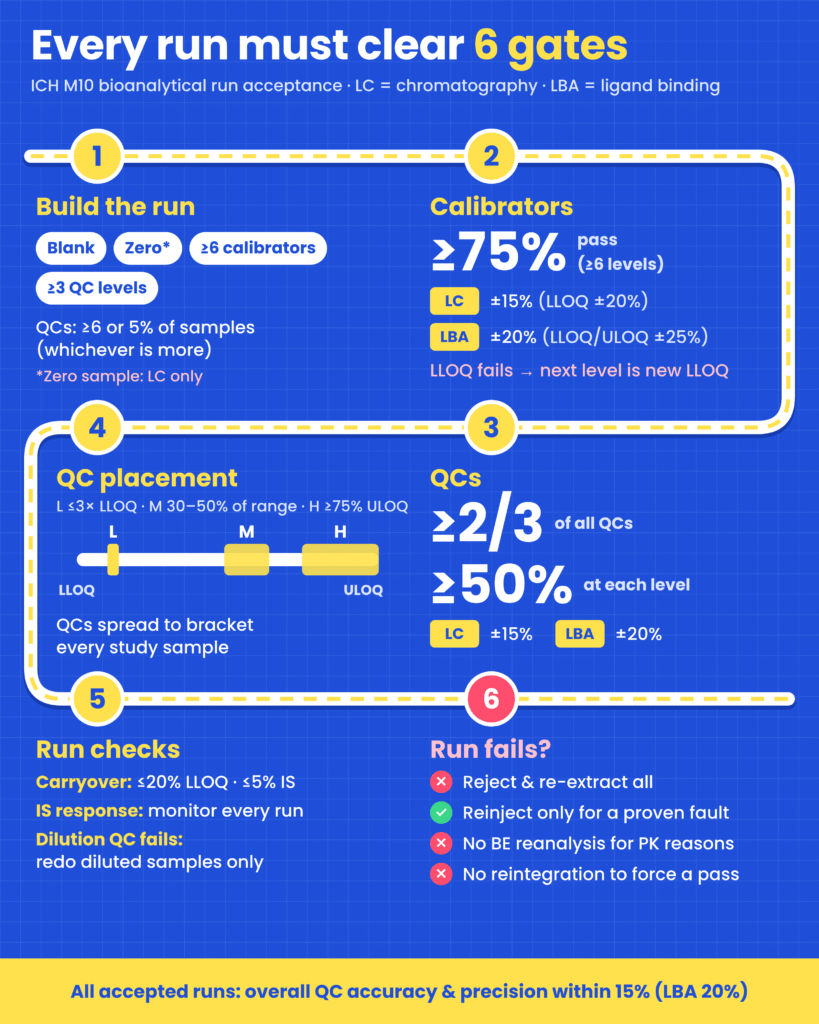
- What a run must contain: a blank, a zero sample (chromatography only), at least 6 non-zero calibration levels from LLOQ to ULOQ, and at least 3 QC levels (low, medium, high). Total QCs must be at least 6 or 5% of study samples, whichever is higher. Calibrators and QCs come from separate stock solutions and use the same matrix as the study samples.
- Calibration acceptance: at least 75% of calibrators, across at least 6 levels, must pass.
- Chromatography: within ±15% (±20% at LLOQ).
- LBA: within ±20% (±25% at LLOQ and ULOQ). LBA anchor points don’t count toward the 75%.
- If the LLOQ or ULOQ fails, the range narrows to the next passing level. Calibrators from a failed batch can’t support another batch.
- QC acceptance: at least 2/3 of all QCs and at least 50% at each level must fall within ±15% (chromatography) or ±20% (LBA). If either the calibration or QC criterion fails, the whole run is rejected.
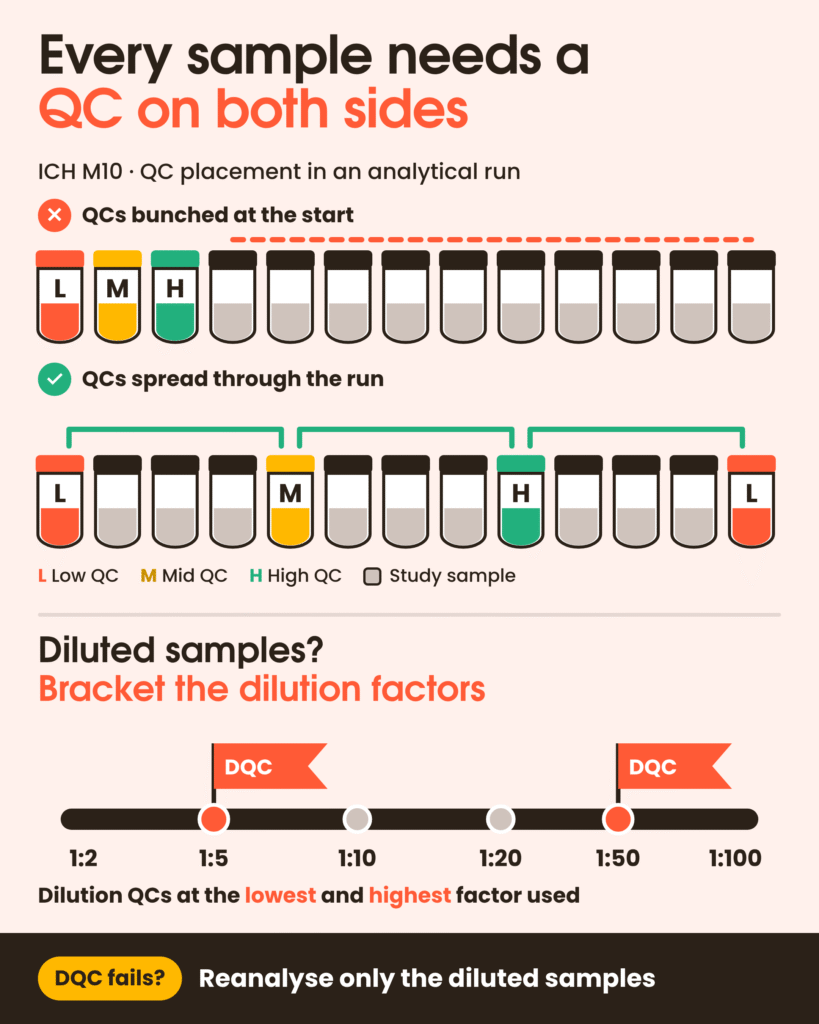
- QC placement: the low QC sits within 3× the LLOQ, the medium QC at 30–50% of the range, and the high QC at or above 75% of the ULOQ. QCs must be spread through the run so every study sample is bracketed. If dilution QCs fail, only the diluted samples are redone, not the whole run.
- Ongoing run checks:
- Carryover in the blank after the ULOQ must be ≤20% of the LLOQ response and ≤5% of the IS response.
- IS response must be monitored in every run.
- Overall QC accuracy and precision across all accepted runs must stay within 15% (20% for LBA), or the lab must investigate.
- Failed runs and data integrity: a failed run means re-extracting and reanalyzing all samples. Reinjection is allowed only for a proven technical fault with validated reproducibility. BA/BE samples can’t be reanalyzed for PK reasons. All reintegration must follow pre-set SOPs with ALCOA-C documentation. The FDA has cited “testing into compliance” and uncontrolled manual integration, so validated CDS/LIMS systems with audit trails are the safeguard.
What Must Be Included in a Regulated Bioanalytical Run Under ICH M10
ICH M10 Sections 3.3.1 (chromatography) and 4.3.1 (LBA) describe an analytical run as a complete batch containing blank matrix controls, at least six non-zero calibration standard concentration levels covering the range from the LLOQ to the ULOQ, QC samples at a minimum of three concentration levels analyzed in duplicate (or 5% of the total study sample count), and study samples positioned between these QCs. Chromatographic assays must also include a zero sample, consisting of blank biological matrix spiked with an internal standard (IS). In contrast, LBAs do not include a zero sample as part of their analytical run structure.
Several essential design requirements must be addressed before data acquisition begins. Calibration standards and QCs must be prepared using separate stock solutions and the same biological matrix as the study samples, including any applicable anticoagulants and additives. A surrogate matrix may be used only when scientifically justified, such as when an analyte-free matrix is unavailable. Blank samples are excluded from calibration curve parameter calculations, while regression models are developed using non-zero calibration standards. When multiple analytes are measured simultaneously, such as a parent drug together with its metabolites or co-administered therapies, each analyte must have its own independent calibration curve within the analytical run. For stability assessments, the ICH M10 Frequently Asked Questions (FAQs) also clarify that measuring QC concentrations at time zero confirms that the initial QC samples were accurately prepared in accordance with their nominal concentrations before storage or exposure to stress conditions.
A compliant routine study-sample analytical run must contain the following components:
- A blank matrix sample prepared without the analyte or internal standard to verify the absence of baseline interference.
- A zero sample (chromatographic runs only) consisting of blank matrix spiked with an internal standard.
- At least six non-zero calibration standard concentration levels, including both the LLOQ and ULOQ.
- At least three QC concentration levels (low, medium, and high), analyzed in duplicate (a minimum of six QCs), or QCs representing at least 5% of the total study sample count. These must be distributed throughout the analytical run to bracket all unknown study samples.
- Dilution QCs positioned to bracket or correspond to the dilution factors applied to any study samples exceeding the calibration curve range in chromatographic runs.
Learn how a structured bioanalytical strategy supports reliable method selection, validation, and study execution.
Bioanalytical Strategy for Drug Development
Analytical Run Acceptance Criteria in Regulated Bioanalysis for Calibration Standards and QCs
Under ICH M10 Sections 3.3.2 and 4.3.2, analytical run acceptance criteria in regulated bioanalysis require every analytical batch to satisfy two separate quantitative acceptance requirements: calibration curve back-calculation accuracy and QC accuracy, evaluated across both the total number of QCs and the individual concentration levels. Failure to meet either the calibration standard acceptance threshold or the QC acceptance requirements necessitates immediate rejection of the analytical run.
For a routine analytical batch containing the minimum six QCs, consisting of three concentration levels analyzed in duplicate, satisfying the “at least two-thirds” requirement means that a minimum of 4 out of 6 QCs (66.7%) must fall within the specified acceptance limits. At the same time, the requirement that “at least 50% at each concentration level” must pass means that at least 1 out of 2 replicates at each level (low, medium, and high) must meet the acceptance criteria. For an illustrative larger batch containing 240 study samples, applying the 5% scaling requirement produces 12 QCs, with four replicates at each of the three concentration levels. In this situation, at least 8 out of 12 QCs overall and at least 2 out of 4 replicates at every individual concentration level must pass. The following table compares the harmonized analytical run requirements for chromatographic assays and LBAs.
| Parameter | Chromatographic Assays (ICH M10 Section 3.3) | Ligand Binding Assays (ICH M10 Section 4.3) |
|---|---|---|
| Calibration Curve Composition | Blank, zero sample (blank + IS), ≥6 non-zero levels including LLOQ and ULOQ | Blank sample, ≥6 non-zero levels including LLOQ and ULOQ (often 4PL/5PL fit) |
| Calibration Standard Accuracy | Within ±15% of nominal (±20% at LLOQ) | Within ±20% of nominal (±25% at LLOQ and ULOQ) |
| Minimum Passing Calibrators | ≥75% of calibration standards and ≥6 concentration levels | ≥75% of calibration standards (excluding anchor points) and ≥6 levels |
| Anchor Points | Not part of chromatographic calibration curve design | Permitted below LLOQ and above ULOQ to aid fit; no acceptance criteria and excluded from 75% count |
| Routine Study-Run QC Levels | 3 levels: LQC (≤3× LLOQ), MQC (30–50% of range), HQC (≥75% of ULOQ) | ≥3 levels: low, medium, and high QCs spanning the range |
| Minimum QCs per Analytical Run | ≥3 levels in duplicate (≥6 QCs) or 5% of study samples | ≥3 levels in duplicate (≥6 QCs) or 5% of study samples |
| Per-Run QC Acceptance Criteria | ≥2/3 (commonly 67%) of total QCs and ≥50% per level within ±15% of nominal | ≥2/3 (commonly 67%) of total QCs and ≥50% per level within ±20% of nominal |
| Overall Between-Run QC Criteria | Overall accuracy (within ±15%) and precision (≤15% CV) across all accepted runs | Overall accuracy (within ±20%) and precision (≤20% CV) across all accepted runs |
| Dilution QCs in Routine Runs | Required when samples are diluted; lowest and highest dilution factors may be bracketed; failure affects diluted samples only | Dilution linearity and hook effect validated pre-study; dilution QCs not routinely required per industry implementation summaries |
| Carryover Threshold (Blank After ULOQ) | ≤20% of LLOQ analyte response and ≤5% of IS response | Generally not applicable; if platform is carryover-prone, blank response must be below LLOQ |
How ICH M10 Handles Rejected Calibration Standards, Anchor Points, and Replicates
When individual calibration standards fail to meet the required accuracy limits, they must be excluded from the calibration curve, and the regression must be recalculated without the failing standards. This is permitted provided that at least 75% of the calibration standards and a minimum of six non-zero concentration levels remain acceptable. If the rejected standard corresponds to the LLOQ, the lower limit of quantification for that analytical run automatically increases to the next lowest acceptable calibration standard. Similarly, if the ULOQ fails, the upper limit of the analytical range is reduced to the next highest acceptable standard. Any study sample with a concentration below the revised LLOQ or above the reduced ULOQ must undergo reanalysis.
When calibration standards are analyzed in replicates, such as duplicate calibration curves, ICH M10 Section 3.2.4 requires at least 50% of the calibration standards tested at each concentration level to satisfy the ±15% accuracy requirement (±20% at the LLOQ). Training examples published in January 2024 by the ICH M10 Expert Working Group demonstrate two acceptable approaches for constructing regression models using replicate calibrators. Laboratories may calculate the mean of acceptable replicates at each concentration level and use it as a single regression point, excluding failing replicates from the calculation. Alternatively, all individually acceptable replicates may be included directly in the regression model. However, an entire concentration level must be excluded whenever more than 50% of its replicates fail the acceptance criteria. For LBAs, anchor points placed below the LLOQ and above the ULOQ are excluded from both the 75% calibration standard count and accuracy assessments. These points are primarily intended to improve curve fitting, particularly with 4-parameter or 5-parameter logistic (4PL/5PL) models, beyond the quantifiable concentration range.
Importantly, the final Step 4 version of ICH M10, particularly Sections 3.3.2 and 4.3.2, introduced an explicit clarification concerning multi-batch analytical runs that was not included in the Step 2 draft. Calibration standards from a failed batch cannot be used to support the acceptance of other batches within the same analytical run.
Review the key regulatory expectations for bioanalytical method validation under ICH M10.
ICH M10 Bioanalytical Method Validation Guidelines
QC Concentration Levels and Where ICH M10 Requires Them to Be Placed
ICH M10 requires routine study-sample analytical runs, together with non-accuracy-and-precision (non-A&P) validation runs, to include at least three QC concentration levels: low, medium, and high. For chromatographic assays, these are defined as a Low QC (LQC) within three times the LLOQ, a Medium QC (MQC) positioned at approximately 30–50% of the calibration curve range, and a High QC (HQC) at or above 75% of the ULOQ. Additionally, QCs must be distributed throughout the analytical run to ensure that every study sample is bracketed by QC samples. At least two QC concentration levels must also fall within the concentration range observed in the study samples.
Setting Low, Medium, and High QC Levels Under ICH M10 vs. Legacy Guidances
One of the main structural differences between method validation and routine study-sample analysis concerns the number of QC concentration levels required. During full validation accuracy and precision (A&P) runs, chromatographic assays require four QC levels: LLOQ, LQC, MQC, and HQC. Each level must be evaluated using at least five replicates per level across a minimum of three runs conducted over at least two days. LBA A&P validations require five QC levels, including an additional ULOQ QC, along with total error acceptance criteria of ≤30% at standard QC levels and ≤40% at the LLOQ and ULOQ. Industry and regulatory guidance documents describe varying expectations for the number of validation runs. For example, published CRO summaries refer to at least three runs with duplicate sets at each level, whereas legacy FDA 2018 practice specified a minimum of six independent runs. Once a method has been validated and enters routine study-sample analysis, the LLOQ and ULOQ QCs are no longer required because accuracy at these boundaries is monitored through the calibration curve. Consequently, routine analysis generally retains only LQC, MQC, and HQC.
The positioning of the Medium QC is one of the most significant changes introduced by ICH M10 for chromatographic assays. Under earlier industry practices, the MQC was commonly positioned near the geometric mean of the calibration range. However, on calibration curves spanning several orders of magnitude, the geometric mean generally falls considerably lower within the range. ICH M10 instead recommends positioning the MQC at approximately 30–50% of the calibration curve range. A Celerion white paper summarizing discussions at the Workshop on Recent Issues in Bioanalysis (WRIB) documents that regulators emphasized positioning the MQC at approximately 50% of the ULOQ because of the statistical sensitivity of peak exposure (Cmax) comparisons in bioequivalence studies. The discussion also highlighted that including more than one intermediate QC between the LQC and HQC, or retaining the geometric mean approach in non-BE studies, can help prevent large unmonitored concentration gaps across calibration curves spanning multiple orders of magnitude.
If study-sample concentrations unexpectedly cluster toward one end of the calibration curve after analysis has started, ICH M10 Section 3.3.3 instructs laboratories to discontinue sample analysis and perform a partial validation to narrow the calibration range or revise the method by introducing additional QC levels that cover the observed clinical concentration range. Sample analysis may resume after these adjustments have been completed. However, samples that were validly analyzed before the optimization do not need to be reanalyzed. Similarly, when study-sample concentrations consistently exceed the ULOQ, laboratories should extend the calibration curve range whenever feasible and adjust the HQC concentration accordingly.
Understand how FDA and EMA requirements compare when planning compliant analytical validation programs.
EMA vs. FDA Bioanalytical Method Validation Differences
Sequence Placement, Bracketing Rules, and Dilution QC Positioning
ICH M10 specifically requires QC samples to be distributed throughout the analytical run so that every study sample is bracketed by QC samples. Placing all QCs exclusively at the beginning or end of the analytical sequence is therefore not acceptable. In chromatographic workflows, distributing LQC, MQC, and HQC samples evenly throughout the autosampler queue helps identify progressive instrument drift during extended analytical batches. For this reason, ICH M10 Section 3.2.5.2 recommends including at least one validation A&P run with a batch length comparable to the anticipated study-sample analytical run. In plate-based LBA workflows, QC samples must be distributed across individual microtiter plates as well as throughout the complete analytical run to ensure that all study samples are appropriately bracketed.
When study samples exceed the ULOQ and require dilution using blank matrix, chromatographic analytical runs must include dilution QCs prepared above the ULOQ and subsequently diluted into the validated calibration curve range. Under the final Step 4 version of ICH M10 (Sections 3.2.7 and 3.3.2), laboratories are not required to prepare a separate dilution QC for every dilution ratio used within an analytical batch. Instead, they may bracket the dilution factors by evaluating dilution QCs at only the lowest and highest dilution factors applied during the run, provided both factors fall within the validated dilution range. An important distinction is that dilution QC acceptance applies only to the diluted study samples. If dilution QCs fail while the standard LQC, MQC, and HQC samples meet their acceptance requirements, the analytical run itself remains acceptable. Only the diluted study samples must be prepared again and reanalyzed.
Learn how structured method transfer supports reproducibility and continuity across bioanalytical studies.
Bioanalytical Method Transfer Services
Overall QC Tracking, Carryover Limits, and Internal Standard Monitoring
Passing the individual analytical run acceptance requirements does not automatically establish the acceptability of an entire study. Overall between-run QC accuracy or precision may still exceed the permitted ±15% limits (±20% for LBAs), carryover may exceed regulatory thresholds, or internal standard responses may demonstrate unexplained systematic variations. Under ICH M10 Sections 3.3.2 and 4.3.2, bioanalytical laboratories must calculate and report the overall (between-run) QC accuracy and precision across all accepted analytical runs at every concentration level. For chromatographic studies, when cumulative mean accuracy or precision exceeds the 15% acceptance criterion, the laboratory must initiate a formal investigation to identify the underlying cause. Regulatory reviewers may also reject the dataset in comparative BA/BE submissions if the cumulative QC results do not satisfy the required limits. LBAs follow a similar approach, applying an overall accuracy and precision benchmark of ±20%.
For multi-analyte chromatographic runs, ICH M10 establishes specific rules to ensure that valid analytical data are retained wherever possible. If an analytical run satisfies the acceptance criteria for one analyte but fails the calibration or QC requirements for another co-quantified analyte, the accepted data for the passing analyte should still be reported. Only the analyte that failed the acceptance requirements must undergo re-extraction and reanalysis. In addition to routine QC evaluation, laboratories must continuously monitor two important run-level controls:
- Carryover Limits: Blank matrix injections performed immediately after the ULOQ calibration standard must demonstrate an analyte response of ≤20% of the LLOQ response and an IS response of ≤5% in chromatographic assays. On carryover-prone LBA platforms, the blank response must remain below the LLOQ. Method validation must also demonstrate that carryover does not compromise analytical accuracy.
- Internal Standard Monitoring: ICH M10 requires laboratories to monitor IS responses across unknown study samples to identify systematic IS variability relative to calibration standards and QCs. Predefined SOP acceptance criteria must establish the conditions under which individual IS outliers, commonly referred to as “flyers,” require sample reanalysis.
Review the role of matrix-effect assessment in maintaining reliable LC-MS/MS bioanalytical measurements.
Matrix Effects in LC-MS/MS Bioanalysis
Managing Failed Runs, Reinjection, Reintegration, and Audit Readiness
When an analytical run fails to satisfy the calibration or QC acceptance requirements, ICH M10 requires the laboratory to reject the entire run and prepare a new analytical batch through re-extraction of all study samples. Reinjection is permitted only when an identifiable technical or equipment-related failure has occurred and the reproducibility of reinjection has been established during method validation or appropriately documented in the analytical report.
All repeat analyses, reinjections, and chromatogram integration activities must be performed in accordance with a priori SOPs and supported by ALCOA-C (Attributable, Legible, Contemporaneous, Original, Accurate, Complete) documentation. In comparative BA/BE studies, bioanalytical reports must contain a separate summary table presenting the results from rejected analytical runs, together with complete documentation of every reanalyzed and reintegrated chromatogram. The following table distinguishes acceptable analytical run management practices from activities that may result in regulatory inspection findings.
| Operational Scenario | Permitted Under ICH M10 | Prohibited / Compliance Violation | Required Documentation |
|---|---|---|---|
| Failed QC or Calibration Run | Reject the run and re-extract and reanalyze all study samples in a new batch | Using calibration standards from a failed batch to accept another batch, or retaining data from a failed run | Separate table reporting values from rejected runs (comparative BA/BE) and documented justification |
| Instrument / Autosampler Malfunction | Reinject the processed batch if reinjection reproducibility was validated (Section 3.2.9) | Reinjecting a full run or failed calibrators/QCs without an identified analytical cause | Documented equipment/analytical cause, timestamps, and reinjection reproducibility data |
| Anomalous Study Sample Concentration | Reanalyze for SOP-defined analytical reasons (>ULOQ, <revised LLOQ, IS outlier, pre-dose peak, poor chromatography) | Reanalyzing BA/BE study samples for pharmacokinetic (PK) reasons (e.g., incongruous PK profile) | Initial value, reason for reanalysis, repeat value(s), final accepted value, justification, and summary count table |
| Chromatographic Peak Integration | Perform integration and manual reintegration strictly under a priori study plan, protocol, or SOP rules | Altering peak integration to force failing calibrators or QCs into passing limits without SOP controls or justification | List of reintegrated chromatograms, reason, analyst/reviewer audit trail, plus original and repeat chromatograms/results |
| Incurred Sample Reanalysis (ISR) | Reanalyze a subset of accepted study samples on a different day within the stability window to confirm reproducibility | Replacing original study-sample concentrations with ISR repeat values | ISR pass rate (≥2/3 within ±20% CC / ±30% LBA) and documented investigation if failing |
Preventing Testing Into Compliance Under Analytical Run Acceptance Criteria in Regulated Bioanalysis
Regulatory agencies consider the manipulation of analytical run acceptance criteria in regulated bioanalysis, particularly “testing into compliance,” retrospective rejection of previously accepted runs, and uncontrolled manual peak integration, to be serious data-integrity violations. Publicly available FDA enforcement records demonstrate the level of scrutiny applied by inspectors when reviewing raw analytical run histories, IS response trends, and chromatographic integration logs.
Following an April 2023 inspection documented through a Form 483 and an August 6, 2024 General Correspondence Letter (GCL) issued to Raptim Research, Ltd. concerning bioequivalence studies, FDA investigators identified several compliance concerns. These included the retrospective rejection of valid analytical runs that had already satisfied predefined acceptance criteria following repeat analysis, high percentages of unacceptable IS responses across multiple methods without appropriate root-cause investigations, and practices that appeared to constitute “testing into compliance.” Similarly, FDA Warning Letter 652067, issued to Intas Pharmaceuticals Limited following a July 2023 CGMP laboratory inspection, identified instances in which analysts performed manual chromatographic integration that generated passing results without appropriate SOP controls, supervisory approval, or contemporaneous justification.
To avoid these regulatory compliance failures, modern bioanalytical laboratories implement validated chromatography data systems (CDS) and LIMS environments. These may include automated ICH M10 Section 3.3.2 calculation and flagging packages, such as those described in SCIEX technical documentation. Such systems can lock processing methods, automatically calculate calibration and QC acceptance thresholds without relying on manual spreadsheet transcription, enforce role-based access controls, and maintain immutable audit trails. Regulatory data-processing analyses further emphasize that fixed numerical acceptance requirements, including calibration back-calculations, QC ratios, and carryover flags, should be handled through validated software rules. Human scientific judgment should instead be reserved for SOP-controlled investigations, multi-analyte data dispositions, and supervisory reviews of documented chromatographic reintegration activities.
Understand the procedures and acceptance considerations for incurred sample reanalysis.
Incurred Sample Reanalysis (ISR) in Bioanalytical Studies
Conclusion
Harmonized analytical run acceptance criteria in regulated bioanalysis under ICH M10 establish clearly defined and auditable requirements for calibration curve boundaries, Medium QC positioning, dilution QC bracketing, and multi-batch analytical run validation. Achieving regulatory readiness requires laboratories to combine strict quantitative acceptance thresholds (±15% for chromatography and ±20% for LBAs) with consistent QC bracketing across analytical runs and microtiter plates, cumulative between-run QC monitoring, validated reinjection reproducibility, and ALCOA-C-compliant documentation governing reintegration and reanalysis activities.
Discuss your study requirements and explore the available collaboration options.
Bioanalytical CRO Partnership
Operating from its GLP- and GCP-compliant facility in Laval, Quebec, ResolveMass Laboratories Inc. develops and conducts LC-MS/MS, HRMS, and hybrid LBA–MS bioanalytical programs designed to meet ICH M10 requirements. Its capabilities include validated LIMS audit trails and inspection-ready reporting for preclinical toxicokinetic, clinical pharmacokinetic, and BA/BE studies. To discuss custom method development, method validation, or regulated study-sample analysis with the scientific team, visit the ResolveMass Laboratories contact page.
Frequently Asked Questions
Routine study-sample analysis requires at least three QC levels: LQC, MQC, and HQC, with duplicate measurements (a minimum of six QCs) or a total QC count equivalent to 5% of study samples. Full chromatographic accuracy and precision validation requires four QC levels, including LLOQ QC, with at least five replicates per level across three or more runs conducted over at least two days. LBA validation involves five QC levels, including ULOQ QC, with applicable total error requirements and validation run expectations.
ICH M10 requires laboratories to distribute QC samples across the entire analytical sequence rather than placing them together at the beginning or end. Every unknown study sample must be positioned between QC samples to help identify potential variations during analysis. For LBAs, this distribution requirement also applies across individual microtiter plates, and at least two QC concentration levels must represent the range observed in the study samples.
ICH M10 recommends positioning the Medium QC at approximately 30–50% of the calibration curve range for chromatographic methods. Earlier industry practices frequently placed the MQC near the geometric mean of the calibration range, which could leave substantial concentration intervals insufficiently monitored. For calibration curves covering multiple orders of magnitude, laboratories may introduce additional intermediate QC levels between LQC and HQC to improve concentration coverage.
When the LLOQ calibrator does not satisfy the required accuracy criteria, it must be excluded, and the next lowest acceptable calibration standard establishes the revised LLOQ for that run. If the ULOQ calibrator fails, the next highest acceptable standard becomes the revised upper quantification limit. Study samples falling outside these adjusted boundaries must be reanalyzed to ensure their reported concentrations remain within the accepted calibration range.
A failed dilution QC does not automatically result in rejection of the entire analytical run under ICH M10. Its acceptance criteria apply specifically to study samples that have undergone dilution, rather than to the standard calibration curve or routine LQC, MQC, and HQC results. Therefore, only the affected diluted samples need to be prepared again and reanalyzed when the remaining run acceptance requirements are satisfied.
No. The final Step 4 version of ICH M10 explicitly prevents laboratories from using calibration standards belonging to a rejected batch to establish the acceptability of another batch within the same analytical run. Each batch must independently satisfy the applicable calibration and QC acceptance requirements. This restriction helps maintain reliable analytical results and prevents failed calibration data from influencing the acceptance of other batches.
Reinjection is acceptable when an identifiable technical or equipment-related problem has affected the analytical run and the underlying cause is properly documented. Laboratories must also demonstrate that reinjection produces reproducible results through method validation or appropriate documentation in the bioanalytical report. Reinjecting failed calibrators, QCs, or complete analytical runs without an established technical justification is not permitted.
Chromatographic assays generally require calibration standard accuracy within ±15%, with ±20% permitted at the LLOQ, while QC samples must meet ±15% limits. LBAs use wider tolerances of ±20% for calibration standards and QCs, with ±25% permitted at the LLOQ and ULOQ. Chromatographic methods include a zero sample and require dilution QCs when applicable, whereas LBAs exclude zero samples and may use anchor points outside the quantification range to support 4PL/5PL curve fitting.
Routine QC acceptance evaluates the accuracy and precision of an analytical batch using prepared QC samples containing known analyte concentrations. In contrast, ISR assesses the reproducibility of measurements obtained from actual incurred study samples that have already been analyzed, using repeat testing on a different day within the stability period. ISR generally requires at least two-thirds of repeat results to agree within ±20% for chromatographic assays or ±30% for LBAs, following the applicable sample selection requirements. Original reported study-sample concentrations must remain unchanged and cannot be replaced by ISR results.
Reference:
- Meertens, M., Kerssemakers, N., de Vries, N., Rosing, H., Steeghs, N., Beijnen, J. H., & Huitema, A. D. R. (2025). Clinical application of volumetric absorptive microsampling for therapeutic drug monitoring of oral targeted anticancer drugs. Therapeutic Drug Monitoring, 47(5), 625–634. https://doi.org/10.1097/FTD.0000000000001315
- Fluhler, E., Vazvaei, F., Singhal, P., Vinck, P., Li, W., Bhatt, J., de Boer, T., Chaudhary, A., Tangiuchi, M., Rezende, V., & Zhong, D. (2014). Repeat analysis and incurred sample reanalysis: Recommendation for best practices and harmonization from the Global Bioanalysis Consortium Harmonization Team. The AAPS Journal, 16(6), 1167–1174. https://doi.org/10.1208/s12248-014-9644-1
- Kocur, A., Olkowski, B., Moczulski, M., Miszewska-Szyszkowska, D., Rostkowska, O. M., Polak, K., Korniluk, K., Bączkowska, T., Durlik, M., & Pawiński, T. (2025). Therapeutic drug monitoring of everolimus using volumetric absorptive microsampling and quantitative dried blood spot methods with LC-MS/MS in adult solid organ transplant recipients: An analytical and clinical comparative study. Molecules, 30(15), 3139. https://doi.org/10.3390/molecules30153139
- Wojcik, J., Sikorski, T., Wang, J., Huang, Y., Sugimoto, H., Baratta, M., et al. (2025). 2024 white paper on recent issues in bioanalysis: Three way-cross validation; urine clinical analysis; automated methods; regulatory queries on plasma protein binding; automated biospecimen management; ELN migration; ultra-sensitivity mass spectrometry (Part 1A and Part 1B). Bioanalysis, 17(5), 299–337. https://doi.org/10.1080/17576180.2025.2450194
- International Council for Harmonisation of Technical Requirements for Pharmaceuticals for Human Use (ICH). (2022). ICH guideline M10 on bioanalytical method validation and study sample analysis. European Medicines Agency. https://www.ema.europa.eu/en/scientific-guidelines/ich-m10-bioanalytical-method-validation
- European Medicines Agency. (2026). Guideline on predictive biomarker assays in the context of medicinal product lifecycle (Draft). EMA/CHMP/800914/2016. https://www.ema.europa.eu/en/documents/scientific-guideline/draft-guideline-predictive-biomarker-assays-context-medicinal-product-lifecycle_en.pdf
Get In Touch With Us
About The Author