

Introduction
In Abbreviated New Drug Applications (ANDA), ANDA Analytical Deficiencies are one of the most common reasons for delays, Complete Response Letters (CRLs), and even rejections. Despite access to modern instruments and advanced techniques, regulatory bodies like the FDA continue to identify repeated issues. These are usually caused by execution gaps rather than lack of capability.
Many of these deficiencies begin early in the development phase but are only discovered during regulatory review. This leads to additional studies, increased costs, and delayed timelines. A proactive approach that integrates regulatory expectations from the start can prevent such outcomes.
This article highlights real-world ANDA Analytical Deficiencies and provides practical solutions to avoid them. The goal is to help analytical teams improve submission quality, reduce risks, and achieve faster approvals.
Learn more about navigating regulatory hurdles: Explore Analytical Requirements for ANDA Submissions
Share via:
🔍 Quick Summary
- ANDA Analytical Deficiencies most commonly arise from poor method validation, incomplete impurity profiling, and inadequate stability data.
- Method validation gaps—especially in specificity, robustness, and reproducibility—are among the top FDA concerns.
- Impurity and degradation product characterization is often insufficient or not aligned with ICH Q3A/Q3B expectations.
- Dissolution method inadequacy frequently leads to major review delays.
- Data integrity and documentation inconsistencies remain a critical compliance risk.
- Avoidance strategies include lifecycle-based method validation, early forced degradation studies, and thorough documentation aligned with FDA and ICH guidance.
1. Method Validation Gaps: Why ANDA Analytical Deficiencies Start Here
Most ANDA Analytical Deficiencies begin with incomplete or poorly planned method validation.
Key Issues Observed
- Lack of specificity (API not separated from impurities)
- Missing forced degradation studies
- Weak robustness testing
- Limited intermediate precision data
- No lifecycle-based validation approach
Why This Matters
Regulators expect analytical methods to be stability-indicating and aligned with ICH Q2(R1)/(R2) guidelines. If validation is incomplete, it affects the credibility of the entire dataset. This can raise concerns across multiple sections of the submission.
Weak validation also leads to inconsistent results during routine testing. Over time, this may cause out-of-specification results and compliance issues. A strong validation process is critical for both approval and long-term product quality.
How to Avoid
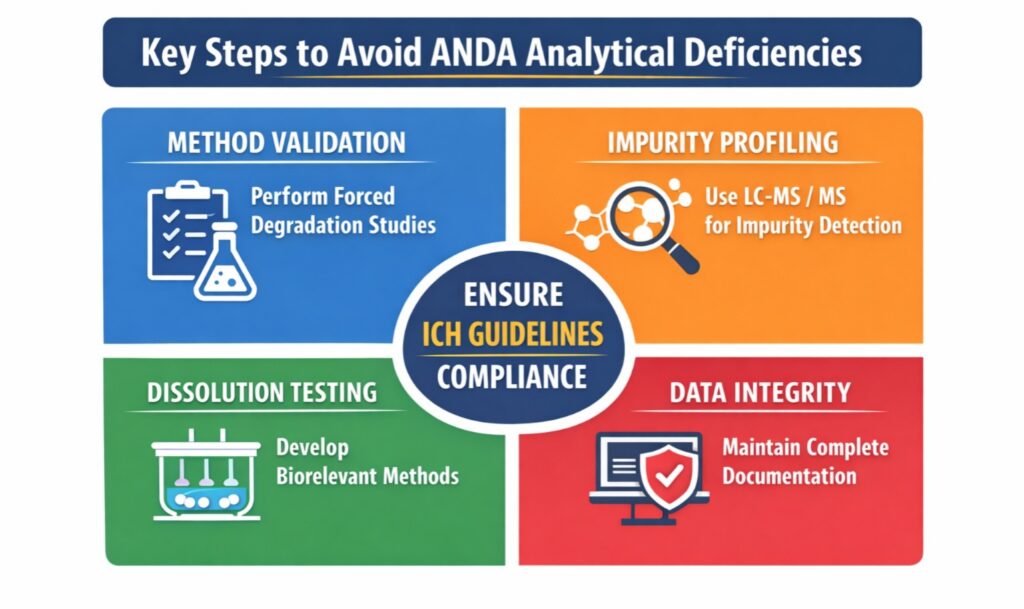
- Perform forced degradation studies (acid, base, oxidative, thermal, light)
- Validate across different analysts, instruments, and days
- Use Design of Experiments (DoE) for robustness
- Follow a lifecycle approach (development → validation → monitoring)
Ensure your methods meet global standards: Review ANDA Method Validation Requirements
2. Impurity Profiling Deficiencies in ANDA Submissions
ANDA Analytical Deficiencies often include incomplete impurity identification and control.
Common Deficiencies
- Unknown impurities above ICH limits
- Missing structure identification
- Lack of qualification data
- Inconsistent impurity limits across batches
Regulatory Expectations
Regulators require compliance with ICH Q3A and Q3B guidelines. Impurities above reporting thresholds must be identified and controlled with proper justification. Failure to do so raises safety concerns.
Advanced tools like LC-MS and NMR are expected for proper characterization. Even small unidentified impurities can delay approval. Consistency across batches is also essential.
How to Avoid
- Conduct stress studies to identify impurities
- Use LC-MS/MS for accurate detection
- Track impurities consistently across batches
- Justify limits using toxicological data
Identify and quantify complex impurities: See our Impurity Identification for ANDA Submission services
3. Dissolution Method Deficiencies: A Leading ANDA Analytical Deficiencies Cause
Poor dissolution methods are a major source of ANDA Analytical Deficiencies.
Common Problems
- Non-discriminatory methods
- Inability to detect formulation changes
- Lack of biorelevant conditions
- Poor in vitro–in vivo correlation
FDA Concerns
Dissolution methods must detect changes in product quality and support bioequivalence. If a method cannot differentiate between good and poor batches, it is not acceptable. This often leads to delays or rework.
Dissolution also plays a key role after approval. A weak method can create long-term regulatory challenges.
How to Avoid
- Develop discriminatory methods early
- Use biorelevant media (FaSSIF, FeSSIF)
- Perform comparative dissolution studies
- Establish IVIVC when possible
Optimize your testing protocols: Learn about High-Resolution Mass Spectrometry (HRMS) Analysis
4. Stability-Indicating Method Deficiencies in ANDA
Many ANDA Analytical Deficiencies occur when stability methods fail to detect degradation properly.
Observed Issues
- Poor separation of degradants
- Incomplete stability datasets
- Missing photostability studies
- Weak container-closure evaluation
Why It Matters
Stability data determines shelf life and storage conditions. If degradation is not properly measured, it can lead to incorrect conclusions. This directly impacts patient safety.
Regulators expect complete and consistent data under multiple conditions. Missing data can lead to serious review questions.
How to Avoid
- Ensure methods are stability-indicating
- Conduct long-term and accelerated studies
- Evaluate packaging impact
- Follow ICH Q1A–Q1E guidelines
Address specific contamination risks: View Nitrosamine Testing in ANDA Submissions
5. Data Integrity and Documentation Deficiencies
Documentation issues are critical ANDA Analytical Deficiencies that can trigger compliance actions.
Common Issues
- Missing raw data
- Inconsistent chromatograms
- Unexplained outliers
- Lack of audit trails
Regulatory Expectations
ALCOA+ principles must be followed. Data should be attributable, legible, accurate, and complete. Regulators expect full traceability from raw data to final reports.
Data integrity issues are often treated as systemic problems. This can lead to inspections or rejection.
How to Avoid
- Use validated electronic systems
- Maintain audit trails
- Conduct internal audits
- Train staff on documentation practices
Strengthen your data package with expert support: Explore Bioanalytical Services
6. Inadequate Method Transfer and Verification
Poor method transfer leads to reproducibility-related ANDA Analytical Deficiencies.
Typical Problems
- Method works in R&D but fails in QC
- No transfer protocols
- Lack of comparative data
Method transfer ensures consistency across sites. Without it, even validated methods may fail under new conditions. This results in delays and additional work.
Differences in environment, equipment, and analysts can impact results. A structured transfer process minimizes these risks.
How to Avoid
- Create formal transfer protocols
- Perform co-validation
- Train receiving teams
- Document all outcomes
Utilize precise analytical techniques: Learn more about HPLC Analysis
7. Reference Standard Qualification Issues
Improper standard qualification is a hidden but serious ANDA Analytical Deficiency.
Issues Seen
- Use of unqualified standards
- Missing purity data
- No traceability
Reference standards directly impact analytical accuracy. Poor-quality standards can invalidate results and affect the entire submission.
Regulators expect proper documentation and traceability. Even small gaps can lead to major concerns.
How to Avoid
- Use USP/EP standards
- Fully characterize internal standards
- Maintain proper documentation
Ensure specialized molecule accuracy: Review Peptide Characterization Services
8. Batch Analysis Inconsistencies
Batch variability often indicates deeper ANDA Analytical Deficiencies.
Common Findings
- Out-of-trend results
- Variable impurity levels
- Uninvestigated deviations
Consistency across batches shows process control. Any variation must be properly investigated and explained.
Analytical variability may also indicate weak methods. Fixing these issues early improves reliability.
How to Avoid
- Perform trend analysis
- Investigate OOT/OOS results
- Ensure consistent methods
📊 Table: Summary of Common ANDA Analytical Deficiencies and Solutions
| Deficiency Area | Root Cause | Regulatory Risk | Prevention Strategy |
|---|---|---|---|
| Method Validation | Incomplete validation | CRL, delays | Full ICH Q2 compliance |
| Impurity Profiling | Unknown impurities | Safety concerns | LC-MS, stress studies |
| Dissolution | Non-discriminatory method | BE failure risk | Biorelevant methods |
| Stability | Non-stability-indicating methods | Shelf-life issues | Forced degradation |
| Data Integrity | Poor documentation | Compliance action | ALCOA+ adherence |
| Method Transfer | Poor reproducibility | Site failure | Transfer protocols |
9. Strategic Approach to Avoid ANDA Analytical Deficiencies
A proactive strategy is the best way to prevent ANDA Analytical Deficiencies.
Best Practices
- Align analytical and formulation development
- Apply Quality by Design (QbD)
- Conduct regulatory gap analysis
- Perform mock FDA audits
- Encourage cross-team collaboration
A structured approach helps identify issues early. This reduces risks during submission and improves efficiency.
Collaboration between teams ensures better alignment with regulatory expectations. This leads to stronger submissions and faster approvals.
Scale your operations efficiently: Discover the benefits of Outsourcing Analytical Testing for ANDA Submissions
Conclusion
ANDA Analytical Deficiencies are predictable and preventable when proper scientific and regulatory practices are followed. From validation gaps to data integrity issues, most problems arise due to lack of planning and alignment.
Companies that invest in strong analytical systems and lifecycle validation see better outcomes. These efforts improve product quality and reduce approval timelines.
Eliminating ANDA Analytical Deficiencies is not just about compliance—it ensures patient safety, reliable products, and faster market entry.
👉 For expert guidance on improving your submissions: Contact us
FAQs on ANDA Analytical Deficiencies
The most frequent issue is incomplete method validation. Many submissions fail to properly demonstrate specificity, robustness, and consistency of analytical methods. This creates uncertainty about the reliability of the data provided. As a result, regulators often raise questions or request additional studies.
The FDA may reject analytical methods when they do not consistently produce accurate and reproducible results. If a method cannot clearly show stability-indicating capability, it raises concerns about product quality. Poor validation or lack of scientific justification can also contribute. These gaps often lead to delays or rejections.
Impurity profiling is essential to ensure patient safety and regulatory compliance. All impurities above defined limits must be identified and properly controlled. Missing or unclear impurity data can create serious concerns during review. A strong impurity strategy supports faster approval.
A dissolution method becomes unacceptable if it cannot detect meaningful changes in the formulation. It should clearly distinguish between batches with different performance. If the method lacks sensitivity or relevance, it fails its purpose. This often leads to additional testing requirements.
Data integrity issues can significantly damage the credibility of a submission. Missing records, inconsistent data, or lack of traceability can raise compliance concerns. Regulators may view these as systemic problems rather than isolated cases. This can result in inspections, delays, or rejection.
Method transfer ensures that analytical methods perform consistently across different laboratories. Differences in equipment or environment can affect results if not properly managed. A well-documented transfer process reduces variability and risk. It also supports smooth commercial manufacturing.
ANDA analytical requirements are mainly guided by ICH guidelines such as Q2, Q3, and Q1. These provide standards for validation, impurities, and stability testing. In addition, FDA-specific guidance documents must also be followed. Together, they ensure consistency and regulatory compliance.
Reference:
- U.S. Food and Drug Administration. (2022). Good ANDA submission practices: Guidance for industry. https://www.fda.gov/media/187318/download
- Liu, Q., Davit, B. M., Cherstniakova, S. A., Dandamudi, S., Walters, J. F., Lee, C. H., Raines, K. W., Ren, K., Williamson, L. N., & Conner, D. P. (2011). Common deficiencies with bioequivalence submissions in abbreviated new drug applications assessed by FDA. AAPS PharmSciTech, 14(1), 19–22. https://doi.org/10.1208/s12248-011-9312-7
- Pawar, J., Hegde, N., & Sharma, S. (2025). Focusing on first cycle approval in ANDA submission: Understanding common deficiencies & case study insights. Therapeutic Innovation & Regulatory Science, 59(3), 426–437. https://doi.org/10.1007/s43441-025-00755-5
Get In Touch With Us
About The Author


