
Introduction
Antioxidant extractables in pharmaceutical polymers comprise low-molecular-weight parent stabilizers, such as Irganox 1010 and Irgafos 168, along with their chemical degradation products that migrate from polymer components into drug solutions under specific processing and storage conditions. The characterization of antioxidant extractables in pharmaceutical polymers primarily focuses on two widely used industrial stabilizers: Irganox 1010, a primary sterically hindered phenolic antioxidant, and Irgafos 168, a secondary organophosphite antioxidant. Although these additives preserve the structural integrity and mechanical properties of polyolefins, including low-density polyethylene (LDPE), high-density polyethylene (HDPE), and polypropylene (PP), during melt processing and sterilization, they do not remain chemically unchanged. Thermal stress, exposure to ionizing radiation, and contact with reactive oxygen species initiate complex oxidation, hydrolysis, and chain-scission reactions. The resulting transformation species, including bis(2,4-di-tert-butylphenyl) phosphate (bDtBPP), 2,4-di-tert-butylphenol (2,4-DTBP), quinone methides, and Irgafos 168 oxide, frequently exhibit greater mobility, different polarity profiles, and higher toxicological significance than their intact parent compounds. Characterizing these transformation products through orthogonal analytical platforms is essential for ensuring compliance with compendial standards, including USP, USP, and ICH Q3E guidelines.
For a broader understanding of chemical migration from pharmaceutical materials, explore our guide to extractables and leachables in biopharmaceutical applications.
Share via:
Quick Summary:
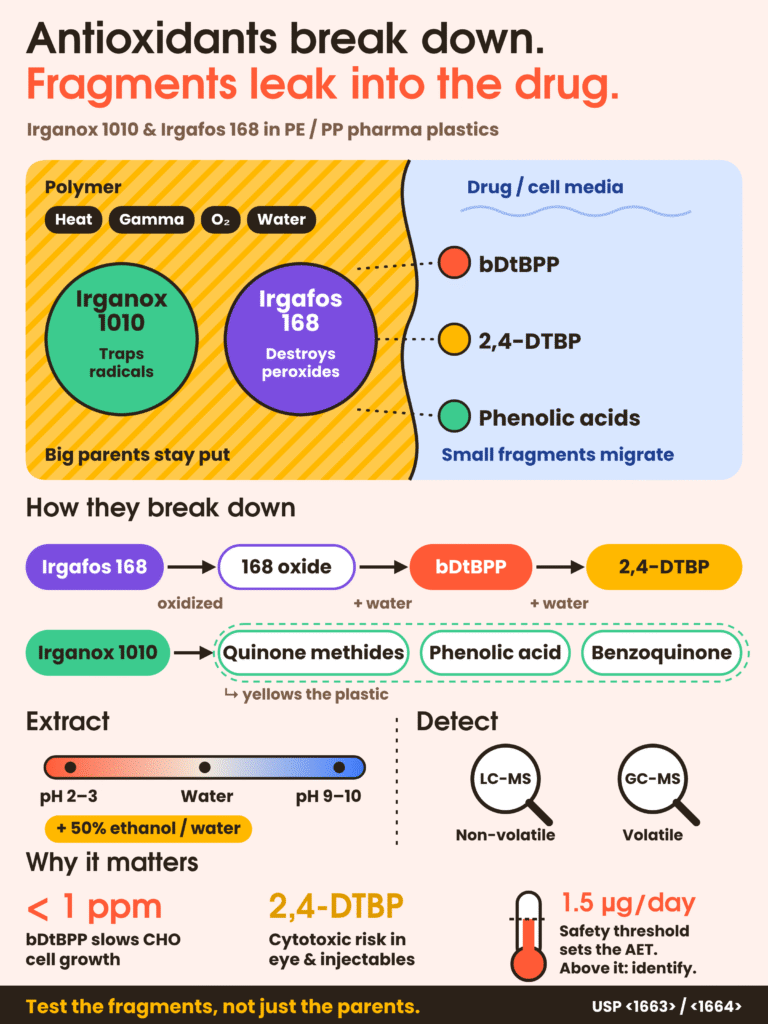
- Two stabilizers, two jobs: Irganox 1010, a hindered phenol, traps free radicals. Irgafos 168, a phosphite, breaks down hydroperoxides. Together they protect PE and PP during extrusion, gamma sterilization and storage.
- They don’t stay intact: Heat, gamma radiation, oxygen and moisture break them down. Irgafos 168 becomes Irgafos 168 oxide, then bDtBPP, then 2,4-DTBP. Irganox 1010 forms quinone methides (which yellow the plastic), phenolic acids and benzoquinones.
- Smaller means more mobile: The bulky parent compounds (log Kow > 10) mostly stay in the polymer. Their smaller, more polar fragments, such as bDtBPP and 2,4-DTBP, can migrate into drug products, parenteral solutions and cell culture media.
- Two analytical platforms are needed: LC-MS (ESI+ and ESI−, ideally high-resolution) covers the non-volatile parents and acidic degradants like bDtBPP. GC-MS (headspace or direct injection) covers volatile compounds like 2,4-DTBP.
- Worst-case extraction design: Studies use acidic (pH 2–3), neutral and basic (pH 9–10) aqueous media, plus 50% ethanol or isopropanol mixtures that mimic lipophilic or surfactant-containing formulations.
- Real biological risk: At levels below 1 ppm, bDtBPP from gamma-irradiated single-use bioreactor bags slows CHO cell growth. 2,4-DTBP is cytotoxic and a concern in ophthalmic and parenteral products.
- Threshold-driven assessment: The 1.5 µg/day Safety Concern Threshold for parenteral products is used to calculate the Analytical Evaluation Threshold (AET). Any peak above the AET must be identified and toxicologically qualified under USP <1663>/<1664>.
Stabilization Chemistry and Antioxidant Extractables in Pharmaceutical Polymers
The primary mechanism responsible for antioxidant stabilization in pharmaceutical polymers involves a binary stabilization package in which primary hindered phenols scavenge free radicals, while secondary organophosphites decompose hydroperoxides to prevent auto-oxidation. Together, these two antioxidant classes function synergistically to protect polyolefin matrices against thermal degradation during extrusion, gamma sterilization, and long-term storage.
Polymer auto-oxidation follows a free-radical chain reaction initiated by mechanical shear, thermal energy, ultraviolet radiation, or residual polymerization catalysts. Polymer alkyl radicals (R•) react with ambient molecular oxygen to form peroxy radicals (ROO•). These peroxy radicals abstract hydrogen atoms from neighboring polymer chains, producing reactive hydroperoxides (ROOH) and propagating a degradative chain reaction that can ultimately result in polymer cross-linking or chain scission.
Initiation Phase
Polymer (RH) → R• + H• (Heat / Radiation)
Propagation Phase
R• + O₂ → ROO•
ROO• + RH → ROOH + R•
Primary Radical Scavenging
ROO• + Irganox 1010-OH → ROOH + Irganox 1010-O•
(Sterically hindered, unreactive phenoxy radical)
Secondary Hydroperoxide Decomposition
ROOH + Irgafos 168 [P(OR)₃] → ROH + Irgafos 168 oxide [OP(OR)₃]
Irganox 1010 (Pentaerythritol tetrakis(3-(3,5-di-tert-butyl-4-hydroxyphenyl)propionate)) contains a central pentaerythritol core connected to four sterically hindered phenolic groups. As a primary antioxidant, Irganox 1010 donates a hydrogen atom from its phenolic hydroxyl group to propagating peroxy radicals through the reaction (ROO• + AH → ROOH + A•). The resulting phenoxy radical (A•) is sterically protected by two bulky tert-butyl groups positioned at the ortho positions relative to the hydroxyl group. This resonance stabilization prevents the phenoxy radical from abstracting hydrogen atoms from the polymer backbone, thereby terminating the radical chain reaction.
Irgafos 168 (Tris(2,4-di-tert-butylphenyl) phosphite) contains a trivalent phosphorus atom bonded to three phenoxy groups. As a secondary antioxidant, Irgafos 168 decomposes hydroperoxides (ROOH) before they undergo homolytic cleavage into highly reactive alkoxy (RO•) and hydroxyl (HO•) radicals. The trivalent phosphorus atom undergoes nucleophilic attack by the hydroperoxide, reducing it to an inert alcohol (ROH) while converting the phosphite into tris(2,4-di-tert-butylphenyl) phosphate (Irgafos 168 oxide).
Degradation Pathways and Antioxidant Extractables in Pharmaceutical Polymers
Degradation pathways transform parent additives into diverse chemical species through oxidation, ester hydrolysis, and radiolytic cleavage, changing the volatility and solubility characteristics of antioxidant extractables in pharmaceutical polymers. Understanding these degradation mechanisms is essential because transformation products may exhibit lower octanol-water partition coefficients (log Kow), increasing their potential to migrate into aqueous pharmaceutical formulations.
Understanding the broader requirements for evaluating these chemical transformations is important when designing compliant studies. Read more about USP requirements for extractables and leachables testing.
Irganox 1010 Degradation Cascade
The degradation cascade of Irganox 1010 involves phenolic hydrogen donation and ester-linkage cleavage, resulting in transformation products such as quinone methides, phenolic propionates, benzoquinones, and 2,4-di-tert-butylphenol. Following the donation of phenolic hydrogen atoms to radical species, the phenoxy radicals of Irganox 1010 undergo intramolecular rearrangement and radical-radical coupling. Continued exposure to heat, atmospheric oxygen, or gamma irradiation during terminal sterilization promotes further degradation of the ester linkages connecting the hindered phenol groups to the central pentaerythritol backbone.
Quinone Methides: Phenoxy radicals undergo oxidative dehydrogenation to produce cinnamate quinone methide derivatives. These conjugated structures absorb UV-visible light and are among the primary contributors to yellowing and discoloration in polyolefin films.
Phenolic Propionate Acid and Ester Fragments: Cleavage of the central ester core produces 3,5-di-tert-butyl-4-hydroxyhydrocinnamic acid and related low-molecular-weight propionate esters. These acidic degradation products exhibit greater aqueous solubility than the parent tetramer.
Substituted Benzoquinones and Aldehydes: Advanced degradation reactions generate compounds such as 2,6-di-tert-butyl-p-benzoquinone and 3,5-di-tert-butyl-4-hydroxybenzaldehyde.
2,4-Di-tert-butylphenol (2,4-DTBP): Under aggressive processing conditions or radiolytic exposure, terminal cleavage reactions can produce 2,4-DTBP, a volatile alkylphenol with considerable migration potential.
Irgafos 168 Transformation Network
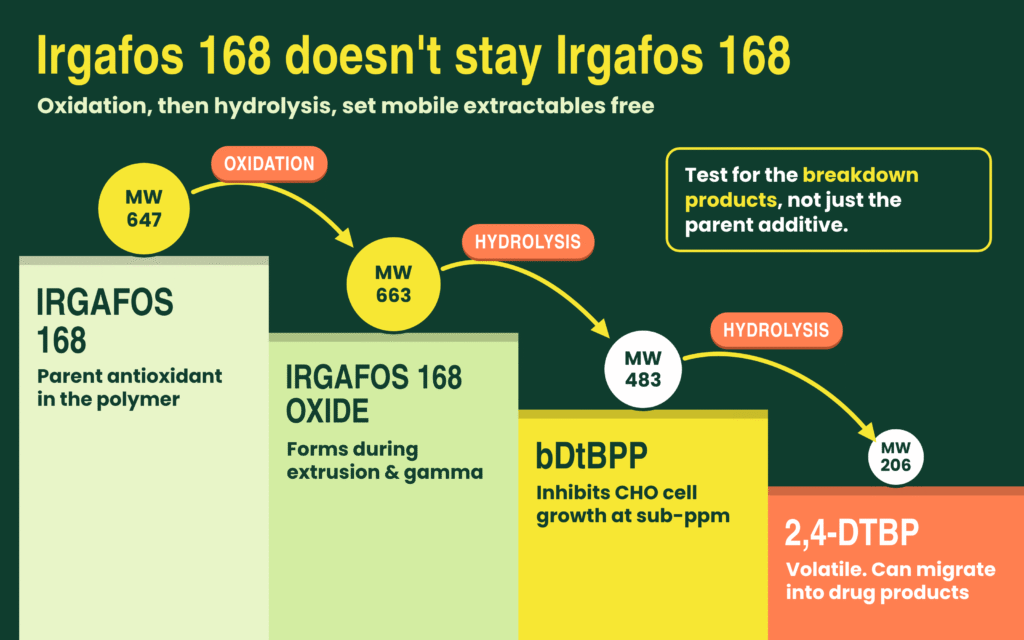
Irgafos 168 primarily undergoes organophosphite oxidation to form Irgafos 168 oxide, followed by aqueous hydrolysis that produces bis(2,4-di-tert-butylphenyl) phosphate (bDtBPP) and 2,4-di-tert-butylphenol. This multistep transformation pathway is strongly influenced by processing temperature, moisture content, and gamma irradiation dose.
Irgafos 168 Oxide (Tris(2,4-di-tert-butylphenyl) phosphate): This compound forms directly through hydroperoxide reduction during melt extrusion or exposure to atmospheric oxygen. It represents one of the most abundant primary transformation products found in solid polymer resins.
Bis(2,4-di-tert-butylphenyl) Phosphate (bDtBPP): In the presence of ambient moisture, elevated humidity, or aqueous extraction media, Irgafos 168 oxide undergoes ester hydrolysis. The removal of one 2,4-di-tert-butylphenyl group produces bDtBPP, an acidic diester phosphate compound.
2,4-Di-tert-butylphenol (2,4-DTBP): Hydrolytic cleavage of intact Irgafos 168, Irgafos 168 oxide, or bDtBPP can release free 2,4-DTBP.
1,3-Di-tert-butylbenzene: This minor, highly volatile degradation product forms through dehydroxylation and side-chain cleavage under extreme thermal or radiolytic stress.
Physicochemical Profile of Antioxidant Extractables in Pharmaceutical Polymers
The physicochemical characteristics of antioxidant extractables in pharmaceutical polymers change considerably as parent additives undergo degradation, converting initially insoluble lipophilic compounds into more mobile, water-soluble, or volatile degradation products. High-molecular-weight parent molecules generally exhibit strong hydrophobicity, whereas their lower-molecular-weight transformation products demonstrate increased water solubility and volatility.
| Compound Name / CAS Number | Chemical Class | Molecular Weight (g/mol) | Degradation Source | Primary Analytical Detection Platform | Physicochemical Character and Partitioning Behavior (log Kow) |
|---|---|---|---|---|---|
| Irganox 1010 (6683-19-8) | Tetrafunctional Hindered Phenol | 1177.6 | Parent Additive | UHPLC-UV / LC-MS (ESI+) | Highly lipophilic (log Kow > 10); insoluble in aqueous media; soluble in organic solvents. |
| Irgafos 168 (31570-04-4) | Trivalent Organophosphite | 646.9 | Parent Additive | UHPLC-MS / GC-MS | Highly lipophilic (log Kow > 10); thermally unstable; prone to oxidation in solution. |
| Irgafos 168 Oxide (95906-11-9) | Organophosphate Ester | 662.9 | Oxidation of Irgafos 168 | UHPLC-MS (ESI+) / LC-UV | High molecular weight; highly lipophilic; limited aqueous migration; soluble in organic co-solvents. |
| bDtBPP (69284-93-1) | Acidic Diester Phosphate | 482.6 | Hydrolysis of Irgafos 168 Oxide | LC-MS/MS (ESI−) | Ionizable acid; moderate lipophilicity (log Kow ≈ 4.5); highly soluble in cell culture media and buffers. |
| 2,4-Di-tert-butylphenol (96-76-4) | Substituted Alkylphenol | 206.3 | Cleavage of Irganox 1010 and Irgafos 168 | HS-GC-MS / GC-MS / LC-MS | Volatile to semi-volatile; moderate hydrophobicity (log Kow ≈ 4.9); significant migration into aqueous and lipophilic media. |
| Quinone Methide (N/A) | Conjugated Quinonoid | Variable (~500–1100) | Oxidative transformation of Irganox 1010 | UHPLC-UV-HRMS | Strong UV chromophore; contributes to polymer yellowing; moderate lipophilicity. |
| 3,5-Di-tert-butyl-4-hydroxyhydrocinnamic Acid (20170-32-5) | Phenolic Monocarboxylic Acid | 278.4 | Ester hydrolysis of Irganox 1010 | LC-MS (ESI−) | Ionizable phenolic acid; pH-dependent solubility; migrates into alkaline aqueous extracts. |
Parent antioxidants such as Irganox 1010 (log Kow > 10) generally remain associated with the hydrophobic polyolefin matrix when exposed to neutral aqueous solutions. However, hydrolysis and oxidative chain-scission reactions can break down their bulky ester structures, producing compounds such as bDtBPP (log Kow ≈ 4.5) and 2,4-DTBP (log Kow ≈ 4.9). These degradation products possess sufficient polarity and molecular mobility to migrate across the polymer-liquid interface into pharmaceutical drug products, parenteral solutions, and bioprocessing media.
The choice of extraction medium is particularly important when evaluating compounds with different polarity and solubility profiles. Explore the solvents used in extractables studies to understand how solvent selection influences extraction efficiency and chemical recovery.
Analytical Characterization of Antioxidant Extractables in Pharmaceutical Polymers
The analytical characterization of antioxidant extractables in pharmaceutical polymers requires orthogonal analytical platforms, primarily liquid chromatography-mass spectrometry for non-volatile compounds and gas chromatography-mass spectrometry for volatile or semi-volatile degradation products. Since no single chromatographic technique can cover the complete range of molecular weights, polarities, and thermal stabilities associated with antioxidants and their transformation products, regulatory frameworks require complementary analytical testing strategies.
Liquid Chromatography-Mass Spectrometry (LC-MS) Protocols
Liquid chromatography-mass spectrometry is the primary analytical technique for quantifying intact parent stabilizers, oxidized phosphites, and polar degradation products such as bDtBPP in extractable solutions. LC-MS workflows are particularly effective for analyzing high-molecular-weight, thermally labile, and non-volatile organic compounds.
Chromatographic Separations: Reverse-phase UHPLC separations employ C18 or C8 sub-2 μm particle columns operated with binary gradient mobile phases containing water and acetonitrile (or methanol). These mobile phases are modified with 0.1% formic acid or 1–2 mM ammonium acetate to facilitate ion formation and improve analytical performance.
Ionization Modes: Electrospray Ionization in positive mode (ESI+) generates ammonium ([M+NH₄]⁺) or protonated ([M+H]⁺) adducts for Irganox 1010 (m/z 1194.8 for [M+NH₄]⁺) and Irgafos 168 oxide (m/z 663.5). Negative mode (ESI−) is necessary for detecting ionizable acidic degradation products, including bDtBPP (m/z 481.3 for [M−H]⁻) and phenolic propionate acids.
High-Resolution Mass Spectrometry (HRMS): Quadrupole Time-of-Flight (QToF) or Orbitrap mass spectrometers provide accurate mass measurements with a mass error of less than 5 ppm, along with characteristic MS/MS fragmentation patterns. For example, bDtBPP produces a distinct product ion at m/z 211.1, representing the monoisopropyl/phenolic phosphate core, which supports its identification in complex analytical matrices.
Gas Chromatography-Mass Spectrometry (GC-MS) Protocols
Gas chromatography-mass spectrometry provides high-resolution separation and spectral library identification of volatile and thermally stable semi-volatile extractables, including 2,4-di-tert-butylphenol and 1,3-di-tert-butylbenzene. GC-MS complements LC-MS by targeting low-molecular-weight compounds that may elute close to the solvent front or lack ionizable functional groups suitable for liquid chromatography.
Headspace GC-MS: High-temperature headspace extraction, involving equilibration at 150–200 °C, isolates highly volatile degradation products directly from solid polymer matrices without requiring solvent extraction. This approach helps minimize sample preparation artifacts and reduces the introduction of non-volatile matrix components into the analytical system.
Direct Injection GC-MS: Organic solvent extracts, such as those prepared using dichloromethane or hexane, are analyzed using capillary GC columns, including 5% phenyl-arylene methylpolysiloxane columns, equipped with Multimode Inlets (MMI) operated in solvent-vent or splitless mode. Electron Ionization (EI) at 70 eV produces reproducible mass spectra that can be compared against NIST spectral libraries. 2,4-DTBP generates a characteristic molecular ion at m/z 206 and a base fragment ion at m/z 191 ([M−CH₃]⁺).
Selecting complementary chromatographic techniques is essential for obtaining a comprehensive chemical profile of polymer-derived compounds. Learn more about the differences between GC-MS and LC-MS in extractables and leachables testing.
Extraction Solvent Dynamics and Study Design
Extraction study designs simulate worst-case migration kinetics by evaluating pharmaceutical polymers in aqueous buffers and organic/water co-solvent systems under exaggerated temperature conditions. Controlled extraction studies developed in accordance with USP and USP evaluate polymer materials using model solvent systems under exaggerated contact times and temperatures.
Aqueous Solvent Systems: Neutral water, low-pH aqueous media (pH 2–3), and high-pH aqueous media (pH 9–10) are used to evaluate the migration behavior of ionizable compounds. Phenolic acids preferentially migrate into high-pH media because of deprotonation, whereas intact phosphites generally remain unextracted in aqueous solutions because of their pronounced hydrophobicity.
Organic / Aqueous Co-Solvents: Mixtures containing 50% ethanol/water or 50% isopropanol/water simulate lipophilic drug formulations and cell culture media containing surfactants. These semi-polar extraction media can efficiently extract intact Irganox 1010 and Irgafos 168, along with their transformation products, including bDtBPP and 2,4-DTBP.
Toxicological Impact and Risk Assessment of Antioxidant Extractables in Pharmaceutical Polymers
Toxicological risk assessments of antioxidant extractables in pharmaceutical polymers evaluate the biological effects of migrating chemical species, including cell culture inhibition and tissue cytotoxicity, against calculated Safety Concern Thresholds. Degradation products originating from Irganox 1010 and Irgafos 168 can produce significant biological effects, making their qualification necessary during bioprocess validation and drug product release.
Evaluating the potential health effects of migrating substances requires appropriate toxicological assessment and exposure calculations. Read more about toxicological qualification of leachables.
CHO Cell Inhibition by bDtBPP in Bioprocessing
Bis(2,4-di-tert-butylphenyl) phosphate (bDtBPP) can inhibit Chinese Hamster Ovary (CHO) cell growth at sub-ppm concentrations by disrupting mitochondrial membrane potential during bioprocess operations. In single-use bioprocessing applications, bDtBPP has been identified as a critical leachable originating from polyethylene bioreactor films. Gamma irradiation of single-use bags promotes the conversion of Irgafos 168 into Irgafos 168 oxide, which can subsequently undergo hydrolysis upon contact with aqueous cell culture media, releasing bDtBPP.
At concentrations as low as 0.1 to 1.0 mg/L (ppm), bDtBPP can interfere with mitochondrial membrane potential in CHO cell lines. This disruption may result in impaired cell growth, reduced cell viability, and substantial decreases in therapeutic protein yield. This finding contributed to the development of standardized raw material screening protocols under USP to ensure that single-use bioprocessing films are assessed for their potential to release bDtBPP before being introduced into manufacturing operations.
Cytotoxicity and Localized Tissue Effects of 2,4-DTBP
Leached 2,4-di-tert-butylphenol exhibits dose-dependent cytotoxicity and can disrupt cell membranes, creating potential toxicological concerns in ophthalmic and parenteral drug formulations. 2,4-Di-tert-butylphenol (2,4-DTBP) can migrate from elastomeric stoppers, silicone valves, and polyolefin containers into aqueous formulations, particularly those containing surfactant excipients such as polysorbates or polyoxyethylenated castor oil. In ophthalmic drug delivery systems and injectable preparations, leached 2,4-DTBP may cause localized cellular irritation involving ocular tissues and vascular endothelium. Consequently, its migration and concentration require careful monitoring in ophthalmic and parenteral drug formulations.
For additional insights into chemical migration risks associated with sensitive eye medications, explore extractables and leachables testing for ophthalmic drug products.
Analytical Evaluation Threshold (AET) Calculation
The Analytical Evaluation Threshold defines the reporting concentration above which an extractable peak must undergo structural identification and toxicological qualification in accordance with USP and USP guidelines. The AET is derived from the Safety Concern Threshold (SCT), which is established at 1.5 μg/day for parenteral drug products based on generic threshold of toxicological concern (TTC) principles.
AET = [SCT / (Maximum Daily Dose Volume × Number of Components)] × (1 / UF)
Where:
- SCT: The Safety Concern Threshold, established at 1.5 μg/day for parenteral products.
- Maximum Daily Dose Volume: Expressed in mL/day or total dosage units.
- Number of Components: Represents the total number of primary packaging or product-contact elements contributing to the contact train.
- UF: The Analytical Uncertainty Factor, typically ranging from 1.3 to 2.0, applied to account for potential variations in relative response factors (RRF) among unknown compounds during chromatographic screening.
If an extractable peak corresponding to an antioxidant degradation product exceeds the calculated AET, toxicological qualification must be performed using relevant database toxicity limits, Cramer structural classifications, or ICH M7 mutagenicity frameworks.
The AET plays an important role in determining which detected compounds require further identification and toxicological assessment. Explore our detailed guide to AET calculations for extractables and leachables studies.
Conclusion on Antioxidant Extractables in Pharmaceutical Polymers
Managing antioxidant extractables in pharmaceutical polymers is essential for maintaining product quality, bioprocess yield, and patient safety throughout the lifecycle of therapeutic products. Although intact Irganox 1010 and Irgafos 168 provide important thermal and mechanical protection during polymer processing, their degradation products, particularly bDtBPP, 2,4-DTBP, and quinone methides, introduce distinct concerns related to cell culture viability, drug stability, and patient safety. The application of orthogonal UHPLC-HRMS and GC-MS analytical platforms enables laboratories to characterize parent additives alongside their volatile, semi-volatile, and non-volatile degradation products at concentrations down to sub-ppm levels. Incorporating standardized extraction workflows aligned with USP and USP allows pharmaceutical sponsors and packaging manufacturers to identify potential leachable risks proactively, establish appropriate quality control limits, and preserve the safety and quality of therapeutic products throughout their lifecycle.
For organizations planning comprehensive analytical evaluations, learn more about extractables and leachables testing services for pharmaceutical products.
For technical inquiries regarding controlled extraction studies, analytical method development, and toxicological evaluation of pharmaceutical polymer systems, visit ResolveMass Laboratories Contact Us.
Frequently Asked Questions
During gamma sterilization, Irgafos 168 can undergo oxidation and form tris(2,4-di-tert-butylphenyl) phosphate, commonly known as Irgafos 168 oxide. When this oxidation product comes into contact with aqueous cell culture media, subsequent hydrolysis can generate bDtBPP. This degradation product may migrate from polyethylene bioreactor films into processing fluids and negatively affect CHO cell growth.
2,4-Di-tert-butylphenol (2,4-DTBP) is produced through the degradation of Irganox 1010 and Irgafos 168 under thermal, oxidative, and hydrolytic conditions. Its relatively low molecular weight and moderate hydrophobicity allow it to move through polymer matrices and enter surrounding pharmaceutical formulations. Consequently, it is an important compound to monitor when evaluating leachables from polyolefin packaging and elastomeric components.
A combination of UHPLC-HRMS using positive and negative Electrospray Ionization (ESI+/ESI−) and GC-MS is necessary to characterize antioxidants with different physicochemical properties. UHPLC-HRMS is suitable for identifying non-volatile compounds, including Irganox 1010, Irgafos 168 oxide, and bDtBPP. GC-MS, including direct liquid injection and headspace analysis, helps detect volatile and semi-volatile compounds such as 2,4-DTBP and 1,3-di-tert-butylbenzene.
Gamma irradiation promotes free-radical formation within polyolefin materials, accelerating the consumption and degradation of incorporated antioxidant additives. This process can increase the formation of Irgafos 168 oxide, quinone methides, phenolic propionate acids, and 2,4-DTBP. Changes in the concentration of these transformation products can alter the extractables profile and increase the potential for leachable migration into pharmaceutical products.
Solution pH affects the ionization, aqueous solubility, and migration behavior of antioxidant degradation products. Acidic compounds, such as 3,5-di-tert-butyl-4-hydroxyhydrocinnamic acid, become more ionized under alkaline conditions, which can promote their transfer into aqueous extraction media. In comparison, less ionized and highly hydrophobic compounds generally exhibit lower migration into purely aqueous solutions.
The Analytical Evaluation Threshold (AET) is determined using the Safety Concern Threshold (SCT), maximum daily dose volume, number of product-contact components, and an analytical uncertainty factor. For parenteral products, the SCT is typically established at 1.5 μg/day. Extractable compounds detected above the calculated AET require further structural identification and toxicological assessment to determine their potential impact on patient safety.
Intact Irganox 1010 has a very high octanol-water partition coefficient (log Kow > 10), indicating strong hydrophobicity and extremely limited solubility in water. Therefore, its migration into purely aqueous pharmaceutical formulations is generally minimal. However, formulations containing organic co-solvents, lipid emulsions, or solubilizing surfactants may increase its extraction and migration from polymer packaging materials.
USP establishes standardized approaches for evaluating extractables from plastic components used in biopharmaceutical manufacturing. Its testing framework supports the selection of extraction conditions, appropriate analytical procedures, and reporting of compounds against relevant evaluation thresholds. These assessments help manufacturers identify primary antioxidants, secondary antioxidants, and their degradation products in single-use bioreactor bags, tubing, and filter housings.
Polymer compounders can limit the formation of undesirable degradation products by carefully controlling antioxidant concentrations and selecting organophosphites with improved hydrolytic stability. Optimizing extrusion temperatures, minimizing oxygen exposure, and reducing excessive thermal stress can further limit oxidation reactions during manufacturing. Appropriate purification, washing procedures, and controlled gamma irradiation conditions can also help reduce residual precursors and minimize the potential release of harmful transformation products.
Reference:
- Moreta, C., & Tena, M.-T. (2015). Determination of plastic additives in packaging by liquid chromatography coupled to high resolution mass spectrometry. Journal of Chromatography A, 1414, 77–87. https://doi.org/10.1016/j.chroma.2015.08.030
- Dopico-García, M. S., López-Vilariño, J. M., Bouza, R., Abad, M. J., González Soto, E., & González Rodríguez, M. V. (2004). Extraction and quantification of antioxidants from low-density polyethylene by microwave energy and liquid chromatography. Analytica Chimica Acta, 521(2), 179–188. https://doi.org/10.1016/j.aca.2004.05.087
- Barrieu, M., Chennell, P., Mailhot-Jensen, B., & Sautou, V. (2025). Investigation of 2,4 di-tert-butylphenol leaching from multidose ophthalmic devices into tacrolimus micellar formulations. The AAPS Journal, 27(6), Article 164. https://doi.org/10.1208/s12248-025-01124-8
- Jenke, D. (2002). Extractable/leachable substances from plastic materials used as pharmaceutical product containers/devices. PDA Journal of Pharmaceutical Science and Technology, 56(6), 332–371. https://www.researchgate.net/publication/10976945_Extractableleachable_substances_from_plastic_materials_used_as_pharmaceutical_product_containersdevices
- Jenke, D. (2022). General principles of chemical assessment: Analytical testing for extractables and leachables; Organic compounds. In D. Jenke (Ed.), Extractables and leachables (pp. 73–146). Wiley. https://doi.org/10.1002/9781119605096.ch3
- Cuadros-Rodríguez, L., Lazúen-Muros, M., Ruiz-Samblás, C., & Navas-Iglesias, N. (2020). Leachables from plastic materials in contact with drugs: State of the art and review of current analytical approaches. International Journal of Pharmaceutics, 583, Article 119332. https://doi.org/10.1016/j.ijpharm.2020.119332
Get In Touch With Us
About The Author