

Introduction
Moving beyond NIST and Wiley commercial spectral databases is essential for effective extractables and leachables (E&L) screening because publicly available repositories have limited coverage of non-volatile analytes, soft-ionization adducts, structural isomers, and dynamic polymer degradation products. By developing multidimensional in-house spectral libraries, advanced analytical testing facilities can achieve more definitive compound identification, meet global regulatory expectations, and minimize toxicological uncertainty.
Extractables and leachables characterization operates at the critical intersection of analytical chemistry, material science, and pharmaceutical risk management. Regulatory frameworks, including United States Pharmacopeia chapters USP and USP, ISO 10993-18:2020, and the ICH Q3E draft guideline, require comprehensive chemical identification and quantitative evaluation of potential migrants detected at or above the Analytical Evaluation Threshold (AET).
Although conventional commercial spectral databases offer a useful starting point for gas chromatography-mass spectrometry (GC-MS) screening, depending exclusively on these resources can introduce significant risks of spectral misidentification, false-positive results, and unidentified chromatographic peaks.
To establish complete analytical defensibility and safeguard patient safety, organizations such as ResolveMass Laboratories Inc. implement carefully curated in-house spectral libraries. These repositories integrate high-resolution accurate mass (HRAM), retention index matching, tandem fragmentation trees, and authentic reference standards to improve the reliability of chemical identification.
Explore extractables and leachables testing approaches to understand how specialized analytical testing supports reliable E&L characterization.
Share via:
Quick Summary:
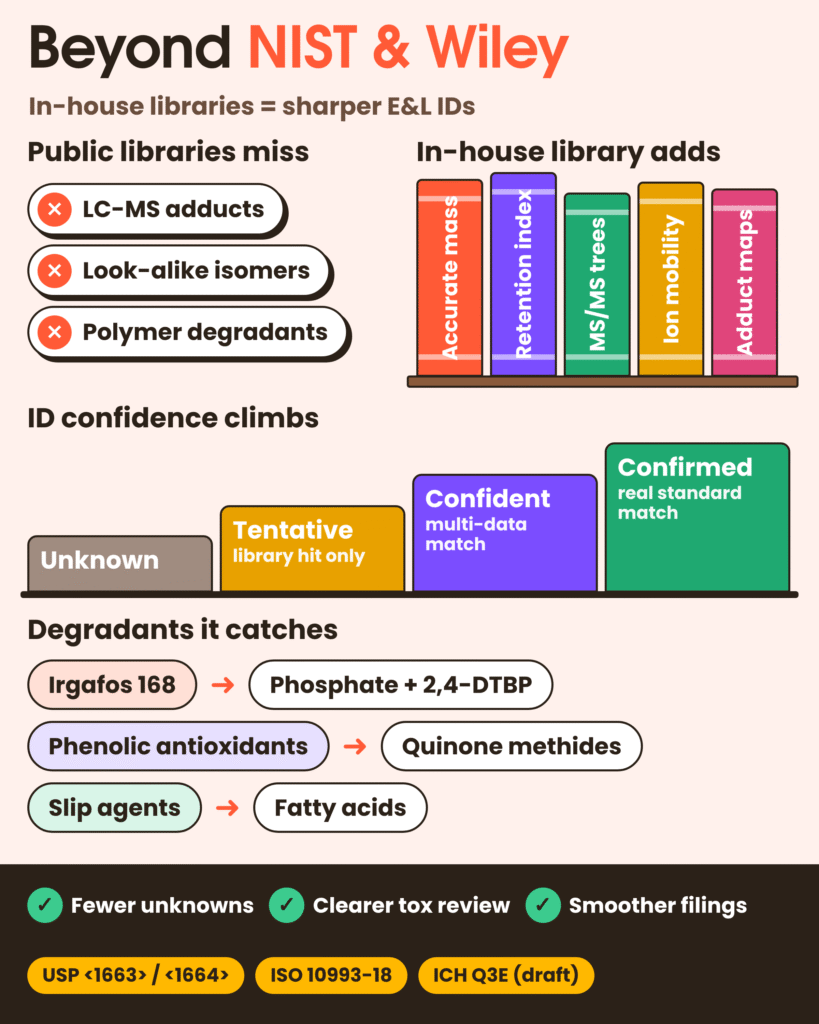
- Public libraries aren’t enough: NIST and Wiley mostly hold 70 eV EI spectra of volatile compounds. They can’t match LC-MS soft-ionization adducts ([M+H]+, [M+Na]+, etc.) and have few entries for polymer degradation products.
- High match scores can mislead: Top-hit scores above 800/1000 can still point to the wrong isomer or an unrelated compound that shares fragments, such as phthalates at m/z 149. Without retention index or retention time checks, wrong identities can reach regulators.
- In-house libraries add more data per compound: They combine sub-2 ppm accurate mass, GC retention indices and LC retention times, multi-energy MS/MS fragmentation trees, ion mobility CCS values, and adduct maps, all built from authentic reference standards.
- Identification confidence improves: Instead of stopping at a tentative library hit, labs can reach confident identifications using multiple matching data, or confirmed ones by matching an authentic standard, in line with USP <1663>/<1664>. Compound-specific response factors also make quantitation more accurate.
- Degradants get identified: In-house libraries catch transformation products that public databases miss. Examples include Irgafos 168 breaking down to its phosphate and 2,4-DTBP, quinone methides from phenolic antioxidants, and fatty acids from erucamide and oleamide slip agents.
- Toxicology and filings benefit: Confirmed structures, CAS numbers and response factors let toxicologists use QSAR and Cramer classification instead of conservative default thresholds like the TTC or SCT. This avoids unnecessary retesting, redesigns and regulatory delays.
- Bottom line: NIST and Wiley stay useful for first-pass screening of volatiles. Meeting USP, ISO 10993-18 and draft ICH Q3E expectations, though, increasingly needs curated in-house spectral libraries.
Beyond NIST and Wiley: Limitations of Commercial Mass Spectral Databases in E&L Screening
Commercial mass spectral databases, including NIST and Wiley, have limitations when applied to comprehensive extractables and leachables screening. Their spectral collections consist primarily of 70 eV electron ionization (EI) spectra developed for volatile organic compounds rather than non-volatile, polar analytes commonly evaluated through liquid chromatography-mass spectrometry (LC-MS). Additionally, these publicly available databases provide limited retention index calibration for complex polymer matrices and contain very few spectral entries for transformation products formed during thermal processing or sterilization.
The analytical characterization of modern container-closure systems, single-use bioprocessing bags, and medical devices increasingly depends on Liquid Chromatography coupled to High-Resolution Mass Spectrometry (LC-HRMS), using Electrospray Ionization (ESI) or Atmospheric Pressure Chemical Ionization (APCI). These soft ionization techniques produce various mobile-phase-dependent precursor adducts, including [M+H]+, [M+Na]+, [M+NH4]+, and [M+Formate]−. Conventional GC-EI-MS commercial libraries do not provide matching capabilities for these liquid-phase ionic species, making them unsuitable as standalone resources for characterizing non-volatile extractables.
Learn more about solvent selection for extractables studies and its impact on comprehensive chemical characterization.
In gas chromatography applications, depending exclusively on top-hit search scores from publicly available EI databases can frequently result in incorrect compound assignments. Commercial search algorithms compare intensity patterns across broad fragmentation profiles and may assign high reverse match scores (greater than 800/1000) to structural isomers or unrelated compounds that share common fragment ions. Examples include the characteristic phthalate fragment at m/z 149 and various aliphatic hydrocarbon clusters. Without additional verification through chromatographic retention time or retention index matching, laboratories may report incorrect chemical identities to regulatory authorities.
Furthermore, polymeric materials experience substantial physical and chemical stress during compounding, extrusion, and terminal sterilization processes, including autoclaving and gamma irradiation. Primary antioxidants, stabilizers, slip agents, and plasticizers can undergo complicated degradation reactions, generating multiple transformation products that are not represented in commercial spectral catalogs. When an unknown chromatographic peak appears above the Analytical Evaluation Threshold (AET) but does not produce a reliable match in NIST or Wiley, analysts may have no option but to classify the compound as “unidentified.” This can lead to conservative toxicological assumptions and additional regulatory inquiries.
Understand the analytical differences between GC-MS and LC-MS in E&L testing to select suitable techniques for different chemical analytes.
Beyond NIST and Wiley: Architecture of an Advanced In-House Extractables Library
An advanced in-house extractables library improves compound identification by integrating high-resolution accurate mass (HRAM), orthogonal chromatographic retention indices (RI/RT), multi-energy MS/MS fragmentation trees, and ion mobility collision cross-sections (CCS) into a searchable multidimensional database. This combined analytical framework enables chemists to differentiate closely related structural isomers and establish more definitive chemical identities beyond the capabilities of conventional NIST and Wiley databases.
Developing an enterprise-grade in-house extractables library requires the systematic analysis of certified reference materials (CRMs), industrial additive standards, and controlled forced-extraction samples under standardized chromatographic and mass spectrometric conditions. The resulting database preserves multiple independent analytical parameters, including:
- High-Resolution Accurate Mass (HRAM): Measurements obtained at sub-2 ppm mass accuracy using Orbitrap or Q-TOF mass spectrometers. These measurements establish reliable elemental compositions (CxHyOzNaSb) for both precursor and fragment ions.
- Orthogonal Retention Indices (RI / RT): Gas chromatography Kovats retention indices are determined using alkane series and combined with standardized liquid chromatography retention times calibrated across controlled mobile phase gradients.
- Multi-Energy MS/MS Fragmentation Trees: Collision-Induced Dissociation (CID) and Higher-energy C-trap Dissociation (HCD) spectra are acquired across multiple stepped collision energies. This approach generates reproducible fragmentation fingerprints for soft-ionization LC-MS analytes.
- Ion Mobility Collision Cross-Section (CCS): Gas-phase ionic mobility measurements (Å2) are obtained using drift-time or traveling-wave ion mobility spectrometry. These measurements provide information about molecular structure and conformation, helping distinguish compounds with identical mass spectra.
- Adduct and Isotope Profile Maps: Comprehensive adduct behavior is evaluated under different mobile phase pH and buffer conditions. The analysis includes [M+H]+, [M+Na]+, [M−H]−, and [M+Formate]−.
The following table compares the analytical capabilities of conventional commercial databases with those of advanced in-house extractables libraries.
| Analytical Parameter | Commercial Libraries (NIST / Wiley) | Advanced In-House Extractables Library |
|---|---|---|
| Primary Ionization Modes | 70 eV Electron Ionization (EI) | Multi-mode: EI, ESI (+/−), APCI (+/−), APGC |
| Spectral Softness & Adducts | Hard ionization; intact precursor ions are often absent | Soft and hard ionization modes; archives intact adducts ([M+H]+, [M+Na]+) |
| Mass Accuracy & Resolution | Unit mass resolution (m/z ± 0.5 Da) | High-Resolution Accurate Mass (HRAM, <2 ppm) |
| Chromatographic Verification | Basic Kovats index on generic GC columns | Dual GC Retention Index (RI) and LC Retention Time (RT) |
| Conformational Data | None (no IMS functionality) | Ion Mobility Collision Cross-Section (CCS, Å2) |
| Degradation Product Coverage | Minimal; restricted to commercially available compounds | Extensive; includes polymer degradants, oligomers, and NIAS |
| USP Identification Level | Tentative to weakly confident | Confident to confirmed (through authentic standard matching) |
| False Positive Rate | Moderate to high in complex matrices | Significantly reduced through multiparameter spectral filtering |
Elevating USP Identification Confidence Levels
Using a carefully curated in-house extractables library can improve compound identification confidence under USP guidelines, progressing assignments from tentative identification toward confirmed identification through direct experimental comparison with authentic reference standards analyzed under identical laboratory conditions. This approach strengthens analytical certainty and supports global regulatory expectations while reducing the need to procure individual chemical standards after completing the initial screening process.
USP establishes a hierarchy for reporting the identities of organic extractables detected at or above the Analytical Evaluation Threshold. The identification levels include:
Unidentified / Unknown (Level 0): Chromatographic peaks detected above the AET for which the available spectral information is insufficient to establish a molecular formula or propose a structural class.
Tentative Identification (Level 1): Assignments that correspond to a general molecular class or are based exclusively on mass spectral similarity searches against commercial databases, such as NIST and Wiley. These identifications lack additional confirmation through accurate mass formula validation or retention index matching.
Confident Identification (Level 2): Assignments supported by multiple independent experimental parameters, including sub-2 ppm accurate mass measurements, predicted MS/MS fragmentation trees, and chromatographic retention behavior. These combined data help eliminate most possible structures, except closely related structural isomers.
Confirmed Identification (Level 3): Structural assignments established through direct comparison of experimental accurate mass, MS/MS fragmentation patterns, chromatographic retention times, and ion mobility CCS values with an authentic reference standard analyzed using the same analytical platform.
The following table summarizes the data requirements for each USP identification confidence level and explains how an in-house library contributes to achieving the corresponding level.
| USP Confidence Level | Required Data Inputs for Assignment | In-House Library Contribution |
|---|---|---|
| Level 0: Unidentified | Peak detected above AET; insufficient spectral data | Helps eliminate unknowns by matching against proprietary degradant spectra |
| Level 1: Tentative | Mass spectrum match against public databases (NIST/Wiley) | Replaces basic database matching with multidimensional identification protocols |
| Level 2: Confident | HRAM formula, MS/MS fragments, orthogonal RI/RT | Achieved through HRAM, MS/MS, and RT library filtering |
| Level 3: Confirmed | Mass spectrum, retention time, and CCS match with an authentic standard | Established through pre-indexed authentic CRM reference data |
By using a customized library developed from authentic reference standards, analytical laboratories can also reduce response factor uncertainty during quantitative evaluations. Instead of depending on generic surrogate standards that may overestimate or underestimate analyte concentrations, in-house databases can maintain compound-specific Relative Response Factors (RRFs). This supports more accurate quantitative assessments against the Safety Concern Threshold (SCT).
Explore the role of AET in extractables and leachables studies to understand how threshold-based evaluations guide analytical assessments.
Practical Impact: Deconvoluting Polymer Degradation Products
In-house extractables libraries allow analytical laboratories to systematically investigate complex polymer degradation pathways by maintaining accurate reference spectra for transformation products generated during extrusion, autoclave cycles, and irradiation. This capability supports the rapid identification of secondary migrants, including oxidized phosphite stabilizers, hindered phenolic degradants, and slip agent derivatives, which are frequently missing from publicly available databases.
Polymer degradation follows recognizable patterns across specific chemical families during manufacturing and processing. Some important examples include:
1. Irgafos 168 Transformation Cascade
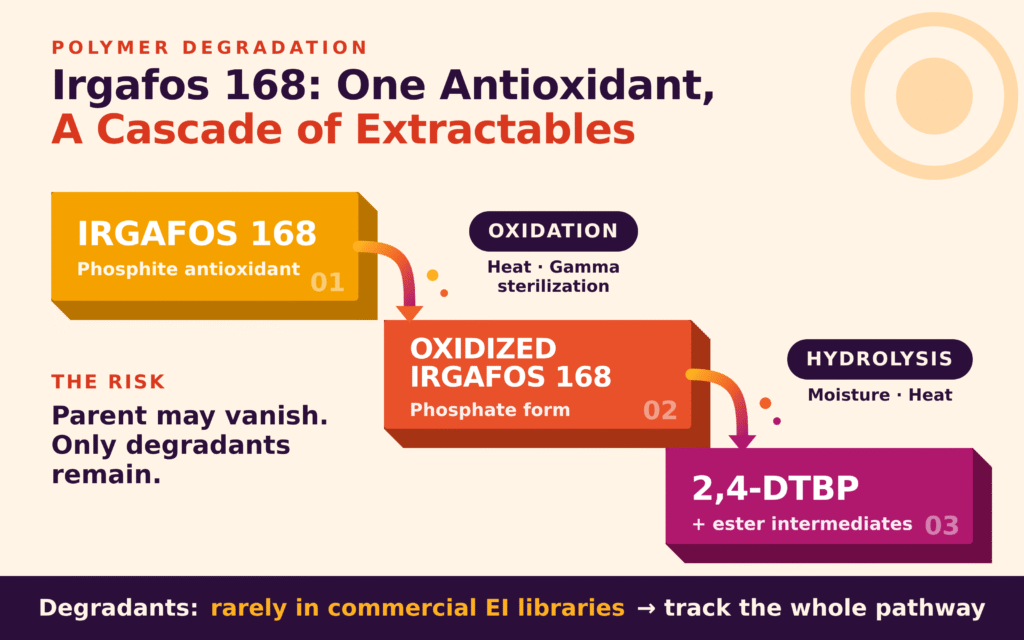
Tris(2,4-di-tert-butylphenyl) phosphite (Irgafos 168) is commonly used as a melt-processing antioxidant in polyolefin container-closure systems and single-use bioprocessing bags. During manufacturing processes or gamma sterilization, Irgafos 168 can undergo oxidation to form tris(2,4-di-tert-butylphenyl) phosphate (oxidized Irgafos 168).
Further hydrolytic degradation can produce 2,4-di-tert-butylphenol (2,4-DTBP), along with mono- and di-ester intermediates. Under aggressive extraction conditions, the original Irgafos 168 compound may undergo extensive degradation, leaving primarily its oxidation and hydrolysis products in the resulting solution.
Commercial EI libraries generally lack entries for intact LC-MS phosphate adducts. In contrast, an in-house extractables repository can rapidly identify precursor ions, MS/MS fragmentation trees, and retention times associated with the complete degradation pathway. This provides a more comprehensive understanding of the chemical transformations occurring within polymeric materials.
2. Hindered Phenolic Antioxidants (Irganox 1010, Irganox 3114, Irganox 1076)
Exposure to thermal stress and ionizing radiation can cause hindered phenolic antioxidants to undergo radical scavenging reactions. These reactions may generate quinone methide intermediates, oxidized dimers, and ester-cleaved degradation products.
Because commercial spectral libraries generally contain entries for the original commercially available additives rather than their transformation products, these degradation compounds frequently remain unidentified during routine screening.
In-house databases can maintain complete HRAM MS/MS spectral trees for specific radiolytic degradation products. This enables analysts to identify these compounds more efficiently without necessarily requiring custom synthesis or complicated NMR isolation procedures.
3. Slip Agents and Plasticizer Derivatives
Fatty acid amides, including erucamide and oleamide, are incorporated into high-density polyethylene (HDPE) and polypropylene formulations to reduce friction during molding and processing.
When exposed to thermal or oxidative stress, these amides may undergo hydrolysis, producing free fatty acids, or degrade into volatile alkyl amides. Such transformation products can contribute to the overall extractables profile of polymeric materials.
Proprietary in-house libraries can track both the original slip agents and their oxidation derivatives across positive and negative electrospray ionization modes. This capability supports rapid and reliable compound assignments when these substances are detected above the AET.
Discover low-leachables packaging materials and their importance in reducing potential chemical migration risks.
Strategic Advantages for Regulatory Compliance and Risk Assessment
In-house extractables libraries offer pharmaceutical and medical device manufacturers significant strategic advantages during regulatory submissions. By providing toxicologists with confirmed chemical structures, these libraries support more precise hazard evaluations under the draft ICH Q3E guideline, USP, and ISO 10993-18 standards.
Establishing reliable chemical identities reduces uncertainty during toxicological assessments and can help prevent unnecessary regulatory delays, product redesigns, and additional testing requirements.
When an extractable remains classified as “unidentified” or “tentative,” toxicological risk assessors may need to apply precautionary default thresholds, including the generic Threshold of Toxicological Concern (TTC) of 1.5 µg/day or Safety Concern Threshold (SCT) of 0.15 µg/day. Meeting these stringent thresholds may require extensive analytical retesting or unnecessary modifications to packaging materials and product designs.
By comparison, providing toxicologists with confirmed chemical structures, CAS registry numbers, and accurate compound-specific RRFs enables more targeted hazard characterization. This includes Quantitative Structure-Activity Relationship (QSAR) mutagenicity modeling and Cramer Class classification.
Access to reliable chemical identification data makes toxicological assessments more specific and scientifically defensible. It also reduces regulatory ambiguity and helps manufacturers address the stringent expectations of global regulatory authorities.
Learn more about toxicological qualification of leachables and how chemical identification supports scientifically sound safety assessments.
ResolveMass Laboratories Inc. incorporates these advanced library-matching protocols into routine analytical testing workflows. This approach strengthens analytical defensibility, improves the reliability of extractables identification, and supports more streamlined regulatory approval processes.
Explore E&L testing for pre-filled syringes to understand the analytical considerations involved in evaluating these drug delivery systems.
Conclusion: The Future of E&L Identification Beyond NIST and Wiley
Moving beyond NIST and Wiley toward customized, multidimensional in-house spectral repositories represents an important advancement in extractables and leachables testing for the biopharmaceutical and medical device industries.
Integrating high-resolution mass spectrometry, retention index tracking, tandem fragmentation profiling, and ion mobility parameters provides a more comprehensive approach to compound identification. These combined analytical capabilities strengthen analytical defensibility, improve identification confidence, and support uncompromised patient safety.
Although commercial spectral databases remain valuable resources for the initial screening of volatile compounds, the increasingly demanding requirements of modern regulatory compliance call for the greater analytical depth offered by carefully curated in-house spectral libraries.
Implementing these multiparameter identification strategies helps laboratories align their analytical workflows with USP, USP, ISO 10993-18, and the draft ICH Q3E guideline. It also enables pharmaceutical and medical device manufacturers to obtain more reliable chemical identification data and make better-informed toxicological risk assessments.
For comprehensive analytical support, explore GMP-compliant extractables and leachables testing for pharmaceutical and medical device applications.
To discuss customized extractables profiling, method validation, or packaging characterization services tailored to your regulatory requirements, connect with the analytical specialists at the ResolveMass Contact Page.
Frequently Asked Questions (FAQs)
An in-house extractables library combines several experimental parameters, including high-resolution accurate mass (HRAM), retention indices (RI/RT), tandem MS/MS spectra, and ion mobility collision cross-sections (CCS). These measurements, obtained using authentic reference standards, provide multiple levels of confirmation during compound identification. This integrated approach reduces false-positive assignments and supports higher identification confidence under USP guidelines.
Polymer additives can undergo thermal, radiolytic, and hydrolytic degradation during manufacturing, processing, and sterilization. These reactions produce secondary compounds, including oxidized Irgafos 168 and 2,4-di-tert-butylphenol, which may not be represented in commercial spectral databases. In-house libraries preserve reference spectra generated through controlled degradation studies, allowing analysts to recognize these transformation products more accurately.
USP establishes different identification confidence levels, ranging from tentative to confirmed assignments. An in-house database containing authentic reference standard data allows analysts to compare unknown compounds using accurate precursor masses, retention times, and tandem MS/MS fragmentation patterns. When the required experimental parameters match an authentic standard, the compound can be assigned a Confirmed (Level 3) identification without unnecessary delays in obtaining additional reference materials.
Collision Cross-Section (CCS) represents the effective three-dimensional size and shape of an ion in the gas phase and is measured using ion mobility mass spectrometry. Including CCS values in an in-house spectral library provides an additional parameter for evaluating molecular structures. This information helps distinguish structural isomers and stereoisomers that may have identical accurate masses and very similar fragmentation patterns.
Mass spectral matching alone may produce incorrect compound assignments because different structural isomers and polymer additives can generate similar 70 eV EI fragmentation patterns. Comparing experimental spectra with Kovats retention indices provides an additional level of chromatographic verification. This comparison evaluates the elution behavior of compounds relative to an alkane reference series, helping eliminate unreliable database matches.
Using a single surrogate standard for the semi-quantitative evaluation of multiple extractables can introduce significant measurement errors because different compounds exhibit different detector responses. In-house databases maintain experimentally determined, compound-specific Relative Response Factors (RRFs) against appropriate internal standards. These values improve concentration estimates and support more reliable quantitative assessments against the Analytical Evaluation Threshold (AET).
A comprehensive E&L spectral library should incorporate Electron Ionization (EI) for GC-MS, Atmospheric Pressure Gas Chromatography (APGC), Electrospray Ionization (ESI) in positive and negative modes, and Atmospheric Pressure Chemical Ionization (APCI) in both polarities. Combining these techniques expands analytical coverage across volatile, non-volatile, polar, and non-polar compounds. This enables laboratories to characterize a broader range of potential migrants from pharmaceutical packaging and medical device materials.
Proprietary in-house spectral libraries can strengthen regulatory submissions by providing supporting experimental evidence for chemical identification and toxicological evaluation. Their use helps laboratories establish greater identification confidence, reduce the number of unidentified migrants, and generate more reliable analytical datasets. These capabilities support compliance with ISO 10993-18, USP requirements, and the draft ICH Q3E guideline when supported by appropriate validation and documented analytical procedures.
Yes, well-developed in-house extractables libraries can accelerate analytical investigations by automating comparisons between unknown compounds and previously characterized reference spectra. This reduces repetitive manual interpretation, minimizes the need for additional peak isolation and characterization, and helps analysts prioritize compounds requiring further investigation. As a result, laboratories can prepare more comprehensive analytical reports efficiently and support faster regulatory assessments of biopharmaceutical packaging materials.
Reference:
- Song, X.-C., Canellas, E., Dreolin, N., Goshawk, J., & Nerín, C. (2022). Identification of nonvolatile migrates from food contact materials using ion mobility–high-resolution mass spectrometry and in silico prediction tools. Journal of Agricultural and Food Chemistry, 70(30), 9499–9508. https://doi.org/10.1021/acs.jafc.2c03615
- Sapozhnikova, Y., Nuñez, A., & Johnston, J. (2021). Screening of chemicals migrating from plastic food contact materials for oven and microwave applications by liquid and gas chromatography–Orbitrap mass spectrometry. Journal of Chromatography A, 1651, 462261. https://doi.org/10.1016/j.chroma.2021.462261
- Jenke, D. (2020). Identification and quantitation classifications for extractables and leachables. PDA Journal of Pharmaceutical Science and Technology, 74(2), 275–285. https://doi.org/10.5731/pdajpst.2019.010538
- Saartama, V., Consolaro, C., Dvorakova, D., Forsell, V., Haimi, J., Hurley, R., Jemec Kokalj, A., Kalčíková, G., Pulkrabova, J., Talvitie, J., Tsagkaris, A. S., & Selonen, S. (2026). Effects of conventional and biodegradable microplastics on earthworm Eisenia andrei in two generations. Journal of Hazardous Materials: Plastics, 2, 100019. https://doi.org/10.1016/j.hazmp.2025.100019
Get In Touch With Us
About The Author