


Introduction
Developing reliable bioanalytical assays for emerging therapeutic modalities requires navigating an increasingly complex biophysical environment. When establishing analytical strategies for innovative drug candidates, Bioanalytical Method Development for mRNA Therapeutics serves as the foundation for demonstrating safety, efficacy, and predictable pharmacokinetic behavior throughout both preclinical and clinical development. Because synthetic messenger RNA molecules are inherently fragile and rely entirely on sophisticated lipid-based delivery systems, bioanalytical scientists must create workflows capable of isolating, identifying, and quantifying both the nucleic acid payload and the associated synthetic lipid components across a wide range of biological matrices.
In contrast to conventional small-molecule drugs or extensively characterized monoclonal antibodies, mRNA-LNP therapeutics present multifaceted analytical challenges that cannot be adequately addressed through a single analytical platform. Developing robust methodologies demands comprehensive expertise in chromatographic separations, mass spectrometric technologies, polymer chemistry, and regulatory requirements. This article discusses the engineering considerations, optimization approaches, and validation requirements needed to implement robust bioanalytical methods that satisfy current regulatory expectations.
Need expert support for your program? Explore our bioanalytical strategy drug development services to streamline your path to the clinic.
Article Summary:
- Bioanalytical method development is critical for ensuring the safety, efficacy, and performance of mRNA-LNP therapeutics.
- ICH M10 guidelines require validated assays with high sensitivity, accuracy, precision, and selectivity across biological matrices.
- Key mRNA quality attributes include structural integrity, 5′ capping efficiency, poly(A) tail consistency, and impurity control.
- Lipid nanoparticle (LNP) characterization focuses on size, charge, lipid composition, stability, and mRNA encapsulation efficiency.
- Complex tissue analysis requires specialized extraction and stabilization techniques to prevent RNA degradation and matrix interference.
- Advanced analytical tools such as qPCR, LC-MS/MS, and LC-HRMS are used for accurate quantification and characterization.
- Robust validation and regulatory compliance are essential for generating reliable data and supporting successful drug development.
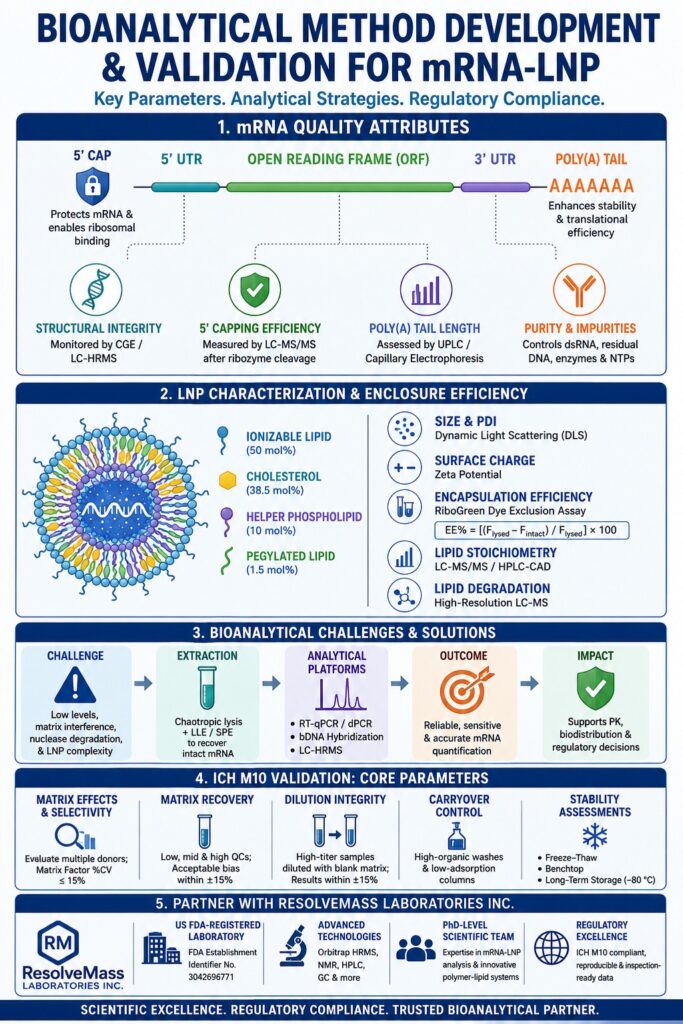
Regulatory Landscape & Analytical Frameworks (ICH M10 Compliance)
How do ICH M10 and regulatory frameworks govern the validation of mRNA and LNP bioanalytical assays?
Validation under the ICH M10 guideline requires bioanalytical procedures to demonstrate exceptional sensitivity, selectivity, and reproducibility across all intended biological matrices in order to support regulatory decision-making. For mRNA-LNP therapeutics, this validation framework must address both the nucleic acid payload and the novel ionizable lipid components to ensure the safety, effectiveness, and consistency of the final therapeutic product.
Ensure your data holds up to scrutiny: Learn more about our adherence to ICH M10 bioanalytical method validation guidelines.
Because RNA-LNP drug products frequently advance under accelerated development programs, regulatory authorities such as the FDA and EMA require rigorous validation of all analytical procedures. Preclinical biodistribution studies and clinical pharmacokinetic (PK) investigations necessitate method validation across multiple matrices, including plasma, whole blood, and target tissues such as the liver, spleen, and kidneys. Under ICH M10, any quantitative bioanalytical method must undergo comprehensive validation through assessment of several critical parameters:
Selectivity and Specificity
The analytical method must reliably distinguish the target mRNA sequence and synthetic lipid excipients from endogenous biological matrix components.
Lower Limit of Quantitation (LLOQ)
Due to the rapid systemic clearance of lipid nanoparticles, analytical methods require extremely low quantitation limits, often reaching concentrations in the low picogram-to-nanogram per milliliter range.
Calibration Range and Linearity
The calibration curve must encompass the anticipated concentration range throughout absorption, distribution, metabolism, and excretion (ADME) processes without exhibiting saturation or nonlinearity.
Accuracy and Precision
Both intra-run and inter-run variability must remain within established regulatory acceptance criteria, typically within ±15% of nominal concentrations and within ±20% at the LLOQ.
For laboratories performing nonclinical safety studies under Good Laboratory Practice (GLP) and clinical investigations under Good Clinical Practice (GCP), strict compliance with these validation requirements ensures the integrity and reliability of data throughout the therapeutic product’s development lifecycle.
Critical Parameters in Bioanalytical Method Development for mRNA Therapeutics
What are the critical quality attributes targeted during Bioanalytical Method Development for mRNA Therapeutics?
The primary critical quality attributes (CQAs) assessed during bioanalytical development include mRNA sequence identity, structural integrity, 5′ capping efficiency, and poly(A) tail uniformity. Evaluation of these parameters confirms that the drug substance remains stable, resists intracellular degradation, and maintains the biological activity required for effective in vivo protein expression.
                     [ 5' Cap ]
                       │  (Ensures ribosomal binding and protects against 5'-exonucleases)
                       ▼
  5' UTR ─── Open Reading Frame (ORF) ─── 3' UTR ─── [ Poly(A) Tail ]
                                                         │  (Regulates translational
                                                         ▼   efficiency and stability)
                                                    Single-strand integrity
                                                    (Monitored via CGE/LC-HRMS)
mRNA Structural Integrity and Degradation Sizing
The translational performance of an mRNA therapeutic is directly dependent on its structural integrity. In vitro transcribed (IVT) mRNA molecules are large macromolecules, generally ranging from 500 to 5,000 nucleotides, and are highly vulnerable to RNase-mediated degradation and physical shearing forces.
Bioanalytical methods must be capable of differentiating intact mRNA from partially degraded fragments. Automated capillary gel electrophoresis (CGE) and microfluidic chip-based fragment analysis provide rapid, high-resolution sizing and integrity assessments, often reported as RNA Integrity Numbers or comparable metrics. In addition, liquid chromatography-high resolution mass spectrometry (LC-HRMS) is increasingly employed to characterize degradation pathways and identify specific breakdown products with high precision.
Need rapid turnaround for your studies? Review our bioanalytical services for rapid proof of concept.
5′ Capping Efficiency and Poly(A) Tail Polydispersity
The 5′ cap structure, commonly a Cap-1 configuration, protects mRNA transcripts from 5′-exonuclease degradation while facilitating ribosomal recruitment. Similarly, the 3′ polyadenylated poly(A) tail plays a critical role in regulating intracellular stability and translational longevity.
Accurate quantification of capping efficiency and poly(A) tail length requires specialized analytical workflows involving liquid chromatography and enzymatic processing.
Capping Efficiency
Selective cleavage of the 5′ terminus using targeted ribozymes followed by liquid chromatography-tandem mass spectrometry (LC-MS/MS) or high-resolution Orbitrap mass spectrometry enables precise differentiation between capped and uncapped transcript populations.
Poly(A) Tail Length
Oligo(dT)-mediated hybridization combined with ultra-performance liquid chromatography (UPLC) or capillary electrophoresis facilitates detailed profiling of poly(A) tail length distributions and polydispersity, supporting batch-to-batch consistency assessments.
Purity, dsRNA, and Process Impurities
During IVT manufacturing, double-stranded RNA (dsRNA) byproducts may be generated and can activate innate immune pathways, potentially inducing undesirable inflammatory responses. Analytical methods such as enzyme-linked immunosorbent assays (ELISA) utilizing dsRNA-specific antibodies are developed and validated to monitor and control this critical impurity.
Additionally, residual plasmid DNA templates, T7 RNA polymerase, and unincorporated ribonucleotide triphosphates must be quantified at trace levels. Quantitative PCR (qPCR) and orthogonal chromatographic methodologies are commonly employed to detect and monitor these process-related impurities with high sensitivity.
Seeking a strategic partner? Start your journey toward a successful bioanalytical CRO partnership with our dedicated team.
Characterizing Lipid Nanoparticles (LNPs) and Encapsulation Dynamics
How are LNP physicochemical dynamics and encapsulation efficiency quantified?
Lipid nanoparticle (LNP) physicochemical properties and encapsulation efficiency are evaluated using fluorescence-based dye exclusion techniques together with high-performance liquid chromatography coupled to charged aerosol detection (HPLC-CAD) or mass spectrometric methods. These analytical approaches monitor both nanoparticle stability and the precise stoichiometric composition of lipid excipients.
Effective intracellular delivery of mRNA relies on highly engineered multi-component LNP systems. These formulations generally contain four distinct lipid classes, each contributing a specific functional role:
LNP Formulation = Ionizable Lipid (50 mol%) + Cholesterol (38.5 mol%) + Helper Phospholipid (10 mol%) + PEGylated Lipid (1.5 mol%)
Comprehensive characterization of these delivery vehicles requires a combination of physical and chemical analytical techniques, as outlined below:
| Attribute | Analytical Technique | Regulatory Significance |
|---|---|---|
| Size & Polydispersity | Dynamic Light Scattering (DLS) | Controls cellular uptake and minimizes macro-aggregation |
| Surface Charge | Zeta Potential Measurement | Evaluates colloidal stability and cellular interactions |
| Encapsulation Efficiency | RiboGreen Dye Exclusion Assay | Confirms the percentage of mRNA encapsulated within the particle core |
| Lipid Stoichiometry | LC-MS/MS / HPLC-CAD | Monitors molecular ratios among formulation lipids |
| Lipid Degradation | High-Resolution Orbitrap LC-MS | Identifies oxidation and hydrolysis products of ionizable lipids |
Determining Encapsulation Efficiency (EE%)
Confirmation that the mRNA payload remains fully protected within the lipid core is a critical quality requirement. The RiboGreen assay evaluates encapsulation efficiency by comparing free RNA to total RNA content. This is achieved by measuring fluorescence in the intact formulation, which detects only externally exposed RNA, and comparing it to fluorescence obtained after lysis with a surfactant such as Triton X-100, which exposes the entire RNA payload.
EE% = [(FluorescenceLysed − FluorescenceIntact) / FluorescenceLysed] × 100
This parameter should remain highly consistent, typically exceeding 90%, across both preclinical and clinical manufacturing batches.
Stoichiometric Lipid Profiling
As LNP formulations undergo metabolism in vivo, individual lipid constituents distribute and clear at significantly different rates. Customized LC-MS/MS methods enable bioanalytical laboratories to perform absolute quantification of ionizable lipids and PEGylated lipids within biological matrices.
This analytical capability is essential for mitigating toxicological risks associated with lipid accumulation, particularly the immunogenic effects of PEG-containing lipids, which may contribute to accelerated blood clearance (ABC) following repeated administration.
Challenges and Solutions in Complex Matrix Bioanalysis
What are the primary bioanalytical challenges when extracting mRNA-LNPs from complex tissue matrices?
The most significant challenges associated with tissue bioanalysis arise from substantial matrix interference, extremely low analyte concentrations, and the rapid degradation of unprotected mRNA by endogenous nucleases. Addressing these obstacles requires immediate tissue stabilization, efficient dissociation of lipid nanoparticles, and highly effective extraction methodologies such as solid-phase extraction or phenol-chloroform isolation.
Quantification of mRNA in heterogeneous tissues, including lipid-rich or collagen-dense organs such as the liver and spleen, demands carefully optimized extraction workflows. Direct analysis of tissue homogenates without purification often results in rapid degradation of the mRNA payload due to nuclease release during cellular disruption.
Optimizing for clinical success? See how we support critical programs with bioanalytical CRO services for phase II phase III trials.
Extraction Protocols and Recovery Optimization
To isolate intact mRNA from protective LNP structures, bioanalytical scientists utilize extraction systems containing powerful chaotropic agents such as guanidinium thiocyanate together with reducing agents like β-mercaptoethanol. These reagents rapidly denature endogenous nucleases and preserve RNA integrity.
Standard extraction strategies include:
Liquid-Liquid Extraction (LLE)
Phenol-chloroform-isoamyl alcohol extraction followed by isopropanol precipitation remains a highly effective approach for separating hydrophilic nucleic acids from hydrophobic lipid excipients.
Solid-Phase Extraction (SPE)
Automated silica-based SPE systems and magnetic bead hybridization technologies provide efficient high-throughput purification, making them particularly valuable for large-scale clinical studies.
Hybridization Assays versus qPCR and LC-MS
Selection of an appropriate bioanalytical platform depends on the pharmacokinetic questions being addressed.
RT-qPCR and dPCR
Reverse transcription quantitative PCR and digital droplet PCR (ddPCR) offer exceptional sensitivity, capable of detecting target sequences at near single-copy levels. However, these techniques may be affected by matrix-associated enzyme inhibition and can amplify degraded RNA fragments, potentially leading to overestimation of biologically active drug concentrations.
Branched DNA (bDNA) Assays
The branched DNA hybridization platform eliminates the need for nucleic acid extraction by directly hybridizing target mRNA within lysates. This approach offers strong reproducibility and reduced sensitivity to assay variability, although analytical sensitivity may differ among tissue types.
LC-HRMS
Intact mass analysis by LC-HRMS employs ion-pairing reversed-phase chromatography using mobile phase modifiers such as Hexafluoroisopropanol (HFIP) and Diisopropylethylamine (DIPEA) in combination with advanced stationary phases including BEH C18 columns. This methodology simultaneously resolves and quantifies intact therapeutic RNA and its metabolites while providing definitive chemical identity confirmation.
Validating mRNA-LNP Assays under ICH M10: Essential Criteria for Bioanalytical Method Development for mRNA Therapeutics
How are validation parameters optimized for Bioanalytical Method Development for mRNA Therapeutics under ICH M10?
Optimization of validation parameters under ICH M10 involves detailed evaluation of matrix effects, recovery performance, dilution integrity, carryover behavior, and analyte stability under diverse storage and handling conditions. Addressing these factors requires stringent control of chromatographic system performance and comprehensive stability testing within biological matrices.
                [ Biological Sample Matrix ]
                           │
                           ▼
              [ Optimization Parameters ]
 ┌─────────────────────────┼─────────────────────────┐
 │                         │                         │
 ▼                         ▼                         ▼
[ Matrix Recovery ]  [ Dilution Integrity ]  [ System Carryover ]
Assessed via low,    Ensures high-titer      Controlled through
mid, and high QCs    samples remain within   high-organic washes and
(within ±15% bias)   calibration limits      low-adsorption columns
Matrix Effects and Selectivity
To establish assay selectivity, analysts must evaluate blank biological matrices obtained from multiple individual donors, typically at least six independent sources, to verify the absence of interfering signals at analyte and internal standard retention times.
Matrix effects in mass spectrometry are quantitatively assessed using the matrix factor:
Matrix Factor = Peak Response of Analyte in Extracted Matrix ÷ Peak Response of Analyte in Pure Solvent
After normalization using a stable isotope-labeled internal standard, the coefficient of variation (%CV) should not exceed 15%.
Dilution Integrity and Carryover Control
Drug concentrations immediately following administration may exceed the upper limit of quantitation (ULOQ). Consequently, dilution integrity studies must demonstrate that dilution with blank matrix does not adversely affect assay accuracy or precision.
In addition, the highly polar phosphate backbone of mRNA and the adhesive characteristics of ionizable and cationic lipids make system carryover a significant analytical challenge. Liquid chromatography methods therefore require carefully optimized column chemistries, including hybrid silica hardware designed to reduce nonspecific adsorption, together with aggressive needle-washing protocols utilizing high-organic solvent systems.
Stability Assessments
Regulatory compliance requires demonstration of analyte stability under multiple operating conditions:
Freeze-Thaw Stability
Analyte recovery is assessed after repeated freezing and thawing cycles to simulate routine sample handling procedures.
Benchtop Stability
Stability studies conducted at room temperature establish acceptable processing windows during sample preparation.
Long-Term Storage Stability
Long-term stability evaluations verify analyte integrity during extended storage, typically at temperatures such as −80°C, corresponding to the anticipated interval between sample collection and analysis.
Strategic Imperatives in Bioanalytical Method Development for mRNA Therapeutics
How does ResolveMass Laboratories Inc. elevate bioanalytical validation for mRNA-LNP drug products?
ResolveMass Laboratories Inc. provides advanced bioanalytical method validation services by integrating deep expertise in mass spectrometry with a state-of-the-art US FDA-registered testing facility. Their scientific team specializes in addressing structural complexity, evaluating innovative polymer-lipid systems, and developing customized chromatographic methodologies aligned with international regulatory requirements.
Successfully navigating the analytical challenges associated with mRNA therapeutics requires collaboration with contract research organizations possessing both specialized scientific expertise and advanced instrumentation capable of meeting rigorous global validation standards. Operating from a world-class facility in Montreal, Canada, ResolveMass Laboratories Inc. supports biotechnology and pharmaceutical organizations throughout North America and Europe.
Ready to accelerate your drug discovery? Learn how our bioanalytical CRO for AI drug discovery integrates cutting-edge technology to shorten development timelines.
Through the use of high-resolution mass spectrometry platforms, including Orbitrap HRMS, together with NMR, HPLC, and gas chromatography technologies, their PhD-level scientific team addresses complex drug delivery challenges with precision and efficiency. As a United States FDA-registered laboratory (FDA Establishment Identifier No. 3042696771), ResolveMass ensures that every bioanalytical method development and validation program is compliant, reproducible, scientifically robust, and fully prepared to withstand regulatory inspection.
Frequently Asked Questions (FAQs)
Reducing carryover of highly charged mRNA molecules in LC-MS systems requires a combination of optimized hardware and effective cleaning procedures. Columns and fluidic pathways engineered with low-adsorption surface technologies help prevent nonspecific binding of RNA molecules. In addition, high-organic solvent washes, elevated column temperatures, and ion-pairing reagents such as HFIP can assist in removing residual analyte from the chromatographic system. These measures collectively improve reproducibility and reduce contamination between injections.
Intact RNA analysis by LC-MS generally benefits from the use of volatile ion-pairing systems that improve chromatographic separation and ionization performance. A commonly adopted combination includes Diisopropylethylamine (DIPEA) and Hexafluoroisopropanol (HFIP), which work together to enhance peak shape and sensitivity. These additives facilitate efficient ion-pairing interactions while maintaining compatibility with mass spectrometric detection. As a result, they support accurate characterization of large RNA molecules.
The physicochemical properties of ionizable lipids can significantly affect electrospray ionization behavior during LC-MS analysis. Depending on their concentration and composition, these lipids may suppress or enhance analyte signals, potentially impacting quantitation accuracy. To address this challenge, chromatographic conditions must be optimized to separate lipid components from the target analyte. The use of stable isotope-labeled internal standards further helps compensate for matrix-related signal variability.
The N/P ratio describes the relationship between protonatable amine groups present in ionizable lipids and phosphate groups found within the RNA backbone. This parameter is a critical determinant of nanoparticle formation, encapsulation performance, and transfection efficiency. Verification typically involves measuring lipid concentrations using LC-MS/MS while independently quantifying mRNA through fluorometric or spectroscopic techniques. Accurate determination of this ratio helps ensure formulation consistency and biological performance.
Although the RiboGreen assay is highly effective for measuring nucleic acid concentration, it does not provide information regarding RNA size or structural integrity. The assay detects nucleic acids through fluorescence-based binding but cannot distinguish intact therapeutic mRNA from degraded fragments. Consequently, samples with substantial degradation may still generate strong fluorescence signals. Techniques such as capillary gel electrophoresis (CGE) or size-exclusion chromatography (SEC) are therefore required to confirm true molecular integrity.
Differentiating encapsulated mRNA from unprotected mRNA generally involves a selective enzymatic digestion strategy. Plasma samples are first exposed to RNases, which rapidly degrade any free RNA present in circulation while leaving lipid nanoparticle-protected mRNA unaffected. Following enzyme inactivation, the lipid nanoparticles are disrupted using a suitable surfactant to release the protected payload. The recovered mRNA can then be extracted and quantified to determine the encapsulated fraction.
Regulatory agencies recognize that PEG-containing lipids may induce anti-PEG immune responses in certain individuals. As a result, developers are expected to implement validated immunogenicity assessment programs during preclinical and clinical studies. These evaluations commonly include ligand-binding assays or cell-based methods designed to detect anti-drug antibodies (ADA). Additional investigations may also be required to determine whether these antibodies influence nanoparticle clearance, safety, or therapeutic performance.
Large mRNA molecules and intact mRNA-LNP complexes possess substantial hydrodynamic dimensions that often exceed the capabilities of conventional SEC columns. Standard pore structures may restrict analyte movement, leading to poor resolution and potential column fouling. Ultrawide-pore SEC columns, typically featuring pore sizes of 1,000 Å or 2,000 Å, provide sufficient accessibility for these large biomolecules. This enables effective separation of monomeric species from aggregates while preserving native structural characteristics.
Reference:
- Zhou, M., Zhang, X., Yan, H., Xing, L., Tao, Y., & Shen, L. (2024). Review on the bioanalysis of non-virus-based gene therapeutics. Bioanalysis, 16(23–24), 1279–1294. Advance online publication. https://doi.org/10.1080/17576180.2024.2437418
- Zhou, J., Rao, R., Shapiro, M. E., Tania, N., Herron, C., Musante, C. J., & Hughes, J. H. (2025). Model-informed drug development applications and opportunities in mRNA-LNP therapeutics. Clinical Pharmacology & Therapeutics, 118(6), 1329–1339. https://doi.org/10.1002/cpt.3641
- Skerritt, J. H., Tucek-Szabo, C., Sutton, B., & Nolan, T. (2024). The platform technology approach to mRNA product development and regulation. Vaccines, 12(5), 528. https://doi.org/10.3390/vaccines12050528
- Vervaeke, P., Borgos, S. E., Sanders, N. N., & Combes, F. (2022). Regulatory guidelines and preclinical tools to study the biodistribution of RNA therapeutics. Advanced Drug Delivery Reviews, 184, 114236. https://doi.org/10.1016/j.addr.2022.114236
- Prasanth, V. G., & Singh, A. (2025). Recent advances in analytical and bioanalytical methods for COVID-19 and other critical new therapeutics (2022–2024): A comprehensive review. International Journal of Pharmaceutical Sciences, 3(7), 130–138. https://doi.org/10.5281/zenodo.15783646
Get In Touch With Us
About The Author


